
Playroom Organization Ideas: How to Tame the Toy Chaos
Tame your playroom's toy chaos with a system that works for real kids. You'll learn how to purge toys, zone your space, and select accessible storage for easier play and cleanup.
- Ruthlessly purge toys before buying any storage.
- Implement simple, visible systems your kids can maintain.
- Divide your playroom into zones for intuitive play and cleanup.
- Select accessible, visible storage like open bins and cube units.
- Label all storage bins, using pictures for pre-readers.
This post contains affiliate links. As an Amazon Associate I earn from qualifying purchases.
The playroom was supposed to contain the chaos. Instead, it’s become ground zero for toy explosions—LEGO landmines, stuffed animal avalanches, and that one puzzle that’s missing exactly three pieces but you can’t bring yourself to throw away.
If your playroom makes you want to close the door and pretend it doesn’t exist, you’re not alone. The good news? With the right systems, even the most overwhelming toy collection can be tamed. I’ve helped dozens of families organize their playrooms, and the strategies in this guide actually work with real kids (who are notorious system-ignorers).
Free printable · 7 pages
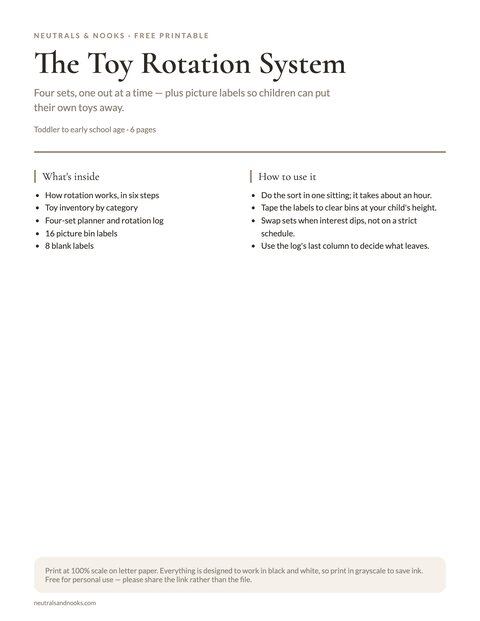
The Toy Rotation System
Four sets, one out at a time, plus 16 picture bin labels so children can put their own toys away.
Free. Your download link appears right here. You'll also join the Monthly Home Reset. Unsubscribe anytime. Privacy
In this article (11 sections)
The Playroom Organization Mindset
Before you buy a single bin, let’s talk about why playroom organization fails—and how to set yourself up for success.
Why most systems fail:
- Too complicated for kids to maintain
- Storage isn’t accessible to children
- Too many toys for the space
- No clear homes for items
- Parents organize once and never maintain
What actually works:
- Simple, visible systems kids understand
- Everything has a clear home
- Regular decluttering cycles
- Age-appropriate expectations
- Storage at kid height
The goal isn’t Pinterest perfection—it’s a room where kids can play independently, find what they want, and clean up (mostly) on their own.
Step 1: The Great Toy Purge
You can’t organize too much stuff. Before buying any storage, you need to ruthlessly edit what you’re storing.
Sort toys into categories:
- KEEP: Played with regularly, age-appropriate, complete sets
- DONATE: Outgrown, duplicates, never played with
- TRASH: Broken, missing pieces, happy meal toys
- ROTATE: Good toys that can be stored and rotated in later
Questions to ask:
- Has this been played with in the last 3 months?
- Do we have multiple versions of essentially the same toy?
- Is it age-appropriate for who’s playing with it now?
- Does it bring joy or just take up space?
Pro tip: Do this while kids are asleep or away. Involving kids in major purges often leads to keeping everything.
Toy Rotation System: Less Toys, More Play
Step 2: Zone Your Space
Divide the playroom into zones based on how your kids actually play. This makes both play and cleanup more intuitive.
Common playroom zones:
Creative Zone: Art supplies, coloring books, craft materials
- Needs: Table surface, accessible supplies, easy cleanup floor
Building Zone: LEGO, blocks, magna-tiles, train sets
- Needs: Flat surface for building, contained storage for small pieces
Imaginative Play Zone: Dress-up, dolls, action figures, play kitchen
- Needs: Accessible storage, mirror, open floor space
Reading Nook: Books, cozy seating
- Needs: Comfortable spot, good lighting, accessible book storage
Active Play Zone: Ride-on toys, indoor slide, ball pit
- Needs: Open floor space, possibly mats for safety
Not every playroom needs every zone. Choose based on your kids’ ages and how they actually play.
Step 3: Choose the Right Storage
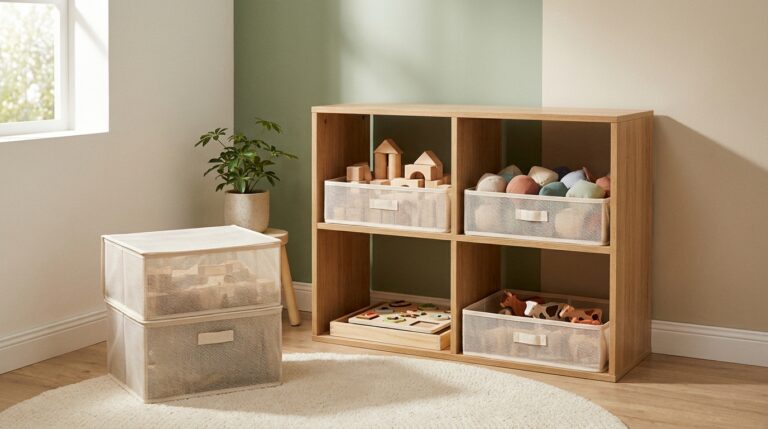
Storage should be accessible, visible, and simple. Here’s what works:
Open Bins and Baskets
Best for: Large toys, stuffed animals, balls, dress-up clothes
Budget option: Fabric bins from Target, IKEA DRONA boxes ($5-10 each)
Upgrade option: Woven baskets from Pottery Barn Kids, Serena & Lily ($30-80 each)
Tips:
- Choose one or two neutral colors for cohesion
- Size bins to fit the toys they’ll hold
- Label everything (even for pre-readers, use pictures)
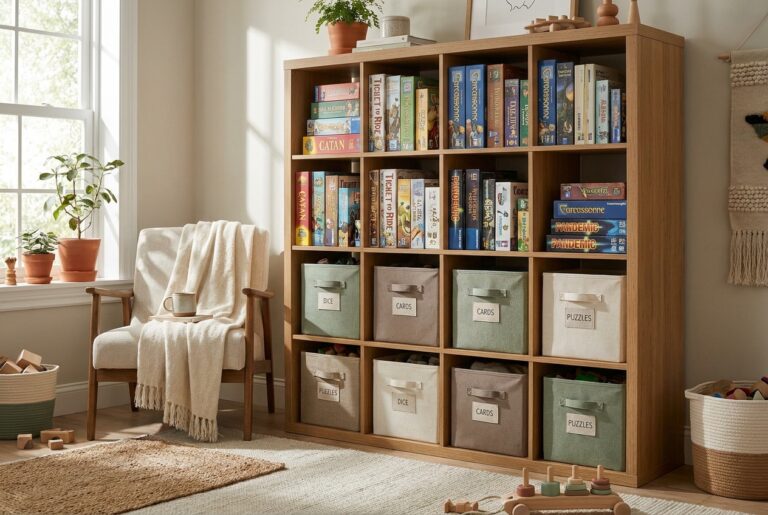
Cube Storage Systems
Best for: Flexible organization with mix of bins and open shelves
Budget option: IKEA Kallax ($40-90 depending on size)
Upgrade option: RH Baby & Child cabinet storage ($400-800)
Tips:
- Anchor all furniture to walls
- Mix bins and baskets with open cubbies
- Use tops as additional play or display surface
Clear Containers
Best for: Small pieces, craft supplies, LEGO by color, puzzle pieces
Budget option: Sterilite bins from Walmart ($3-8 each)
Upgrade option: The Container Store bins ($8-15 each)
Tips:
- Labels still help even though contents are visible
- Stackable saves space
- Consistent sizing looks cleaner
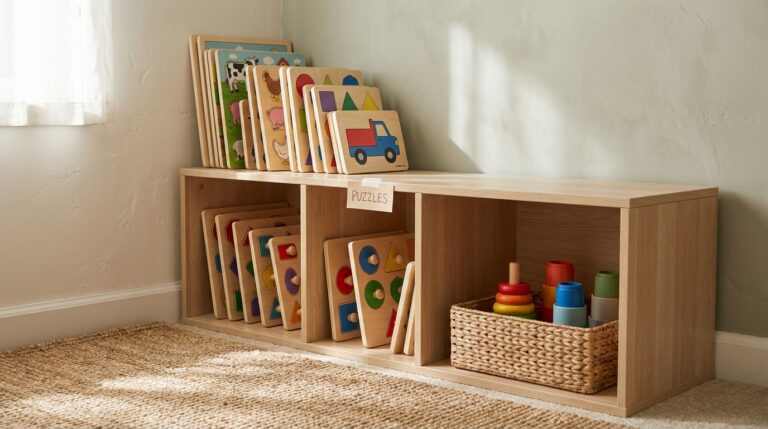
Shelving
Best for: Books, display items, frequently accessed toys
Budget option: IKEA LACK shelves ($10-25)
Upgrade option: Floating ledges from Crate & Kids ($50-100)
Tips:
- Mount at child height for accessibility
- Use for current favorites, not long-term storage
- Book ledges encourage front-facing storage
[SHOP THE LOOK]
- IKEA Kallax 4×4 shelf unit – $89
- IKEA DRONA boxes (set of 4) – $20
- Fabric toy bins with handles – $30 for 4
- Laminated picture labels – DIY or Etsy $15
- Woven baskets for large toys – $25-40 each
Step 4: Label Everything
Labels are the secret to maintaining any organization system—especially with kids.
For pre-readers:
- Use picture labels (photos or clipart)
- Add both picture and word for transition to reading
- Laminate for durability
For early readers:
- Large, clear text
- Consistent font and style
- Place at child eye level
Label ideas:
- LEGO
- Blocks
- Dress-up
- Cars & Trucks
- Dolls
- Art Supplies
- Games
- Puzzles
Where to get labels:
- DIY with printer and laminator
- Etsy shops (search “playroom labels”)
- Cricut or Silhouette machine
- Chalkboard labels for flexibility
Step 5: Create a Cleanup System
The best organization is useless if kids can’t or won’t maintain it. Build cleanup into the routine.
Make it routine:
- Cleanup before transitions (before lunch, before bed)
- “Everything has a home” mantra
- One activity out at a time rule (for older kids)
Make it manageable:
- Break cleanup into specific tasks: “Put all the LEGO in the LEGO bin”
- Clean as you go during the day
- Don’t expect perfection
Make it fun:
- Cleanup songs or timers
- Make it a game: “Can you put away 10 cars before I put away 10 blocks?”
- Celebrate completion
Be realistic:
- Kids 2-4 can put toys in clearly labeled bins with help
- Kids 5-7 can clean up independently with reminders
- Kids 8+ should maintain their own space with periodic check-ins
Zone-by-Zone Organization Ideas
Art Zone Organization
Storage needs:
- Paper and coloring books (vertical magazine files)
- Crayons, markers, colored pencils (divided caddies)
- Paint supplies (clearly labeled containers, stored out of reach)
- Scissors, tape, glue (adult-accessible drawer)
- Play-Doh and modeling supplies (sealed containers)
Budget setup:
- IKEA FLISAT table with paper roll holder ($50)
- Rotating craft caddy ($15)
- Drawer organizers for small supplies ($10)
LEGO and Small Pieces
Storage options:
- Sort by color (drawer systems)
- Sort by set (labeled bags or containers)
- Sort by size (small, medium, large pieces)
- Don’t sort at all (one big bin)
What works for most families:
- One bin for “regular LEGO”
- Separate storage for special sets kids want to keep built
- Flat surface for building
LEGO-specific products:
- LEGO-compatible brick storage boxes
- Drawer tower systems
- Under-bed rolling bins for bulk storage
Stuffed Animals
The stuffed animal situation is… a lot. Here’s how to contain it:
- Bean bag storage: Stuffed animals fill the bag, serve as seating
- Hanging nets: Corner hammocks hold many animals
- Zoo cage: DIY with bungee cords or buy premade
- Rotate: Keep favorites accessible, rotate others
Playroom Maintenance Schedule
Organization isn’t one-and-done. Build maintenance into your routine:
Daily:
- End-of-day cleanup (doesn’t have to be perfect)
- Quick reset of major zones
Weekly:
- Return misplaced items to correct homes
- Quick scan for broken toys or trash
- Tidy book display
Monthly:
- Edit one category (this month: art supplies)
- Check for outgrown items
- Assess what’s not getting played with
Seasonally:
- Major purge before birthdays and holidays
- Rotate toys in and out
- Deep clean storage containers
- Reassess zones based on changing interests
Budget Breakdown
Budget-friendly playroom organization: $100-200
- IKEA Kallax or similar: $70-90
- Basic bins and baskets: $30-50
- DIY labels: $10-20
- Hooks and hardware: $10-20
Mid-range makeover: $300-500
- Quality cube storage: $150-250
- Woven baskets and bins: $100-150
- Professional-looking labels: $30-50
- Additional shelving: $50-100
Investment playroom: $800+
- Custom or high-end furniture
- Designer storage pieces
- Built-in solutions
Neutral Nina
Neutral Nina is an interior design enthusiast and mom of three who proves that beautiful, organized spaces and family life can coexist. She shares practical strategies for creating calm, functional homes that work for kids and grown-ups alike.
Frequently Asked Questions
How do I get my kids to actually put toys away?
Start with low expectations and build. Make cleanup part of the routine (not optional). Make it physically easy—bins at their height, simple categories. Praise effort. Do it together until they can do it alone.
What do I do about toys with a million pieces?
Either embrace the chaos (one big bin) or commit to sorting (drawer systems). Don’t try to sort toys kids are actively playing with—save that for LEGO collections, not daily play pieces.
How do I handle toys from grandparents and relatives?
Have a conversation if possible. Suggest experience gifts. Quietly donate duplicates and outgrown items. Rotate toys so everything isn’t accessible at once.
Should I let my kids help organize?
For setup, no—do the major organization without them. For maintenance, yes—they need to understand and use the system. Let them have input on categories that make sense to them.
Conclusion
A organized playroom isn’t about creating a showroom—it’s about creating a functional space where kids can play independently and cleanup is actually possible. Start with a serious purge, choose simple storage, label everything, and build maintenance into your routine.
Pick one zone to tackle this weekend. Once you see how much better it functions, you’ll be motivated to keep going.
Your playroom peace awaits.
IKEA Playroom Hacks: Budget-Friendly Organization
—