Vertical Storage Ideas for Kids’ Rooms
Discover how to maximize your child's room by utilizing vertical wall space, nearly doubling usable area. This guide provides specific product recommendations, installation tips, and safety advice for floating shelves and pegboard systems to create functional and beautiful storage.
- Utilize wall space to nearly double usable area in your child's room.
- Install floating shelves at varying heights for independent, parent-assisted, and display zones.
- Always anchor shelves into wall studs for safety; use a stud finder and heavy-duty toggle bolts.
- Consider pegboard systems like IKEA SKADIS for flexible, customizable wall organization.
- Choose specific products like IKEA LACK or MOSSLANDA shelves for versatile storage.
I measured our daughter’s bedroom floor one rainy afternoon: 96 square feet. Then I measured the wall space: 168 square feet. That was the moment it clicked—the walls in a kid’s room offer nearly twice the usable area as the floor, and most of us use almost none of it. We were cramming a bookshelf, a toy chest, a dresser, and a small desk onto that tiny floor, leaving barely enough room for her to spin around without whacking an elbow. Within a weekend, I moved half of that storage off the floor and onto the walls, and the room went from cramped to spacious without removing a single item. Vertical storage is not just a small-room hack—it is a fundamental rethinking of where things live.
This guide covers every type of vertical storage solution for kids’ rooms, from simple floating shelves to ceiling-height systems, with specific products, installation tips, and design strategies that keep things accessible, safe, and beautiful.
In this article (6 sections)
Floating Shelves: The Foundation of Vertical Storage
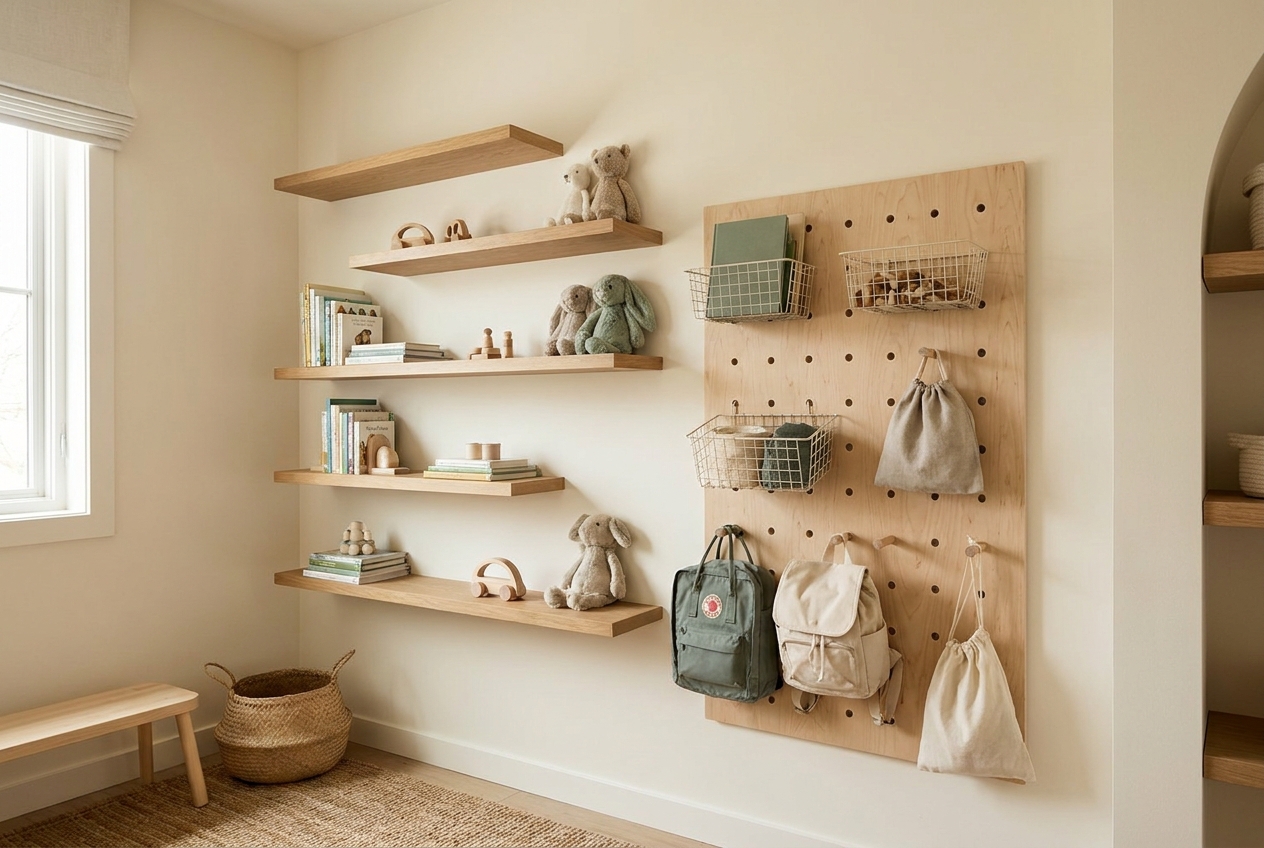
Floating shelves are the simplest, most versatile vertical storage option, and they work in every room at every age. A well-placed set of floating shelves can replace an entire bookshelf, freeing up 12–18 inches of floor depth while displaying items beautifully.
Best floating shelves for kids’ rooms:
- IKEA LACK wall shelf ($10 for 43 inches): The workhorse. Holds up to 15 pounds, comes in white, black, and oak finishes. Install with the included hardware into wall studs for maximum weight capacity.
- IKEA MOSSLANDA picture ledge ($10–15): Has a front lip that prevents items from sliding off—perfect for book display and small toy collections. Available in white, birch, and black at 22 or 45 inches long.
- Prepac floating shelf with rail ($20–30 at Amazon): Includes a metal rail along the front for hanging hooks, making it dual-purpose: display on top and hanging storage below.
Installation height strategy: In a kid’s room, shelf height should correspond to access needs. Shelves at 18–30 inches from the floor are in the child’s independent-access zone—stock these with daily-use items like favorite books, frequently played-with toys, and art supplies. Shelves at 36–48 inches are the parent-assisted zone—good for items used regularly but that you want to control access to (play dough, glitter supplies, special toys). Shelves at 48–60+ inches are the display and storage zone—for decorative items, keepsakes, and overflow storage that does not need daily access.
Critical safety note: Every floating shelf must be anchored into wall studs, not just drywall. A stud finder ($10–20 at Home Depot) is an essential tool for any vertical storage project. Drywall anchors alone are not sufficient for shelves in kids’ rooms—children will inevitably pull on, hang from, or load shelves beyond their rated capacity, and a shelf crashing down is a serious injury risk. If your studs do not align with where you want shelves, use heavy-duty toggle bolts ($6–10 for a pack) rated for the shelf’s weight capacity plus a generous safety margin.
Pegboard Systems: The Customizable Wall Organizer
Pegboard has moved far beyond the garage workshop. Modern pegboard systems are some of the most flexible and visually appealing vertical storage solutions available, and they are particularly brilliant in kids’ rooms because the configuration can change as your child’s needs evolve.
IKEA SKADIS pegboard ($17–25 for the board, accessories $2–10 each): This is the gold standard for kids’ room pegboard. The white or wood-look board mounts on the wall and accepts a huge range of accessories: shelves, hooks, containers, elastic bands for holding papers, and even small flower pots. Install it beside a desk for school supply organization, above a changing table for diaper supplies, or in a playroom for art materials.
A complete SKADIS setup for a kids’ desk area might include: the pegboard ($20), three small containers ($3 each for pencils, markers, and erasers), two hooks ($2 each for headphones and a bag), one shelf ($5 for a small plant or clock), and a letter holder ($4 for papers and assignments). Total: approximately $40 for a complete, customizable wall-mounted desk organizer that takes up zero desk space.
DIY pegboard alternative: A 2×4-foot sheet of standard pegboard from Home Depot ($8–12) painted to match the room creates the same functionality for less. Standard pegboard accepts universal hooks and accessories available at any hardware store ($0.50–$2 each). Paint the board with latex paint before installing (pegboard accepts paint beautifully), mount it with spacers so the hooks can insert from behind, and add accessories as needed.
Pegboard layout for an art station: Mount the board at kid height (the bottom edge at about 24 inches from the floor for preschoolers, 30 inches for school-age kids). Arrange hooks to hold scissors in sheaths, cups for markers and crayons, a small shelf for paint trays, and clips for displaying current artwork. The visual arrangement itself becomes part of the room’s decor—especially when you color-coordinate the supplies.
Wall-Mounted Bins, Baskets, and Pockets
For items that need to be contained rather than displayed, wall-mounted bins and baskets provide the hidden-storage benefit of drawers with the floor-saving advantage of vertical placement.
IKEA FLISAT wall storage ($15): A simple wooden rail that mounts on the wall and holds removable bins or containers. IKEA sells matching TROFAST bins ($3–5 each) that hang from the rail, but the real trick is that the rail also holds standard magazine files, small baskets, and other containers. Mount one beside the bed for books and a nightlight, one in the entryway for mittens and hats, or one in the playroom for art supplies.
Fabric wall pockets: The 3 Sprouts wall organizer ($18–25 on Amazon) has three large pockets that mount flat against the wall and hold books, stuffed animals, or diapers. It comes in adorable animal designs (elephant, owl, bear) that double as wall art. For a more budget-friendly option, a hanging shoe organizer ($5–12 on Amazon) mounted on the wall with a curtain rod provides 12–24 pockets for small toys, art supplies, or accessories. Cut a standard over-the-door organizer to the desired height and mount just the section you need.
Wire wall baskets: Industrial-style wire baskets mounted on the wall create a farmhouse-chic storage display. The Spectrum Diversified wire baskets ($10–15 each on Amazon) come in various sizes and mount with two screws. Group three baskets vertically on a wall for incoming mail, school papers, and coloring books. Or mount a row of identical baskets at kid height in a playroom for sorting toys by category.
Magnetic strips and boards: A magnetic knife strip ($12–20 on Amazon) mounted on a kid’s wall at waist height stores metal toy cars, magnetic building tiles, and letter magnets in a visible, organized line. A magnetic dry-erase board ($15–25) serves triple duty: message board, art display, and magnetic toy storage. Mount it at kid height and it becomes an interactive wall station.
Over-the-Door and Behind-Door Solutions
Doors are the most wasted storage surface in most homes. Every door in a kid’s room—bedroom door, closet door, even bathroom door—has a backside that can hold meaningful storage without any modification to the door itself.
Over-the-door shoe organizers (for everything except shoes): A clear 24-pocket shoe organizer ($10–15 on Amazon) is the Swiss Army knife of kids’ room organization. Hang it on the back of the closet door and fill the pockets with: socks and underwear (goodbye, dresser drawer rummaging), hair accessories and jewelry, small toy collections (Shopkins, Polly Pockets, Matchbox cars), art supplies, first aid items, or diaper supplies in the nursery. Each pocket is visible at a glance, and items stay separated without mixing. This single item replaces an entire drawer or shelf unit.
Over-the-door hooks: The Spectrum Ashley over-the-door hook rack ($8–15 at Target) provides 3–6 hooks that sit over the door top without drilling. Hang bathrobes, towels, tomorrow’s outfit, backpacks, or costume accessories. For bedrooms shared by multiple kids, assign each child one hook for their daily essentials.
Behind-the-door mirror with storage: A full-length mirror mounted on the back of the door serves the obvious purpose, but adding a narrow set of adhesive-mounted bins along one side creates a getting-ready station. The child can see their outfit in the mirror while grabbing accessories from the bins beside it. This works beautifully for kids ages 5+ who are starting to dress themselves independently.
Closet door organization system: The ClosetMaid 8-tier adjustable door rack ($20–30 at Target or Home Depot) mounts on the back of the closet door and provides eight adjustable wire shelves for shoes, folded clothes, toys, or supplies. In a small room where closet interior space is at a premium, this effectively adds an entire shelving unit using zero floor or wall space.
Ceiling and High-Wall Storage for Overflow
When walls and doors are full, look up. Ceiling-adjacent storage is perfect for items that are needed infrequently—seasonal clothing, keepsakes, special-occasion toys, backup supplies—and keeps them accessible without consuming any of the prime real estate below eye level.
High shelves around the room perimeter: A continuous shelf installed 12–18 inches below the ceiling, running along one or more walls, provides significant storage capacity that is virtually invisible from a child’s perspective. Use a 1×10 or 1×12 board ($10–15 per 8-foot length at Home Depot) supported by L-brackets ($2–4 each) every 24 inches, screwed into studs. Paint the shelf and brackets the same color as the wall so they blend in. Stock with matching labeled bins for out-of-season clothes, backup supplies, and keepsakes.
Ceiling-mounted cargo net: A cargo net ($10–15 on Amazon) mounted in a corner of the room at ceiling height creates a hammock-style storage pocket for stuffed animals, lightweight balls, and other soft items that take up enormous amounts of floor and shelf space. Mount with screw-in ceiling hooks ($4 for a 4-pack) into ceiling joists for secure support.
Over-closet storage shelf: Many closets have a gap of 12–18 inches between the top of the closet frame and the ceiling. A simple shelf bracket set ($8–12) and a cut-to-fit board ($5–10) create a bonus shelf that holds labeled bins of out-of-season items. This space exists in virtually every room and goes unused in 90% of homes.
Hanging organizers from the ceiling: For art stations or craft areas, a ceiling-mounted pot rack ($15–25 at HomeGoods or Amazon) repurposed with S-hooks holds scissors, tape dispensers, rulers, and small supply bags within reach while keeping the work surface clear. This is a particularly creative solution for homeschool rooms or shared craft spaces where multiple children need access to the same supplies.
Creating a Cohesive Vertical Storage Design
The risk with vertical storage is visual chaos—too many shelves, hooks, baskets, and bins covering the walls in a mismatched jumble that makes the room feel smaller rather than larger. The solution is the same principle that governs all good design: consistency, restraint, and intentional negative space.
Choose one system and repeat it. Rather than mixing floating shelves, pegboard, fabric pockets, and wire baskets on the same wall, choose one or two vertical storage methods and use them consistently. Three identical floating shelves in a column look clean and intentional. The same wall holding a floating shelf, a pegboard, a wire basket, and a fabric pocket looks like an organization store exploded.
Use matching containers everywhere. If you use bins on your shelves, choose one style and one color across all shelves. The IKEA KUGGIS box in white ($5–8) or the Target Brightroom fabric bin in cream or gray ($5–8) look polished when repeated across multiple shelves. Mixing four different bin styles on four shelves creates visual noise that makes the room feel cluttered even when everything is technically organized.
Leave breathing room. Not every inch of wall needs to hold storage. Intentional blank space between storage elements makes each piece stand out and prevents the walls from feeling oppressive. A good rule: no more than 60% of the available wall space should hold storage or decor. The remaining 40% should be open wall—and that openness is what makes the room feel airy and calm rather than like a storage unit.
Balance visual weight. Heavy, solid-looking storage (closed bins, full bookshelves) should be lower on the wall. Lighter, more open storage (wire baskets, picture ledges with a few books, individual hooks) should be higher. This follows the natural visual weight distribution of a room and prevents the top-heavy feeling that comes from mounting large, full containers at eye level and above.
Vertical storage is the closest thing to magic in home organization. It creates space where none existed, keeps items accessible without consuming floor real estate, and—when done thoughtfully—makes walls functional and beautiful simultaneously. The key is matching the solution to the need, anchoring everything securely, and maintaining the visual calm that makes a kid’s room feel like a restful, inviting space rather than a warehouse with a bed in it. Your walls are your biggest untapped resource. Time to put them to work.
Neutral Nina
Neutral Nina is an interior design enthusiast and mom of three who proves that beautiful, organized spaces and family life can coexist. She shares practical strategies for creating calm, functional homes that work for kids and grown-ups alike.