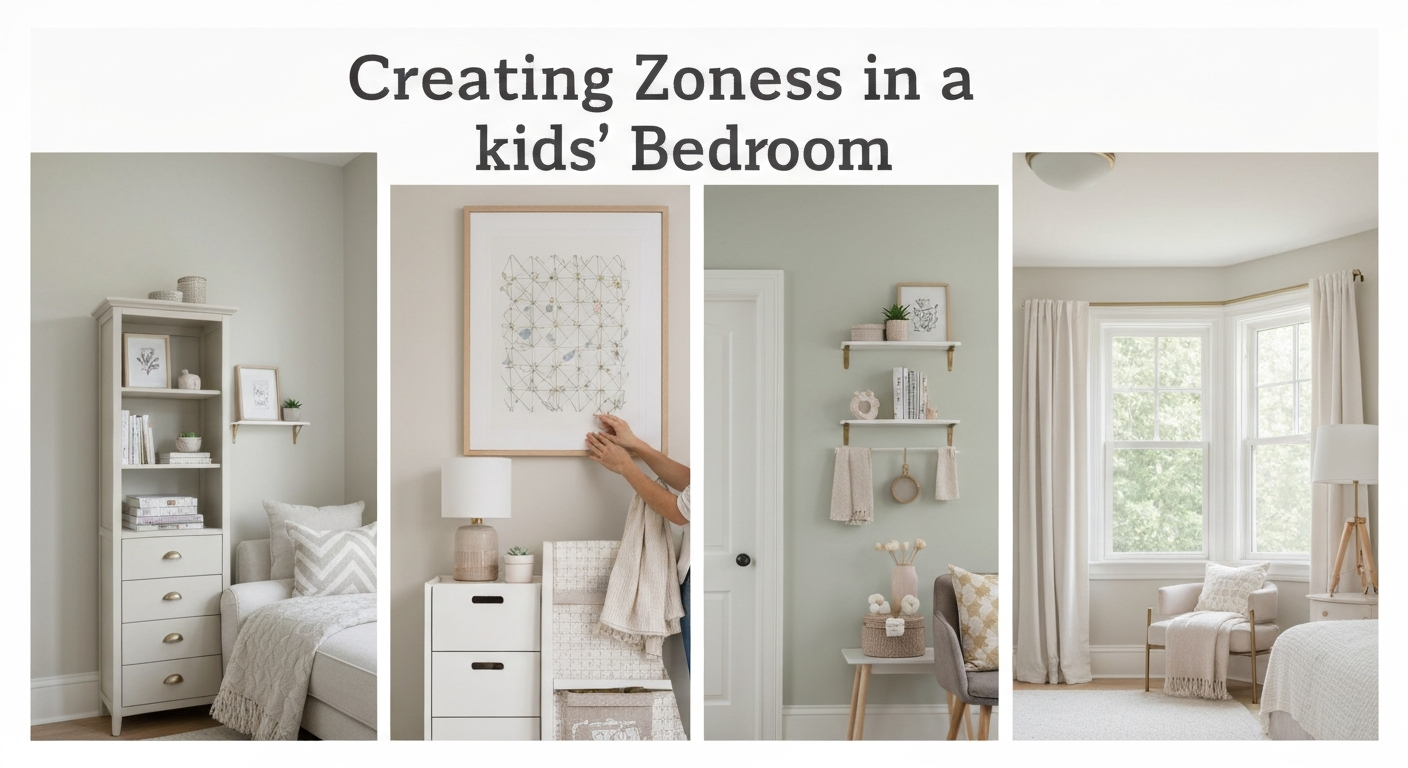
Creating Zones in a Kids’ Bedroom
Learn how to transform your child's bedroom into a multi-functional space by creating intentional zones for sleep, play, and study. This guide will help you reduce chaos, improve predictability, and make cleanup easier for your family.
- Divide your child's bedroom into distinct zones for sleep, play, and study to reduce chaos.
- Create a calm sleep zone with a bed canopy or curtain, minimal items, and muted bedding.
- Maximize play zone storage with vertical solutions like TROFAST bins and wall-mounted pegboards.
- Use rugs, furniture placement, and peel-and-stick wallpaper to visually define each zone.
Picture this: your seven-year-old is sprawled on the floor building a LEGO castle, your toddler is pulling every book off the shelf, and somehow a pile of homework sheets has migrated under the bed. Sound familiar? When a single room has to serve as a sleep sanctuary, a play paradise, a study spot, and a reading retreat, chaos is almost inevitable—unless you create intentional zones. Dividing a kids’ bedroom into clearly defined areas doesn’t require a renovation or even a big budget. With some smart furniture placement, a few visual cues, and a little creativity, you can transform one room into a multi-functional space that actually works for your family.
In this article (6 sections)
Why Zoning a Kids’ Bedroom Matters
Children thrive on predictability. When every activity has a designated home, kids learn where things belong, transitions between activities become smoother, and bedtime battles ease because the bed area feels separate from the play area. Research from child development experts consistently shows that environmental order supports self-regulation in young children.
Zoning also makes cleanup dramatically faster. Instead of a vague “clean your room” directive, you can say “put the art supplies back in the create zone”—and kids actually know what that means. It turns an overwhelming task into manageable chunks, which is a win for everyone.
Beyond behavior, zoning maximizes every square foot. Even a 10×10 bedroom can accommodate four distinct zones when you think vertically and use furniture as dividers rather than pushing everything against the walls.
The Sleep Zone: Creating a Restful Retreat
The sleep zone should feel noticeably calmer than the rest of the room. Position the bed in the quietest corner, ideally away from the door and any windows that catch morning sun. If siblings share a room, consider the IKEA KURA reversible bed ($249) which can be flipped as kids grow and creates a natural visual boundary.
Use a canopy, curtain panel, or even a simple tension rod with a sheer drape to create a cozy enclosure around the sleep area. The IKEA VIDGA track system (around $15 for a single track) mounts to the ceiling and lets you hang lightweight curtains that kids can pull closed at bedtime. This physical separation signals to their brains that it’s time to wind down.
Keep this zone minimal: the bed, a small shelf or wall-mounted caddy for a water bottle and one bedtime book, and a nightlight. Everything else lives elsewhere. The Hatch Rest+ sound machine ($70) does double duty as a nightlight and white noise machine, helping block out any lingering play-zone energy.
- Stick to soft, muted bedding—save the bold patterns for the play zone
- Add a small washable rug beside the bed for bare-foot comfort
- Mount a reading light like the Amazon Basics clip-on LED ($12) so overhead lights stay off
- Use peel-and-stick wallpaper on just the sleep wall to visually differentiate it
The Play Zone: Containing the Creative Chaos
This is where the magic (and the mess) happens. Designate the largest open floor area as the play zone, ideally near the closet so toy storage is within reach. A foam play mat or interlocking tiles from Skip Hop ($40–60 for a set) define the boundary and protect your floors.
Vertical storage is your best friend here. The IKEA TROFAST system ($40–$90 depending on size) is a parent favorite for good reason—the removable bins come in multiple sizes, kids can see and reach everything, and you can label bins with picture labels for pre-readers. Pair it with the Container Store’s Elfa mesh drawers for art supplies and smaller items that need corralling.
If floor space is tight, go vertical with wall-mounted pegboard. A 2×4-foot pegboard from Home Depot (about $15) plus hooks and baskets turns a blank wall into customizable storage that grows with your child. Kids love rearranging the hooks themselves, which gives them ownership over their space.
Set boundaries for the play zone with a colorful area rug. When toys stay on the rug, cleanup is visual and simple: if it’s on the rug, it’s fine. If it’s off the rug, it goes back. This one rule has saved countless families from the “toys everywhere” spiral.
- Sort toys into categories: building, pretend play, vehicles, art supplies
- Assign each category a specific bin or shelf
- Rotate toys seasonally to keep the zone fresh without buying more
- Keep a small donation bin in the closet for outgrown items
The Study and Homework Zone
Even preschoolers benefit from a dedicated workspace. It doesn’t need to be a full desk—a small table and chair set works beautifully for younger kids, while school-age children need a proper desk with storage.
The IKEA MICKE desk ($99) is compact enough for small bedrooms and includes a built-in drawer and cable management hole. For shared rooms, a wall-mounted fold-down desk like the Prepac floating desk ($130 at Target) takes up zero floor space when not in use.
Lighting matters enormously in the study zone. Position the desk near natural light when possible, and add a quality task lamp. The TaoTronics LED desk lamp ($30–40 on Amazon) offers adjustable brightness and color temperature, which reduces eye strain during homework sessions.
Stock the zone with essentials in a desktop organizer: pencils, erasers, scissors, glue sticks, and a small timer for focused work sessions. The mDesign desk organizer caddy ($16 at Target) keeps supplies visible and accessible without cluttering the work surface. Mount a small cork board or magnetic board above the desk for schedules, spelling lists, and artwork-in-progress.
The key rule: homework supplies stay in the study zone, play supplies stay in the play zone. This separation helps kids mentally shift between “work mode” and “play mode,” which is surprisingly effective even for kids who resist homework.
The Reading Nook: A Quiet Corner for Books
Every child deserves a cozy spot to curl up with a book, and it takes remarkably little space to create one. A corner of the room, the space beside a bookshelf, or even a wide windowsill can become a reading nook with a few simple additions.
Start with comfortable seating. A large floor cushion like the Pottery Barn Kids Anywhere Beanbag ($79–$129) or a more budget-friendly option from Target’s Pillowfort line ($25–$40) gives kids a soft landing. Add a couple of throw pillows and a small blanket, and you’ve created an inviting retreat.
Display books face-out using wall-mounted book ledges. The IKEA MOSSLANDA picture ledge ($13 each) is the classic hack—mount three or four at kid height, and suddenly books become decor. Children are far more likely to grab a book when they can see the covers rather than just spines on a shelf.
Enhance the nook with a string of warm fairy lights (the Pottery Barn Kids Glimmer String Lights at $29 or similar from Amazon for $10–$15) and maybe a small canopy overhead. These touches make the reading zone feel special and separate, even if it’s only two feet from the play area.
- Rotate displayed books weekly to keep interest fresh
- Include a mix of picture books, chapter books, and magazines
- Add a small basket for library books so they don’t get mixed in with owned books
- Let your child help choose the cushion color and pillows—buy-in matters
Tips for Making Zones Work in Small Rooms
Not everyone has the luxury of a large bedroom, but zoning works even in compact spaces. The trick is using visual cues rather than physical barriers. Different colored rugs, distinct wall colors or decals, and varied lighting all signal zone changes without eating up floor space.
Loft beds are a game-changer for small rooms. The space beneath a lofted bed can become a study zone, reading nook, or play area. The IKEA VITVAL loft bed ($279) fits a twin mattress up top and leaves generous space below for a desk or cozy corner.
Multi-functional furniture pulls double duty: an ottoman with storage serves as both play-zone seating and toy storage. A bookshelf turned perpendicular to the wall becomes a room divider that also holds books. The IKEA KALLAX 2×4 shelf unit ($89) is perfect for this—it’s stable, two-sided, and the cubbies accept fabric bins from the Container Store or Target.
Finally, involve your kids in the zone-planning process. Walk through the room together and ask where they’d like to read, where they want to play, and what would help them feel cozy at bedtime. When children have input in the design, they’re far more likely to respect the zones and keep things organized. You might be surprised by their ideas—my five-year-old suggested putting the reading nook inside the closet (we removed the doors), and it became her favorite spot in the entire house.
Zoning a kids’ bedroom isn’t about perfection. Some days the LEGO will migrate to the bed and the homework will end up in the play zone. That’s okay. The structure is there as a guide, a gentle framework that makes the room work harder and helps your child build habits that will serve them for years to come. Start with one zone this weekend, see how it feels, and expand from there.
Neutral Nina
Neutral Nina is an interior design enthusiast and mom of three who proves that beautiful, organized spaces and family life can coexist. She shares practical strategies for creating calm, functional homes that work for kids and grown-ups alike.