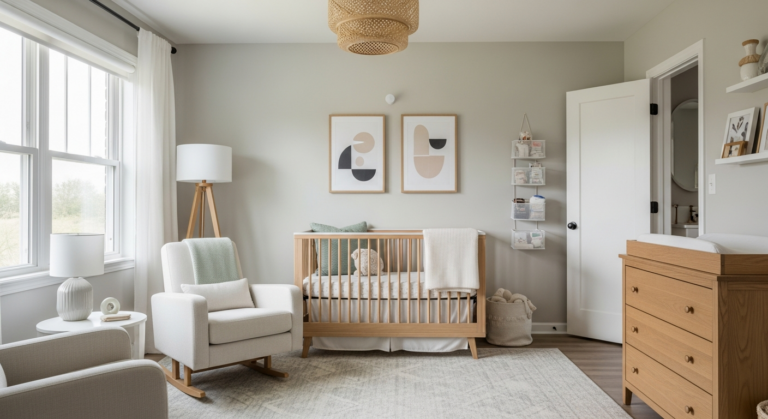

Nursery Organization for Small Rooms
Learn how to maximize space in your small nursery by implementing smart layout strategies, choosing compact furniture like mini cribs, and utilizing vertical storage solutions to create a functional and calm environment.
- Measure your room precisely, noting door swings and outlets, as inches matter in small spaces.
- Opt for a mini crib to save significant floor space, viable until your child is 18-24 months.
- Apply the 'triangle rule' to position crib, changing, and seating for easy access and no dead zones.
- Utilize vertical space with floating shelves and over-the-door organizers to free up floor area.
- Select narrow dressers and slim gliders to fit essential items without overcrowding your nursery.
Our first nursery measured exactly 8 feet by 9 feet. That is 72 square feet—smaller than most walk-in closets—and it needed to fit a crib, a changing area, storage for an absurd quantity of tiny clothes, and enough room for me to shuffle around at 3 AM without stubbing my toe on every piece of furniture. When I measured the room for the first time, I genuinely wondered if we should just co-sleep forever. But after a lot of measuring, re-measuring, and creative problem-solving, that nursery became the coziest, most functional room in our home. Small rooms force smart choices, and smart choices lead to better design.
Whether you are working with a tiny spare bedroom, a converted closet, or a corner of your primary suite, this guide covers every organizational strategy, product recommendation, and layout trick that makes a small nursery feel spacious, calm, and completely functional.
In this article (5 sections)
Measuring and Planning Your Layout
Before you buy or move anything, grab a tape measure and a piece of graph paper (or the free RoomSketcher app). Measure wall to wall, mark the door swing, note window placement, and identify every outlet location. In a small room, inches matter—a piece of furniture that is two inches too deep can block a door or make a walkway impassable.
A standard crib is 28 inches wide by 52 inches long. A mini crib is 24 inches by 38 inches. In a room under 90 square feet, the mini crib is worth serious consideration. The DaVinci Kalani Mini Crib ($200) and the Babyletto Origami Mini Crib ($230) are both beautifully designed and save 14 inches of length—which in a small room is the difference between fitting a bookshelf and not. Babies sleep in mini cribs until they are ready for a toddler or twin bed, typically around 18–24 months, making it a completely viable option.
For layout, follow the triangle rule: position the crib, changing area, and seating so you can reach any two of the three in one or two steps. In a small room, this happens almost naturally, but being intentional about placement prevents awkward dead zones that waste precious floor space.
The most efficient small nursery layout places the crib along the longest wall, the changing area (a dresser with a changing pad) across from it, and a slim glider or rocker in the corner nearest the door. This keeps the center of the room clear for a small rug and enough floor space for tummy time as baby grows.
- Room under 80 sq ft: Mini crib + wall-mounted changing station + compact rocker
- Room 80–100 sq ft: Standard crib + narrow dresser with changing pad + slim glider
- Room 100–120 sq ft: Standard crib + full dresser + standard glider + small bookshelf
- Closet conversion: Mini crib centered + wall shelves for all storage
Vertical Storage: Your Most Valuable Real Estate
In a small nursery, your walls are more valuable than your floor. Every square foot of vertical space is an opportunity to store something that would otherwise take up floor real estate. Think of the walls as your secret storage weapon.
Floating shelves are the foundation of small-nursery storage. The IKEA LACK wall shelf ($10 for a 43-inch shelf) mounted 18–20 inches above the changing area holds diapers, wipes, cream, and a decorative plant or two. Install two or three at different heights to create a functional and attractive arrangement. These shelves hold up to 15 pounds each—more than enough for baby supplies.
The IKEA MOSSLANDA picture ledge ($10–15) is a nursery multitasker. Mount one at adult height above the crib for a few decorative items, and another at toddler height once your child is mobile for board books they can grab independently. The lip on the front keeps books from sliding off, and they take up just 4 inches of depth—virtually nothing.
Over-the-door organizers are criminally underused in nurseries. A clear over-the-door shoe organizer ($10–15 on Amazon) hung on the back of the closet door or the nursery door itself provides 24 pockets perfect for lotions, socks, pacifiers, burp cloths, medicine, thermometers, and all those small items that create drawer chaos. You can see everything at a glance, and it takes up zero floor or wall space.
For the closet, the IKEA ALGOT or BOAXEL shelving system ($50–80) transforms a basic reach-in closet into a fully organized storage wall. Install shelves at varying heights, add a low hanging rod for tiny hangers, and use fabric bins on upper shelves for out-of-season clothing and backup supplies. This one closet upgrade can eliminate the need for a separate dresser entirely—freeing up four to six square feet of floor space.
Multi-Purpose Furniture for Tiny Spaces
In a small nursery, every piece of furniture should serve at least two functions. Single-purpose items are a luxury that tiny rooms cannot afford.
The dresser-as-changing-table approach is the most common and effective dual-purpose solution. A 3-drawer dresser (the IKEA HEMNES 3-drawer at $200 or the IKEA KULLEN at $60 for a more budget-friendly option) with a Keekaroo Peanut changing pad ($130) or Summer Infant Contoured pad ($20) on top serves as both the changing station and the primary clothing storage. When diaper days end, remove the pad and you have a dresser that works through the teen years.
The IKEA RASKOG cart ($30) is the MVP of small nursery organization. During the newborn phase, it holds diapers, wipes, and feeding supplies beside the glider. When baby starts solids, roll it to the kitchen for mealtime supplies. During playtime, it becomes a mobile toy and book station. Its 18-inch width slides into gaps between furniture that would otherwise be wasted space.
For seating, consider a compact rocker instead of a full glider if space is tight. The Nursery Works Sleepytime Rocker ($300) has a significantly smaller footprint than traditional gliders. An even more space-efficient option: a rocking chair from Wayfair or Target ($100–$200) paired with a lumbar pillow. It takes up about two-thirds the floor space of a glider and still provides the soothing motion babies love.
If your room truly cannot fit a seating option, consider a wall-mounted fold-down shelf ($30–50 on Amazon) that creates a feeding station only when needed. You can sit on the bed (if the nursery is also your bedroom) or bring in a lightweight stool that slides under the crib when not in use.
Closet Maximization Strategies
The closet in a small nursery is not just a closet—it is an entire storage room that happens to have a door. Maximizing every inch of closet space can make or break a small nursery’s functionality.
Start with a double-hang rod system. Baby clothes are tiny—a standard closet rod wastes half the vertical space. Install a second rod (a tension rod works perfectly for $8–12) halfway down the closet to double your hanging capacity. Use the top rod for longer items and the bottom rod for everyday outfits organized by size.
Add shelf dividers ($12 for a 4-pack on Amazon) to the existing closet shelf to create sections for blankets, swaddles, sheets, and towels. Without dividers, that top shelf becomes a jumbled pile that topples every time you pull something out. The dividers turn it into organized, accessible zones.
Use the closet floor intentionally. Place a 3-drawer rolling cart ($25–35 from Target or Walmart) on the closet floor for diaper supplies, extra sheets, or keepsakes. The rolling mechanism lets you pull it out when needed and push it back to keep the closet floor clear.
For closet doors, replace sliding doors with a curtain ($15–25 for a tension rod and curtain panel). Sliding doors eat up half the closet width at any given time, and standard hinged doors require 30 inches of clearance to swing open. A curtain slides fully open, giving you access to the entire closet width, and pushes flat against the wall when closed. Choose a curtain that matches your nursery color scheme for a soft, intentional look.
- Top shelf: Keepsakes, out-of-season clothes, backup supplies (with dividers)
- Upper rod: Special occasion outfits, sleep sacks, jackets
- Lower rod: Daily outfits organized by size, going left to right from current to next size up
- Closet floor: Rolling cart with diapers, wipes, and extra supplies
- Door back: Over-the-door organizer for small items
Visual Tricks That Make Small Rooms Feel Bigger
Organization is not just about fitting everything in—it is also about making the room feel spacious and serene. Visual clutter is just as overwhelming as physical clutter, and a few design choices dramatically affect how large a small nursery feels.
Paint color matters enormously. Stick with light, warm neutrals: Benjamin Moore White Dove, Sherwin-Williams Alabaster, or Behr Cameo White all reflect light and make walls recede. If you want a color, choose a pale sage, soft blush, or light sky blue and paint just one accent wall—keeping the remaining three walls white or off-white. This adds personality without shrinking the visual space.
Choose furniture in the same tone as the walls. A white crib against a white wall virtually disappears, making the room feel less full. This does not mean everything must be white—natural wood against warm cream walls achieves the same blending effect. The goal is reducing visual contrast between large furniture pieces and the backdrop.
Use the same storage container throughout. Three different baskets in three different materials create visual noise. Five identical IKEA KUGGIS boxes in white on a shelf read as calm and uniform. This single-container approach is one of the simplest ways to make a small space feel organized and intentional rather than cramped and chaotic.
Keep the floor as clear as possible. Every piece of furniture sitting on the floor shrinks the visual space. Where you can, mount things on walls (shelves instead of bookcases, wall hooks instead of a coat rack, a wall-mounted diaper organizer instead of a tabletop caddy). The more floor you can see, the bigger the room feels.
A small nursery is not a limitation—it is an invitation to be creative and intentional with every choice. Some of the most beautiful, most photographed nurseries I have seen were under 90 square feet, because small rooms force a level of curation that larger rooms rarely achieve. When every item earns its place, the room feels calm, purposeful, and deeply personal. Your baby does not need a sprawling suite—they need a safe, warm, organized space where everything is within arm’s reach. And that is exactly what a well-planned small nursery delivers.
Neutral Nina
Neutral Nina is an interior design enthusiast and mom of three who proves that beautiful, organized spaces and family life can coexist. She shares practical strategies for creating calm, functional homes that work for kids and grown-ups alike.