How to Create a Calm-Down Corner at Home: A Room-by-Room Design Guide for Kids of Every Age
This guide shows you how to design a beautiful, intentional calm-down corner in your home, integrating emotional support with your aesthetic. You'll learn the research behind these spaces, placement strategies, and age-specific setups.
- Create a calm-down corner for emotional regulation, not as a punishment.
- Design your corner to be aesthetically pleasing and functionally supportive.
- Practice "time-ins" and co-regulation instead of isolating timeouts.
- Learn about color science, lighting, and age-specific setups for your space.
- Utilize sensory tools like weighted blankets to aid regulation.
Your child is going to fall apart. Not because you did something wrong, not because they’re “misbehaving,” but because they’re human. They’re going to have moments when their emotions are bigger than their ability to manage them. The tantrum in the grocery store, the meltdown after school, the tears over a broken crayon that are really about something much deeper. It’s going to happen. And when it does, they need somewhere to go.
Here’s what most parents don’t realize: that somewhere doesn’t have to be a timeout chair in the hallway or a bare corner of their bedroom. It doesn’t have to look clinical, childish, or like it belongs in a therapist’s office. A calm-down corner can be one of the most beautiful, intentional spaces in your entire home — a design feature, not an afterthought. A place where emotional safety meets aesthetic intention.
The concept of a calm-down corner has exploded in popularity for good reason. Research published in the International Journal of the Whole Child found that calming corners improved overall classroom climate and significantly reduced behavioral incidents. Occupational therapists and child psychologists have been recommending dedicated regulation spaces for years. And parents are catching on — but most of the advice out there focuses purely on function without any consideration for how the space actually looks and feels within your home.
That’s where this guide is different. We’re approaching the calm-down corner from a home design perspective — because you shouldn’t have to choose between supporting your child’s emotional development and maintaining a cohesive, beautiful living space. This guide covers everything: the research behind why these spaces work, room-by-room placement strategies, color science, lighting design, age-specific setups, and three budget tiers to make it work for any family.
In this article (11 sections)
- What Is a Calm-Down Corner (And Why It’s Not a Timeout)
- Where to Put a Calm-Down Corner: Location Matters More Than You Think
- Design Principles for a Beautiful Calm-Down Corner
- Essential Furniture and Layout
- Age-by-Age Setup Guide
- Must-Have Calming Tools by Sense
- How to Introduce the Corner to Your Child
- Budget Breakdown: Three Tiers
- Common Mistakes to Avoid
- Frequently Asked Questions
- Building a Home That Holds All the Feelings
What Is a Calm-Down Corner (And Why It’s Not a Timeout)
Let’s get this out of the way first, because the distinction matters enormously.
A calm-down corner is NOT a punishment. It’s not where your child goes because they did something wrong. It’s where they go because they need help — and eventually, where they choose to go because they’ve learned it helps.
The Shift from Time-Outs to Time-Ins
For decades, the standard parenting advice was the timeout: remove the child from the situation, isolate them until they calm down, then talk about what happened. The problem? Emerging research shows that timeouts, especially for young children, can activate the same brain pathways as physical pain. When a child is already dysregulated — when their amygdala has essentially hijacked their thinking brain — isolation doesn’t help them learn. It just adds fear and shame to an already overwhelming emotional experience.
Time-ins flip the script. Instead of sending your child away, you go to them. You sit with them in a designated space that’s designed to help their nervous system settle. You co-regulate — which means your calm presence helps their brain remember how to be calm too. The thinking brain comes back online not through punishment, but through safety.
A calm-down corner is the physical infrastructure for time-ins. It’s a regulation station (a term from the widely used Zones of Regulation framework) — a specific space stocked with specific sensory tools that help a child move from a dysregulated state back to a regulated one.
What the Research Says
The evidence behind dedicated calming spaces is compelling:
- Reduced anxiety symptoms: Studies have shown that designated emotional regulation spaces can reduce anxiety symptoms by as much as 40% when used consistently alongside co-regulation strategies.
- Improved emotional vocabulary: Children who regularly use calm-down corners with labeled emotions and feelings charts develop stronger emotional literacy, which is the foundation of self-regulation.
- Parasympathetic activation: Occupational therapists recommend deep pressure stimulation tools like weighted blankets and lap pads because they activate the parasympathetic nervous system — essentially telling the body “you’re safe, you can relax.” A well-stocked calm-down corner puts these tools within arm’s reach.
- Better classroom behavior: The International Journal of the Whole Child research found that when calming corners were implemented with proper introduction and consistent use, they improved the overall emotional climate — not just for the children who used them most, but for everyone in the environment.
The takeaway for parents: This isn’t a trend. It’s an evidence-based strategy that works. And when you design the space thoughtfully, it becomes something your child actually wants to use — which is the entire point.
Where to Put a Calm-Down Corner: Location Matters More Than You Think
One of the biggest mistakes parents make is tucking the calm-down corner into the most remote spot in the house. It feels intuitive — give them privacy, right? But child development experts are clear on this: the space should be in a central, visible location, not isolated or associated with punishment.
When the calm-down corner is in a back bedroom behind a closed door, it sends a subtle message: your big feelings need to be hidden. When it’s in the living room or a central hallway, the message is different: your feelings are welcome here. This is part of our home. This is part of our life.
That said, “central” doesn’t mean “in the middle of everything.” The ideal location has a few key qualities:
- Visible but slightly set apart — a corner, a nook, an alcove
- Accessible without help — your child can get there independently
- Near family activity — close enough that a parent can be present without it feeling surveilled
- Away from high-stimulation zones — not next to the TV, the kitchen during dinner prep, or a sibling’s play area
Living Room Integration
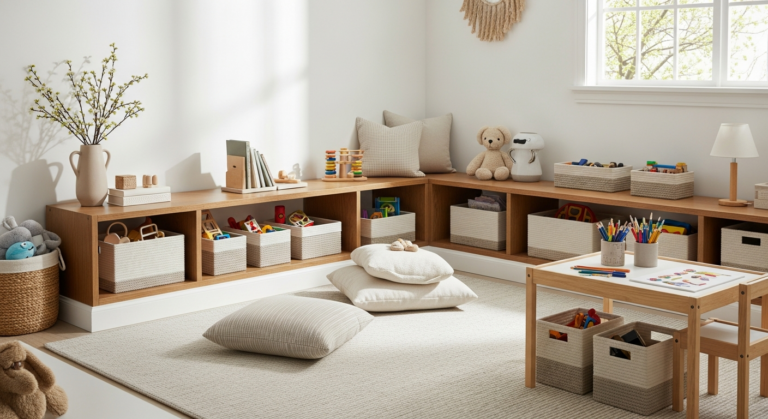
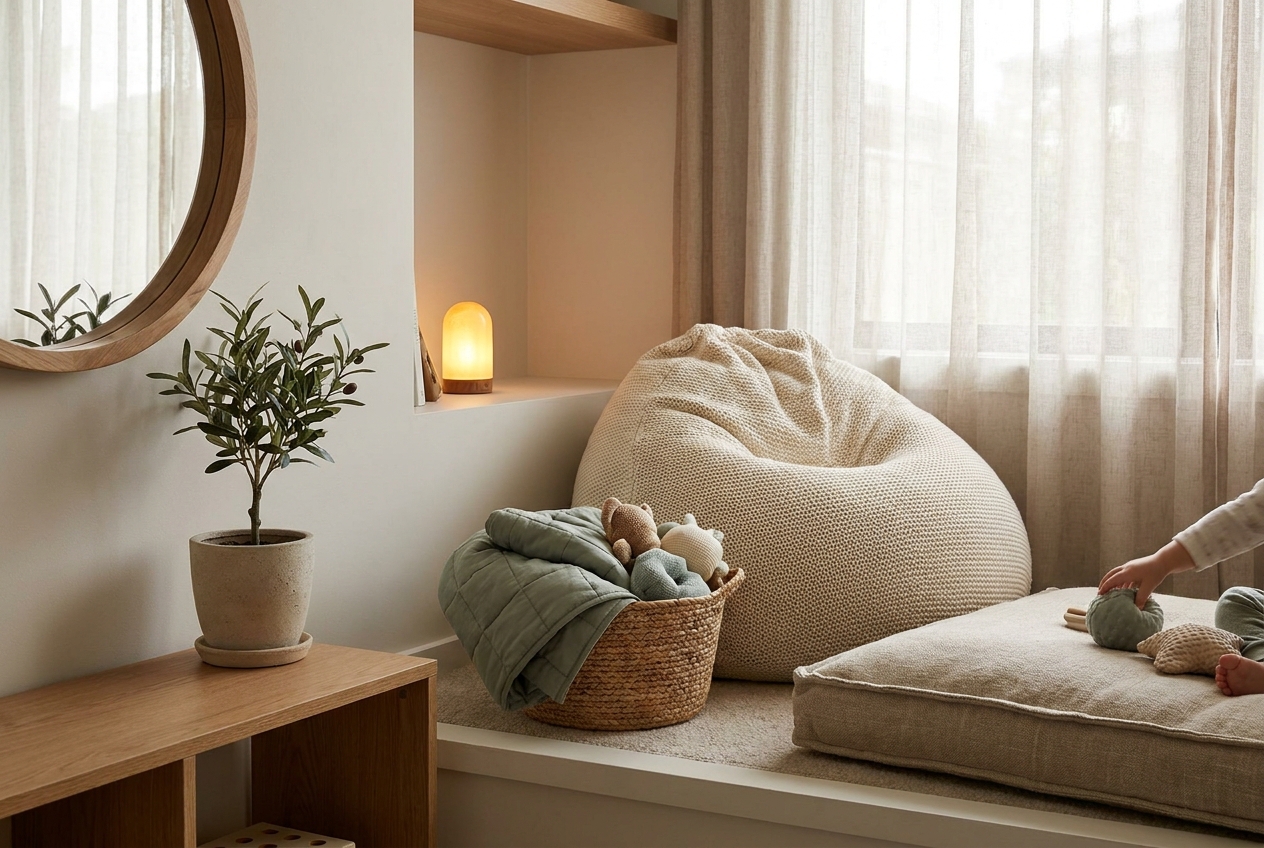
The living room is often the best choice, especially for younger children who need co-regulation. Look for underused corners, the space beside a bookshelf, or the area under a window. A floor cushion, a small canopy or curtain, and a low basket of tools can create a calm-down corner that looks intentional and design-forward, not clinical.
Design tip: Use the same color palette as the rest of your living room, just in softer, muted tones. If your living room is warm neutrals with olive accents, your calm-down corner might be cream, oatmeal, and sage. It reads as part of the room, not an addition to it.
Bedroom Corners
The bedroom works well for school-age children who are beginning to self-regulate independently. The natural privacy of a bedroom gives older kids the dignity they crave while still maintaining the space’s accessibility. Place it away from the bed — you want the corner to be associated with active regulation (breathing, squeezing, drawing), not passive avoidance (hiding under the covers).
Design tip: A floor-level reading nook doubles beautifully as a calm-down corner. Add a basket of sensory tools alongside the books and you have a multi-purpose space that doesn’t scream “emotional regulation station.”
Hallway and Under-Stairs Nooks
If you’re blessed with an under-stairs space, a wide hallway, or a landing area, these make surprisingly perfect calm-down corners. They’re naturally set apart without being isolated. They’re transitional spaces — which mirrors what the corner is designed to do: help your child transition from one emotional state to another.
Design tip: Install a curtain rod with a sheer linen curtain. When the curtain is drawn, it creates a gentle boundary. When it’s open, the space blends into the hallway. This gives your child agency — they can choose how much enclosure they want.
Shared Spaces and Small Homes
Not everyone has a spare nook. If your home is small, the calm-down corner can be portable. A beautiful basket or tote with a foldable cushion and a curated selection of tools can live on a shelf and be pulled out when needed. The “corner” becomes wherever your child takes the basket — the couch, the floor, their bed.
Design tip: Choose a basket that matches your decor. A woven seagrass basket or a linen storage bin in a neutral tone looks at home on any shelf and signals “this belongs here” rather than “this was added because we had to.”
Design Principles for a Beautiful Calm-Down Corner
This is where Neutrals and Nooks parts ways with the typical calm-down corner article. Most advice focuses entirely on what to put IN the corner. We’re going to focus on how to design a space that’s both therapeutically effective AND visually cohesive with your home.
Color Palettes That Actually Calm
Color isn’t just aesthetic — it has measurable psychological effects, especially on children. Research in environmental psychology has consistently shown that certain colors lower heart rate and promote relaxation, while others increase alertness and agitation.
Colors to embrace:
- Soft blues and blue-greens: These are the most consistently calming colors across studies. Think dusty blue, soft teal, sky blue — not bright royal blue or electric turquoise.
- Sage and muted greens: Green connects us to nature and signals safety. Sage, olive, eucalyptus, and moss tones work beautifully.
- Warm neutrals: Cream, oatmeal, warm white, light taupe, sand. These feel safe and grounding without being cold or institutional.
- Blush and soft clay: Very gentle warm tones that feel nurturing without being stimulating.
Colors to avoid:
- Bright reds and oranges: These increase heart rate and energy — the opposite of what you want.
- Stark white: Can feel clinical and cold. Warm white or cream is always better.
- Neon anything: Overstimulating for a space designed to calm.
- Too much black or very dark tones: Can feel heavy and confining for young children.
The ideal palette is 2-3 colors: one dominant neutral (walls, large cushion), one soft accent (canopy, rug), and one grounding tone (basket, wooden shelf). Think of it like designing a spa — serene, cohesive, and intentionally simple.
Lighting: Dimmable, Warm, and Child-Safe
Lighting is one of the most underestimated elements of a calm-down corner. Harsh overhead fluorescents or bright LEDs work against the space’s purpose. You want light that mimics the warmth and gentleness of natural light at golden hour.
Best lighting options:
- Battery-operated LED candles or fairy lights: Safe, warm, and magical for young children. Drape fairy lights inside a canopy for an instant cocoon effect.
- Dimmable table lamp with a warm bulb: Look for 2700K color temperature. A small ceramic or wooden lamp keeps the design cohesive.
- Himalayan salt lamp: These cast a beautiful warm amber glow and have become a popular recommendation among OTs for calm-down spaces. Choose a small one and place it out of reach of toddlers.
- Natural light with sheer filtering: If your corner is near a window, a sheer linen curtain diffuses light beautifully without darkening the space.
Avoid: Overhead lighting as the sole light source. Color-changing LED strips (too stimulating). Anything with a blue-toned or daylight bulb.
Design tip: If your calm-down corner doesn’t have access to natural light, a warm-toned puck light or adhesive LED strip along the base of a shelf adds ambient glow without requiring an outlet.
Textures and Materials: Soft, Natural, Inviting
Touch is the fastest path to nervous system regulation. The materials you choose for your calm-down corner matter both aesthetically and therapeutically.
Prioritize:
- Natural fibers: Cotton, linen, wool, muslin. These feel grounding and look beautiful. A chunky knit throw, a linen cushion cover, a cotton floor mat.
- Soft without being slippery: Velvet and minky fabrics feel luxurious but can be overstimulating for some sensory-sensitive children. Start with cotton and gauge your child’s response.
- Wood over plastic: A small wooden shelf, wooden sensory tools, a wooden tray. Natural wood adds warmth and aligns with a neutral aesthetic.
- Warmth underfoot: A soft area rug or sheepskin (real or faux) defines the space and adds a sensory layer. Choose something washable — this space will get used.
The design principle: Layer textures the way you would in a well-designed bedroom. A base layer (rug), a seating layer (cushion or pouf), a cozy layer (throw or blanket), and an enclosure layer (canopy or curtain). Each layer serves a sensory purpose AND a design purpose.
Essential Furniture and Layout
The physical setup of your calm-down corner needs to accomplish three things: define the space, provide comfortable seating, and organize the tools. Here’s how to do all three beautifully.
Seating: Get Low
Children regulate better when they’re low to the ground. It’s safer, it’s cozier, and it activates the proprioceptive system (the sense of where your body is in space). Forget chairs. Think floor-level.
Best seating options:
- Large floor cushion (24-30 inches): The anchor of the space. Choose a removable, washable cover in your palette. Linen or heavy cotton holds up best.
- Bean bag (structured, not floppy): A structured bean bag in a neutral fabric provides deep pressure and envelops the child. Look for ones with inner liners and lockable zippers for safety.
- Floor pouf: A round knit or woven pouf adds texture and is sturdy enough for sitting or leaning against.
- Nest chair or papasan: For school-age kids, a small nest-style chair provides that enclosed, hugged feeling. Choose rattan or natural fiber for the frame.
Enclosure: Creating Gentle Boundaries
Children intuitively seek enclosed spaces when they’re overwhelmed. Think of the child who hides under the table or crawls into a closet. Your calm-down corner should provide that sense of enclosure without isolation.
- Canopy or tent: A cotton or muslin canopy hung from the ceiling or mounted on a wall bracket creates a defined overhead boundary. Sheer fabric lets light through and keeps the space visible.
- Curtain panels: Two curtain panels on a corner-mounted rod let the child choose their level of privacy. Linen or cotton in your palette color.
- Low open shelving as a partition: A low bookshelf (24-30 inches tall) placed perpendicular to the wall creates a visual boundary while keeping the space open and visible to parents.
- A large floor-to-ceiling plant: Hear me out — a tall plant (real or high-quality faux) placed at the edge of the corner creates a natural, organic boundary that looks stunning.
Storage: Tools Within Reach, Chaos Out of Sight
The calm-down corner needs tools (more on those below), and those tools need a home. The key is accessible but contained. A child in the middle of a meltdown cannot navigate a complicated storage system.
- One open basket: A single, beautiful basket (woven seagrass, rope, or linen) at floor level holds the most-used tools. This is the grab-and-go container.
- A low, open shelf: Two to three compartments maximum. Each compartment holds one category of tools. Don’t overthink this — simple is better.
- Wall-mounted pockets or pouches: A fabric wall organizer with three to four pockets can hold flat items like feelings cards, breathing exercise printables, and small fidgets. Choose one in a coordinating fabric.
Layout principle: Everything the child needs should be reachable from their seated position. If they have to stand up and walk across the room to get a tool, the system breaks down. Design the corner so that from the cushion, they can reach the basket, the shelf, and the wall pockets.
Age-by-Age Setup Guide
A calm-down corner for a two-year-old looks very different from one for an eight-year-old. Here’s how to tailor the space as your child grows.
Toddlers (18 Months to 3 Years): Co-Regulation Central
At this age, your child cannot self-regulate. Period. Their prefrontal cortex — the brain region responsible for impulse control and emotional regulation — won’t be fully developed until their mid-twenties. For toddlers, the calm-down corner is where YOU go together.
Design priorities:
- Extra-large cushion or mat: Big enough for you AND your child to sit together. This is non-negotiable. You will be in this space with them every single time at this age.
- High-contrast textures: Toddlers are deeply sensory. Include a variety of textures they can touch — a ribbed pillow, a smooth wooden ring, a fuzzy blanket, a cool metal tin.
- Board books about feelings: “The Color Monster,” “Grumpy Monkey,” “Little Owl’s Night.” Keep two or three in the basket, rotating regularly.
- A simple visual: One image — a photograph of a calm face, a simple breathing visual (smell the flower, blow out the candle) — mounted at their eye level.
Safety note: No small parts, no long cords (canopy ties should be short or eliminated), no heavy items that could topple. Anchor any shelving to the wall.
What to skip at this age: Feelings charts with complex emotions, journals, timers, anything that requires reading or fine motor skills.
Preschoolers (3 to 5 Years): Building the Vocabulary
Preschoolers are beginning to name their emotions and understand that feelings are temporary — but they still need significant support. The calm-down corner starts to include more tools and more visual guidance.
Design additions:
- Feelings poster or chart: A simple chart showing 4-6 core emotions (happy, sad, angry, scared, calm, frustrated) with clear facial expressions. Mount it at the child’s eye level. Choose one with a clean, modern design — not a garish cartoon poster.
- Breathing exercise visuals: A simple “breathe in… breathe out” visual or a pinwheel they can blow. Some families use a jar of water with glitter (a “calm-down jar”) — shake it up and breathe until the glitter settles.
- Stuffed animal or comfort object: One designated “calm buddy” that lives in the corner. This gives the child something to hold, squeeze, and talk to.
- Noise-reducing ear muffs: Many preschoolers are sensitive to noise, especially during meltdowns. A pair of child-sized noise-reducing ear muffs (not headphones — just muffs) can be incredibly effective.
Co-regulation is still primary at this age, but you can begin modeling independent use. “I’m feeling frustrated. I’m going to sit in our cozy corner and take some breaths.” Let them see YOU use the space.
School-Age (6 to 10 Years): Growing Independence
This is when the calm-down corner starts to shift from a co-regulation space to a self-regulation space. School-age children are developing the cognitive skills to identify their emotions, choose a strategy, and use it independently. Your job is to provide the tools and the privacy.
Design additions:
- A journal or sketchpad: Some children process emotions better through writing or drawing. A small journal and colored pencils in the basket gives them an outlet.
- Kid-safe headphones and a music player: Calming music or nature sounds can be profoundly regulating. A simple MP3 player or an old phone loaded with calm playlists (no internet access) and over-ear headphones gives them auditory control.
- A timer or hourglass: School-age children can begin to use timed breathing exercises or simply watch sand fall. A 3-5 minute sand timer in a wooden frame is beautiful and functional.
- Expanded feelings vocabulary: Move beyond the basic 6 emotions to a more nuanced chart. “Disappointed,” “overwhelmed,” “embarrassed,” “jealous” — these are the emotions school-age kids are navigating.
- A menu of choices: A simple, laminated card that says “When I’m in the [blue/red/yellow] zone, I can…” with 4-5 options they’ve pre-selected. This aligns with the Zones of Regulation framework and gives them agency.
Design consideration: School-age kids are increasingly aware of aesthetics and peer judgment. Make the space look intentional and cool, not babyish. Think minimalist, cozy, and mature enough that they wouldn’t be embarrassed if a friend saw it.
Must-Have Calming Tools by Sense
The tools in your calm-down corner should engage multiple senses, because different children (and different emotions) respond to different sensory input. Here’s a curated list organized by sense.
Touch (Tactile)
- Weighted lap pad (2-5 lbs): Deep pressure on the lap activates the parasympathetic nervous system. Choose one with a washable, soft cover.
- Stress ball or squeeze toy: Simple, satisfying, and endlessly useful. Opt for a natural rubber ball over plastic.
- Textured fabric swatches: A small collection of different textures — velvet, corduroy, burlap, satin — in a pouch. Running fingers over textures is grounding.
- Kinetic sand or putty: Moldable, squeezable, and deeply satisfying. Keep it in a sealed container within the basket.
Sight (Visual)
- Calm-down jar or sensory bottle: A sealed bottle or jar filled with water, glitter glue, and a few drops of food coloring. Shake and watch the glitter slowly settle. Mesmerizing and calming.
- Liquid motion timer: Those desk toys with colored bubbles that drip slowly. Surprisingly effective for visual focus.
- Nature photographs or prints: A small, framed photograph of a forest, ocean, or mountain can provide a visual anchor. Choose images with natural, muted tones.
Sound (Auditory)
- Noise-reducing ear muffs: For blocking overwhelming noise.
- Rain stick or ocean drum: Gentle, rhythmic sounds that the child controls.
- Curated playlist: Nature sounds, soft instrumental music, or binaural beats designed for relaxation.
Proprioception (Body Awareness)
- Weighted blanket: The classic deep pressure tool. Choose one that’s roughly 10% of your child’s body weight. Linen or cotton cover in your neutral palette.
- Resistance band tied to the shelf or a sturdy hook: Pulling against resistance is incredibly organizing for the nervous system.
- A small pillow for squeezing or punching: Sometimes the body needs to DO something with the big energy. A firm, dense pillow they can squeeze, hug tightly, or push against the wall gives that output.
Curation over quantity: Resist the urge to stock the corner with every tool on this list. Start with one tool per sense — four or five items total. Observe which ones your child gravitates toward and adjust. A cluttered calm-down corner is an overstimulating calm-down corner, which defeats the entire purpose.
How to Introduce the Corner to Your Child
You’ve designed the space. It’s beautiful. It’s stocked. Now comes the most important part: the introduction. Get this wrong and the corner becomes furniture. Get it right and it becomes a lifeline.
Name It Together
Let your child name the space. “Cozy corner,” “calm cave,” “peace place,” “chill zone” — whatever resonates with them. When they name it, they own it. This is their space, not a place you send them.
Practice When Calm
This is critical. The first time your child uses the calm-down corner should NOT be during a meltdown. Introduce it on a calm, connected day. Sit in the space together. Explore the tools. Try the breathing exercises. Read a book in the corner. Make it a positive, warm experience.
Do this multiple times over several days before ever suggesting it during a difficult moment. You’re building a positive association — this is a GOOD place, a SAFE place, a COZY place.
Model It Yourself
Children learn by watching. Use the corner yourself. “I’m feeling really frustrated right now. I’m going to sit in the calm corner and take some deep breaths.” Then do it. Let them see a regulated adult using the same tools you’re offering them. This is powerful beyond measure.
Use It Together First
For the first several weeks (months for toddlers), go to the corner WITH your child during difficult moments. “I can see you’re having a big feeling. Let’s go to the cozy corner together.” Sit with them. Breathe with them. Offer a tool. Don’t lecture, don’t problem-solve, don’t talk about what happened. Just be present.
Over time, you’ll notice your child beginning to go to the corner on their own. This is the goal. This is self-regulation developing in real time. Celebrate it quietly — a simple “I noticed you went to your calm corner when you were upset. That was really smart” goes a long way.
Budget Breakdown: Three Tiers
You do not need to spend hundreds of dollars to create an effective calm-down corner. Here’s how to do it at every budget level.
The Essentials Tier: ~$50
- Large floor pillow ($15-20, Target, IKEA, or thrift store)
- Soft throw blanket ($10-15, you may already own one)
- Woven basket ($8-12, Dollar Tree, HomeGoods, or thrift store)
- DIY calm-down jar ($3-5, mason jar + glitter glue + water)
- Printed feelings chart (free — dozens of beautiful free printables online)
- Stress ball ($3-5)
- One comfort stuffed animal (likely already owned)
This tier gets you a fully functional calm-down corner. It may not have the canopy or the curated aesthetic, but it works. Function first. Always.
The Elevated Tier: ~$150
Everything in the Essentials tier, plus:
- Cotton or muslin canopy ($20-35, Amazon, Target, IKEA)
- Small area rug ($20-30, washable, neutral tone)
- Weighted lap pad ($20-30)
- Fairy lights or small warm lamp ($10-15)
- Wooden shelf or wall-mounted shelf ($15-25, IKEA KALLAX insert or floating shelf)
- Fabric wall organizer ($10-15)
This tier gives you the full calm-down corner experience with intentional design. It looks beautiful, it feels intentional, and it’s stocked with enough tools to cover the sensory bases.
The Dream Tier: $300+
Everything above, plus:
- Custom or high-quality cushions with removable linen covers ($50-80)
- Faux sheepskin rug ($30-40)
- Himalayan salt lamp ($15-25)
- Wooden sand timer set ($15-20)
- Noise-reducing ear muffs ($20-30)
- Liquid motion timers and premium sensory tools ($20-30)
- Framed nature prints ($15-25)
- High-quality structured bean bag ($40-60)
This tier is the magazine-worthy calm-down corner. Every element is chosen for both therapeutic value and design impact. It’s an investment, but it’s one that pays dividends in your child’s emotional development and in the beauty of your home.
Common Mistakes to Avoid
Even with the best intentions, there are a few pitfalls that can undermine your calm-down corner.
Using It as Punishment
This is the most common and most damaging mistake. If you ever say “Go to your calm-down corner” in an angry or punitive tone, you’ve turned it into a timeout. The child will associate the space with being in trouble and will resist using it. Always frame it as an invitation, not a directive. “Would you like to go to the cozy corner?” or “Let’s go to the calm corner together.”
Making It Too Stimulating
More is not better. A corner crammed with 20 fidgets, 5 posters, flashing lights, and bright colors is the opposite of calming. Edit ruthlessly. A few well-chosen tools in a serene setting will always outperform a sensory explosion.
Isolating the Location
We covered this above, but it bears repeating. A calm-down corner in a far corner of the basement or behind a closed door sends the wrong message. Keep it central, visible, and accessible.
Skipping the Introduction
Plopping a canopy in the corner and hoping your child figures it out doesn’t work. The introduction period — practicing when calm, exploring tools together, modeling use — is what makes the space effective. Skip this step and you have a cute corner that nobody uses.
Giving Up Too Soon
Your child may not use the corner right away. They may resist it during meltdowns (because they’re, you know, melting down). This is normal. Keep offering it gently, keep modeling it yourself, keep the tools stocked. Some children take weeks to warm up to the space. Consistency and patience are everything.
Letting It Become a Dumping Ground
If the calm-down corner gradually becomes buried under toys, laundry, or clutter, it stops being a dedicated space. Treat it like you would a reading nook or a meditation corner — maintain it. A weekly tidy-up takes two minutes and keeps the space inviting.
Neutral Nina
Neutral Nina is an interior design enthusiast and mom of three who proves that beautiful, organized spaces and family life can coexist. She shares practical strategies for creating calm, functional homes that work for kids and grown-ups alike.
Frequently Asked Questions
What if my child refuses to use the calm-down corner?
Never force it. If they resist, sit near the corner yourself and start using one of the tools. Often, a dysregulated child will slowly move toward you. You can also try bringing one tool FROM the corner TO your child — “Here, would you like to hold the squishy ball?” Over time, they’ll make the connection between the tools and feeling better, and the corner becomes appealing on its own.
Can siblings share a calm-down corner?
Yes, but with clear expectations. Only one person uses the corner at a time. If two children need it simultaneously, have a portable backup basket or a second small space. Some families designate a “waiting” signal — a small sign the child can flip to show the corner is occupied.
How do I keep it from looking like a daycare in my living room?
This is the central premise of this entire article. Stick to your home’s existing color palette, use natural materials, choose streamlined storage, and edit the tools down to a curated few. A linen canopy, a cream floor cushion, a woven basket, and a wooden shelf look like intentional interior design, not a classroom. The secret is restraint and palette cohesion.
At what age should I start?
You can begin introducing a calm-down corner as early as 18 months, with the understanding that toddlers will always need a caregiver present. The space evolves as your child grows — what starts as a co-regulation spot for a two-year-old becomes an independent self-regulation space for a nine-year-old.
What if we live in a very small home or apartment?
Go portable. A beautiful basket or tote bag with a foldable cushion and a handful of tools can be stored on a shelf and brought out when needed. You can also create a “calm-down kit” in a zippered pouch that travels — for the car, for grandparents’ houses, for restaurants. The tools matter more than the physical corner.
Should the calm-down corner be in my child’s bedroom?
It can be, especially for school-age children who prefer privacy. For toddlers and preschoolers, a more central location is usually better because they need your presence for co-regulation. If the bedroom is the best option, make sure it’s in a corner of the room separate from the bed, and keep the door open during use so the child doesn’t feel isolated.
Building a Home That Holds All the Feelings
Here’s what I want you to take away from this guide: creating a calm-down corner is not about managing your child’s behavior. It’s about designing your home to support their emotional growth. It’s about saying, with your furniture and your fabric and your carefully chosen tools, “Every feeling you have is welcome here.”
The most beautiful homes aren’t the ones with the most expensive furniture or the most perfect color palettes. They’re the ones that were designed with intention — with the people who live in them in mind. A calm-down corner is one of the most intentional things you can add to your home. It says that emotional safety is a design priority, right alongside aesthetics and function.
Start simple. A cushion, a blanket, a basket of tools, and an invitation: “This is your cozy corner. It’s here whenever you need it.”
Your child will fall apart. And they’ll have a beautiful place to put themselves back together.