

Kids’ Bookshelf and Reading Nook Organization: A Cozy System That Encourages Reading
Learn how to organize your kids' bookshelf and create an inviting reading nook with a system that includes auditing, sorting, front-facing books, and regular rotation to encourage reading.
- Conduct a book audit: pull all books and sort into five piles.
- Front-face 8-15 books on the bottom shelf for young readers.
- Sort remaining books into 4-7 labeled categories.
- Design your reading nook with light, seating, and washable materials.
- Rotate books every few weeks to maintain engagement.
This post contains affiliate links. As an Amazon Associate I earn from qualifying purchases.
Last fall, my kids’ books lived in a laundry basket. By the time we dug out the dump truck book my youngest wanted, she had wandered off. The books just needed a home.
Here’s the kids’ bookshelf organization system that fixed it, plus reading nook ideas for kids that hold up to daily use. It covers the audit, sorting, shelving, the nook, rotation, and a budget that starts around $70.
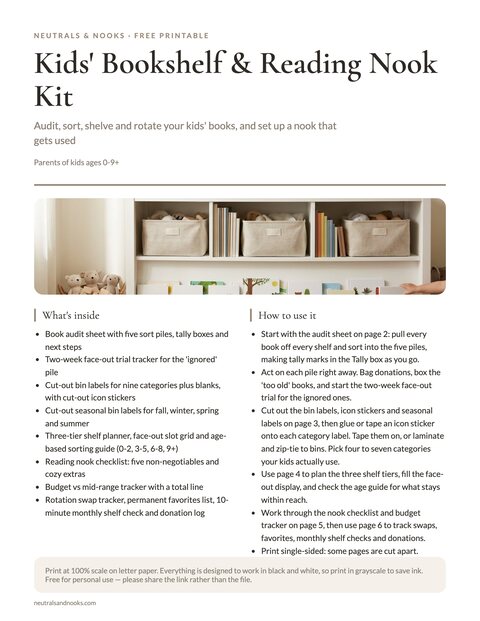
Free printable · 6 pages
Kids' Bookshelf & Reading Nook Kit
A book audit sheet with tally boxes and a two-week face-out trial tracker, cut-out bin labels for nine categories plus blanks, icon stickers and seasonal bin labels, a three-tier shelf planner with an age-based sorting guide, a reading nook checklist with a budget vs mid-range tracker, and a book rotation calendar with permanent favorites, a monthly shelf check and a donation log.
Free. Your download link appears right here. You'll also join the Monthly Home Reset. Unsubscribe anytime. Privacy
The system in briefFront-face 8–15 books on the bottom shelf. Sort the rest into 4–7 labeled categories. Build the nook around light, seating, nearby books, a boundary, and washable materials. Rotate every few weeks.
In this article (12 sections)
- Why Most Kids’ Bookshelves Become Clutter Magnets
- How to Do a Kids’ Book Audit
- How to Organize Kids’ Books by Category (Not Alphabet)
- Front-Facing vs. Spine-Out Kids’ Bookshelves
- Designing the Reading Nook: The Non-Negotiables
- Reading Nook Lighting, Seating, and Cozy Details
- The Rotation System: Keeping the Nook Fresh Without New Books
- A Low-Effort Maintenance Routine That Actually Sticks
- Reading Nook Ideas for Kids by Space Type
- Budget Breakdown: What This Actually Costs
- Frequently Asked Questions
- Next Steps: Start With the Book Audit
Why Most Kids’ Bookshelves Become Clutter Magnets
Books multiply quietly through library hauls, birthday gifts, and hand-me-downs, and they don’t sort by size the way clothes do. Within months, a tidy shelf becomes a wall of spines that all look the same to a child who can’t read yet.
Spine-out shelving is built for adults who already know what they want. Kids under seven browse by cover, recognizing the illustration before the title. A shelf that hides every cover gets ignored, no matter how many books are on it.
Reading nooks fail for practical reasons: a floor cushion in a dark corner, or a window seat with nowhere to put the book or the water cup. The fix for shelves and nooks is the same: design around how your kids actually behave, not how a magazine spread looks.
How to Do a Kids’ Book Audit
Every good system starts with every book off the shelf, even the ones wedged behind other things. It sounds tedious, but most families finish in under an hour, and it makes every later step easier.
- Pull every book. Empty every shelf, bin, and basket onto the floor.
- Sort into five piles. Use the table below.
- Act on each pile right away. Bag donations and set library books by the door so they don’t drift back onto the shelf.
- Box the “too old” pile. Label the bin and store it out of sight.
- Set a face-out trial date. Give the “ignored” pile two weeks on display, then decide.
Here’s what goes in each pile and what to do with it.
| Pile | What it is | Action |
|---|---|---|
| Too young / outgrown | Board books your early reader has graduated past. Baby books nobody has picked up in a year. | Donate, or pass along to a friend with a younger kid, a Little Free Library, or a shelter that accepts books. |
| Too old / not yet | Chapter books gifted by relatives that are still a stretch, or picture books with themes your child isn’t ready for. | Box up in a labeled bin, out of sight. |
| In rotation: loved | Requested constantly, dog-eared, memorized. | Keep in the display. |
| In rotation: ignored | Age-appropriate and available, but never chosen. | Face-out trial for two weeks, then decide. |
| Duplicates or damaged | Two copies of the same board book, a library book mixed in, anything falling apart at the spine. | Recycle, donate, or return to the library. |
Keep the “too old” bin out of the active rotation. A five-year-old will always grab the familiar board book over a chapter book that takes more effort.
The “ignored” pile deserves a second look. Some books just aren’t a hit, and those can be donated. Others go unchosen because they sit spine-out on a low shelf where a toddler can’t see the cover, or they’re buried three books deep. The two-week face-out trial tells you which is which.
Doing this alongside a broader declutter? The Declutter Score Quiz is a quick gut check on whether you keep too much “just in case” or purge too aggressively.
A Quick Age-Based Sorting Guide
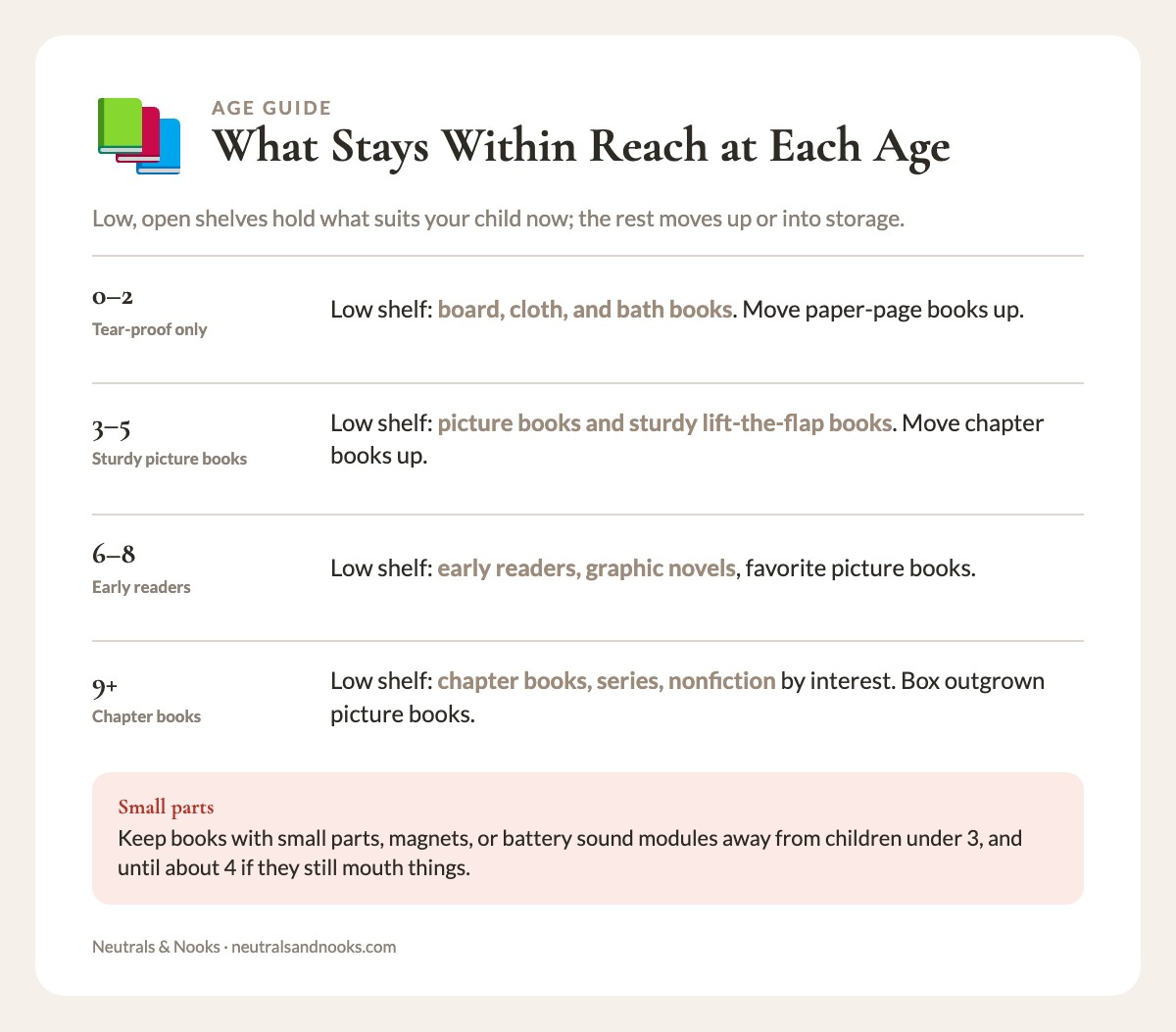
Use this as a starting point for what stays within reach and what moves up or into storage.
| Age | What tends to work on open, low shelves | What can move to higher/rotating storage |
|---|---|---|
| 0–2 | Board books, cloth books, bath books. | Paper-page picture books a baby will tear. Any book with detachable pieces, buttons, magnets, or sound modules. |
| 3–5 | Picture books, sturdy lift-the-flap books. | Chapter books, encyclopedic reference books. |
| 6–8 | Early readers, graphic novels, favorite picture books. | Board books (unless a younger sibling still uses them). |
| 9+ | Chapter books, series books, nonfiction by interest. | Picture books they’ve outgrown emotionally. Keep a few sentimental ones and box the rest. |
Safety firstKeep books with small parts, magnets, or battery sound modules away from children under 3, and until about 4 if they still mouth things. Check them regularly for loose parts and cracked battery covers.
How to Organize Kids’ Books by Category (Not Alphabet)
Alphabetizing by author feels organized, but it’s almost useless to a child. A six-year-old isn’t looking for Mo Willems. They want a funny book, or the one about trucks.
Sorting by category is easier for kids to browse and easier to put back correctly. That is the real test of whether a system survives contact with actual children.
These categories work well for most home libraries.
| Category | Icon idea | What goes in it |
|---|---|---|
| Animals | Paw print | Farm, zoo, and pet books. |
| Vehicles / trucks | Truck sticker | Trucks, trains, and planes. In a truck-loving house, this earns its own shelf. |
| Silly / funny | Smiley face | The books that get giggles. |
| Bedtime / calm stories | Moon | Quiet, slow-paced reads. |
| Favorites | Star | A rotating shelf for whatever is on heavy repeat. |
| Fairy tales / adventure | Crown or castle | Princesses, quests, and folk tales. |
| Nonfiction / how things work | Magnifying glass | Facts, science, and how-it-works books. |
| Holiday / seasonal | Leaf or snowflake | Boxed up and rotated in (see the rotation section). |
| Chapter books / early readers | Bookmark | Usually sorted by series rather than category. |
You don’t need all of these — pick four to seven categories that match what your kids actually own and gravitate toward. The goal isn’t a perfect taxonomy; it’s a system simple enough that a four-year-old can correctly return a book to its bin without adult help, most of the time.
Label each bin or shelf section with both a word and a simple icon, like a paw print for animals or a truck sticker for vehicles, so pre-readers can self-sort. Painter’s tape and a marker work for a low-cost version. Laminated cardstock tags zip-tied to a bin look tidier and hold up longer.
Keep labels broad. “Animals” beats separate bins for “Farm Animals” and “Zoo Animals,” because at pickup time nobody sorts that precisely.
A Note on Series and Chapter Books
Once a reader moves into chapter books, category sorting starts to break down. A kid who loves a series wants those books together and in order, not scattered across “adventure” and “funny.”
Around age seven or eight, switch that part of the shelf to sorting by series or author. Keep picture books in the category system for as long as they’re in the house. Many families keep a curated picture book shelf well into elementary school for bedtime reading.
Front-Facing vs. Spine-Out Kids’ Bookshelves
The highest-impact change you can make is switching at least the bottom shelf, at toddler or preschooler eye level, from spine-out to front-facing display. Front-facing shelves show the cover art, which is how young kids recognize a book.
They also limit how many books are out at once, since a front-facing shelf holds far fewer books per foot. That helps prevent the too-many-choices shutdown that makes some kids skip picking a book entirely.
A blended approach works best for most families:
- Bottom shelf or lowest tier (reach height for ages 1–5, and crawling babies too): front-facing, rotating display of 8–15 books max. For babies under 1, keep only sturdy board or cloth books within reach.
- Middle shelves (reach height for ages 6–9): category bins or magazine-file dividers, spine-out but grouped and labeled.
- Top shelf (adult or older-kid reach): overflow, sentimental keepsakes, books currently out of rotation, reference books parents pull down for read-alouds.
Wall-mounted picture-book ledges, sold at most home stores, are an inexpensive way to add front-facing display without buying a new bookcase. A few ledges at different heights can hold the “currently loved” rotation while a traditional bookcase nearby handles bulk storage.
| Shelf type | Best for | Watch out for |
|---|---|---|
| Wall-mounted ledges | Front-facing rotation, ages 1–6 | Mount into studs or rated anchors. Stay under the weight rating, and don’t overload with hardcovers. |
| Cube storage bins | Category sorting, ages 2–8 | Deep bins where books get lost at the bottom. |
| Traditional bookcase | Bulk/overflow storage, chapter books | Spine-out only works once kids can read titles. |
| Rolling book cart | Small spaces, flexible placement | Wheels can shift, and carts are hard to anchor. Lock the casters or remove the wheels, or choose a wide-base, non-rolling shelf if your child climbs. |
| Closet shelving (repurposed) | Small bedrooms without floor space to spare | Needs good lighting, since closets are often dim. |
Safety firstAnchor every bookcase, including low ones used as room dividers, with the manufacturer’s anti-tip kit into studs or rated anchors. Put heavy books on the lower shelves, and don’t let children climb shelves, since toddlers climb to reach a favorite cover. Mount wall ledges into studs or rated anchors and stay under the weight rating. Choose rounded edges and shallow lips, and don’t hang ledges above a spot where a toddler sits or stands.
Designing the Reading Nook: The Non-Negotiables
A reading nook doesn’t need a bay window or a custom built-in. A nook can be as simple as a floor cushion in a closet with the doors removed, or a bedroom corner with just a beanbag and a lamp. Daily use comes down to five things, in order of importance:
- Good light. Natural light during the day, a warm lamp for evenings. A dim corner gets skipped even if it’s beautifully styled.
- Comfortable, kid-sized seating. A beanbag, a floor cushion, a small kid-scale armchair, or even just a pile of soft blankets. Adult-sized furniture that swallows a small child isn’t as inviting as it looks.
- Proximity to the books. The nook needs to be within a few steps of the shelf — ideally right next to it. A nook across the room from the books just means books get carried elsewhere and never make it back.
- A defined boundary. Many kids are drawn to enclosed, cozy spaces. A low bookshelf used as a divider, a curtain, or even a rug that marks “this is the reading spot” can do the job. An undefined corner of an open room doesn’t read as a destination.
- Low-maintenance materials. Choose machine-washable cushion covers and a crumb-hiding rug with a non-slip pad under it. Avoid curled edges, especially on hardwood. Nothing should be so precious that a spilled cup of milk becomes a crisis, because a nook you’re afraid to use stops being used.
“Looks good in photos” isn’t on the list. My first attempt was a pretty cushion in a dim corner, and nobody sat on it until I added a lamp. A plain nook that hits all five is far more likely to get used, and daily use is the goal.
Does your nook also need to work as a wind-down space after a big day? See how to create a calm-down corner at home. Soft textures, defined boundaries, and warm light serve both purposes.
Reading Nook Lighting, Seating, and Cozy Details
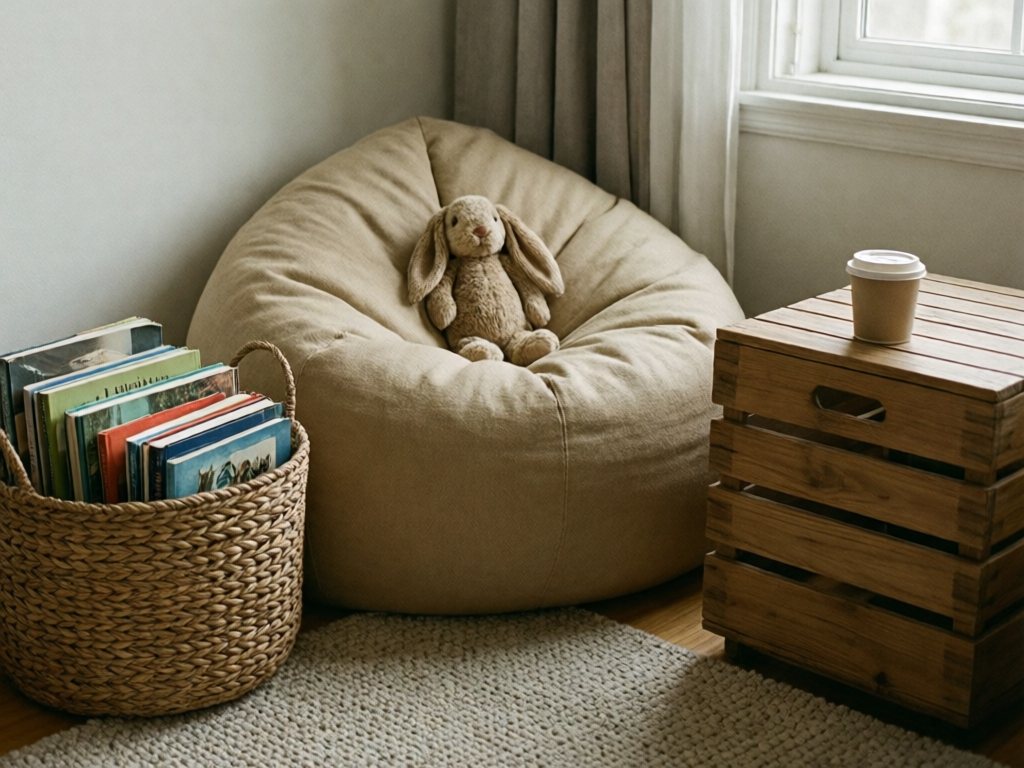
With the five basics covered, these details turn a functional corner into a spot kids choose.
Lighting specifics
A single overhead light rarely feels cozy. Layer in a warm lamp (look for bulbs labeled 2700K–3000K, which read warm rather than clinical). Choose a cool-running LED bulb and a stable or clamped base. Place the switch where a child can reach it.
If the nook is near a window, position seating to catch daytime light without glare on the page.
Safety firstCords and lights need extra care in a child’s nook. Use UL- or ETL-listed low-voltage LED string lights, or battery lights with a screw-secured battery compartment. Keep cords short, secured, and out of reach with a cord cover or shortener. Never drape lights over fabric or canopies, and keep cords out of sleeping areas. A swallowed button battery is a time-critical emergency. Don’t wait for symptoms, and don’t induce vomiting. Go to the ER right away. On the way, call the US National Battery Ingestion Hotline at 800-498-8666 or Poison Help at 1-800-222-1222.
Seating that actually gets sat in
- A beanbag or floor cushion big enough for one kid, or two in a pinch for sibling read-alongs.
- A small canopy or teepee if space allows. The enclosed feeling reads as special to many kids and adds the boundary. Choose a stable freestanding one, or one securely anchored with rated hardware, with no long cords or ties. Keep fabric away from lamps and lights.
- A window seat with a cushion, if your layout has one, topped with a couple of throw pillows sized for kids (adult-sized pillows tend to overwhelm the space).
- Floor seating over furniture seating for the youngest kids — toddlers and preschoolers often prefer sprawling on a soft rug to sitting upright in a chair.
Safety firstChoose a beanbag with a locked or sewn-shut zipper, since loose bead filling is a choking hazard. Beanbags, pillows, and soft nooks aren’t for babies under 12 months, and a baby shouldn’t be left alone in one. Keep cushions and pillows out of an infant’s sleep space.
Cozy details that earn their keep
- A soft rug underfoot — this alone does a lot of the “cozy” work and is easier to keep clean than upholstered furniture.
- A small basket or bin right next to the seating for the 2–3 books currently being read, separate from the main shelf, so a half-finished bedtime story doesn’t have to be re-found from scratch the next night.
- A stuffed animal or two that “live” in the nook, since a lot of kids treat the nook as much as a hangout spot as a reading spot.
- A small side table, crate, or shelf ledge at seating height for a lidded, spill-resistant cup. It prevents a lot of spilled-drink-on-a-book incidents. Keep drinks away from lamps and outlets, and keep hot drinks out of a child’s nook.
The Rotation System: Keeping the Nook Fresh Without New Books
The simplest way to keep a nook fresh is book rotation, borrowed from our toy rotation system. In my house, the kids lost interest in a static shelf the same way they did with a static toy bin, because the books got too familiar. Our shelf went stale within weeks before I started swapping.
Rotating books through the front-facing display every few weeks makes the collection feel bigger without buying anything new. The Kids’ Bookshelf & Reading Nook Kit has a rotation schedule you can print if you like a plan on paper.
A simple rotation routine:
- Store half. Keep about half or more of your board and picture book collection in an accessible bin or closet shelf, out of the active display.
- Swap every few weeks. Trade roughly a third to half of the displayed books with ones from storage, so the display stays in the 8–15 range. Every few weeks is a rule of thumb, so adjust it to your kids.
- Keep the favorites. Leave a small handful of most-requested books in permanent rotation. Taking those away can cause real frustration.
- Follow the seasons. Swap in fall and Halloween books in September and October, snow and holiday books in December, and so on. If you already store seasonal decor in bins, use the same logic from our guide to holiday decor storage. Keep one labeled bin of books per season and swap it in on a schedule.
A Low-Effort Maintenance Routine That Actually Sticks
Without a maintenance rhythm, any system drifts back toward chaos within a couple of months. Book upkeep folds easily into an existing routine.
“Put the book back” is a task most kids as young as three can do once the categories are simple.
A few habits that keep the system running:
- Tie book pickup into an existing evening routine rather than treating it as a separate chore. If your family already does a nightly tidy sweep, add “books back in their bin” as one stop. The 15-minute evening reset is a good framework if you need one. A nook resets fastest as part of a whole-house sweep.
- Do a 10-minute “shelf check” monthly, not a full re-sort. Look for books in the wrong bin, pull damaged ones, and see whether the rotation is due for a swap.
- Keep a standing donation box nearby, in a closet or on a garage shelf. Outgrown books land there instead of drifting back onto the shelf “just in case.” A book that’s been in the donation box for a month with no protest is safe to actually donate.
- Involve kids in the sort, even young ones. A three-year-old can tell you “this one’s a truck book” and put it in the truck bin. The goal is ownership of the system, because a system only the parent maintains collapses the first busy week.
Reading Nook Ideas for Kids by Space Type
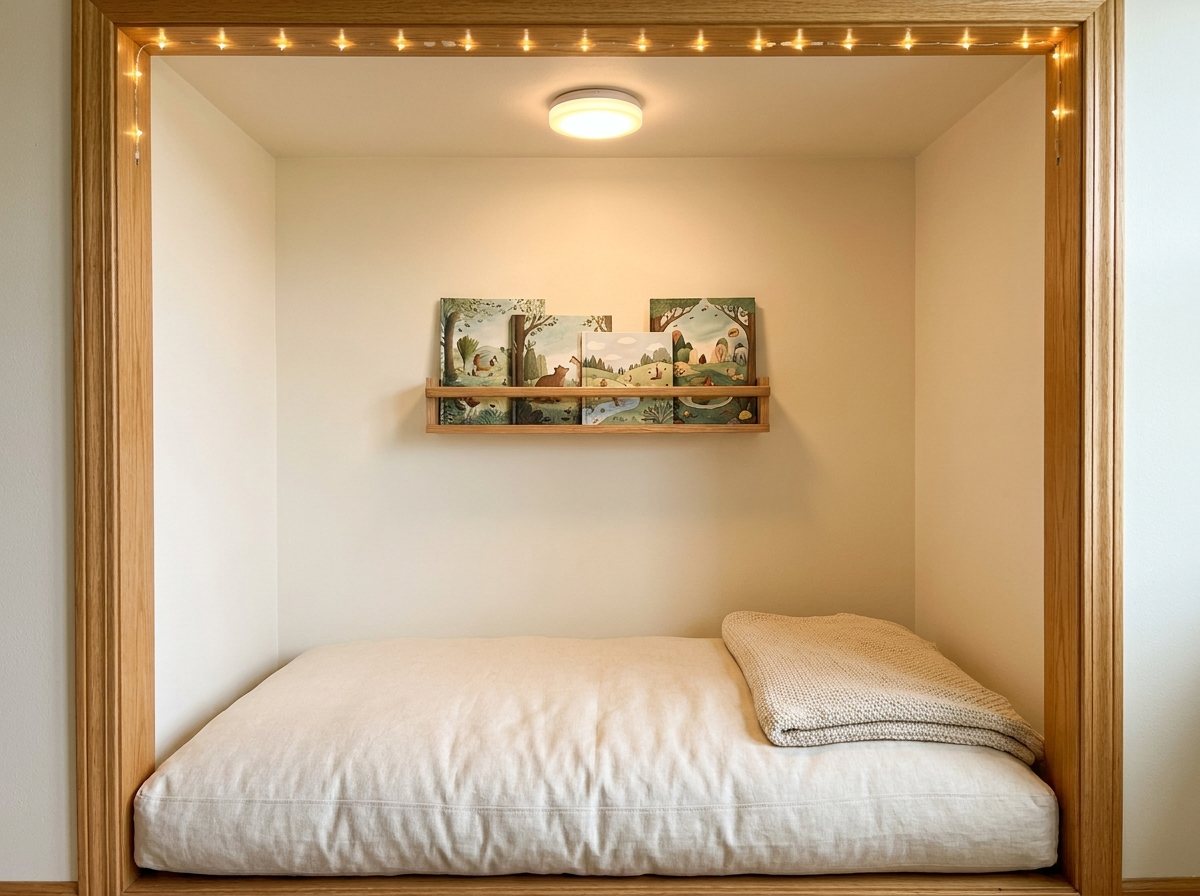
Here’s how the same principles adapt to common space constraints.
Small bedroom corner
Use a low bookshelf as both storage and a room divider. Put a rug and a floor cushion on the far side to make a small room within a room. Anchor the bookshelf to the wall. Wall-mounted ledges save floor space entirely.
Shared kids’ bedroom
In a shared room, the nook can double as neutral territory. One shared reading spot works better than separate mini-nooks in a room that’s already tight on space. If bunk beds or divided zones are part of your setup, our guide to shared kids’ bedroom organization covers how to split storage fairly between siblings. It pairs well with a single reading zone that belongs to both kids equally.
Hallway or landing nook
An underused stretch of hallway near the bedrooms works well because it doesn’t compete with any other room’s function. A cushioned bench with storage underneath and a wall-mounted lamp turns dead space into prime reading real estate.
Closet conversion
Remove the closet doors and add a cushion and a small shelf. Unused closet depth becomes an enclosed, cave-like spot that many kids love because it feels hidden and special.
Lighting is the make-or-break detail, since closets are rarely designed for reading. Use cool-running LED lighting only. Good options are a rechargeable puck light, a plug-in sconce, or a battery puck light with a screw-secured battery compartment. Keep cords out of reach and don’t stack blankets around bulbs.
Safety firstSupervise young children in enclosed nooks. Remove or secure overhead closet rods and any shelves at head height.
Living room corner
A nook in a shared family space needs to be visually calm so it doesn’t clash with the room. It is also often the easiest spot to get consistent use, since the family is already there. An armchair-and-basket setup tucked near (not blocking) a window works well.
Budget Breakdown: What This Actually Costs
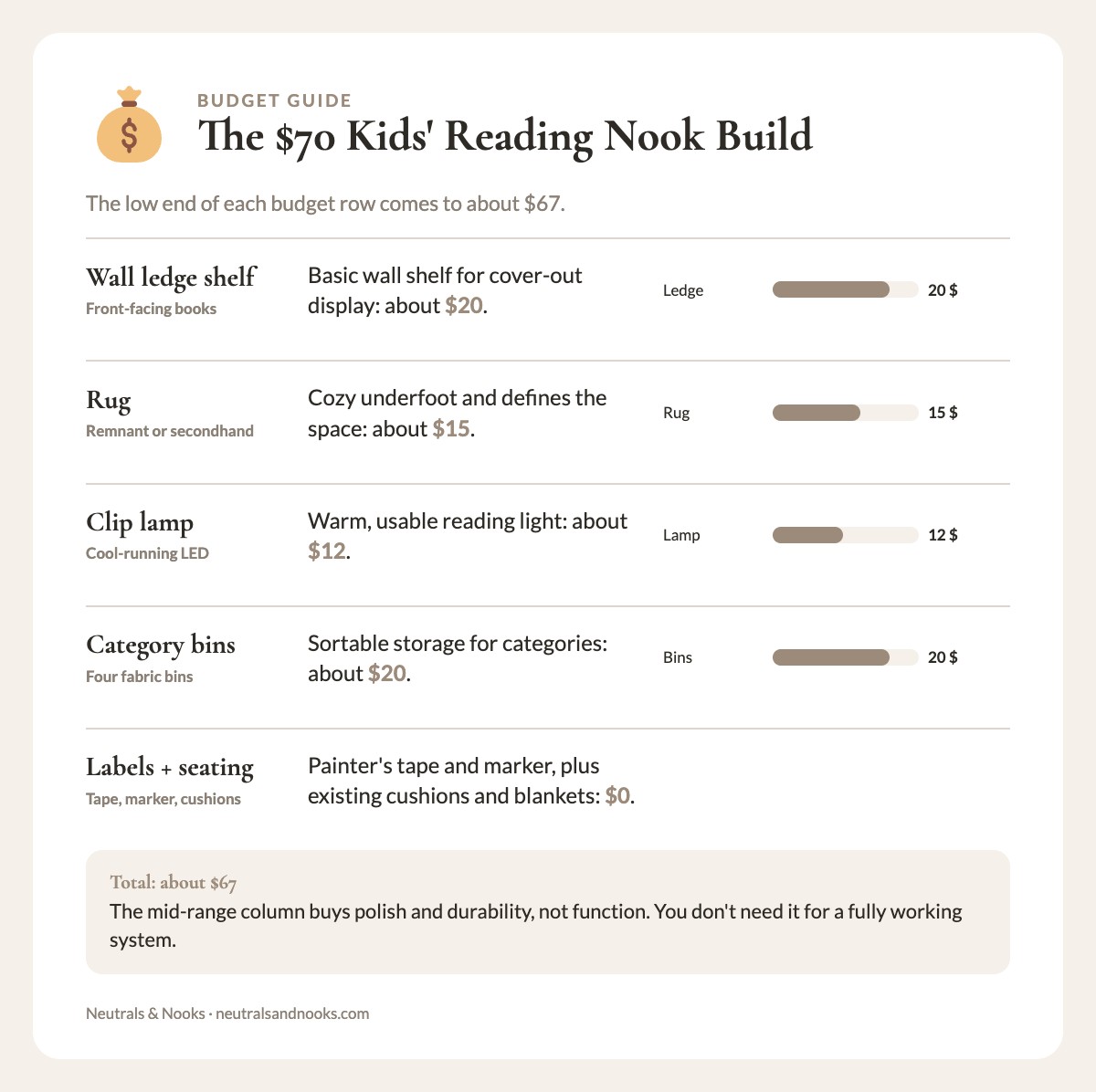
Costs vary widely depending on what you already have on hand, but here’s a realistic range for building this system from scratch.
| Item | Budget option | Mid-range option | What it does |
|---|---|---|---|
| Front-facing ledge shelves (2–3) | $20–35 (basic wall shelf) | $60–100 (matched set, painted) | Cover-out book display. |
| Seating | $0 (existing floor cushions/blankets) | $40–90 (beanbag or floor chair) | Comfortable kid-sized spot. |
| Rug | $15–30 (remnant or secondhand) | $60–150 (new, washable) | Cozy underfoot, defines the space. |
| Lamp/lighting | $12–20 (clip lamp) | $35–60 (cool-running LED, stable base, short secured cord) | Warm, usable light. |
| Category bins/baskets (4–6) | $20–35 (basic fabric bins) | $50–90 (matching labeled set) | Sortable, kid-manageable storage. |
| Labels | $0 (tape + marker) | $15–25 (laminated tag set) | Self-sorting cues for pre-readers. |
| Total range | ~$67–120 | ~$260–515 |
You don’t need the mid-range column for a fully functional system. It buys polish and durability, not function. The $70 version below uses the low end of each budget row.
The $70 version
- Basic wall ledge shelf for front-facing books: about $20.
- Rug remnant or secondhand rug: about $15.
- Clip lamp with a cool-running LED bulb: about $12.
- Four basic fabric bins for categories: about $20.
- Painter’s tape and marker for labels: $0.
- Seating from existing floor cushions and blankets: $0.
That comes to about $67, so $70 covers it.
Frequently Asked Questions
How many books should actually be on display at once?
Fewer than you’d think: for toddlers and preschoolers, 8–15 front-facing books offers real choice without overwhelming them, and the rest can wait in labeled bins. Older kids who read spine titles can handle a larger visible collection.
My kid never puts books back where they belong. What am I doing wrong?
Usually it’s a system problem, not a compliance problem. The categories may be too granular, the bins too deep for a small hand to see into, or the labels may rely on reading skills your child doesn’t have yet. Simplify to four or five broad categories, use bins shallow enough to see the bottom, and add a picture icon alongside the word on each label. If the system is genuinely simple enough, most kids three and up can maintain it with only occasional reminders.
Is it worth buying a dedicated kids’ bookshelf, or can I use a regular bookcase?
A regular bookcase works fine for bulk and overflow storage, especially once kids are reading well enough to browse spine-out. But for the most-used books, especially for kids under six, a front-facing element makes a bigger difference than new furniture. Even one or two wall-mounted ledges added near an existing bookcase will do it. You can mix and match rather than replacing what you already own.
How do I stop the reading nook from turning into a dumping ground for random toys?
Give the nook a clear, narrow purpose and keep other toy storage elsewhere in the room so there’s no ambiguity about what belongs there. A small basket for the 2–3 books currently being read plus one or two “resident” stuffed animals is fine. If cars, blocks, or craft supplies start migrating in, they probably lack a good home elsewhere. A quick nightly reset (see the routine above) catches drift before it becomes permanent clutter.
What’s the best age to switch from board books to a full picture-book rotation?
There’s no hard cutoff. Most families start phasing in picture books alongside board books between 18 months and 2.5 years. Many shift the display to mostly picture books by age 3–4, once the tearing phase has mostly passed. Keep a small board book bin in reach if there’s a younger sibling or your child still loves the chunky pages at bedtime. There’s no rush to retire them. For books with small parts, magnets, or batteries, follow the safety note under the age-based sorting guide.
How often should I actually rotate the books on display?
Every few weeks works for many families with younger kids (see the rotation routine above), while older kids who choose by title and series rarely need it.
My space is tiny — is a reading nook even realistic?
Yes. Some of the best-used reading nooks are the smallest ones — a repurposed closet with the doors off, a cushion in a stair landing, or literally a folded blanket in the corner of a shared bedroom. The five things that matter (light, comfortable seating, proximity to books, a defined boundary, and low-maintenance materials) all scale down fine. A tiny, well-lit, cozy corner will get used far more than a large but poorly lit or awkwardly placed one.
Next Steps: Start With the Book Audit
The goal was never a picture-perfect shelf. It was kids grabbing a book on their own, without me hunting through a laundry basket first.
Start with just the book audit if that’s all you have time for this week. Everything else can follow once the books have a home that makes sense.
For printable category labels with icons and an audit sheet to work from, grab the Kids’ Bookshelf & Reading Nook Kit.
