
The 15-Minute Evening Reset: A Family Tidying Routine That Actually Sticks
Learn how a 15-minute daily evening reset can transform your home from chaotic to consistently tidy, eliminating stressful weekend cleaning marathons. Discover the psychology behind why this family routine works and how to implement it effectively.
- Shift from weekend cleaning marathons to a daily 15-minute family evening reset.
- Your home will be consistently tidier with less total effort and stress.
- Understand the compound effect and Zeigarnik effect to maintain tidiness.
- Implement a daily 15-minute family tidying routine between dinner and bedtime.
- Avoid overwhelming messes and reduce mental load from "open loops."
I used to be a weekend warrior.
Every Saturday morning, I’d stare at the house — the playroom floor invisible under a debris field of Magna-Tiles and doll clothes, the kitchen counter buried under mail and lunch containers and a banana peel nobody claimed, the living room couch cushions on the floor because they’d become part of a “boat” at some point during the week — and I’d spend three hours clawing back to baseline. By noon I’d be sweating, irritable, and resentful. By Monday evening, the house looked exactly the same as it had Saturday morning. The cycle repeated, every single week, and I started to genuinely believe that keeping a family home tidy was a Sisyphean delusion.
Free printable · 5 pages
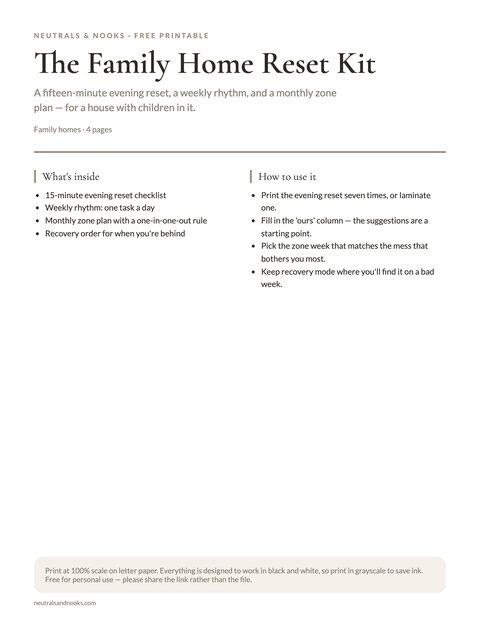
The Family Home Reset Kit
A 15-minute evening reset, a weekly rhythm and a monthly zone plan, for a house with children in it.
Free. Your download link appears right here. You'll also join the Monthly Home Reset. Unsubscribe anytime. Privacy
Then I tried something different. Not a new organizational product. Not a better storage system. Not a bigger house (though I fantasized about that regularly). I tried a 15-minute evening reset — a family-wide, daily tidying blitz that happens every night between dinner and bedtime.
That was fourteen months ago.
I haven’t done a marathon Saturday cleaning session since. The house isn’t perfect. It’s never going to be perfect. But it’s consistently at a level where I don’t dread walking downstairs in the morning, where surprise visitors don’t send me into a panic spiral, and where I can find my keys, the library books, and my sanity. Every single day, not just on the four hours after the Saturday binge.
This guide is everything I’ve learned about making the evening reset work — not just in the first enthusiastic week, but for months and years. The psychology behind why it works, the exact minute-by-minute breakdown, how to get every family member (including the reluctant ones) participating, and what to do when the routine inevitably falls apart because real life doesn’t care about your systems.
In this article (10 sections)
- Why the Evening Reset Works Better Than Weekend Deep Cleans
- The Science Behind the 15-Minute Sweet Spot
- Your Evening Reset Blueprint: Minute-by-Minute
- Age-Appropriate Tasks for Every Family Member
- Room-Specific Quick-Reset Checklists
- Making It Stick: Habit Triggers, Visual Cues, and Gamification
- What to Do When the Routine Falls Apart
- Seasonal Adjustments: Summer vs. School Year
- The Long-Term View: What Happens After 6 Months
- Frequently Asked Questions
Why the Evening Reset Works Better Than Weekend Deep Cleans
This isn’t just anecdotal. There’s actual psychology behind why short daily maintenance outperforms periodic marathon sessions — and understanding the “why” makes you more likely to stick with it.
The Compound Effect of Daily Maintenance
James Clear, in Atomic Habits, talks about the power of 1% improvements. The same principle applies to tidying. Fifteen minutes of daily tidying across a week is 105 minutes — roughly the same total time as a weekend deep clean. But the outcomes are dramatically different because the mess never reaches the overwhelming threshold.
Here’s the math that changed my perspective:
| Approach | Total Weekly Time | Worst Mess Level (1-10) | Average Mess Level | Stress Impact |
|---|---|---|---|---|
| Weekend marathon (3 hrs Saturday) | ~3 hours | 8-9 by Friday | 6.5 | High spikes, low baseline |
| Evening reset (15 min daily) | ~1.75 hours | 4-5 max | 2.5 | Low and consistent |
The evening reset actually takes less total time because you never reach the compounding stage where mess creates more mess. A cluttered counter attracts more clutter. A clean counter stays clean longer. When you reset every evening, you stay in the “easy to maintain” zone and never cross into the “this requires a whole morning” zone.
Decision Fatigue and the “Open Loop” Problem
The Zeigarnik effect is a psychological principle that says incomplete tasks occupy more mental space than completed ones. Every item out of place in your house is an open loop — your brain registers it, holds it, and expends low-level cognitive energy on it whether you’re conscious of it or not.
A messy living room at 9 PM isn’t just a visual problem. It’s dozens of open loops: that jacket needs to go to the closet, those toys need to go to the playroom, that cup needs to go to the dishwasher, those papers need to go… somewhere. Each one occupies a thread in your mental processing. By the end of a week without resets, you’re carrying hundreds of these micro-tasks, and the accumulated weight manifests as what most people describe as “I can’t relax in my own house.”
The evening reset closes every open loop, every day. You go to bed in a reset house. You wake up in a reset house. The psychological relief is disproportionate to the effort involved.
Why Evening Specifically
Morning resets don’t work for families because mornings are already saturated with logistics — getting dressed, breakfast, packing bags, managing emotions about school, finding the shoes that are somehow never where they were left. Adding tidying to the morning routine creates conflict and stress at the worst possible time.
After-school resets don’t work because kids (and parents) are depleted. Willpower and cooperation are at their daily low between 4 and 6 PM. Asking a tired child to tidy before dinner is a recipe for meltdowns.
Evening works because:
- Dinner creates a natural transition point. The meal is done, the day’s activities are complete, and there’s a defined block of time before bedtime routines begin.
- The visual contrast is motivating. You can see the day’s accumulation and feel the satisfaction of watching it disappear.
- It creates a calm environment for bedtime. Walking through a tidy house during the bedtime routine sets a settled, calm tone that directly supports better sleep transitions for kids.
- Adults get the evening back. After kids are in bed, you sit down in a clean living room instead of staring at the mess and deciding whether to deal with it now or leave it for tomorrow-you.
The Science Behind the 15-Minute Sweet Spot
Why 15 minutes, not 10 or 20 or 30?
Fifteen minutes is long enough to make a visible difference in every main living area of a typical family home, but short enough that no one — including a resistant four-year-old — finds it unbearable. That balance is critical for sustainability.
Habit Stacking
BJ Fogg’s behavior design research shows that new habits stick best when they’re attached to existing routines (he calls this “anchoring”). The evening reset works because it stacks onto an anchor that already exists in every family’s day: the end of dinner.
The formula is: After [dinner cleanup], we [do the 15-minute reset], before [bedtime routine starts].
This isn’t a free-floating obligation you have to remember. It’s a fixed point in a sequence that already happens. Dinner ends. Reset happens. Bedtime starts. The reset becomes as automatic as brushing teeth — not because it’s inherently exciting, but because it occupies a slot in the sequence that becomes uncomfortable to skip.
The Timer Effect
Setting a visible or audible 15-minute timer changes the psychology of the task in three ways:
- It creates an endpoint. Open-ended cleaning is demoralizing because you never know when you’re “done.” A timer says: you are done in 15 minutes regardless of what still needs doing. This removes the perfectionist trap.
- It creates urgency. Parkinson’s Law states that work expands to fill the time available. Without a timer, a 15-minute reset drifts to 25 minutes, then 35, then you’re reorganizing the pantry at 8:45 PM and bedtime is shot. The timer creates productive urgency.
- It gamifies the task for kids. “How much can we get done before the timer goes off?” turns tidying into a challenge rather than a chore. This is legitimately effective for children aged 3-10.
Why Not Longer?
Beyond 15 minutes, compliance drops sharply — especially with children. Research on children’s sustained attention for non-preferred tasks shows significant drop-off after 10-15 minutes for preschoolers and 15-20 minutes for school-age kids. By keeping the reset at 15 minutes, every family member can sustain effort for the full duration.
Additionally, a longer routine is harder to protect from schedule disruptions. If the reset takes 30 minutes, any evening with a late dinner, an activity, or a special event kills it entirely. A 15-minute window is small enough to fit into even a compressed evening schedule.
Your Evening Reset Blueprint: Minute-by-Minute
Here’s the framework. Adapt it to your home, your family size, and your specific clutter patterns — but start with this structure and adjust after two weeks of practice.
The Setup (Before the Timer Starts)
- Announce the reset. Same words, every night. Ours is: “Reset time!” Said in a neutral, matter-of-fact tone — not a drill sergeant bark, not an apologetic request. It’s a fact. It’s happening. The announcement is a cue.
- Start the music. We play the same playlist every single night — a 15-minute mix of upbeat but not frantic songs. The kids associate the playlist with the reset. When the music starts, they know what to do. More on music selection in the “making it stick” section.
- Set the timer. Visible to everyone. We use the kitchen timer on the stove. A phone timer works, but a physical timer that everyone can see creates more shared urgency.
Minutes 0-5: The Sweep
Everyone moves through the main living areas — kitchen, living room, dining room, entryway — and grabs everything that doesn’t belong there. The goal is collection, not organization. You’re not putting things away yet. You’re gathering displaced items.
Each person grabs their own things plus any communal items in their path. Items go to a central landing spot — we use a large basket at the bottom of the stairs, but it could be a bench, a bin, or a designated corner.
The “five things” rule for small kids: Instead of the abstract instruction “pick up everything that’s not where it belongs,” tell younger children to find five things. Five toys. Five pieces of clothing. Five books. A concrete number they can count and complete.
What happens in these 5 minutes:
- Shoes go to the shoe zone (entryway, mudroom, or wherever they live)
- Jackets go to hooks
- Toys migrate toward the playroom or the landing basket
- Books return to shelves or the landing basket
- Cups, plates, and utensils go to the kitchen sink or dishwasher
- Trash goes to the trash
- Blankets and pillows go back on couches and beds
Minutes 5-10: The Kitchen Reset
The kitchen gets a dedicated 5-minute block because it’s the room that degrades fastest and matters most for morning sanity. Waking up to a clean kitchen is the single highest-impact result of the evening reset.
If you have a partner, one person does the kitchen while the other continues the sweep or moves to the playroom. If you’re solo parenting the evening, do the kitchen while kids handle the sweep under the “five things” rule.
The kitchen reset checklist (5 minutes):
- [ ] All dishes in the dishwasher (or hand-washed if few)
- [ ] Counters wiped
- [ ] Stove top wiped
- [ ] Table cleared and wiped
- [ ] Leftover food put away
- [ ] Dish towel swapped for a clean one (if needed)
- [ ] Trash taken out only if it’s full or smells — don’t add a trip to the curb every night
You will not deep clean the kitchen in 5 minutes. That’s not the goal. The goal is visual reset — everything off the counters, surfaces wiped, dishes handled. When you walk in tomorrow morning, it should look ready for the day rather than left over from yesterday.
If your kitchen is a particular pain point, our toddler-friendly kitchen setup guide covers zoning strategies that make the evening kitchen reset dramatically faster.
Minutes 10-13: The Playroom/Kid Zone Blitz
The playroom or primary play area gets 3 minutes. Not a full reorganization. Not a sort-by-category project. A rapid return-to-bins.
The rules:
- Toys go in bins. It doesn’t matter which bin (controversial, I know — but during the evening reset, speed matters more than categorical perfection). You can sort properly during a weekly deeper tidy.
- Art supplies get capped, sealed, or closed and returned to the art zone.
- Books go on the shelf — spines don’t need to face out, they just need to be off the floor.
- Couch cushions, play blankets, and fort materials get returned to their starting positions.
- If you use a toy rotation system, the active toys go back to their designated spots and anything that wandered from the stored rotation goes back to storage.
For families who have established playroom rules, the evening reset is when those rules are enforced. “One activity out at a time” is aspirational during the day; the reset is where it gets corrected.
Minutes 13-15: The Final Walk-Through
One adult does a fast lap through the main areas. This is the quality check — not to redo anyone’s work, but to catch the things that slip through:
- Entryway: Shoes lined up, bags on hooks, nothing on the floor
- Living room: Cushions in place, surfaces clear, blankets folded (or at least not on the floor)
- Kitchen: Quick visual scan — anything left on the counter?
- Hallways and stairs: Nothing left on the stairs or in walkways (tripping hazards and visual clutter)
- Landing basket: Items in the basket get carried upstairs during bedtime routines (each kid carries their own things to their room on the way up)
Timer goes off. Music stops. Reset is done.
Whatever didn’t get finished, stays. This is critical for long-term sustainability. The reset is not “until the house is perfect.” It’s 15 minutes. If the playroom still has toys on the floor when the timer rings, they’ll get picked up tomorrow. Extending the timer “just five more minutes” is the first step toward the reset becoming a dreaded, indefinite chore instead of a bounded, manageable one.
Age-Appropriate Tasks for Every Family Member
The reset only works if everyone participates. Here’s what each person can realistically contribute in 15 minutes.
Toddlers (Ages 1-3): The Apprentice
Toddlers can’t execute the reset independently, but they can participate — and participation at this age builds the habit foundation for later years.
What they can do:
- Pick up 3-5 toys and put them in a bin (with pointing and encouragement)
- Carry a small item to a specific location (“Can you put this cup in the kitchen?”)
- “Help” wipe the table with a cloth (they’ll mostly move the crumbs around, but they’re learning)
- Put books on a low shelf
- Throw things in the trash (they love this part)
What to expect: More cheerleading than productivity. A toddler’s reset contribution is about 2 minutes of actual work wrapped in 13 minutes of redirection, distraction, and accidentally un-tidying what someone else just fixed. That’s fine. They’re building neural pathways. The productivity comes later.
Preschoolers (Ages 3-5): The Specialist
At this age, they can follow specific instructions and complete discrete tasks independently.
Assign one zone, not the whole house:
- “Your job tonight is to put all the books back on the shelf.”
- “Your job is to find all the shoes and put them by the door.”
- “Your job is to put the couch pillows back.”
The picture chart: For pre-readers, a laminated visual chart showing what the reset looks like in pictures is worth more than any verbal instruction. Photos of the playroom tidy, the shoes lined up, the books on the shelf. Post it at their eye level. “Make it look like the pictures.”
School-Age Kids (Ages 6-10): The Zone Owner
These kids can own an entire room’s reset with minimal supervision.
Assign rooms on a rotating weekly schedule:
| Day | Child A Zone | Child B Zone |
|---|---|---|
| Monday | Living room sweep | Playroom reset |
| Tuesday | Kitchen helper | Entryway and shoes |
| Wednesday | Playroom reset | Living room sweep |
| Thursday | Entryway and shoes | Kitchen helper |
| Friday | Free choice | Free choice |
The rotation prevents boredom and “that’s not fair” arguments. Friday free choice means they pick their zone — or pick a new task like wiping the bathroom counter or taking out recycling.
Give them a checklist, not a vague instruction. “Clean the living room” is abstract and overwhelming. “Pick up everything off the floor, put cushions back on the couch, fold the blankets, put remotes on the table” is concrete and completeable.
Tweens and Teens (Ages 11+): The Co-Manager
Older kids can handle adult-level reset tasks and should be treated as co-managers of the household, not as employees receiving orders.
What they can handle:
- Full kitchen reset including loading the dishwasher properly
- Sweeping or vacuuming a floor
- Taking out trash and recycling
- Wiping down bathroom counters and mirrors
- Managing their own room reset independently (door-closed autonomy with the expectation that it gets done)
The negotiation: Teens will push back on the evening reset because… they’re teens. The non-negotiable is participation. The negotiable is which tasks and when. “You can do your part any time between dinner and 9 PM” gives them autonomy over timing while maintaining the expectation.
The Reluctant Partner
Let’s be honest: in many households, one partner is more invested in the evening reset than the other. This creates friction.
What works:
- Assign specific, concrete tasks rather than expecting them to “just help.” “Can you handle the kitchen tonight?” is clearer than “the house needs tidying.”
- Focus on the benefit they care about. If they value morning calm, emphasize waking up to a clean kitchen. If they value evening relaxation, emphasize that 15 minutes of reset buys a clean living room to sit in afterward.
- Model without martyrdom. Doing the reset consistently yourself while loudly sighing is not a system. Having a direct conversation about shared household responsibility is.
- Start with buy-in on the kitchen only. If the full 15-minute reset feels like too big an ask initially, get agreement on a nightly kitchen reset. Once the morning-calm benefit becomes obvious, expanding is easier.
Room-Specific Quick-Reset Checklists
Print these, laminate them, and post them in or near each room. They serve as visual cues and eliminate the “I don’t know what to do” excuse.
Kitchen Quick-Reset (5 Minutes)
- [ ] All food put away
- [ ] Dishes in dishwasher or drying rack
- [ ] Counters cleared and wiped
- [ ] Stove top wiped
- [ ] Table cleared and wiped
- [ ] Sink rinsed (no food particles sitting in it)
- [ ] Dish towel replaced if wet or dirty
- [ ] Floor spot-checked (sweep or pick up visible crumbs)
Living Room Quick-Reset (3 Minutes)
- [ ] All items that don’t live here returned to their home or the landing basket
- [ ] Couch cushions and pillows replaced
- [ ] Blankets folded or draped
- [ ] Remotes returned to their spot
- [ ] Surfaces cleared (coffee table, side tables, console)
- [ ] Nothing on the floor
Playroom Quick-Reset (3 Minutes)
- [ ] All toys in bins (speed over categorization)
- [ ] Art supplies capped and contained
- [ ] Books on shelves
- [ ] Play furniture returned to position
- [ ] Floor visible (the only non-negotiable)
Entryway Quick-Reset (2 Minutes)
- [ ] Shoes paired and in their zone
- [ ] Jackets and bags on hooks
- [ ] Mail sorted or placed in the command center inbox
- [ ] Keys in their designated spot
- [ ] Floor clear
- [ ] Anything that came home from school processed (papers to recycling or action pile, lunchboxes to kitchen)
Bathroom Quick-Reset (2 Minutes)
- [ ] Counter wiped
- [ ] Towels straightened on hooks or bars
- [ ] Toilet lid closed
- [ ] Toothbrush area tidied
- [ ] Floor picked up (no clothes or towels on floor)
Making It Stick: Habit Triggers, Visual Cues, and Gamification
Starting the evening reset is easy. The first week is fueled by novelty and motivation. Week three is when it falls apart for most families. Here’s how to build the infrastructure that carries you past the motivation cliff.
The Music Playlist
This is not optional. The playlist is the single most effective habit trigger in our evening reset.
Why it works: Music creates a Pavlovian association. After 2-3 weeks of hearing the same songs during the reset, the music itself triggers the behavior. You don’t have to announce the reset, explain it, or negotiate it. The music starts. People start moving. It’s a conditioned response.
Playlist guidelines:
- 15 minutes long (exactly — this is your timer)
- Upbeat but not aggressive (you want energizing, not frantic)
- Songs the whole family can tolerate (this eliminates most of what the adults would choose)
- Consistent — play the same playlist every night for at least a month before changing it
What works for us: We rotate quarterly. Current playlist includes a mix of upbeat pop, movie soundtracks, and a couple of songs the kids specifically requested. The last song is always the same — it’s the “winding down” signal. When they hear it, they know they have about 2 minutes to finish.
Visual Cues
The “before” photos: Take photos of each room in its reset state. Print them and post them in each room (inside a cabinet door, on the wall at kid height, on the back of a door). These photos define “done.” Instead of an abstract standard of cleanliness, there’s a concrete visual target.
The reset station: Keep everything needed for the kitchen wipe-down — spray bottle, cloth, and sponge — in one visible, accessible spot. Not under the sink behind the pipe. On the counter in an attractive container. Visible tools are used tools. Hidden tools are forgotten tools.
The landing basket: Place it in the path between the living areas and the stairs (or bedrooms). It’s physically impossible to ignore if it’s in the walkway. Items in the basket get carried to their rooms during the bedtime migration.
Gamification for Kids
The reset race: “Can we finish before the music ends?” Simple, effective, works every time for kids under 8. You’re not competing against each other — you’re competing against the timer.
The point system: For families that need stronger motivation, a simple point system works: 1 point per night of willing participation (not grudging, argument-filled participation — willing effort). Points accumulate toward a family reward: movie night, ice cream outing, choosing dinner for the evening. Weekly reset, not daily rewards — the delay teaches delayed gratification while still providing incentive.
The “before and after” photo game: Take a photo of the messy room. Do the reset. Take an after photo. Kids love seeing the transformation side by side. This also builds their awareness of what “tidy” actually looks like, which is a learned skill, not an innate one.
The spinner or dice: Make a reset spinner or task dice. Each section/face has a task: “pick up 10 toys,” “wipe the table,” “find all the shoes,” “put away the books.” Spin or roll at the start. Random assignment feels fairer and more fun than assigned chores.
The Family Meeting Check-In
Once a month, spend five minutes at dinner talking about the reset. What’s working? What’s annoying? What should change? Kids who have a voice in the system are dramatically more likely to buy in. If your seven-year-old says “I hate doing the playroom every night,” rotating the schedule is a small adjustment that prevents rebellion.
This is also the time to acknowledge effort. Not generic praise (“great job, everyone!”) but specific recognition (“I noticed you wiped the table without being asked on Tuesday — that was helpful.”).
What to Do When the Routine Falls Apart
It will fall apart. Not if — when. Vacations, illnesses, schedule chaos, holidays, a new baby, a rough week — the reset will get skipped. Multiple days in a row. Maybe a week. Maybe two.
This is normal. This is not failure. This is life with a family.
The Grace-Based Recovery
Do not attempt to “catch up.” If you’ve skipped the reset for a week and the house is a disaster, doing a week’s worth of accumulated tidying in one evening is overwhelming and punishing. It associates the reset with drudgery rather than maintenance.
Instead:
Day 1 of recovery: Half-reset. Set the timer for 7 minutes. Do half of what you’d normally do. Kitchen only, or just the floor sweep. The goal is re-establishing the habit loop, not restoring the house to perfection.
Day 2: Three-quarter reset. Timer for 12 minutes. Add the playroom or living room.
Day 3: Full reset. Back to 15 minutes. By this point, the half-resets from days 1 and 2 have reduced the accumulated mess enough that a normal 15-minute reset can handle it.
Day 4-5: Maintenance. You’re back. The habit loop is re-established. Move on.
The “Just the Kitchen” Minimum Viable Reset
On the hardest nights — someone’s sick, everyone’s exhausted, there was a meltdown at bedtime, you’re barely functioning — the full reset is too much. For these nights, the minimum viable reset is the kitchen. Counters wiped. Dishes in the dishwasher. Table cleared. That’s it. Three minutes.
Waking up to a clean kitchen, even if the rest of the house is chaos, provides enough psychological reset to face the next day. Protect the kitchen reset as the non-negotiable core. Everything else is a bonus.
Restarting After a Long Break
If the reset has been dormant for more than two weeks (vacation, moving, new baby, major life event), treat the restart like a fresh launch:
- Reset the house to baseline first. Before restarting the daily routine, do a one-time deep tidy — this might take a Saturday morning or a couple of evenings. You can’t maintain a standard you haven’t established. If you need inspiration for this reset, the declutter score quiz can help you identify which areas need the most attention.
- Re-announce the reset to the family. Same words, same energy as the first time. “We’re starting the evening reset again tonight.”
- Expect resistance, especially from kids. They’ve enjoyed the reset-free evenings. Acknowledge it: “I know we’ve had a break. It’s back now.”
- Start with the easy version. Half-reset for the first three days, then scale back up to the full routine.
Seasonal Adjustments: Summer vs. School Year
The evening reset isn’t one-size-fits-all across the year. Seasons change the rhythm of family life, and the reset should flex with them.
School Year Reset (September – May)
Timing: Immediately after dinner, before homework or bedtime routine. Usually 6:30-7:00 PM.
Focus areas: Kitchen, entryway (school bags, shoes, papers), living room, playroom. The entryway gets extra attention because school generates a daily wave of incoming items — lunchboxes, papers, art projects, permission slips.
School-specific additions:
- Lunchboxes emptied and rinsed (part of the kitchen reset)
- School papers triaged: trash, action needed (goes to the command center), or keepsake
- Tomorrow’s outfits discussed or laid out (this is a bedtime task, but it connects to the reset because finding the right clothes requires a tidy room)
- Backpacks re-packed with anything needed for tomorrow
Summer Reset (June – August)
Timing: Later, because summer evenings run long. Usually 7:30-8:00 PM, or after the last outdoor play session of the evening.
Focus areas: Kitchen, outdoor spaces (porch, patio, yard toys), living room, playroom. The entryway pressure drops without the school-stuff daily wave, but outdoor gear takes its place — sandals, sunscreen, pool towels, bug spray, water bottles.
Summer-specific additions:
- Outdoor toys and gear brought in or consolidated (leaving things in the yard overnight leads to sun damage, dew moisture, and the slow migration of every toy you own to the backyard)
- Swimsuits and towels hung to dry rather than left in a wet heap
- Cooler/water bottle emptied and rinsed
- Sunscreen station restocked for tomorrow
Holiday Season Reset (November – December)
Timing: Same as school year, but with adjusted expectations. Holiday season means more stuff coming into the house (gifts, decorations, seasonal items, baked goods, craft supplies). The reset may take 18-20 minutes during this period, and that’s acceptable.
Holiday-specific additions:
- Gift wrapping supplies corralled after use (this is the thing that spreads through the house like a virus — tape, ribbon, tissue paper appearing on every surface)
- Advent calendar or holiday activity managed
- Incoming gift staging area maintained (a designated spot for gifts that have arrived but aren’t yet wrapped or distributed)
- Decoration clutter managed (the line between festive and cluttered gets crossed quickly)
Transition Weeks
The first week of each season change is the hardest because the routine’s autopilot needs updating. At the start of each season, revisit the checklist, adjust the zones, and communicate the changes. “Starting this week, we’re adding outdoor toy pickup to the reset because summer’s here.”
The Long-Term View: What Happens After 6 Months
I want to give you an honest picture of what consistency looks like, because the social media version of “habit transformations” is misleading.
Month 1: The reset is effortful. You’re reminding, redirecting, and managing. Kids are learning. You’re figuring out timing. Some nights it works beautifully. Some nights it’s a disaster. The house is measurably tidier than before, and mornings are noticeably calmer.
Month 2-3: The habit is forming. The music starts and bodies begin moving automatically. Kids still need prompting some nights, but the negotiation decreases. You start to feel the cumulative effect — the house doesn’t slide as far between resets.
Month 4-6: Autopilot. Not perfect compliance every night, but the routine is embedded. Missing a night feels wrong, like skipping brushing your teeth. The reset takes closer to 10-12 minutes because the house never gets far from baseline. You realize you’ve been using those reclaimed Saturday hours for things you actually enjoy.
Beyond 6 months: It’s just what your family does. Your kids will do it at sleepovers and confuse their friends. You’ll arrive home from vacation and do a reset before unpacking because the habit is that strong. Visitors will comment that your house is always tidy and you’ll feel a private satisfaction knowing it takes exactly 15 minutes a day.
This is what sustainable organization looks like. Not a perfect home. Not an Instagram home. A home with a system that works because it’s small enough to maintain, specific enough to execute, and forgiving enough to survive real life.
Start tonight. Set the timer. Turn on the music.
Fifteen minutes. That’s all.
Frequently Asked Questions
What if my spouse or partner refuses to participate?
Start without them. Seriously. Do the reset yourself (with the kids, if applicable) for two weeks. Don’t nag, don’t guilt-trip, don’t sigh loudly. Just do it consistently. Two things tend to happen: first, the partner notices the calmer mornings and cleaner evenings and starts to appreciate the benefit. Second, seeing everyone else participate creates social momentum — it feels increasingly awkward to be the one person sitting on the couch. If after a month there’s still no participation, have a direct conversation about shared household responsibility. Frame it around the outcome (“I need to not wake up to last night’s mess — it’s affecting my stress levels”), not the behavior (“you never help clean up”).
My toddler actively destroys things during the reset. How do I handle this?
This is universal. Toddlers are chaos agents, and asking them to help tidy while simultaneously preventing them from un-tidying is like trying to mop in the rain. Two strategies: (1) Give them a contained, specific task in one room while the reset happens in the others — “Put all the blocks in this bin” keeps them busy while you handle the kitchen. (2) Accept that their “contribution” is participation, not productivity. They’re learning the rhythm. If they’re actively pulling things OUT of bins while you put things IN, redirect them to a different task (“Can you bring me all the shoes?”) or give them the spray bottle and a cloth and let them “clean” the table. Their mess-making during the reset is a temporary developmental phase, not a permanent obstacle.
We get home late from activities 3 nights a week. How does the reset work?
On late nights, default to the minimum viable reset: kitchen only, 3-5 minutes. Counters wiped, dishes handled, table cleared. That’s the non-negotiable floor. The other rooms can slide for one night without catastrophic accumulation. If you’re consistently getting home late more than 3 nights a week, consider shifting the reset to a different anchor point — immediately after the last person gets home, or immediately before bedtime routines, even if that means it happens at 8:30 PM. The specific time matters less than the consistency of the trigger.
Should I let my kids skip the reset as a punishment (or require extra as punishment)?
Neither. The reset should be emotionally neutral — not a reward, not a punishment. Making it a punishment (“You were bad today, so you’re doing extra reset”) turns it into something negative. Letting them skip it as a reward (“You were good, so no reset tonight”) teaches them that tidying is inherently unpleasant and something to be escaped. The reset is just a thing that happens. Like dinner. Like bedtime. It’s not connected to behavior. Consequences for behavior should be entirely separate from household routines.
How do I handle the “but I didn’t make that mess” complaint?
The communal responsibility conversation needs to happen once, clearly, and then be referenced without re-arguing it each time. The message: “In a family, we all contribute to the shared spaces. You didn’t make every dish in the sink, and I didn’t leave every toy on the floor. We all live here, we all use these spaces, and we all help reset them. That’s how families work.” After that initial conversation, when the complaint comes up (and it will, nightly for a while), the response is brief: “We all help with the shared spaces. That’s the deal.” Do not engage in a forensic analysis of who left what where. That’s a trap.
What if 15 minutes genuinely isn’t enough for our house?
If 15 minutes consistently can’t touch the daily accumulation, one of two things is happening: (1) You have too much stuff. If every surface fills up daily despite a reset, the problem isn’t the reset — it’s the volume of items in circulation. Consider a significant declutter, especially of toys and communal-area items. Check out our guide on organizing toys by type for a systematic approach. (2) The house needs a baseline reset first. You can’t maintain a standard you haven’t established. Spend one Saturday getting every room to “reset state,” and then the daily 15 minutes should be sufficient to maintain it. If after a baseline reset and a declutter, 15 minutes still isn’t enough, scale up to 20 — but resist going beyond that. Anything over 20 minutes starts feeling like a chore rather than a habit.
Does the evening reset replace weekly cleaning?
No. The evening reset is tidying — returning displaced items and wiping surfaces. It’s not cleaning. You still need weekly vacuuming, mopping, bathroom scrubbing, and dusting. What the evening reset does is make the weekly clean faster and easier because you’re not spending the first hour of your cleaning session just picking things up off the floor. When tidying is handled daily, the weekly clean becomes purely about actual cleaning — which takes roughly half the time it did when you were combining tidying and cleaning into one marathon session.
How do I get started tonight?
Tonight’s the easiest version. After dinner, set a 15-minute timer on your phone. Tell whoever is home: “We’re going to do a quick tidy-up before bedtime.” Spend the first 5 minutes picking everything up off the floors in the main living areas. Spend the next 5 minutes resetting the kitchen. Spend the last 5 minutes doing a quick sweep of any remaining rooms. Don’t explain the whole system tonight. Don’t create checklists or playlists or point systems. Just do 15 minutes. Tomorrow, refine. The system builds itself over the first two weeks — you don’t need to have everything figured out before you start.