Neutral Thanksgiving Table Decor Ideas That Survive Kids
Learn how to create a beautiful, neutral Thanksgiving table that withstands kids by using a risk-rated materials guide and strategic layout. You'll discover how to choose decor that survives spills, grabs, and drops, ensuring a stress-free holiday meal.
- Rate decor elements on spill, breakage, grab, and cleanup risk to make informed choices.
- Place fragile or small items out of reach of children, especially those under four.
- Opt for wipeable runners, LED candles in low trays, and durable plates for your table.
- Utilize the provided materials guide and layout tips to design a resilient centerpiece.
This post contains affiliate links. As an Amazon Associate I earn from qualifying purchases.
Picture the most beautiful table you have ever set: an oatmeal linen runner, pale ceramic bud vases, ivory tapers in glass holders. Then a four-year-old in muddy socks reaches across for a dinner roll.
A sleeve catches a vase and the vase catches a candle. Even if nobody is hurt, that table was designed for a photo, not for a dinner.
The look can stay soft, quiet and warm. What changes is the question I ask about every piece: what happens when this gets grabbed, tugged, spilled on, or dropped by a four-year-old?
This guide answers it piece by piece: a risk-rated materials guide, a low tray layout that keeps the pretty parts out of reach, a day-of timeline, and a stain rescue chart for when something spills anyway.
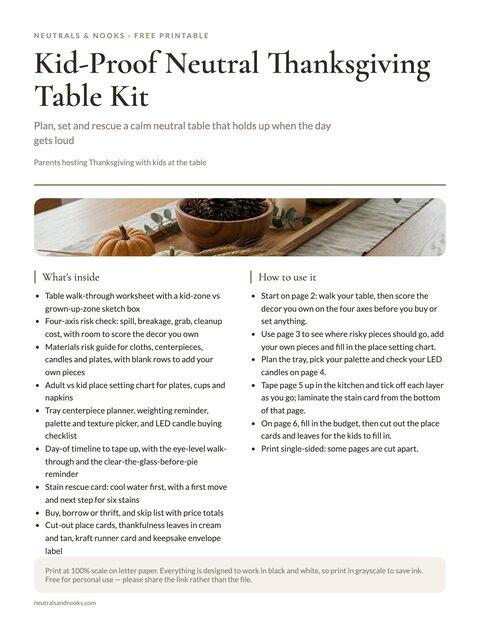
Free printable · 6 pages
Kid-Proof Neutral Thanksgiving Table Kit
A table walk-through with a four-axis risk check, a Low/Medium/High materials guide with blank rows and a place setting chart, a tray centerpiece planner, a neutral palette and texture picker, an LED candle checklist, a day-of timeline, a stain rescue card, a buy/borrow/skip budget, and cut-out place cards, thankfulness leaves, a kraft runner card and a keepsake envelope label.
Free. Your download link appears right here. You'll also join the Monthly Home Reset. Unsubscribe anytime. Privacy
In this article (14 sections)
- The Durability Lens: Why Most Tablescape Lists Fall Short
- The Materials Guide: Spill and Breakage Ratings for Every Decor Element
- Start With the Foundation: Choosing a Neutral Base That Hides Mess
- The Centerpiece Rethink: Low, Heavy, and Grouped
- Building a Kid-Friendly Thanksgiving Table Without Losing the Look
- The Kids’ End of the Table: A Practical Zone
- Choosing LED Candles and Placing Real Ones Safely
- Layering Without Clutter: The Sideboard and Beyond
- The Day-Of Timeline: Setting the Table in Layers
- Stain Rescue: What to Do When Something Spills Anyway
- A Shopping List: What to Buy, What to Borrow, What to Skip
- Looking Ahead: Reusing Your Table for the Rest of the Season
- Frequently Asked Questions
- Setting a Table You Can Actually Enjoy
The Durability Lens: Why Most Tablescape Lists Fall Short
Most Thanksgiving table photos assume adults only. A glass hurricane vase with a pillar candle, or dried pampas in a tall ceramic jug, looks stunning. Both are a bad bet with a toddler at the table.
These pieces are not wrong, but each one has a cost with kids around, so I rate every decor element on four axes:
- Spill risk: Does it hold liquid, or is it likely to be near liquid? Does it absorb a spill and stain permanently?
- Breakage risk: If it hits the floor from table height, does it shatter, chip, or just bounce?
- Grab risk: Is it small enough, shiny enough, or tempting enough that a small child will pick it up and walk away with it?
- Cleanup cost: If something goes wrong, is it a wipe, a wash, or a loss?
A piece can score badly on one axis and be perfectly fine if you manage the others. A glass votive is breakable but also heavy and stable, so it is fine in the middle of an adult-only zone. A linen napkin stains easily but costs almost nothing to wash. The goal is not to remove every risk. It is to put the risky pieces where kids cannot reach them, and put the sturdy pieces where kids will actually be.
My longer breakdown of kid-friendly fabrics and materials covers fabric choices in depth, and the same principles apply to table linens.
The Materials Guide: Spill and Breakage Ratings for Every Decor Element
I have rated each common Thanksgiving decor element Low, Medium, or High risk, with a note on what to do instead. These ratings are my own judgment from setting this table a few times. They are not safety certifications, and your child and table may behave differently than mine.
The button-battery and choking guidance follows the general advice from Poison Control and the CPSC; check their current pages.
Safety firstOne placement rule runs through every table below, so I will state it once. Glass, water-filled vases, heavy metal pieces and anything small enough to fit through a toilet-paper tube go at the adult end or on a high mantel or shelf, out of reach of children under 4. Anything that fits through a toilet-paper tube (about 1.75 inches) is a choking hazard for children under 3; I use under 4 to be safe. A standard sideboard is table height, so it follows the same rule as the table.
Short on time? These are my best picks:
- A wipeable or washable textured runner in oatmeal or sand
- LED candles in a low wooden tray, with screw-closed battery compartments
- Melamine plates and lidded cups in a color that matches the adult set
Table Surfaces and Linens
| Element | Spill risk | Breakage risk | Notes | Kid-proof move |
|---|---|---|---|---|
| Cotton or linen tablecloth, light color | High (stains) | Low | Beautiful, but cranberry and gravy are unforgiving | Use a stain-release wash plan or choose a patterned oatmeal weave that hides marks |
| Washable cotton runner | Medium | Low | Cheap to launder; stays put better than slippery fabrics | Choose a textured weave in oat, sand, or greige |
| Vinyl-backed or wipeable tablecloth | Low | Low | Not as pretty up close, but a quiet neutral looks fine from a few feet | Layer a thin runner on top for the adult end |
| Bare wood table | Medium | Low | Water rings and scratches are a long-term cost | Use placemats under every plate and glass |
| Paper table runner (kraft or butcher paper) | Low | Low | Disposable; kids can draw on it | Excellent for the kids’ end |
| Slippery satin or polyester | High | Low | Slides when tugged; whole setting can come with it | Skip it |
Safety firstA tugged tablecloth can pull a whole setting, and hot food, with it. Skip long overhangs when hot dishes are on the table, and use runners or placemats where toddlers sit.
Centerpieces and Vessels
| Element | Spill risk | Breakage risk | Grab risk | Kid-proof move |
|---|---|---|---|---|
| Glass bud vases with water | High | High | Medium | High mantel or shelf, or the far adult end |
| Tall ceramic jug with dried stems | Low | High if tipped | Low | Set a sealed, taped zip bag of sand or stones in the bottom, or use floral putty; keep it at the adult end |
| Pumpkins larger than a fist | Low | Low | Medium (roll and throw) | Fine in the middle; expect a few to migrate. Tiny pumpkins and gourds stay off the tray, at the adult end |
| Wooden bowls with large pumpkins or dried wheat | Low | Low | Medium | One of the best choices when filled with pieces too big to swallow; pinecones and nuts stay out of reach |
| Dried wheat, grasses, pampas | Low | Low | Medium (shedding) | Keep in a low bowl or use faux stems, and away from any real flame |
| Brass or metal candlesticks | Low | Low | High (heavy, tempting) | Adult end only, even with LED candles |
| Ceramic votive holders | Low | Medium | Medium | Cluster in a wooden tray so they stay together |
| Fresh flowers in a heavy vase | Medium | Medium | Low | Use a weighted vase with a wide base |
Candles and Lighting
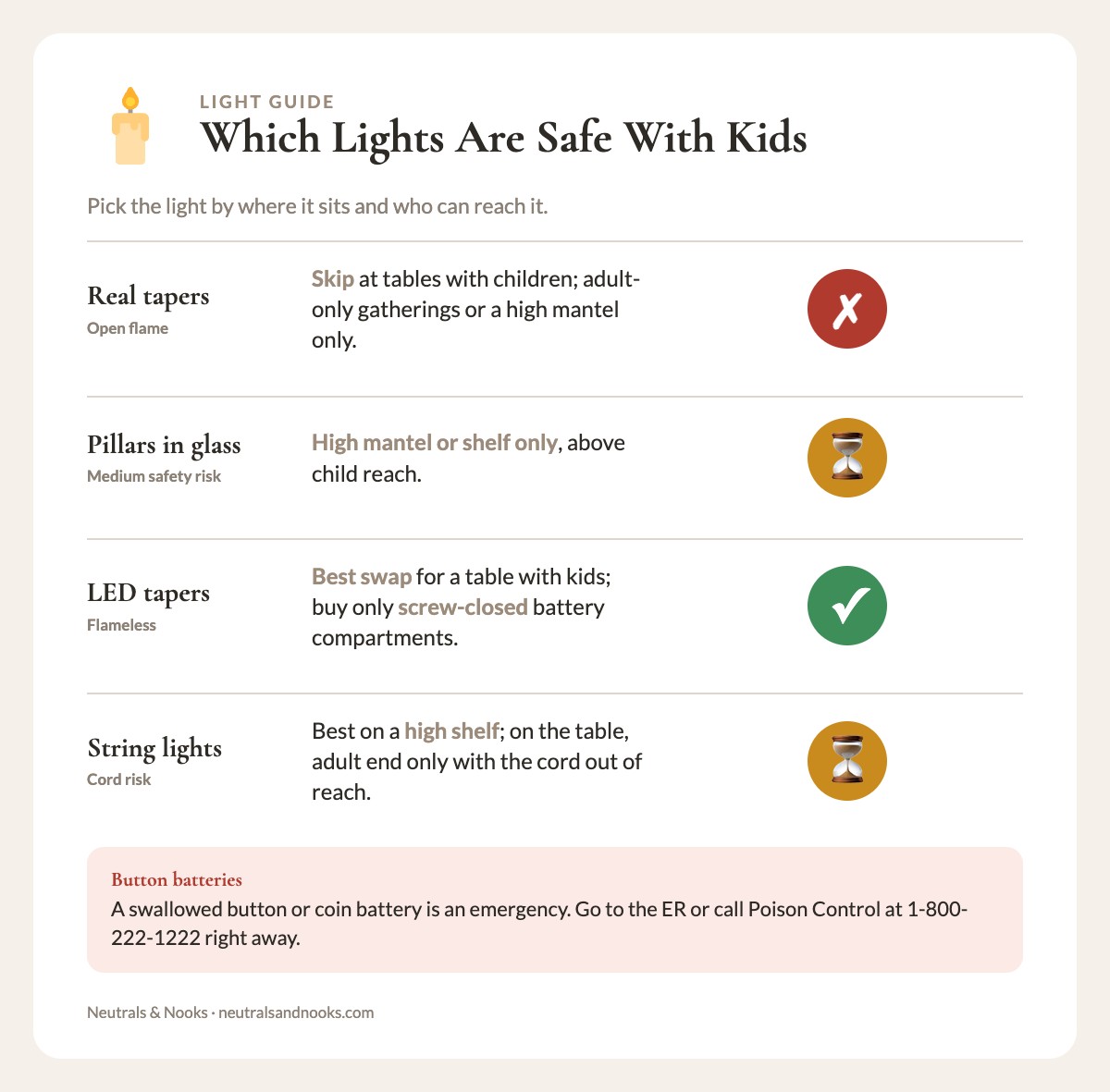
| Element | Spill risk | Breakage risk | Safety risk | Kid-proof move |
|---|---|---|---|---|
| Tapered candles, real flame | Medium (wax) | Low | High | Skip at tables with children and use LED tapers. Real tapers only at an adult-only gathering or on a high mantel |
| Pillar candles in glass | Low | Medium | Medium | High mantel or shelf only, above child reach |
| Flameless LED taper | Low | Low | Low (fire); battery risk for under 4s | The best swap for a table with kids; buy only screw-closed battery compartments |
| String lights on a runner | Low | Low | Medium (cords) | Best on a high shelf or mantel. On the table: adult end only, no dangling cord, away from spills. Choose battery lights with screw-closed compartments |
Safety firstButton batteries and loose cords are the two hazards to check on every light.
Place Settings and Serveware
| Element | Spill risk | Breakage risk | Notes | Kid-proof move |
|---|---|---|---|---|
| Ceramic dinner plates | Low | High if dropped | Heavier than melamine; chips on tile | Use sturdy stoneware for adults, melamine or silicone for kids. Let hot food cool before it goes on melamine, and never microwave it |
| Glassware, stemmed | High | High | Elegant, fragile | Stemless for adults; sturdy cups with lids for kids |
| Stainless flatware | Low | Low | Heavy enough to feel real | Great for everyone |
| Linen napkins | Medium (stains) | Low | Wash immediately | Buy extras; a stack of cheap cotton napkins costs less than one dry-cleaning trip |
| Cloth placemats | Medium | Low | Wipe or wash | Choose a woven or jute style |
| Paper napkins in neutral shades | Low | Low | Convenient | Fine for the kids’ side |
| Place cards (paper) | Low | Low | Likely to be moved | Use small wooden tags kids can decorate |
Safety firstKeep wine and unfinished glasses out of children’s reach.
Start With the Foundation: Choosing a Neutral Base That Hides Mess
A neutral palette is forgiving, as long as you pick the right neutral. Pure white shows every drop and deep black shows every crumb. Mid-range neutrals such as oatmeal, sand, putty, warm greige and soft taupe hide a surprising amount of everyday mess.
Here is what tends to work:
- Oatmeal and flax hide light spills like water and juice almost completely, and soften the look of gravy splashes.
- Warm sand looks beautiful under candlelight and masks crumbs.
- Deep clay or terracotta accents tend to hide cranberry, tomato, and wine better than pale shades.
- Pure white is a gamble. I use it only in napkins, which I treat as a consumable.
- Textured weaves (a slubby linen, a nubby cotton) camouflage small stains better than flat smooth fabrics.
A Palette That Works
If you want a ready-made scheme, this is a reliable one:
- Base: oatmeal or flax tablecloth or runner
- Secondary: warm cream napkins (washable, bought in multiples)
- Accent: one muted clay or burnt-sienna element, used sparingly
- Natural elements: wood, wheat, dried stems, a few white or tan pumpkins
- Metal: matte brass or black, only in sturdy pieces
If your home already leans soft and warm, this will blend right in. The throw textures and wood tones from my cozy neutral family room ideas for small spaces this fall carry over to the table nicely.
Why Texture Does More Than Color
A table feels designed when the textures layer: smooth ceramic next to rough linen, matte wood next to a glint of brass. With kids, texture can do the work that color usually does. Four or five textures in two or three tones read as intentional.
For a family with young children, I lean toward textures that are also practical:
- Stoneware with a matte glaze (heavy, chip-resistant, forgiving)
- Wooden boards and bowls (bounce rather than break)
- Woven jute or rattan placemats (wipeable, hide stains)
- Cotton waffle or slub napkins (wash well, look soft)
The Centerpiece Rethink: Low, Heavy, and Grouped
The classic centerpiece is a tall arrangement in the middle of the table, which is the worst thing to put in front of a three-year-old. A low, grouped centerpiece often looks better in photos, and it keeps sightlines open so people can actually talk to each other.
The Tray Method
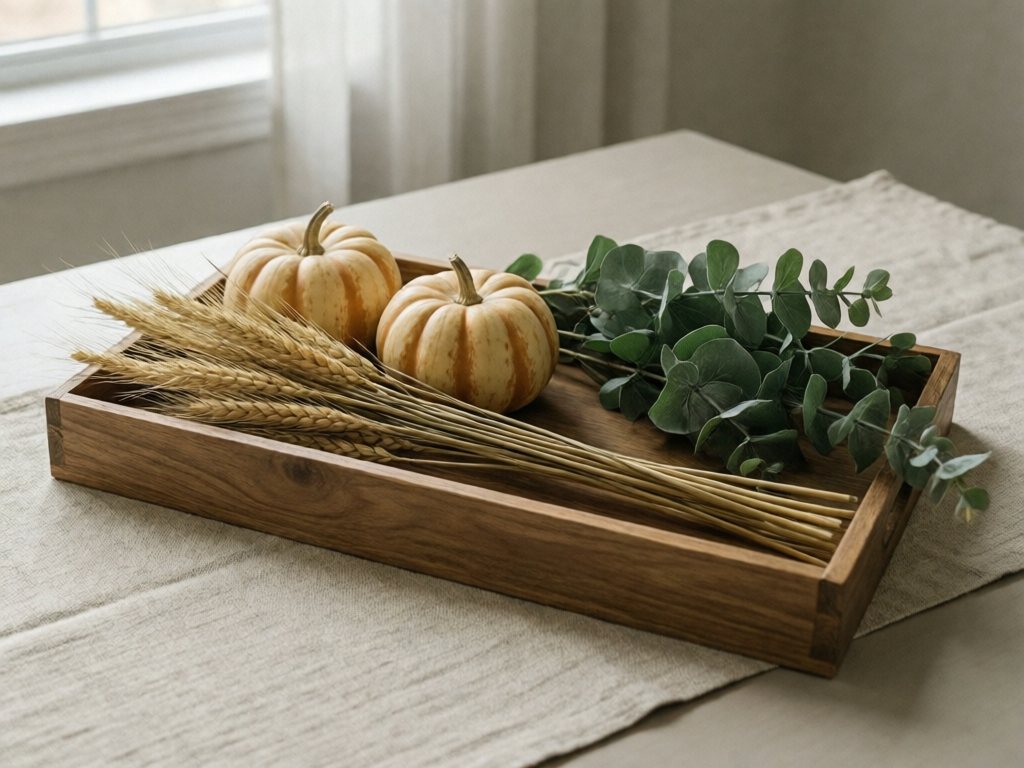
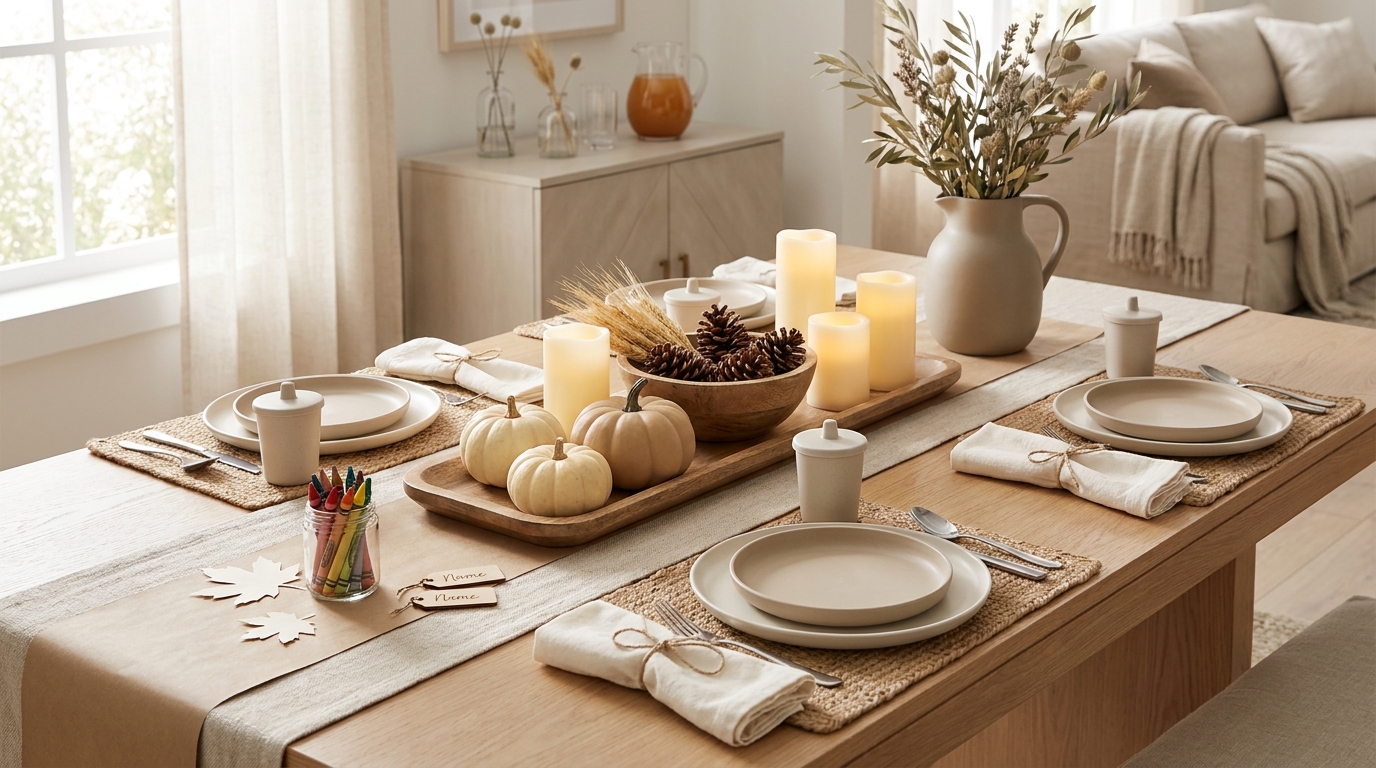
My favorite approach is a single long wooden tray or board running down the middle of the table. Everything decorative lives on the tray. If a kid grabs something, it is contained. If the tray gets bumped, it slides rather than scattering.
What goes on the tray:
- Two or three pumpkins larger than a fist in cream, tan, or pale green
- A low wooden bowl of faux stems or dried wheat
- Two or three LED pillar candles in varying heights
- A single weighted ceramic vase with faux or dried stems, at the adult end of the tray
- A few sprigs of faux greenery laid across the tray, such as eucalyptus or olive
Everything is low, everything is stable, and nothing holds water that can be dumped on a lap. The delicate pieces sit at the far end of the tray, near the adults, where I can see them. The end nearest the kids gets the sturdiest things: wooden bowls and pumpkins larger than a fist.
Safety firstWalnuts, pinecones, acorns, tiny gourds and felt leaves stay off the tray and out of reach of children under 4 (see the tube rule above). Nuts can also trigger allergies in guests.
Weight Anything That Can Tip
If you love a tall ceramic jug or a slim vase, add weight. Set a sealed, taped zip bag of sand or small river stones in the bottom, or anchor the base to the tray with floral putty. Either one makes tipping much harder, and the sealed bag keeps loose pieces from scattering if the vase breaks.
Weighted vases still go at the adult end. For a vase with water, choose a wide base and fill it halfway.
Real or Faux Greenery?
I use faux anywhere kids can reach, including the tray. Real greenery smells wonderful, but it drops leaves, and some greenery, including eucalyptus, can be toxic if chewed by children or pets. Faux eucalyptus and olive branches hold up well.
If you use real plants, check them against pet-safety lists first and keep them at the adult end or on a high shelf. If a child chews on any plant, call Poison Control at 1-800-222-1222.
Building a Kid-Friendly Thanksgiving Table Without Losing the Look
A kid-friendly Thanksgiving table does not have to mean plastic dinosaurs and cartoon turkeys. It can feel grown-up and intentional and still work for a child with a sippy cup and a short attention span.
Place Settings That Work for Everyone
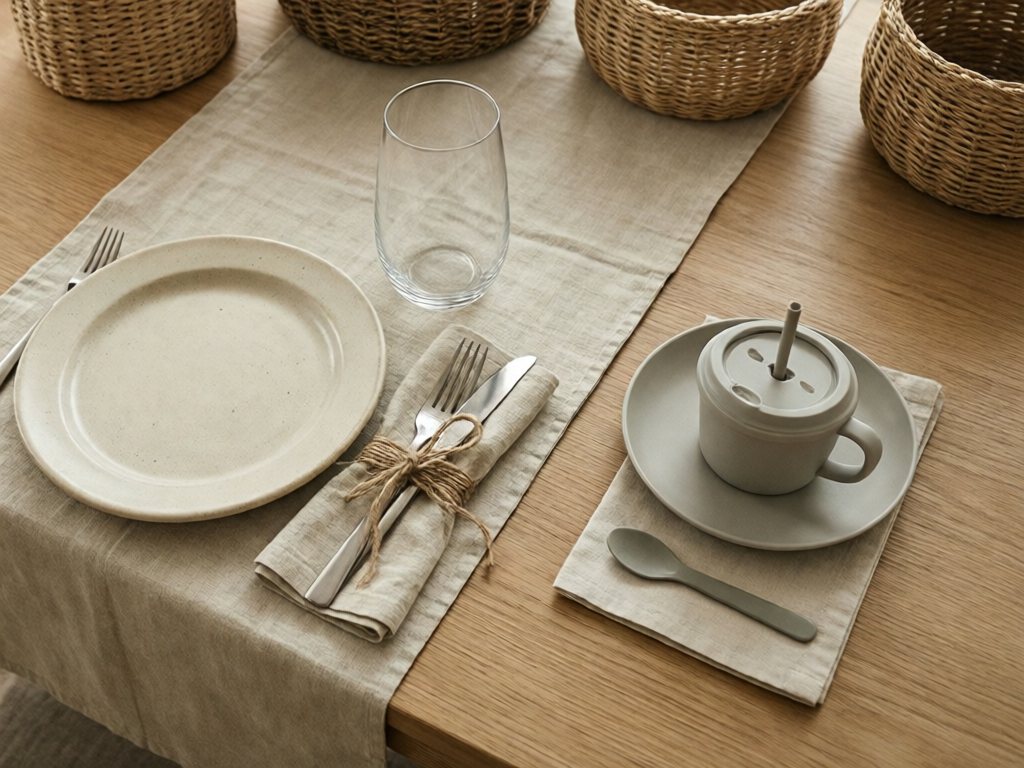
For the grown-up places, I set:
- A heavy stoneware dinner plate in cream or greige
- A salad plate on top, if there is room
- A stemless glass or a short tumbler (no stems anywhere near the kids)
- Stainless flatware
- A cotton napkin folded loosely or tied with a bit of twine
For the kid places, I swap in:
- A melamine or silicone plate in a matching neutral shade (plenty of options now come in oat, sage, and clay)
- A sturdy cup with a lid or a weighted base for younger children
- Child-sized flatware in a muted finish
- A paper or cotton napkin that I do not mind losing
Safety firstMelamine is for serving, not heating. Never microwave it, and do not put food straight from the oven or stovetop on it. Let hot food cool for a few minutes before plating, or use silicone or a plate labeled for hot food.
The trick is color matching. When the kid plates are the same oatmeal tone as the adult plates, the table reads as cohesive, even though half of it is unbreakable. Nobody notices unless you point it out.
The Sturdy-Cup Question
Cups cause more Thanksgiving disasters than any other item. A tall cup with a wide mouth is an invitation. If you have kids under five at the table, consider these options:
- Lidded cups with a straw: the least likely to spill
- Short, wide-based tumblers: harder to knock over than tall ones
- Pitchers off the table: keep refills on the kitchen counter, pushed well back from the edge; you pour, not them
For older children, a regular tumbler is fine. Just fill it halfway, and keep the pitcher out of their reach.
Place Cards Kids Can Help With
Handmade place cards are a small way to include children without handing them anything breakable. Cut small rectangles from kraft cardstock, or use wooden tags from a craft store, and give each child a marker or a pencil. They write their own name (or decorate the card for someone else). It keeps them busy for ten minutes before dinner and gives the table a personal touch.
If you want to make it a tradition, keep the cards in an envelope and add a year on the back. A few years from now, you will have a small stack of messy, lovely handwriting.
The Kids’ End of the Table: A Practical Zone
If your gathering includes several children, you may set a separate kids’ table or a kids’ end of a long table. The second usually works better: the kids sit closer to the adults, which means fewer trips back and forth to settle arguments. Either way, the principle is the same: give the kids a surface that is built for them.
Paper Runner Method
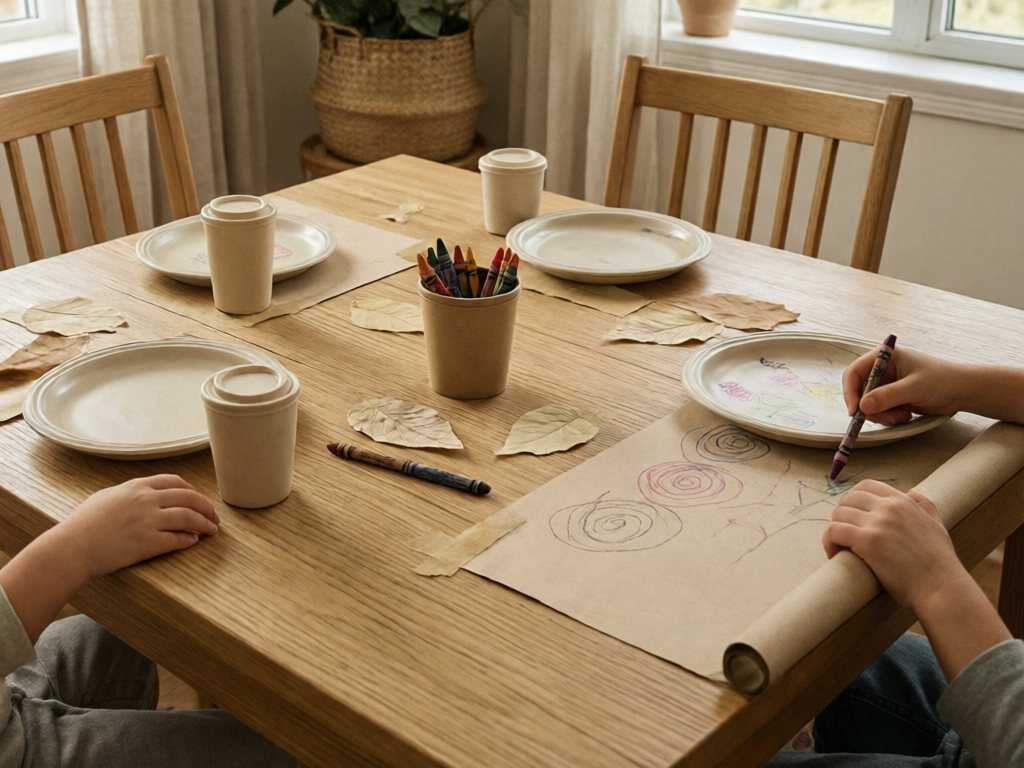
Roll out a length of kraft or butcher paper down the kids’ end. Tape it at the corners. Put a small cup of crayons or pencils in the middle, and let them draw, doodle, and write what they are thankful for. When dinner is over, you roll the whole thing up and throw it away. There is nothing to wash.
A few notes from experience:
- Use washable markers or crayons only, and put a placemat or protective layer under the paper, since paper alone does not stop bleed-through. Supervise pencils and small crayon pieces for children under 3
- Tape the paper down firmly; a loose edge becomes a tug-of-war
- Skip the glitter and the glue; keep the activities dry
A Thankfulness Activity That Doubles as Decor
Here is a quiet little project that fits the neutral look. Cut paper leaves from cream and tan cardstock. Set one at each place with a pencil. Before dinner, everyone writes one thing they are thankful for.
Afterward, tuck the leaves into a wooden bowl in the center of the table. Or string them on twine and hang them high on a wall or window frame, well away from the sideboard and any real candles.
Safety firstPaper leaves and real flame do not share a surface. If the leaves go on or above the sideboard, use LED candles there. Hang twine taut and above children’s reach, since a loose length is a cord hazard for toddlers.
It keeps small hands busy, and kids who cannot yet write can draw a picture.
Soft Seating for Short Legs
Chairs are a surprisingly large part of table design. Children who are too short for the table get fidgety, and fidgety kids knock things over. For young children, use a booster or high chair that is strapped to the chair and has a harness. Loose cushion or blanket stacks on adult chairs are unstable and a fall risk, so skip them for toddlers.
If you have several kids and limited seating, think about where the family hub lives in your house during the holidays. A well-organized spot for coats, bags, and extra chairs makes hosting easier, and I wrote about setting that up in my guide to a family command center. Having a place for the coats and the diaper bags means they do not end up on the table or the floor.
Choosing LED Candles and Placing Real Ones Safely
Candlelight is the most atmospheric thing you can add to a Thanksgiving table, and the most hazardous around children. You know your household, so I will not say never. Here is how I handle it.
What to Look for in LED Candles
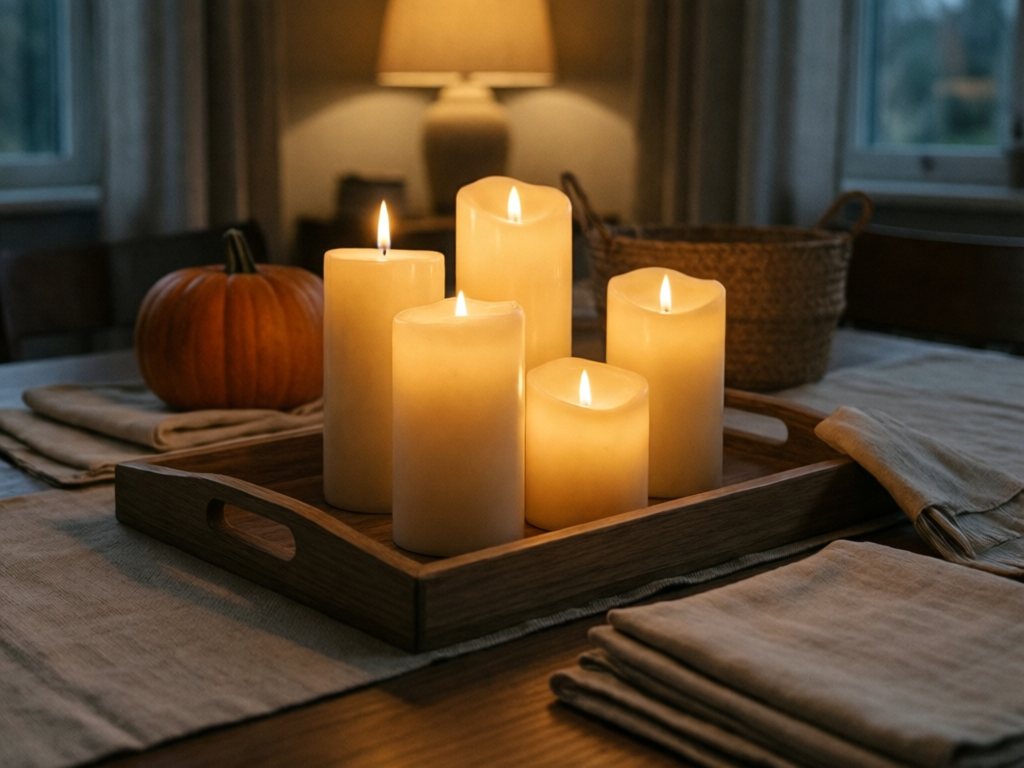
Modern LED tapers and pillars have flickering bulbs and warm tones that are very hard to tell from the real thing in dim light.
A few things to check when buying:
- Warm white light, not cool white. Cool white looks clinical.
- Screw-closed battery compartments. Button and coin batteries are a serious hazard for young children. Buy only candles with a screw-secured compartment, and lock spare batteries away.
- Flicker effect. A subtle flicker looks more natural than a constant glow.
- Weight. Heavier bases tip less easily.
Safety firstIf you think a child swallowed a button or coin battery, go to the ER immediately. Do not wait for symptoms, and give no food or drink unless the hotline tells you to. Call the National Battery Ingestion Hotline (800-498-8666) or Poison Control (1-800-222-1222) on the way, and ask whether honey is appropriate (it is only for children 12 months and older). Burns can start within hours.
Soft Light Beyond the Table
You do not need to rely on the table alone. A lamp pushed to the back of the sideboard, a string of warm lights along a high shelf, and dimmed overheads create a glow that makes everything look better, including leftover mashed potatoes.
A knocked-over lamp is a bigger problem than a candle. Choose lamps with heavy bases, set them back against the wall, and run cords behind the furniture where a toddler cannot pull them.
Avoid Open Flame Near Anything Flammable
Wherever real candles go, they burn only with an adult in the room and never near dried wheat, paper leaves or napkins. Dried grasses are lovely and highly flammable.
Set real candles in glass holders on a stone, ceramic, or metal tray on a high mantel or shelf. Extinguish them before anyone leaves the room or goes to bed.
Layering Without Clutter: The Sideboard and Beyond
One of the best ways to keep the table itself safe is to move some of the decor off it. The table is for plates, food, and people. A high mantel, a tall shelf, or a console above toddler reach is where the more fragile and fancy pieces can live. A standard sideboard is table height, so I treat it like the table: sturdy pieces only while children under 4 are in the room.
A Sideboard Vignette
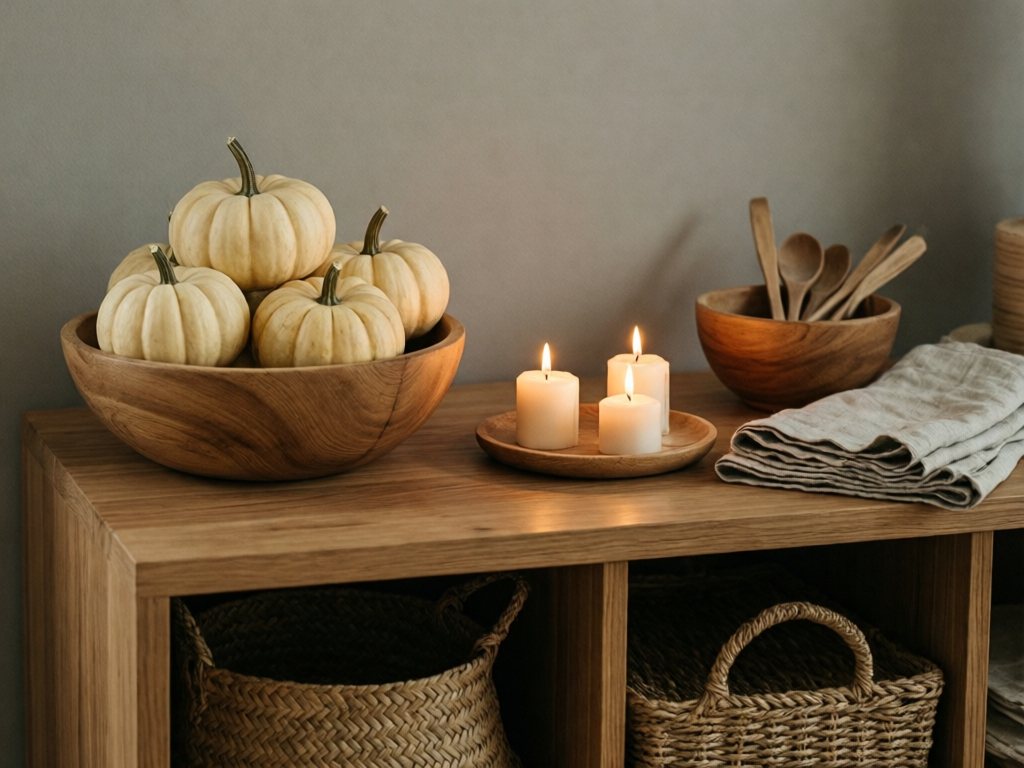
With little ones in the house, my sideboard holds only sturdy pieces:
- A low wooden bowl of pumpkins larger than a fist
- A stack of napkins and a bowl of serving spoons, pushed to the back (extra plates wait on the kitchen counter)
- A small tray of LED candles
- A framed print or a simple sign, hung on the wall above the sideboard, not propped on it
Nothing fragile sits at toddler height. The glass bud vases go up on the mantel, and the pitcher of water or cider waits on the kitchen counter, pushed well back, for an adult to pour.
If every child at your gathering is school age, the vases and pitcher can come back to the sideboard, set toward the back. If you serve from the sideboard as well, make sure the decor does not crowd the food.
Safety firstKeep hot dishes, gravy, coffee and alcohol away from table and sideboard edges and out of toddlers’ reach. Glass, pitchers and lamp cords on a sideboard follow the same rule.
Don’t Forget Storage
Clearly labeled bins for holiday decor storage make next year’s setup faster, and you will actually use the nicer pieces rather than leaving them buried.
The Day-Of Timeline: Setting the Table in Layers
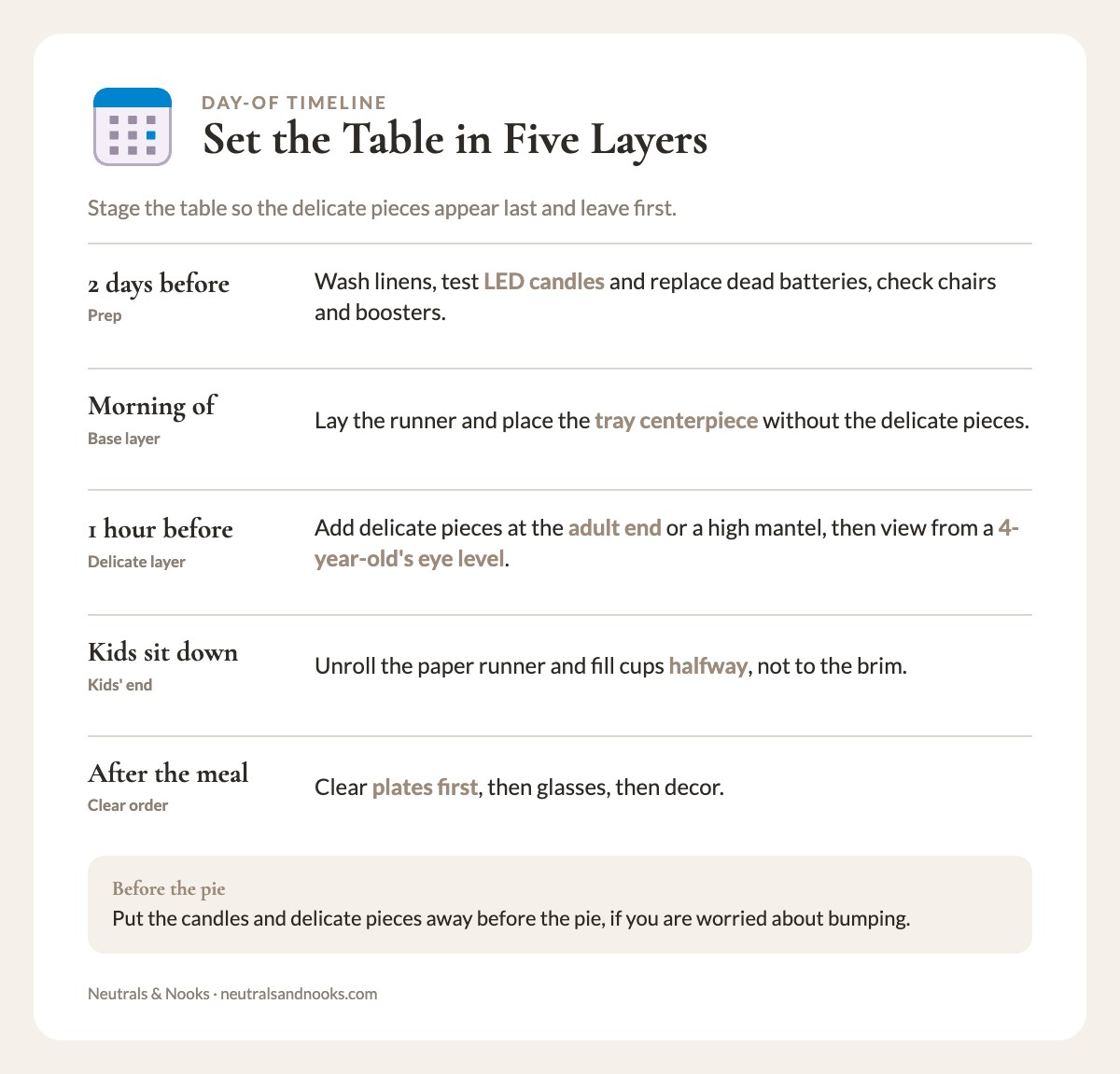
A table that survives kids is not only about what you buy. It is also about when you set it. If you set the whole thing at noon and dinner is at four, you give small hands a long time to find your arrangements. I stage mine in layers.
Two Days Before
- Wash and iron linens (or steam them, if you do not iron)
- Check that you have enough chairs, plus strapped boosters or high chairs for little ones
- Test your LED candles and replace any dead batteries
- Gather and sort your serveware and label which dish goes in which bowl
The Morning Of
- Lay the tablecloth or runner
- Place the tray centerpiece (without the delicate pieces)
- Set out plates, flatware, and napkins
- Put the kids’ paper runner and crayons in a bag nearby, but do not unroll it yet
An Hour Before Guests Arrive
- Add the delicate pieces to the adult end of the table or the mantel
- Turn on the LED candles and lamps
- Fill water pitchers and set them on the kitchen counter, pushed well back from the edge
- Do a quick walk-through and look at the table from a four-year-old’s eye level. Anything tempting? Move it up or away.
When Kids Sit Down
- Unroll the paper runner at the kids’ end
- Hand out the thankfulness leaves
- Fill cups halfway, not to the brim
- Set hot dishes, gravy and coffee well back from table edges, and remove anything you are nervous about without drama
After the Meal
- Clear plates first, then glasses, then decor
- Blot spills with a damp cloth right away; do not let them dry
- Put the candles and delicate pieces away before the pie, if you are worried about bumping
That last step is my favorite trick. By the time pie comes out, everyone is relaxed and slightly sleepy, and that is when the elbows start flying. A table with the glass already cleared is a calm table.
Stain Rescue: What to Do When Something Spills Anyway
No plan is perfect. Someone will spill something. Here is how I handle the usual suspects. Always check the care label on your fabric first, and test any treatment on a hidden corner.
| Stain | First move | Then |
|---|---|---|
| Cranberry sauce | Scrape off the excess, blot with cool water | Soak in cool water with a little laundry detergent before washing |
| Gravy | Scrape, then blot with a paper towel | Pre-treat with dish soap, which cuts grease, then wash |
| Red wine | Blot, do not rub | Flush with cool water from the back of the fabric. Pre-treat with detergent, wash, and check the stain is gone before drying |
| Wax | Let it harden, then lift gently | For residue, put a paper towel over it and press with a low-heat iron on a towel-protected surface, with no child in the room. Unplug and cool the iron before leaving it |
| Juice | Blot and rinse with cool water | Wash as usual |
| Butter or oil | Blot, sprinkle with baking soda to absorb | Pre-treat with dish soap and wash warm |
The general rule: cool water first, heat later. Heat can set most stains, so check that a stain is gone before anything goes in the dryer. And do not let stained linens sit overnight if you can avoid it. A quick soak before bed saves a lot of grief.
If you are shopping for new linens, look for cotton blends with a “stain release” finish, or choose a darker oatmeal tone that hides marks. Check labels and wash before first use. If you are buying for a household with babies, it may be worth buying two sets of napkins and rotating them.
A Shopping List: What to Buy, What to Borrow, What to Skip
Here is the short version, grouped by priority. I have kept it focused on pieces that serve you beyond a single Thanksgiving.
Worth Buying
- A washable cotton or linen runner in oatmeal or flax
- A dozen cotton napkins in cream, bought in multiples
- A long wooden tray or board for the centerpiece
- Two or three wooden bowls
- Flameless LED candles in several heights, with screw-closed battery compartments
- Melamine or silicone plates and sturdy cups for the kids in matching neutral tones (silicone or plates labeled for hot food if you plate straight from the oven)
- Woven placemats in jute or rattan
- A roll of kraft paper
Worth Borrowing or Thrifting
- Ceramic vases and jugs (secondhand shops are full of them)
- Brass or metal candle holders
- Extra chairs and boosters from a friend or neighbor
- Serving platters and large bowls
Worth Skipping (for Now)
- Tall glass hurricane vases
- Hand-blown glass anything at kid height
- Real taper candles within reach of children
- Delicate stemware for the whole table
- Loose glitter, confetti, or tiny scatter pieces that become choking hazards for little ones
Buy the sturdy base pieces first and add the pretty extras over time.
Looking Ahead: Reusing Your Table for the Rest of the Season
The linens, wooden tray, LED candles and bowls carry over to Friendsgiving and the winter holidays. Swap the pumpkins for evergreen (kept out of little hands), trade the clay accent for deep green, and you have a Christmas table with almost no new spending.
If you are already thinking about December, my Christmas planning checklist for families walks through an eight-week timeline that includes decor, hosting, and the sneaky tasks that pile up. Starting early on the neutral foundation makes everything after it easier.
Frequently Asked Questions
What is the most durable neutral tablecloth for a table with young kids?
A textured cotton or cotton-linen blend in oatmeal, flax, or warm sand is a good balance. The texture hides small stains, and the fabric is easy to launder. If you want maximum protection, a wipeable vinyl-backed cloth in a plain neutral works well, especially if you layer a thin cotton runner over it on the adult end. Avoid slippery satin or polyester, which slides when tugged and can bring the whole setting with it.
Can I still use real candles on a Thanksgiving table with kids?
You can, but I wouldn’t put them within a child’s reach. My approach is flameless LED candles on the dining table and the sideboard, and real candles only on a high mantel or shelf, lit while an adult is nearby.
If you do use real flames on the table for an adult-only gathering, keep them away from dried grasses, paper decor, and napkins, and never leave them unattended.
If you buy LED candles, choose ones with screw-closed battery compartments and lock spare batteries away. The battery emergency steps are in the lighting section above.
How do I make a neutral Thanksgiving tablescape without it looking boring?
Layer texture rather than color. Combine a slubby linen runner, matte stoneware, wooden bowls, a little matte brass, and dried wheat or greenery. Add one muted accent, such as clay or burnt sienna, and repeat it two or three times across the table. Varying heights with a few pumpkins and a low tray gives the eye something to travel across, even in a tight color range.
What are the best Thanksgiving table setting ideas for kids?
Match the kids’ plates and cups to the adult place settings in color, but choose unbreakable materials like melamine or silicone. Give each child a place card they can decorate, a paper runner to draw on, and a paper leaf to write what they are thankful for. Keep their cups lidded or short and wide-based, and fill them halfway. The result looks cohesive and doesn’t require a separate cartoon-themed table.
Should I set up a separate kids’ table?
It depends on your space and the ages of the children. A kids’ end of the main table keeps them close to adults, which tends to mean fewer disputes and easier supervision. A separate kids’ table gives them freedom and can feel like a special treat for older children. For toddlers, I would keep them within arm’s reach of a grown-up either way. Whichever you choose, use a paper runner and sturdy dishware at the kids’ spot.
How do I keep little hands from grabbing the centerpiece?
Keep the centerpiece low, heavy, and contained on a tray. Use items that are fine if handled, like wooden bowls and pumpkins larger than a fist, and move fragile pieces to the adult end or a high shelf. Look at the table from a child’s eye level before guests arrive, and move anything tempting out of reach. Giving kids their own activity, like decorating place cards or writing on a paper runner, also gives them something better to grab.
What do I do if red wine, cranberry, or gravy gets on my linens?
Act quickly and use cool water first. Scrape off any excess, blot (never rub), and soak the fabric in cool water with a little detergent before washing. For greasy stains like gravy, pre-treat with a small amount of dish soap. Avoid heat until the stain is gone, since heat can set it. Always check the care label and test any treatment on a hidden corner first.
Setting a Table You Can Actually Enjoy
Spills and muddy socks will still happen. A table that is low, warm and sturdy lets you sit down and enjoy the meal rather than guard it.
Start with the sturdy pieces, keep the delicate ones at a distance, and let the calm palette hold the day together, noise and elbows included.