Kids’ Thanksgiving Table Ideas Plus a Free Printable Placemat
Learn how to create an engaging and mess-proof Thanksgiving kids' table with tips on placement, seating, safe food cuts, easy activities, and a free printable placemat.
- Strategize placement and seating to make your kids' table its own fun space.
- Utilize mess-proofing tips to prevent spills and keep the area clean.
- Prepare safe food cuts and easy activities to keep young guests engaged.
- Download a free printable placemat featuring coloring, a word search, and a thankful list.
This post contains affiliate links. As an Amazon Associate I earn from qualifying purchases.
Two Thanksgivings ago, I spent three evenings styling the main table. Then I noticed the card table by the sideboard, where five kids aged three to eight sat with paper plates and no plan. Cranberry juice crept across it like a slow red tide. Two kids left to inspect the dog, and the one who stayed lined up peas because nobody had given the table a job.
Since then, I treat the kids’ table as its own small room. Below you’ll find placement, seating, mess-proofing, safe food cuts, easy activities, and a free printable placemat with a coloring scene and a word search.
Free printable · 2 pages
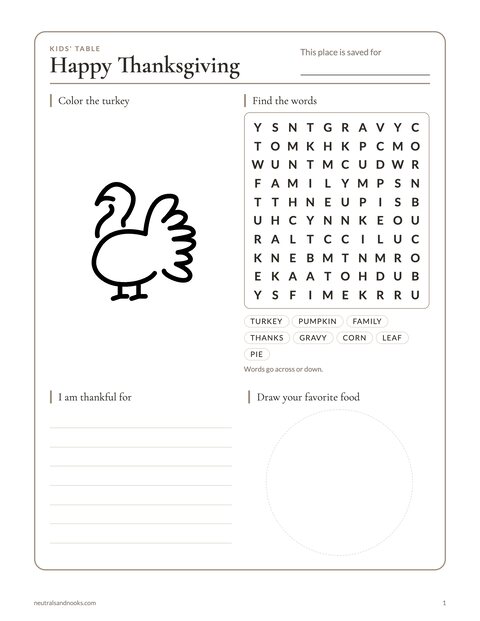
Kids' Thanksgiving Placemat
A print-per-child placemat with a turkey to color, an eight-word word search, a thankful list and a draw-your-plate circle, plus setup tips for the kids' table.
Free. Your download link appears right here. You'll also join the Monthly Home Reset. Unsubscribe anytime. Privacy
If you want the grown-up table to match, I wrote a companion piece on neutral Thanksgiving table decor that survives kids. This one is about the other table.
In this article (14 sections)
- Why the Kids’ Table Deserves Its Own Plan
- Where to Put the Kids’ Table
- Seating That Actually Works for Ages 3 to 8
- Setting the Kids’ Table: The Neutral, Low-Fuss Look
- Mess-Proofing the Table
- The Free Printable Placemat
- Activities for the Kids’ Table
- Keeping the Kids’ Table Safe
- Tailoring the Table to Mixed Ages
- A Sample Timeline for the Day
- Setup Checklist for the Kids’ Table
- Cleaning Up in Under Ten Minutes
- Frequently Asked Questions
- A Calmer Table, One Small Plan at a Time
Why the Kids’ Table Deserves Its Own Plan
A kids’ table fails for predictable reasons, and they have almost nothing to do with the children being “difficult.”
- Wrong height. Kids who sit on standard chairs at a standard table are chin-level with their plate, so everything spills and nothing is comfortable.
- No job. Young children can only sit still for short stretches, and a holiday meal runs long.
- No boundaries for mess. Decor, drinks, and food are all fighting for the same square footage.
- No adult line of sight. If the kids’ table is in another room or behind a wall of relatives, nobody notices a problem until it’s a big one.
- Everything arrives at once. Food lands on the table, hot and heavy, and small hands reach for it.
The sections below fix each one in turn: placement, seating, mess-proofing, and food timing.
I think of the kids’ table like any good kid space: easy to use correctly and hard to use badly, so the setup does the work instead of you saying “careful” all afternoon.
Where to Put the Kids’ Table
Placement matters more than decor. Before you buy a single paper napkin, decide where the table goes.
Line of sight beats everything
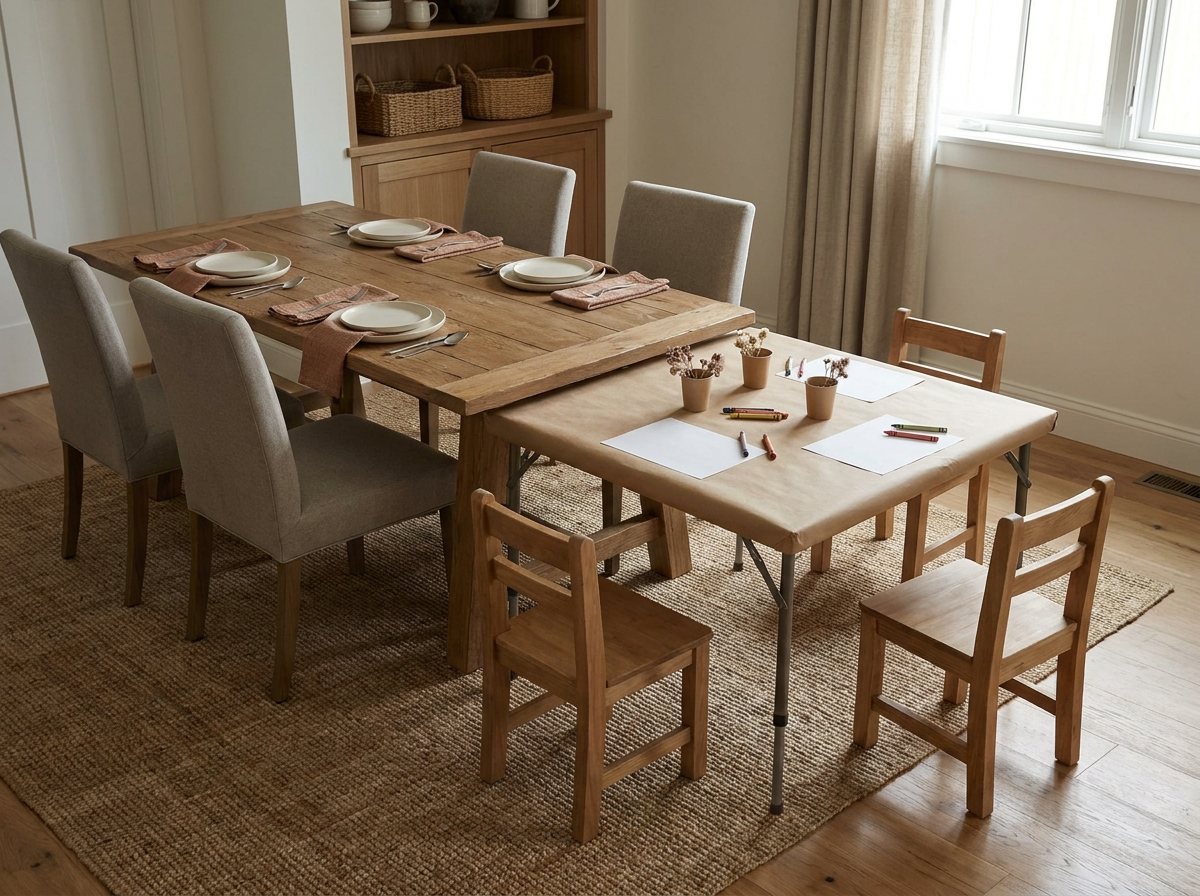
The best spot is one where at least one adult can see the kids’ table from where they’re sitting at the main table. That doesn’t mean it has to be in the same room, but it must be in direct view from a seat at the adult table, so an adult can see every child’s face while they eat.
| Location | Pros | Cons |
|---|---|---|
| Adjoining the main table (L-shape) | Kids feel included; easy to supervise | Needs floor space; can crowd chairs |
| Same room, separate corner | Close, but with its own zone | Adults may turn their backs on it |
| Open kitchen island or peninsula | Easy food handoff, wipeable surface | Counter stools are too tall for young kids |
| Next room over | Quiet, contained mess | Out of sight; only for kids 6+, with an adult seated at that table |
| Outdoors or porch (mild climates) | Space to wiggle | Weather, wind, no easy bathroom trip; only for kids 6+, with an adult seated there |
TipMy default is the same room, in a corner or at the end of the main table, with a clear line of sight to every child’s face. A card table set at a right angle to the end of your main table extends the “one table” feeling without asking small kids to sit at adult height.
Keep it away from the danger zones
Think about traffic and heat before you think about charm.
- Keep the kids’ table out of the path between the kitchen and the dining table. Hot dishes and small kids should never share a hallway.
- Keep it away from the oven, any hot buffet setup, and candles.
- If you have stairs nearby, put the table on the side of the room away from them, or block them.
- Leave at least three feet of walking space around the table so an adult can lean in to help without squeezing past chairs.
Seating That Actually Works for Ages 3 to 8
This is where I see the most avoidable misery. A child who is perched awkwardly cannot eat neatly, and a child who cannot eat neatly will spill.
The elbow rule
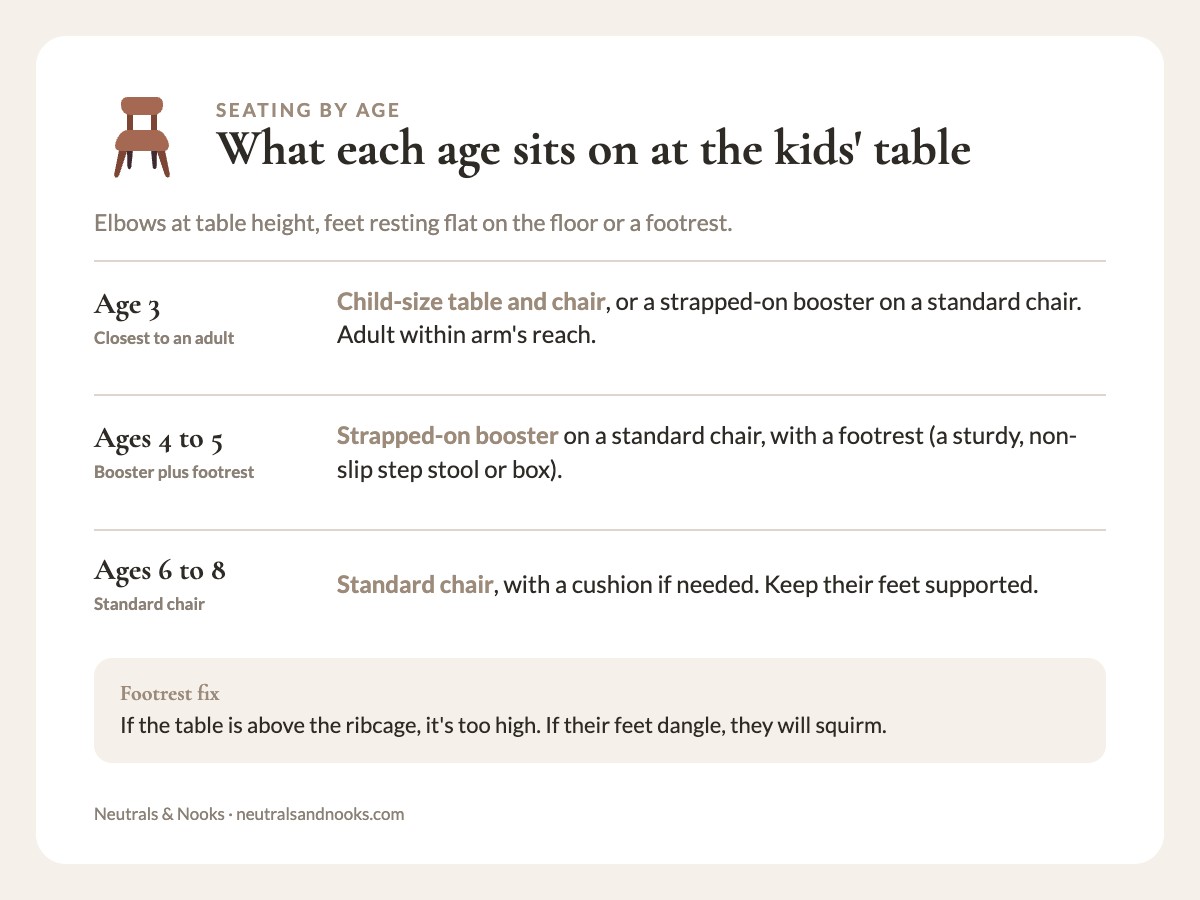
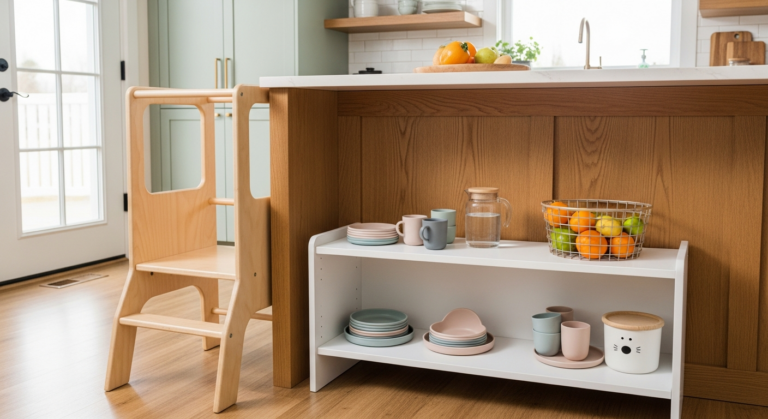
When a child sits at a table, their elbows should land at roughly table height, and their feet should rest flat on something, either the floor or a footrest. If the table is above the ribcage, it’s too high. If their feet dangle, they will squirm.
| Age | Typical seat solution | Notes |
|---|---|---|
| 3 | Child-size table and chair, or a strapped-on booster on a standard chair | Adult within arm’s reach; an older child can sit beside them for company |
| 4 to 5 | Strapped-on booster seat on a standard chair, with a footrest | A sturdy, non-slip step stool or box works as a footrest |
| 6 to 8 | Standard chair, with a cushion if needed (6 and up can manage a loose one) | Most can manage, but keep their feet supported |
Practical seating tricks
- Use a footrest. A sturdy non-slip step stool or box under the table changes how a child sits. Dangling feet cause a lot of the wiggling.
- Pair ages. Sit a 7 or 8-year-old next to a 3-year-old. The older child enjoys the company, and the younger one copies good manners. Every 3-year-old still sits within arm’s reach of an adult. The older child is company only, never backup.
- Assign seats with place cards. Kids love a place card with their name on it. It prevents the “I wanted that chair” argument, and it gives you control over who sits next to whom. I draw a small leaf on each one and let the child color it when they arrive.
- Seat the most wiggly child on the end, near an adult, with easy access to get up for a stretch break without climbing over anyone.
- Anchor the table. Folding card tables can wobble. Check each leg is locked, and if the table tips even slightly under a leaning elbow, put a folded cardboard shim under the short leg.
Do you need a separate table at all?
Not always. If you have three or fewer children, or if everyone is 6 or older, one table with the right boosters may be easier and feel more inclusive. Separate tables work best when you have four or more kids, a wide age range, or a main table that’s already full of adults. Whichever you choose, be honest about the group you actually have, not the Thanksgiving you imagine.
Setting the Kids’ Table: The Neutral, Low-Fuss Look
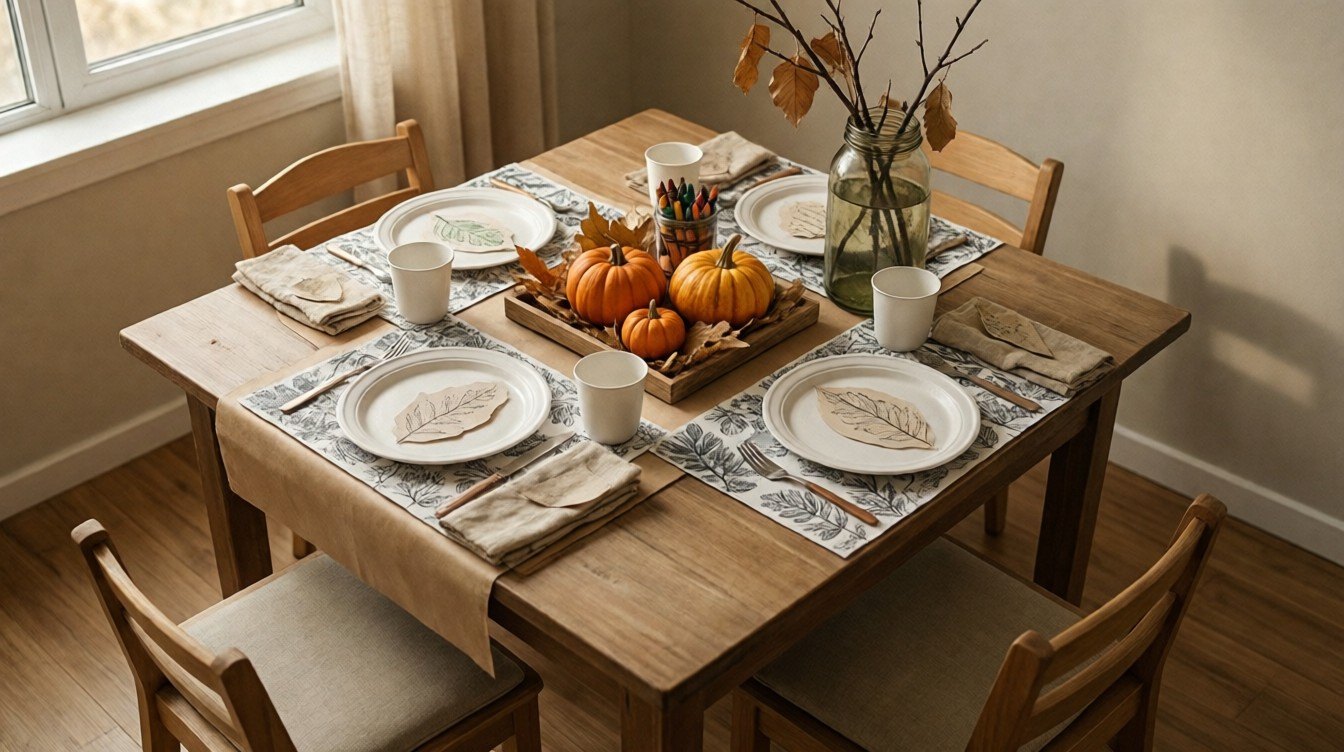
You can have a kids’ table that looks calm and intentional without spending much. The trick is to let the activity be the decoration.
The base layer
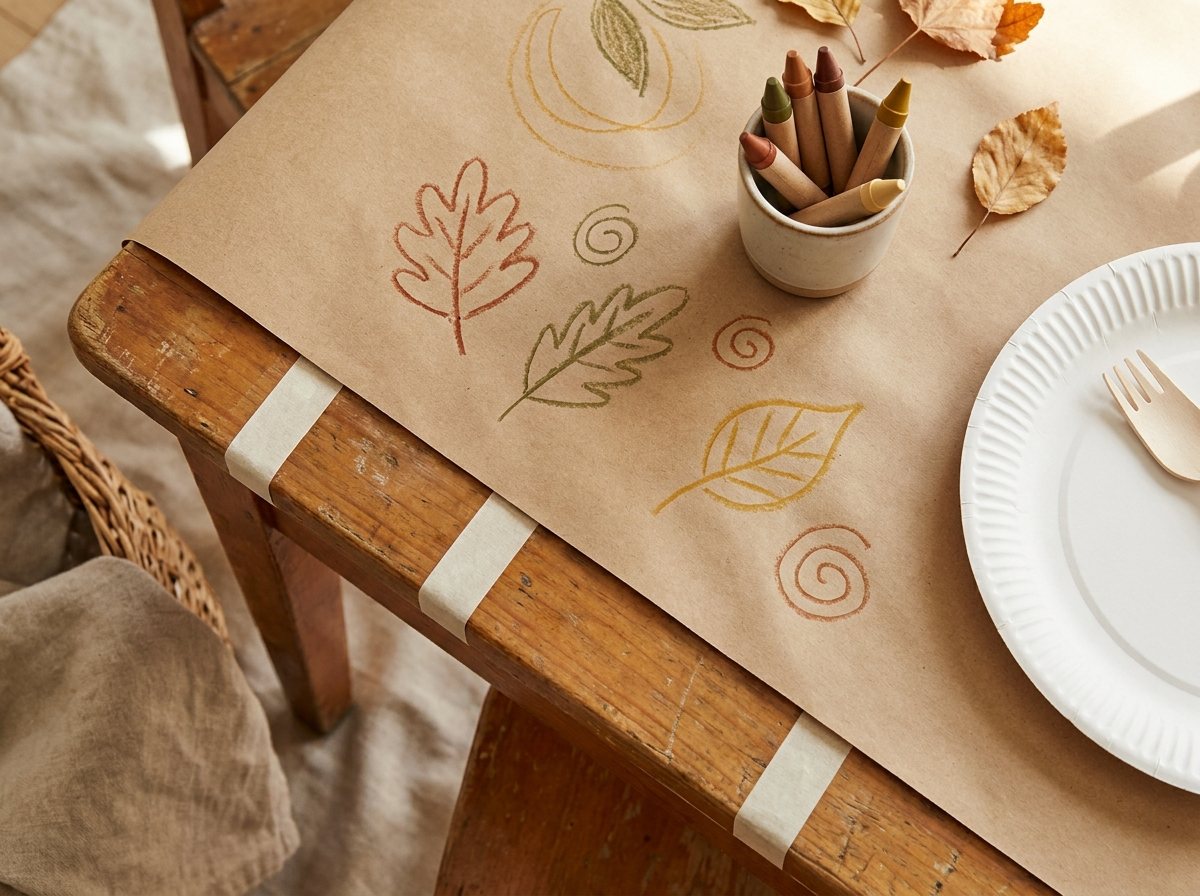
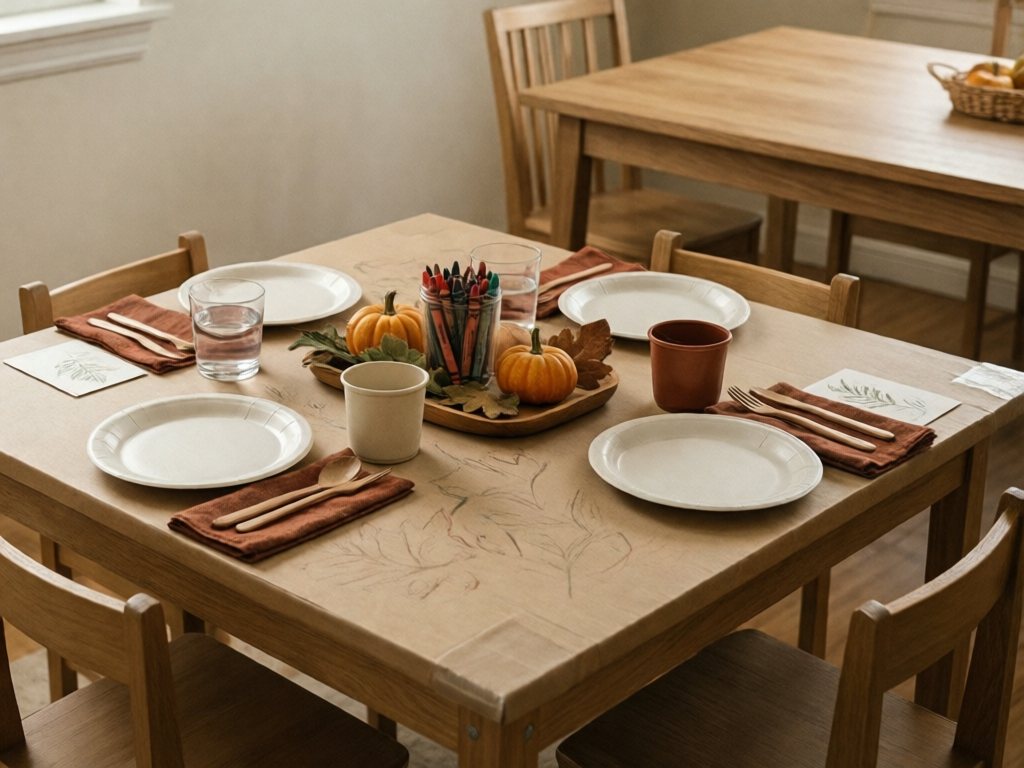
Start with a butcher-paper or kraft-paper runner down the center, or cover the entire table. It does three jobs:
- It’s a drawing surface. Kids can doodle between courses.
- It protects the table from marker, spill, and gravy.
- It’s neutral, so it goes with almost any palette.
Tape the paper to the underside of the table edge so it doesn’t slide. You can roll the whole thing up and throw it away at the end of the meal, which is the entire point.
A palette that doesn’t fight the main table
I like to keep the kids’ table in the same three or four tones as the adult table: warm white, oat, a muted terracotta or rust, and a touch of olive or sage. It feels like part of the same meal, not a separate dumping ground. Kraft paper, plain white paper plates, and wooden cutlery already sit in this palette.
If you want the grown-up table to match, I wrote a companion piece on neutral Thanksgiving table decor that survives kids.
| Element | Simple, neutral option | Why it works |
|---|---|---|
| Table covering | Kraft paper roll | Drawable, disposable, warm tone |
| Plates | Plain white or natural fiber, compostable | No licensed characters to clash |
| Cups | Short, wide, weighted-bottom plastic or silicone | Hard to tip |
| Napkins | Cloth napkins in rust or oat, or plain paper | Cloth looks nice, paper is easier |
| Centerpiece | Small tray of mini pumpkins or felt leaves | Low, sturdy, can’t be knocked into laps |
| Accent | Dried leaves, scattered | Decor and a counting game in one |
Keep the centerpiece low and unbreakable
At the kids’ table, nothing should be taller than a child’s eyeline, and nothing should be breakable or flammable. A wooden tray of mini pumpkins or a few felt leaves along the paper runner is plenty. Pinecones are fine for kids 4 and up.
No real candles and no glass vases. For every child under 4, skip loose small items such as acorns, and keep out anything that fits through a toilet-paper tube.
Mess-Proofing the Table
This is the unglamorous section that will save your afternoon. Plan for mess the way you’d plan for rain: assume it will happen, and make it irrelevant.
The spill-proof setup
- Use weighted or wide-based cups. A short, wide cup is much harder to knock over than a tall one. Fill it only halfway.
- Serve drinks in small amounts. Pour four ounces at a time. A refill is easier than a flood.
- Use plates with a lip or a suction base. For ages 3 to 5, a plate that doesn’t slide is a huge help. For older kids, regular plates are fine.
- Place a silicone placemat or a tray under each plate if you aren’t using kraft paper.
- Choose no-stain colors where you can. Cranberry sauce, gravy, and sweet potato will find the one white shirt in the room. If you have a say in outfits, a darker or patterned top for the meal is kinder than a pristine one.
The “one-minute wipe” station
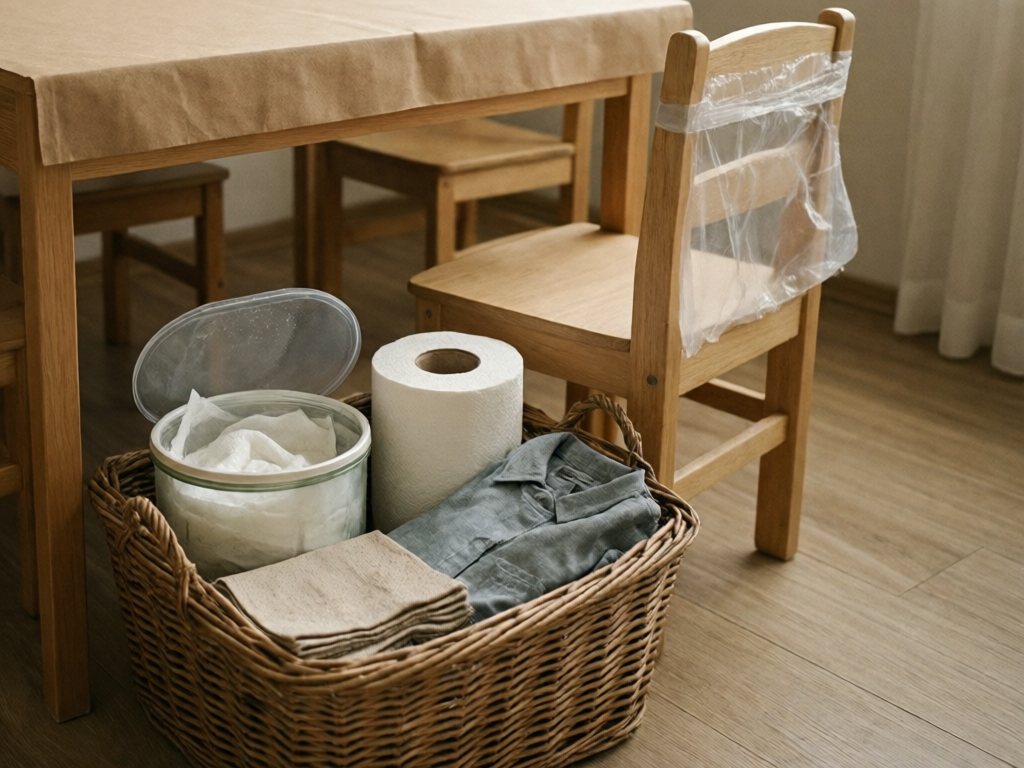
Put a small basket near the kids’ table with:
- A stack of damp washcloths or unscented wipes in a lidded container
- A small trash bag taped to a chair back
- A roll of paper towels
- A spare set of napkins
- One change of clothes for the youngest child, tucked behind a chair
It takes five minutes to assemble, and having it nearby means a spill is handled in one minute instead of becoming an event.
Plan the food for little hands
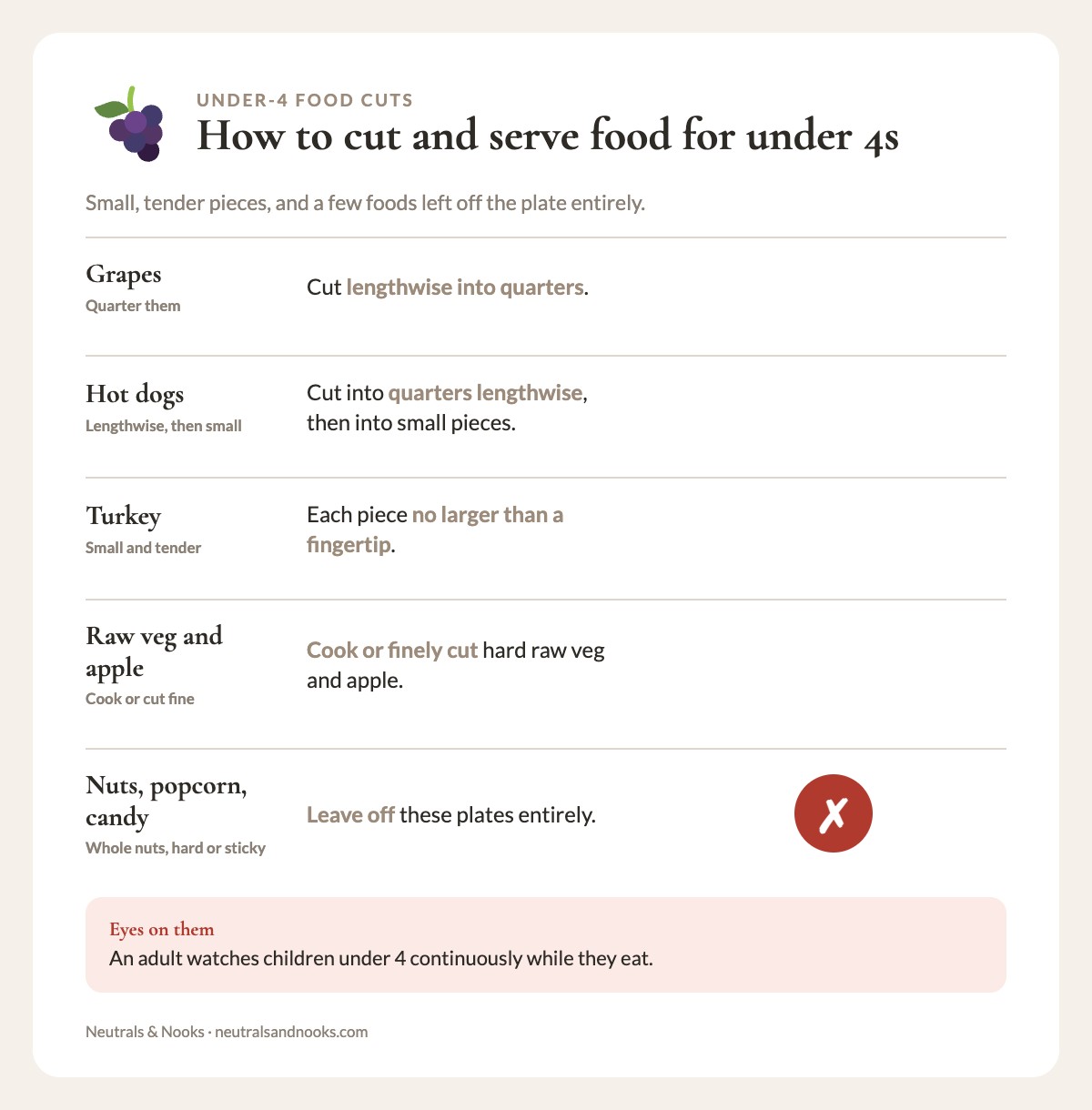
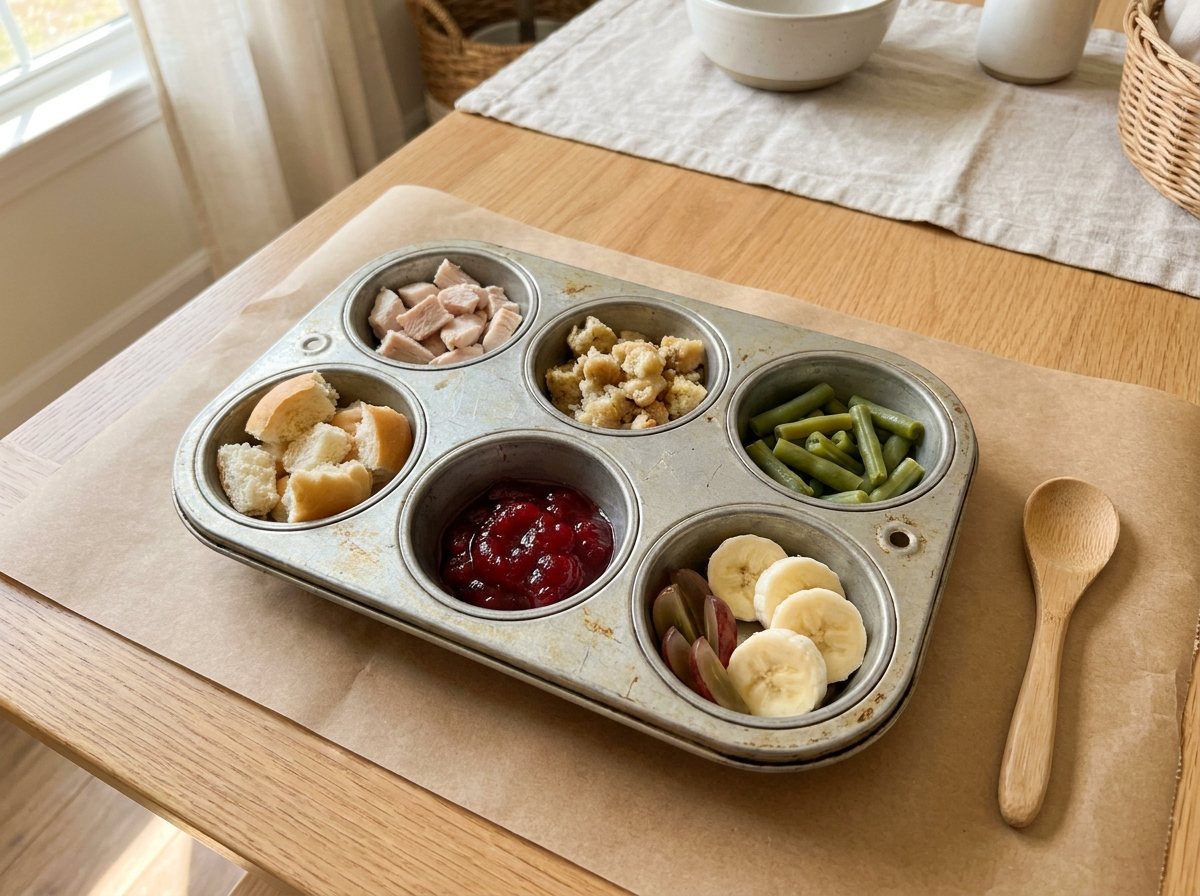
Safety firstFor children under 4: quarter grapes lengthwise, cut hot dogs into quarters lengthwise and then small pieces, and keep meat in small tender pieces. Cook or finely cut hard raw veg and apple. No whole nuts, popcorn, or hard or sticky candy. An adult watches them continuously while they eat. No honey before 12 months.
A few small changes also reduce mess:
- Cut turkey into small, tender, bite-sized pieces before it’s served. For under 4s, keep each piece no larger than a fingertip.
- Serve cranberry sauce in a small separate dish so it doesn’t bleed into everything else.
- Use a muffin tin as a plate for younger kids. Each food gets its own cup (turkey, stuffing, green beans, roll, cranberry, fruit), and nothing touches. Offer choices, with no required bites.
- Offer one safe food everyone will eat, such as a plain roll torn into small pieces or soft fruit like banana. For children under 4, apple must be cooked, finely grated, or cut very small, as in the safety note above. A child who isn’t going to touch the turkey will not starve, and no one needs a standoff.
- Follow the under-4 cuts in the safety note above, and keep whole nuts and popcorn off those plates entirely.
Serve the kids first, and in stages
The most useful change is timing. Make and deliver the kids’ plates before the main table is served, so the children are eating and calm while the adults finish carrying dishes.
One adult stays seated with the kids the whole time, and the others rotate in. Let plates cool before serving them to kids.
The full day-of timeline, from morning setup to cleanup, is in the sample timeline near the end of this guide.
The Free Printable Placemat
A printable placemat gives every child something to do from the moment they sit down, without a pile of supplies. I made this one for ages 3 to 8.
What’s on it
The placemat is a single letter-size page, designed to print in black and white so it saves ink and takes crayons or markers well. It has three parts:
- A coloring scene. A cozy harvest table with a turkey, pumpkins, leaves, and a stack of pies. The lines are thick and the spaces are large, so even a 3-year-old can fill in big shapes without frustration.
- A word search. Eight Thanksgiving words in a grid, with large letters. The words run left to right and top to bottom only, so a younger reader isn’t hunting diagonals or backwards words.
- A “gratitude line.” A blank line at the bottom with the prompt “I’m thankful for ___.” Younger children can draw. Older ones can write.
The word list
The word search hides these words:
| Word | Why it’s there |
|---|---|
| TURKEY | The obvious one |
| PIE | Short, so it’s a win for early readers |
| CORN | Four letters, easy to spot |
| LEAVES | Ties into the fall decor |
| FEAST | Reads like the main event |
| THANKS | The heart of the day |
| FAMILY | A good one to talk about |
| HARVEST | The challenge word for 7 and 8-year-olds |
How to use it by age
| Age | How they’ll use the placemat | Your role |
|---|---|---|
| 3 | Color the big shapes with chunky crayons. Skip the word search, or circle letters in the word “PIE” with help. | Sit nearby and point out colors |
| 4 to 5 | Color the scene, then find the first letter of PIE or CORN in the grid together. | Offer a few words to “find” together |
| 6 to 8 | Do the word search independently, then color, then fill in the gratitude line | Minimal. Perhaps a bonus challenge: “Who can find three words first?” |
Printing tips
- Print on regular letter paper at 100 percent. No special settings required.
- For a sturdier placemat, use cardstock or slip each page into a clear sleeve and let kids use dry-erase markers. The sleeves can be reused for years.
- Print one extra per child. Somebody will spill on theirs, and the spare saves you a negotiation.
- Tape the corners down with painter’s tape so the page doesn’t slide while they color.
- If you want a bigger scene, print two pages and tape them edge to edge.
A small trick I like
Put the crayons in a small cup in the middle of the table, not at each seat. It sets up a gentle sharing moment. Use chunky crayons for children under 4, since marker caps are a choking hazard. For older kids, washable markers only, with caps on whatever isn’t in use.
Activities for the Kids’ Table
The goal isn’t constant entertainment. It’s enough small, low-mess options that no one is stranded with nothing to do.
Before the meal (while the food comes together)
- Place card decorating. Hand each child a blank card and a crayon. They color, then place it at their seat.
- Leaf rubbing. Put real leaves under paper and let kids rub crayons across them. It looks good enough to hang on a wall afterward.
- The placemat itself. Hand it out as soon as they sit down.
During the meal
- “Rose, bud, thorn.” Each child shares one good thing and one thing they’re looking forward to. The “thorn,” something hard this week, is optional. Listen, and follow up privately afterwards if something heavy comes up. The youngest can just do “one good thing.”
- A thankful jar. Pass a jar around with slips of paper. Each child adds something they’re thankful for, and you read them aloud at dessert.
- Table talk cards. A small stack of questions in a cup: “What’s your favorite pie?” “If you could be any animal at this table, which would you be?” “What’s the silliest thing you ate this year?”
After the meal (the long stretch)
This is where kids’ tables fall apart. The food is gone, the adults are still talking, and children’s patience is spent. Have a few quiet options ready.
If your crayons, glue sticks, and paper already live in a craft supply zone, pull one bin for the day and you’re set.
| Activity | Mess level | Best for ages | Supplies |
|---|---|---|---|
| Word search and coloring (the placemat) | Low | 3 to 8 | Printable, crayons |
| Paper-bag turkey puppets | Medium | 4 to 8 | Brown lunch bags, construction paper, glue sticks |
| Thankful tree | Low | 4 to 8 | Branch in a heavy unbreakable container, paper leaves, tape or short yarn |
| Pumpkin pie playdough | Medium | 3 to 6 | Playdough (contains wheat, not edible; skip for children who mouth things or have a wheat allergy), cupcake liners, plastic spoons |
| Draw the feast | Low | 4 to 8 | Kraft paper tablecloth, markers |
| Memory game with leaves | Low | 4 to 8 | 10 leaf shapes, 5 pairs, flipped over |
| Story circle | None | 5 to 8 | Just imagination |
The thankful tree
Put a bare branch in a heavy, unbreakable container that won’t tip. Cut paper leaves in warm tones.
Each child aged 4 and up writes or draws something they’re thankful for on a leaf, then hangs it with tape or a piece of yarn under 6 inches. By the end of the meal you have a small centerpiece, and the leaves go into a keepsake box afterward.
Quiet-time options for the youngest
A 3-year-old will often want to leave the table before anyone else. Have a basket of quiet-time items nearby in another corner: board books, a few wooden puzzles, a magnetic drawing board. If you have a calm corner already set up, even better. A place to retreat for ten minutes is useful for any child who gets overwhelmed by noise, and it keeps the table from becoming a tense standoff. If you haven’t built one, this guide to a calm-down corner walks through a simple version.
Keeping the Kids’ Table Safe
Safety firstAn adult stays eyes-on and within arm’s reach of every child under 4 for the whole meal. Choking is silent, so occasional check-ins are not enough. Older children are company, not backup. For ages 4 and up, a glance every few minutes is fine.
- Allergens. Tell everyone serving food about any allergy, label dishes with a small card, and use separate serving utensils for each dish. Kids will trade food, so seat an allergic child near an adult and have everyone wash hands before eating. Know the child’s action plan and where the epinephrine is.
- Choking hazards. See the under-4 food cuts in the safety note in the food section.
- Hot dishes. Never place hot casseroles or gravy within a child’s reach. Serve kids from the counter, let plates cool first, and avoid any overhanging cloth a child can pull. Keep hot drinks off the table.
- Candles. Skip candles at the kids’ table. If you use LED tea lights, choose ones with a screw-secured battery door and keep them out of reach of under-4s.
- Drinks. Keep adult beverages, including wine glasses and coffee, off the kids’ table entirely.
- Supervision. Even an eight-year-old shouldn’t be the only “responsible” person. Adults rotate in so someone is always seated with the kids.
Tailoring the Table to Mixed Ages
Most holiday gatherings aren’t neatly divided into one age group. You may have a 3-year-old, a 6-year-old, and a teenager all at the “kids'” table, each with different needs.
Strategies for a wide range
- Give older kids a role. An 8-year-old can be the “table captain,” in charge of passing the rolls or reading the gratitude slips. It makes them feel important and gives them a reason to participate instead of rolling their eyes.
- Layer the activities. The placemat does this naturally: little ones color, older ones find the words.
- Let teenagers choose. If a teen is old enough to feel stranded at the kids’ table, invite them to the adult table, or ask them to sit with the kids as a “helper” for a short time. Don’t force either.
- Keep the youngest closest to an adult. Place the 3-year-old at the end nearest the main table, with an adult seated within arm’s reach for the whole meal (and for spills).
What about babies and toddlers under 3?
A high chair pulled up to the adult table is usually better than the kids’ table for kids under three. They need closer attention and different food.
For a mobile toddler, keep soft board books nearby, or offer a spoon and a bowl of soft finger foods eaten seated in the high chair with an adult watching. No honey under 12 months, and no whole grapes, nuts, popcorn, or hard raw foods. If your home isn’t toddler-ready yet, the baby-proofing guide covers the basics.
A Sample Timeline for the Day
Here’s how the kids’ table portion of my Thanksgiving typically runs. Adjust for your own meal time, of course.
| Time | Task |
|---|---|
| Night before or morning | Set up the table: kraft paper, cups, cloth napkins. Print placemats. Prep the wipe-down basket. |
| 1 hour before | Pull out a few activity supplies and place them on a nearby shelf. Fill small cups with crayons. |
| 30 minutes before | Cut turkey and fruit into small pieces. Fill muffin-tin plates. |
| 15 minutes before | Kids sit, color place cards, start the placemat. |
| Meal time | Serve kids first. An adult stays seated with them throughout. |
| Mid-meal | Gratitude jar passes around. |
| After eating | Word search, thankful tree, or a craft. |
| Dessert | Small slices, with plenty of napkins. |
| After dessert | Free play or quiet time. Roll up the paper and toss it. |
Notice that setup happens the day before or the morning of, not in the thirty minutes when you also have a turkey to deal with. The more you can do ahead, the more relaxed the afternoon feels.
Setup Checklist for the Kids’ Table
Here is the whole thing on one list. Copy it into your notes app.
Furniture and layout
- Table placed with clear sight line to adults
- Away from the oven, buffet, stairs, and main traffic path
- Chairs or boosters at the right height, with footrests
- Table checked for wobbling
Table setting
- Kraft paper or washable covering taped down
- Placemats printed (plus extras)
- Washable crayons or markers in a shared cup
- Short, wide cups, filled halfway
- Low, unbreakable centerpiece
- Place cards with names
Mess-proofing
- Basket with wipes, paper towels, and a trash bag
- Spare clothes for the youngest child
- Muffin-tin plates or divided plates
- Food cut for little mouths
Activities
- Placemat and word search
- Thankful jar or tree
- Table talk cards
- A few quiet-time items for later
Safety
- Allergen list shared with serving adults
- No candles, glass, or hot dishes within reach
- Adult eyes-on and within arm’s reach of every child under 4 for the whole meal
Cleaning Up in Under Ten Minutes
The best part of a well-planned kids’ table is how little there is to clean.
- Roll up the kraft paper with all the crumbs inside and throw it away.
- Collect the cups and dishes into a bin and carry them to the kitchen.
- Wipe the table with a damp cloth.
- Sort the keepsakes. Pull aside any placemats, gratitude leaves, or drawings you want to keep, and put them in a folder or a flat box.
- Reset the chairs and return boosters and footrests to wherever they live.
If you want to keep the placemats, slide them into a binder with plastic sleeves, or file them with the rest of your kids’ artwork and school papers. In a few years, a stack of Thanksgiving placemats, each with a child’s handwriting and a “thankful for” line, is a lovely thing to flip through.
Frequently Asked Questions
How many kids can sit comfortably at a standard card table?
A 34-inch card table seats about four children, one per side. A six-person folding table seats about five. Allow roughly 22 inches of edge per child so elbows don’t collide, and keep the adults seated nearby. With more kids than that, set up two tables or give the extras a spot at the adult table.
What are the best activities for kids at the Thanksgiving table?
Keep them simple and low mess. A printable placemat with a coloring scene and word search is the easiest. Other good options include a thankful tree with paper leaves, “rose, bud, thorn” sharing, leaf rubbings, and table talk cards with silly questions. Save messier crafts for after the meal, when the food is cleared.
How do I keep the kids’ table from becoming a mess?
Cover the table with kraft paper you can roll up and discard, use short wide cups filled halfway, and serve food on divided plates or in muffin tins. Keep a basket of wipes, paper towels, and a trash bag nearby so spills take one minute to handle. Also serve the kids first so they are seated and eating while adults carry dishes.
What should I do if a child refuses to stay at the kids’ table?
Check the basics first: is the seat the right height, are their feet supported, and do they have something to do? Many kids wander because they’re bored or uncomfortable. If that doesn’t help, seat them closer to an adult, offer a job like handing out napkins, or allow a short stretch break between courses. A quiet corner with books or puzzles gives them a place to reset without disrupting the table.
Is the printable placemat suitable for a 3-year-old?
Yes, with a little help. The coloring scene has thick lines and big shapes that younger children can fill in with chunky crayons.
A 3-year-old probably won’t do the word search alone, but you can ask them to find the letters in “PIE.” Older kids can do the word search and the “I’m thankful for” line independently.
How can I make the kids’ table look good without spending much?
Stick to a neutral palette that matches the main table: kraft paper, plain white plates, cloth or paper napkins in rust or oat, and a low tray of mini pumpkins. Let the activities, like the colored placemats and the thankful tree, act as decoration. It looks intentional and costs very little.
Should teenagers sit at the kids’ table?
It depends on the teen. Some enjoy helping the younger kids, especially if you give them a small role like table captain. Others feel stranded and would rather sit with adults. Ask them, and let them choose. Either way, it’s kind to avoid labeling the table as “the kids’ table” in a way that makes older kids feel excluded.
A Calmer Table, One Small Plan at a Time
You don’t need a perfect kids’ table, only a thoughtful one: the right height, a clear line of sight, a covering you can roll up, and something fun to do between bites. Print the placemat, put out a cup of crayons, and let the children claim their corner of the holiday.
Heading into the rest of the season? The Christmas planning checklist and the holiday decor storage guide keep the next few weeks just as calm.