Lighting Ideas for Kids’ Spaces
Learn how to optimize your child's room lighting for better sleep, mood, and function. This guide details the three essential lighting layers—ambient, task, and accent—along with specific product ideas and color temperature tips to create a magical and practical space.
- Utilize three lighting layers: ambient, task, and accent, each with separate controls.
- Install dimmer switches on overhead lights for smooth transitions and better sleep.
- Choose warm white bulbs (2700K-3000K) for bedtime and accent lighting.
- Select neutral white bulbs (3500K-4000K) for task and general overhead lighting.
- Replace generic overhead fixtures with options that add personality and better light.
Many preschoolers go from a bright ceiling light straight to pitch black at bedtime, and that sudden darkness can feel scary. A warm amber nightlight and a dimmer on the bedside lamp often make the switch gentler.
This guide covers the three layers of light a kid’s room needs, from bright task lighting for homework to a soft glow for bedtime. You will find product ideas, safety rules by age, and a short FAQ. The Kids’ Room Lighting Planner printable on this page helps you map each layer. For the wider room, see creating a calm bedroom for kids.
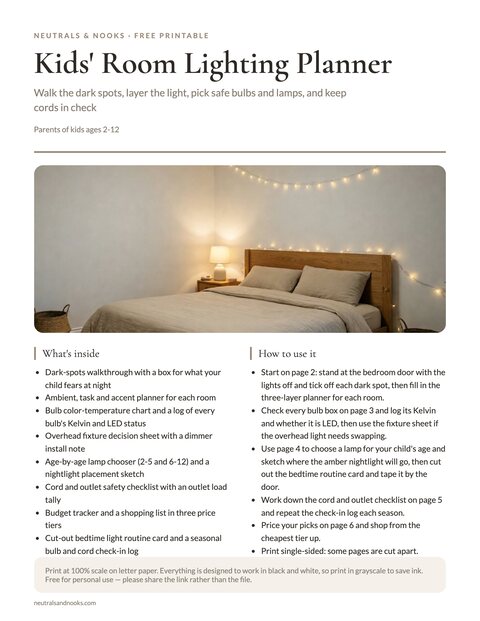
Free printable · 6 pages
Kids' Room Lighting Planner
A dark-spots walkthrough, a three-layer planner, a bulb Kelvin log, an age-by-age lamp chooser, an overhead fixture sheet with a nightlight placement sketch, a cord and outlet checklist, a budget tracker with a tiered shopping list, and a cut-out bedtime light routine card with a seasonal check-in log.
Free. Your download link appears right here. You'll also join the Monthly Home Reset. Unsubscribe anytime. Privacy
Safety firstKeep every cord, string light, and battery compartment out of a child’s reach. Choose UL/ETL-listed products, anchor fixtures securely, and keep lights clear of cribs, beds, and curtains.
In this article (7 sections)
- Kids’ Room Lighting Ideas: Ambient, Task and Accent Layers
- Overhead Lighting: Beyond the Builder Fixture
- Bedside and Reading Lamps: Safe, Functional, and Fun
- Best Nightlights for Kids
- Fun Lighting Ideas for Kids’ Rooms: String Lights, Projectors and Signs
- Safety Rules for Every Light in the Room
- Kids’ Room Lighting FAQ
Kids’ Room Lighting Ideas: Ambient, Task and Accent Layers
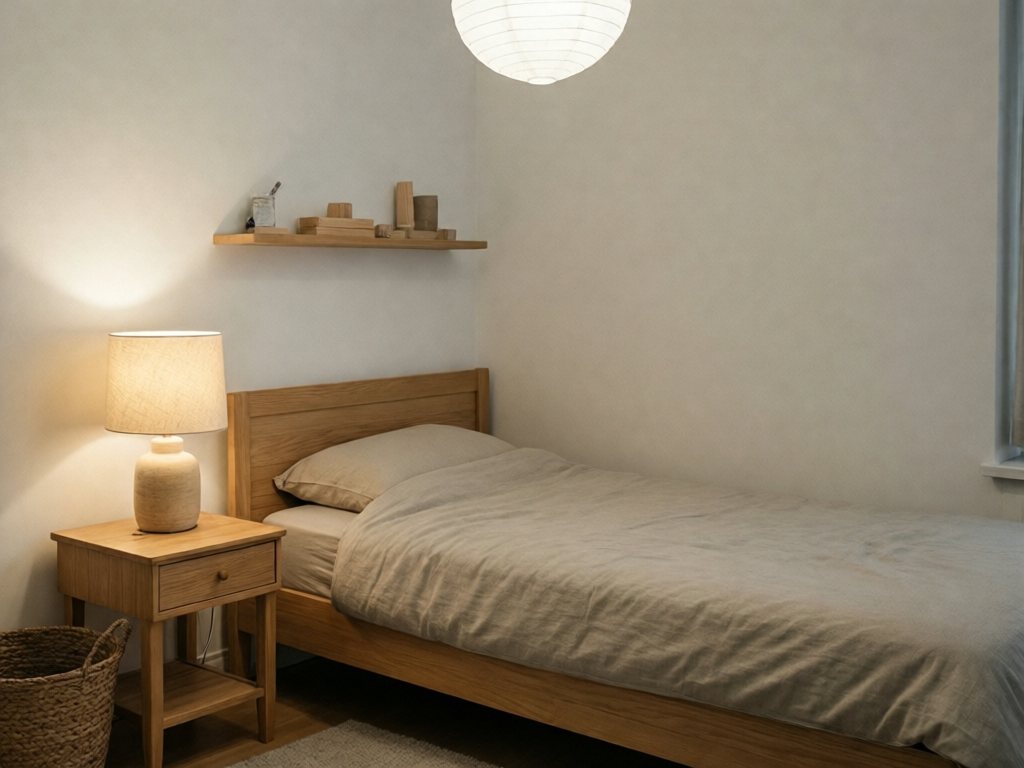
Designers often describe three layers of light: ambient (general room illumination), task (focused light for specific activities), and accent (decorative light that adds atmosphere). Kids’ rooms work best with all three, each on its own control.
Ambient lighting is your overhead or general room light. In most kids’ rooms, this is a ceiling fixture controlled by a wall switch.
One trade-off I have noticed: mismatched bulbs and dimmers can buzz or flicker at low settings, so buy them as a matched pair. The key upgrade is replacing the on/off switch with a dimmer switch (around $15–25 at Home Depot). Pair an LED-rated dimmer with dimmable LED bulbs. Then you can run the light at full brightness for play, about half for wind-down, and off for sleep. A steady wind-down routine helps many kids settle.
For most families, I would have a licensed electrician do the dimmer swap. If you are experienced with household wiring, here is what the job involves.
- Turn off the breaker. Switch off the circuit that powers the fixture.
- Confirm the power is off. At the switch box, use a non-contact voltage tester to confirm the power is off before you touch any wire.
- Check the wiring. Stop and call a licensed electrician if you see 3-way switches, no neutral wire, aluminum wiring, damaged insulation, or a switch box that feels warm.
- Match the parts. Install an LED-rated dimmer and use dimmable LED bulbs.
- Check the rated wattage. Compare the dimmer’s rated wattage with the total wattage of the bulbs it will control.
Task lighting provides focused illumination for reading, homework, building, and art. A bedside lamp, a desk lamp, and a clip-on reading light each serve this purpose in different parts of the room. The best task lights for kids are adjustable (so the beam aims where it is needed) and use LED bulbs, which run much cooler than incandescent ones.
Accent lighting is the layer that makes a kids’ room feel magical. String lights, nightlights, light-up wall art, and LED strips all fall into this category. It is also the layer that helps with the darkness-to-sleep transition.
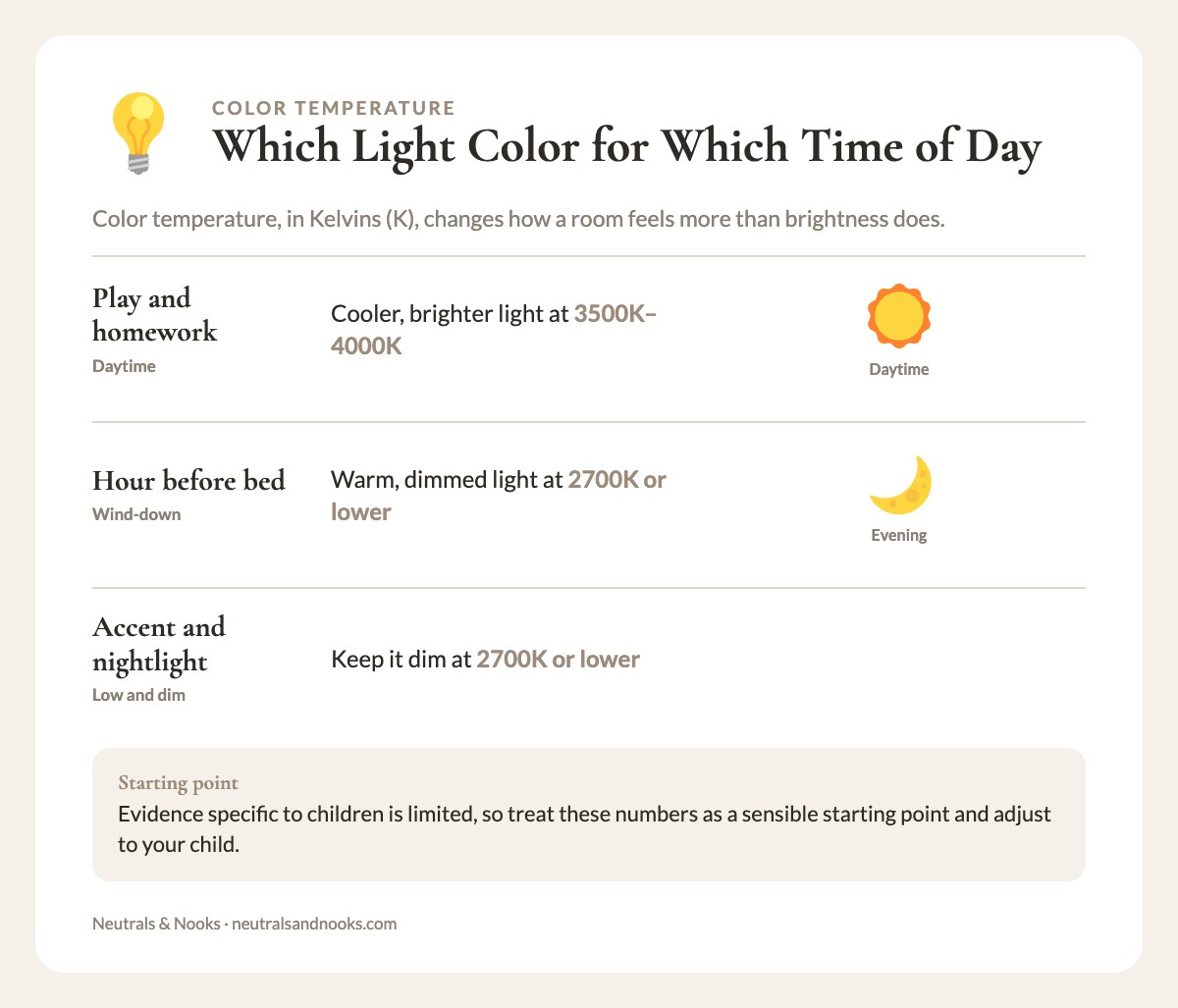
When choosing bulbs for any layer, pay attention to color temperature. It is measured in Kelvins (K) and changes how a room feels more than brightness does.
A common rule of thumb is cooler, brighter light (3500K–4000K) for daytime play and homework, then warm (2700K or lower), dimmed light in the hour before bed. Evidence specific to children is limited, so treat these numbers as a sensible starting point and adjust to your child.
| Layer | Where it goes | Color temperature | Control |
|---|---|---|---|
| Ambient | Ceiling fixture | 3500K–4000K by day, dimmed and warm at night | LED-rated dimmer |
| Task | Desk, reading spot | 3500K–4000K | Adjustable arm, on/off |
| Accent and nightlight | High on walls, low outlet | 2700K or lower, dim | Timer or touch dimming |
Overhead Lighting: Beyond the Builder Fixture
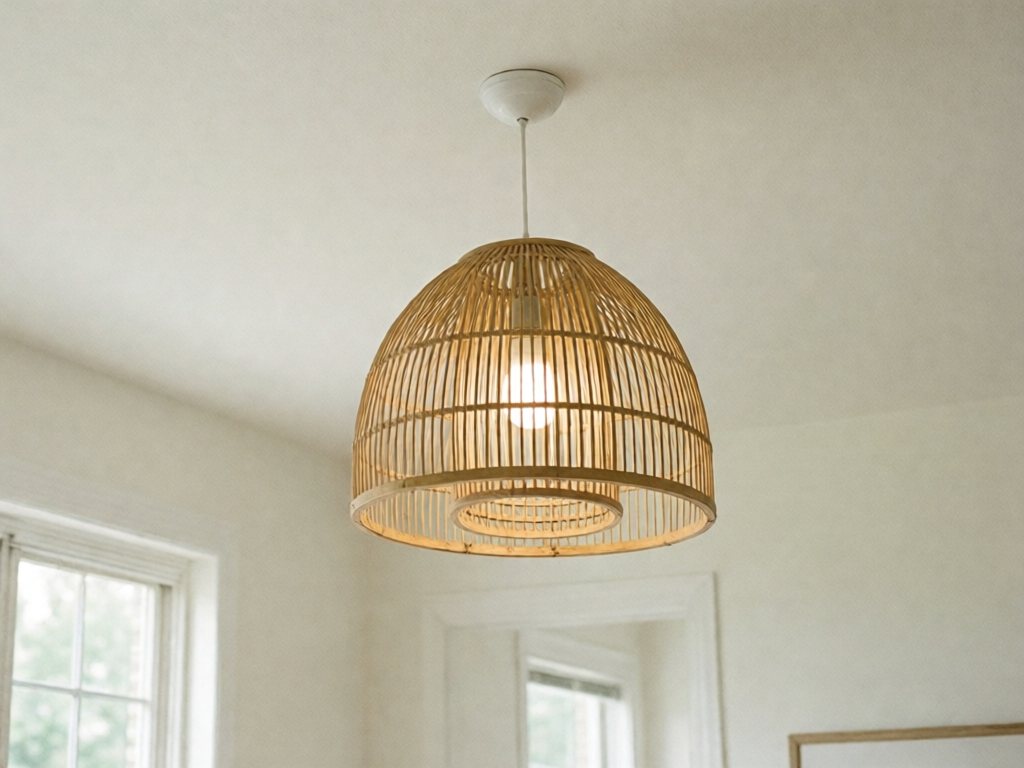
Most kids’ rooms come with a single builder-grade dome light that gives flat light and no personality. Swapping it out is one of the highest-impact changes you can make.
Prices in this guide are approximate, and product lines change. Check current listings before you buy. If a named item is no longer sold, look for the same features in a current model.
TipPut every ceiling light on a dimmer. Check that the bulb is labeled dimmable and that the dimmer is LED-rated.
Flush mounts under $40
- IKEA CALYPSO ceiling lamp (about $25): a clean, modern white look that works in any room.
- Hampton Bay Mushroom flush mount (about $30–40 at Home Depot): comes in fun shapes.
- Globe Electric Harrow flush mount (about $30 on Amazon): a simple mid-century look.
Pendants and semi-flush mounts, $30–$80
If your ceiling is 8 feet or taller, a semi-flush mount hangs slightly lower and looks more designed. The IKEA SINNERLIG pendant (about $30, so check the current price) in bamboo adds warmth and texture.
Every ceiling fixture needs a junction box rated for its weight. If the room does not have one, have a licensed electrician install it.
Over beds and cribs, choose a lightweight fixture with a shatter-resistant shade in plastic, fabric, or acrylic, and avoid glass. A heavy fixture over a crib is a hazard whatever it is made of. Skip pendants near loft or bunk beds, where heads can hit them.
No junction box?
Good to knowRooms with no ceiling junction box (common in older homes and apartments) are tricky. I would skip a plug-in swag pendant in nurseries and toddler rooms, because a cord running down the wall is a pull and strangulation risk.
Never hang a swag pendant above a bed or play area, since a ceiling hook is not a secure mount. If you use one, keep it over a desk or reading chair with a lightweight shade and the cord fully out of reach.
A wall sconce or plug-in lamp is a safer choice. You can also have an electrician install a proper ceiling fixture.
Smart dimmer
Install the overhead light on a smart dimmer switch like the Lutron Caseta (around $50–60, compatible with most LED fixtures). Program it to dim at bedtime and brighten gradually in the morning. That makes a steady bedtime routine easier to keep.
Bedside and Reading Lamps: Safe, Functional, and Fun
A bedside lamp is the most-used light source in a kid’s room. It gets turned on for bedtime stories, turned off (and occasionally back on) during nighttime fears, and bumped, knocked, and occasionally used as a sword during imaginative play. It needs to be stable, cool-touch, and easy to operate.
Ages 2–5
Choose a lamp that is weighted at the base, has no accessible bulb, and has a touch or push-button control instead of a switch that needs fine motor skills. A rechargeable LED touch lamp is a good fit, as long as the battery compartment is closed with a screw. Keep spare button batteries locked away.
Safety firstButton and coin batteries are a serious swallowing hazard. If your child may have swallowed one, go to the emergency room right away and call the National Battery Ingestion Hotline at 800-498-8666. Do not wait for symptoms.
Choose products with a screw-secured, child-resistant battery compartment. Look for packaging that says the product meets Reese’s Law, the CPSC safety standard for products with button and coin batteries.
A small clip-on rechargeable book light can handle story time without a lamp sitting on the nightstand. Check that it is UL/ETL-listed.
Ages 6–12
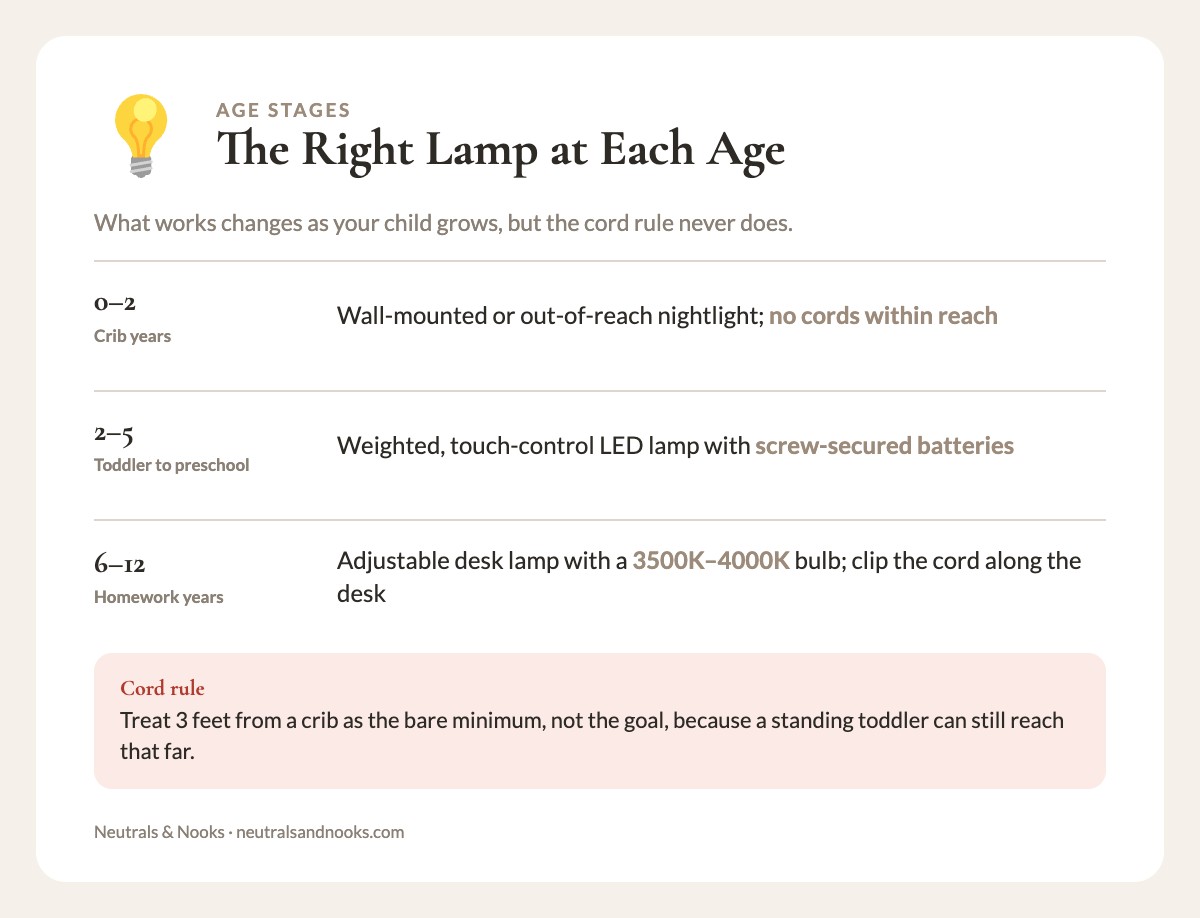
A proper adjustable desk lamp becomes important for homework. The IKEA TERTIAL work lamp (about $10) is an adjustable clamp-arm lamp at a low price. Pair it with a 3500K–4000K LED bulb for reading and homework, and clip its cord along the desk edge.
For something more polished, look for an LED desk lamp with multiple brightness levels, a color temperature adjustment, and a USB charging port. Many cost about $25–35 on Amazon.
The cord rule: keep every cord and plug-in device completely out of a child’s reach, including window blind cords. Treat 3 feet from a crib as the bare minimum, not the goal, because a standing toddler can still reach that far. Cords are strangulation and tripping hazards.
Run cords behind furniture and secure them with adhesive cord clips along the wall and baseboard. Never run a cord under a rug (fire hazard) or across a walkway.
For bedside lamps, a cordless rechargeable option removes the cord entirely. A rechargeable LED touch lamp (about $15–25 on Amazon) with a screw-secured battery compartment is a safe choice.
| Age group | Best lamp type | What to avoid | Cord/battery note |
|---|---|---|---|
| 0–2 | Wall-mounted or out-of-reach nightlight | Any lamp within reach of the crib | No cords within reach |
| 2–5 | Weighted, touch-control LED lamp | Floor lamps, exposed bulbs | Screw-secured batteries |
| 6–12 | Adjustable desk lamp, 3500K–4000K | Cords across walkways | Clip cord along the desk |
Safety firstIn cribs and toddler rooms, keep cords, plug-in units, and lamps out of the crib’s reach altogether. That includes window blind cords. Treat 3 feet from the crib as a minimum, not a target. Use tamper-resistant outlets or covers for floor-level plug-ins, and check that plug-in nightlights stay cool. For a full room walk-through, see baby proofing your home.
Best Nightlights for Kids
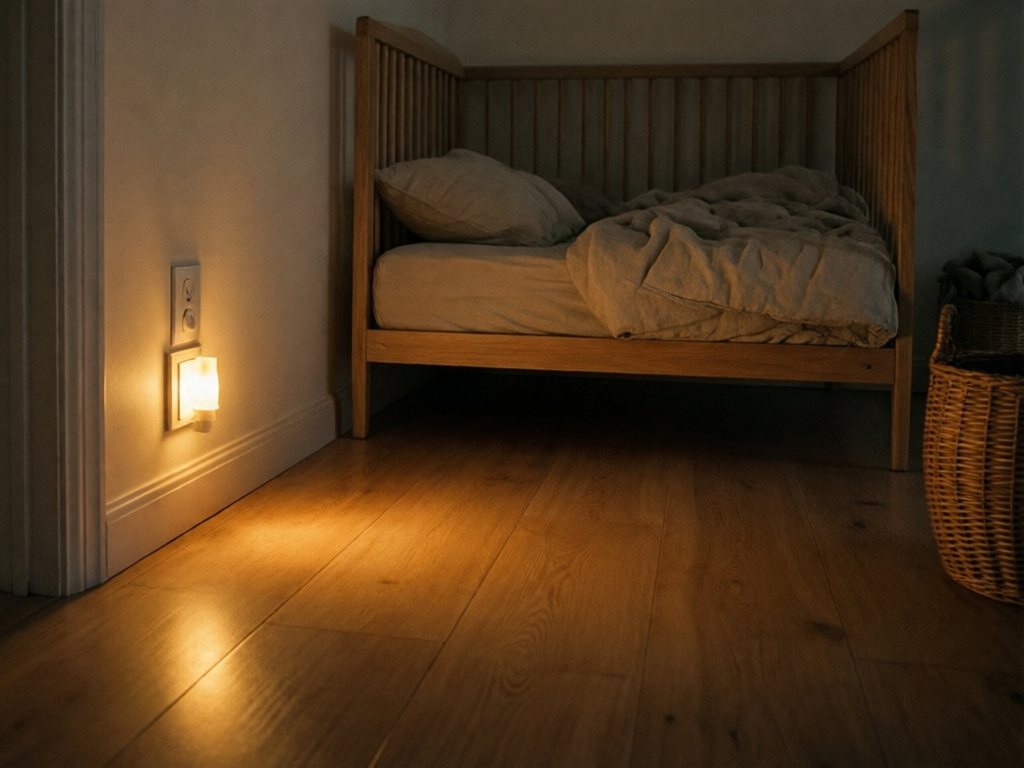
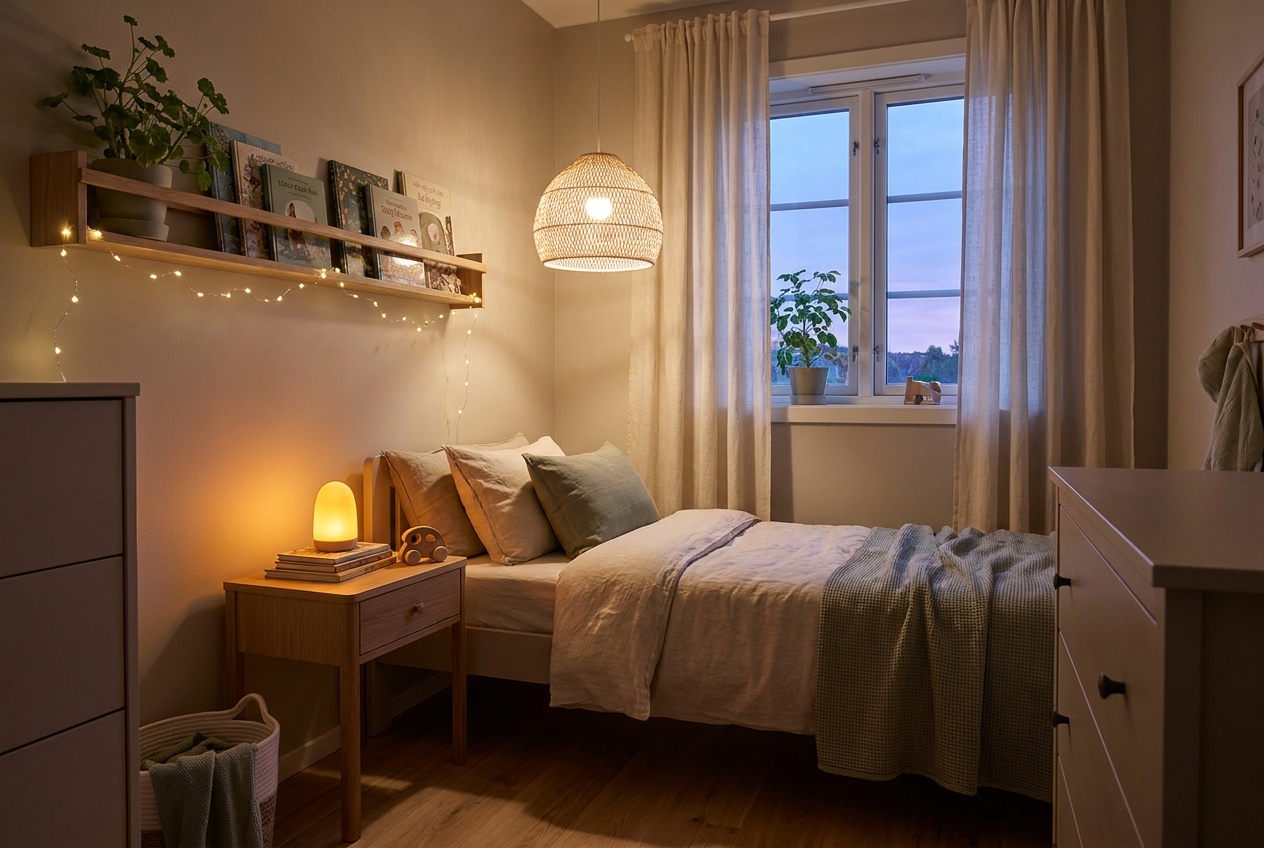
Choose a dim amber or soft orange light, placed low and out of the child’s direct view. A nightlight that is too bright, too blue, or poorly placed can make settling harder.
Nightlight color: Dim, warm light is gentler on sleep than bright or blue-rich light. Most of the research is in adults, so treat this as a sensible default, not a guarantee. Brightness and duration matter as much as color.
Best nightlights for kids:
- Hatch Rest: a premium sound machine and nightlight with app-controlled color, brightness, and bedtime and wake schedules (check the current price). Set it to a dim amber or red setting.
It plugs in, so follow the cord rule above.
Separately, the American Academy of Pediatrics advises placing sound machines as far from the crib as possible and keeping the volume low. - LittleHippo Mella (around $40): a toddler clock with a nightlight that changes color to tell kids when it is okay to wake up.
- Rechargeable amber nightlight (about $15–25 on Amazon): choose a UL/ETL-listed light with warm amber glow, dimming, and a screw-closed battery compartment. Keep it in a fixed spot rather than letting a toddler carry it around.
- Plug-in amber LED night light (about $8–12 for a 2-pack on Amazon): the simplest option. It plugs directly into an outlet, gives a low amber glow, and uses very little electricity.
Placement matters: position the nightlight low to the ground and away from the child’s direct line of sight while lying in bed.
An outlet near the bedroom door or along a far wall is ideal. It gives enough light to see the room’s familiar shapes without shining in their eyes.
With a portable nightlight, place it on the floor behind a piece of furniture so the light bounces softly off the wall. Keep nightlights clear of bedding, curtains, and furniture, and use cool-running LED units only.
Good to knowIf your child still resists sleep or seems anxious about the dark after a couple of weeks, talk with your pediatrician.
| Option | Power source | Best for | Safety note |
|---|---|---|---|
| Plug-in amber LED | Outlet | Hallways, bedrooms | Keep clear of bedding and curtains |
| Sound/light machine | Plug-in | Nurseries, toddler clocks | Cord and unit out of crib reach; keep volume low and the unit far from the crib |
| Rechargeable light | Battery | Fixed spot by a bed | Screw-closed battery compartment |
| Star projector | Battery or plug-in | Wind-down time | Use dim red or warm mode with an auto-off timer |
Fun Lighting Ideas for Kids’ Rooms: String Lights, Projectors and Signs
Accent light looks best when it matches the room’s palette, so our guide to color schemes that grow with kids can help you choose warm tones. Read the safety rules below before you buy anything on this list.
String lights and fairy lights
Warm white string lights create instant coziness. Mount them high on the wall or ceiling, well out of reach. Keep them away from beds, cribs, window blind cords, and shelves, and never drape them on or above a bed or crib.
The IKEA VISSVASS LED string lights (about $6–10) run on battery or USB with a warm, soft glow. Globe string lights (about $12–20 on Amazon) have frosted bulbs for a softer look.
LED strings run much cooler than incandescent ones. Choose UL/ETL-listed strings, screw-secure any battery compartment, and keep spare batteries locked away.
LED strip lighting
A strip of LED tape light gives a soft glow, but keep it out of reach. Limit it to spots like the top of shelves or a high ledge, not under a loft bed or behind a headboard. Choose UL/ETL-listed low-voltage strips with short, covered cords. Avoid them in toddler rooms, since strips can be peeled off and mouthed and adhesive can fail.
Color-changing, app-controlled strips such as Govee are popular. Check current specs and prices, and set them to warm, dim settings at night with color modes off before sleep. Warm white strips are the simpler choice.
Projection nightlights
The BlissLights Sky Lite (about $25–40) projects a galaxy of stars and nebula clouds across the ceiling. Many kids enjoy it, though some units have a small fan that adds noise. Use the dim red or warm setting with an auto-off timer, or turn it off before sleep. The MOREDIG star projector (about $15–20 on Amazon) rotates and changes colors for a simpler, more affordable version of the same effect.
Neon-style LED signs
Custom LED neon signs are popular in kids’ rooms. Sites like Custom Neon and Amazon sellers offer personalized names, phrases, or shapes starting at about $30–50.
They use LED technology (not real neon gas), so they run cooler than glass neon. They still have transformers and cords, so choose certified products, mount them out of reach, and secure the cord. A child’s name in soft pink or warm white script makes a good focal point, but mount it on a wall away from the bed.
| Idea | Approx. price | Best age | Mounting spot | Main hazard |
|---|---|---|---|---|
| String lights | $6–20 | 3 and up | High on wall or ceiling | Cords and batteries |
| LED strips | Varies | 6 and up | Top of shelves, high ledge | Peeling adhesive, mouthing |
| Projectors | $15–40 | 3 and up | Dresser or shelf out of reach | Bright or colored light at bedtime |
| Neon-style signs | $30 and up | 5 and up | Wall, away from the bed | Transformer and cord |
Safety Rules for Every Light in the Room
Run every fixture, cord, and bulb through this list before you buy.
LED bulbs only. Incandescent and halogen bulbs get hot enough to burn skin and ignite fabric on contact. LED bulbs produce far less heat than incandescent bulbs, are often rated for 15,000 hours or more, and use a fraction of the energy. Replace any remaining incandescent or halogen bulbs in a child’s room.
Skip floor lamps in kids’ rooms. Floor lamps tip over. A toddler can pull one down, and an older child can knock one over during play. Use table lamps on stable surfaces, wall-mounted sconces, or overhead fixtures instead. If you must have one in a shared family space, choose a heavy weighted base and secure it with a rigid bracket or anti-tip strap.
Cord management is non-negotiable. Follow the cord rule above: every cord completely out of a child’s reach, with 3 feet from any crib as the minimum. Secure every lamp cord with adhesive clips and leave no loops or slack.
Mount string lights at ceiling height or high on a wall. Never drape them at bed level, where a child could pull them down.
Outlet awareness: LEDs draw very little power, but never exceed a strip’s or power strip’s rating, and never daisy-chain strips.
Keep power strips and adapters out of reach, and use tamper-resistant outlets or covers. If a plug or outlet feels warm, unplug it and have it checked.
- Dimmable LED bulbs only
- Every cord out of reach, in a raceway where needed
- No string lights at bed level
- Battery compartments screw-secured
- UL/ETL-listed products
- Nightlights clear of bedding and curtains
- Tamper-resistant outlet covers
- Fixtures anchored to rated boxes
When ambient, task, and accent light work together, the room shifts easily from morning play to homework to a dim evening wind-down. For a calm-down spot, see our calm-down corner guide; for sharing a room, shared kids room ideas.
Kids’ Room Lighting FAQ
What color nightlight is best for kids?
A very dim, warm amber or soft orange light. It is gentler on sleep than bright or blue-rich light, and keeping it dim matters most.
What color temperature is best for a kids’ room?
Use 3500K–4000K for daytime play and homework. In the hour before bed, use warm light at 2700K or lower, dimmed.
Are string lights safe in a kid’s room?
Only if they are UL/ETL-listed, mounted high and out of reach, and kept away from beds, cribs, and blind cords. Battery compartments should be screw-secured.
What is the best nightlight for a toddler?
A dim, warm amber LED nightlight placed low and out of the child’s line of sight. A plug-in unit or a rechargeable light with a screw-closed battery compartment both work, as long as they stay clear of bedding and curtains.
Do kids need a nightlight?
Not every child does. Many preschoolers find total darkness scary, and a very dim amber light can help. If your child stays anxious about the dark after a couple of weeks, talk with your pediatrician.
Neutral Nina
Neutral Nina is an interior design enthusiast and mom of three who proves that beautiful, organized spaces and family life can coexist. She shares practical strategies for creating calm, functional homes that work for kids and grown-ups alike.