Budget Neutral Fall Decor Ideas for Kids’ Bedrooms
Learn how to create budget-friendly fall decor for your child's bedroom (ages 3-8) using neutral palettes and kid-specific design filters. You'll find ideas for items under $10, free yard finds, and sample room budgets.
- Apply four filters—scale, height, handling, and sleep—when choosing decor for your child's room.
- Select a tight, neutral fall palette (e.g., cream, warm tan, rust, olive) to save money and ensure cohesion.
- Utilize items under $10 and free yard finds to decorate your child's room on a budget.
- Prioritize safety checks for all decor and test your chosen palette together before committing.
This post contains affiliate links. As an Amazon Associate I earn from qualifying purchases.
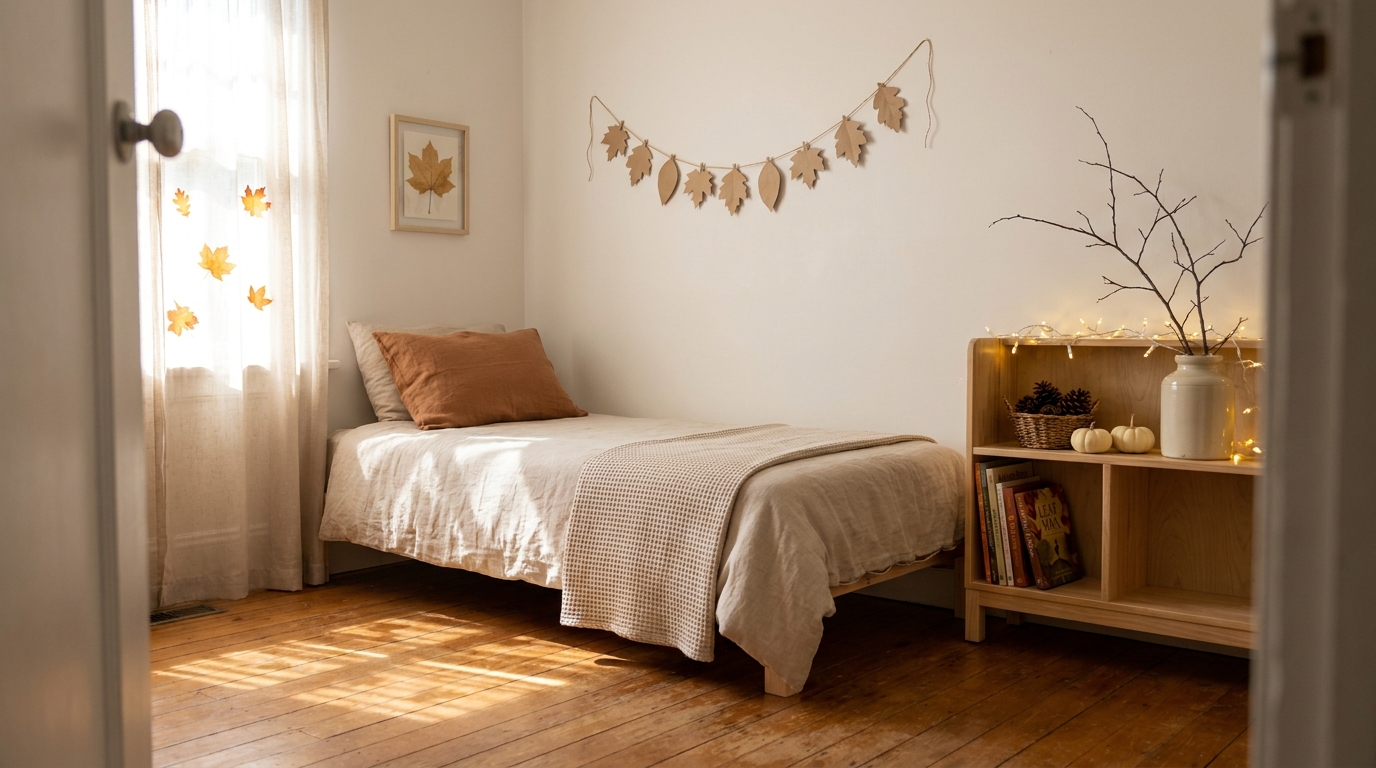
Last October I stood in the seasonal aisle holding a nine-dollar faux-fur pumpkin, wondering if my five-year-old’s room needed it. It did not. I went home with a bag of pinecones, a roll of kraft paper, and a six-dollar thrifted oat blanket, and by Sunday her room felt like fall.
Inside: items under $10, free yard finds, safe warm lighting, and sample rooms at $15, $30, and $50, all in a calm neutral palette. The plan is for ages 3 to 8; nurseries and cribs need different rules.
If you mostly want the numbers, jump to The Under-$10 Budget Breakdown and Three Sample Room Budgets. Safety checks for every item have their own section near the end, and the ones that matter most are flagged as you go.
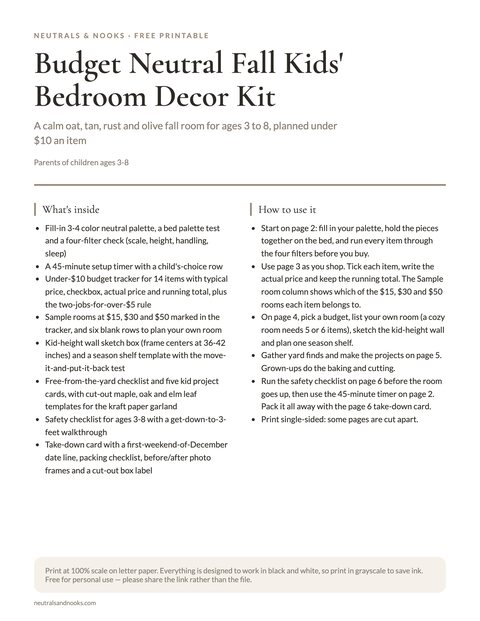
Free printable · 6 pages
Budget Neutral Fall Kids' Bedroom Decor Kit
A palette check with four filters, an under-$10 budget tracker with $15, $30 and $50 sample rooms, a kid-height wall and season shelf planner, yard-find projects, a safety checklist, a 45-minute setup timer and a take-down card.
Free. Your download link appears right here. You'll also join the Monthly Home Reset. Unsubscribe anytime. Privacy
In this article (14 sections)
- Why Kids’ Rooms Need Their Own Fall Decor Rules
- Choose a Neutral Fall Palette First (It Saves Money)
- The Under-$10 Budget Breakdown
- Free and Nearly Free: What the Yard Gives You
- Textiles: The Best Place to Spend Money
- Walls and Shelves at Kid Height
- Warm Light Without the Risk
- Fall Decor Safety for Kids’ Bedrooms (Ages 3 to 8)
- Three Sample Room Budgets
- Making It Look Intentional, Not Cluttered
- Storing and Reusing Everything Next Year
- Quick Fall Setup: A 45-Minute Plan
- Frequently Asked Questions
- Start With One Corner This Weekend
Why Kids’ Rooms Need Their Own Fall Decor Rules
Most fall decor lists are written for adult mantels. A child’s bedroom is a place to sleep, play, read, and often hide when the day has been too much, so I run every piece through four filters.
| Filter | What it means for decor |
|---|---|
| Scale | Kids’ rooms are usually 10 by 10 or smaller, so a garland that looks airy over a mantel looks enormous here. Small, repeated accents read better than one big statement. |
| Height | Kids live between knee and shoulder height. Put a fall detail where a five-year-old can see it without a stool, and make sure it’s safe to touch. |
| Handling | Anything within reach gets picked up, carried to another room, and possibly named. Skip fragile ceramics, sharp-rimmed glass, and anything that sheds; decor here should survive being loved roughly. |
| Sleep | In my experience, strong color and busy patterns feel busier at bedtime, while cream, oat, warm tan, muted clay, and deep olive read as calm. The better-supported part is light: dim, warm light in the hour before bed is easier on sleep than bright light. |
If you hold your choices up against those four filters, the shopping list gets short quickly, and most of what’s left costs very little.
Choose a Neutral Fall Palette First (It Saves Money)
Before buying anything, decide on three or four colors. A tight palette is the cheapest design trick there is, because it means thrifted, borrowed, and leftover pieces all look like they belong together. It also means you can reuse the same items next year without them going out of style.
For a neutral fall room, I like this set:
- Oat or cream for the base (blankets, pillowcases, paper)
- Warm tan or camel for wood tones, kraft paper, and burlap
- Muted rust or terracotta as the one warm accent
- Soft olive or sage for a cool counterweight to the warm tones
Skip bright orange, black, and glitter. If your child has strong feelings about orange (many do), one small orange pumpkin in a basket of cream ones satisfies everyone.
If your child’s room already has a defined color scheme, work with it rather than against it. Our guide to kids’ room color schemes that grow with your child covers how to choose a base that lasts from preschool through the early school years. A room built on soft neutrals needs almost nothing to feel seasonal, and a few warm accents carry the whole look.
A quick palette test
Hold your three or four chosen items together on the bed before you commit. If they look related in daylight and under lamp light, they’ll work. If one pops out in an unflattering way, that piece goes back or goes to a different room. This takes two minutes and prevents the most common budget mistake, which is buying something cheap that never quite fits.
The Under-$10 Budget Breakdown
Prices are typical retail or thrift ranges for budget stores, dollar-style stores, craft stores, and secondhand shops. Your local prices will vary a little, but the order of magnitude holds. Nothing here needs a specialty store.
| Item | Typical cost | Where it works in a kid’s room |
|---|---|---|
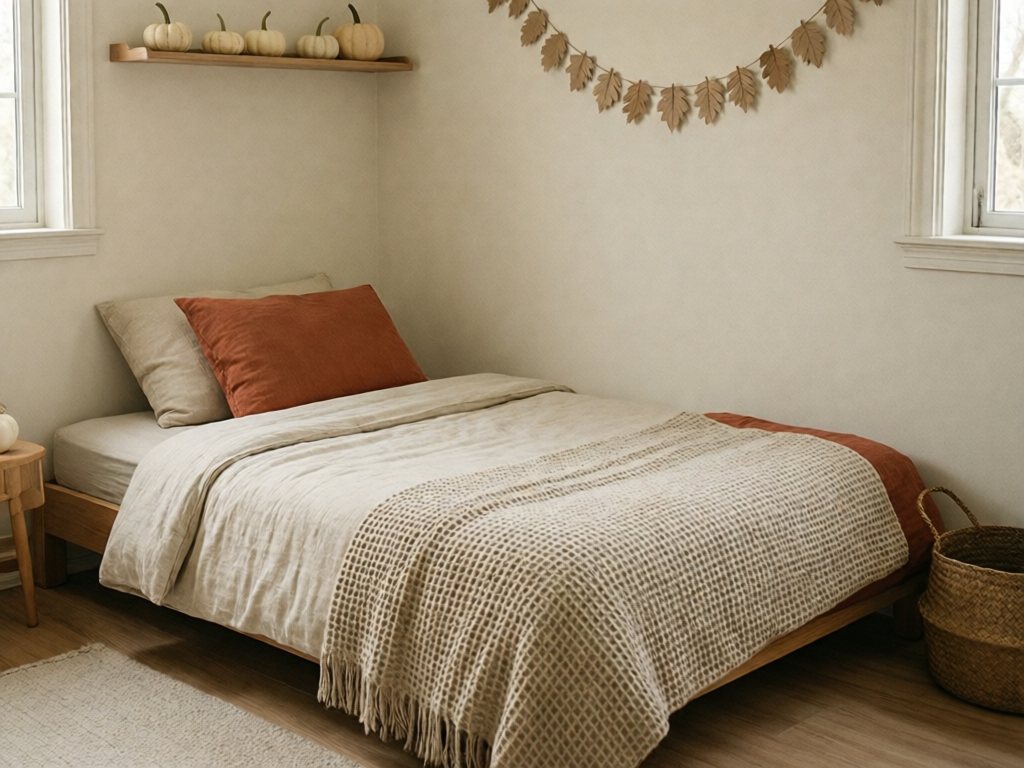
| Thrifted or discount cotton/waffle throw in oat or cream | $6–9 | Folded at the foot of the bed (never in a crib) or draped over a reading chair |
| Kraft paper leaf garland (DIY from a roll of paper) | $2–4 | Taped flat high on a wall, out of reach, above a reading nook or window |
| Cotton pillowcase in rust, oat, or olive | $4–8 | Swapped onto the bed pillow or a floor cushion |
| Bag of pinecones (or free from a walk) | $0–5 | In a basket or bowl on a shelf (high shelf if under 5) |
| Mini cream or white pumpkins (real) | $1–3 each | On a shelf or windowsill (high shelf for ages 3-5 who mouth things) |
| Faux cream pumpkins, dollar-store type | $1–3 each | Shelf or dresser for kids who handle everything |
| Warm-white battery LED string lights (screw-closed battery box) | $5–9 | Along a shelf edge or window frame, flat to the wall, away from the bed and at least a foot from any garland |
| Lightweight thrifted frame (glass swapped for acrylic) with a leaf rubbing or pressed leaf | $3–6 | Wall at child’s eye height, never over the bed |
| Felt leaf garland in neutral tones | $4–7 | Taped flat high on a different wall from the string lights, out of reach |
| Fabric remnant as a dresser runner | $3–6 | Dresser top or nightstand, under books and baskets |
| Mini terracotta pots, painted cream with non-toxic water-based paint, as crayon cups (plastic or metal cups for ages 3-5) | $2–4 | Art table or desk |
| Foraged branch (sharp ends trimmed) in a weighted plastic or metal container | $0–3 | On an anchored shelf or dresser; glass only for older kids and out of reach |
| Contact-paper “stained glass” leaf window cling | $3–5 | Bedroom window; adult cuts and peels, child arranges |
| Autumn picture books from the library | $0 | Display shelf or bedside basket |
Buying one of everything on the list (counting one real and one faux pumpkin) would run about $34–72, but you will never buy everything. A complete, cozy room needs five or six items. That’s where the sample budgets later in this article come in.
How I priced these
I kept two rules. First, every item had to cost under $10 at ordinary retail, without a coupon or a lucky sale. Second, anything over $5 had to do at least two jobs.
A throw blanket is decor and also a nap blanket. A string of lights is decor and also a night glow. Those are the pieces worth a few extra dollars.
Free and Nearly Free: What the Yard Gives You
Some of the best fall decor costs nothing at all, and a walk around the block counts as an activity. For ages 3 to 8, collecting the decor is half the fun.
Branches and leaves
A single bare branch in a weighted container looks intentional, especially in a warm neutral room. Choose a branch no longer than your arm, with no thorns or brittle twigs, and trim any sharp ends.
Use a heavy plastic or metal container for ages 3 to 5, and keep it on a stable shelf rather than the floor. Anchor dressers and bookcases to the wall, and keep heavy or glass items off tall furniture a child could climb. Inspect anything you forage and dry it first. Skip anything moldy or from treated areas, and avoid berries and plants you can’t identify.
Fresh leaves dry out and curl within a few days, which is part of the charm. Press the best ones between two sheets of parchment under a heavy book for a week, and they stay flat and colorful for months. Pressed leaves tucked into a thrifted frame become wall art at no real cost.
Pinecones
A basket of pinecones costs nothing if you have a park nearby. Shake them out and skip any that are sticky or moldy.
TipPinecone prep: bake on a foil-lined tray at about 200°F for 30 to 60 minutes. Stay in the kitchen, keep children away from the oven, and let them cool fully. Some sap may remain, so skip sticky ones. No oven? Freeze them overnight instead.
A low basket is fine for children about 5 and up who no longer mouth things. Under 5, keep pinecones on a high shelf and bring them down for supervised play. Sorting them by size is a perfectly good bedroom activity.
Paper
A roll of kraft paper is one of the cheapest decor supplies you can buy, and it stays useful long after fall. Cut leaf shapes in a range of sizes, let your child decorate a few with crayon or stamp prints, and string them on twine. The garland costs a couple of dollars and takes about half an hour.
Children use safety scissors with supervision, and an adult handles anything sharper. Tape the finished garland flat, high on the wall and out of reach, with no loops or hanging tails.
If you want a project that doubles as an art lesson, trace real leaves onto the paper first. Children aged 5 to 8 usually enjoy noticing that no two maple leaves have exactly the same edges.
Textiles: The Best Place to Spend Money
If you only spend money on one category, make it textiles. Fabric changes the look and feel of a room faster than anything else, and it’s the thing a child actually touches every day.
The throw blanket
A cozy throw is the anchor of the whole plan. Look for cotton, waffle-weave, or a soft knit in oat, cream, or warm gray. Thrift stores and discount home stores often carry them for $6 to $9. Skip anything with long fringe, which can wrap around fingers or necks, and avoid wool-blend throws for kids with sensitive skin.
Fold it across the foot of the bed, not over the pillows. For most children 3 and up, a folded throw at the foot is fine if they can pull it on and off themselves.
Safety firstThe AAP advises no loose bedding or decor in the sleep space for babies under 12 months. Under age 2, skip loose blankets entirely, so the throw never goes in a crib. In a nursery, drape it over a chair instead.
Pillowcases
A rust or olive pillowcase is the least expensive way to add fall color to a bed, usually $4 to $8 at budget stores. It swaps onto the pillow you already own, so afterward there’s only a folded pillowcase to store. For a texture-picky child, wash it once or twice first so it’s soft by bedtime.
Fabric remnants
A fabric remnant from the bargain bin costs a few dollars and can become a dresser runner, a shelf liner, or a simple banner. It does the same job as a decorative runner that would cost three times as much.
Choose a linen, canvas, or flannel texture. Cut it with pinking shears, which slow fraying so you can skip the hem, and keep the shears out of reach. Lay it flat, and never under a lamp.
Walls and Shelves at Kid Height
The most overlooked trick in children’s rooms is simply hanging things where children can see them. If every piece of art is up at adult eye level, your child may never really look at any of it.
A kid-height gallery
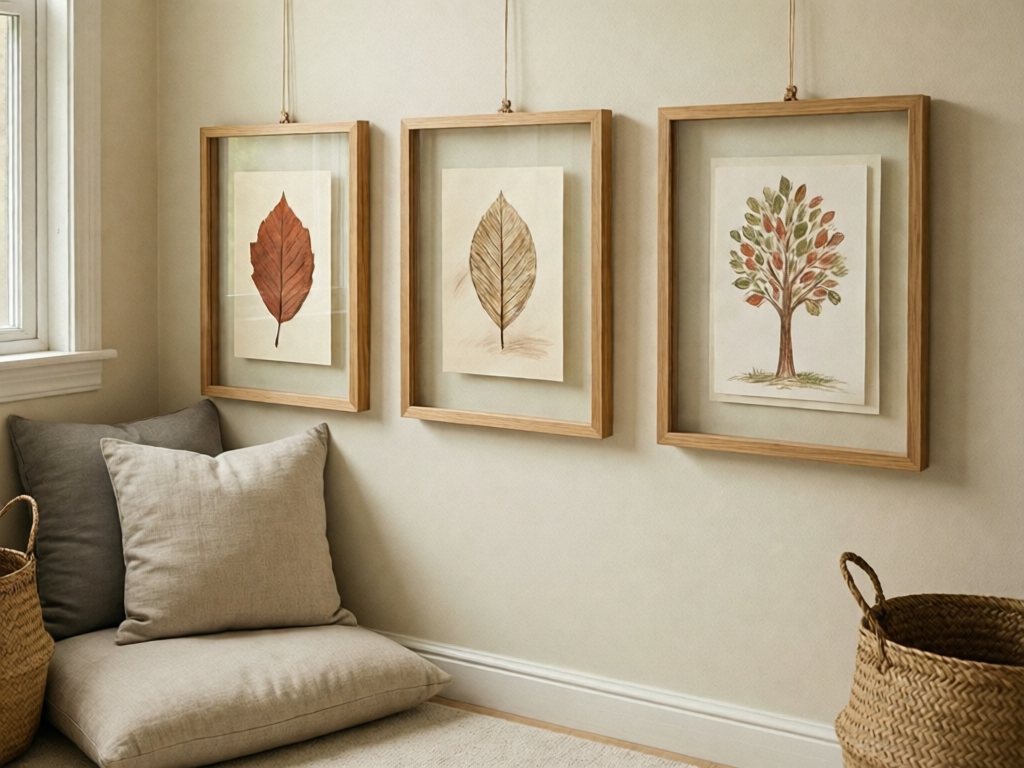
Pick a stretch of wall near the reading nook or bed. Hang two or three lightweight frames so their centers sit at roughly 36 to 42 inches from the floor, which is a comfortable height for most children aged 3 to 8. Fill them with:
- A pressed leaf on cream paper
- Your child’s own autumn drawing
- A leaf rubbing made with the side of a crayon
Thrifted frames usually have glass, so swap it for acrylic or use just the backing board. Choose lightweight frames only, use removable strips rated well above the weight, and test the hold before you walk away. Never hang a frame over the bed, and recheck the strips every few weeks. More ideas are in our guide to safe wall decor for kids’ rooms.
A single “season shelf”
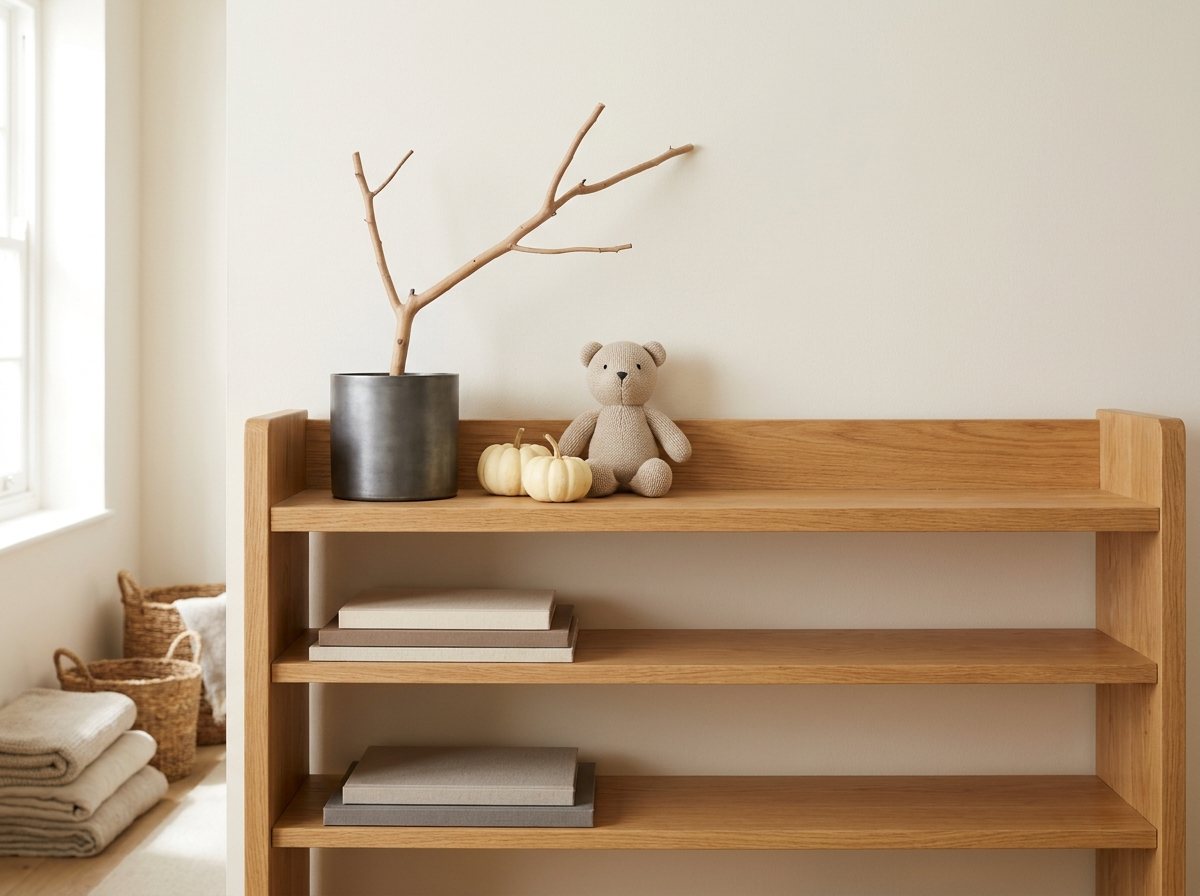
Rather than scattering decor around the room, choose one shelf and make it the season shelf. If you’ve set up distinct areas for sleeping, playing, and reading, it belongs near the calm zone. Our walkthrough of how to set up zones in a kids’ bedroom explains how to decide where each type of item belongs.
A good season shelf has three parts:
- One tall element, such as a branch in a weighted plastic or metal container (glass only for older kids, out of reach) or a stack of books
- One low group, such as a basket of pinecones or two mini pumpkins
- One personal item, such as a favorite stuffed animal or a small framed drawing
Three elements are enough to feel finished, and arranging them takes about ten minutes. The best test is whether your child can remove an item, play with it, and put it back without ruining the arrangement. If not, the shelf is too precious for this age group.
A window moment
Windows are the second cheapest focal point after shelves. A contact-paper leaf cling costs a few dollars, takes about ten minutes, and lets light through in warm amber and tan tones.
- Cut. An adult cuts leaf shapes from sheer tissue or translucent paper and peels the backing off a sheet of clear contact paper.
- Arrange. Children aged 4 to 8 press the leaves onto the sticky side.
- Seal and stick. An adult covers the leaves with a second sheet of contact paper and sticks the result to the glass.
It usually peels off in spring, but test a corner first.
Warm Light Without the Risk
Soft light is what makes a room feel like fall, but fall decor traditionally involves candles. In a child’s room, you can skip the real ones entirely.
Battery string lights
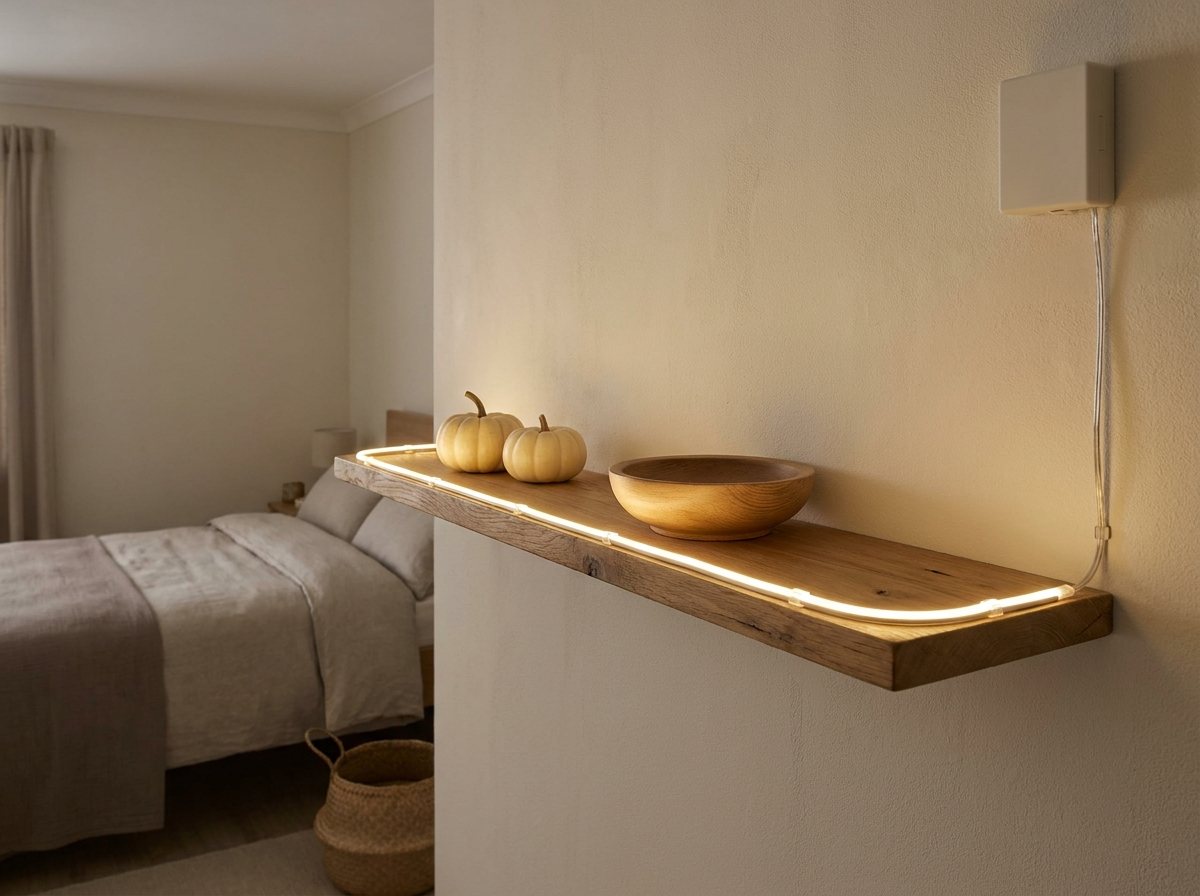
Warm-white battery string lights, around 2700K, give a soft glow similar to, but not the same as, candlelight. A string typically costs $5 to $9. For more on bedroom lighting, see our lighting ideas for kids’ spaces. Look for one with these features:
- A battery box that closes with a screw, which makes it harder for a child to open
- Warm white rather than cool white or multicolor
- A timer, so they switch off on their own after a few hours (a convenience, not a safety guarantee)
- Certified battery lights from a reputable maker
Where they go matters as much as which ones you buy:
- Along a shelf edge or window frame, well away from the bed
- On a different wall or shelf from any paper or felt garland, at least a foot apart, and never on the same window frame as a garland or window cling
- Battery box mounted out of reach and checked now and then
- Cords secured flat to the wall and out of reach, with no loops or dangling lengths
- Never draped across the sleeping area or wrapped around a bed rail
Why not button-cell tea lights?
Many flameless tea lights run on button batteries, often in unsecured compartments, so I skip them in favor of a screw-closed AA or AAA string light.
Safety firstAvoid button-cell products in kids’ rooms unless the battery compartment is screw-secured, and keep them away from younger siblings. If you suspect a child swallowed a battery, go to the ER at once and call the National Battery Ingestion Hotline at 800-498-8666. Don’t induce vomiting, and don’t wait for symptoms.
A night-light that doubles as decor
If your child already uses a night-light, consider a sturdy, cool-to-the-touch LED night-light with a soft fabric or silicone shade rather than a bright plastic one. A warm, dim light in an oat or tan shade fits the palette and may help bedtime feel calmer.
Fall Decor Safety for Kids’ Bedrooms (Ages 3 to 8)
Cheap decor is only a bargain if it’s also safe. Here are the checks I run on every item before it goes into a child’s bedroom.
| Check | What to do |
|---|---|
| Small parts | Anything that fits through a toilet-paper tube is a choking risk for children under 3, so keep it out of their rooms. Through about age 5, and around any younger sibling, I keep acorns, small beads, and loose buttons in a closed jar on a high shelf. |
| Cords and garlands | Nothing hangs loosely over a bed or crib, and nothing with a loop or long tail sits within a child’s reach. Secure cords flat to the wall and out of reach. The cord and battery rules apply at every age in this plan. |
| Weight above the bed | Heavy frames, wreaths, and wooden signs don’t belong over the head of a bed, and I hang no frames there at all. Keep paper garlands high on the wall with removable strips, and check them regularly. |
| Pumpkins and gourds | Real ones rot, so check them every few days and remove them as soon as they soften. Some children will try to bite them. Foam or dollar-store faux pumpkins may break into small pieces, so check for loose bits and pick sturdy fabric or smooth wood ones for younger children. |
| Dried plants | Pampas grass and some dried florals shed a lot and can irritate allergies. They’re also a choking, chewing, and flammability risk, and some plants are toxic. Skip dried florals, seed heads, and berries unless they’re well out of reach, and use branches, paper, or fabric instead. |
| Glass and ceramic | Use them sparingly, and choose plastic or metal containers for ages 3 to 5. Anchor dressers and bookcases to the wall, and keep heavy or glass items off tall furniture a child could climb. |
| Heat | Keep paper garlands and fabric well away from heaters, radiators, and lamps with hot bulbs. Never cover a lamp or bulb with fabric or paper, keep paper garlands away from string lights, and don’t put a fabric runner under a lamp. |
If you’re ever unsure, ask whether you would be comfortable with a four-year-old grabbing the item and carrying it across the room. If not, move it higher or leave it out.
Three Sample Room Budgets
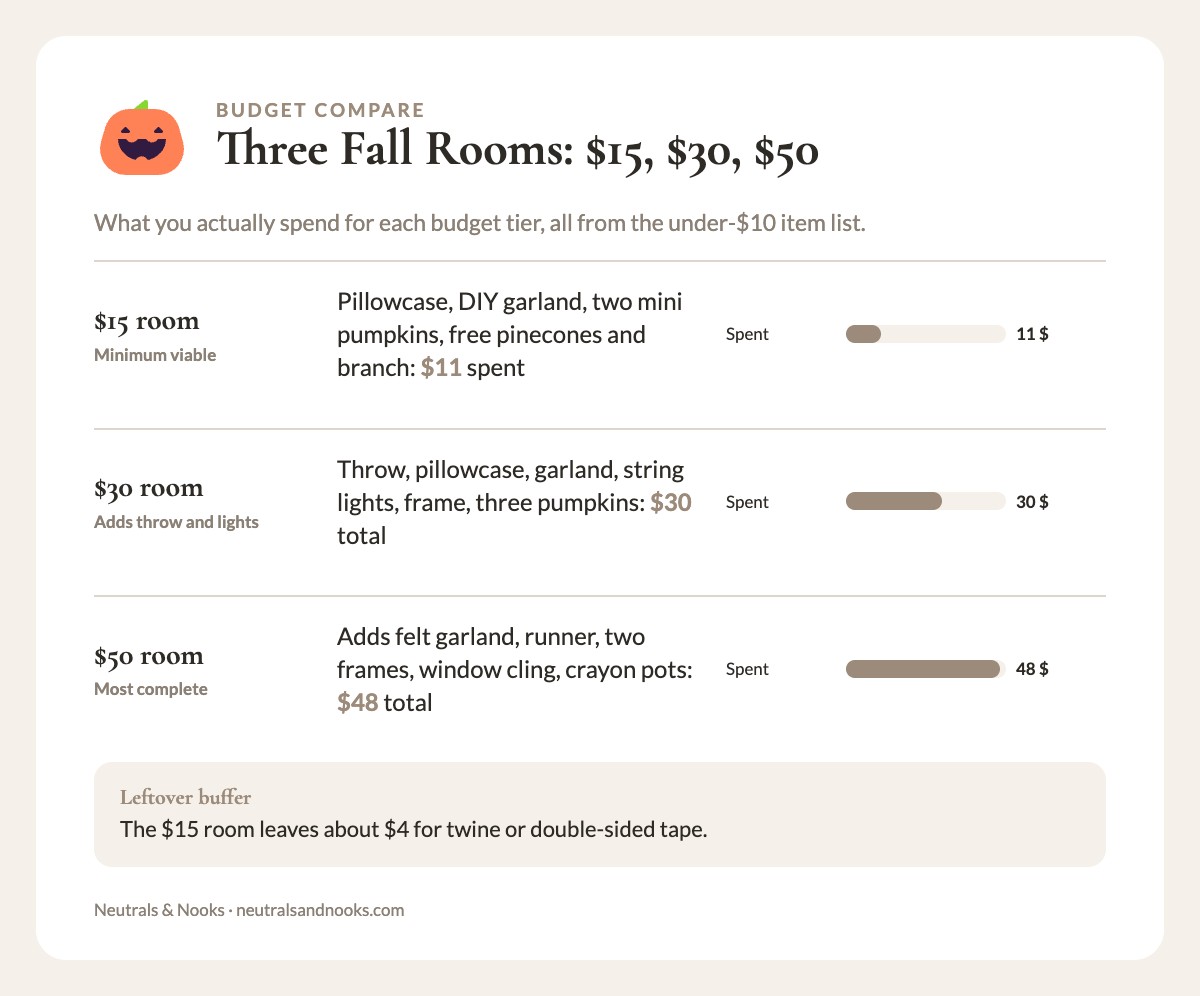
Here are three ways to put the list together, depending on how much you want to spend. All prices are approximate and all items come from the budget table above.
The $15 room (about $11 spent)
This is the minimum viable fall room. It makes a visible difference with only a few purchases.
| Item | Cost |
|---|---|
| Rust or olive pillowcase | $5 |
| Kraft paper leaf garland (DIY) | $2 |
| Pinecones from the yard in a basket you own | $0 |
| Foraged branch in a weighted plastic or metal container you own (glass only for older kids, out of reach) | $0 |
| Two mini cream pumpkins (about $2 each) | $4 |
| Library picture books on display | $0 |
| Total | $11 |
You have about $4 left over, which is a nice buffer for twine or double-sided tape.
The $30 room
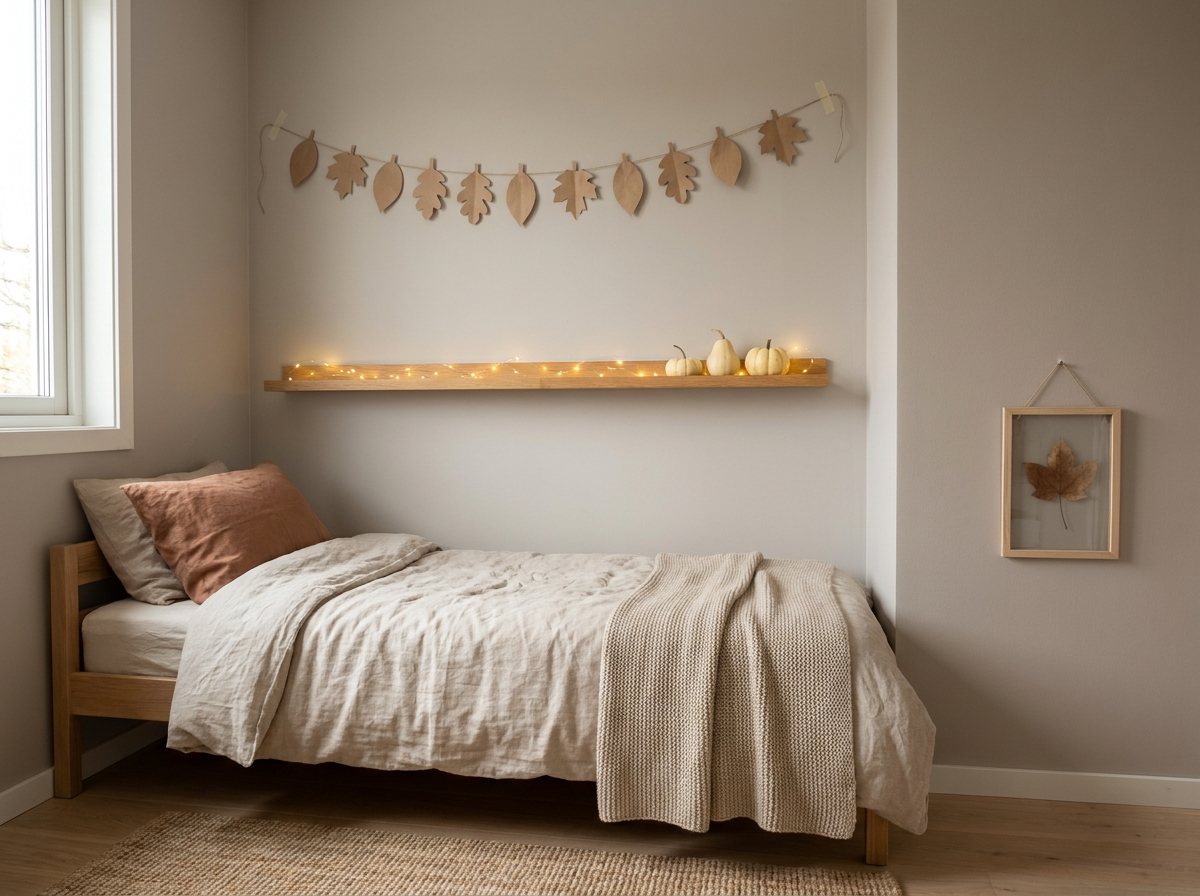
This version adds a real textile moment and some light.
| Item | Cost |
|---|---|
| Thrifted oat throw | $7 |
| Rust or olive pillowcase | $5 |
| Kraft paper leaf garland (DIY) | $2 |
| Warm-white battery string lights | $7 |
| Thrifted frame with pressed leaf | $4 |
| Three mini cream pumpkins (under $2 each) | $5 |
| Pinecones and branch (free) | $0 |
| Total | $30 |
The $50 room
This one is the most complete. It could serve as the main fall look for a shared room or a larger bedroom.
| Item | Cost |
|---|---|
| Thrifted oat throw | $7 |
| Pillowcase in rust or olive | $5 |
| Felt leaf garland (on a different wall from the lights) | $5 |
| Warm-white string lights | $7 |
| Fabric remnant runner | $4 |
| Two thrifted frames with pressed leaves | $8 |
| Window cling (contact paper) | $4 |
| Mini terracotta pots as crayon cups | $3 |
| Mini cream pumpkins (three, under $2 each) | $5 |
| Total | $48 |
That lands at $48, with a little room left over. Notice that none of these rooms feels crowded. They look better because each has just a few things that repeat the same colors.
Making It Look Intentional, Not Cluttered
The difference between a styled room and a cluttered one is often the number of things on each surface. With a child’s room, where there is already a lot of visual noise from books, toys, and clothes, restraint matters even more.
A few guidelines that help:
- Group in threes. Odd numbers look more natural. Three pumpkins, three frames, three pinecone-filled bowls.
- Repeat one color. If rust shows up in a pillowcase, a leaf garland, and one pumpkin, it feels deliberate.
- Leave clear space. At least half of every shelf and dresser top should stay empty. Children need room to set down what they’re holding.
- Keep the floor clear. Decor lives on walls, shelves, and beds, never the floor. Floor decor gets stepped on, tripped over, or thrown.
If you’re working in a room that already feels busy, pair this plan with a quick reset of what’s already there. Our article on cheap organization ideas that look expensive shows how low-cost baskets, labels, and consistent containers do much of the same visual calming that decor does. In many kids’ rooms, ten minutes of tidying makes the biggest “decor” difference of all, and it costs nothing.
Let your child have a say
Between ages 3 and 8, children usually have strong opinions about their rooms. Give them a small, bounded choice, like the rust pillowcase or the olive one, or which shelf the pumpkins go on, and the room starts to feel like theirs.
Children also tend to look after what they helped choose. A child who helped make a leaf for the window is much less likely to pull it off the glass.
Storing and Reusing Everything Next Year
The point of buying cheap, neutral pieces is that they can come out again next year. A little care at the end of the season makes that easy.
- Take-down day. Plan it for the first weekend of December, or whenever you switch to winter or holiday decor. Let your child help; many children enjoy “putting fall to sleep” the way they enjoy tucking in a doll.
- Labeled box. Use one shoebox or small bin labeled “Fall, [child’s name].” Roll the paper garland loosely, fold the pillowcase, wrap the string lights (batteries removed) around a piece of cardboard, and bag the pumpkins.
- Fabric first. Wash the throw and pillowcase before storing so they’re fresh next year. Fold them with a cedar block or a dry sachet if you have one.
- Check the pumpkins. Real ones go into the compost. Faux ones go into the box.
- Take a photo. A quick photo of the finished room helps you recreate it next year in half the time.
If your fall clothing swap is happening at the same time, you might combine the two jobs. Our guide to fall closet organization for kids’ clothes works well alongside this one, since the same Saturday can cover both the decor and the wardrobe.
Quick Fall Setup: A 45-Minute Plan
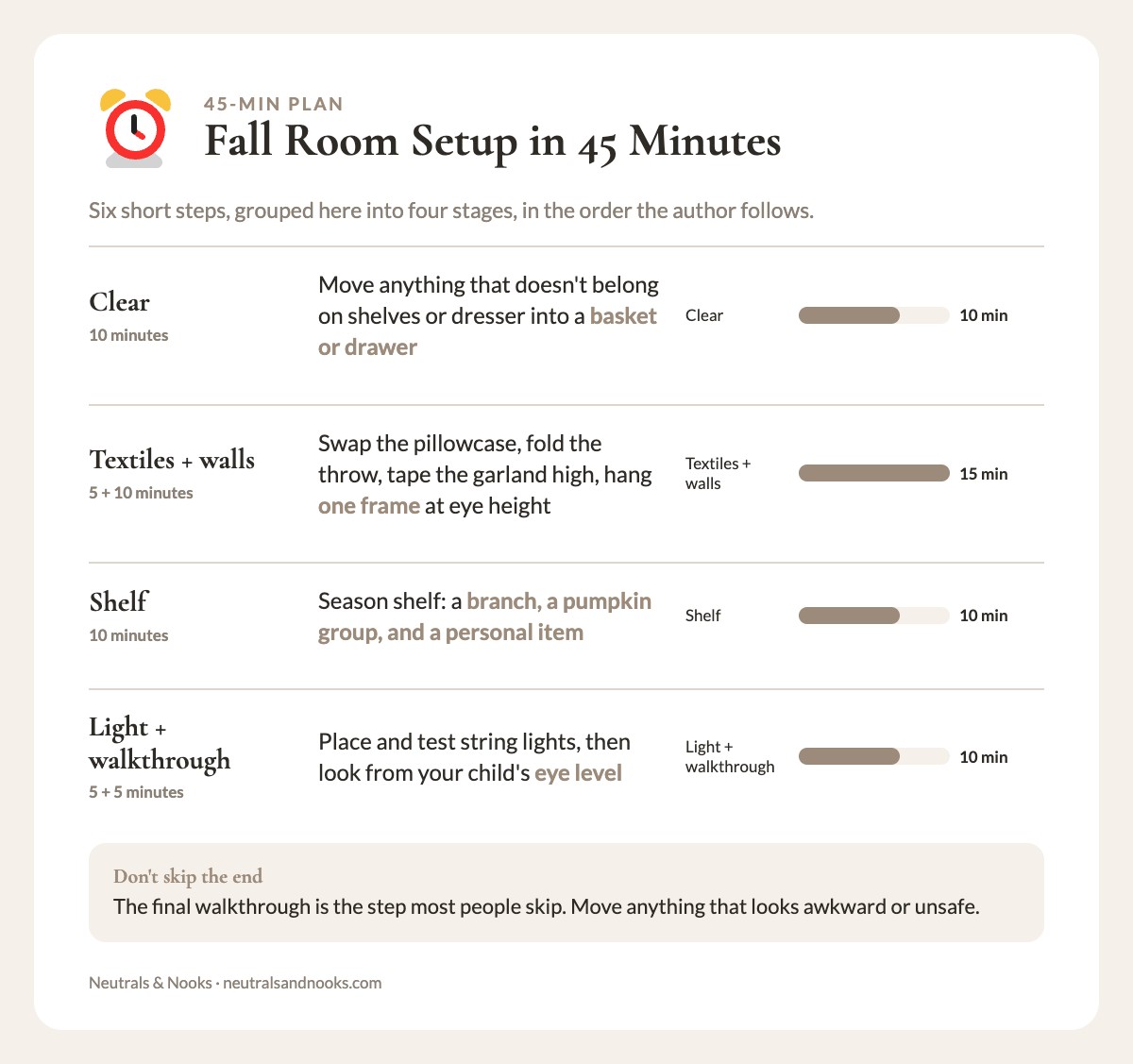
If you want to do the whole thing in a single afternoon, here is the order I’d follow.
- Clear (10 minutes). Remove anything that doesn’t belong on shelves or the dresser top. Put it in a basket or a drawer.
- Textiles (5 minutes). Swap in the pillowcase and fold the throw at the foot of the bed.
- Walls (10 minutes). Tape the paper garland flat, high on the wall and out of reach. Hang one lightweight framed leaf at child’s eye height, not over the bed.
- Shelf (10 minutes). Build the season shelf with a branch, a pumpkin group, and a personal item.
- Light (5 minutes). Place and test the string lights.
- Walkthrough (5 minutes). Get down to your child’s eye level and look at the room from there. Move anything that looks awkward or unsafe.
That final step is the one most people skip. Looking at the room from three feet off the ground shows you exactly what your child sees and can reach.
Frequently Asked Questions
What is the cheapest way to add neutral fall decor to a kid’s room?
Start with free and nearly free pieces: pinecones, a foraged branch, and a paper leaf garland made from a roll of kraft paper. Stand the branch in a weighted plastic or metal container you already own (glass only for older kids, out of reach). For about $5 more, add a rust or olive pillowcase. Those four things change the feel of a room for under $10 total and can be put away in one small box.
What colors count as neutral fall decor for a kids’ room?
Cream, oat, warm tan, soft gray, muted terracotta, and sage or olive green are the most reliable. Aim for three or four from that list and repeat them across the room. A little rust or clay is enough warmth, and you don’t need bright orange or black to make a room feel like fall.
Is it safe to use string lights in a young child’s bedroom?
It can be, with precautions. Choose certified battery-powered warm-white lights with a screw-closed battery box, which is harder for a child to open but not impossible, so mount it out of reach and check it now and then. Hang the lights flat along a shelf or window frame, away from the bed and crib, with no reachable cord. Avoid button-cell flameless candles in kids’ rooms, because swallowed button batteries are dangerous at any age.
How do I keep fall decor from adding clutter to a small bedroom?
Limit yourself to one decorated shelf, one wall moment, and one textile swap. Leave at least half of each surface empty, and keep all decor off the floor. If the room still feels busy, tidy the existing items first, because a calm base makes a few seasonal touches look intentional.
What fall decor is best for toddlers and preschoolers aged 3 to 5?
Choose soft, large, unbreakable pieces: a throw blanket, a pillowcase, felt or paper leaves, and faux pumpkins. Skip small beads, acorns, glass, and anything with long cords or loops. Keep pinecones and other small natural items in a closed jar on a high shelf, and bring them down only for supervised play.
Can my child help make the decor, and is it worth the mess?
Yes, and it’s often the best part. Children aged 4 to 8 can trace and cut paper leaves, press leaves in a book, make crayon rubbings, and assemble a window cling. Cover the table with newspaper or kraft paper, give them washable supplies, and keep the project short. Handmade pieces tend to be treated more gently, and they make the room feel like theirs.
How should I store the decor so I can reuse it next year?
Use one labeled shoebox or small bin. Wash and fold the textiles, roll the paper garland loosely, wrap the string lights around a piece of cardboard, and keep faux pumpkins in a bag. Compost any real pumpkins. A quick photo of the finished room also helps you recreate the look in less time next fall.
Start With One Corner This Weekend
A fall bedroom for a small child doesn’t need to be impressive. It needs to be soft, safe, and a little bit special, the kind of room where a five-year-old climbs into bed, notices the leaves in the window, and feels that the season has arrived. A thrifted blanket, a handful of pinecones, and a paper garland you made together are enough. Start with one corner this weekend, see how it feels, and let the rest of the room grow from there.