Wall Decor Ideas Safe for Kids’ Rooms
Learn how to choose safe and beautiful wall decor for your kids' rooms, avoiding hazards like glass and heavy frames. This guide provides specific product ideas and installation tips for peel-and-stick solutions and lightweight framing.
- Use peel-and-stick wall decals for maximum impact and zero risk in your child's room.
- Create an accent wall with peel-and-stick wallpaper for a safe, temporary focal point.
- Opt for frames with shatter-resistant acrylic fronts instead of glass for safety.
- Consider frameless canvas prints for lightweight, shatter-proof wall art.
The framed glass print lasted exactly eleven days in my son’s bedroom. Eleven days before a rogue Nerf dart knocked it off the wall and sent shattered glass across the carpet at 7:15 on a Tuesday morning. That was the moment I realized that wall decor in kids’ rooms operates under a completely different set of rules than the rest of the house. It needs to be beautiful, yes—but it also needs to survive flying toys, enthusiastic wall-leaning, curious fingers, and the occasional attempt to climb it. Safety-first wall decor does not mean boring wall decor. It means making smart material choices that let you create stunning spaces without the anxiety of glass, sharp edges, or heavy frames waiting to fall.
This guide covers every safe wall decor option for kids’ rooms—from peel-and-stick solutions to lightweight frames to interactive wall features—with specific products, price ranges, and installation methods that keep your walls beautiful and your kids unharmed.
Peel-and-Stick Wall Decals: Maximum Impact, Zero Risk
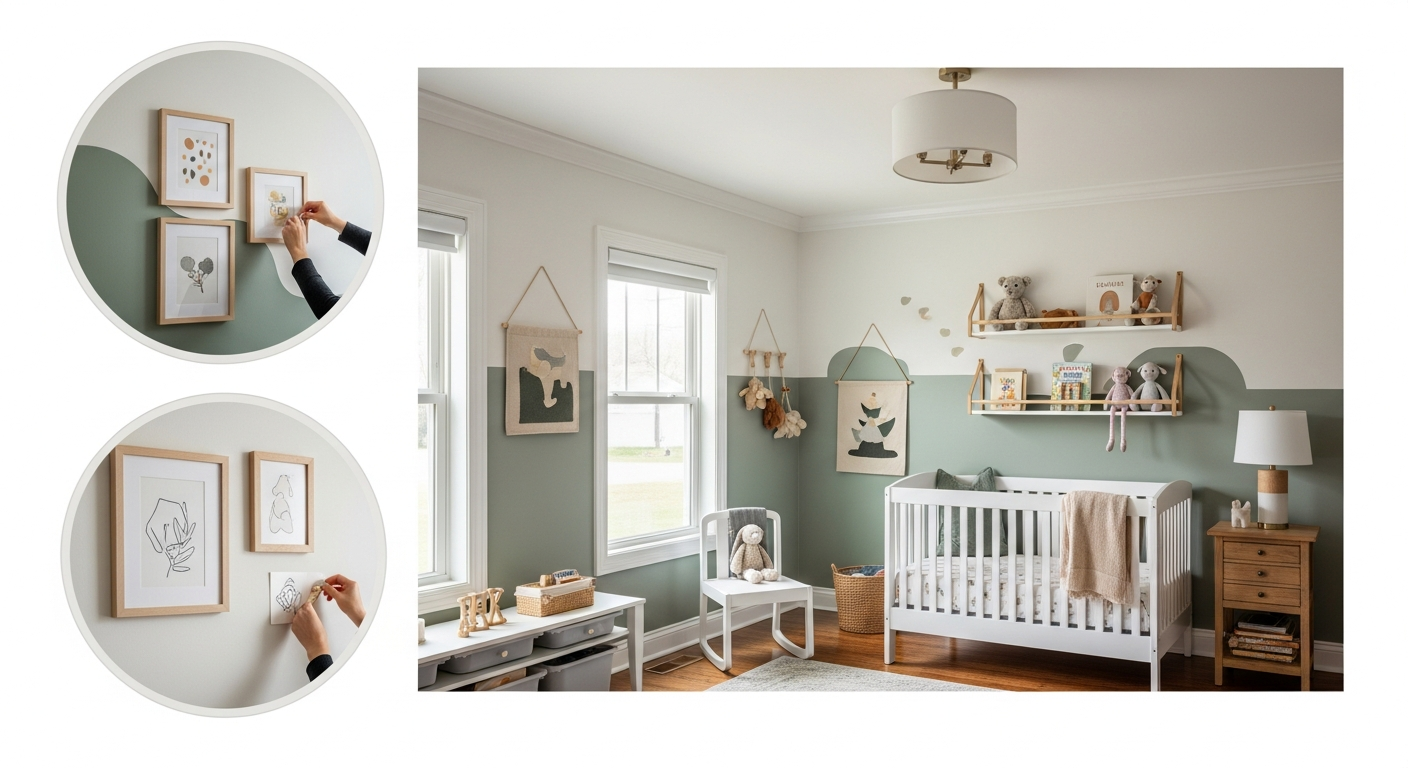
Wall decals are the safest form of wall decor because they sit flat against the surface—there is literally nothing to fall, break, or shatter. Modern decals have come an extraordinary distance from the cartoony stickers of a decade ago. Today’s options include watercolor murals, realistic botanical prints, geometric patterns, and hand-drawn illustrations that look like custom artwork.
Best sources for quality wall decals:
- UrbanWalls on Etsy: High-end watercolor decals (animals, florals, abstracts) starting at $20–40 for a set. Their fabric-based decals are repositionable and leave no residue—perfect for renters.
- RoomMates peel and stick decals (Target/Amazon): The most accessible option, $10–25 per set. Their tree branch, star, and dot decals are nursery classics. The quality is good for the price, though they are slightly thinner than Etsy options.
- Project Nursery decals (Amazon): Beautiful minimalist designs including arches, rainbows, and mountain silhouettes, $15–35. These have a modern, Instagram-friendly aesthetic.
- Wallpops (Walmart/Amazon): Budget-friendly at $8–20 per set. Their metallic dot and confetti decals are especially popular for adding subtle sparkle.
Application tips for a professional look: Clean the wall with a damp cloth and let it dry completely before applying. Start from the center of your design and work outward. For large murals, have a second person help align the top edge while you smooth from center to edges. Use a credit card or squeegee wrapped in a soft cloth to press out air bubbles. Peel slowly at a 45-degree angle when repositioning to avoid stretching the decal. Most quality decals can be repositioned 2–3 times before the adhesive weakens.
Peel-and-stick wallpaper is the decal’s bigger sibling and creates a full accent wall effect. Tempaper ($35–60 per roll at Target) and NuWallpaper ($25–40 per roll at Lowe’s) offer patterns from subtle linen textures to bold geometric prints. One accent wall in a kids’ room—behind the crib, behind the bed, or behind a reading nook—creates a focal point without the commitment of traditional wallpaper. When your child outgrows the pattern (or you just want a change), it peels off cleanly.
Lightweight and Shatter-Proof Framing Solutions
Framed art is a wall decor staple, but traditional frames with glass fronts are a genuine hazard in kids’ rooms. The solution is not to avoid frames entirely—it is to choose frames designed for safety.
Acrylic-front frames: Replace glass with acrylic (plexiglass) in any frame. Acrylic is shatter-resistant, lighter than glass, and optically clear. You can buy frames that come with acrylic fronts, or replace the glass in existing frames with cut-to-fit acrylic sheets ($5–10 per sheet at Home Depot, cut for free in-store). The Americanflat picture frames on Amazon ($8–15 each) come standard with shatter-resistant acrylic fronts and are one of the most popular options for kids’ rooms.
Frameless canvas prints: Canvas prints eliminate the frame-and-glass combination entirely. The image is printed directly on wrapped canvas that is lightweight and cannot shatter. Canvaspop and Shutterfly print custom photos on canvas starting at $30–50 for a 12×16 inch print. For art prints rather than photos, Society6 and Etsy sell ready-to-hang canvas art in virtually every style, $20–60 for kid-friendly designs.
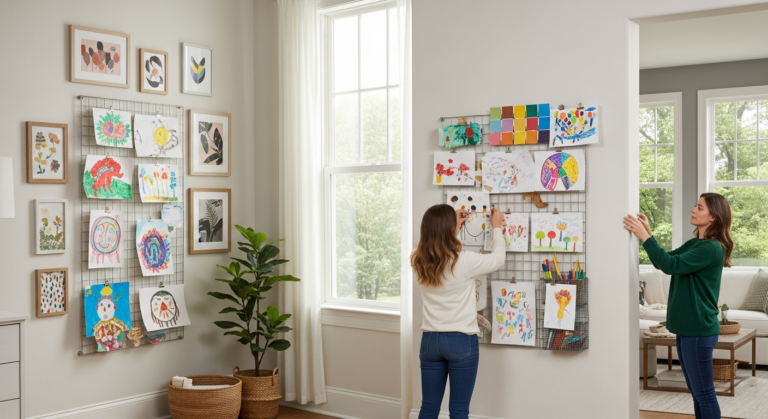
IKEA FISKBO frames: At $2–4 each, these lightweight plastic frames are practically disposable—which makes them perfect for kids’ rooms where artwork rotates frequently. They come with a plastic front (not glass), making them safe for any height. Mount a row of three or four at kid height for a rotating art gallery where your child can swap their own creations in and out.
Clipboards as frames: Mount clipboards ($1–2 each from Dollar Tree, spray-painted to match the room) directly on the wall with Command strips. Clip in current artwork, photos, postcards, or printed designs. The clipboard serves as both frame and hanging mechanism, and artwork changes take five seconds. Three matching clipboards in a row create a gallery wall that is always fresh.
Washi tape framing: For the truly commitment-free option, washi tape ($3–5 per roll at Target or craft stores) applied directly to the wall creates “frames” around prints, photos, or even bare wall spaces. Tape a rectangle on the wall, place a print inside it—no frames, no nails, no holes. When the art changes, peel the tape and reapply. Washi tape comes in hundreds of colors and patterns, so you can match any room’s palette.
Interactive Wall Decor Kids Can Touch and Use
The best wall decor for kids is not just decorative—it is interactive. Wall features that children can touch, write on, rearrange, or contribute to transform the walls from a “look but don’t touch” surface into an active part of the room’s function.
Chalkboard wall or section: Rust-Oleum chalkboard paint ($12 for a quart at Home Depot) turns any section of wall into a reusable drawing surface. Paint a 3×4-foot rectangle at kid height on one wall (use painter’s tape for clean edges) and your child has an ever-changing art canvas. Alternatively, chalkboard peel-and-stick sheets ($8–15 on Amazon) provide the same surface without permanent paint—they peel off cleanly when you are done. Stock a small wall-mounted cup with chalk and an eraser, and you have a self-contained art station that takes up zero floor space.
Magnetic paint wall: Rust-Oleum magnetic primer ($20 for a quart) applied under regular paint creates a wall surface that holds lightweight magnets. This is not as strong as a magnetic board—you will need two to three coats of magnetic primer before the top coat for decent hold—but it works well for displaying lightweight artwork with decorative magnets, hanging magnetic letters for spelling practice, or playing with magnetic building tiles directly on the wall. For stronger magnetic pull, mount a sheet metal panel ($15–25 at Home Depot, available in 2×3 foot pieces) on the wall and paint over it to match.
Art display wire system: String a thin steel cable or heavy-gauge wire ($5‐8 at a hardware store) horizontally across a wall at kid height, secured with two hooks at each end. Use mini clothespins ($3 for a pack of 50) to clip artwork, photos, and cards along the wire. This creates a gallery that children can curate themselves—adding and removing pieces as they create new work. The wire is virtually invisible, so the art itself is the focus.
Felt letter board: The Letterfolk letter board ($25–40) or similar felt boards from Amazon ($15–25) provide a wall-mounted surface where kids can spell words, leave messages, and display favorite quotes. Hang it at kid height with Command strips. This is both decorative and educational—early readers love composing messages, and the board doubles as a family communication station.
Growth chart: A canvas growth chart ($15–25 on Amazon or Etsy) mounted on the wall serves as both decor and a years-long keepsake. Mark heights with dates and roll it up to save when you move or when your child outgrows it. The Schoolhouse growth chart ($25) has a beautiful minimalist design, or find handmade wooden ruler-style charts on Etsy for $30–50.
Fabric, Textile, and 3D Wall Art
Fabric and textile wall hangings add warmth, texture, and softness to kids’ rooms—qualities that paint and paper cannot replicate. They are also inherently safe: lightweight, soft, and shatter-proof.
Macrame and woven wall hangings: The boho trend has made macrame wall art widely available at every price point. Target carries macrame and woven hangings in their Opalhouse line ($10–30) that add texture to nurseries and kids’ rooms. TJ Maxx and Marshalls are goldmines for discounted textile wall art ($8–20). Etsy has thousands of options from handmade to mass-produced, $15–60 depending on size and complexity. A single large macrame piece above a crib or bed creates a soft, natural focal point.
Fabric banner and garland: Fabric pennant banners ($10–15 on Amazon) draped across a wall or along a bookshelf add color and movement. You can make your own from fabric scraps cut into triangle shapes and strung on twine—a simple afternoon craft project that creates a custom banner in your exact color palette. Pom-pom garlands ($8–15 on Amazon) and felt ball garlands ($12–18) add playful, touchable texture.
3D foam or soft sculpture: Lightweight 3D foam wall art (animals, letters, shapes) is available at craft stores like Hobby Lobby ($5–15 during sales) and on Amazon. These pieces have depth and dimension but weigh almost nothing, making them completely safe even above a crib or bed. A set of foam animal heads (think mounted deer or unicorn—but soft, cartoonish, and weighing ounces) creates a whimsical focal point. The Pillowfort plush wall head at Target ($15–25) is a ready-made option that kids love.
Tapestry or fabric panel: A lightweight tapestry ($10–25 on Amazon or Society6) provides the visual impact of an oversized art print without the weight or glass. Hang it from a simple wooden dowel ($3–5 at a craft store) threaded through a rod pocket or attached with clips. Tapestries come in everything from world maps (educational and decorative) to nature scenes to abstract patterns. They are easy to change seasonally or as your child’s taste evolves, and they fold flat for storage.
Safe Mounting Methods: Keeping Everything on the Wall
Even the safest wall decor becomes a hazard if it falls off the wall. Proper mounting is the final and most critical step in kid-safe wall decoration.
Command strips and hooks (3M): For lightweight items (under 5 pounds), Command picture hanging strips ($5–8 for a multi-pack) are the safest mounting option. They hold securely, remove without wall damage, and—most importantly—fail cleanly. If a Command strip does give way, the item simply slides down the wall rather than crashing with force. Use the weight-rated strips appropriate for your item: small strips for frames under 1 pound, medium for 1–3 pounds, large for 3–5 pounds.
Velcro strips for frequently changed items: Industrial-strength Velcro strips ($6–10 at Home Depot) let you swap items on and off a wall quickly. Apply one side to the wall and the other to the back of a lightweight frame, canvas, or board. This is perfect for rotating art galleries—you can change the display in seconds without removing and reapplying adhesive each time.
Screw-into-stud mounting for heavier items: Anything over 5 pounds should be mounted directly into a wall stud with appropriate screws and anchors. For shelves, pegboards, and heavy canvas pieces, use a stud finder ($10–20) to locate studs, then drive screws directly into the solid wood behind the drywall. This provides the strongest, most reliable hold. Always drill a pilot hole first to prevent the stud from splitting.
The “above the bed” safety rule: For wall decor directly above a child’s bed or crib, apply the strictest safety standard: nothing that could cause harm if it fell onto a sleeping child. This means no frames (even acrylic-front), no heavy shelves, and no mounted objects with sharp edges. Acceptable above-bed decor includes: wall decals, tapestries hung from a lightweight dowel with Command strips, very lightweight canvas prints (under 1 pound) secured with two sets of Command strips, and fabric or macrame hangings. When in doubt, hold the item above your own head and drop it. If it would not hurt if it landed on your face, it is safe above the bed.
Safe wall decor in a kids’ room is not a compromise—it is an opportunity. When you remove glass, sharp corners, and heavy frames from the equation, you open up a world of creative options that are often more interesting, more personal, and more fun than traditional framed prints. Walls that children can interact with—drawing surfaces, magnetic play spaces, rotating art galleries—do not just decorate a room. They make it a space where creativity lives. And that is the best kind of wall art there is.