
LEGO Storage Solutions That Actually Work
Discover effective LEGO storage solutions by first understanding your child's building style, whether they're a set builder or a free builder. You'll learn specific container recommendations like IKEA TROFAST, Sterilite organizers, and Plano tackle boxes to keep your bricks organized.
- Match your storage system to your child's building style (set builder vs. free builder).
- Choose containers that are see-through, stackable, sturdy, and kid-friendly.
- For large collections, consider the IKEA TROFAST system with removable bins.
- Use Sterilite 3-drawer units for medium collections or Plano tackle boxes for small pieces.
- Sort LEGOs by piece type (bricks, plates) rather than by set for flexibility.
Step on a LEGO brick barefoot at 6 a.m. and you will understand why storage matters. Those tiny bricks have a talent for escaping their containers and landing in carpets, couch cushions, and the soft arches of your feet.
This page covers containers by collection size, how to sort bricks, a building surface, instruction booklets, and fast cleanup. The goal is a system that survives kids who dump, build, and rebuild every day.
Short on time? The container table by collection size is in the second section, The Best Storage Containers for LEGO Bricks.
Safety firstAge labels vary by set, so check the box. Many standard sets are labeled 6+ or higher, and the 4+ label mainly covers simpler starter sets. Standard bricks and small parts are a choking hazard for children under 4, so use Duplo for them. Store bricks and sorting trays out of reach of babies and toddlers, behind latching lids or on high shelves.
In this article (7 sections)
Set Builder or Free Builder? Pick Storage to Match
Before you buy any organizer, observe how your child actually plays with LEGO. There are two broad categories, and the ideal storage system is different for each.
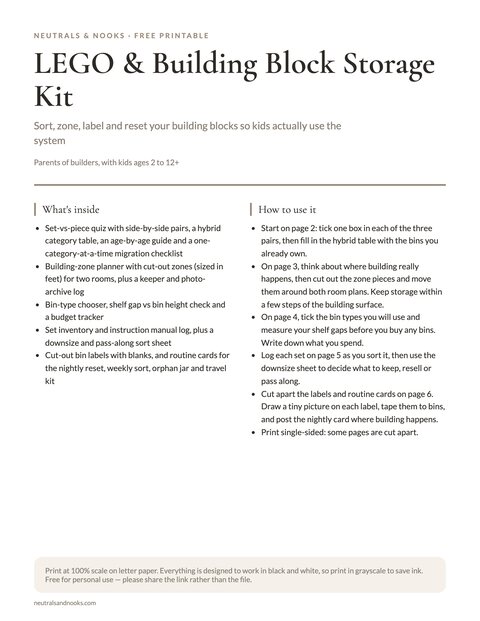
Free printable · 6 pages
LEGO & Building Block Storage Kit
A set-vs-piece sort decider, a four-zone planner with a to-scale floor plan, a bin and shelf-fit worksheet with budget tracker, a set and manual log, display and keeper trackers, routine cards, and an age-by-age chart with a downsizing checklist.
Free. Your download link appears right here. You'll also join the Monthly Home Reset. Unsubscribe anytime. Privacy
The Set Builder follows instructions, values completed builds, and wants to display finished models. This child needs: a system for keeping sets separate (or at least findable), storage for instruction booklets, and display space for completed builds. Set builders get frustrated when pieces from different sets get mixed together.
The Free Builder dumps everything into a pile and creates from imagination. This child needs: a large, accessible collection sorted by color or piece type, a generous building surface, and easy dump-and-sort capability. Free builders don’t care which set a piece came from—they care about finding the right 2×4 brick in red. If the pile is getting out of hand, my toy rotation system keeps part of the collection out of sight.
| Set Builder | Free Builder | |
|---|---|---|
| Needs | Separate sets, booklet storage, display space | Big accessible collection, generous building surface |
| Best sort method | By set, for a small number of sets | By piece type |
| Best container | Labeled bins or bags per set | Drawers or a bin frame |
In my experience, many kids start as set builders and drift toward free building as the collection grows. Some toggle between both. Choose storage for how your child builds today, and leave room to change it.
One approach that works for both types: sort by piece type (all bricks together, all plates together, all specialty pieces together) rather than by set. This makes free building easy and set building possible. You can still rebuild a set from a type-sorted collection using the instruction booklet.
The Best Storage Containers for LEGO Bricks
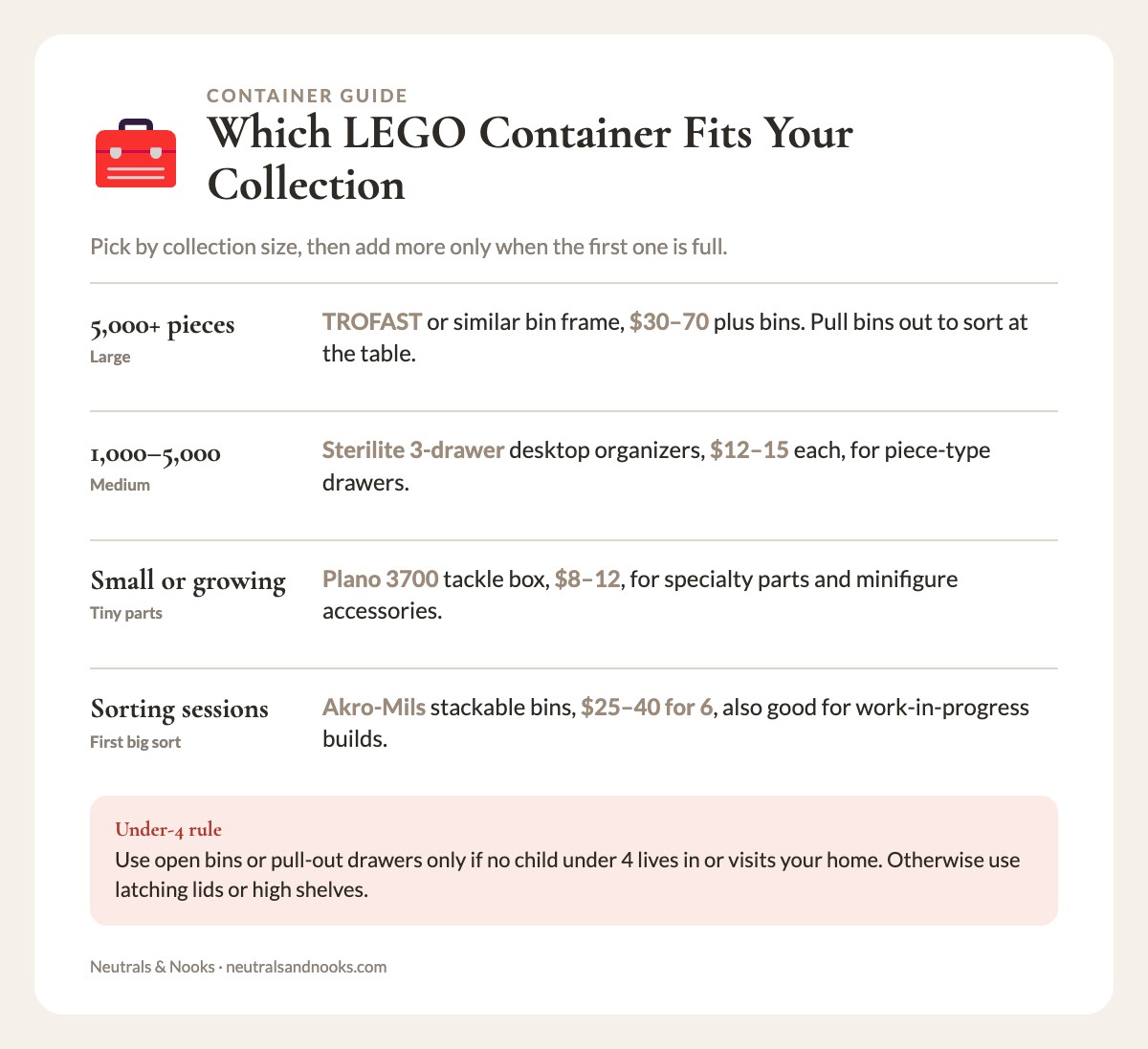
Good LEGO containers share a few traits:
- See-through, so kids can find pieces quickly
- Stackable, because the collection will grow
- Sturdy, since LEGO is heavy in quantity
- Kid-openable lids, only if no child under 4 lives in or visits the home; otherwise use latching lids or high shelves
| Collection size | Container | Approx. price | Best for |
|---|---|---|---|
| Large (5,000+ pieces) | IKEA TROFAST or similar bin frame | Frame $30–70, plus bins | Pulling out bins to sort at the building table |
| Medium (1,000–5,000) | Sterilite 3-drawer desktop organizers | $12–15 each | Piece-type drawers on a shelf or desk |
| Small or growing | Plano 3700 tackle box | $8–12 | Tiny specialty parts and minifigure accessories |
| Sorting sessions | Akro-Mils stackable bins | $25–40 for 6 | The big first sort and work-in-progress builds |
For Large Collections (5,000+ pieces): Use shallow bins for flat pieces (plates, tiles) and deep bins for bricks and specialty items. A frame with 9–12 bins holds an enormous collection. TROFAST availability varies by market, and similar bin frames work just as well. For more ways to use one, see my IKEA playroom hacks. Prices are approximate, so check current listings before you buy.
For Medium Collections (1,000–5,000 pieces): Stack two or three Sterilite units and label each drawer by piece type or color. Kids can carry a single drawer to their building surface. Pull-out drawers are easy for toddlers to open, so keep the stack on a high shelf if a child under 4 lives in or visits your home.
One trade-off I’ve noticed: closed drawers look calmer on a shelf, but open bins are quicker for kids to put away. If cleanup is the daily battle, I lean toward bins.
Safety firstOnly use open bins or pull-out drawers if no child under 4 lives in or visits your home. Otherwise, choose bins with latching lids or keep the bricks on high shelves. This applies to every container in the tables on this page.
For Small/Growing Collections: The Plano 3700 tackle box (about $8–12) has adjustable dividers that create custom-sized compartments. It suits small specialty pieces, minifigure accessories, and tiny elements that get lost in larger bins. Buy two or three as the collection grows.
For Sorting Sessions: Large Akro-Mils stackable bins (about $25–40 for a set of 6) are excellent for the initial big sort. Pour all the LEGO into these sorting bins, then distribute pieces into their permanent homes. They’re also great for “work in progress” builds that need to be set aside.
Sorting Systems: Color vs. Type vs. Set
You can organize by color, by piece type, or by set. Each has merits, but many builders find sorting by piece type works best.
| Method | Pros | Cons | Best for |
|---|---|---|---|
| By color | Looks beautiful | Hard to find a specific shape | Very small collections, young kids |
| By piece type | Fast building, every color visible | Takes one big sort to set up | Most families |
| By set | Easy to rebuild a set | Breaks down past 10–15 sets | New sets, display builders |
By Color: You end up digging through a bin of same-colored pieces in dozens of shapes. Save it for very young children who build mainly by color.
By Piece Type: When you need a 1×2 plate, you go to the plate bin and see every color at once. This is the method I recommend for most families.
By Set: The moment one piece migrates to the wrong bag, the system breaks. Past 10–15 sets, sort by type and keep the instruction booklets organized separately.
Recommended categories for a type-based sort:
| Category | Example pieces | Suggested container |
|---|---|---|
| Basic bricks | 1x, 2x, 4x in all heights | Large bin or deep drawer |
| Plates | Flat pieces, baseplates | Shallow bin or drawer |
| Slopes and wedges | Roof and angled pieces | Drawer |
| Tiles and smooth pieces | Flat finishing pieces | Drawer or tackle box |
| Technic | Beams, pins, axles, gears | Tackle box compartments |
| Specialty | Windows, doors, fences, hinges, clips | Drawer |
| Minifigures and accessories | Bodies, heads, hair, tools | Tackle box compartments |
| Wheels and vehicle parts | Wheels, axles | Drawer or small bin |
How to Run the First Sort
Plan on about one afternoon. Older kids can help, and it goes faster when no child under 4 is in the room.
- Spread a sheet. Tip the whole collection onto a flat bedsheet on a cleared floor.
- Pull the big pieces first. Large bricks, baseplates, and wheels come out quickly and shrink the pile.
- Sort by type. Work through the rest into sorting bins, one category per bin, using the table above.
- Move and label. Tip each bin into its permanent drawer and label it with the category name. A simple drawing next to the word helps pre-readers.
- Keep it up. A short monthly sort keeps the categories from blurring.
The Building Surface: Where Creation Happens
Great LEGO storage is only half the equation. You also need a dedicated building surface that’s large enough for serious projects and at a comfortable height. Keep it near the storage so pieces are within arm’s reach.
The LEGO Table Hack
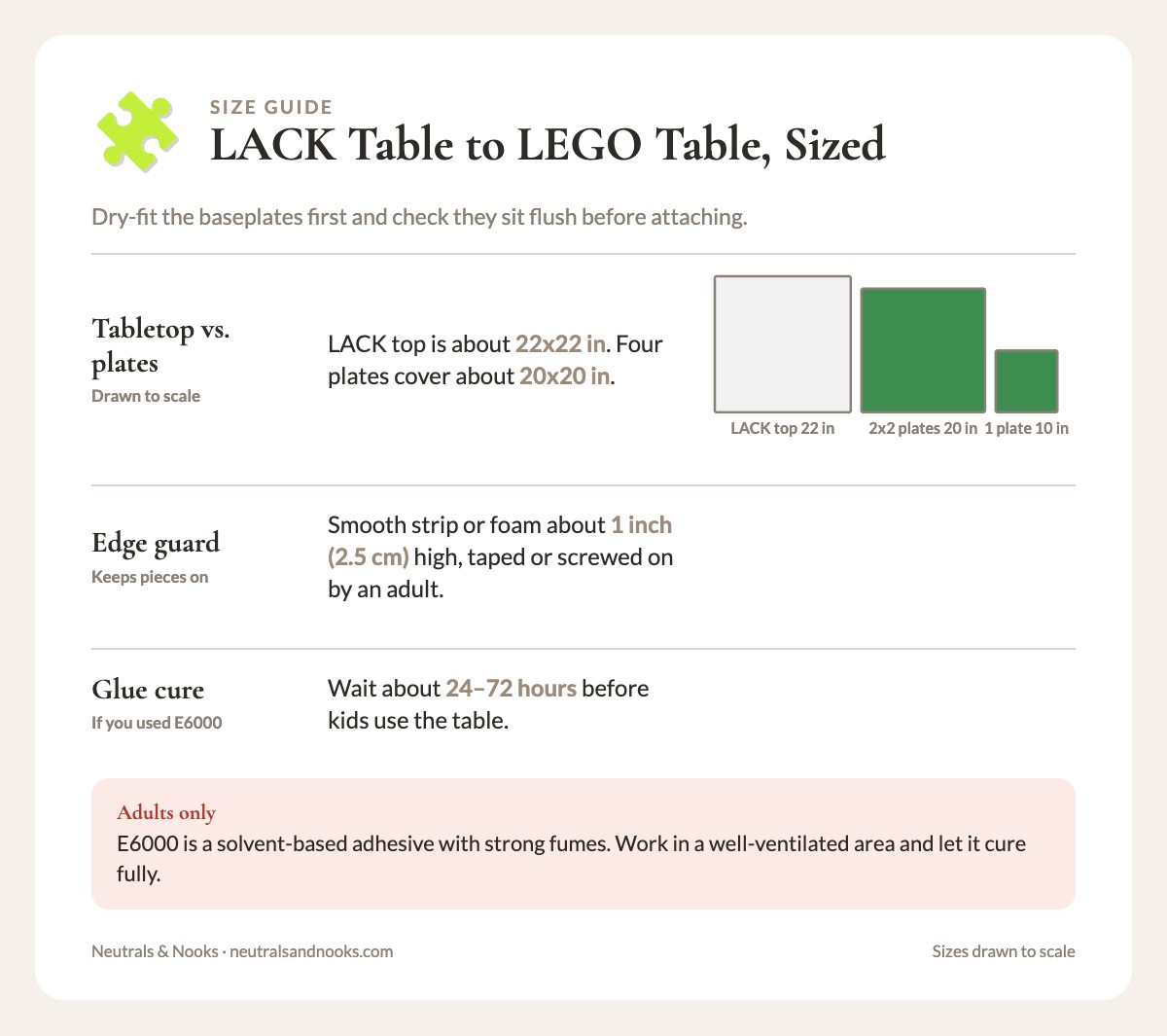
Take an IKEA LACK side table (about 22×22 in, roughly $10–15) and attach LEGO baseplates to the top. It fits four standard 10×10-inch baseplates in two rows of two (a 2×2 grid). The LACK is a good height for kids sitting on the floor or on small chairs.
- Dry-fit first. Two rows of two 10-inch (25 cm) baseplates cover about 20 x 20 inches, leaving a small margin on each side. Lay them on the tabletop and check they sit flush before attaching.
- Attach them. For baseplates you want to remove later, use heavy-duty hook-and-loop strips or removable double-sided mounting tape. For a permanent bond, an adult can use E6000.
- Cure fully. If you used glue, leave the table alone until it has cured (about 24–72 hours) before kids use it.
- Add an edge guard. Attach a smooth strip or foam edge about 1 inch (2.5 cm) high with double-sided tape, or have an adult screw it on, so pieces stay on the table.
Safety firstE6000 is a solvent-based adhesive with strong fumes, so it is an adults-only job. Work in a well-ventilated area, follow the label, and let it cure fully before kids use the table. Check the corners now and then and re-stick any that lift.
The Play-and-Store Table
A bin frame with a tabletop (an IKEA TROFAST or a similar frame) creates a surface above and storage bins below.
Safety firstFix the tabletop securely to the frame. Anchor the frame to the wall with anti-tip anchors, since a tabletop adds weight on top. Teach kids not to climb on it.
Kids build on top and reach into bins below for pieces, which works well in smaller spaces. Add the same edge guard described above to keep pieces from rolling off. TROFAST availability varies, so a similar frame is fine.
The Portable Building Tray: No space for a dedicated table? Try a large lap tray with raised edges (about $15–25) or a cookie sheet with a rim (about $10) that you keep just for LEGO. Either one keeps pieces contained during building sessions on the couch, floor, or dining table.
When building time is over, slide the tray into under-bed storage or behind furniture. For more space-saving ideas, see my playroom organization ideas.
A crucial addition to any building area: a LEGO brick separator tool (included in many sets or $3 from the LEGO Store). Keep two or three in the building area at all times. They save fingernails and give kids a safe way to pull bricks apart, so no one is tempted to use teeth. Bricks should never go in the mouth, because they are a choking risk.
Instruction Booklet and Set Box Management
LEGO instruction booklets multiply almost as fast as the bricks themselves. Each set comes with at least one booklet, and popular sets often include three or four. Without a system, they end up crumpled under beds and inside random drawers.
| Item | Keep or recycle | How |
|---|---|---|
| Booklets you can find online | Recycle | Look up the set number on LEGO.com or in the LEGO Builder app |
| Booklets you want on paper | Keep | Upright in a magazine file, labeled by set number or theme |
| Set boxes | Recycle, unless you plan to resell or gift | Flatten and store in one large bin |
Go Digital: Instructions for most current sets, and many older ones, are free when you search the set number on LEGO.com. They are also in the LEGO Builder app (free for iOS and Android). That means you can recycle physical booklets with zero guilt.
If You Keep Physical Booklets: Store them in a magazine file box (about $5–8) on a bookshelf, sorted by set number or theme. The IKEA TJENA magazine file ($5 for a 2-pack) holds dozens of booklets and keeps them upright and browseable. Label the spine: “City,” “Star Wars,” “Creator,” “Technic.”
Set Boxes: Most families can recycle boxes once the set is built, since they take up a lot of room. Keep one if you plan to resell or gift the set later. If you keep boxes, flatten them and store them in a single large bin.
Booklets can live on the shelf set up in my kids’ bookshelf and reading nook guide.
Cleanup Systems: Making Tidying Painless
The fastest way to ruin a child’s love of LEGO is to make cleanup feel like punishment. Make cleanup fast, and ideally a little fun.
The Sweep-Up Mat: A drawstring play mat (about $15–25) is an easy cleanup tool. Spread it flat for building. When playtime ends, pull the drawstring and the entire session’s worth of loose pieces cinches into a bag. Open it next time and everything’s right where you left it. The Swoop Bag (about $30) is one version. Mats work best on a clear floor and are bulky to store.
Safety firstThe drawstring cord is a strangulation and entanglement hazard for babies and toddlers. Store the mat and the cinched bag out of their reach, and keep both out of cribs and play areas. Never leave the mat looped, cinched, or unattended around a child under 4. If a baby or toddler lives in or visits your home, choose a mat that closes with a zip or a roll top instead.
TipUse the mat only when no child under 4 is present, and spread it on a cleared floor so stray bricks don’t hide underneath.
The Sorting Tray: Use this one only where no child under 4 plays or visits. Empty it into its bin after every session and store it on a high shelf.
With that in place, keep a craft sorting tray with small compartments on the building surface for small pieces during a build. I pick a craft tray over a muffin tin or ice cube tray, so nothing holding small parts looks like food ware. This prevents the “search through a giant bin” frustration and teaches organizational habits naturally.
The 5-Minute Brick Pickup: The goal isn’t perfection. It’s getting loose bricks off the floor and back near the storage system.
- Set the timer. Five minutes at the end of building time.
- Bricks to bins. Loose bricks go into their bins, close enough is fine.
- Strays to lost-and-found. Anything found under the couch goes in the small container.
- Sort monthly. Save the thorough sorting for a monthly session.
For stray bricks that escape (and they always do), keep a small “lost and found” container with a latching lid on a high shelf, out of reach of any child under 4 who lives in or visits your home. When anyone finds a random LEGO piece under the couch or in the washing machine, it goes in the lost-and-found bin. Empty it into the main collection during monthly sorting.
LEGO storage grows with your child’s collection. The system for a five-year-old with a first set will look nothing like the one a ten-year-old needs for 20,000 pieces.
Your next step: watch one building session this week and note whether your child follows a booklet or dumps the pile. Then buy one container type from the table above and run the first sort. Add more only when that one is full.
LEGO Storage FAQ
How do I store LEGO without sorting?
Use one large lidded bin and a play mat that closes with a zip or a roll top. Spread the mat to build, close it when playtime ends, and add a tackle box for tiny pieces once digging gets frustrating. A drawstring mat is an option only if no child under 4 lives in or visits your home, because the cord is a strangulation hazard.
What is the best LEGO storage for small spaces?
A rimmed tray that slides under a bed, plus a stack of desktop drawers on a shelf. A bin frame with a tabletop also gives you a building surface and storage in one footprint. My small playroom ideas have more options.
How do I store LEGO sets with their instructions?
Sort the bricks by type and keep the booklets upright in a labeled magazine file. You can rebuild a set from a type-sorted collection using the booklet or the free digital instructions.
What about Duplo and other building blocks?
Bigger blocks need fewer, larger bins and no tiny compartments. See my LEGO and building block storage guide for those.
Neutral Nina
Neutral Nina is an interior design enthusiast and mom of three who proves that beautiful, organized spaces and family life can coexist. She shares practical strategies for creating calm, functional homes that work for kids and grown-ups alike.