Dress-Up Clothes Organization and Storage
Tired of dress-up clutter? Learn how to effectively organize your child's costume collection by curating items, utilizing hanging storage for full costumes, and corralling accessories with smart solutions.
- Curate your collection first: remove unused items and keep 15-20 pieces per child.
- Utilize low clothing racks or wall-mounted rods for hanging costumes to prevent wrinkles.
- Corral accessories like hats, wands, and jewelry with hooks or designated containers.
- Use kid-sized hangers and display costumes facing out for easy browsing and re-hanging.
There’s a superhero cape draped over the banister, a princess dress balled up behind the couch, and a pirate hat wedged between the sofa cushions. The lid of the “dress-up box” hasn’t closed in months.
This guide follows the order you’d set it up: sort and edit the collection, hang full costumes at kid height, give accessories labeled spots, teach a quick cleanup routine, and rotate seasonally. Optional DIY station ideas and a troubleshooting table sit in between, and our Dress-Up Clothes Storage Kit printable goes with the plan.
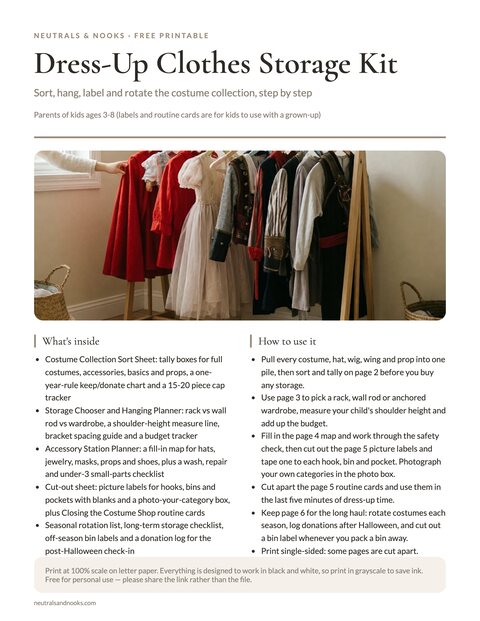
Free printable · 6 pages
Dress-Up Clothes Storage Kit
A costume sort sheet with category tallies, a one-year keep/donate chart and a 15-20 piece cap tracker, a rack vs rod vs wardrobe chooser with a hanging and budget planner, an accessory station map with a safety check, a cut-out sheet of picture labels and closing-the-costume-shop routine cards, and a seasonal rotation, long-term storage and donation log.
Free. Your download link appears right here. You'll also join the Monthly Home Reset. Unsubscribe anytime. Privacy
If the costumes live in a playroom, our playroom organization ideas cover the bigger picture.
In this article (8 sections)
- How to Sort and Edit a Dress-Up Collection
- Dress-Up Storage Ideas: Racks, Rods and Hangers
- Storing Dress-Up Accessories, Hats and Props
- DIY Dress-Up Station Ideas
- How to Get Kids to Put Costumes Away
- Troubleshooting Common Dress-Up Storage Problems
- Seasonal Rotation and Long-Term Costume Storage
- Dress-Up Storage FAQ
How to Sort and Edit a Dress-Up Collection
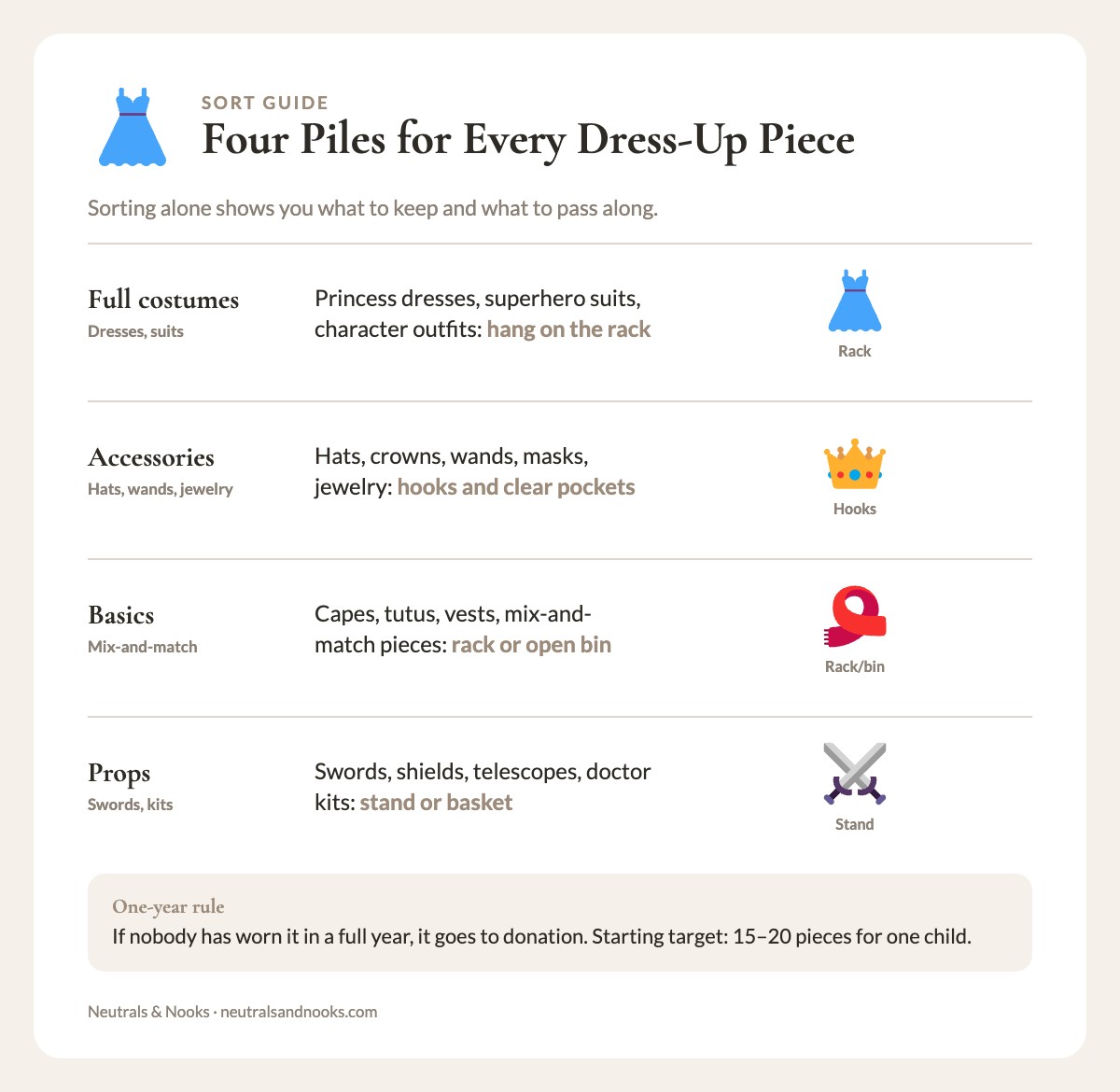
Before you buy any storage, edit the collection. Pull every costume, accessory, hat, wig, pair of wings, and prop out of the house and pile them up.
The volume is usually surprising. Between Halloween costumes, party favors, hand-me-downs, and impulse buys, most families own far more dress-up than their kids actually use.
Sort everything into four categories. This sorting alone will show you what to keep and what to pass along.
| Category | Examples | Where it goes |
|---|---|---|
| Full costumes | Princess dresses, superhero suits, character outfits | Hang on the rack |
| Accessories | Hats, crowns, wands, masks, jewelry | Hooks and clear pockets |
| Basics | Capes, tutus, vests, mix-and-match pieces | Rack or open bin |
| Props | Swords, shields, telescopes, doctor kits | Stand or basket |
Apply the “one-year rule”: if nobody has worn it in a full year, it goes to donation. A costume that comes out of the rotation bin and gets worn counts as used.
Pass along costumes that no longer fit, and any character your child has moved on from. Keep the mix-and-match basics.
Safety firstCheck every piece for hazards before it goes back in the rotation.
- Small parts: use the toilet-paper tube test on anything a child under 3, or any child who still mouths objects, can reach. That includes a younger sibling who shares the room. If a button, bead, sequin, or gem fits inside the tube, remove it, secure it, or store the piece out of their reach.
- Neck closures: a cape that doesn’t release can choke a child if it catches on furniture or play equipment. Swap neck ties and ribbons for a snap or a light hook-and-loop closure, or retire the cape.
- Flame: keep costumes away from candles, stoves, and heaters.
- Button and coin batteries: check light-up wands, crowns, swords, and sound-making props. The battery compartment should be held shut with a screw. Remove any prop with a loose or exposed battery, or store it out of reach. A swallowed battery can cause severe internal burns within hours, so seek emergency care immediately. In the US, Poison Help is 1-800-222-1222.
- Check care labels, then wash or spot-clean as directed before storing.
- Repair loose buttons, torn seams, and broken zippers now, or discard the piece.
- Don’t share wigs or face paint without washing, and patch-test makeup first.
- I suggest a starting target of 15–20 pieces for one child, and a little more for siblings who share. The number is flexible.
Dress-Up Storage Ideas: Racks, Rods and Hangers
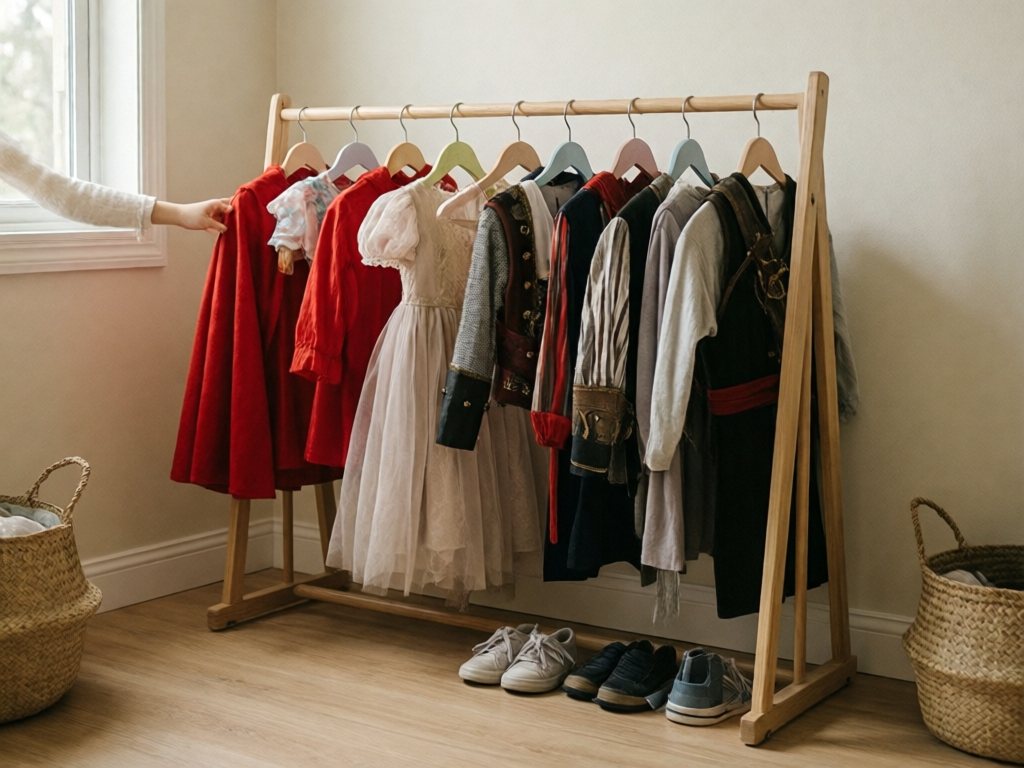
The biggest mistake with dress-up clothes is stuffing everything into a bin. Costumes get wrinkled, kids can’t see what’s available, and they dump the whole bin to find one piece. Hanging full costumes avoids all three.
A low kids’ clothing rack works well for dress-up, and many cost roughly $15–35. Choose one that adjusts so the rail sits about 30–36 inches high for ages 3-5, then raise it as your child grows. Lightweight racks fit neatly in a corner.
I like a plain wooden rack with matching hangers here. The storage stays quiet, and the colorful costumes become the focal point.
If floor space is limited, mount a sturdy curtain rod on the wall at your child’s shoulder height. It uses no floor space and turns a blank wall into a costume display. Screw the brackets into studs or use rated heavy-duty anchors. Keep the span short enough that a loaded rod won’t sag.
Use the rod for light costumes only, not heavy coats or bags, and stay within the weight rating printed on the brackets or anchors.
Safety firstAnchor freestanding racks, wardrobes, and tall shelves to the wall. Racks and rods hold light costumes only. Kids must never hang, swing, or climb on them, so set the rail low enough that they can reach without climbing. Keep cords, long ties, and ribbons away from necks, and supervise the youngest children around racks and rods.
Use kid-sized hangers so costumes don’t slip, and add a loop or hook for capes and items without a hanger loop.
Hang each costume with its front facing the room, and leave a little space between hangers. Kids rehang things more easily when each costume has its own visible spot.
Not everything hangs. Tutus, wings, and shoes do better in open bins or baskets at floor level, so the rack stays for full costumes only.
Storing Dress-Up Accessories, Hats and Props
Accessories are where dress-up storage usually falls apart. Wands and swords end up under beds, crowns get crushed, and jewelry tangles into knots. The solution is designated containers positioned right next to the hanging costumes.
For hats, crowns, and helmets, mount a row of wall hooks at kid height. Each hook holds one or two headpieces, keeping them visible and easy to reach. An over-the-door hook strip works too.
For jewelry, masks, and small accessories, use a hanging shoe organizer with clear pockets. Hang it on the back of a closet door or on the wall beside the costume rack. Keep beaded or gem-heavy jewelry out of reach of toddlers and younger siblings.
For larger props like swords, shields, and wands, an umbrella stand keeps them upright and easy to return. Choose soft foam props, and keep rigid or pointed ones out of the kids’ set because they can injure eyes. Weight the stand or place it against a wall so it can’t tip.
Shoes and boots deserve their own small bin or shallow basket at floor level, separate from everyday footwear.
| Item type | Best container | Placement | Notes |
|---|---|---|---|
| Hats and crowns | Wall hooks | Kid shoulder height | One or two per hook |
| Jewelry and masks | Clear-pocket organizer | Door or wall by the rack | Keep small parts away from toddlers |
| Wands and swords | Weighted umbrella stand | Against a wall | Soft foam props only |
| Shoes | Shallow bin | Floor level | Separate from daily shoes |
| Wigs | Open basket | Shelf or floor | Wash before sharing |
DIY Dress-Up Station Ideas
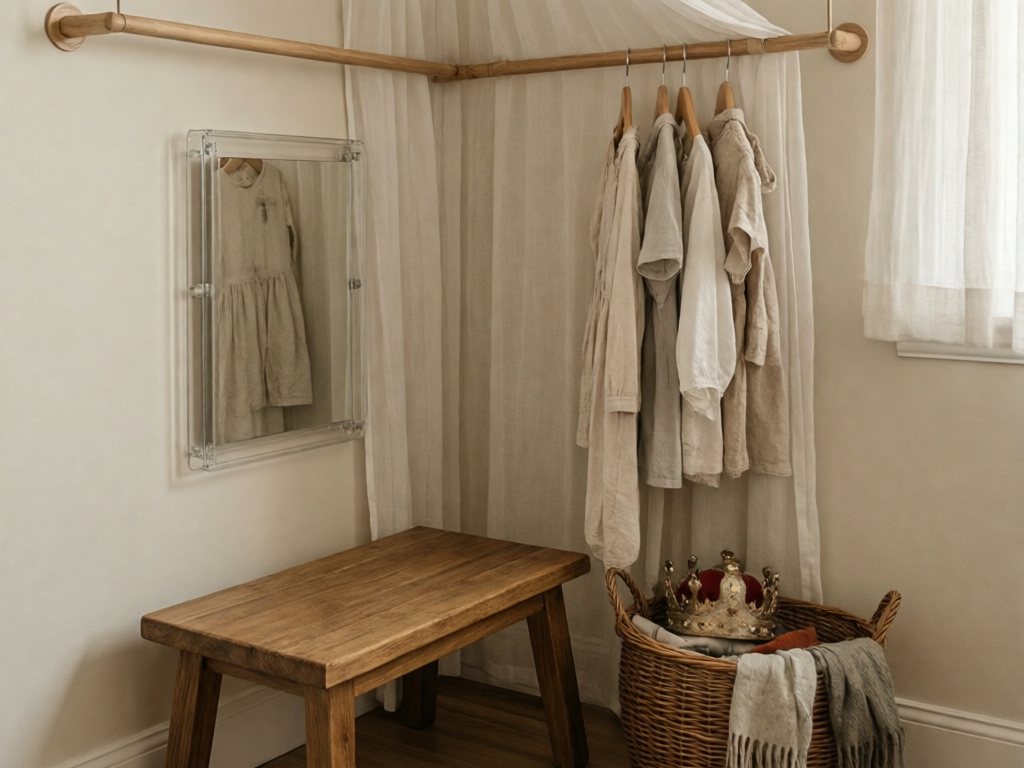
If you love a weekend project, a dedicated dress-up station gives a playroom or bedroom a clear focal point. Most of these projects are simple and budget-friendly.
Good to knowUse furniture only as designed, anchor everything to the wall, and use a shatterproof mirror.
The Shelf-and-Rack Station
Pair a low shelf unit, used as designed, with a separate low clothing rack beside it. Anchor the shelves to the wall with the hardware supplied. Use the cubbies for bins of accessories, and fabric bins for a polished look. If you add a rod, make sure it is firmly seated or screw-mounted.
The Corner Dress-Up Nook
Install two sturdy rods meeting at a 90-degree angle, screwed into studs, and hang a sheer curtain behind them for a “backstage” feel. Add an acrylic or shatterproof children’s safety mirror, securely wall-mounted at kid height. Finish with a basket for accessories and, if you like, a sturdy low stool.
The Repurposed Wardrobe
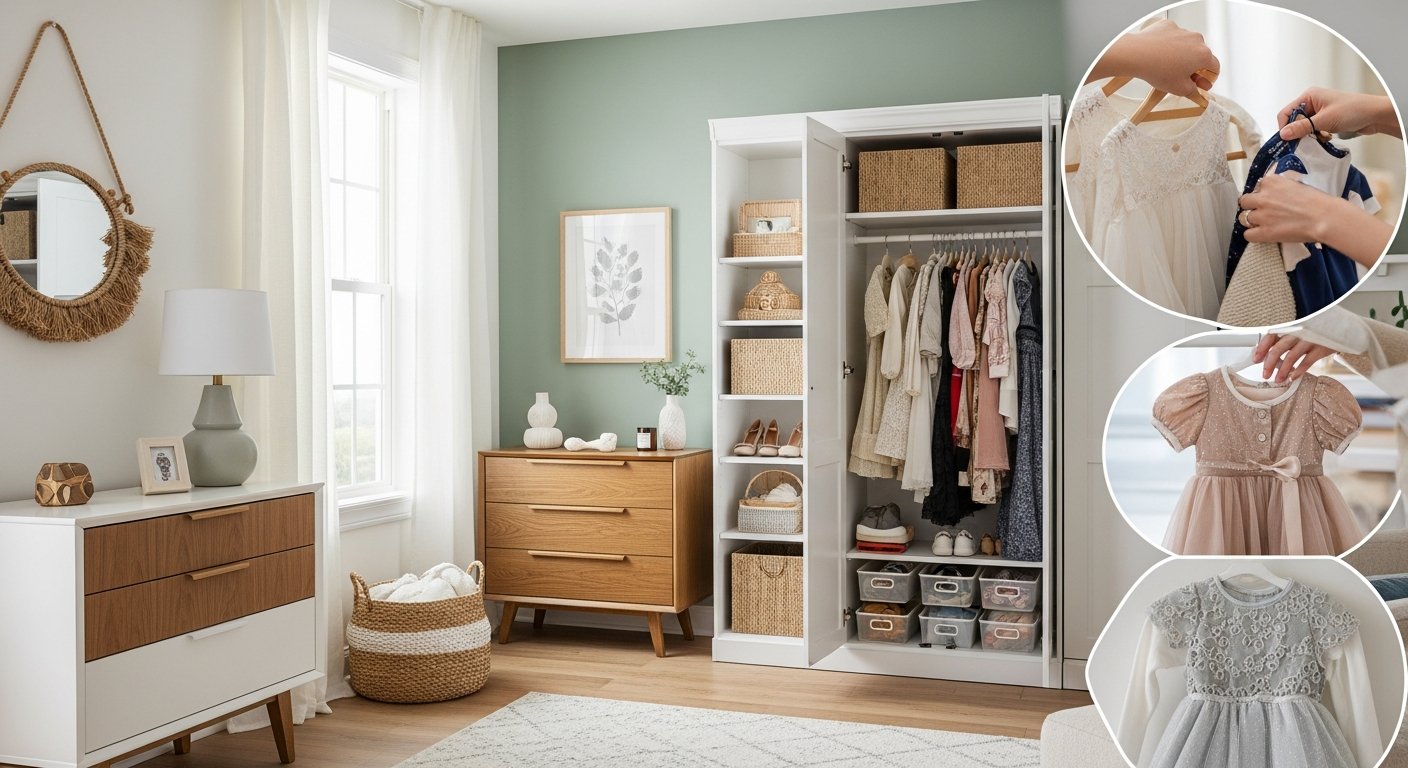
A small secondhand wardrobe or armoire can hide everything behind closed doors, which suits living rooms and shared spaces. Add hooks inside the doors, a rod for hanging, and bins on the bottom shelf.
Safety firstMake a secondhand wardrobe safe before any costumes go in.
- Anchor it to a wall stud with anti-tip brackets.
- Keep the inside rod for light costumes only, and teach kids not to hang on it or climb inside.
- Remove door latches, or fit a catch that opens from the inside, so a child can’t be trapped.
- Don’t sand or scrape old finishes, since they may contain lead. Test first or choose a different piece.
- Use low-VOC paint and let it cure fully before use.
| Station | Space needed | Best for | Safety must-do |
|---|---|---|---|
| Shelf-and-rack | One wall | Playrooms | Anchor shelves to the wall |
| Corner nook | A corner | Bedrooms | Shatterproof, wall-mounted mirror |
| Repurposed wardrobe | One wall | Shared spaces | Anti-tip brackets, no latch trap |
How to Get Kids to Put Costumes Away
A beautiful dress-up station only works if kids actually use it. The goal is a system simple enough that putting things away feels like part of the game.
One honest trade-off: an open rack looks busy, while a closed wardrobe hides the mess but tends to get used less. Pick the one your family will actually reset, and expect some mess either way.
Start with the “one in, one out” rule: before pulling out a new costume, the previous one goes back. This prevents the floor-covered-in-costumes situation and teaches kids to reset as they go.
Label everything with pictures for pre-readers. Take photos of each costume and accessory category, print them on a home printer, and tape them to the corresponding hook, bin, or pocket. When a child can match the fairy wings to the photo of fairy wings, they can put things away independently.
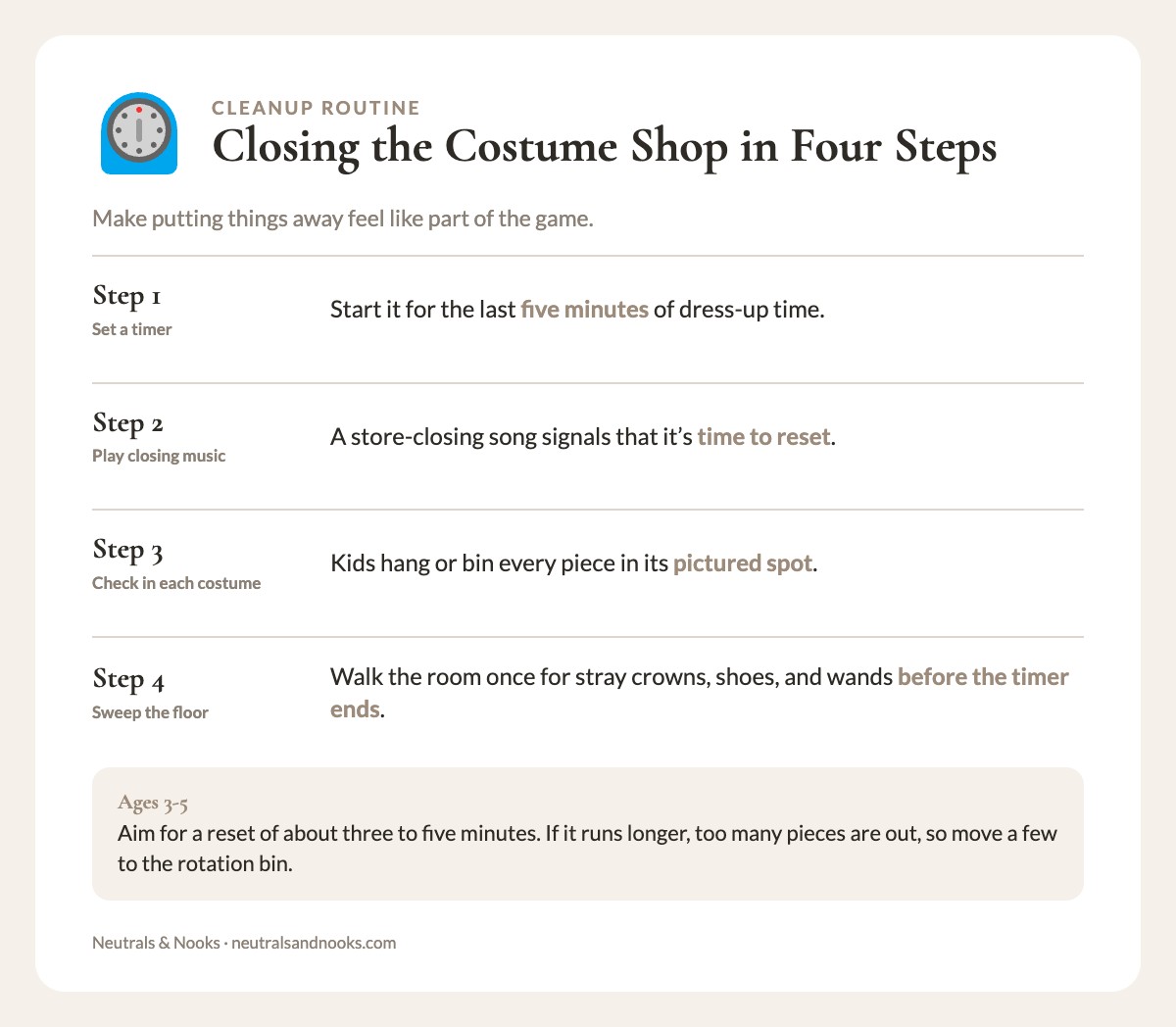
Build cleanup into the play itself by making “closing the costume shop” part of the game.
- Set a timer. Start it for the last five minutes of dress-up time.
- Play closing music. A store-closing song signals that it’s time to reset.
- Check in each costume. Kids hang or bin every piece in its pictured spot.
- Sweep the floor together. Walk the room once for stray crowns, shoes, and wands before the timer ends.
TipFor ages 3-5, aim for a reset that takes about three to five minutes. If it regularly takes longer, too many pieces are out, so move a few to the rotation bin.
Habits That Help
- Model hanging up costumes yourself the first few times.
- Praise the process (“I love how you hung that cape so carefully”), not just the result.
- Accept imperfect hanging. A crooked cape on a hook is better than a cape on the floor.
- Occasionally add a new thrift store accessory as a reward for keeping it tidy.
Troubleshooting Common Dress-Up Storage Problems
If the system isn’t holding, find the problem below and try the fix.
| Problem | Likely cause | Fix |
|---|---|---|
| Kids dump the rack | Too many pieces are out | Edit again and move the extras to the rotation bin. |
| A toddler pulls everything down | The rail is within the toddler’s reach | A rail low enough for a 3-5 year old is also low enough for a toddler, so height alone won’t solve it. Use a closed, anchored wardrobe, gate off the dress-up corner, or move the rack to a room the toddler can’t enter. Supervise when the toddler is nearby. |
| Costumes get wrinkled or slip off hangers | Adult-size hangers or a crowded rail | Switch to kid-sized hangers and leave space between them. Move tutus and stretchy pieces to an open bin. |
| Tiny space | No floor room for a rack | Use a wall rod plus one bin, and rotate more often. |
| Siblings fight over pieces | No clear way to share favorites | Give each child their own hook for personal pieces, keep shared pieces in one spot, and use a timer for turns. |
Seasonal Rotation and Long-Term Costume Storage
Not every costume needs to be out all year. Rotation keeps the collection fresh and the storage manageable, and it works like our toy rotation system.
TipKeep a small core set out (capes, crowns, tutus) and rotate the rest. Store bins out of toddler reach.
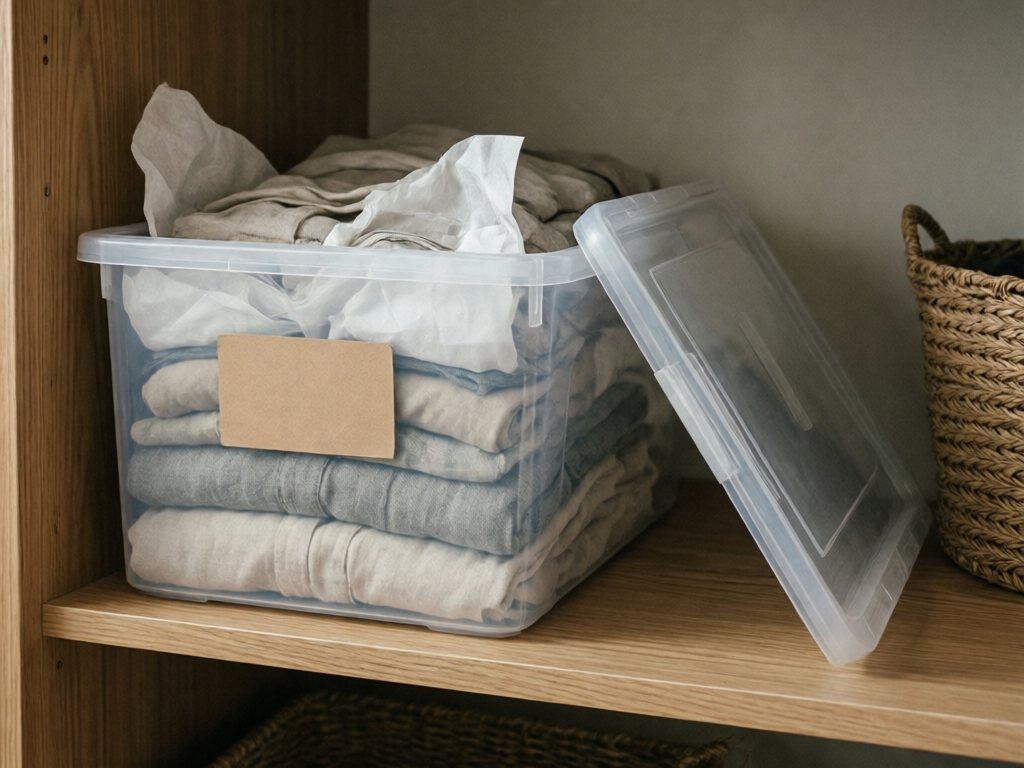
Rotate seasonal and character-specific costumes in and out. Store off-season costumes in a labeled clear bin on a high shelf. Use a bin with a loose lid, not a latching one, in case a toddler ever climbs in.
Before costumes go into long-term storage, work through four quick steps.
- Clean and dry. Clean each piece as the care label says, and make sure it is fully dry.
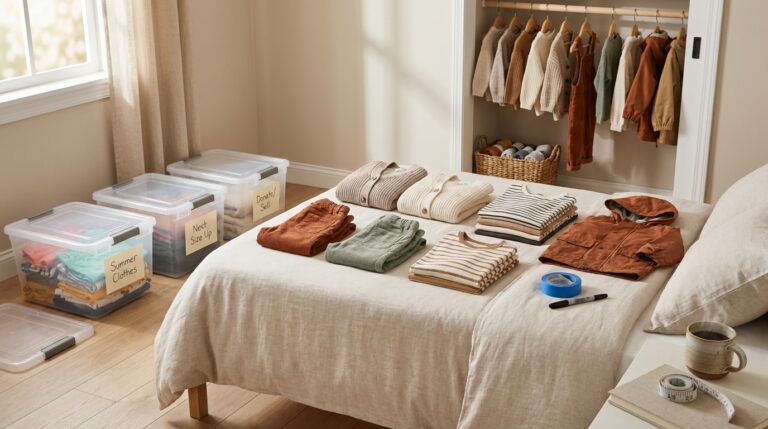
- Fold loosely. Tuck tissue paper into structured pieces to keep their shape.
- Protect delicate pieces. Slip delicate or sentimental costumes into garment bags.
- Skip the mothballs. Never use them. Clean, dry storage is the real protection against moths.
Cedar is optional and only mildly effective against moths. If you use it, keep it in a closed sachet with the bin on the high shelf, well away from where children play.
Halloween is the biggest influx of new costumes. Make a post-Halloween tradition of sorting through the collection together: new costume in, outgrown costume to the donation pile.
More organizing guides: the same edit-and-zone approach works for kids’ closets, shared kids’ rooms, and mudroom cubbies.
Dress-Up Storage FAQ
How many costumes should I keep?
Start with the 15–20 piece target from the sorting step, then adjust to how your child actually plays. If the rack stays tidy and nothing gets dumped, the number is right.
How do I store dress-up clothes without a closet?
Use a low rack or a wall-mounted rod, plus a bin for tutus and wings. A closed wardrobe also works if it is anchored and can be opened from the inside.
How do I store costumes long term?
Clean and fully dry them, fold loosely, and keep them in a labeled bin with a loose lid on a high shelf. Cedar is optional; if you use it, keep it in a closed sachet out of children’s reach.
Where do dress-up shoes and accessories go?
Shoes go in a shallow bin at floor level. Hats, jewelry, and props get their own hooks, pockets, or stand.
Neutral Nina
Neutral Nina is an interior design enthusiast and mom of three who proves that beautiful, organized spaces and family life can coexist. She shares practical strategies for creating calm, functional homes that work for kids and grown-ups alike.