Cheap Organization Ideas That Look Expensive
Learn how to create expensive-looking home organization on a budget by focusing on color consistency, decanting items, and using clever DIY labeling techniques. You'll discover specific products and hacks to transform your space for a fraction of the cost.
- Choose a consistent two-color palette for each space to achieve a cohesive, high-end look.
- Decant items from original packaging into matching jars, canisters, and pump bottles.
- Create professional-looking labels using Canva, chalk pens, or simple clip-on tags.
- Utilize affordable storage lines like Target Brightroom, IKEA KUGGIS, or mDesign clear bins.
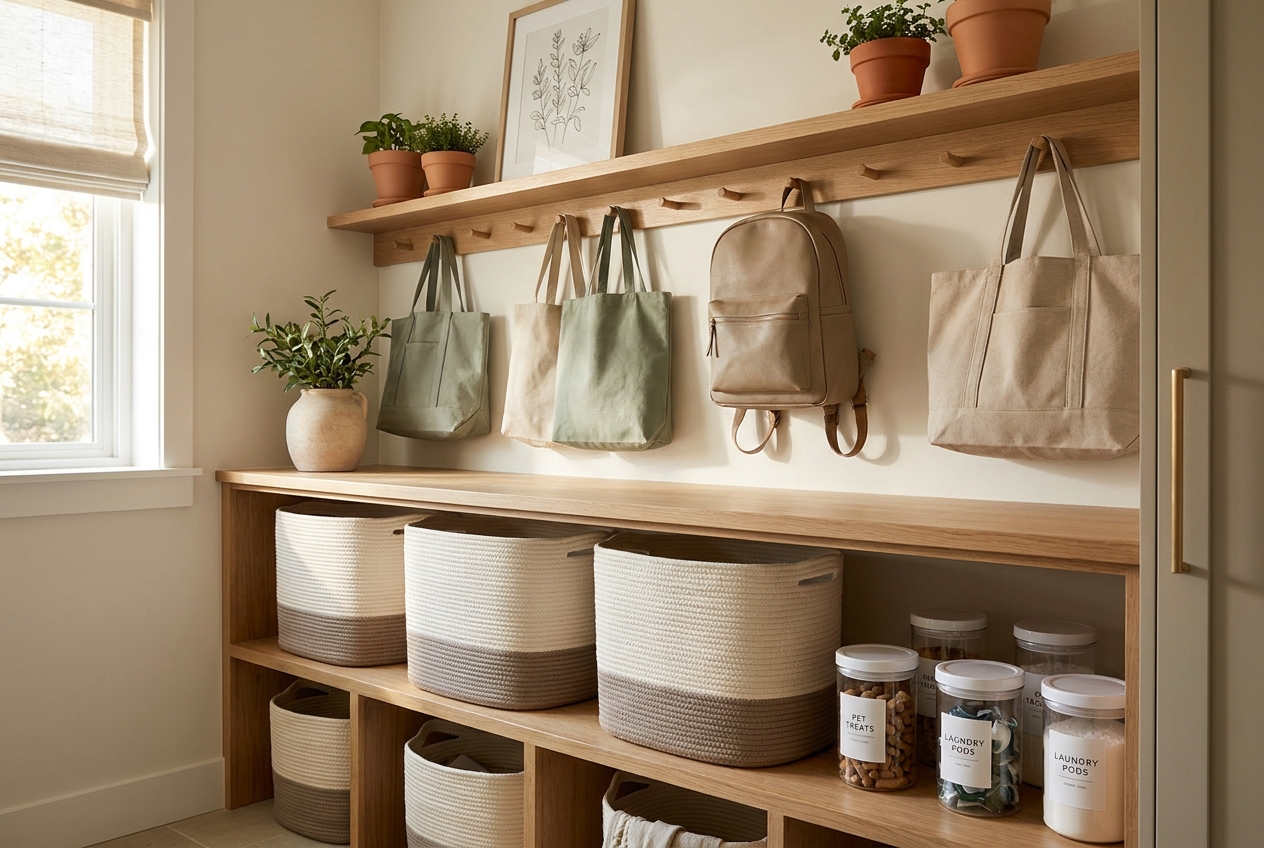
Last Thanksgiving, my sister-in-law walked into our mudroom and asked who our interior designer was. I almost choked on my coffee. That mudroom—with its matching baskets, labeled hooks, and coordinated color palette—cost exactly $47 to put together, most of it from Dollar Tree and Target’s clearance endcap. The secret to organization that looks like it belongs in a magazine is not money. It is consistency, intentional color choices, and a few clever tricks that make $5 items look like $50 ones.
I have spent the last four years turning our 1,400-square-foot home into a space that functions for two adults, three kids, and a golden retriever—all without blowing our budget. These are the specific techniques, products, and hacks that create that “expensive organized” look for a fraction of the cost.
In this article (6 sections)
The Color Coordination Principle
The single biggest difference between cheap-looking organization and expensive-looking organization is color consistency. Walk into any Container Store display and notice: everything matches. The bins are the same shade, the labels use the same font, and there are no more than two or three colors in the entire setup. You can replicate this at home for almost nothing.
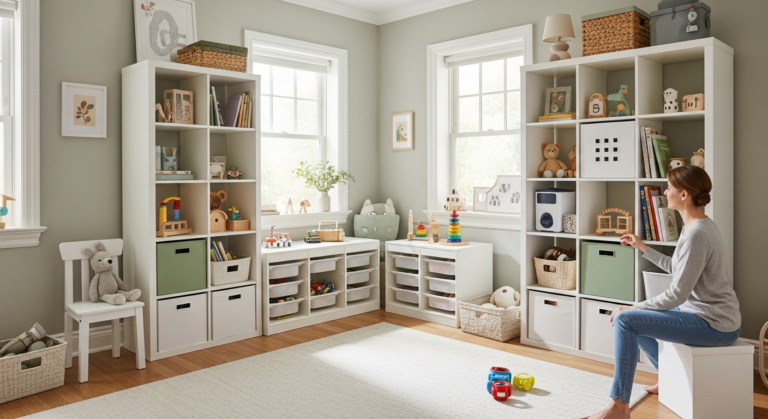
Start by choosing a two-color palette for each space. For kitchens, white and natural wood reads as clean Scandinavian. For playrooms, soft sage and cream feels modern without screaming “kids live here.” For bathrooms, white and matte black creates that spa-like feel. Write your palette down and refuse to buy anything that does not match, no matter how cute it is on the shelf.
The Target Brightroom line is a goldmine for affordable matching storage. Their woven baskets ($8–15) come in cream, gray, and sage across multiple sizes—so your bathroom basket matches your living room basket matches your linen closet basket. IKEA’s KUGGIS boxes ($5–8) in white create that sleek, uniform look on shelves. And for transparent storage, the mDesign clear bins on Amazon ($12–18 for a set of 4) look nearly identical to the $8-per-bin options at The Container Store.
Here is a trick professional organizers use: remove all original packaging. Transfer cereal into matching canisters, put cotton balls in a glass jar, and decant dish soap into a matching pump bottle. The IKEA 365+ dry food jars ($4–7 each) with bamboo lids look nearly identical to the $25 Anthropologie versions that fill Pinterest boards. Suddenly your pantry looks like a styled photoshoot instead of a grocery haul.
Labels That Elevate Everything
Labels are the jewelry of home organization—they take a basic setup and make it look intentional and polished. But skip the label maker for now. The most expensive-looking labels are actually the cheapest to make.
Option 1: Canva + clear sticker paper. Design minimalist labels in Canva (free) using a clean sans-serif font like Montserrat or Lato. Print on clear sticker paper from Amazon ($10 for 15 sheets) using your home printer. Applied to glass jars or white bins, these look absolutely professional. I have had multiple friends ask if I ordered custom labels—nope, just a $10 pack of sticker paper.
Option 2: Chalk pen on dark surfaces. A white chalk marker ($6 for a 2-pack) on dark baskets, black bins, or chalkboard labels creates that farmhouse-chic look. The writing wipes off and reapplies, so you can update labels as your storage needs change—perfect for pantries where contents rotate.
Option 3: Clip-on tags. Small kraft paper tags ($4 for 100 on Amazon) tied to basket handles with twine give a warm, artisan feel. This works beautifully on woven baskets in linen closets, mudrooms, and kids’ shelving. The total cost is about seven cents per label.
- Pantry jars: Print clear labels on sticker paper — $0.67 per label
- Basket tags: Kraft tags with twine — $0.07 per label
- Bathroom containers: Waterproof vinyl labels from Cricut or Canva — $0.50 per label
- Kids’ bins: Picture labels (printed photos of contents) for pre-readers — free with home printer
Transforming Dollar Store Finds Into Designer Storage
I will never stop singing the praises of Dollar Tree for organization, but the key is transformation. A plain plastic bin looks like a plain plastic bin. That same bin with a coat of spray paint and a linen liner looks like something from West Elm.
Wire basket upgrade: Dollar Tree carries small wire baskets that, when spray-painted matte gold or matte black with Rust-Oleum 2X Ultra Cover ($5 at Walmart), become gorgeous shelf accents. Line them with a scrap of linen fabric or a cloth napkin from the thrift store, and you have a catchall that looks like it cost $20–25 from Target.
Glass jar transformation: The plain glass cylinder vases and apothecary-style jars at Dollar Tree ($1.25 each) are identical in shape to containers sold at HomeGoods for $12–18. Use them in the bathroom for cotton swabs, bath salts, or hair ties. Group three different heights together on a small tray (also Dollar Tree, $1.25) for an instant vanity display.
Acrylic bin hack: Dollar Tree now carries clear acrylic bins in the craft section. These are the exact type of bins that professional organizers charge clients $8–15 each for at The Container Store. Buy a dozen, use them in your refrigerator, your bathroom drawers, or your kids’ craft supplies. Nobody will know they cost $1.25 each.
Clipboard gallery: Buy five or six Dollar Tree clipboards, spray-paint them all the same color (white, natural wood-tone, or matte black), and mount them in a row on a wall. Clip in your kids’ artwork, family photos, or weekly meal plans. This creates a functional, rotating gallery wall for under $10 that looks like a custom installation.
Secondhand Scores: What to Buy Used
Some of the most expensive-looking organizational furniture in our home came from Facebook Marketplace, estate sales, and Goodwill. The trick is knowing what to look for and how to give it a five-minute facelift.
Bookcases: Solid-wood bookcases from Goodwill ($15–40) painted in Behr Cameo White or Sherwin-Williams Alabaster look indistinguishable from a $250 Pottery Barn Kids bookcase. Sand lightly, prime with Kilz, and apply two coats. The whole refresh costs about $25 in supplies and transforms the piece completely.
Baskets: Woven baskets at thrift stores typically run $2–5 each. If they are slightly discolored, a quick coat of white spray paint unifies them. Line them all with the same fabric (buy a yard of muslin from Joann Fabrics for $3) and suddenly you have a matching set that rivals the $30-per-basket options at Pottery Barn.
Trays and containers: Wooden trays, ceramic dishes, and glass containers show up at thrift stores constantly. A wooden tray ($3) with new felt pads on the bottom becomes a drawer organizer. A ceramic baking dish ($2) holds remote controls on the coffee table. Think function first, original purpose second.
Dressers as storage: A dated dresser ($20–50 on Marketplace) in your entryway, painted to match your decor, provides hidden storage for shoes, scarves, dog leashes, and mail. Add new knobs from Hobby Lobby ($2–4 each during their perpetual 50% off sale) and it looks like a custom entryway console.
Room-by-Room Quick Wins Under $20
Sometimes you do not need a full overhaul—you just need one or two targeted upgrades that make a space feel dramatically more organized. Here are the highest-impact changes I have made, all under $20 per room.
Bathroom: Install a Command hook strip ($8 for a 6-pack) inside the cabinet door under your sink. Hang hair tools, cleaning spray bottles, or small baskets. This single change freed up an entire shelf in our bathroom and cost less than a fast-food meal. Add a matching set of pump bottles ($10 for 3 on Amazon) for soap, lotion, and hand sanitizer to eliminate visual clutter on the counter.
Kitchen: A lazy Susan ($8–12 from Target or Amazon) inside a deep cabinet or on the countertop corrals oils, spices, or kids’ cups. It is one of those small upgrades that makes daily life noticeably smoother. Pair it with matching spice jars ($15 for 12 on Amazon) and suddenly your spice cabinet looks like it belongs in a cooking show.
Entryway: Three matching adhesive hooks ($6) at kid height, plus a single basket below for shoes ($8 from Target), creates an instant kid-friendly drop zone. Label each hook with your child’s name using a chalk pen for that custom mudroom look. Total cost: $14. Impact: no more shoes scattered across the living room floor.
Playroom: Replace mismatched toy bins with a uniform set. The IKEA TROFAST bins ($3–5 each) in white or natural fit standard shelving units and create instant visual calm. Even just switching to all-white bins in your existing shelf makes the room look 50% more organized without actually reorganizing anything.
Maintaining the Look Without the Effort
The most beautifully organized home in the world falls apart without maintenance systems. The good news is that maintenance does not mean spending hours tidying—it means building tiny habits into routines you already have.
The “one in, one out” rule is the single most effective long-term organization strategy, and it costs nothing. Every time something new comes into the house—a toy, a kitchen gadget, a pair of shoes—something similar leaves. This prevents the slow creep of clutter that makes even great organizational systems fail.
Set a 15-minute evening reset timer after the kids go to bed. Each family member has a basket or bin (there are those matching baskets again) where stray items land throughout the day. During the reset, everyone returns their items to their proper homes. This is not deep cleaning—it is surface-level tidying that keeps your organization systems visible and functional.
Finally, seasonal purging keeps things from accumulating beyond your storage capacity. At the start of each season, spend one hour per room removing anything unused, outgrown, or broken. Donate, sell, or toss. The less you own, the less you need to organize—and the more expensive your home looks, because breathing room is the ultimate luxury.
Beautiful organization is not about spending more. It is about matching colors, using labels, and making intentional choices with inexpensive materials. When everything coordinates and every item has a home, a $5 basket looks just as elegant as a $50 one. Your home deserves to feel pulled together—and your wallet deserves a break.
Neutral Nina
Neutral Nina is an interior design enthusiast and mom of three who proves that beautiful, organized spaces and family life can coexist. She shares practical strategies for creating calm, functional homes that work for kids and grown-ups alike.