Thrift Store Finds for Kids’ Room Decor
Discover how to furnish your kids' room affordably with charming, character-filled secondhand finds. This guide shows you where to find the best deals and what specific items to thrift for quality and style.
- Explore diverse sources like Goodwill, Facebook Marketplace, and estate sales for unique finds.
- Prioritize solid wood dressers, sturdy bookshelves, and frames for budget-friendly decor.
- Shop midweek at thrift stores or early/late at estate sales for the best selection and deals.
- Look for quality indicators like dovetail joints in furniture for lasting pieces.
The nursery makeover on your Pinterest board costs $3,200. The one you can actually afford? Maybe $200 if you’re stretching it. But here’s a secret that design-savvy parents have been whispering about for years: some of the most charming, character-filled kids’ rooms are furnished almost entirely with secondhand finds. Thrift stores, estate sales, Facebook Marketplace, and Goodwill are treasure troves of solid-wood furniture, vintage decor, and one-of-a-kind pieces that bring personality to a child’s room in ways that mass-produced big-box store items simply cannot. The key is knowing what to look for, what to skip, and how to transform a $12 dresser into the centerpiece of a room that looks like it belongs in a magazine.
In this article (5 sections)
Where to Thrift: The Best Sources for Kids’ Room Finds
Not all thrift sources are created equal. Knowing where to shop—and when—makes the difference between frustrating empty-handed trips and thrilling $8 hauls.
Goodwill and Salvation Army: These national chains are the workhorses of thrifting. Prices are low ($3–25 for most decor and small furniture), inventory turns over quickly, and most stores restock daily. Visit midweek for the freshest selection—weekends get picked over fast. Many Goodwill locations now have color-tag sales where certain tags are 50% off on rotating days. Check your local store’s schedule.
Facebook Marketplace and Buy Nothing Groups: This is where you find the big pieces—dressers, bookshelves, bed frames, desks. Search for specific items (“kids bookshelf,” “white dresser,” “twin bed frame”) and set a radius of 10–15 miles. Buy Nothing groups are hyperlocal communities where everything is free—you’d be amazed at what families give away when their kids outgrow a room theme. Join your neighborhood’s group and watch for posts.
Estate Sales: Estate sales are the best-kept secret for quality furniture. You’ll find solid-wood pieces from decades past that were built to last—not the particleboard that dominates today’s market. Prices at estate sales are often negotiable, especially on the final day. Check EstateSales.net or EstateSales.org for upcoming sales in your area. Arrive early on the first day for the best selection, or go on the last day for 50% off everything.
Habitat for Humanity ReStore: These nonprofit home improvement stores sell donated furniture, building materials, and home goods at deeply discounted prices. The selection is unpredictable but the quality is often excellent, and every purchase supports affordable housing. Find your nearest ReStore at habitat.org/restores.
- Consignment shops like Once Upon A Child specialize in kids’ items and are well-curated
- Garage sales in upscale neighborhoods often have premium brands at giveaway prices
- End-of-semester college town thrift stores overflow with perfectly good furniture
- Always check the clearance section—stores deeply discount items that haven’t sold quickly
The Best Things to Thrift for Kids’ Rooms
Some items are incredible thrift finds. Others are better bought new. Knowing the difference saves you money and keeps your kids safe.
Absolutely Thrift These:
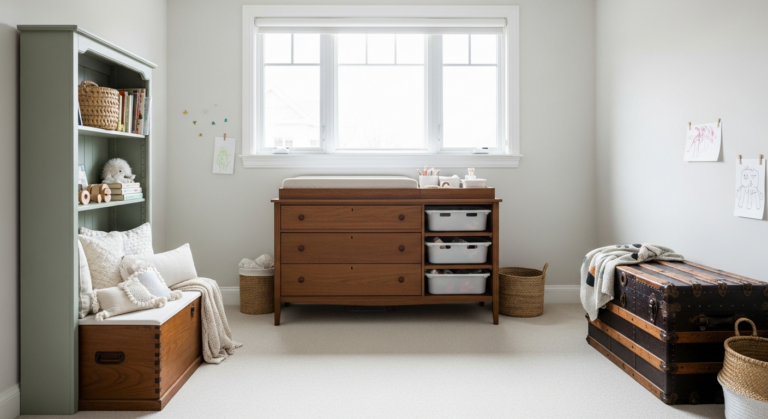
Solid wood dressers and nightstands. Older dressers are typically made from real wood (not MDF or particleboard), which means they’re stronger, more durable, and sand/paint beautifully. A vintage dresser for $15–40 from Goodwill or an estate sale, refinished with a fresh coat of paint, will outlast a $200 IKEA MALM. Look for dovetail joints in the drawer corners—that’s a sign of quality construction.
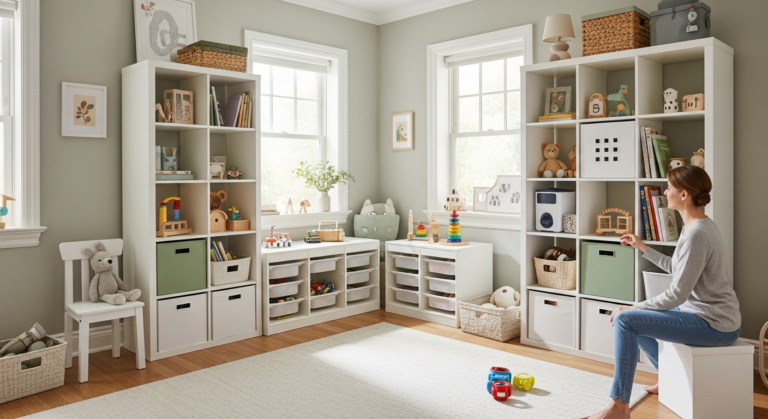
Bookshelves. Sturdy bookshelves are everywhere at thrift stores ($8–25 typically). Solid wood or quality laminate in good condition can be used as-is or painted. The IKEA BILLY shows up in thrift stores constantly for $10–15.
Frames for gallery walls. Mismatched frames in various sizes ($1–4 each) create a charming gallery wall when spray-painted a uniform color. Buy 8–12 frames in different shapes and sizes, spray them all white or gold, and you have a cohesive display for under $20 that would cost $80+ new.
Baskets, bins, and organizers. Woven baskets ($2–8 each) are thrift store staples and perfect for toy storage, book corrals, and closet organization. They add warmth and texture to any room.
Lamps. Table lamps and floor lamps ($5–15) are abundant at thrift stores. A new lampshade from Target ($10–20) and a fresh bulb transform any thrifted lamp base into a modern piece.
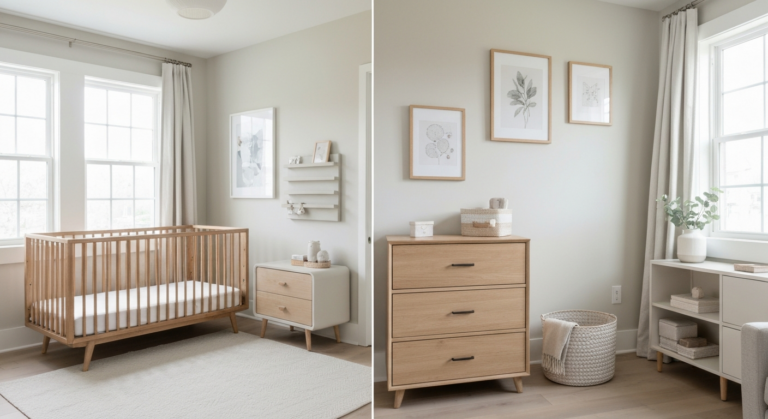
Skip These at Thrift Stores: Mattresses (hygiene and safety concerns), car seats (expiration dates and unknown crash history), cribs manufactured before 2011 (safety standards changed), stuffed animals (difficult to fully sanitize), and anything with peeling paint that could contain lead (pre-1978 items).
The Art of the Thrift Store Transformation
The magic of thrift store decorating is the transformation. A scuffed-up brown dresser becomes a showstopper with the right paint and hardware. Here’s how to execute common transformations that even non-crafty parents can handle.
Furniture Painting 101: Sand the piece lightly with 120-grit sandpaper, wipe clean, apply a coat of primer (the Zinsser Bulls Eye 1-2-3 primer, $12 at Home Depot, sticks to anything), then apply 2–3 coats of your chosen paint. For kids’ furniture, Behr Ultra Interior paint ($35/gallon at Home Depot) in a satin finish is durable, washable, and low-VOC. Popular kid-room colors right now: sage green, dusty blue, warm white, soft terracotta, and muted blush.
Hardware Swaps: New knobs and pulls completely change a piece of furniture’s personality. Anthropologie has gorgeous ceramic knobs ($8–14 each) that turn a plain dresser into a statement piece. For a budget option, Amazon’s Franklin Brass knobs ($3–5 each in bulk packs) come in dozens of finishes. Unscrew the old hardware, fill any mismatched holes with wood filler, and install the new pulls—a 20-minute project.
Wallpaper Drawer Liners: Line the inside of dresser drawers with peel-and-stick wallpaper for a delightful surprise when kids open drawers. Tempaper and Chasing Paper sell removable wallpaper ($1–2 per square foot) in playful patterns. Measure the drawer bottom, cut the wallpaper, and press it in. This takes 30 minutes and adds a designer touch that costs under $10.
Reupholstering: Thrifted chairs and stools with good frames but ugly fabric can be recovered using a staple gun and 1–2 yards of new fabric. JOANN Fabrics sells kid-friendly printed cottons for $8–12 per yard (use the 40% off coupon that’s always available). Pull off the old fabric, stretch the new fabric over the seat, and staple it underneath. The whole project takes under an hour.
Curating a Cohesive Look from Mismatched Finds
The biggest challenge with thrift store decorating is making a room look intentional rather than random. The trick is unifying elements through color, finish, or theme.
The Unified Color Palette: Choose 2–3 colors and apply them consistently. If your palette is white, sage, and natural wood, paint all thrifted furniture white, add sage accents (pillows, a painted stool, a small shelf), and let natural wood pieces provide warmth. When disparate items share a color story, they look collected rather than cluttered.
The Matching Finish Trick: Spray-painting multiple items the same color creates instant cohesion. Five mismatched thrift store frames, a lamp base, and a small shelf—all sprayed the same matte black or brushed gold—suddenly look like a curated set. Rust-Oleum Universal spray paint ($7–9 per can at Home Depot) has excellent coverage and comes in every imaginable finish.
Anchor with One Nice Piece: Pair thrift finds with one or two quality new items. A new bedding set from Target’s Pillowfort line ($25–55 for a comforter set) or IKEA’s BRUNKRISSLA duvet ($20–30) provides a clean, fresh anchor that makes everything else in the room look intentional. The bed is the focal point of a child’s room, so new bedding ties thrifted furniture together beautifully.
Safety Checks for Secondhand Kids’ Furniture
Thrifting for kids’ rooms requires an extra layer of safety awareness. Children interact with furniture differently than adults—they climb, pull, hang, and chew—so every secondhand piece needs a safety evaluation before it enters the room.
Stability: Test every piece of furniture for wobble and tip risk. Dressers are the biggest concern—the CPSC reports that a child is injured by a tipping piece of furniture every 17 minutes in the U.S. Always anchor dressers and bookshelves to the wall using anti-tip furniture straps ($8–10 for a 2-pack at Target or Amazon), regardless of whether the piece is new or thrifted.
Lead Paint: Any piece manufactured before 1978 may contain lead paint. If you’re unsure of the age, use a 3M LeadCheck swab ($10 for a 2-pack at Home Depot) to test before bringing it into your home. If lead is present, either skip the piece or have it professionally stripped—do not sand lead paint yourself.
Hardware and Small Parts: Check for loose knobs, sharp edges, exposed screws, and splinters. Tighten everything, sand rough spots, and replace any hardware that a toddler could pull off and choke on. Replace small round knobs with larger pulls if you have children under 3.
Structural Integrity: Open and close every drawer. Sit on every chair. Push against every shelf. If it’s wobbly, determine whether a simple tightening of screws will fix it or whether the joints are genuinely compromised. Wobbly joints in solid wood can often be repaired with wood glue and clamps ($5 total). Wobbly joints in particleboard are usually unrepairable.
Thrifting for your child’s room is one of the most rewarding decorating approaches I’ve discovered. Beyond the obvious budget savings, there’s something deeply satisfying about giving beautiful pieces a second life and creating a room full of character and stories. My daughter’s room features a $20 estate sale dresser (now painted soft pink with Anthropologie knobs), a $5 Goodwill mirror (spray-painted gold), and a $3 woven basket that holds her library books. The room looks like it cost ten times what it did, and every piece has a little story behind it. That’s something no trip to a big-box store can give you.
Neutral Nina
Neutral Nina is an interior design enthusiast and mom of three who proves that beautiful, organized spaces and family life can coexist. She shares practical strategies for creating calm, functional homes that work for kids and grown-ups alike.