Rotating Book Display Ideas Kids Actually Use
You can encourage your child's independent reading by displaying a small selection of books cover-out and rotating them regularly. Learn about three effective display styles and how to implement a simple rotation routine.
- Display books cover-out at eye level to boost your child's independent reading.
- Rotate a small selection (4-12 books) every 1-3 weeks to keep them fresh.
- Choose from ledge shelves, rotating racks, or magazine files based on your space.
- Use the provided comparison to select the best display style for your child's age and room.
- Download the free kit to help plan your book rotation and reading nook.
This post contains affiliate links. As an Amazon Associate I earn from qualifying purchases.
My two-year-old niece once walked past a forty-book shelf I had sorted by color and sat down to “read” the box it came in. Then I stood three books on a low shelf, covers out, and she had one in her lap within ten minutes.
Young children choose books by cover, and they can only choose what they can see. This guide covers three front-facing display styles (ledge shelf, rotating rack, magazine file), a comparison table, small-space setups and a five-minute weekly rotation routine. For whole-house storage, see my book storage ideas for kids post.
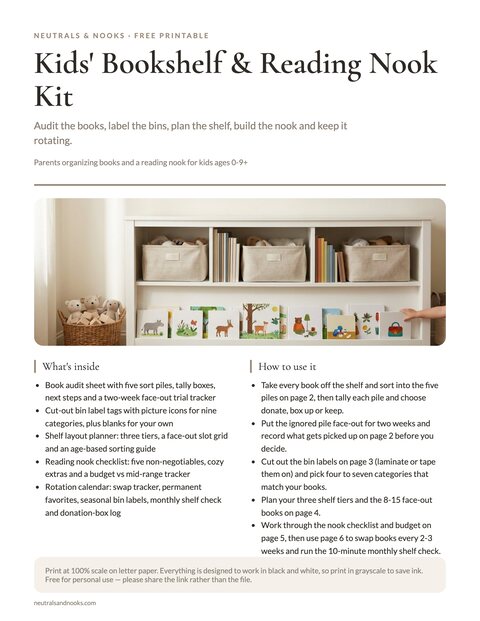
Free printable · 6 pages
Kids' Bookshelf & Reading Nook Kit
A book audit sheet with a two-week face-out tracker, cut-out bin labels with picture icons, a three-tier shelf planner with an age guide, a reading nook checklist with budget tracker, and a rotation calendar with a monthly shelf check and donation log.
Free. Your download link appears right here. You'll also join the Monthly Home Reset. Unsubscribe anytime. Privacy
In this article (17 sections)
- Why a Front-Facing Toddler Book Display Works
- The Three Display Styles at a Glance
- Ledge Shelves: The Calm, Wall-Hugging Classic
- Rotating Book Racks for Toddlers and Preschoolers
- Magazine File Book Displays for Small Spaces
- Book Storage for Kids in Small Spaces
- How Many Books Should Be Out?
- Best Books for a Toddler Book Display, by Age
- A Five-Minute Rotation Routine
- Display Ideas by Room
- Make a Book Display Look Calm
- Common Mistakes (and Easy Fixes)
- Pairing a Display With a Reading Nook
- Troubleshooting: When the Display Isn’t Working
- A Sample Setup You Can Copy
- Frequently Asked Questions
- Start With Three Books (Quick Version)
Why a Front-Facing Toddler Book Display Works
A spine tells a toddler almost nothing. A cover shows the bear, the red truck, the moon. Front-facing storage gets even better with rotation. Keep a small number of books on display, swap them every week or two, and let the rest wait in a bin.
Toddlers choose with their eyes
Between ages one and three, children recognize a book by its cover image, color and shape, not its spine. Facing the cover out turns a storage problem into an invitation.
Fewer choices means more reading
A child facing forty titles often pulls everything into a pile or walks away; a child facing six covers picks one. It’s the same logic as toy rotation, which I wrote about in How Many Toys Should Be Out at Once? A Rotation Guide.
Independence is built into the height
At eye level and within reach, a child can look, pick, carry and return a book without asking you.
Rotation makes old books feel new
A book that has lived on the same shelf for months becomes furniture. Put it away for a few weeks and bring it back, and it’s an event, with nothing new bought.
The Three Display Styles at a Glance
Here is a comparison to help you choose. Capacities are approximate and depend on your book sizes; I’ve noted the assumptions so you can adjust.
| Feature | Ledge Shelf (picture ledge) | Rotating Rack (spinner or tiered) | Magazine File (wall or tabletop) |
|---|---|---|---|
| Best for ages | 1 to 5 | 3 to 5 (under 3 only if anchored and supervised) | 2 to 5 |
| Display style | Cover fully visible, books lean on the wall | Cover visible on every tier, rotates to reach | One cover visible per file, others hidden behind |
| Capacity (approx.) | A 36-inch ledge holds about 6 board books or 3 to 4 standard picture books | Most 4-sided racks hold roughly 16 to 24 books depending on tier depth | 1 cover shown per file; each file holds 4 to 6 books if you want backstock inside |
| Footprint | Wall only, no floor space | 12 to 18 inches square on the floor | Wall or small tabletop footprint |
| Rotation effort | Very easy: lift, swap | Easy, but heavier to restock | Easy; pull the front book, slide the next forward |
| Tipping risk | Low when mounted into studs or rated anchors; check the mounting every few months | Needs a weighted base; anchor to the wall | Low when screwed into studs or rated anchors (no adhesive strips); keep tabletop files on stable furniture |
| Typical cost | About $15 to $40 (approx.) | About $40 to $120 (approx.) | About $8 to $25 each (approx.) |
| Weak point | Books can slide off a shallow ledge | Floor space; can be pushed over by a runner | Only one cover per file shows |
| Best in | Small rooms, hallways, toddler bedrooms | Larger playrooms with floor space | Tight corners, shared rooms, desk sides |
A short version: if you’re only buying one thing, buy the ledge shelf. If you have floor space and a child who loves browsing, add a rack. If you need to squeeze into a tiny corner or a shared room, magazine files fit best.
Ledge Shelves: The Calm, Wall-Hugging Classic
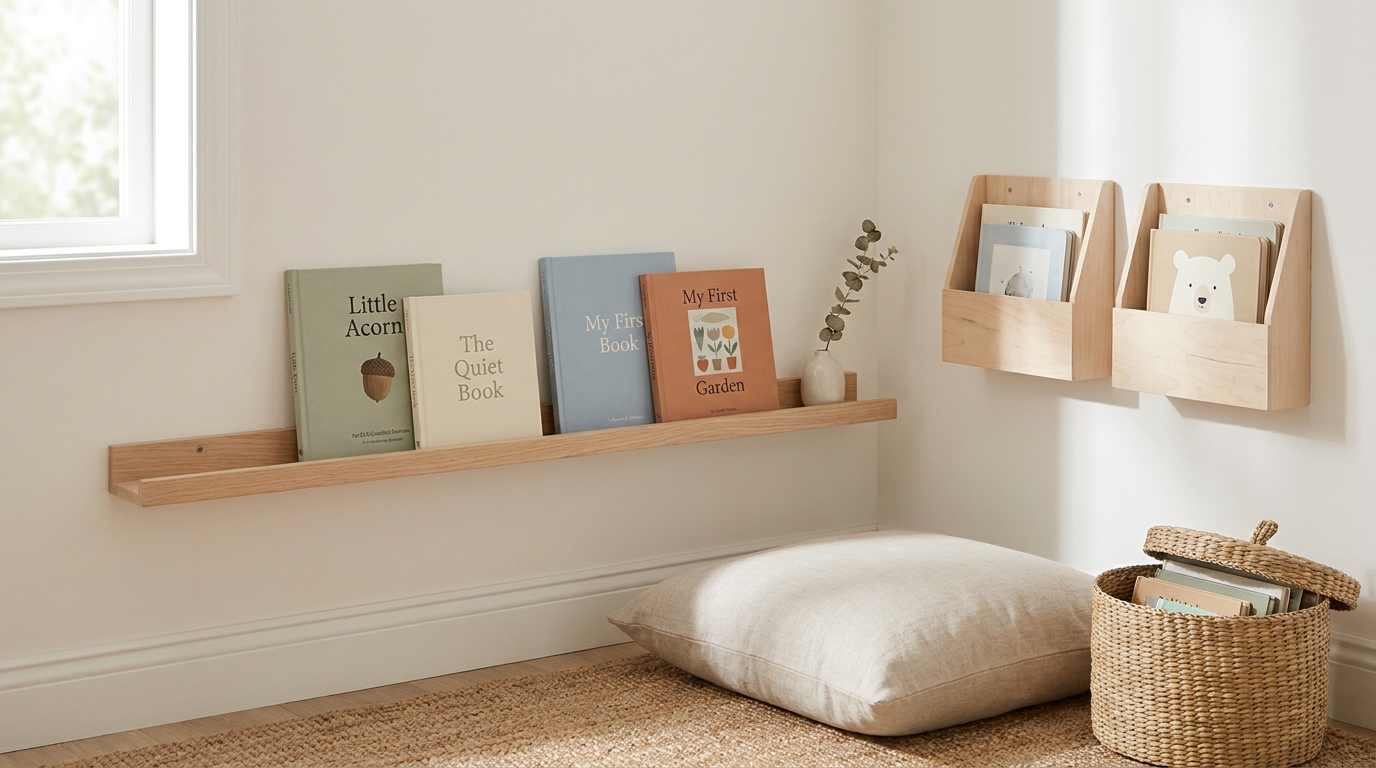
A picture ledge (sometimes called a gallery ledge) is a narrow shelf, usually 3 to 4 inches deep, with a small lip on the front. Books sit upright on it with their covers facing into the room. It is the simplest version of front-facing storage, and it has the best ratio of calm to function I’ve found.
How deep and how long
Depth matters more than people realize. A ledge that is too shallow will let heavier picture books tip forward. Look for a depth of about 3.5 to 4 inches and a front lip that comes up at least three-quarters of an inch. The lip is what keeps a book from sliding when a small hand yanks it.
For length, here’s a practical way to plan. A typical board book is about 5 to 6 inches wide. A standard picture book is closer to 8 to 10 inches. On a 36-inch ledge, that’s roughly six board books or three to four picture books if you want them fully visible without overlapping. Longer ledges, in the 48 to 60 inch range, let you display five to seven picture books and still look composed rather than crowded.
Mounting height
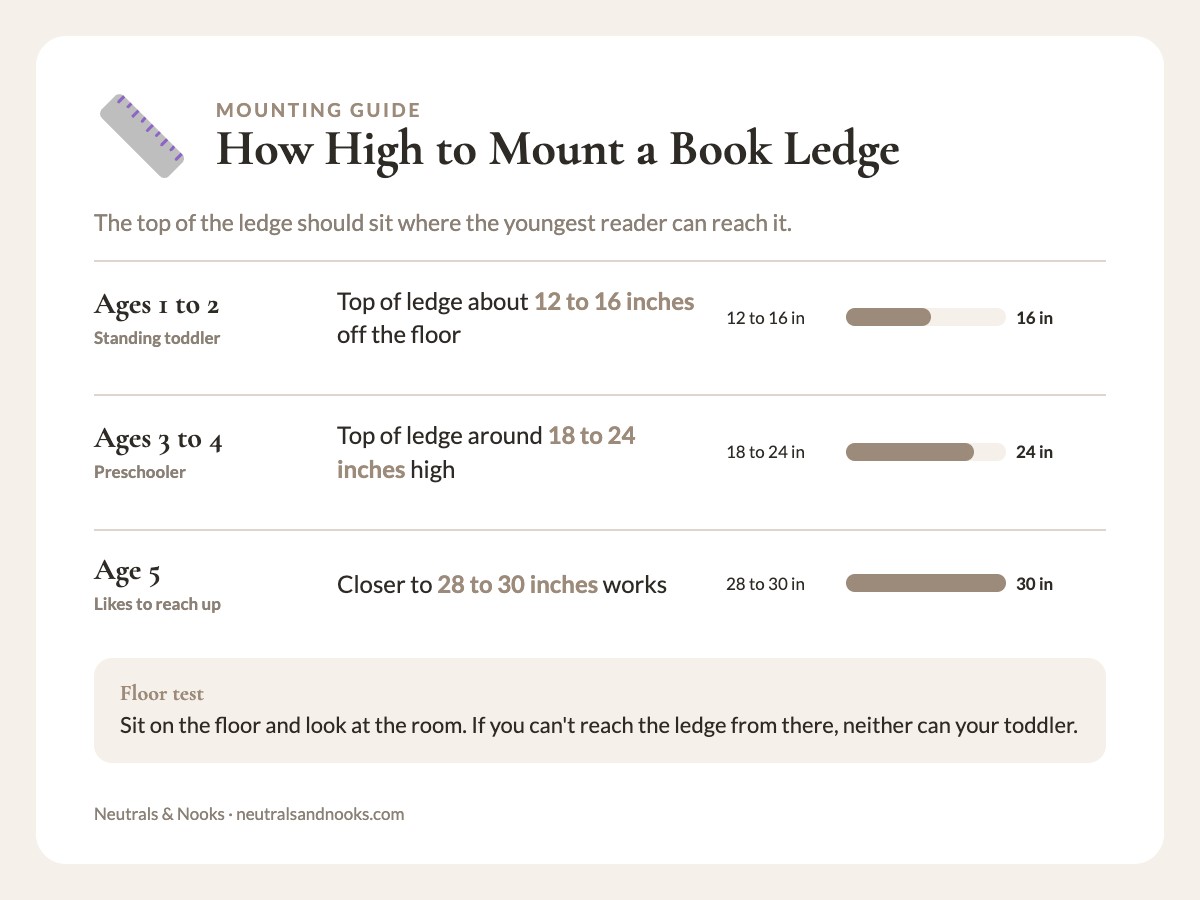
The right height depends on the youngest child using it.
- Ages 1 to 2: the ledge sits with its top about 12 to 16 inches off the floor, so a toddler can grab a book while standing.
- Ages 3 to 4: the top of the ledge sits around 18 to 24 inches high.
- Age 5: closer to 28 to 30 inches works, and a five-year-old likes reaching up a little.
If you have siblings in a range, you can stack two ledges: one low for the toddler, one higher for the older child. This works nicely in a shared kids’ room, where each child can have their own rung of the wall.
Anchoring and safety
Safety firstScrew ledges into studs or use anchors suited to your wall type, and follow the ledge’s load rating. Cover or countersink screw heads, and pull-test the ledge before use. Children may pull or hang on low ledges, so a ledge is not a climbing aid. A few hardcover picture books can weigh several pounds, so keep heavy hardcovers off low ledges and use lightweight board books or paperbacks there. Choose rounded corners, check the mounting every few months, and keep ledges away from cribs and changing tables.
Styling a ledge
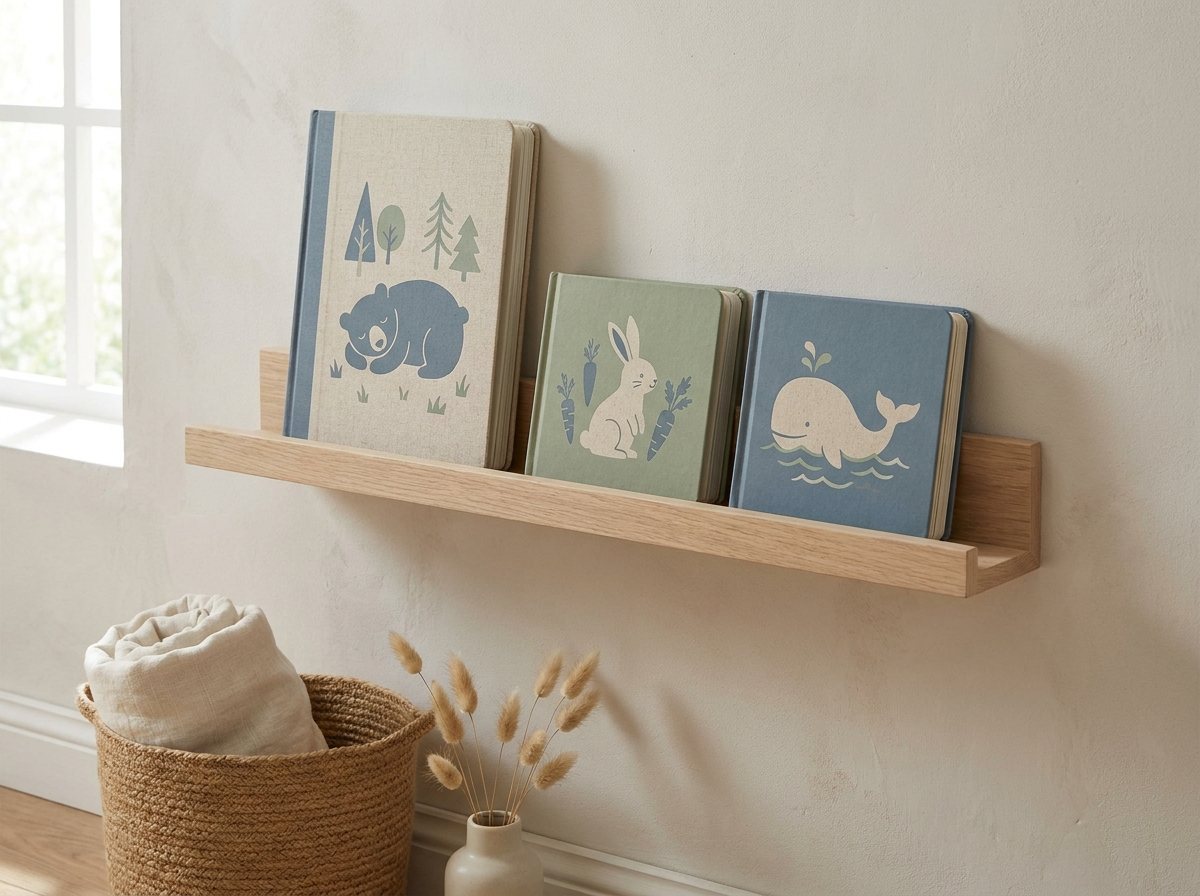
Neutral does not have to mean boring. A few approaches I like:
- Cover-forward, color-calm. Choose books with soft or earthy palettes for the ledge, and keep loud, neon covers in the backstock bin. Rotation lets you do this without banning anything.
- One small item per ledge. A soft fabric item, or an object too large to fit through a toilet-paper tube, at the end of the row; otherwise put it only on a higher ledge. One only. More than one and the shelf starts to feel like a shop display.
- Alternate heights. Put one tall book next to two short ones. The slight rhythm looks intentional.
What to do when books keep sliding
Almost every parent hits this. Try a small piece of non-slip shelf liner cut to the depth of the ledge. It’s invisible and takes two minutes.
Rotating Book Racks for Toddlers and Preschoolers
A rotating bookshelf for kids, also called a spinner rack or tiered book carousel, shows covers on several sides and lets the child turn it to browse. It’s the closest thing to a tiny library at home, and children treat it that way.
Who it’s for
I recommend racks from about age three. Children that age have the coordination to spin one gently and the interest in browsing. Under three, use only a rack that can be anchored or has a wide, weighted base, and only with supervision. Do not let children climb, ride or hang on a rack.
Capacity and footprint
Most four-sided racks hold somewhere around 16 to 24 books, depending on how many tiers they have and how deep the pockets are. That sounds like a lot, and it is. For a rotation system I’d treat a rack as a place to show the best twelve to sixteen, not to fill every slot. A half-empty rack looks more inviting than a stuffed one.
The footprint is typically 12 to 18 inches square, so it fits comfortably in a corner or beside a reading chair but not in a narrow hallway.
Tipping and stability
Check three things before buying:
- Weighted base. The base should be wider than the top tier.
- Height. For ages one to five, a rack under about 36 inches tall is safer and more usable.
- Anchoring. Buy only racks that can be anchored. Anchor every rack to the wall with the supplied strap or bracket. A corner is not a substitute for anchoring.
Loading the rack
Put the heaviest and tallest books on the bottom tiers where the rack is most stable. Reserve the top tiers for lighter board books and flexible paperbacks. This is a small thing that cuts down on tipping and also puts the books younger children grab most within easy reach.
The tiered-shelf alternative
If a spinner feels like too much, a slanted tiered shelf (the kind with a front rail and sloped pockets) gives you the same face-out display without the rotation. These are less compact than a ledge but hold more.
Treat a tiered shelf like a rack. Buy one that can be anchored or has a wide, weighted base, anchor it with the supplied strap or bracket, put heavy books on the bottom tiers, and do not let children climb it. Use it from about age 3.
Magazine File Book Displays for Small Spaces
This option uses an object most of us already own or can buy cheaply. A magazine file (the open-fronted box meant for periodicals) holds books upright with one cover showing. Mount a few on the wall or line them on a low shelf and you have a display that looks tidy and costs very little.
How it works
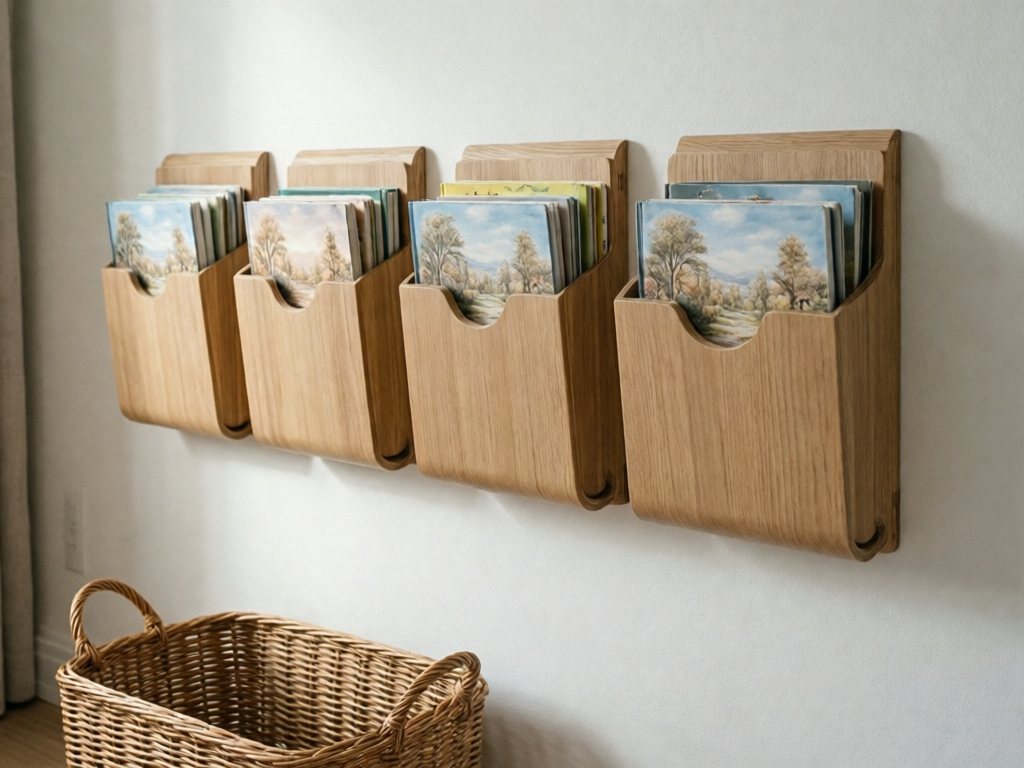
Each file shows the front cover of its first book. Behind that book, you can tuck three to five more, which is your built-in backstock. When your child finishes with the front book and returns it, you can slide the next one forward on rotation day. The display and the storage live in the same object.
Capacity notes
Because only one cover shows per file, think of a magazine file as one “visible slot” with a few books of reserve. A row of four wall-mounted files gives you four visible covers and perhaps sixteen to twenty books in total. That is a perfectly good setup for a small bedroom or a shared space.
Choosing the files
- Material. Wood, powder-coated metal, or sturdy cardboard-covered in linen all look calm. Avoid flimsy plastic that bows under the weight of a hardcover.
- Opening height. A front cut that dips low enough to let a child pull a book without lifting it all the way out.
- Width. Standard magazine files fit most picture books but cut off the edges of oversized ones. Measure your favorites first.
Mounting versus tabletop
Wall-mounted files at toddler height work well in nurseries and bedrooms where floor space is precious. Screw them into studs or rated anchors rather than using adhesive strips, follow the file’s load rating, and check that corners are rolled and no screws are exposed. At toddler height keep wall files to lightweight board books, and keep them out of reach of a crib or cot.
Tabletop files, lined up on a low bench or the top of a cabinet, are good for ages four to five who like to browse standing up. Keep them on stable furniture.
For families doing this in narrow rooms, I’ve written more about corners and slim furniture in Small Nursery Ideas: Maximize Space in a Tiny Room, and the same logic applies to any under-ten-foot-wide space.
Book Storage for Kids in Small Spaces
If you’re working with a studio, a shared room, or a hallway nook, you can still do a front-facing display. The trick is to use vertical space and borrow wall area from furniture you already have.
Four small-space setups that work
- A ledge on a nearby wall, away from the changing table or dresser. Keep it out of reach and out of fall range of the changing pad and crib. If it must go above a dresser, anchor the dresser to the wall and keep the books lightweight.
- Magazine files on the side of a bookcase. Anchor the bookcase or any tall furniture to the wall first, then hang a pair on the outside edge using hardware rated for the furniture material. Keep the files to lightweight board books.
- A bookcase turned into a display wall. Anchor a shallow bookcase to a wall stud with furniture anchors before removing any shelves, and never remove structural or back-bracing shelves. Then add a small lip to a few shelves so they work as ledges.
- Over-the-door pocket organizer. Cheap, flat, and effective for board books in a child’s bedroom. Hang it on the latch side with flat hooks, keep it out of reach for under-2s and away from the crib, and check the door still closes freely. Choose clear or neutral fabric pockets so the covers show.
A dual-purpose shelf
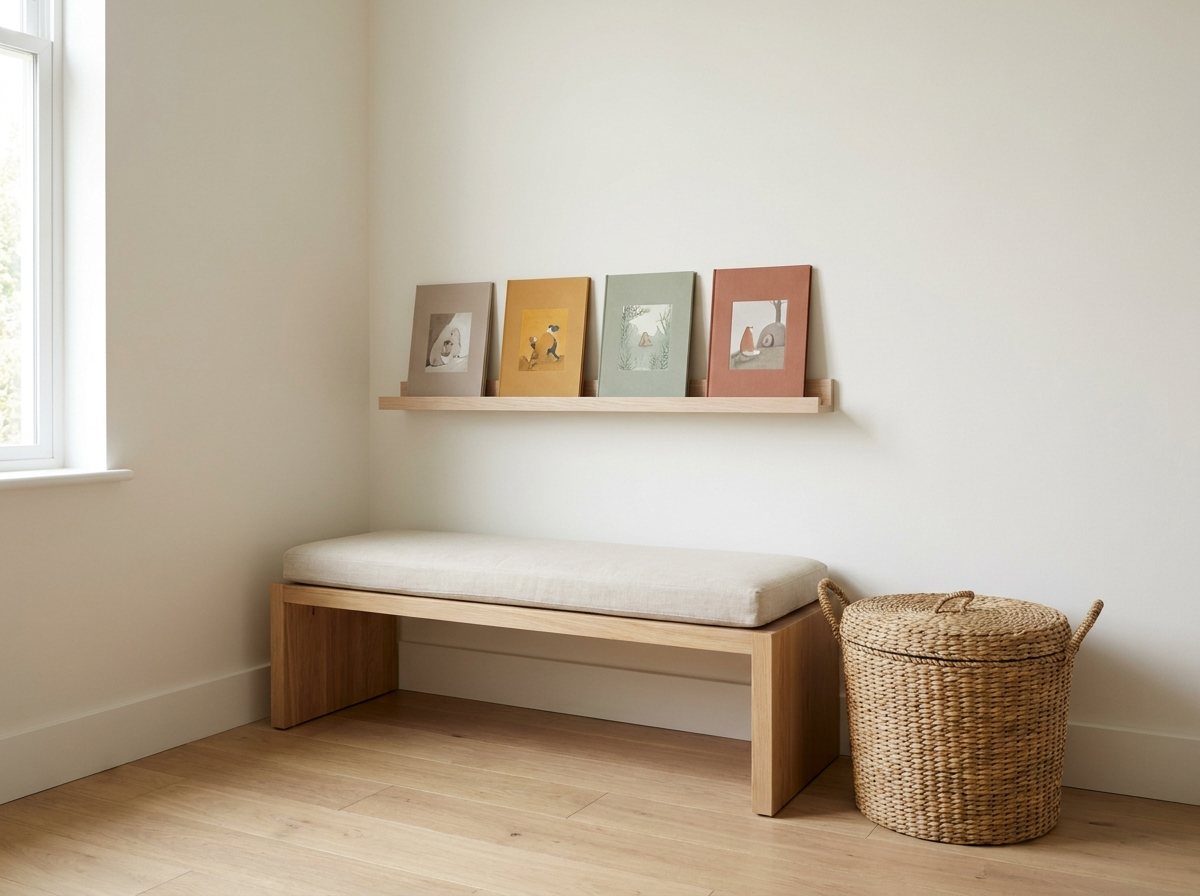
In smaller homes, a low bench with a cushion on top and a ledge mounted on the wall behind it becomes a reading nook that also holds the day’s rotation. I describe more ways to build that into a corner in reading nook ideas for kids, including how to anchor the seating so it feels cozy rather than cluttered.
Where to put the backstock
The backstock is the pile of books that are not on display. In a small home, don’t give it a prime location. Good options:
- A lidded basket on the top shelf of a closet.
- A flat bin under the bed (child’s or yours).
- The bottom of a cabinet in the hallway.
- A single canvas bin on top of a wardrobe, out of reach but easy for you.
Label the bin if you share a home with other adults. “Books, rotation” on a slip of paper is plenty.
How Many Books Should Be Out?
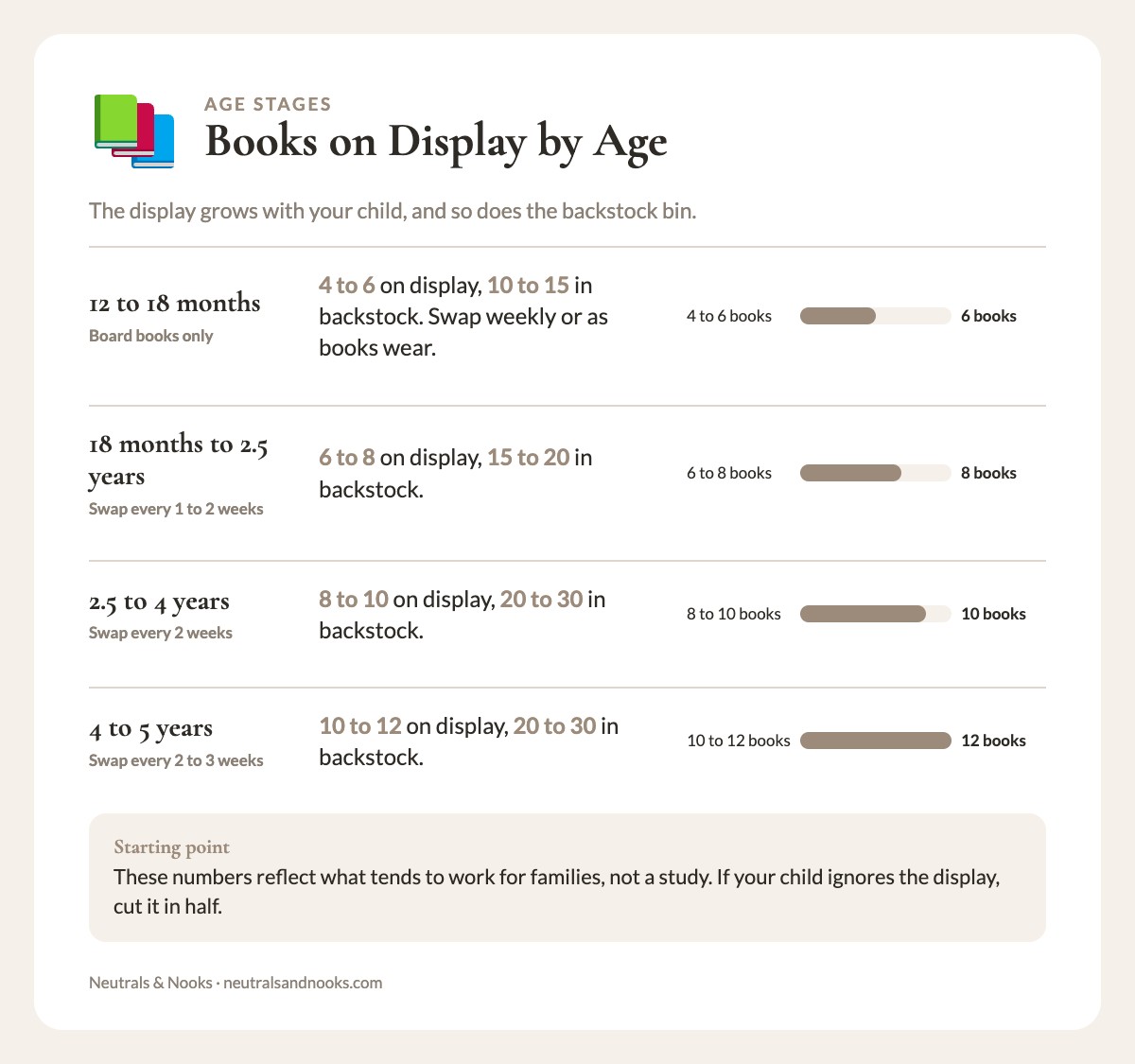
There isn’t one answer, but there are good starting numbers. These reflect what tends to work for families, not a study, so treat them as a starting point.
| Child’s age | Books on display | Books in backstock | Swap frequency |
|---|---|---|---|
| 12 to 18 months | 4 to 6 (board books only) | 10 to 15 | Weekly, or as books get chewed or worn |
| 18 months to 2.5 years | 6 to 8 | 15 to 20 | Every 1 to 2 weeks |
| 2.5 to 4 years | 8 to 10 | 20 to 30 | Every 2 weeks |
| 4 to 5 years | 10 to 12, including a few early chapter or picture-heavy nonfiction | 20 to 30 | Every 2 to 3 weeks |
Adjust for your child
If your child ignores the display, you probably have too many books out, or you have the wrong ones. Cut the display in half and see what happens. If your child asks for the same three books every day, leave those three out. Rotation is a tool, not a rule. A beloved book is a staple, not a rotation candidate.
Keep one “anchor” per display
I like to leave one or two favorites on the display at all times, and rotate the rest around them. This keeps the display from feeling unfamiliar and makes the new additions feel like friends arriving, not strangers.
Best Books for a Toddler Book Display, by Age
What goes on the display matters as much as how. Here is how I think about selection by age.
| Age | What to look for | What to avoid |
|---|---|---|
| 1 to 2 | Sturdy board books with large, simple images, textures, flaps, short rhymes, photo books of faces, animals and objects, and a familiar bedtime book or two | Anything you would mind seeing soggy. Chewing is real, so keep the nicer books in backstock |
| 2 to 3 | Repetitive, rhythmic stories, concept books (colors, counting, opposites), simple routine stories about bath, bed and food, and lift-the-flap books | Delicate flaps on the display for long; rotate lift-the-flap books more often because they wear out |
| 3 to 4 | Longer picture books with a small plot, stories about feelings and friendship, early nonfiction with real photographs, and wordless picture books | Fragile pop-ups, which are better read together |
| 4 to 5 | Picture books with richer language, early readers and phonics sets, poetry and short-story collections, and books tied to current interests | Too many early readers at once; keep the display varied |
Safety firstFor under-3s, avoid books with small detachable parts, battery sound modules, magnets, or ribbon and cord tags. Inspect flaps and textures often, and retire any book with torn corners or loose pieces.
If you’re building the collection with intention, the same “fewer, better” thinking behind my Montessori gifts by age guide applies to books: pick titles that invite a child to return, not ones that fill space.
A good display also mixes formats: a board book, a picture book, a book with photographs, and one that’s a bit above their level. Library books are a gift for rotation too. A fresh stack every couple of weeks means you never run out of “new,” so reserve a spot on the ledge for the library picks.
A Five-Minute Rotation Routine
The best system is the one that actually happens. Here’s a routine small enough to survive a busy week.
Pick a day that already exists
Rotation works best when it is attached to something you already do. Sunday evening after bath. Friday before the weekend. The day the recycling goes out. Whatever it is, pick it and keep it.
The five steps
- Collect. Pull everything from the display and put it in your arms or a small basket. (30 seconds.)
- Set aside favorites. Any book your child requested three or more times this week stays out. (30 seconds.)
- Check the condition. Flag torn pages, loose bindings, or anything sticky. Fix or retire them. (1 minute.)
- Choose the new set. Pull from backstock using a simple mix: a couple of familiar books, a couple of “haven’t seen in a while,” and one wild card, like a seasonal or library title. (2 minutes.)
- Reset the display. Arrange the covers and return the pulled books to the backstock bin. (1 minute.)
Let your child join in when they’re ready
Around age three, many children like to help choose. Offer two books from the bin and let them pick one for the display. It’s a small ownership moment and it reduces the “but I wanted that one” protests. At four and five, they can often handle the whole swap with a little supervision.
Seasonal and themed sets
You can group rotations by theme without making it a project:
- Autumn: leaves, pumpkins, harvest, cozy night books.
- Winter: snow, animals in hibernation, holiday titles.
- Spring: gardens, rain, baby animals.
- Summer: water, travel, camping, bugs.
Themed rotations are an easy way to avoid choosing at random and a nice excuse to pull out holiday books only when they’re relevant. In October, for instance, a small set of fall and cozy-night titles on the ledge feels right without any decorating.
Display Ideas by Room
A front-facing display doesn’t need to live only in a playroom. It tends to work best where your child already spends time and where grabbing a book fits naturally.
The playroom
Put the display near the quieter side of the room, away from the building-block zone. A ledge on the wall above a floor cushion or a low bench does a lot. If you have the space, a rack goes next to the seat so the reading corner feels complete. For help planning the rest of the room around toys and rotation, the same principles from the toy rotation guide apply.
The bedroom
Keep the bedroom display small: four to six books within the child’s reach supports the bedtime routine and encourages quiet looking at wake-up. Mount any ledge on a wall away from the crib, cot or sleep space, and hang nothing over a sleep space. For toddler beds, keep it out of reach from the mattress and use only lightweight board books. Keep the louder or more stimulating covers for another part of the house.
The living room
If your family hangs out in a shared space, a single magazine file or a short ledge near the sofa invites everyone to read. Choose a small selection of family favorites and keep them tidy. Children read what they see grown-ups reading.
The car and the entry
A small basket by the door with three or four board books can save a car ride or a waiting-room afternoon. It isn’t a display in the same sense, but it follows the same rule: a few good choices, easy to see.
The bathroom (yes, really)
A basket on the floor, well outside splash range, with one or two waterproof bath books turns bath-time wind-down into a calm moment. Never leave a child alone in or near the tub.
Make a Book Display Look Calm
A display of children’s books can be the loudest thing in a room. Most covers are saturated and busy, and that’s lovely for a child and a little chaotic for an adult who craves quiet. You don’t have to choose between the two.
Edit the cover palette
On any given rotation, aim for covers that sit within a related palette. Warm earthy tones, soft blues, and classic black-and-white illustrations tend to feel peaceful together. You can keep the brighter, louder books in the backstock and bring them out in a themed rotation.
Use the wall as a frame
A ledge in a pale wood or white against a muted wall turns the books into a gallery. Keep the wall behind them uncluttered. If you want art, put it above the ledge, not beside it.
Keep the surface clear
A ledge or rack with books only looks intentional. Add a toy, a cup, a stack of paper, and it looks like a drop zone. Leave the display for books.
Cover books that don’t match
If you have a few oversized or very busy board books that you love but that fight your palette, you can place them in a basket under the display and rotate them in when the mood allows. A washed linen basket is a neutral companion to any room.
Match the hardware to the room
Wood, white, and black metal all look good together. Choose one finish for ledges and racks across a room so they read as a family rather than a mix, and pick low-VOC finishes with smooth edges. Replace any piece with chipping paint.
Common Mistakes (and Easy Fixes)
| Mistake | Fix |
|---|---|
| Too many books on display. The display becomes a mess and the child ignores it. | Cut it to the numbers in the table above and see what happens. |
| Display is too high. Parents mount at adult-friendly heights. | Sit on the floor and look at the room. If you can’t reach it from there, neither can your toddler. |
| Never rotating. The display slowly becomes decor. | Attach a rotation to something that already happens weekly, and keep the routine to five minutes. |
| Rotating too often. Changing everything every few days can feel unsettling for a child who has favorites. | Keep one or two anchors and move the rest at a two-week pace. |
| Putting fragile books where little hands reach. Pop-ups and thin paperbacks don’t survive. | Keep them in a high backstock bin and read them together. |
| Making backstock hard to reach. If you have to climb or dig, you won’t rotate. | Put the bin on a shelf at your waist height or in a spot you walk by daily. |
| Buying a special piece before testing the habit. A pricey rack is a lot to commit to. | Start with two or three cheap magazine files or a simple ledge, see if the routine sticks, and upgrade later. |
Pairing a Display With a Reading Nook
A display is more than storage; it’s the front door to your child’s reading corner. If you’re building or revising the space, think of three layers:
- See it. The front-facing display, at child height.
- Reach it. A clear path, no furniture to climb over, a rug or cushion nearby.
- Settle in. A soft place to sit, good light, and a bit of privacy.
If you want a deeper look at how shelves, seating, and lighting go together, my guide to kids’ bookshelf and reading nook organization walks through layouts that work in different room sizes. It pairs well with the display ideas here, since the rotation system is the same whether you have a corner or a full room.
A simple nook formula
- About 3 or 4 lightweight picture books on a 36-inch ledge, or 8 to 12 covers on an anchored rack for ages 3 and up
- One seat (floor cushion, small bench, or child-sized chair)
- One light source (a lamp or window, not overhead)
- One basket for backstock or “finished” books
That’s it. You can add a soft throw blanket, but the four elements above carry the whole thing.
Troubleshooting: When the Display Isn’t Working
If your child still isn’t reaching for the books, check these.
| Problem | What to try |
|---|---|
| They only pull everything off. | This is developmentally normal for toddlers. Use a sturdier ledge with a lip, put out fewer books, and offer a basket for “finished” ones so putting back becomes part of the play. |
| They ignore the display but love read-alouds. | Some children are relational readers: the book matters because you are in it. Sit near the display and pick one with them. They may start going on their own once the habit forms. |
| One sibling takes over. | Give each child their own ledge, rack side, or set of magazine files. A shared display works better with visible boundaries. |
| Books end up everywhere else. | Add a “return basket” near the display. Children are far more likely to tidy into a basket than onto a precise shelf spot. |
| The display looks messy within a day. | That’s a sign it’s being used. Do a thirty-second reset each evening if you like a tidy room, and let it be otherwise. |
| A pet or the baby is wrecking it. | Move the display up, or use wall-mounted magazine files for the older child and keep board books at floor level. Keep only sturdy one-piece board books within a baby’s reach, since babies mouth them, and inspect them for loose pieces. |
A Sample Setup You Can Copy
If you like a concrete plan, here is a complete small setup for a playroom or bedroom with a child aged three to four. It is a deliberately light display, about five or six covers; add a second ledge or an anchored rack to reach the 8 to 10 in the table above.
What you need
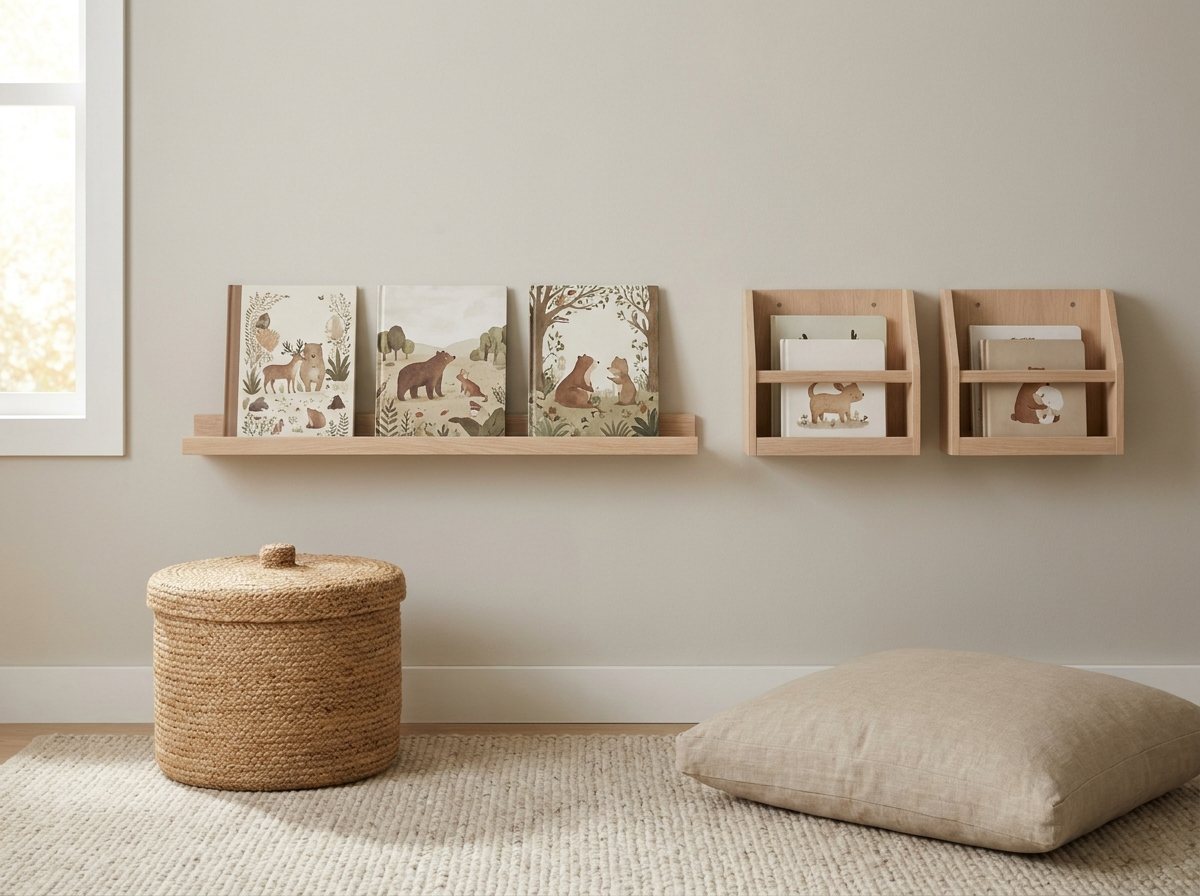
- One 36-inch picture ledge, mounted with its top at about 18 inches off the floor.
- Two wall-mounted magazine files beside it, at the same height, screwed into studs or rated anchors.
- One lidded basket for backstock.
- One floor cushion in a neutral linen.
What goes on display
- On the ledge: 3 to 4 lightweight picture books or paperbacks, covers out. Keep heavy hardcovers in the basket.
- In the magazine files: 1 board book on show in each, with 3 to 4 more tucked behind. Use lightweight board books, within the file’s load rating.
- On the cushion: nothing (it should stay clear for sitting).
What goes in the basket
- 20 to 30 books that aren’t currently on show, sorted loosely by season or theme.
Rotation day
- Every other Sunday, pull the books, set aside favorites, choose a new mix from the basket, reset. Total time: about five minutes.
Approximate total spend
- About $25 to $60 for a ledge and two files, depending on material.
You can scale it up (add a rack, a second ledge) or down (one ledge, one basket) with the same logic.
Frequently Asked Questions
What is the best way to store books for kids when you have very little space?
Go vertical and face the covers out. A narrow picture ledge, a pair of wall-mounted magazine files, or an over-the-door pocket organizer can display six to ten books without using any floor space. Keep the rest of the collection in a lidded basket or bin on a closet shelf, and swap books in every week or two. In a small room, the rotation is doing most of the work: your child only needs to see a handful of books at a time.
How often should I rotate my child’s books?
For most children between one and five, every one to three weeks works well. Younger toddlers who wear out board books quickly may do better with weekly swaps, while four- and five-year-olds usually enjoy a slower, two- to three-week rhythm. Keep one or two beloved favorites on display permanently so the shelf always feels familiar, and rotate the rest around them. If your child asks for a book from the bin, bring it out; rotation should follow your child, not the calendar.
How many books should be on display at once?
A good starting range is about four to six books for the youngest children, rising to eight to twelve by ages four to five. If your child seems overwhelmed or pulls everything onto the floor, reduce the number. If they finish the display in a day and ask for more, add a few. The right number is the one your child actually uses.
Is a rotating rack or a ledge shelf better for toddlers?
For most toddlers, a ledge shelf is the better first choice. It mounts flat against the wall, so there is no floor footprint to tip over, as long as it is screwed into studs or rated anchors and checked every few months. A rotating rack is great for browsing, but it takes floor space and is best from about age three. Choose a low model with a wide, weighted base and anchor it to the wall.
Will my child tear up books on a front-facing display?
Some wear is inevitable, particularly with the youngest children. Reduce the risk by putting only sturdy board books at toddler height and keeping delicate paperbacks, pop-ups, and treasured hardcovers in the backstock for shared reading. A ledge with a proper front lip helps prevent books from being yanked or dropped. And a well-loved, slightly battered favorite is usually a sign the system is working.
How do I keep a book display from looking cluttered?
Limit the number of books, choose covers that sit within a similar color range for each rotation, and keep the surface free of other objects. Use one finish for the hardware, such as light wood or white, so it reads as part of the room. Store louder or oversized books in the backstock and bring them out in themed rotations. A single soft item at the end of a ledge is plenty; for under-3s, make it too large to fit through a toilet-paper tube.
Can I use magazine files instead of a bookshelf?
Yes, and for small rooms they’re often a smart choice. Each file shows one cover and holds several more books behind it, so the display and backstock live together. Wall-mounted files at toddler height keep the floor clear. The trade-off is that only one cover per file is visible, so for more variety on display, combine a few files with a short ledge.
Start With Three Books (Quick Version)
If this all feels like a lot, begin with a floor-level basket or a low shelf. Pick three books, face them out where your child can reach, and notice what happens over the next few days. You don’t need a perfect shelf or a matched set of hardware. You need visible covers, a small selection, and a habit of changing them.
Start small and swap often. Visible covers and a short, changing selection do most of the work.