Junk Drawer Declutter Checklist: What to Keep, Toss, and Relocate
Learn how to purge and organize your cluttered junk drawer in 25 minutes using a simple three-question decision tree.
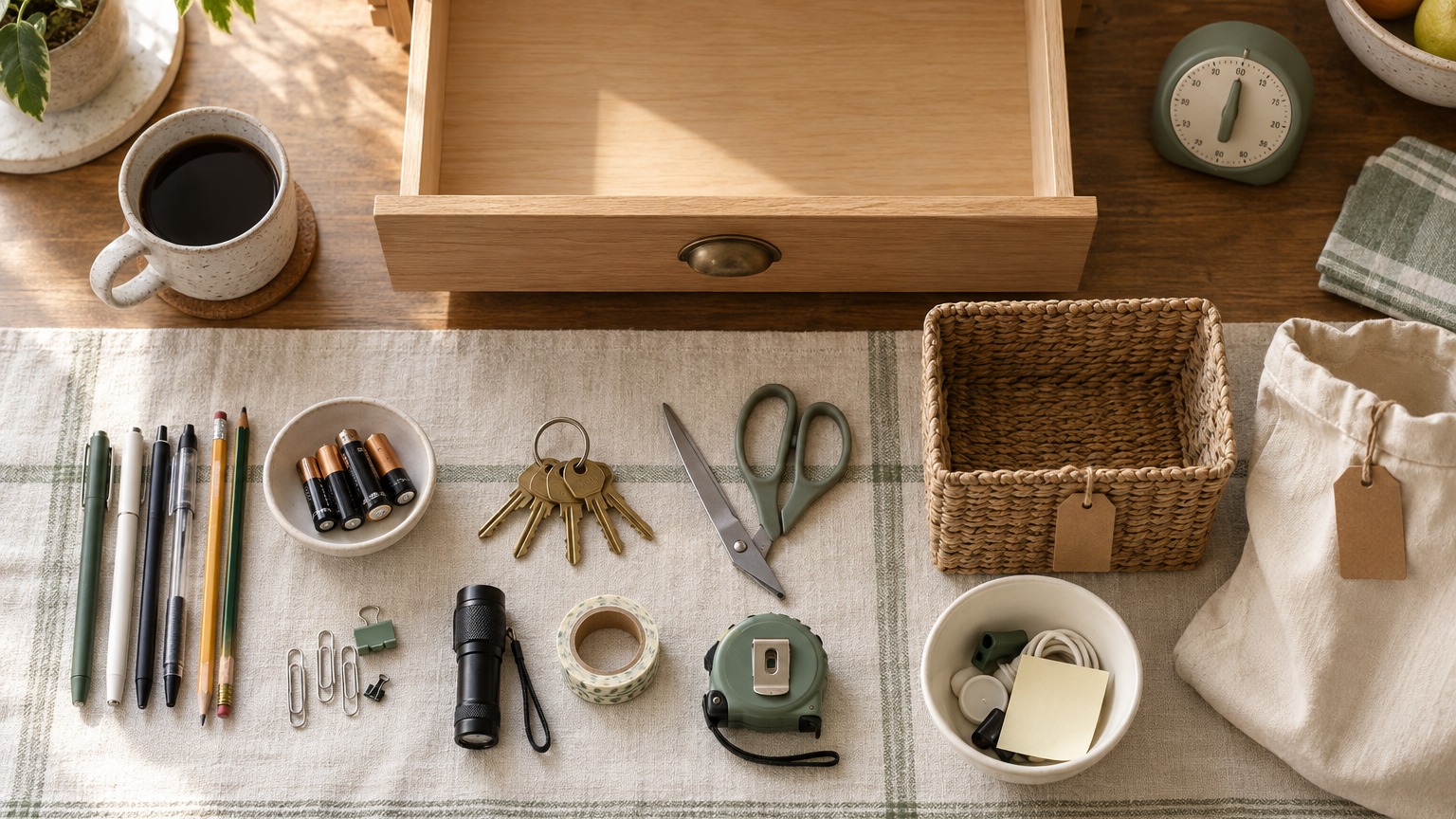
- Empty your entire drawer onto a flat surface instead of sorting inside it.
- Group items by category and decide on quantities rather than sorting one by one.
- Use a 25-minute timer and a maybe bowl to avoid getting stuck on tough decisions.
- Let adults handle dangerous items like batteries, medicine, and sharp tools.
This post contains affiliate links. As an Amazon Associate I earn from qualifying purchases.
Last month I pulled the kitchen drawer out so far, hunting for scissors, that it came off its runners. Inside were dead batteries, a key to a padlock we no longer own, eleven soy sauce packets, and a takeout menu for a restaurant that closed two winters ago. The scissors were in a kid’s craft bin.
This is a keep, toss, or relocate checklist for one drawer in about 25 minutes. You’ll get a three-question decision tree, item-by-item verdict tables, safe handling for batteries and medicine, and a printable purge sheet. Arranging dividers comes afterward, and it goes much faster once you’ve decided what stays.
In this article (13 sections)
- Why Junk Drawers Fill Up
- Before You Start: Set Up for a 25-Minute Purge
- The Three-Question Decision Tree
- Keep, Toss, or Relocate Checklist
- Category-by-Category Walkthrough
- The Relocate List: Where Things Actually Belong
- The Maybe Bowl: How to Handle What You Can’t Decide On
- Deciding What Comes Back Into the Drawer
- How to Keep a Junk Drawer Decluttered
- A Sample Purge: What a 25-Minute Session Looks Like
- Troubleshooting: When the Purge Gets Stuck
- Frequently Asked Questions
- One Drawer, One Decision at a Time
Why Junk Drawers Fill Up
A junk drawer isn’t a character flaw. It’s where a shared home puts things that belong to no single room, and “for now” has no expiration date. Four sources keep it full:
- Pocket and bag dumps. Receipts, hair ties, a rock, an arcade token.
- Orphans. The charger with no device, the key with no lock. Tossing them feels risky.
- “Might need it” items. Twist ties, rubber bands, free pens. Each is harmless; together they take over.
- Misfiled essentials. Batteries, medicine, and tools that should live elsewhere land here because it’s where you were standing.
Dividers handle the shape of the problem, not the volume: 140 items in 12 compartments is still 140 items. Purge first, and the layout has much less work to do.
Before You Start: Set Up for a 25-Minute Purge
You do not need a free Saturday. A single drawer takes 20 to 30 minutes if you set up properly, and the setup is what keeps you from getting derailed halfway. That assumes a standard kitchen drawer; a deep or shared one may take two sessions, and that is fine.
What to gather
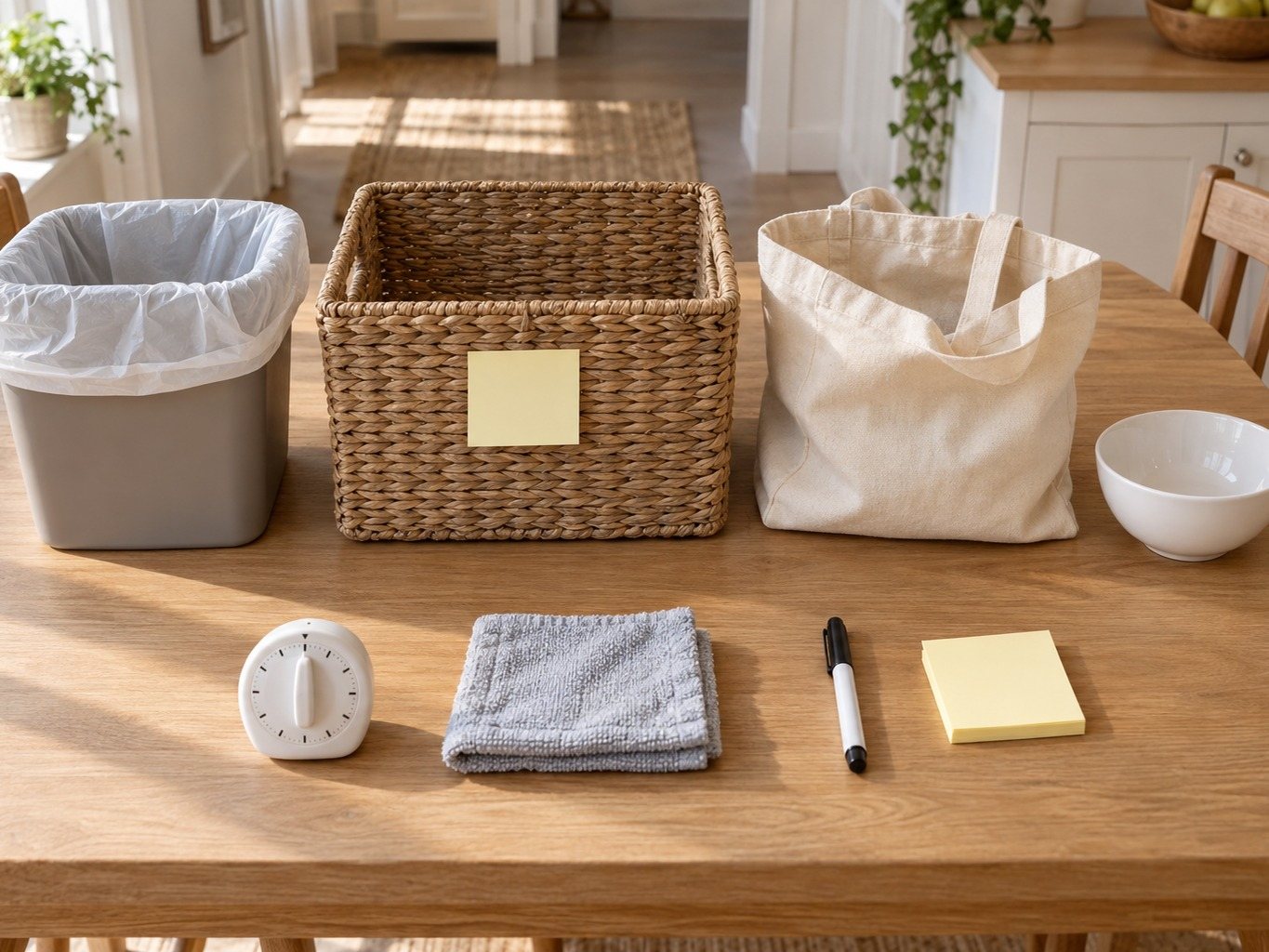
- Four containers or zones: a trash bag, a “relocate” box or laundry basket, a “donate/recycle” bag, and a small “maybe” bowl.
- A flat surface: the kitchen table or counter. Do not sort inside the drawer.
- A damp cloth or all-purpose wipe: drawers collect crumbs, glitter, and mysterious sticky patches.
- A marker and a few sticky notes: for labeling the relocate box by destination (garage, office, bathroom, kids’ room).
- A timer: set it for 25 minutes. A time limit protects you from the rabbit hole where you start testing every pen.
The ground rules
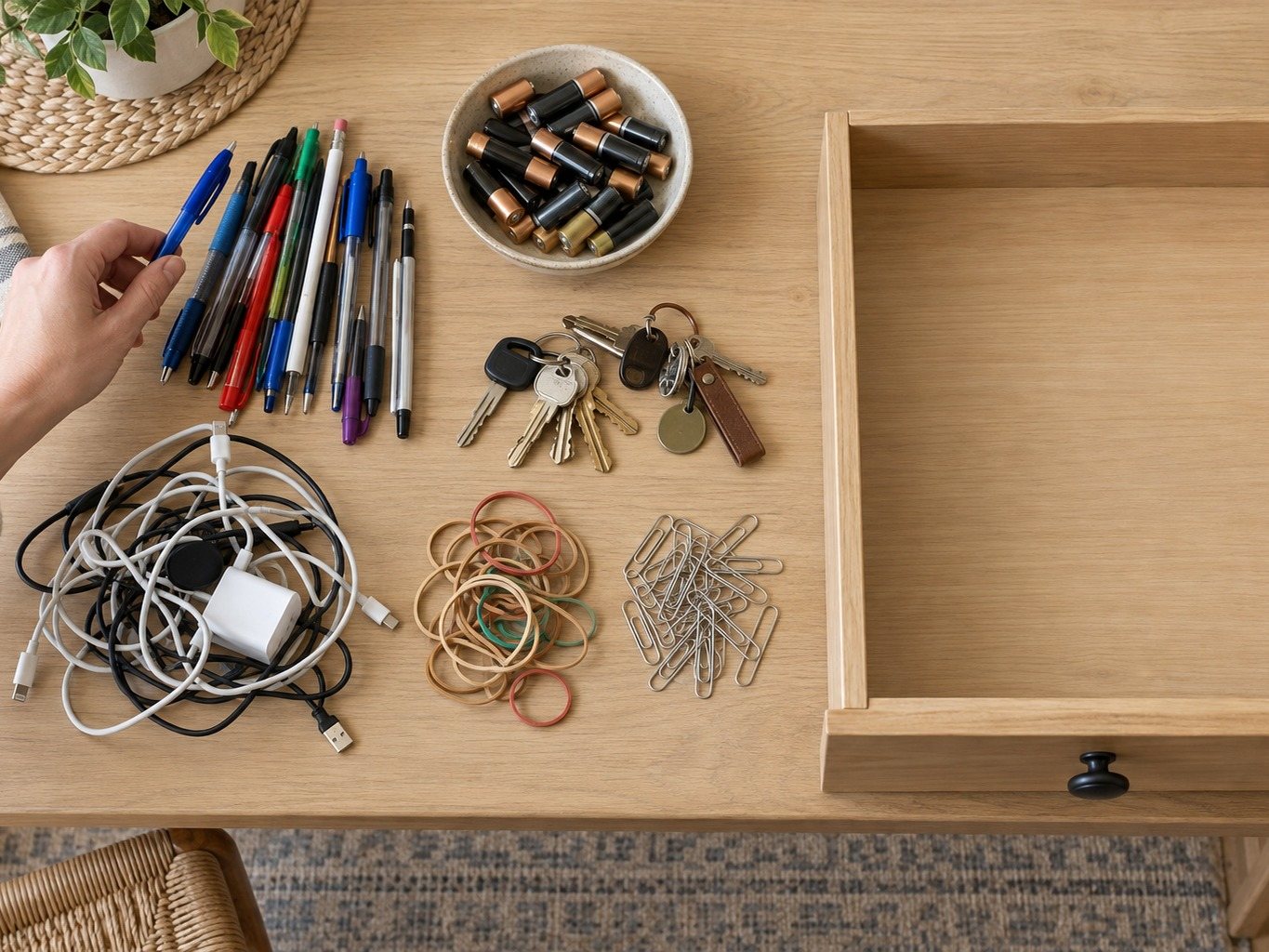
- Empty the whole drawer. Not half. Half-emptying lets you “skip” the offending corner.
- Group like with like on the table. Don’t decide yet. Just pile pens with pens, batteries with batteries, keys with keys. Patterns show up quickly: you’ll see you own nineteen pens and think, I do not need nineteen.
- Decide by category, not item by item. It is far easier to say “I’ll keep five pens” than to evaluate each pen individually.
- Wipe the empty drawer before anything goes back.
- Anything you can’t decide on in 10 seconds goes to the maybe bowl. We’ll handle that bowl properly further down.
Safety firstSchool-age kids can help with safe piles, such as pens, paper clips, and plastic items. Adults handle all batteries, sharp tools, hardware, and small parts. Children under about 5, or any child who still mouths objects, should sit this one out.
For a broader approach to short bursts of decluttering, the routine in 10-minute tidy decluttering pairs nicely with this one. Use it as the maintenance habit after today’s big sort.
The Three-Question Decision Tree
Pick up one item (or one category pile) and ask these three questions in order. Stop at the first verdict.
- Is it broken, expired, empty, dead, or a duplicate beyond what I need? Yes: toss it (follow local disposal rules for batteries, electronics, and ink items). No: go to the next question.
- Does this belong somewhere else in my home? Yes: relocate it to that spot today, or put it in the relocate box. No: go to the next question.
- Do I (or someone in my family) reach for this at least a few times a year from this location? Yes: keep it in the drawer. No: toss, donate, or move it to a labeled bin in a closet if it’s a true “just in case” item.
That’s it. The key phrase in Question 3 is “from this location.” A great flashlight can be a keeper and still belong in the hall closet instead of the kitchen. The drawer is prime real estate, so items have to earn their spot by being grabbed often.
A note on “just in case”
“Just in case” is the phrase that keeps junk drawers alive. Here is a gentler test that works well: If this went missing tomorrow, would I buy a replacement, borrow one, or shrug? If you’d shrug or borrow, it’s not a keeper. If you’d be annoyed enough to rebuy it within a week, it’s a keeper.
Keep, Toss, or Relocate Checklist
The tables below sort common items into three groups: writing and paper, household odds and ends, and safety items. Each row gives a default verdict, so work down them as you sort your piles, one category at a time.
Good to knowIf you’d rather sort with a pen at the counter, print the Junk Drawer Purge Sheet. It has the three-question decision tree, a keep, toss, or relocate table with checkboxes, the count cap, a maybe-bowl log for review dates, and the weekly, monthly, and seasonal check schedule.
Writing, paper, and office supplies
| Category | Keep in the drawer | Toss or recycle | Relocate to |
|---|---|---|---|
| Pens & pencils | 3 to 5 pens that write on the first try, 2 pencils | Dried-out pens, chewed caps, promo pens beyond your 5 | Kids’ art bin, desk, or homework station |
| Markers & crayons | None (they bloom everywhere) | Dry markers, broken crayon stubs | Kids’ art supplies |
| Scissors | 1 pair of good all-purpose scissors | Rusty or sticky scissors | Craft bin (kids’ scissors) |
| Tape | 1 clear tape roll, 1 masking or painter’s tape | Tape rolls with no starting edge, dried-out tape | Wrapping station or craft bin |
| Paper clips & binder clips | A small handful | Rusty clips, bent clips | Desk or homework station |
| Sticky notes | One pad | Dried-out or half-used scraps | Desk or command center |
| Stamps | A few forever stamps | Torn or stuck-together stamps | Command center mail spot |
| Takeout menus | None (photograph the 1 or 2 you order from) | All paper menus, once photographed | Digital bookmark or phone favorite |
| Coupons & gift cards | Active gift cards only | Expired coupons, empty gift cards | Wallet, or the command center |
| Receipts | None (except pending returns) | Everything else | A single “returns” envelope at the command center |
| Warranties & manuals | None | Manuals for things you no longer own | A manual folder or digital scan |
| Phone numbers & notes | None | Scraps with old numbers | Command center or contacts app |
Household, kitchen, and personal odds and ends
| Category | Keep in the drawer | Toss or recycle | Relocate to |
|---|---|---|---|
| Keys | Labeled keys you use (mailbox, shed, spare house key) | Mystery keys you can’t identify after one honest try | Key hooks by the door or a key box |
| Chargers & cords | 1 or 2 you actively use, labeled | Frayed cords, chargers for devices you no longer own | Charging station or office drawer |
| Flashlight | 1 small flashlight with fresh batteries | Dead flashlights | Hall closet or power-outage kit |
| Measuring tape | 1 retractable tape that actually retracts | Broken or unreadable tapes | Toolbox |
| Basic tools | A small screwdriver or multi-tool | Stripped bits, bent tools | Toolbox in the garage |
| Screws, nails, hardware | None (sorted bag at most) | Mystery hardware with no project | Labeled hardware container in the garage |
| Rubber bands & twist ties | A small handful (10 rubber bands, 10 twist ties) | Brittle or sticky rubber bands, 100-count excess | Pantry (bag clips) |
| Bag clips & chip clips | 3 to 5 | Cracked, springless clips | Pantry |
| Corkscrew & bottle opener | 1 each if the kitchen needs them | Duplicates and broken ones | Bar cart or utensil drawer |
| Condiment packets | None | Anything expired, undated, or that you won’t use this week (trash, not recycling) | Fridge door bin if you truly use them |
| Birthday candles | None | Used, partial candles | Party or gift wrap bin (one small pack) |
| Coins & loose change | A small dish with a handful | Foreign coins you’ll never use | A change jar or coin dish |
| Hair ties & clips | None | Stretched-out or broken ties | Bathroom or bedroom tray |
| Jewelry & loose earrings | None | Single, broken earrings you won’t repair | Jewelry box |
| Unknown items | None | Anything unidentifiable after 10 seconds | Maybe bowl, then decide |
Safety items: batteries, lighters, medicine, and small toys
| Category | Keep in the drawer | Toss or recycle | Relocate to |
|---|---|---|---|
| Batteries | A small container of AA/AAA for daily use only | Dead, leaking, swollen, or corroded batteries (drop-off for lithium, rechargeable, and button cells; alkaline per local rules; see the safety notes below) | Garage or hall closet kit for bulk spares |
| Matches & lighters | None | Empty lighters | High, latched cabinet out of children’s sight and reach; use child-resistant lighters |
| Medications & first-aid | None | Expired medicines (use a pharmacy take-back) | A cool, dry, high, locked or latched spot out of children’s sight and reach (not a humid bathroom) |
| Small toys & party favors | None | Broken toys, tiny trinkets no one wants | Toy bins or a kid “treasure” box |
Treat every “keep” column as a maximum, not a target. The count cap later in this post sets the specific limit for each category.
TipWith babies or toddlers at home, keep cords short and coiled and out of reach, and never near cribs or beds. If children under 5 are in the house, put scissors, screwdrivers, and multi-tools in a drawer with a child-safety latch or keep them above reach.
Category-by-Category Walkthrough
The table gives you the verdicts. This section gives you the reasoning, because some of these categories are where people get stuck.
Writing tools: pens, pencils, markers
Pens are the great junk drawer multiplier. You get them from banks, hotels, conferences, and school events, and they reproduce overnight.
Run a quick test: scribble on a scrap of paper with each pen. Anything that skips or stays dry is trash. From what remains, keep a working handful, the number you’d use if you needed to fill out a form and hand one to a guest. Three to five is plenty for a family.
Markers and crayons almost never deserve a kitchen drawer. They leak, melt, and stain. Move them to wherever the kids actually draw. If the kids’ art spot is a mess, that’s another project, but don’t leave markers behind to inherit a drawer.
Batteries: the one category with a safety angle
Batteries get their own warning because they behave differently from other clutter.
- Dead batteries: check your local rules first. Lithium, rechargeable, and button or coin cells always go to a battery drop-off, and many hardware stores and municipal sites collect them. Ordinary alkaline AA and AAA cells can go in household trash in some areas and must be recycled in others. Until you can drop them off, store them in a lidded non-metal container out of children’s reach, with tape over the terminals of 9-volt, lithium, and all coin or button cells.
- Leaking or corroded batteries should be handled carefully with gloves and a paper towel, then sealed in a bag. Take them to a drop-off, or dispose of them as your local rules allow for alkaline cells. Never put them back loose in the drawer.
- Swollen, hot, or damaged batteries (especially lithium) are a fire risk. Don’t charge, puncture, or crush them. Tape over the terminals or seal each one in its own plastic bag, then bed it in sand or cat litter inside a metal tin so it touches neither the metal nor another battery. Leave the lid loose rather than airtight, and keep the tin away from anything flammable and out of children’s reach. The metal tin is only for damaged cells; ordinary dead ones stay in the non-metal container. Call your local hazardous-waste site to ask how they want damaged lithium batteries brought in, then take it there promptly. Never leave them in the drawer or put them in the regular trash.
- Button and coin cell batteries are a serious hazard for young children and pets. In any home with children under about 6, store them out of reach in a locked or latched spot, never loose in a low drawer, and tape over the terminals of coin cells.
Safety firstIf a child may have swallowed a battery, go to the emergency room immediately and don’t wait for symptoms. Call the National Battery Ingestion Hotline (800-498-8666) or Poison Control (1-800-222-1222). Do not induce vomiting.
A quick test for “dead or alive” is to keep a separate “tested” cup. Anything you’re unsure about, test in a device, then sort. Don’t put untested batteries back with tested ones.
For the drawer itself, keep a small stash of the sizes your household uses daily (usually AA and AAA) and move the bulk pack to the garage or hall closet.
Keys: the mystery-key problem
Every house has them. The key on a loop of yarn, the little brass one, the one that might open the shed or might open a bike lock sold in 2014.
Give each unidentified key one honest attempt: try it on the obvious suspects (mailbox, shed, filing cabinet, luggage, bike lock, garden gate). If it opens something, label it with a tag or a strip of masking tape and give it a home on a hook. If it opens nothing, it goes in the maybe bowl with a date on a sticky note. If 30 days pass and no lock has revealed itself, let it go.
The only keys that belong in the drawer are ones you grab regularly and don’t want hanging by the door, such as a spare for the neighbor who waters your plants. Even then, a labeled hook is better. Label keys by lock or purpose (“shed”), never with your name or address.
Cords and chargers
Chargers are the drawer’s version of tangled holiday lights. Here is a fast way to settle them:
- Lay out every cord and charger on the table.
- Pick up one and name the device it charges. If you can’t, it’s an orphan.
- For orphans, give yourself one search (check the family devices, or look at the connector type), then let it go to electronics recycling.
- Keep the cords you use regularly, labeled with a bit of tape at the plug end.
- Anything else you want to keep “just in case” can live in one labeled bag in an office or closet, not in the daily drawer.
If cords are a recurring problem, a dedicated charging spot on your counter or desk resolves it. The ideas in family command center organization show how a single hub can take charging, mail, and school papers off the kitchen drawer entirely.
Paper: receipts, coupons, menus, and manuals
Paper is the quiet bulk of most junk drawers. It adds up in thin layers.
- Receipts: Keep only those tied to a return window or warranty. Put those in one envelope. Everything else goes.
- Coupons: Check the expiration date on each one. Expired means recycle. Active ones that you will really use go in your wallet or the car, where you’ll actually have them.
- Takeout menus: Photograph the one or two you really use, or save the restaurant to your phone. Recycle the paper.
- Manuals: If you still own the product, scan or photograph the first page and the troubleshooting page, then store the manual in a labeled folder. If you don’t own the product, recycle it. Most manuals are available online anyway.
- School papers: These belong at the command center, not in the drawer.
Hardware and tools
Small hardware accumulates because screws feel like a rare resource. The truth is that a mystery screw almost never matches the thing you’re fixing.
Keep one multi-bit screwdriver or a small basic set. A tape measure that actually retracts is worth a spot. Everything else (a hammer, a level, pliers) belongs in a toolbox in the garage or a closet. Loose screws, nails, and picture hooks go into a small labeled container in your tool area, not the kitchen drawer.
Medications and first-aid supplies
A junk drawer should not hold medication. Kids can reach low drawers, and expiration dates get ignored when pills are mixed in with tape and pens.
Move any medicine, even a single loose pill, out. Store it in a cool, dry, high, locked or latched spot out of children’s sight and reach, in the original child-resistant containers. A humid bathroom is not ideal.
For expired medications, use a pharmacy take-back program or a local disposal event first. If none is available, mix the medicine with used coffee grounds or cat litter, seal it in a bag, and put it in the household trash. Check the FDA flush list (search “FDA flush list”) for the few medicines, mainly certain opioids, that should be flushed instead.
Adhesive bandages and basic first-aid items belong in a single labeled kit in that same high, latched spot.
Safety firstIf a child may have swallowed any medicine, call Poison Control right away at 1-800-222-1222.
Kid treasures and tiny toys
This is the emotionally loaded category. A small plastic dinosaur may be junk to you and a prized possession to a four-year-old.
Handle it kindly. Gather every small toy and trinket into one pile and give your child a small lidded “treasure box” (a shoebox works). Everything they want to keep goes in the box, as long as it’s safe for the youngest child in the house. Anything broken or incomplete goes, with a quick explanation. For more on keeping toy volume manageable, the approach in how many toys should be out at once works well, since a treasure box is a very small version of toy rotation.
Safety firstCoins, button batteries, and magnets never go in the treasure box. Small toys and trinkets are choking hazards for children under 4: if it fits through a toilet paper tube, keep it away from younger siblings. With a sibling under 4 in the house, store the treasure box on a high shelf and bring it down for supervised play. If you keep a coin dish in a low drawer, move it up high too. Swallowed magnets, especially more than one, need urgent medical care even without symptoms.
Condiment packets, candles, and “free” odds and ends
Soy sauce packets, ketchup, relish, and napkins from takeout. They feel like food, so they feel wasteful to toss. But they sit for months, and most will go unused. Check the dates, use only clearly in-date packets, and put the rest in the trash. Food residue means they can’t go in recycling.
For birthday candles, keep one small pack for the household. Used stubs and mismatched singletons can go.
The Relocate List: Where Things Actually Belong
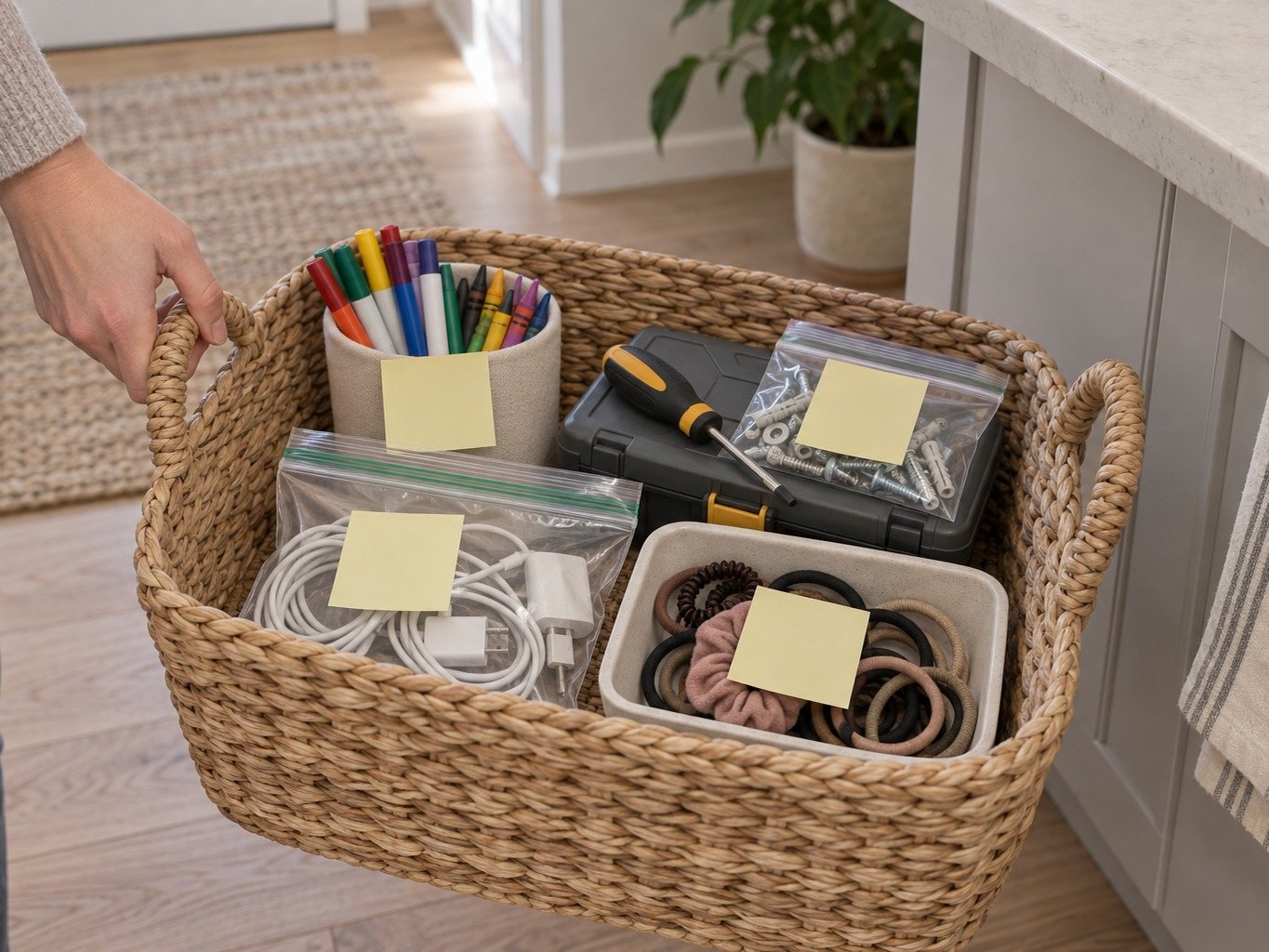
Relocating is the step people skip, and it’s why drawers refill. If the borrowed items don’t leave the kitchen, they find their way back.
Do this part right away, before the energy of the purge fades. Put the relocate box on the floor, and then walk it through the house once, delivering each item. It usually takes a few minutes.
Here is a handy guide for where common items should go.
| Item | Best new home |
|---|---|
| Spare batteries (bulk), flashlights, bulbs | Hall closet or power-outage kit |
| Tools, hardware, tape measure | Garage toolbox or utility closet |
| Markers, crayons, craft scissors, stickers | Kids’ art bin or craft cart |
| Pens, paper clips, sticky notes, stamps | Desk or command center |
| Chargers and cords | Charging station or office |
| Keys (spare and labeled) | Key hooks by the entry |
| Medication, first-aid | Cool, dry, high, locked or latched spot (not a humid bathroom) |
| Hair ties, clips, jewelry | Bathroom tray or bedroom dish |
| Gift cards and coupons | Wallet or command center folder |
| Warranties and manuals | A labeled folder or digital scan |
| Candles, matches, lighters | High, latched cabinet out of children’s sight and reach |
| Bag clips, twist ties | Pantry |
| Small toys and party favors | Toy bins or treasure box |
| Mail and school papers | Command center inbox |
If the places on this list don’t exist yet, the drawer has been serving as your catchall because nothing else is available. That’s a sign you need an entry spot, a charging spot, or a small paper hub. The family command center ideas are a good place to see how those pieces fit together, and the same logic applies to your entryway and mudroom if keys and mail keep stacking up by the door.
A word about the garage and car
Not everything needs to move indoors. Jumper cables, tire gauges, and ice scrapers can head straight to the car. Tape, a flashlight, and a small multi-tool can live in the glove compartment. If you want ideas for the car side of things, the car organization tips for moms show how to keep a small, focused kit rather than a second junk drawer on wheels.
The Maybe Bowl: How to Handle What You Can’t Decide On
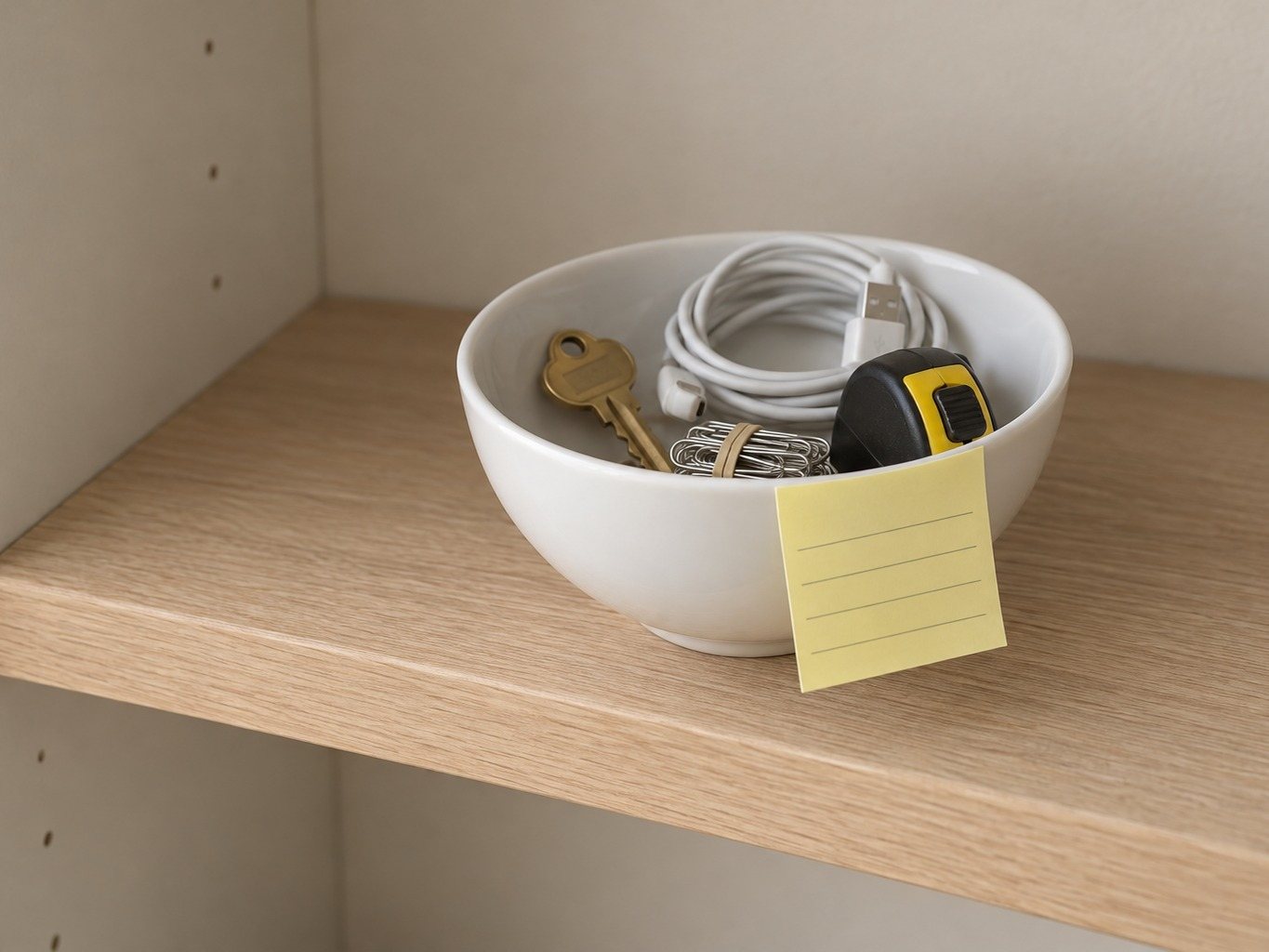
The maybe bowl is an honest tool. It keeps you moving, and it stops you from keeping things by default.
Here’s how to make it work:
- Keep it small. A cereal bowl, not a bin. If it overflows, make a quicker call on the next batch.
- Add a sticky note with today’s date. Place the bowl somewhere out of the way, not back in the drawer.
- Set a review date, usually 30 days. When it comes, look at each thing again. If you haven’t missed it or needed it, it goes.
- Allow a few exceptions. Truly sentimental items (a child’s first tooth holder, a grandparent’s key ring) should graduate to a memory box, not the maybe bowl and not the drawer.
You will be surprised how many things you let go without a second thought when the date arrives.
Deciding What Comes Back Into the Drawer
By now, you should have a pile of “keeps” on the table. Before you return anything, run a final filter.
The “grab test”
Look at each keeper and ask: In the past month, did anyone in my house reach for this? If you can’t remember, it’s borderline. If you can’t remember in the past three months, it’s out of the drawer.
The “count cap”
Set a number for each category. Here’s a sample cap for a family of four:
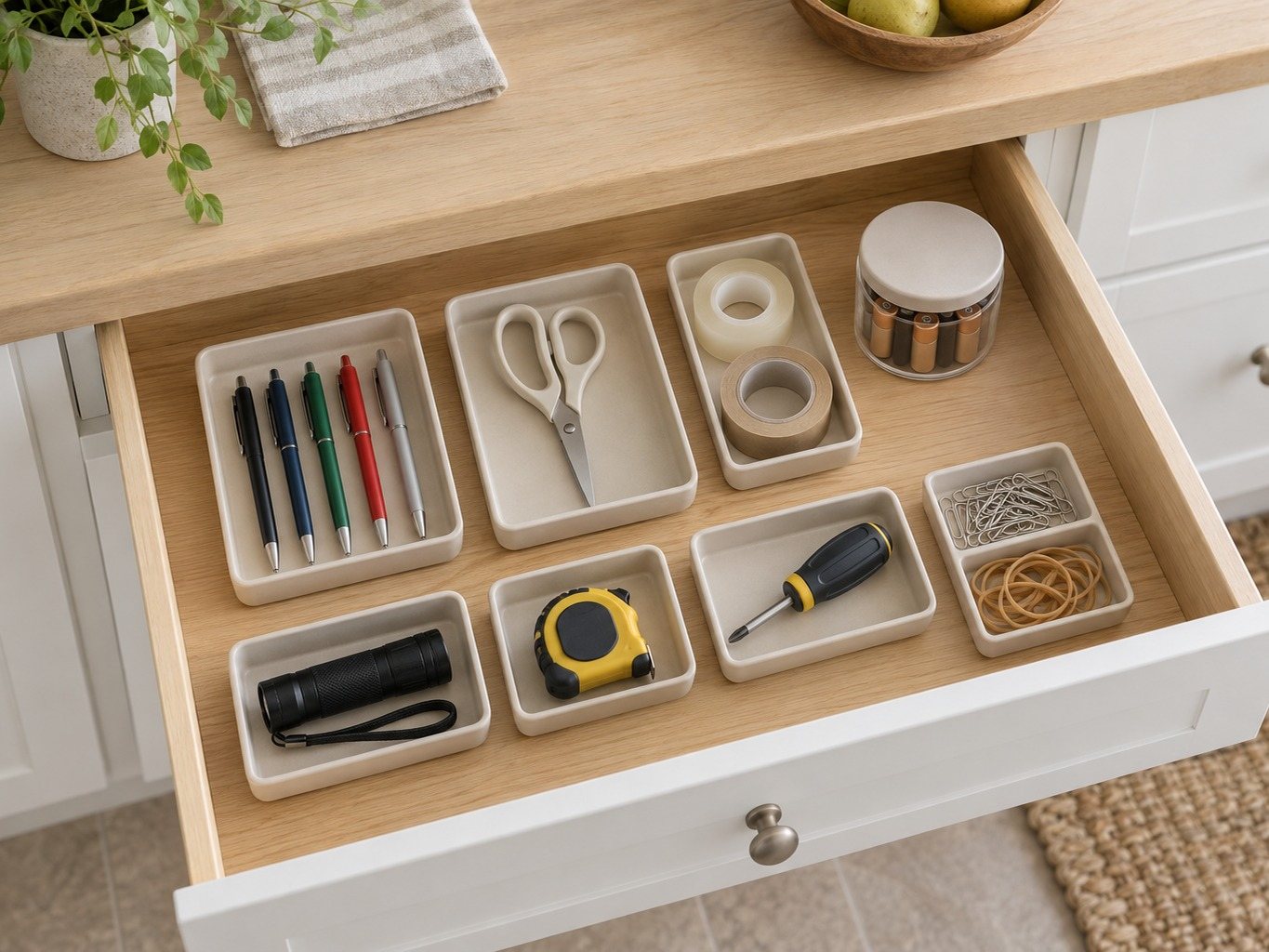
- 3 to 5 pens, 2 pencils
- 1 scissors
- 2 tape rolls
- 1 small container of AA/AAA batteries
- 1 flashlight
- 1 tape measure
- 1 small screwdriver
- 10 rubber bands, 10 twist ties
- A handful of paper clips
- 1 pad of sticky notes
- 1 stamp booklet or a few stamps
- 1 small dish of coins
That’s a drawer that works. If you find yourself wanting to add more, ask whether the item belongs in a different location, rather than whether the drawer can squeeze it in.
A shallow drawer naturally limits how much can accumulate, so a smaller drawer with a strict job beats a deep one.
What a finished drawer looks like
A finished junk drawer should look almost boring. You open it and can identify everything in a single glance. Items aren’t stacked on top of each other, and you aren’t pushing things aside to reach the tape. If you can’t see the bottom of the drawer, there’s still too much.
Once the content is settled, you can add dividers or small containers to keep it that way. A simple set of trays is enough. The goal is something that stays neat without effort, not a styled drawer that needs weekly attention.
How to Keep a Junk Drawer Decluttered
Junk drawers refill, and that’s normal. What matters is a small routine that catches the drift before it becomes a pile.
The 60-second weekly check
Once a week, ideally while waiting for the kettle or coffee, open the drawer and scan. Pull out anything that doesn’t belong. This takes under a minute.
The monthly mini-reset
Once a month, empty the maybe bowl and review what’s inside. Wipe the drawer if needed. Check battery dates and expired coupons.
The seasonal reset
Four times a year, run the whole decision tree again. It will take five to ten minutes instead of 25, because the baseline is low. A good time to do it is alongside bigger seasonal resets, such as before the holidays, when guests and gifts bring new clutter. If you’re getting ready for the season, the approach in the pre-Thanksgiving declutter checklist for busy parents fits well with a quick drawer pass.
Give the family a simple rule
The best rule for everyone in the house is: “If you put it in, you decide if it stays.” Kids can learn this easily. When they drop something into the drawer, they’ll learn to check whether it really belongs.
Another helpful rule: one in, one out for the few categories that tend to multiply, like pens and keys.
Create a landing spot for the real source of the clutter
Most junk drawer growth comes from what’s sitting on your counters and in your pockets at the end of the day. If you add a small tray by the door for keys and pocket contents, and a basket for kids’ small treasures, the drawer sees far less traffic.
A Sample Purge: What a 25-Minute Session Looks Like
Here is a realistic timeline, so you can see how this plays out.
| Minutes | Step |
|---|---|
| 0 to 3 | Gather bags, bowl, timer. Empty the entire drawer onto the table. |
| 3 to 5 | Wipe the empty drawer. Toss obvious trash (wrappers, dried-out pens, crumbs). |
| 5 to 10 | Group like with like. Count each pile. |
| 10 to 18 | Run the three-question decision tree on each category. Fill the trash, relocate, and maybe containers. |
| 18 to 22 | Return only the “keep” items, using the count cap. |
| 22 to 25 | Start delivering the relocate box (a few minutes; finish after the timer if needed). Take the trash out. Place the maybe bowl somewhere out of the way with a dated note. |
If the timer runs out, finish delivering the relocate box the same day, before the items drift back to the counter.
Troubleshooting: When the Purge Gets Stuck
A few common snags, and how to get past them.
| Snag | What to do |
|---|---|
| “Everything is useful.” | Use the replacement test: if it disappeared, would you buy a new one this week? If not, it’s not essential. |
| “My partner keeps adding things.” | Agree on the count cap together, and let them choose which items fill each slot. Shared rules are easier to follow than rules handed down. |
| “I can’t throw away things that still work.” | Donate or give them away. A working screwdriver set, extra scissors, or unused notebooks can go to a school, a community swap, or a neighbor. |
| “The kids keep raiding it.” | That’s useful information. Either the drawer holds a few kid-friendly items (tape, safety scissors, a pencil), or the kids need their own supply spot so the main drawer stays calm. |
| “I don’t have anywhere to relocate things.” | Create a single “homeless items” box and give yourself a week to find or create the right spots. A small shelf, a closet bin, or a labeled hook can be enough. |
Frequently Asked Questions
What should you keep in a junk drawer?
Keep only the things your household grabs often and that don’t belong to a specific room. That means a few working pens, one pair of scissors, and tape. Add a small supply of everyday batteries, a flashlight, and a retractable tape measure. Round it out with a small screwdriver and a handful of rubber bands and paper clips. Items you use rarely, such as bulk batteries, tools, or craft supplies, are better stored in a dedicated spot like a closet, garage, or art bin.
How often should I declutter my junk drawer?
Plan on a full purge about four times a year, with a quick 60-second scan weekly and a short review monthly. After the first big sort, the seasonal check usually takes only five to ten minutes. Tying the check to seasonal changes, such as back-to-school or before the holidays, helps it stick.
What do I do with old batteries, chargers, and cords?
Lithium, button or coin, and rechargeable batteries should always go to a recycling drop-off, never the regular trash. Rules for ordinary alkaline batteries vary by area, so check your local guidance. Hardware stores, electronics retailers, and local collection events usually take dead batteries, chargers, and old electronics. For a swollen or damaged lithium battery, call your local hazardous-waste site first to ask how to bring it in.
Until you can take them in, tape the terminals of 9-volt, lithium, and all coin or button batteries, and store them in a lidded non-metal container out of children’s reach. In any home with young children, keep button and coin batteries locked away. If a child may have swallowed one, go to the ER immediately and call 800-498-8666 or Poison Control at 1-800-222-1222.
What if I can’t identify a key or a cord?
Give it one honest try: test the key on likely locks, or check whether the cord fits any device in your home. If it still doesn’t match anything, put it in a “maybe” bowl with a dated note and review it in 30 days. If nothing has come up by then, let it go. A key for a lock you can’t find, or a cord for a device you no longer own, is no longer doing a job.
How do I get my kids and partner to stop refilling the drawer?
Work with the habits instead of against them. Give everyone a clear spot for what ends up in their pockets, such as a tray by the door, a treasure box for kids, and a charging station. Then agree on a simple rule: whoever puts something in the drawer decides if it stays. Showing everyone the final, tidy drawer after the purge also helps, because people tend to respect a space that looks cared for.
Should I use dividers or organizers right away?
Purge first, then organize. If you buy dividers before you decide what stays, you’ll fit your clutter to the organizer instead of the other way around. Once you know exactly what’s coming back into the drawer, measure the space and choose trays that suit those items. Often a few small containers are all you need.
Is it okay to have more than one junk drawer?
Yes, as long as each drawer has a clear job. Many homes do well with a kitchen drawer for everyday items and a separate spot, like a desk drawer or command center, for paper and office supplies. Trouble starts when a second drawer becomes a place for deferred decisions. If you have more than one, run the same decision tree on each, and give every drawer a short label in your head, such as “daily tools” or “mail and stamps.”
One Drawer, One Decision at a Time
A junk drawer will never be glamorous, and it doesn’t need to be. It just needs to be honest: a small, useful set of things you actually grab, in a drawer where you can see them. Decide what to keep, toss, and relocate, and the rest of the system gets easy.
Start with just one drawer and one timer. Twenty-five minutes from now you’ll know where the scissors are, and that small feeling of calm tends to spread to the next drawer on its own.