Bathroom Counter Organization: How to Tame the Family Bathroom Chaos
Tired of your chaotic family bathroom counter? This guide will help you strip it down and rebuild it with intention, creating a maintainable system so you can achieve a clear, easily wipeable surface every day.
- Recognize your counter's chaos is due to poor family-focused setup, not your messiness.
- Boost morning efficiency by 5-10 minutes when every item has a designated, visible home.
- Improve hygiene and health with a clear counter that's easy to wipe down, preventing mold.
- Reduce your stress and teach kids responsibility by maintaining an organized bathroom routine.
- Aim for a "clear counter" you can wipe in one motion, rather than just an "organized" one.
You know the scene. You walk into the bathroom at 7:15 AM and it looks like a drugstore exploded on the counter. There’s a tube of toothpaste with the cap missing, a rubber duck that migrated from the tub, someone’s retainer case, a bottle of leave-in conditioner lying on its side in a small puddle of itself, and approximately nine toothbrushes — only four of which belong to people who currently live in your house.
And somewhere under all of that, there’s a counter. You’re pretty sure it’s marble-look laminate. You haven’t actually seen it in weeks.
Family bathroom counters are the canary in the coal mine of household organization. When life gets chaotic, the bathroom counter is the first surface to absorb the fallout. It becomes a dumping ground, a catch-all, a place where things go to live permanently because nobody knows where else to put them.
Here’s the truth: the problem isn’t that your family is messy. The problem is that most bathroom counters aren’t set up for what families actually need them to do. They’re designed for a magazine-worthy vignette — not for four people with wildly different hygiene routines, varying heights, and exactly zero patience at 7 AM.
This guide is going to fix that. We’re going to strip your bathroom counter down to nothing, rebuild it with intention, and create a system that every member of your family can actually maintain. No perfection required. Just a counter you can wipe down in one motion.
In this article (12 sections)
- Why Bathroom Counter Organization Actually Matters
- The “Clear Counter” Philosophy
- Step-by-Step: The Bathroom Purge
- Organization Systems by Family Type
- Product Recommendations by Category
- Small Bathroom Solutions
- The Zone System: Every Family Member Gets a Space
- Maintaining the System
- Budget-Friendly vs. Investment Pieces
- Design Principles: Making Organization Look Good
- Frequently Asked Questions
- Building a Bathroom That Works for Your Whole Family
Why Bathroom Counter Organization Actually Matters
Before we dive into bins and baskets, let’s talk about why this matters beyond aesthetics. Because if your only motivation is “it should look nice,” you’ll reorganize the bathroom this weekend and it’ll be destroyed by Wednesday. You need deeper reasons to make a system stick.
Morning Routine Efficiency
The average American family spends 40 to 60 minutes on morning routines, and a significant chunk of that time is spent looking for things. The hair brush that was right here yesterday. The specific detangling spray your daughter insists is the only one that works. Your partner’s contact lens solution that somehow ended up behind the toilet.
When every item has a designated, visible home, your morning routine gets faster. Not dramatically — we’re not promising you’ll save an hour. But shaving five to ten minutes off a chaotic morning by eliminating the “where is it?” moments? That’s real. That’s one fewer meltdown before school. That’s coffee you actually drink while it’s hot.
Hygiene and Health
An organized counter is a clean counter, because an organized counter is a wipeable counter. When products pile up, moisture gets trapped underneath bottles, and you create ideal conditions for mold and bacterial growth. If you can clear the surface in one sweep of your arm, you’ll actually clean it. If you have to move fourteen items to wipe it down, you won’t. That’s human nature.
Mental Health and Teaching Kids Responsibility
Research consistently connects household clutter to elevated stress levels. The bathroom is often the first room you see in the morning and the last room you see at night. Starting and ending your day in visual chaos has a measurable impact on your cortisol. Beyond your own wellbeing, children who have a designated space for their belongings develop organizational habits that extend far beyond the bathroom. The routine is daily, the space is small, and the feedback is immediate.
The “Clear Counter” Philosophy
Here’s the organizational principle that changed everything for our approach to bathrooms: the goal is not an organized counter. The goal is a clear counter.
There’s a critical difference. An “organized counter” still has stuff on it — it’s just arranged neatly. Organized counters look great on day one. By day five, the organized arrangement has devolved into a slightly-less-chaotic pile, because every time someone grabs something and puts it back in roughly the right area, the system degrades a little.
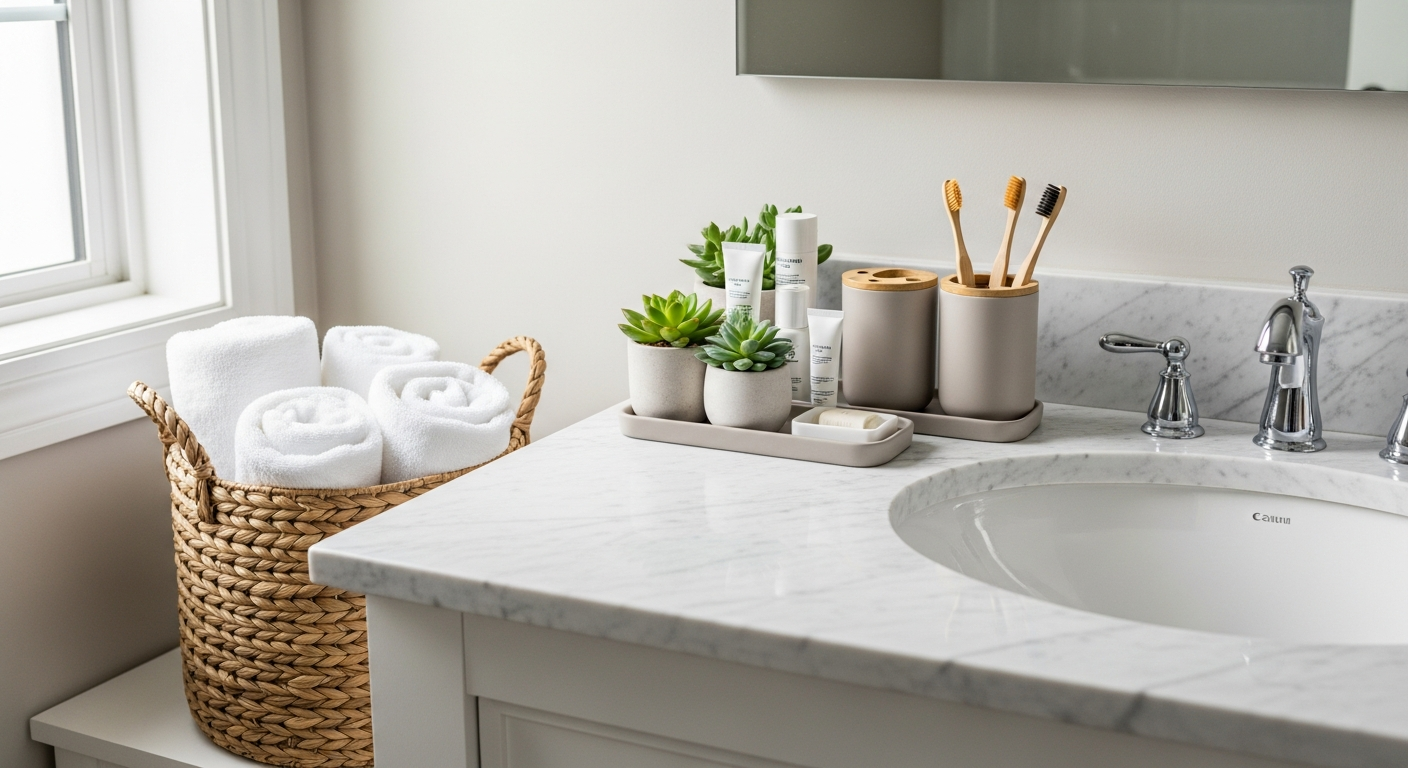
A clear counter means almost nothing lives on the counter surface itself. Products live in drawers, cabinets, wall-mounted organizers, or contained trays. The counter is a workspace — a place where you do things — not a storage surface.
Think of it like a kitchen counter. The best kitchen advice says keep counters clear for food prep and store appliances in cabinets. Your bathroom counter works the same way. It’s where you brush teeth, wash hands, apply products, and get ready. It should be clear enough to actually use.
What Earns a Spot on the Counter
In a family bathroom following the clear counter philosophy, these are the only items that belong on the actual counter surface:
- Soap dispenser (one, matched to your aesthetic, refillable)
- A single small tray or container for items used multiple times daily by multiple people (hand cream, a shared hair brush)
- Toothbrush holder (if wall-mounting isn’t possible)
That’s it. Everything else goes somewhere else. Not far — just not on the counter.
The Psychological Trick
Here’s why clear counters work so well for families: clear surfaces create social pressure to stay clear. When a counter is already cluttered, adding one more item doesn’t register. But when a counter is clean and bare, that abandoned hair tie feels conspicuous. That orphaned toothpaste cap looks out of place. Family members are significantly more likely to put things away when “away” is the obvious default state of the surface.
Step-by-Step: The Bathroom Purge
Before you buy a single organizer, basket, or shelf, you need to do the purge. This takes 30 to 60 minutes per bathroom, and it’s the step that makes everything else work.
Step 1: Clear Everything Off the Counter
Everything. Not “everything except the stuff I know I use.” Put it all in a box or on a towel on the floor. Include items from the medicine cabinet, under-sink area, shower caddy, and drawers. This step is non-negotiable. You can’t see the problem clearly when you’re standing inside it.
Step 2: Clean the Empty Surfaces
While everything is out, really clean. Wipe the counter, scrub the sink, clean inside drawers and cabinets. You’re setting a new baseline — this clean surface is what you’re going to protect going forward.
Step 3: Sort Everything Into Four Piles
- Daily use: Items someone uses every single day — toothbrushes, toothpaste, face wash, deodorant, hair brush, daily medications.
- Weekly or occasional use: Deep conditioner, face masks, nail clippers, first aid supplies.
- Expired, empty, or duplicate: Check expiration dates. Toss expired items. Recycle empties. Consolidate duplicates.
- Doesn’t belong here: The screwdriver from when you fixed the towel bar. The snack wrapper. The toy car.
Step 4: Quantify and Measure
Count the items in piles one and two — this is your actual bathroom inventory. For a typical family of four, that’s 30 to 50 items that need organized homes. Then measure your available storage: counter dimensions, drawer sizes, cabinet space, available wall space, and door-back space. Your storage capacity determines your system.
Organization Systems by Family Type
Not every family’s bathroom needs are the same. A family with a six-month-old has a fundamentally different set of products and routines than a family with two school-age kids. Here’s how to adapt the system.
Families with Babies and Toddlers (0-3 Years)
Babies and toddlers come with an absurd number of products for such small humans. Diaper cream, baby lotion, baby wash, baby shampoo, baby sunscreen, saline drops, a nasal aspirator, infant Tylenol, teething gel, bath thermometer, hooded towels, washcloths, and a fleet of bath toys that are somehow always slightly slimy.
Key principles for this stage:
- Prioritize one-handed access. If you’re holding a wet, squirming baby with one hand, you need to be able to grab the baby wash with the other. Wall-mounted dispensers, magnetic strips, and open-top containers beat lidded bins at this stage.
- Bath products live near the tub, not on the counter. Use a tension rod caddy inside the shower/tub, or a suction-cup mounted basket at the end of the tub. This keeps the counter clear and puts products where you actually use them.
- Rotate bath toys. Keep three to five bath toys in the tub and the rest in a mesh bag or bin in a closet. Rotate weekly. This controls the toy sprawl and keeps bath time interesting.
- Create a diaper-change station drawer. If you change diapers in the bathroom (many families do for older babies), dedicate one drawer to diapers, wipes, cream, and a change of clothes. Everything for the task in one pull.
Top picks: Suction-cup corner shower basket for baby wash, mesh bath toy bag with suction hooks for drainage, a small lazy Susan under the sink for baby products, and a wall-mounted soap dispenser for baby wash.
Families with School-Age Kids (4-12 Years)
School-age kids are in the golden zone of bathroom organization: old enough to have their own routines but young enough that you still control the product inventory. This is the age to build habits that will carry them through the teen years.
Key principles for this stage:
- Each child gets their own container. A small bin, a designated drawer section, or a labeled caddy. Their toothbrush, toothpaste, hairbrush, and any special products live in their container. They are responsible for that container and nothing else.
- Step stools are storage, not obstacles. Invest in a sturdy step stool that tucks under the vanity when not in use. Kids who can reach the counter independently are kids who put their own stuff away.
- Establish the “use it, stash it” rule. Nothing stays on the counter after use. You take your stuff out of your container, use it, and put it back. This is non-negotiable and worth enforcing consistently for the first two weeks until it becomes automatic.
- Limit products. School-age kids don’t need twelve products. They need a toothbrush, toothpaste, a brush or comb, maybe a detangling spray, and soap. Keeping the inventory small makes organization easy.
Top picks: Stackable drawer organizers with removable dividers, individual toiletry caddies with handles, a color-coded toothbrush holder (each kid gets a color for their toothbrush, cup, and towel hook), and a drawer-mounted toothbrush holder.
Shared Adult and Kid Bathrooms
This is the most common — and most challenging — configuration. Adults and children sharing a single bathroom means accommodating vastly different heights, product types, routine lengths, and tidiness standards in one small space.
Key principles for shared bathrooms:
- Vertical separation. Adult products go high, kid products go low. Medicine cabinet and upper shelves for adult skincare, medications, and styling products. Lower drawers and under-sink baskets for kid items. This also doubles as a safety measure — medications and sharp items stay out of reach.
- Time-share the counter. Accept that the counter will have different users at different times. Morning routines for kids (toothbrushing, hair) happen first. Adult routines (skincare, makeup, shaving) happen after kids leave or during naps. Design the counter setup so that each “shift” can be cleared quickly.
- Shared items get a neutral zone. Things everyone uses — hand soap, hand towels, a shared mirror — live in a central, permanent spot. Everything else rotates in and out.
- The “adult only” lockable container. If you don’t have a medicine cabinet with a latch, use a lidded container with a childproof latch for medications, razors, tweezers, nail scissors, and anything else you don’t want small hands accessing.
Product Recommendations by Category
You don’t need to buy everything at once. Start with the category that addresses your biggest pain point, live with it for a week, and add from there. Buying all the organizers before you’ve tested the system is how people end up with a cabinet full of unused containers.
Counter Trays and Caddies
A tray defines the boundary of what’s allowed on the counter. It sounds simple, but a physical boundary is dramatically more effective than a mental rule. If it fits in the tray, it stays. If it doesn’t, it goes somewhere else.
- Stone or concrete tray (approximately 8″ x 12″): Substantial, won’t slide, available in every neutral tone from warm sand to cool gray. Holds a soap dispenser, a small cup, and one or two daily items. Look for trays with slightly raised edges — they contain drips and prevent items from migrating.
- Bamboo vanity tray with compartments: Naturally water-resistant, warm-toned, and available in multi-compartment styles. Good for families who want the counter tray to hold a few more daily items.
- Acrylic tiered organizer: If your counter space is very limited, a tiered organizer uses vertical space while keeping items visible and accessible. Choose clear or frosted for a clean look.
Drawer Organizers
Drawers are the unsung heroes of bathroom organization. A well-organized drawer holds more than a cluttered countertop and keeps everything hidden.
- Expandable bamboo drawer dividers: Adjust to fit any drawer width. Create custom compartments for each family member’s daily items. The bamboo material wipes clean and looks elevated.
- Clear acrylic modular inserts: Stackable, various sizes, let you see everything at a glance. Choose a uniform set for a grid system where every item has an exact spot.
- Non-slip drawer liner: Put this under any organizer system. It prevents inserts from sliding every time you open the drawer and protects the drawer bottom from spills.
Wall-Mounted Solutions
Wall-mounted storage is the biggest game-changer for family bathrooms, especially small ones. Every item you move to the wall is one less item competing for counter space.
- Adhesive-mount toothbrush holder: Sticks to tile or mirror, holds four to six toothbrushes vertically, and keeps them off the counter and out of drawers (where they can’t air-dry properly). Look for designs with a drip tray.
- Magnetic strips: Originally designed for kitchens, a 12-inch magnetic strip mounted inside a medicine cabinet door holds bobby pins, tweezers, nail clippers, and small metal grooming tools. Brilliant use of dead space.
- Floating corner shelves: A pair of small floating shelves in an unused corner can hold daily products for two family members. Mount them at different heights for adults and children.
- Suction-cup or adhesive shower caddies: For products that live in the shower/tub area, get them off the ledge and onto the wall. Rust-proof stainless steel or coated wire designs last longest in wet environments.
- Over-the-toilet shelving unit: If your bathroom layout allows it, this is significant extra storage without taking any floor or counter space. Use matching baskets on the shelves to keep the look cohesive and contain small items.
Under-Sink Storage
The under-sink cabinet is often wasted space — a dark cavern of cleaning supplies, forgotten products, and a mysterious pipe that limits shelf placement.
- Expandable under-sink shelf: An adjustable two-tier shelf that works around pipes. Doubles your usable under-sink storage instantly. The top tier holds products you access regularly; the bottom tier holds backstock and cleaning supplies.
- Pull-out drawer inserts: If your under-sink cabinet is deep, a pull-out drawer on rails means you can access items at the back without getting on your knees and excavating.
- Labeled bins or baskets: Group products by category (hair care, skincare, first aid, cleaning) in separate containers. Labels on the front let anyone in the family find and return items without creating chaos.
- Tension rod for spray bottles: A simple tension rod across the upper area of the under-sink space lets you hang spray bottles by their triggers. Frees up the floor of the cabinet for bins and baskets.
Small Bathroom Solutions
If your family is sharing a bathroom that’s less than 50 square feet — which is common in apartments, older homes, and secondary bathrooms — you need strategies specifically designed for tight spaces. Small bathrooms don’t have less stuff. They just have less room to hide it.
Vertical Storage Is Everything
In a small bathroom, you have to think in terms of vertical square footage, not horizontal. The walls, the back of the door, the space above the toilet, the area above the towel bar — all of it is potential storage.
- Tall, narrow shelving unit: A 6-inch-deep, 60-inch-tall shelf unit fits beside a toilet or in a gap next to the vanity. Five shelves of narrow storage holds an impressive amount of product when organized with small baskets.
- Wall-mounted pocket organizers: Fabric or clear vinyl pocket organizers designed for doors can also be mounted on walls. Each pocket becomes a designated spot for one family member’s products or one product category.
- Recessed shelving (the investment option): If you’re open to a small renovation, recessing a set of shelves between wall studs creates storage that takes zero floor space and zero counter space. A recessed niche between studs is typically 14.5 inches wide and can be as tall as you like — perfect for a column of product storage.
Over-the-Door Organizers
The back of the bathroom door is prime real estate that most families waste.
- Clear pocket organizer: Hangs over the door with metal hooks. Multiple pockets at various heights. Bottom pockets for kids, top pockets for adults. Each family member gets a column. Total cost is usually under fifteen dollars and it adds ten to twenty product-homes of storage.
- Towel rack over-door mount: If your bathroom lacks wall space for towel bars, an over-door towel rack holds two to three towels and takes zero wall or floor space.
- Hook strips: A strip of hooks on the door back holds robes, mesh bags, hair tools, or anything with a loop. Five hooks add five hanging-storage spots for essentially no space cost.
The Pedestal Sink Problem
If your small bathroom has a pedestal sink instead of a vanity, you have zero built-in storage. A slim rolling cart (approximately 5 inches wide) fits in the gap beside the pedestal — pull it out for access, push it back when done. A wall-mounted cabinet beside the mirror gives enclosed storage at arm’s reach. And in any small bathroom, the most effective space-saving strategy isn’t buying smaller organizers — it’s keeping fewer products in the room. Transfer bulk products into smaller containers and keep backstock in a hall closet. A bathroom holding only this week’s products needs a fraction of the storage.
The Zone System: Every Family Member Gets a Space
The zone system is the organizational framework that makes family bathrooms actually work long-term. The concept is simple: each family member is assigned a specific physical zone in the bathroom, and they are responsible only for that zone.
How to Set Up Zones
- List your family members and their daily bathroom products. Be specific. Not “hair stuff” — list the exact items. Brush, detangling spray, hair ties, headband. Specificity determines zone size.
- Assess your available storage areas. Map out every storage location: left drawer, right drawer, medicine cabinet shelves, under-sink left, under-sink right, wall-mounted shelves, door organizer pockets.
- Assign zones based on height, routine, and volume. Young children get lower zones — bottom drawers, lower shelves, bottom door pockets. Adults get upper zones. The family member with the most products gets the largest zone. The family member with the simplest routine can share a zone or take a small one.
- Label clearly. Yes, even in your own home. Labels remove ambiguity and reduce the “I didn’t know where it goes” excuse to zero. You can use elegant labels — a label maker with a clean font, hand-lettered tags, or small brass nameplates for a design-forward look. But label.
- Introduce the system to the family. Walk everyone through their zone. Show kids where their toothbrush goes, where their hairbrush goes, where their towel hook is. Practice the routine once together. “Take your toothbrush out, brush, rinse, put it back. Good. That’s it. That’s the whole system.”
Zone Examples
Family of four with a single-sink vanity (two drawers, under-sink cabinet, medicine cabinet):
| Family Member | Zone | Contents |
|---|---|---|
| Parent 1 | Top drawer (left half) + medicine cabinet (top shelf) | Skincare, razor, deodorant, medications |
| Parent 2 | Top drawer (right half) + medicine cabinet (middle shelf) | Skincare, makeup basics, hair products |
| Child 1 (age 8) | Bottom drawer (left half) + wall-mounted hook | Toothbrush, toothpaste, brush, hair ties, towel |
| Child 2 (age 5) | Bottom drawer (right half) + low wall hook | Toothbrush, toothpaste, comb, towel |
| Shared | Counter tray + under-sink cabinet | Hand soap, hand towel, cleaning supplies, backstock |
For double vanities, the math is even simpler: each adult gets a sink side with its corresponding drawers and under-sink space. Kids share the remaining storage (bottom drawers, over-door organizers), with younger children at lower heights.
When Zones Don’t Work Perfectly
Zones aren’t magic. Kids will put things in the wrong spot. Partners will borrow products. The zone system doesn’t prevent all mess — it limits the blast radius. When things go wrong, they go wrong in one zone, not across the entire bathroom. The fix is specific: “Put your stuff back in your zone.”
Maintaining the System
An organization system is only as good as its maintenance routine. The most beautiful bathroom organization in the world will revert to chaos in two weeks without a maintenance habit. The good news: bathroom maintenance is fast. We’re talking minutes, not hours.
The Daily 2-Minute Reset
This is the single most important habit in bathroom organization. Every night, after the last person has finished their bedtime routine, someone does a two-minute reset:
- Scan the counter. Anything that’s not the soap dispenser or the designated tray goes back to its zone. (30 seconds)
- Wipe the counter. One pass with a cloth or disinfectant wipe. This is only possible because the counter is clear. (15 seconds)
- Check the sink. Rinse toothpaste residue, remove hair, wipe faucet. (15 seconds)
- Scan the floor. Pick up towels, clothes, bath toys. Hang, hamper, or bin them. (30 seconds)
- Mirror glance. Wipe obvious splashes. Doesn’t need to be streak-free every night — just not spotted. (15 seconds)
- Trash check. If it’s full, take it out. If not, move on. (15 seconds)
Two minutes. That’s it. The bathroom starts clean every morning. The compound effect of this tiny daily habit is enormous. After a month of nightly resets, your bathroom never gets to the “disaster” stage. The worst it ever gets is “slightly untidy,” which the two-minute reset fixes immediately.
Make It a Family Habit
The nightly reset doesn’t have to be one person’s job. In fact, it works better when it’s shared.
- Kids aged 3-5: Responsible for putting their toothbrush in its spot and hanging their towel on their hook. Two items. That’s their reset.
- Kids aged 6-9: Responsible for their full zone — everything they used goes back. Plus they wipe their section of the counter with a damp cloth.
- Kids aged 10+: Full reset capability. They can do the entire two-minute routine for the shared bathroom. Add it to a rotating chore chart.
- Adults: Handle the under-sink, trash, and any products that migrated from other rooms.
The Weekly Check (10 Minutes)
Once a week — pick a consistent day — do a slightly deeper maintenance check:
- Restock consumables. Is the soap dispenser low? Toothpaste nearly empty? Toilet paper supply adequate? Refill or add to the shopping list.
- Purge the counter tray. Has anything crept onto the counter that doesn’t belong? Remove it. The counter tray should only hold its designated items.
- Under-sink audit. Are bins still organized? Has anything fallen over or spilled? Quick straighten.
- Towel rotation. Swap out bathroom towels and washcloths for fresh ones.
- Product check. Any nearly-empty products to finish off and recycle? Any products that haven’t been used in the past month that could be relocated to a less prime storage spot?
The Monthly Deep Reset (30 Minutes)
Once a month, do a mini version of the original purge: pull everything out of one storage area (rotate which area each month), wipe it down, check for expired products, and reassess whether the organization still works. Over the course of four months, you’ll cycle through every storage area in the bathroom, preventing the slow accumulation that degrades your system.
Budget-Friendly vs. Investment Pieces
You can organize a family bathroom beautifully at almost any budget. The key is knowing where to save and where to spend.
Where to Save (Under $5 Per Item)
- Clear plastic drawer dividers — same function as bamboo at a fraction of the cost. Clean food containers work too.
- Adhesive hooks and strips — damage-free, hold more weight than you’d expect, endlessly versatile.
- Over-the-door organizers — a repurposed shoe organizer gives you twelve to twenty pockets of storage for under ten dollars.
- Tension rods — for spray bottles under the sink, shower caddies, and cabinet dividers.
- Mason jars — attractive holders for cotton balls, Q-tips, and hair ties. Paint them neutral or leave clear.
Where to Invest ($25-75 Per Item)
- Under-sink expandable shelving — stainless steel or coated metal that lasts years. Cheap versions wobble and sag.
- A cohesive drawer organizer set — modular organizers measured to your exact drawer dimensions look and function better than mismatched containers.
- A quality counter tray — a stone, marble, or ceramic tray in a warm neutral tone is the difference between “organized” and “designed.”
- Wall-mounted shelves — floating shelves matching your fixtures (brushed nickel, matte black, brass) look architectural rather than like afterthought storage.
- A good step stool — sturdy, attractive, tucks under the vanity. Worth it over cheap plastic that cracks or tips.
The “One Nice Thing” Approach
If your budget is tight, here’s a strategy that makes even a basic organization system feel elevated: invest in one beautiful, visible piece and keep everything else functional and budget-friendly. A gorgeous stone tray on the counter costs thirty dollars and makes the entire bathroom look intentional, even if everything inside the drawers is organized with repurposed containers. The visible piece sets the aesthetic tone. The hidden pieces just need to function.
Design Principles: Making Organization Look Good
Your bathroom organization should look as good as it works. A few guiding principles make this effortless.
Match within sight lines. Three identical white bins under the sink look intentional. Three mismatched bins look cluttered even when organized. You don’t need to match across the entire bathroom — just within each visible grouping. Neutral-toned organizers in white, cream, warm gray, natural wood, or matte black have a practical advantage: they match everything and never clash with changing decor.
Make labels beautiful. Consider clear labels with white text on dark containers, brass-framed label holders on baskets, embossed tape in a clean sans-serif font, or handwritten tags on kraft paper tied to basket handles.
Use texture over color. When everything is neutral-toned, create visual interest through material variety. A woven seagrass basket next to a smooth ceramic tray next to a matte concrete dispenser keeps the look warm and layered without visual chaos.
Neutral Nina
Neutral Nina is an interior design enthusiast and mom of three who proves that beautiful, organized spaces and family life can coexist. She shares practical strategies for creating calm, functional homes that work for kids and grown-ups alike.
Frequently Asked Questions
How do I get my partner on board with a new bathroom organization system?
Do the initial setup yourself and then simply show your partner their zone. Don’t ask them to participate in the planning. Present them with a finished system and one responsibility: keep your zone tidy. Most partners resist the process of organizing but happily maintain a system someone else built. If their zone is intuitive, maintenance requires almost zero thought. Give it two weeks — once they experience a clear counter, most partners become converts.
What do I do about guests when all our products are hidden away?
Keep a small “guest basket” ready — travel-size soap, a new toothbrush, lotion, and a fresh hand towel. Store it under the sink. When guests visit, set it on the counter; when they leave, stash it again. Takes thirty seconds to deploy and makes hidden-product organization completely guest-friendly.
My kids keep leaving toothpaste residue everywhere. How do I handle that?
Two changes make a significant difference. First, switch to a toothpaste dispenser that mounts on the wall — kids push a button and get a measured amount, no squeezing, no cap to lose, no tube left on the counter. Second, keep a small stack of inexpensive dark-colored washcloths next to the sink specifically for post-brushing wipe-down. Make wiping the sink part of the toothbrushing routine: “Brush, rinse, wipe, done.” Dark washcloths hide toothpaste stains better than your nice white hand towels. Train the habit, then provide the tools that make the habit easy.
How often should I replace bathroom organizers?
Quality organizers last years — bamboo and acrylic pieces can last five to ten years. Replace when the organizer no longer fits your family’s needs, not when it wears out. Reassess every six to twelve months, but only replace pieces that genuinely aren’t working. Avoid the trap of buying new containers every season — that’s consumption disguised as organization.
We rent our home and can’t drill into walls. What are our options?
Adhesive command strips hold several pounds and remove cleanly. Tension rods, over-the-door organizers, freestanding shelving, and suction-cup caddies all require zero wall damage. The only solutions you truly can’t replicate without drilling are recessed shelving and heavy floating shelves. Everything else has a renter-friendly equivalent.
What about hair tools — where do curling irons and blow dryers go?
Hair tools are one of the most awkward items to store because of their irregular shapes, cords, and heat. The best solutions keep them accessible but off the counter. A mounted hair tool holster — a heat-resistant silicone or metal sleeve that attaches to the inside of a cabinet door or to the wall — holds a hot tool safely with the cord contained. For blow dryers, a wall-mounted or over-cabinet-door holster keeps them visible and grabbable without counter sprawl. If you prefer drawer storage, a heat-resistant mat lines the drawer bottom so you can put tools away warm. Whatever you choose, cord management is key. Velcro cable ties on each tool’s cord prevent the tangle that makes people give up and leave tools on the counter.
How do I organize medications safely in a family bathroom?
Medications should be stored high, contained, and ideally locked. A medicine cabinet with a childproof latch is the gold standard. If you don’t have one, use a lidded container with a childproof closure on the highest shelf in the bathroom. Never store medications on the counter, in low drawers, or in open baskets in a home with children. Within your medication storage, organize by person and by type: daily medications in front, as-needed medications behind, first-aid supplies in a separate small container. Check expiration dates monthly and dispose of expired medications safely — most pharmacies accept medication returns.
Building a Bathroom That Works for Your Whole Family
Here’s what I want you to take away: a family bathroom doesn’t have to look like a disaster zone, and organizing it doesn’t have to be a weekend-long project. Clear the counter. Give every person a zone. Put daily items where they’re used. Hide everything else. Do a two-minute reset every night. That’s the whole system.
Start with the purge this weekend. Even if you don’t buy a single organizer, just removing expired products, duplicates, and items that don’t belong will change the room. Build from there — one organizer at a time, tested for a week before adding more.
Your bathroom is small, but it’s the room where every day starts and ends. It deserves to be organized — not for Instagram, but for your family’s daily life. A clear counter, a few well-chosen containers, and a two-minute habit. That’s all it takes.