Kids’ Closet Organization: Systems That Grow With Your Child
You'll learn to create kids' closet organization systems that adapt to your child's age and changing needs, avoiding common pitfalls of adult-centric methods. Discover how to declutter effectively and set up age-appropriate storage from nursery through high school.
- Design closet systems that grow with your child's age and developmental stage.
- Declutter thoroughly before organizing, keeping only what's needed for 1-2 weeks.
- Avoid adult-level complexity; your kids' systems need to be simple and accessible.
- For babies, prioritize caregiver efficiency with easy access and size sorting.
You organized your child’s closet last month and it was perfect. Then life happened, and now your child wears the same three outfits because nothing else is visible.
This guide sets up a kids’ closet by age, from newborn to teen. You get rod heights, a simple clothing count, budget tiers and a short upkeep routine. Short on time? Jump to the age table under “Kids’ Closet Setup by Age”.
Two things work against a kids’ closet. Children outgrow clothes fast, and their organizing skills change with age, so a system that suits a 3-year-old stops working at 5.
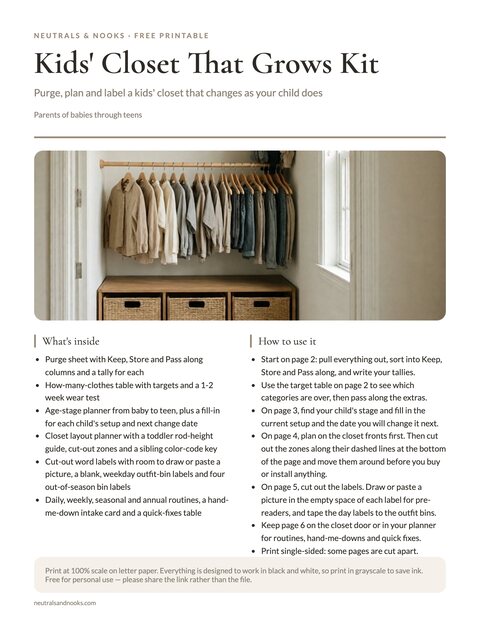
Free printable · 6 pages
Kids' Closet That Grows Kit
A purge sheet with Keep, Store and Pass along tallies, a clothing-count table, an age-by-age closet planner with rod heights and safety notes, a closet layout planner, cut-out picture labels and day labels, routines, a quick-fix table and a budget guide.
Free. Your download link appears right here. You'll also join the Monthly Home Reset. Unsubscribe anytime. Privacy
In this article (10 sections)
- Why Most Kids’ Closet Systems Fail
- Declutter Before You Organize
- Kids’ Closet Setup by Age
- Kids’ Closet Storage Ideas: Rods, Shelves, Bins and Drawers
- Labels That Work for Kids
- Keeping the Closet Working Long-Term
- Common Kids’ Closet Problems Solved
- Kids’ Closet Organization on a Budget
- Frequently Asked Questions
- How to Start Organizing Your Kids’ Closet This Weekend
Why Most Kids’ Closet Systems Fail
Too complicated, too high, too fixed. Adult systems with many categories and precise folds overwhelm children. Standard rods sit at adult reach, so kids can’t get their own clothes. And a setup built for one age has no plan for the next.
Too much stuff. Hand-me-downs, gifts and clearance finds pile up until no system can hold them. That is why we reduce first, then build for the age you have today.
Declutter Before You Organize
No organizer can save you from too much stuff, so reduce what the closet holds before you buy a single bin. The purge takes about 20 minutes. Measuring your child, setting the rod and adding bins and labels brings the full setup to about an hour.
The 20-Minute Purge
- Pull everything out. All of it, so you can see what you are working with.
- Sort into three piles. Keep, store or pass along, using the table below.
- Put back only the Keep pile. Everything else leaves the closet today, into labeled storage or a donation bag.
| Pile | What goes in it |
|---|---|
| Keep | Fits now or within a month, good condition, actually worn |
| Store | Too big (label it for when it will fit), opposite season, rarely worn special-occasion pieces. Our under-bed storage ideas help here. |
| Pass along | Too small, stained or worn out, never worn, duplicates |
The Numbers Game
How many clothes a child needs depends on how often you do laundry. This is a reasonable starting point.
| Item | Everyday count | Notes |
|---|---|---|
| Shirts | 7-10 | Fewer if you wash twice a week |
| Pants and shorts | 5-7 | Season-appropriate only |
| Underwear and socks | 7-10 | One week without laundry |
| Everyday shoes | 2-3 pairs | Plus any sport-specific pair |
| Dressier outfits | 2-3 | Store high or hang separately |
| Play or messy clothes | 2-3 | Keep in their own bin |
| Outerwear and activity clothes | As needed | Current season only |
The test: if your child owns more than they can wear in one to two weeks, you probably have too many. Extra clothes become overflow, and overflow defeats any system.
Keeping It Decluttered
Decluttering isn’t one-time, so build it into moments you already have:
- Scan for anything too small each time you put laundry away.
- Purge as you go during the seasonal switch-out.
- Clear space before birthdays and holidays, when new clothes arrive.
- Do a quick sort after every growth spurt.
Good to knowNot sure how you naturally organize? Take the free Organizing Style Quiz and get tips matched to your style.
Kids’ Closet Setup by Age
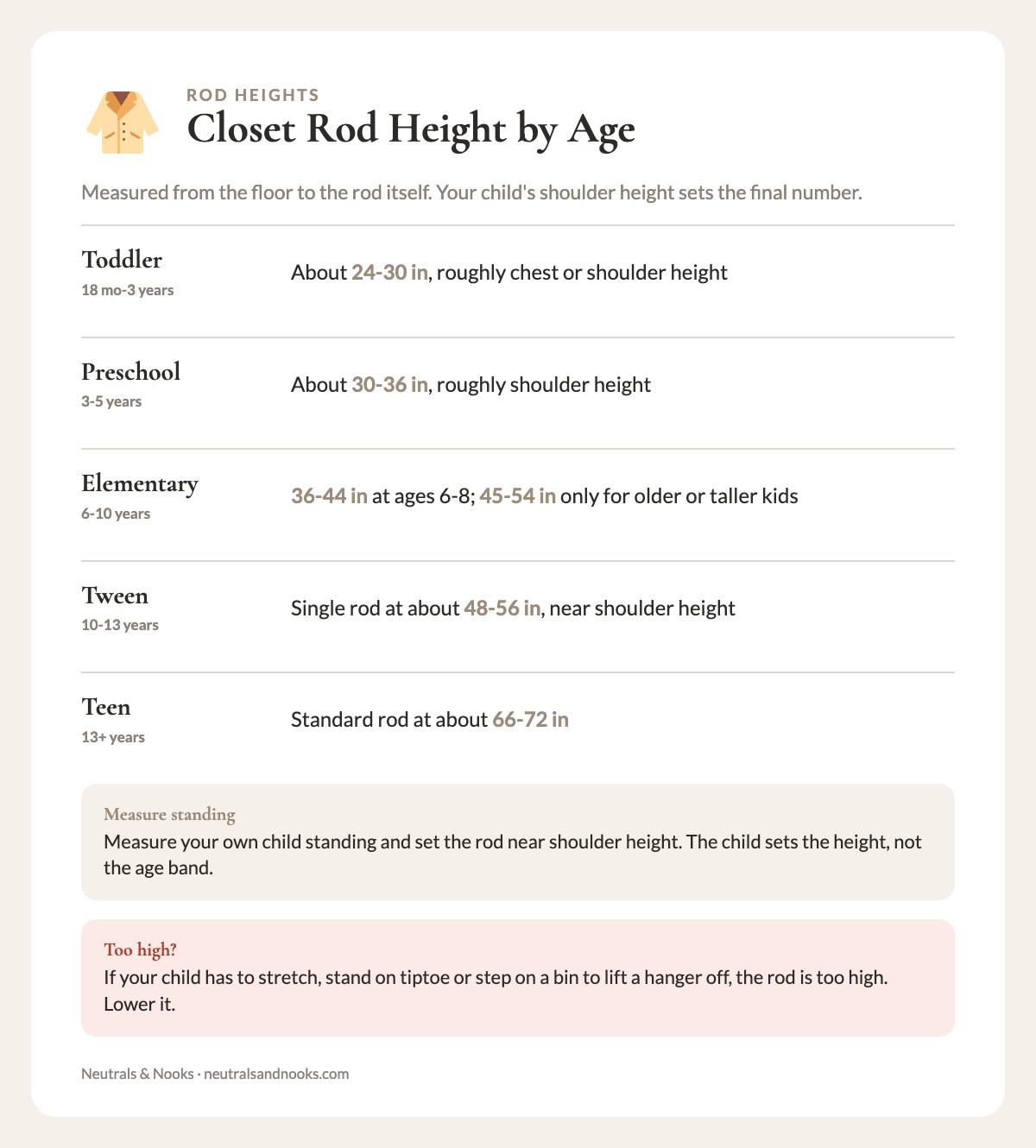
Each stage below is a different job. Heights are starting points, so adjust them to your child and measure before you drill.
| Age band | Rod height | Storage | Who puts clothes away | Labels |
|---|---|---|---|---|
| Baby (0-18 mo) | Standard rod, few hanging items | Low dresser, drawer dividers | You | Size and season |
| Toddler (18 mo-3) | About 24-30 in | Open bins, low basket for shoes | Child, with your help | Pictures |
| Preschool (3-5) | About 30-36 in | Bins, divided hanging area | Child, with visual cues | Photos or picture plus word |
| Elementary (6-10) | About 36-44 in at ages 6-8, up to 45-54 in for older or taller kids, or double-hang | Shelves, file-folded drawers | Child | Words |
| Tween (10-13) | About 48-56 in single rod, or the lower rod of a double-hang, set by shoulder height | Shelves and drawers, organizers they choose | Child | Optional |
| Teen (13+) | Standard (about 66-72 in) or double-hang | Adult-style, their choice | Child | Optional |
Rule of thumb: these heights are for the rod itself, measured from the floor. Through the tween years, measure your child standing and set the rod at about shoulder height. Elementary-age children and tweens can manage a rod slightly above the shoulder, as long as they can lift a hanger off without stretching or standing on tiptoe.
The child sets the height, not the age band. For younger children and tweens, a rod at or above head height invites climbing on bins and shelves, so lower it. Move to a standard rod only once your teen can lift a hanger off with both feet flat.
A typical double-hang setup puts the lower rod at about 40 inches and the upper rod near 80 inches. That lower rod suits elementary-age kids and tweens, so set it lower for a toddler or preschooler.
Nursery and Baby (0-18 months)
For layout ideas in a tight room, see our nursery organization for small rooms guide.
The baby isn’t using the closet, you are, so organize for speed. Use drawer dividers by type (onesies, sleepers, pants, socks) in a low dresser. A low drawer is easier than a high closet shelf at 3 AM with one free hand.
Hang only what you would hang for yourself, like dresses and nicer outfits. Keep the current size in front, the next size visible but separate, and future sizes in labeled bins outside the closet.
Safety firstKeep soft storage, extra clothing and bedding out of the crib, following AAP safe-sleep guidance. Keep hanging organizers, cords and straps out of reach of babies and toddlers. Anchor the nursery dresser to the wall with anti-tip hardware.
Toddler (18 months – 3 years)
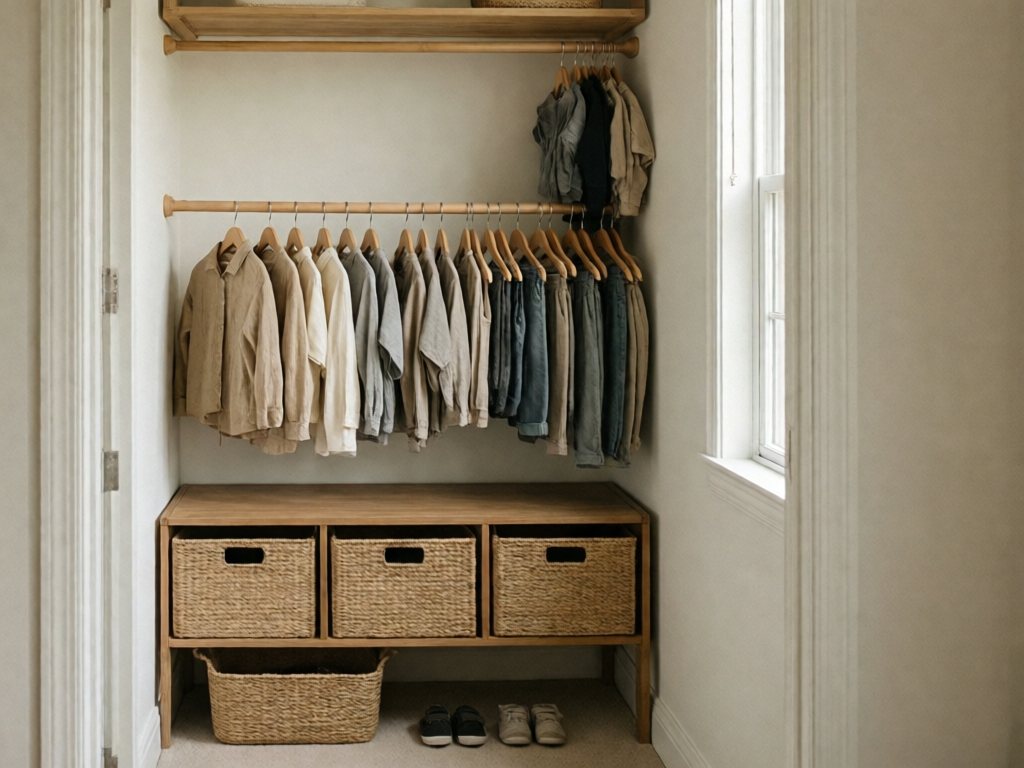
Toddlers want to do things themselves but have limited fine motor skills and no concept of organizing, so they still need adult help. Make the system as close to foolproof as you can.
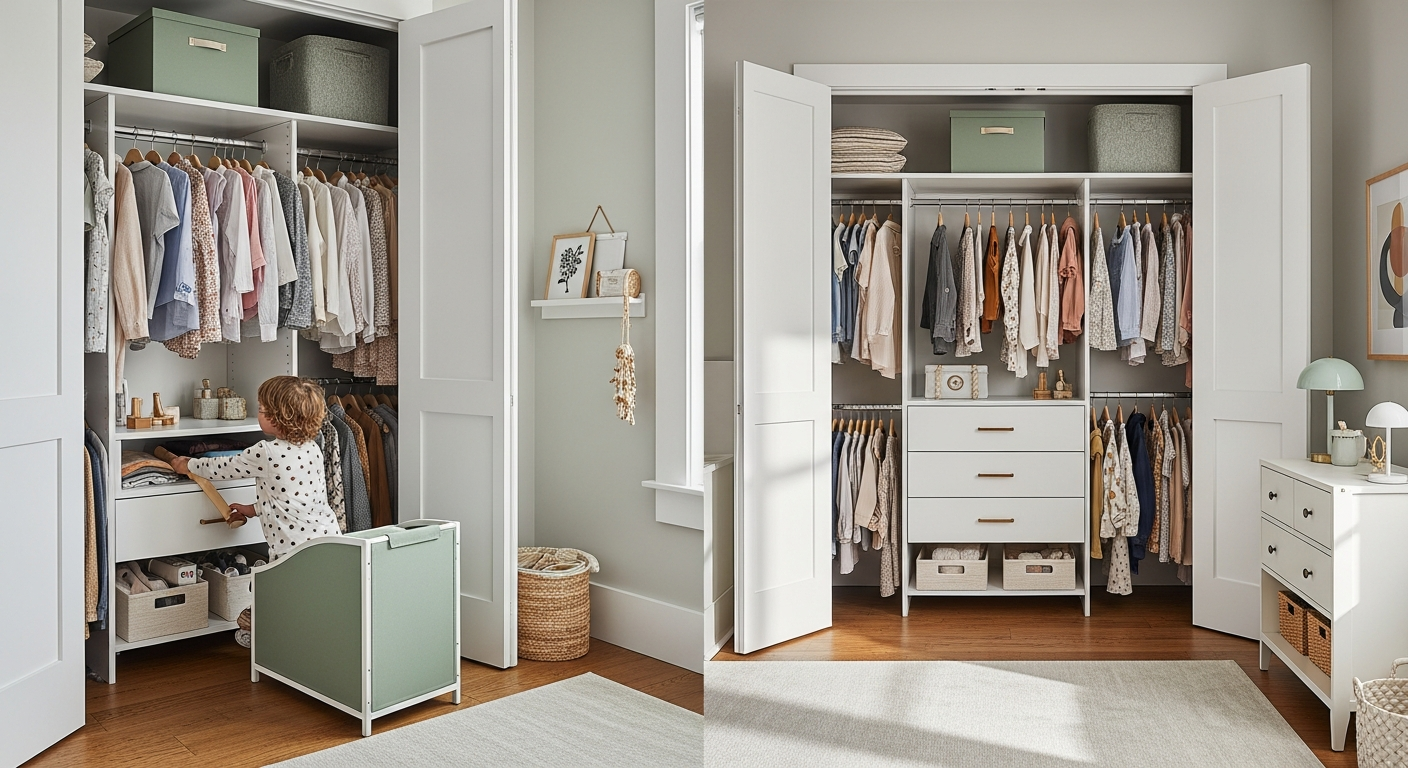
Lower the main rod to about 24-30 inches, roughly your child’s chest or shoulder height. Measure your own child standing, because toddlers vary. Put a second rod above for off-season clothes and overflow that only you reach.
Safety firstA low rod is something a toddler will pull on, so check five things:
- Mounting. Screw the rod into studs, or use one rated to hold your child’s full weight pulling down. Tug on the hardware to confirm it holds. Skip tension rods and hanging extender rods at toddler height.
- Cords and drawstrings. Keep cords, ties, scarves and drawstring hoodies off low rods. Drawstrings on children’s upper outerwear are a strangulation risk.
- Anchoring. Anchor every shelf, cube unit and dresser to wall studs with anti-tip hardware.
- Climbing. Teach your child not to climb shelves or cubbies.
- Small parts. Small clips, hair elastics and beads stay out of reach of children under 4. So do loose labels, label pockets and tape, which a toddler can mouth.
I’d skip drawers at this age. Stiff drawers are hard for small hands, so clothes end up on the floor. I’d choose open bins instead, labeled with pictures, not words.
Keep visible choices small. Offer two items rather than the whole closet, and keep two or three shoe options in a low basket or floor rack.
Preschool (3-5 years)
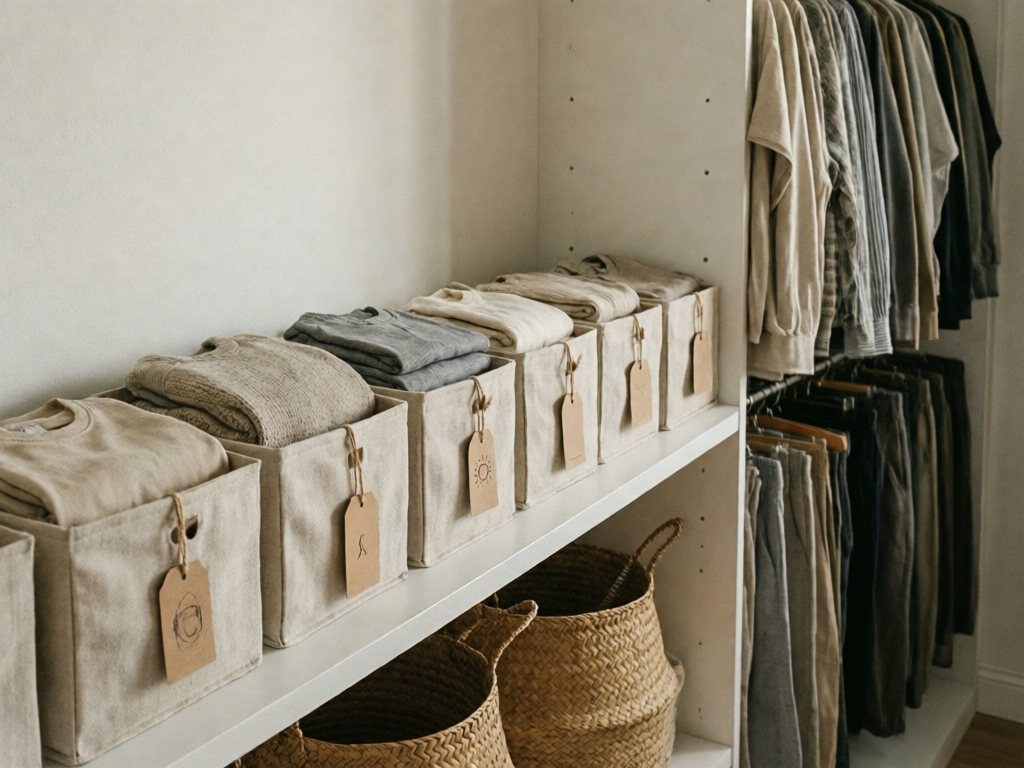
Preschoolers can follow simple systems and love independence, but they still need visual cues and limited options. This is when habits form, so time spent teaching “where things go” pays off for years.
Set up weekly outfit bins, one per day, and fill them together on Sunday. That ends most daily decision battles. Label spaces with photos of what goes there, or photos of your child wearing that category.
Raise the rod to about 30-36 inches, roughly your child’s shoulder height. Measure your own child standing, and lower the rod if they have to stretch or stand on tiptoe to lift a hanger off. A rod they can’t reach invites climbing on bins and shelves, so keep it low and screw-mounted, as at the toddler stage.
Divide the hanging area into shirts in one section and pants in another. Keep favorites within reach and put special-occasion clothes up high, which cuts requests to wear them every day. A small dress-up bin works if you need one.
Elementary School (6-10 years)
Elementary kids handle more categories and are building real organizing skills. They need a system simple enough to maintain on their own.
Split the closet into school clothes, play clothes, sports and special, each with its own section, rod or bin. Put shelves for folded items within reach.
Set the rod near your child’s shoulder height, or slightly above, and measure your own child standing. About 36-44 inches is a starting range for ages 6-8. Go up to about 45-54 inches only for older or taller kids. A double-hang setup also works and uses the vertical space.
If your child has to stretch, stand on tiptoe or step on a bin to lift a hanger off, the rod is too high. Lower it.
Good to knowA worked example: a child about 48 inches tall usually has a shoulder height near 40 inches. Set a single rod at about 40 inches, so they can lift a hanger off with both feet flat. In a double-hang closet, the 40-inch lower rod sits near their shoulder, and the 80-inch upper rod is for you. Raise the rod toward 45-54 inches only as they grow into it.
Teach one simple fold, and try file folding in drawers so clothes stand up and are visible. Accept imperfection, because the goal is participation. I’d take a rumpled drawer a child filled themselves over a perfect one I filled for them.
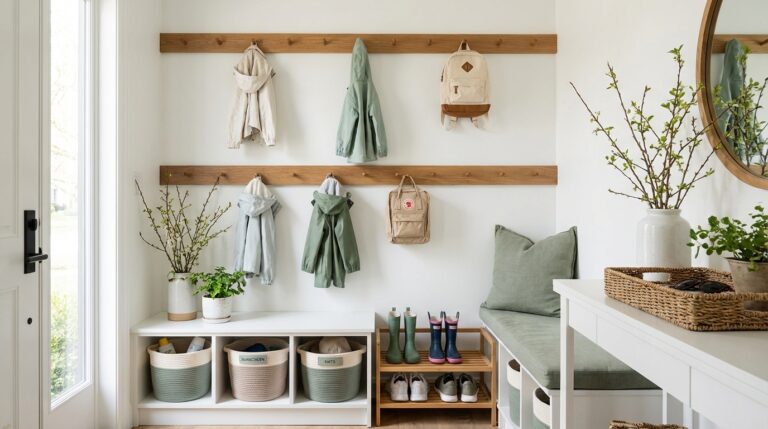
Give sports uniforms and dance bags their own spot, ideally near the door. Our guide to mudroom cubbies for multiple kids shows how.
Tweens (10-13 years)
Tweens have opinions about everything and can run a real system, though they may resist organizing. Let them choose the organizers and the look while you steer toward function.
I’d offer two or three neutral bin and hanger options and let them pick. The closet stays calm to look at, and it still feels like theirs.
Give them the seasonal swap and donation decisions. Sizes change fast, so keep the setup flexible.
Set a single rod at about 48-56 inches, near your tween’s shoulder height, and measure your own child standing. A double-hang setup also works, with shirts and pants on the lower rod at about 40 inches. Hang longer pieces on a stretch of single rod at shoulder height.
If your tween has to stretch or stand on tiptoe to lift a hanger off, the rod is too high. Lower it.
Pick a weekly laundry day for putting away clean clothes, and keep a hamper in the room. Dirty clothes go in the hamper, not on the floor.
Treat the closet as their private space. Ask before organizing it, and agree on a standard together.
Teens (13+ years)
Teens should manage their own closets, with setup help if they want it. Adult-style systems work: category organization, hangers they pick, and drawers they maintain.
A standard rod at about 66-72 inches suits most teens. If a younger or shorter teen has to stretch for it, keep the tween height a while longer. Add a few shelf or drawer units for folded clothes.
Plan room for uniforms or job clothes, formal wear, activity gear and bags. Give a job or sports uniform its own hanger or hook, so it is easy to find on a busy morning. Expect a weekly pickup and their own seasonal rotation.
A laundry basket, or a two-bin sort for lights and darks, makes their own laundry day easier. I’d agree on one shared standard, dirty clothes in the hamper, and let the rest be their call. A closet that isn’t styled my way but is kept up by its owner is a trade-off I’d accept.
Kids’ Closet Storage Ideas: Rods, Shelves, Bins and Drawers
Hanging Storage Solutions
A double-hang system puts a lower rod at child height and an upper rod for off-season clothes and overflow. Choose adjustable, securely mounted rods so you can raise them as your child grows. Cubbies for bins or baskets below the hanging area use the vertical space well.
Canvas hanging shelves and daily outfit organizers save drawer and floor space. Use them for older kids only, and keep them, along with any straps or cords, out of reach of babies and toddlers.
Shelf and Cubby Systems
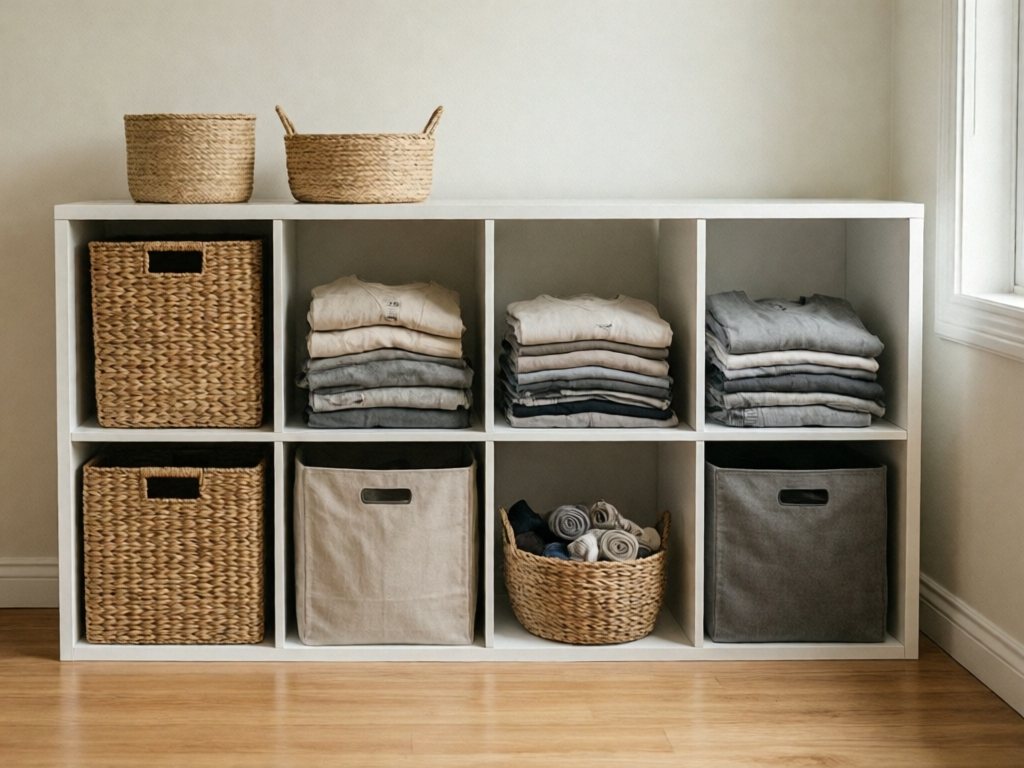
Cube units, such as Ikea KALLAX or similar, are the most flexible option. You can add or remove cubes as needs change, and bins either hide contents or let your child see them.
TipKALLAX cubes take bins about 13 inches square. For any other unit, measure the cube opening before you buy bins.
Adjustable shelves can move up as your child grows. Wire shelving shows what is inside, while solid shelving looks cleaner. I lean toward solid shelves with bins in one neutral color, which keeps the closet calm to look at even on a messy week.
Safety firstAnchor all freestanding shelves, cube units, bookshelves and dressers to wall studs with anti-tip hardware. Open cubbies are climbable, so teach children not to climb them.
Drawer Alternatives
Open bins are the easiest choice for young children, since they can see the contents and pull items out without wrestling a drawer. The trade-off is that open bins look messier than closed drawers. I’d accept that for a few years.
Fabric bins in one neutral color soften the look. A rolling cart lets you move the whole set between rooms as needs change.
Floor Solutions
Keep shoes on a low basket or floor rack while children are small, then move to an over-door organizer once they can reach it. Add a hamper and a donation bin inside or beside the closet, so outgrown items leave the moment you spot them.
Labels That Work for Kids
Picture Labels (Pre-readers)
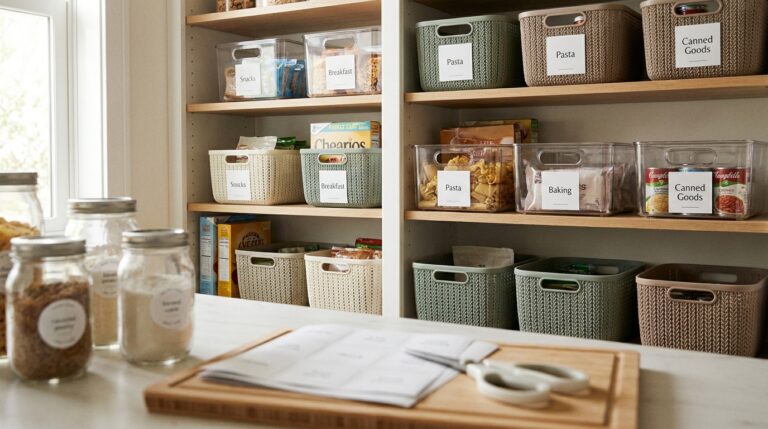
Photograph the actual item, such as a folded shirt or a pair of socks. Print it at about 2 x 3 inches and slip it into a clear label pocket or laminate it. A photo of your child wearing that kind of clothing works too.
Color coding adds a second cue, like blue bins for shirts and green for pants. Use the same colors on every bin.
Word Labels (Early readers)
Use large, plain capital letters like SHIRTS, PANTS and SOCKS, with the picture kept alongside at first. Let your child write a label or two themselves. Handwriting will be imperfect, but they are far more likely to use a system they helped build.
| Stage | Label type | Size or material tip | When to switch |
|---|---|---|---|
| Pre-reader | Photo or icon | About 2 x 3 in, laminated or in a clear pocket | When they start recognizing letters |
| Early reader | Picture plus word | Large, plain capitals | When they read the word without the picture |
| Confident reader | Word only | Standard label maker tape | Drop labels if the categories are obvious |
Keeping the Closet Working Long-Term
The routine below is small on purpose, because a small routine gets done. Our seasonal clothing storage guide for kids and fall closet swap system cover the twice-yearly rotation in more detail.
| Frequency | Task | Time | Who |
|---|---|---|---|
| Daily | Clothes in the closet or hamper, not the floor; outfit chosen the night before | 2 min | Child, with help for young ones |
| Weekly | Put away clean laundry at a set time, then scan for floor clutter and misplaced items | 5 min | Child (age-appropriate) and parent |
| Seasonal | Swap seasonal clothes, check sizes, donate outgrown items, store off-season pieces | 30-60 min | Parent, with older kids deciding |
| Annual | Empty the closet, deep clean, reassess the system for growth (back-to-school works well) | A weekend morning | Whole family |
- Before each season’s shopping, check what fits and write a list first.
- Pick one fixed day each week for putting laundry away.
- Keep a donation bin in or beside the closet.
Common Kids’ Closet Problems Solved
| Problem | Try this first | If that fails |
|---|---|---|
| “There’s no room” | Declutter to the Keep pile and use vertical space | Move off-season clothes under the bed or to a separate dresser |
| My child won’t put clothes away | Simplify the system and switch from drawers to open bins | Coach, don’t punish: cut the options, rehearse the routine together, and never withhold clothing |
| Morning clothes battles, or the same three outfits | Plan outfits the night before or weekly, and offer only acceptable choices | Ask why they love those pieces (comfort? peers?), rotate favorites out temporarily, or accept a smaller wardrobe |
| Hand-me-downs create chaos | Process them right away and keep only current sizes in the closet | Store future sizes in labeled bins outside the closet and pass along what won’t be worn |
| Sports gear takes over | Give each activity a bag-and-go spot separate from clothes | Move gear out of the closet and purge outgrown equipment each season |
Kids’ Closet Organization on a Budget
You don’t need a custom system. Start with what you own and add pieces as you learn what your child actually uses. For two kids in one room, see our shared bedroom storage ideas.
| Budget | What to buy | Approx. cost |
|---|---|---|
| Under $50 | Screw-mounted adjustable rod, repurposed boxes for sorting, home-printed picture labels, dollar-store bins | About $10-25 for the rod, $10-15 for bins |
| $50-150 | Cube storage unit, fabric or wire bins, adjustable closet rod system | Cubes $30-60, bins $20-40, rod system $30-50 |
| $150-300 | Modular closet components (Rubbermaid, ClosetMaid), matched bins, double-hang system, drawer units | Roughly $60-150 for a modular kit, plus $50-150 for bins and drawer units |
| $300+ | Custom closet design, built-in shelving and rods, professional installation | Quote-based |
Safety firstA tension rod or a closet extender rod that hangs from the fixed bar suits only light loads. Use one for older children or the high off-season position. A toddler pulling on clothes can dislodge it, so use a screw-mounted rod at toddler height. For adhesive hooks, check they are rated for the load.
Buy Adjustable Pieces Once
Pick adjustable pieces in neutral colors and skip character bins. Adjustable rods and modular units cost more upfront, but you won’t replace them at each stage.
I’d pick one bin color, such as oatmeal, white or soft gray, and repeat it on every shelf. The closet looks calm, and the same bins move with your child from toddler to teen.
Keep your standards realistic. A toddler’s “organized” looks different from a teen’s, and a closet that is good enough and used beats a perfect one that is ignored. Revisit the setup each year, because what worked last year may not fit now.
Neutral Nina
Neutral Nina is an interior design enthusiast and mom of three who proves that beautiful, organized spaces and family life can coexist. She shares practical strategies for creating calm, functional homes that work for kids and grown-ups alike.
Frequently Asked Questions
How often should I completely reorganize my child’s closet?
Twice a year at season changes, plus a quick scan each laundry cycle. Add a fuller overhaul at back-to-school time, and reorganize sooner if the system stops working.
At what age should kids be putting away their own clothes?
Toddlers want independence but still need your help, so open bins work best. Preschoolers need visual cues and limited options to manage a simple system. By elementary school, kids can put away their own laundry, with age-appropriate expectations for neatness. The system must match their capability, so don’t expect drawer organization from a 4-year-old.
Should I fold or hang children’s clothes?
Hang what you’d hang for yourself: dresses, dress shirts, jackets, items that wrinkle easily. Everything else can be folded or placed in bins. For young children, less hanging and more bins typically works better because bins are easier to manage independently.
How do I handle size inconsistencies across brands?
If clothes fit, they go in the closet regardless of tag size. If they don’t fit yet, store by when they’ll likely fit (“Size 4T, winter”) rather than by tag size. The number on the label is less important than actual fit.
What’s the best way to store out-of-season clothes?
Use clear plastic bins labeled with size, season and contents. Store them outside the main closet: under the bed, in a storage area, or in the garage or attic. Keep only current-season clothes in the closet your child uses.
How do I stop my child from only wearing favorites?
First, ask why: comfort, peer influence, or just preference? If there’s no functional reason, you have three options. Accept a smaller rotation, rotate favorites out for a while, or set a rule. A favorite can be worn again once it’s washed and three other outfits have been worn.
Should kids’ closets match the room decor?
Function comes first, but the two can work together. Choose neutral systems that work at multiple ages rather than character-themed options that will need replacing. Bins and baskets in one or two calm colors tie the closet to the room.
How do I organize a shared closet for siblings?
Divide space clearly—by side, by height zone, or by shelf. Color-code each child’s bins and sections. Make boundaries obvious so each child knows their space. Shared items get a neutral zone.
How to Start Organizing Your Kids’ Closet This Weekend
A messy closet isn’t a failure. It usually means the system no longer fits your child. Involve them at each stage with age-appropriate jobs, and give them more responsibility as they grow.
Start with the 20-minute purge this weekend: pull everything out, sort into Keep, Store and Pass along, and put back only what fits now. Then set the rod and bins for your child’s age using the age table. The full setup takes about an hour.
For hooks at their height, see our mudroom organization guide for families. Our toy rotation system uses the same keep-less-out principle.
Good to knowNot sure which setup suits how you naturally organize? Take the free Organizing Style Quiz for tips matched to your style.