Entryway Organization Ideas for Families
Transform your chaotic family entryway into an organized launch pad by creating a functional zone with strategic storage and a simple system, even in small spaces. You'll learn to assess your needs and implement five core components.
- Assess your entryway's specific needs by observing daily chaos and measuring space.
- Create an entryway zone, even in small spaces, by designing around daily actions.
- Implement five core components: hooks, shoe storage, a drop zone, bag storage, and an outbox.
- Provide individual hooks for each family member at appropriate heights.
- Use an "outbox" for items needing to leave the house to reduce clutter.
Walk through your front door right now and look down. What do you see? If the answer involves a pile of sneakers, three backpacks dumped on the floor, a stray soccer cleat, someone’s jacket wadded up on the stairs, and a scattering of junk mail on the nearest flat surface—congratulations, you have a completely normal family entryway. The problem isn’t your family. The problem is that most entryways aren’t designed for the sheer volume of stuff that walks in and out of a house with kids every single day. The good news? You don’t need a magazine-worthy mudroom to fix this. With some strategic storage, a few affordable products, and a system that even your kindergartner can follow, your entryway can go from daily disaster to smooth-running launch pad.
Assessing Your Entryway (Even If You Barely Have One)
Not every home has a dedicated mudroom or spacious foyer. Many families walk straight into a living room, a narrow hallway, or a cramped landing. That’s okay—you just need to create an entryway zone, even if it’s only 24 inches of wall space beside the door.
Start by standing at your door and asking: what needs to happen here every day? In most families, the answer is: shoes come off, bags get dropped, coats get hung, keys and wallets find a home, and outgoing items (library books, permission slips, sports gear) wait to leave. Design your entryway around these daily actions, and the chaos will dramatically decrease.
Measure your available space carefully. Note the wall height available for hooks and shelves, the floor space for shoe storage, and any existing furniture. Even a space 30 inches wide and 12 inches deep can become a fully functional drop zone with the right approach.
Take photos of your current entryway mess at its worst. This isn’t for shame—it’s for planning. Those photos show you exactly what needs a home: the pile of shoes reveals you need a shoe solution for six pairs, the backpack mountain means you need hooks at kid height, and the mail explosion means you need a paper landing pad.
The Essential Entryway Components
Every family entryway needs five core components, regardless of how much space you have. Get these right and your mornings will transform.
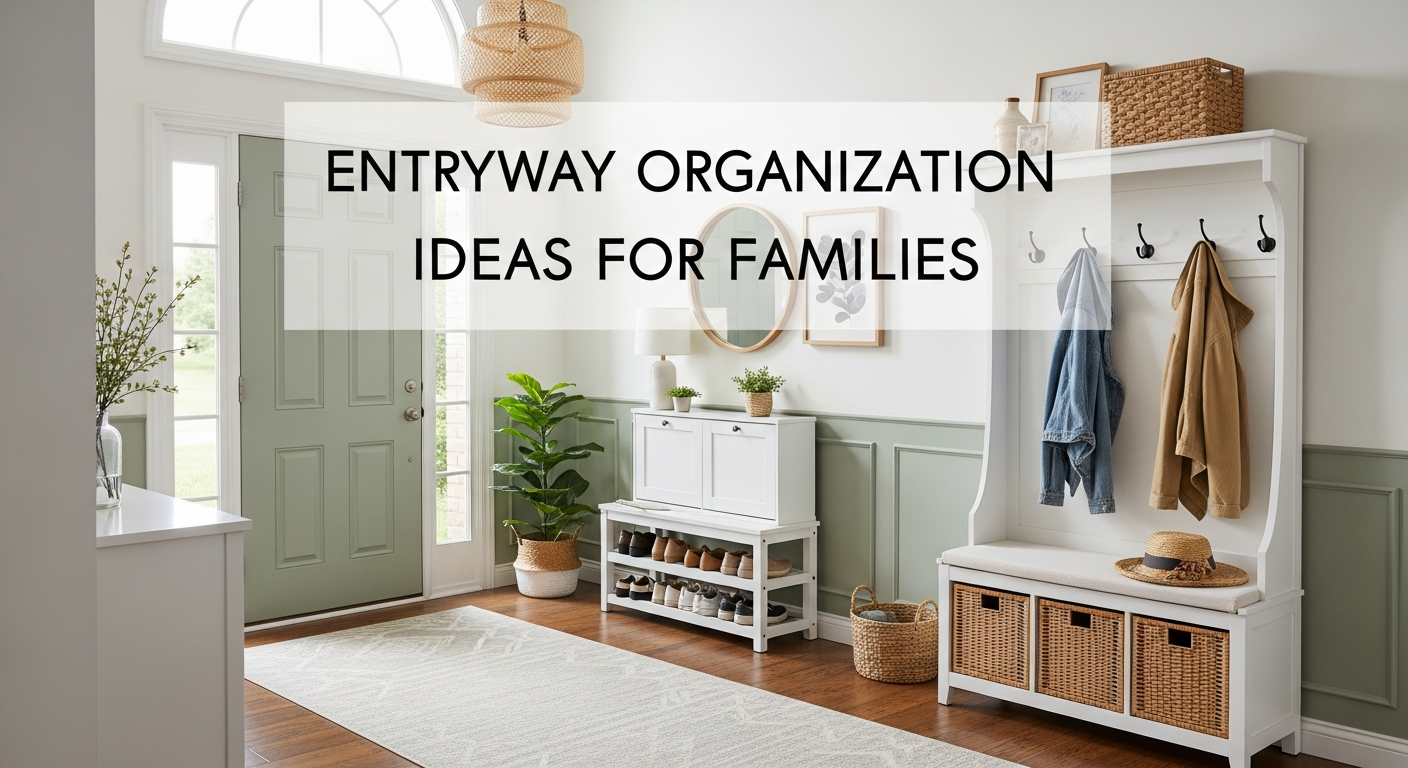
Hooks for Every Person: Each family member needs their own hook, mounted at a height they can reach. For adults, standard height is 48–54 inches from the floor. For kids, mount a second row at 30–36 inches. The IKEA PINNIG rack with 3 hooks ($35) combines coat hooks with a top shelf and is sturdy enough for heavy winter coats. For a budget option, individual Command decorative hooks ($5–8 each at Target) require no drilling and hold up to 5 pounds each.
Shoe Storage: Shoes on the floor are the number-one entryway problem. A 3-tier shoe rack ($15–25 at Target or Amazon) contains 9–12 pairs in a vertical footprint. The IKEA TJUSIG shoe rack ($30) is slim and Scandinavian-clean. For tight spaces, an over-the-door shoe organizer ($10 at Walmart) hung on a coat closet door stores 12+ pairs invisibly.
A Drop Zone for Daily Essentials: Keys, sunglasses, wallets, and masks need a landing pad. A small tray, wall-mounted shelf, or the IKEA SKADIS pegboard ($20 for the panel plus hooks and containers) by the door keeps essentials corralled. Add a small dish or hook for car keys and you’ll never search for them again.
Backpack/Bag Storage: Oversized hooks or a row of double hooks ($4–6 each at Home Depot) handle heavy backpacks better than single hooks. Alternatively, a cubby bench with compartments underneath gives each child a labeled spot for their bag.
An Outbox: This is the secret weapon. Place a basket or bin near the door for items that need to leave the house: library books to return, packages to mail, dry cleaning to drop off, signed permission slips. The Target Brightroom woven basket ($10–15) is attractive and functional. Check the outbox every time you walk out the door.
Budget-Friendly Entryway Setups
You don’t need to spend hundreds to create a functional entryway. Here are three setups at different price points that actually work for families.
The Under-$50 Setup: One IKEA TJUSIG wall rack ($20) for coats, one 3-tier shoe rack from Amazon ($18), and a Dollar Tree basket for the outbox. Total: about $40. Mount the coat rack at adult height and add Command hooks ($5 for a 2-pack) below it at kid height. This covers the basics for a small hallway.
The Under-$150 Setup: An IKEA HEMNES bench with shoe storage ($100) provides seating, shoe cubbies, and a polished look. Add the IKEA PINNIG hook rack ($35) above it and a small wall shelf ($10) for keys and sunglasses. This is a complete entryway station that looks like built-in cabinetry.
The Under-$300 Setup: A Pottery Barn Kids Cameron Wall System or similar modular cubby system gives each family member their own locker-style section with hooks, a shelf, and a cubby. Pair with a sturdy shoe bench below. This is the mudroom look without the mudroom. You can approximate this for less by combining two IKEA KALLAX 1×4 units ($50 each) mounted vertically with hooks and bins.
Personalized Stations for Each Family Member
The fastest way to get kids to use an entryway system is to give them ownership. When each child has a clearly labeled, personalized spot, they feel pride in keeping it tidy—and they know exactly where their stuff lives.
Label each hook, cubby, or section with the child’s name. For little ones who can’t read, use a photo of their face, a symbol (star, heart, dinosaur), or their favorite color. The DYMO label maker ($25) creates clean labels, or for a warmer look, hand-letter names on small wooden tags from the craft section at Michaels ($3 for a pack).
Each station should hold: one coat, one backpack, one pair of daily shoes, and a small bin or basket for extras (hat, gloves, sunglasses). The IKEA VARIERA bins ($5 each) or Target’s Brightroom small storage bins ($4 each) fit perfectly inside cubby shelves.
Keep the rule simple and consistent: when you walk in, everything goes in your station. Coat on hook, shoes on rack, bag in cubby. When you walk out, grab what you need from your station. Practice this routine every day for two weeks and it becomes automatic—even for the kid who drops everything on the floor out of habit.
For families with multiple kids, a quick trick: assign each child a day of the week to “inspect” the entryway. They check that shoes are on the rack, hooks are being used, and nothing is on the floor. Kids love being the inspector, and it distributes the maintenance responsibility.
Solving the Paper and Mail Problem
Paper clutter in the entryway is a silent destroyer. Junk mail piles up, school flyers land on the bench, and permission slips disappear into the abyss. You need a paper system right at the door to intercept this flood before it infiltrates the house.
Mount a wall file organizer ($12–20 at Target or Staples) with three slots right by the door, labeled: Action (needs a response—sign this, pay this, RSVP), File (keep but deal with later), and Recycle (junk mail, flyers, duplicates). Sort mail the second it comes inside. The recycle slot should get emptied into the recycling bin daily.
For school papers, add a magnetic clip strip or clothespin rail ($10 at Amazon) at kid height. Kids clip their own papers there when they get home, and you check it during your evening routine. Important papers move to the Action slot; artwork goes to the display area or the filing system.
Go digital whenever possible. Photograph permission slips before signing and returning them. Use your phone’s calendar for school events instead of keeping paper flyers. The less paper that enters your home, the less your entryway has to manage.
Seasonal Transitions and Maintaining the Flow
An entryway that works in September may not work in January, when bulky coats, snow boots, wet mittens, and hats enter the picture. Build seasonal flexibility into your system.
Keep a boot tray ($12–20 at Target) by the door during wet months. The Mohawk Home boot tray ($15) has raised edges that contain water and mud. In dry months, swap it out for a simple doormat and reclaim the floor space.
During winter, add a mitten and hat basket to each child’s station. A small mesh or open basket (Dollar Tree has great options for $1.25) lets wet items air-dry while staying contained. For really wet gear, a tension rod mounted above a boot tray creates a drying rack—hang wet mittens with clothespins and they’re dry by morning.
Twice a year—when the seasons change—do an entryway audit. Remove outgrown shoes, donate coats that no longer fit, restock the outbox basket, and refresh labels if needed. This 20-minute reset twice a year keeps your system running smoothly.
The entryway is the first thing you see when you come home and the last thing you see when you leave. When it’s organized, your whole day bookends with a sense of calm. When it’s chaotic, you start and end every day a little frazzled. Investing even an hour this weekend into setting up a simple, functional entryway system will pay dividends in peace of mind for months to come. And the first morning your child walks to the door, grabs their bag from their hook, and heads out without a single “Where’s my backpack?!”—you’ll wonder why you didn’t do this years ago.