Laundry Room Organization for Families: Systems That Actually Survive Kids
Your family's laundry system is likely failing due to the sheer volume and unique challenges kids bring. This guide will help you redesign your laundry process, space, and habits to create a system that actually works.
- Recognize family laundry as a daily operation needing a dedicated system.
- Address kid-specific challenges like diverse stains and unpredictable volume.
- Optimize sorting, folding, and putting away, as these are common system failures.
- Diagnose your specific laundry bottleneck before attempting a redesign.
- Build a complete system encompassing workflow, space, and consistent habits.
The laundry is never done. Let that sink in for a moment, because I think half the frustration families feel about laundry comes from the illusion that it’s a task with a finish line. It’s not. It’s the only household chore that literally regenerates overnight. You can fold every last sock at 9 PM and wake up to a full hamper by morning. The sheets need washing, the toddler had a blowout, someone spilled juice on their school shirt, and the dog slept on the couch blanket again.
If you’re a family of four, you’re doing somewhere between 8 and 10 loads of laundry every single week — that’s the average, according to the American Cleaning Institute. Americans spend roughly an hour and a half per week on laundry, and that’s a generous undercount for families with young children. If you’re dealing with cloth diapers, sports uniforms, muddy play clothes, or a child who changes outfits three times before noon, you know the real number is higher.
But here’s the thing most laundry advice gets wrong: the actual washing isn’t the problem. You put clothes in a machine, add soap, press a button. That’s the easy part. The hard part — the part where the system falls apart for nearly every family — is everything else. The sorting. The folding. The putting away. The mystery socks. The stain you didn’t catch until it went through the dryer. The clean clothes that sit in the basket for four days until you just start pulling from it like a clothing buffet.
This guide isn’t about the washing. It’s about building a complete laundry system — a workflow, a physical space, and a set of habits — that can actually survive the relentless demands of family life. We’re going to redesign your laundry process from start to finish, optimize whatever space you have (even if it’s a closet), and make the whole experience a little less soul-crushing. Maybe even pleasant. Let’s not get ahead of ourselves.
Why Family Laundry Needs Its Own System
A single adult’s laundry system can be beautifully simple: one hamper, wash when full, fold on the bed, done. But family laundry is a fundamentally different beast, and treating it like a scaled-up version of single-person laundry is why your system keeps breaking.
The Volume Reality
Eight to ten loads a week means you’re running your washing machine more than once a day. That’s not an occasional chore — that’s a daily operation. Any daily operation needs infrastructure. You wouldn’t cook dinner every night without a functional kitchen layout, a system for groceries, and a place for everything. Your laundry deserves the same operational thinking.
The Kid-Specific Challenges
Children add complexity that no laundry system designed for adults can handle:
- Stain diversity: Grass, marker, food, paint, mud, mystery substances you’d rather not identify. Each stain has its own treatment, and if you miss it before the dryer, it’s permanent.
- Size chaos: Tiny socks the size of your thumb mixed in with adult jeans. Onesies tangled with towels. Sorting by size isn’t something adults-only households think about.
- Volume spikes: Potty training weeks. Stomach bugs. Rainy weeks when they’re changing after every outdoor adventure. Sports seasons. Family laundry volume isn’t consistent — it spikes unpredictably.
- Seasonal gear: Snow pants, rain boots, puffy jackets, swim towels, dress-up costumes. Kids come with accessories, and those accessories need washing.
- The outfit-change habit: Small children change clothes with an enthusiasm that defies logic. Three outfits before lunch, each one worn for twelve minutes. Is it dirty? Is it clean? Who knows anymore.
Where YOUR System Is Breaking Down
Before we redesign anything, you need to diagnose your specific bottleneck. Most family laundry systems break at one of four points:
- The sort: Dirty laundry piles up unsorted, creating a mountain that feels insurmountable.
- The transfer: Clean clothes sit in the washer too long (hello, must-re-wash-because-it-smells), or they sit in the dryer getting wrinkled.
- The fold: This is the number-one breakdown point for most families. Clean clothes end up in baskets, on couches, on beds, or in the dreaded “clean clothes chair.”
- The put-away: Even when clothes get folded, they don’t make it back to drawers and closets. The last mile of laundry is where systems go to die.
Identify which step is YOUR bottleneck. Your organizational solutions should focus the most energy there. There’s no point buying a beautiful sorting system if your real problem is the folding-to-put-away pipeline.
The Sort-Wash-Fold-Put Away Pipeline
The most effective way to think about family laundry isn’t as a single task. It’s a pipeline — a workflow with four distinct stages, each with its own space, tools, and timing.
Stage 1: Sort
Sorting should happen BEFORE laundry enters the laundry room, not in it. The less sorting you do in front of the washing machine, the faster each load cycles through.
Pre-sort strategies that work:
- Multi-compartment hamper in each bedroom or bathroom: A two- or three-section hamper where family members sort as they undress. Darks, lights, and delicates/special care. This requires initial training but pays massive dividends.
- One hamper per person: Each family member has their own hamper. You wash by person rather than by color. This is controversial among laundry purists, but for families, it eliminates the sorting AND the whose-is-this problem at the folding stage. If your four-year-old’s clothes all wash together, they fold together and go back to one room.
- Color-coded hamper bags: Assign each family member a mesh bag color. Everyone puts their socks and underwear in their mesh bag before it goes in the hamper. The bags go straight into the wash. After drying, each bag goes back to its owner — no sock sorting required.
The stain intercept: Whatever sorting system you choose, add a stain treatment step. A small spray bottle of stain remover next to the hamper, or a designated “stain soak” bucket in the laundry room, catches stains before they set. This takes five seconds per garment and saves hours of frustration.
Stage 2: Wash and Dry
This is the most automated stage, but families still lose time here through transfer delays.
Fixes for transfer lag:
- Set a timer on your phone. Not the machine’s end-of-cycle buzzer, which you’ll ignore. A phone alarm that you can’t avoid.
- Batch by timing. Start a load before a predictable event — before school drop-off, before dinner, before bedtime. The event becomes your natural reminder to transfer.
- Consider the “daily load” approach. Instead of marathon laundry days (more on this below), running one load per day means you only have to remember one transfer per day.
Stage 3: Fold
This is where most family systems collapse. Here’s why: folding is the only stage of laundry that requires your full attention and both hands for an extended period. Sorting takes seconds. Loading the machine takes a minute. But folding a full load takes 15-20 minutes of focused work, and in a house with kids, 15 uninterrupted minutes is a luxury.
Strategies to survive the fold:
- Fold immediately out of the dryer. Not later. Not when the kids are in bed. Now. Warm clothes fold faster, wrinkle less, and the task feels shorter when you’re handling warm fabric rather than a cold, tangled mass.
- Create a designated folding surface. This is non-negotiable. If you don’t have a counter or table in your laundry room, use a folding table, an ironing board, or even a clean section of kitchen counter. Folding on the couch invites sitting down and never getting back up.
- The “fold and deliver” method: Fold directly into individual piles or baskets by family member. Each person’s clothes go into their basket, and the basket goes to their room. This combines folding and sorting into one step.
- Involve the kids (more on this in the kid-friendly section below).
Stage 4: Put Away
The last mile. The graveyard of good laundry intentions.
The honest truth: The only reliable way to ensure clothes get put away is to reduce the distance and difficulty between the folding surface and the drawer. Every additional step — carrying a basket upstairs, opening a closet, organizing by type — adds friction. And friction kills habits.
Reducing put-away friction:
- Fold in the room where clothes live, if possible. If your child’s room is upstairs and the laundry is downstairs, carry the clean, unfolded clothes up and fold in their room. It sounds less efficient, but it eliminates the “basket sits at the bottom of the stairs for three days” problem.
- Simplify kids’ clothing storage. Drawers with dividers are lovely for adults. For kids under 8, open bins or cubbies where they can toss folded clothes are more realistic. “Close enough” counts.
- Assign put-away as a job, with a deadline. “Your basket is on your bed. Put your clothes away before screen time.” External motivation works when internal motivation doesn’t.
Laundry Room Layout Ideas by Size
Now let’s talk about the physical space. Because a great laundry system needs a functional environment, and most family laundry rooms are far from ideal.
The Closet Laundry (2-4 Feet Wide)
This is the reality for a huge number of families — particularly in apartments, condos, and older homes. Your washer and dryer are behind bifold doors in a hallway, and your “laundry room” is about as wide as your arm span. Don’t despair. A closet laundry can be remarkably functional with vertical thinking.
Maximize your closet laundry:
- Over-washer shelving: Install a shelf (or two) directly above the machines. This is prime real estate for detergent, stain remover, and a small basket of supplies. Use shelf risers to double your usable surface area.
- Door-mounted organizer: The inside of the bifold or closet doors is unused space. An over-the-door pocket organizer or mounted hooks can hold mesh bags, stain sticks, lint rollers, and dryer sheets.
- Retractable drying rod: A tension rod installed above the machines or a wall-mounted retractable clothesline gives you a spot to hang delicates without taking up any floor space.
- Slim rolling cart: If there’s even 6 inches between the machine and the wall, a slim rolling cart (IKEA makes several) can hold an extraordinary amount of supplies.
- Fold-down folding surface: A wall-mounted drop-leaf shelf or fold-down table installed on the adjacent wall gives you a folding surface that disappears when not in use.
Design consideration: Closet laundries benefit enormously from a fresh coat of paint on the interior walls (something bright and clean — a warm white or very pale sage), a mounted light strip for visibility, and matching containers for supplies. When you open those bifold doors, it should feel organized, not chaotic.
The Small Room (Walk-In but Tight)
You can walk into the room, but there’s not much space once you’re in there. This is probably a 5×6 or 6×8 foot room with the machines against one wall and maybe enough room for a person to stand and turn around.
Layout strategies for small rooms:
- Stacked machines: If you’re still using side-by-side and your room is tight, switching to a stacked washer-dryer frees up half your wall for a folding counter or storage tower. This single change can transform a cramped room into a functional one.
- Counter over front-loaders: If you have front-loading side-by-side machines, a countertop installed directly over them creates an instant folding surface. Butcher block, laminate, or even a custom-cut piece of plywood finished with a coat of paint — it just needs to be flat, stable, and the right height.
- Wall-mounted drying rack: A wall-mounted accordion-style drying rack folds flat against the wall when not in use and extends to hold a full load of hang-dry items. Mount it above eye level so it doesn’t interfere with floor space.
- Open shelving instead of cabinets: In a small room, open shelves feel less claustrophobic than closed cabinets. Use matching baskets or bins on the shelves to maintain a clean look.
- Sorting hampers in the hallway: If there’s no room for hampers inside the laundry room, place them just outside the door. A set of three slim, stacked sorting bins takes minimal hallway space and keeps dirty laundry out of the room.
Design consideration: Small laundry rooms benefit disproportionately from good lighting. Replace any dim overhead fixture with a bright, warm LED flush-mount light. It makes the space feel larger and makes stain-spotting easier. A peel-and-stick backsplash behind the machines adds personality without losing an inch of space.
The Dedicated Room (The Dream Scenario)
If you have a full room dedicated to laundry — congratulations. You have the space to create a genuine laundry command center. The key is zoning: give every stage of the pipeline its own area.
Zone layout for a dedicated laundry room:
- Sorting zone: Near the door. This is where dirty laundry enters the room. Pre-sort hampers or a multi-compartment sorter lives here.
- Washing zone: The machines, plus detergent, stain treatment supplies, and mesh bags. A small wall-mounted shelf or cabinet above keeps supplies within arm’s reach.
- Drying zone: A wall-mounted rack for air-drying, plus a hanging rod for items that come out of the dryer and go straight onto hangers. A ceiling-mounted pulley rack is a beautiful, old-school option that works brilliantly.
- Folding zone: A counter or table, ideally at standing height (36 inches) to save your back. Under-counter space can house rolling bins labeled by family member.
- Stain treatment zone: A small section of the counter near the sink (if you have one) with a stain removal kit: spray, brush, soaking bucket.
- Ironing zone: A wall-mounted ironing board that folds flat, or a compact tabletop ironing board stored vertically between machines and wall.
Design consideration: A dedicated laundry room is one of the best places in your home to invest in aesthetic touches, because you spend more time here than you think. Open shelving with glass jars for pods and scoops, a framed print or two, a mounted speaker for podcasts and music, and a pretty rug in front of the machines transforms the room from a utility space to a space you don’t mind spending time in.
Storage Solutions That Actually Work
Let’s get specific about the organizational products and systems that hold up under the demands of family laundry.
Sorting Systems
- Triple sorter with removable bags: A frame with three fabric bags (darks, lights, colors/delicates). The bags lift out and carry to the machine. Look for a sturdy metal frame — the cheap ones collapse within months. The removable bag feature is non-negotiable. If you have to scoop clothes out, you won’t use it.
- Individual hampers per family member: One labeled hamper per person, lined with a washable bag. Wash the entire bag’s contents as one load. Sort during folding, not before washing.
- Wall-mounted sorting bags: If floor space is limited, canvas bags that hang from wall hooks save every inch. Label them clearly.
Drying Solutions
Not everything goes in the dryer, especially kids’ clothes with prints, athletic wear, and anything you want to last more than one season.
- Wall-mounted accordion rack: Extends 12-24 inches from the wall, folds flat when not in use. These hold surprisingly much and look clean when closed.
- Ceiling-mounted pulley rack: A rack that lowers on a pulley for loading and raises to the ceiling for drying. Takes zero floor space and works brilliantly in rooms with high ceilings. They also look genuinely charming — a vintage-meets-practical detail.
- Retractable clothesline: Install across the room or laundry closet. When not in use, it retracts into a small wall-mounted housing. Perfect for tight spaces.
- Over-the-door drying rack: Hangs over any standard door. Useful for bathrooms or the back of the laundry room door.
The Stain Treatment Station
Stains are a daily reality with kids. Instead of dealing with them ad hoc, create a dedicated station.
What your stain station needs:
- A spray bottle of enzyme-based stain remover (Zout, OxiClean spray, or a DIY mix of dish soap, hydrogen peroxide, and baking soda)
- A small brush (an old toothbrush works, or buy a dedicated stain brush)
- A soaking bucket or basin with a lid (for set-in stains that need to soak)
- A reference card listing common stains and their treatments (laminate it and mount it on the wall)
Place the station between the sorting zone and the washing machine. Stain treatment should happen right before loading — it becomes part of the workflow rather than a separate, forgettable step.
The Lost Sock Solution
Mesh wash bags. That’s it. That’s the solution.
Assign each family member a small mesh laundry bag. Socks and underwear go into the bag before going into the hamper. The bag goes into the washer and dryer with the rest of the load. After drying, each person’s socks are together in their bag. No more singleton socks living on top of the dryer hoping for a reunion that never comes.
If you want to get extra organized, use a different color mesh bag per family member. White for one parent, blue for the other, green for one child, orange for the other. You will never sort another sock again.
Kid-Friendly Laundry Systems
Laundry is one of the best household chores for teaching kids responsibility, because it’s tangible, repetitive, and has clear before-and-after results. But your physical setup needs to support their participation.
Age-Appropriate Laundry Jobs
Ages 2-3: Put dirty clothes in the hamper. Transfer clothes from washer to dryer (hand them items one at a time). Match socks by color (treat it like a game).
Ages 4-5: Sort by color (darks vs. lights). Help fold simple items (washcloths, towels, underwear). Deliver folded piles to the correct rooms.
Ages 6-8: Fold their own clothes (demonstrate, then expect “good enough” — not perfect). Put their own clothes away. Start and transfer loads with supervision. Spray stain remover on dirty items.
Ages 9-12: Run the full cycle independently — sort, wash, dry, fold, put away. Treat stains. Iron simple items if needed. Own their laundry day entirely.
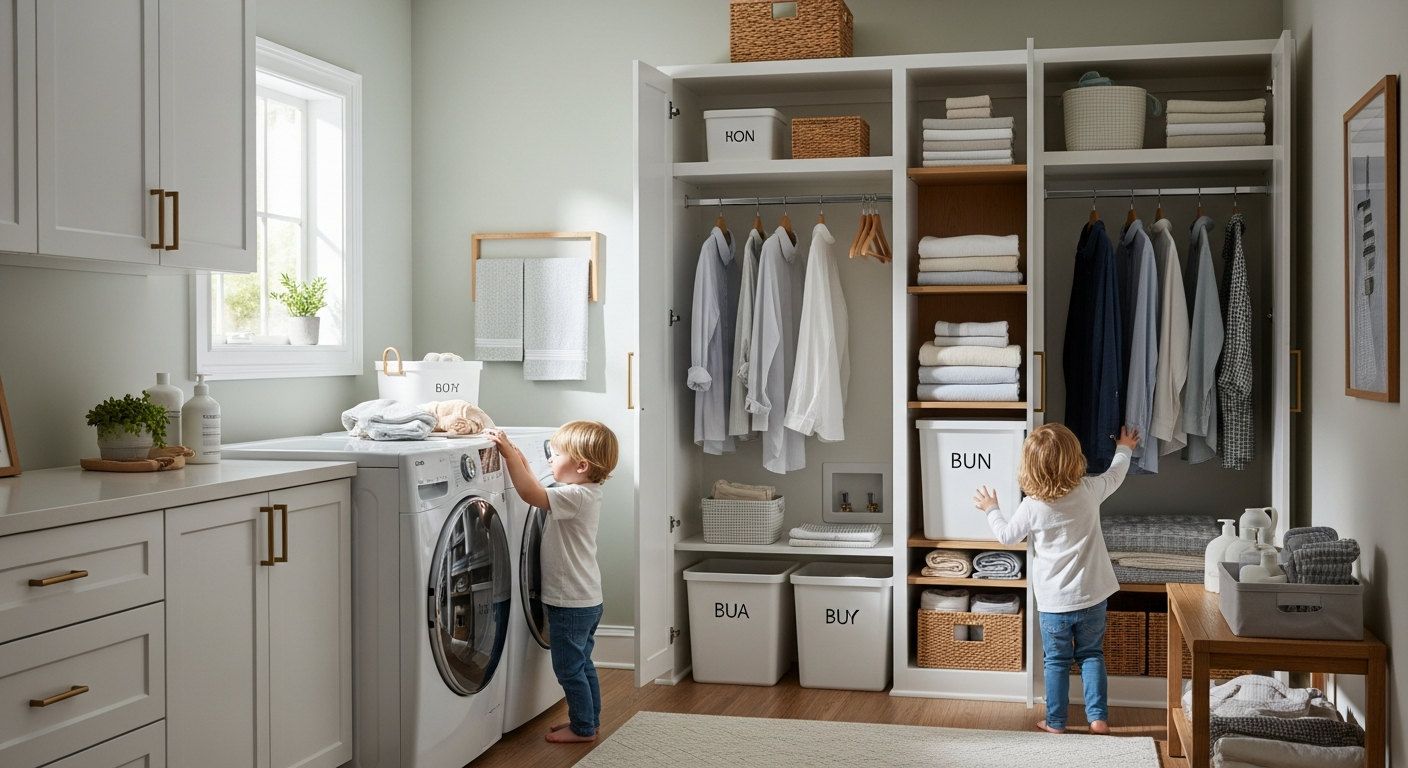
Physical Setup for Kid Participation
- Low hooks: Mount hooks at child height near the laundry room door for hanging mesh bags, aprons, or frequently used items. Kids engage more when they can reach things independently.
- Step stool: A sturdy, non-slip step stool that lives in the laundry room lets kids reach the washer, dryer, and folding counter safely.
- Visual labels: For pre-readers, use picture labels on hampers and bins. A picture of dark clothes on the dark hamper, light clothes on the light hamper. Simple, effective.
- Their own basket or bin: Each child has a labeled bin (their name in large letters, or their chosen color) where their clean, folded clothes go. Their job is to carry it to their room and put everything away. Ownership increases follow-through.
- A posted “how to” guide: A laminated step-by-step guide at child height showing the laundry steps: sort, load, add soap (with the correct amount marked on the cup), select cycle, start. Visual instructions remove the “I don’t know how” barrier.
The real secret to getting kids to do laundry: Lower your standards. A shirt folded by a six-year-old will not look like a shirt folded by you. That’s fine. The goal is participation and habit-building, not perfection. If you refold everything they fold, they’ll stop folding. Accept the lumpy folds. Close the drawer. Move on.
The Family Laundry Schedule That Keeps You Sane
There are two dominant philosophies for family laundry scheduling, and the right one depends entirely on your family’s rhythms.
The Daily Load Approach
How it works: One load per day, every day. Same time each day — first thing in the morning, right after school drop-off, or in the evening. One load washed, dried, folded, and put away each day.
Best for families who:
- Have a consistent daily routine
- Feel overwhelmed by large volumes
- Have small laundry spaces that can’t handle multiple loads at once
- Prefer spreading tasks throughout the week
The rhythm: Start a load at 7 AM. Transfer to dryer at 8 AM. Fold at lunch or after school. Put away before dinner. It becomes a background task rather than an event.
The math works: Seven loads per week covers the average family of four. If you have a heavy week (illness, sports, guests), you run two loads on one day. No big deal.
The Marathon Day Approach
How it works: All laundry done on one or two designated days per week. Saturday laundry day, for example. Every hamper gets emptied, every load gets run, everything gets folded and put away in one extended session.
Best for families who:
- Have unpredictable daily schedules
- Prefer “getting it done” to ongoing maintenance
- Have a dedicated laundry room with space for sorting and folding multiple loads
- Can involve the whole family on laundry day
The reality check: Marathon laundry day only works if you actually FINISH. Six loads washed but only two folded is worse than no system at all, because now you have four baskets of clean clothes sitting around inviting wrinkles and cat hair. If you choose this approach, block the time and protect it.
The Hybrid Approach
How it works: Run one maintenance load daily (like towels or a specific person’s clothes), and do a deeper catch-up session on the weekend. This keeps the volume manageable during the week while giving you a dedicated time to handle sheets, specialty items, and anything that piled up.
This is what works for most families, because it’s forgiving. If you miss a day, the weekend catches you up. If the weekend gets busy, the daily loads keep you from drowning on Monday.
Assigning Laundry Days by Person
A strategy that works especially well for families with older kids: each family member has a designated laundry day. Monday is your day, Tuesday is your partner’s, Wednesday is Child A’s, Thursday is Child B’s. On your day, your laundry gets washed, dried, folded, and put away. For younger kids, a parent runs the load but the child folds and puts away.
This eliminates the “whose is this?” sorting problem entirely, distributes the workload across the week, and gives older kids ownership over their own clothing care.
Budget-Friendly Laundry Room Makeover
You don’t need a full renovation to transform your laundry space. Here are three budget tiers that deliver real results.
The Quick Fix: ~$50
- Shelf risers for over-washer storage ($10-15, Amazon or Target)
- Matching bins or baskets for supplies ($10-15 for a set, Dollar Tree or HomeGoods)
- Mesh laundry bags, set of 6 ($8-12, Amazon)
- Label maker or peel-and-stick labels ($10-15, or use painter’s tape and a marker for free)
- Over-the-door hooks ($5-8)
This tier takes about an hour to implement and immediately improves function. It won’t change your room’s layout, but it will give everything a home and eliminate the visual chaos.
The Weekend Project: ~$150
Everything in the Quick Fix tier, plus:
- Wall-mounted drying rack ($25-40, accordion style)
- Countertop over front-loaders ($30-50 for butcher block cut to size at a hardware store, or a pre-made laundry countertop kit)
- Triple laundry sorter with removable bags ($30-45)
- Improved lighting ($15-25 for a bright LED flush-mount fixture)
- Peel-and-stick backsplash ($15-25 for the area behind the machines)
This tier requires a few hours and some basic tools (drill, level, measuring tape), but it transforms the room’s function AND appearance. The counter alone changes the laundry experience — having a surface to fold on is a game-changer.
The Full Makeover: $300+
Everything above, plus:
- IKEA BOAXEL or similar wall-mounted shelving system ($50-80 for a full section)
- Ceiling-mounted pulley drying rack ($40-60)
- Matching hamper set ($30-50 for a coordinated set of 3-4)
- Wall-mounted fold-down ironing board ($30-50)
- Fresh paint ($30-40 for a gallon of high-quality semi-gloss in a warm white or soft neutral)
- Mounted Bluetooth speaker ($20-30)
- Small rug or mat in front of machines ($15-25, washable)
- Wall art or framed print ($10-20)
This tier requires a weekend and delivers a space that looks and feels intentionally designed. It’s still a fraction of the cost of a renovation, but it creates a room you genuinely don’t mind spending time in — which matters when you’re in there every day.
Design Touches That Make Laundry Less Painful
This is the Neutrals and Nooks part. Because making a space functional is necessary, but making it pleasant is what keeps you using the systems you build.
Good Lighting
We mentioned this above, but it deserves emphasis. Bad lighting makes every task feel more draining. If your laundry room has a single dim bulb or no natural light, upgrading the lighting is the single highest-impact improvement you can make. A 4000K LED fixture (bright but still warm) transforms the space. If you have a window, keep it unobstructed — natural light makes stain identification easier and the room feel bigger.
Sound
Laundry is repetitive work, and your brain needs something to chew on while your hands fold. A mounted Bluetooth speaker or a small shelf for your phone turns laundry time into podcast time, audiobook time, or music time. Some parents report that having a dedicated laundry playlist actually makes them WANT to start a load, because it means they get to listen to their show. Pavlovian conditioning works on adults too.
Beautiful Containers
Decanting laundry supplies into matching containers is a small act with outsized impact. A glass jar for pods, a labeled pump bottle for liquid detergent, a small ceramic dish for stain sticks — it takes ten minutes and makes the space feel curated rather than cluttered. This isn’t about being precious. It’s about creating an environment you don’t resent being in.
A Touch of Art or Personality
A framed print, a small plant (real or faux, since laundry rooms can be low-light), or even a funny laundry-themed quote card mounted on the wall adds personality. This is a room in your home, not a utility closet. Treat it like one. You don’t need to go overboard — one or two personal touches are enough to shift the room from purely utilitarian to something with warmth.
A Comfortable Mat
Standing on hard tile or concrete while folding is fatiguing. A cushioned mat in front of the machines (similar to an anti-fatigue kitchen mat) reduces physical discomfort. Choose a washable one in a neutral tone — it will get dirty, and you’ll want to throw it in the wash occasionally. Because of course you will. It’s a laundry room.
Frequently Asked Questions
How do I keep up with laundry when I have a newborn?
Lower your expectations dramatically. During the newborn phase, your laundry system needs to be as simple as possible. Use the daily load approach — one load per day, focusing on the essentials (onesies, burp cloths, your own clothes). Skip the folding if you need to — a basket of clean baby clothes that you pull from is a perfectly valid system when you’re sleeping three hours a night. This is not the season for a perfectly organized laundry room. It’s the season for survival. The system can evolve later.
What’s the best way to handle sports uniforms and gear?
Designate a specific hook or bin just for sports gear that needs washing. Treat it as its own mini-load with its own schedule — the night before the next practice or game. A mesh bag per sport (soccer bag, baseball bag, swim bag) keeps gear together and prevents grass-stained shorts from contaminating a load of school clothes. For particularly smelly gear, a pre-soak in a vinegar-water solution for 30 minutes before washing makes a real difference.
Should I sort by color or by person?
For families with young children, sorting by person is almost always more efficient. Here’s why: kids’ clothes are small, so a full load of one child’s laundry is a reasonable size. When the load comes out of the dryer, every item belongs to the same person — no sorting needed. Fold and deliver to one room. Done. Color sorting makes more sense for adults’ wardrobes or if you have very specific care requirements. The “rules” about always sorting by color were written for a time when dyes bled more and water temperatures mattered more than they do today. With modern cold-water detergents and colorfast fabrics, a mixed load of one person’s clothes is rarely an issue.
How do I get my partner to help with laundry?
This is a relationship question disguised as a laundry question, but here’s the organizational angle: assign ownership, not tasks. Instead of asking your partner to “help with laundry” (which implies it’s your job and they’re assisting), divide the pipeline. One person owns washing and drying. The other owns folding and putting away. Or one person owns weekday loads and the other owns weekend loads. When someone owns a complete segment of the workflow, they’re responsible for it — not “helping” with someone else’s responsibility.
What do I do about the “clean clothes chair”?
We all have one. The chair (or couch corner, or bed end, or basket) where clean clothes accumulate instead of getting put away. The honest fix is to eliminate the step between the dryer and the drawer. Fold directly out of the dryer. Fold into individual piles by person. Deliver immediately. If you can’t put away right now, at least fold into the person’s individual basket so the pile is pre-sorted. The clean clothes chair exists because there’s too much friction between “clean” and “put away.” Reduce the friction, and the chair empties itself.
Is it worth investing in a higher-end washer and dryer?
If your machines are working, probably not — invest in organization instead. But if you’re replacing machines, the features that actually matter for families are: large capacity (4.5+ cubic feet for the washer), a steam cycle (excellent for stains and freshening), a speed wash option (for the emergency “I need this shirt in an hour” situations), and a sensor dry (prevents over-drying, which saves clothes and energy). Front-loaders are generally more efficient and gentler on clothes, but top-loaders are easier for kids to load and unload. Choose based on who will be using them most.
Making Peace with the Laundry
Here’s the truth nobody puts on a Pinterest graphic: you will never “conquer” laundry. It’s not a problem to be solved once. It’s a continuous process to be managed — like cooking, like cleaning, like all the invisible maintenance work that keeps a family running.
But you can change your relationship with it. You can move from dreading laundry to treating it as a neutral, even mildly pleasant part of your daily rhythm. The right systems reduce the mental load. The right space reduces the physical friction. And the right mindset — releasing the expectation that you should ever be “caught up” — reduces the emotional weight.
Build your pipeline. Optimize your space. Involve your kids. Put on a podcast. Fold the warm clothes. Close the drawer on the imperfect folds.
The laundry will be there tomorrow. But with the right system, it won’t be the mountain it used to be. It’ll just be one load. And you know exactly what to do with it.