Wooden Puzzle Storage Ideas That Keep Sets Complete
I found the missing giraffe piece in the couch cushions three weeks after I’d declared the safari puzzle “incomplete” and shoved it to the back of the closet. Chunky wooden puzzles have tiny pieces and big, awkward trays, and no generic bin fits both.
This post covers storage matched to puzzle shape, a simple piece-tracking system, and options for small spaces and outgrown sets. The free Wooden Puzzle Storage & Complete-Sets Kit goes with it.
Good to knowThe short answer: give every puzzle its own spot. Knob and tray puzzles lie flat, one per cubby or rack rung, and only trays whose pieces stay put when tipped go upright. Stacking puzzles live upright in a basket. Then keep a count of the pieces.
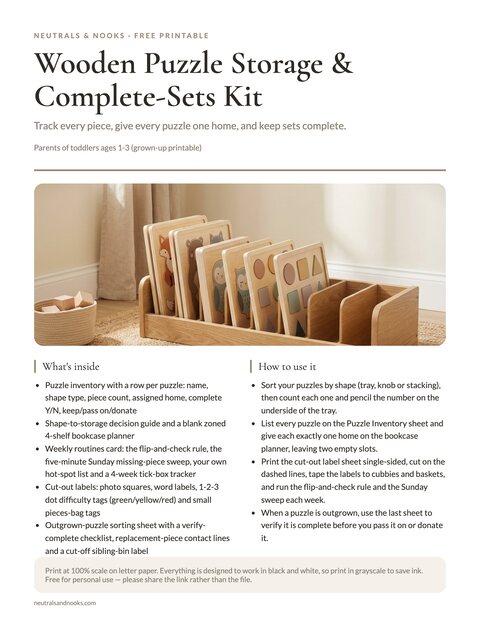
Free printable · 6 pages
Wooden Puzzle Storage & Complete-Sets Kit
A puzzle inventory and piece-count tracker, a shape-to-storage guide with a 4-shelf bookcase planner, a weekly flip-and-check and Sunday sweep card, cut-out labels, and an outgrown-puzzle sorting sheet.
Free. Your download link appears right here. You'll also join the Monthly Home Reset. Unsubscribe anytime. Privacy
In this article (12 sections)
- Why Wooden Puzzles Are Harder to Store Than You’d Think
- The Three Wooden Puzzle Shapes (and Why It Matters for Storage)
- Quick Reference: Matching Puzzle Type to Storage
- How to Store Tray Puzzles Without Spilling Pieces
- Cubby Storage for Knob Puzzles
- Baskets for Stacking Puzzles
- The Complete Sets System: A Piece-Tracking Method That Actually Sticks
- Set Up a Puzzle Zone on One Shelf
- What to Do With Puzzles the Kids Have Outgrown
- Small-Space Solutions: When You Don’t Have a Playroom
- Frequently Asked Questions
- Wrapping Up: Keep Wooden Puzzle Sets Complete
Why Wooden Puzzles Are Harder to Store Than You’d Think
Cardboard jigsaw puzzles are flat and thin. You can slide a dozen into a shoebox, spine out like books. Wooden puzzles for toddlers behave differently, and most generic “toy organization” advice ignores that.
What makes them tricky:
- The tray is structural, not optional. A knob puzzle without its tray is a pile of shapes with no home. Unlike jigsaw pieces, these need their frame to make sense.
- They’re bulky and rigid. A 12-inch square wooden tray doesn’t bend, fold, or compress. It takes up real shelf space whether it has 6 pieces or 20.
- Pieces are small and easy to lose. Chunky knobs wander into toy boxes, bags and couch cushions. Every loose piece is a future “where’s the other cow” moment.
- They stack badly. Trays with raised knobs don’t nest cleanly. Stack three and the bottom tray’s pieces get pressed and can pop out.
- Weight adds up fast. A shelf of eight solid wood puzzle trays is heavier than it looks. Keep the heavy sets low, and anchor the shelf (more on that below).
Safety firstSmall pieces are a choking hazard for babies and children under 3 who still mouth objects. The official small-parts test cylinder is about 1.25 in wide and 1 to 2.25 in deep. Any piece or part that fits entirely inside it is a choking hazard for under-3s. A toilet-paper tube is not a reliable test. Check each puzzle’s age label, and keep small-piece sets away from babies and under-3s. Make sure knobs are firmly attached, discard puzzles with cracked or loose parts, and supervise play.
Wooden puzzles are still wonderful for fine motor skills, but the “bin everything” approach works against you here. The fix is storage that treats the tray and pieces as one unit, starting with the shape category.
The Three Wooden Puzzle Shapes (and Why It Matters for Storage)
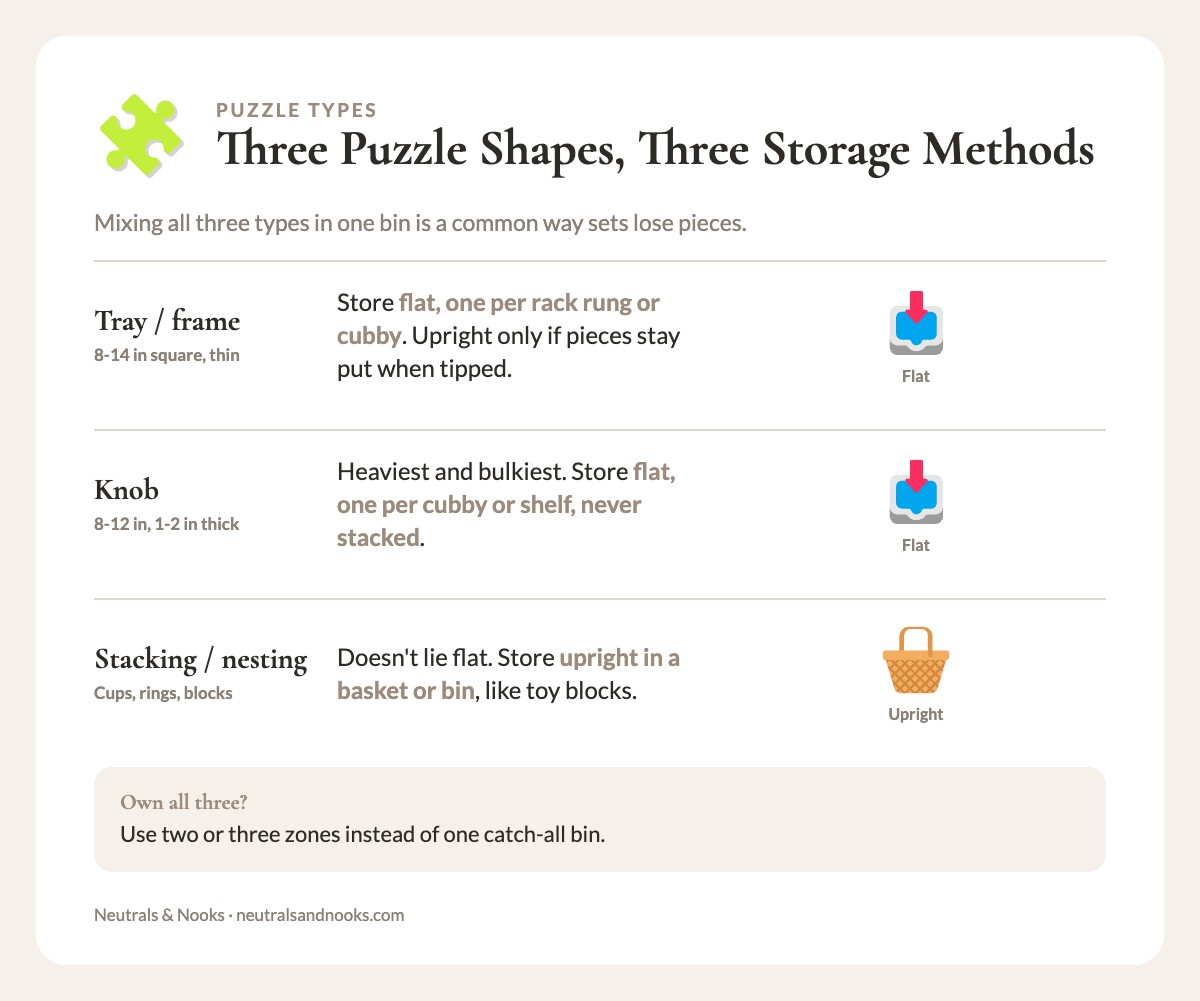
Before you buy or build anything, sort what you own. Nearly every wooden puzzle falls into one of three shape categories, and each wants different storage. Mixing all three in one bin is a common way sets lose pieces.
| Puzzle Type | Typical Size | Storage Challenge | Best Storage Solution |
|---|---|---|---|
| Tray/frame puzzles (flat wooden board, pieces sit in cutouts) | 8″–14″ square, thin | Rigid, stacks badly, pieces fall out if tilted | Flat, one per rack rung or cubby. Upright only if pieces stay put when tipped. |
| Knob puzzles (thick pieces with a peg handle) | 8″–12″ square, 1″–2″ thick | Heaviest and bulkiest; knobs snag on stacked trays | Flat, one per cubby or shelf, never stacked. |
| Stacking/nesting puzzles (cups, rings, blocks that stack instead of lying flat) | Varies, often cylindrical | Doesn’t lie flat at all; different footprint than trays | Upright in a basket or bin, like toy blocks. |
Many toddler shelves lean on knob puzzles, a common pick for ages 1–3. Find your dominant category and pick one main storage method. If you own all three types, use two or three zones instead of one catch-all bin.
Quick Reference: Matching Puzzle Type to Storage
| If you have… | Store it… | Avoid… |
|---|---|---|
| Flat tray/frame puzzles | Flat, one per rack rung or cubby. Upright in a snug file only if pieces stay put when tipped. | Piling several in one stack. Pieces slide and buried puzzles get ignored. |
| Chunky knob puzzles | Flat, one per cubby or shelf. | Standing them on edge, or mixing several in one shared bin. |
| Stacking/nesting puzzles | Upright in a basket or low bin, separate from trays. | Storing them loose with tray puzzles. |
| A mixed collection | Zoned shelf, one section per type. | One giant “puzzles” bin. |
| Outgrown puzzles | Labeled bin, verified complete before storing or donating. | Boxing them up before counting pieces. |
Before you build anything, count how many puzzles are out. Four or five at a time is plenty. If fifteen are crammed onto one shelf, read how many toys should be out at once first. That collection is probably due for a rotation.
How to Store Tray Puzzles Without Spilling Pieces
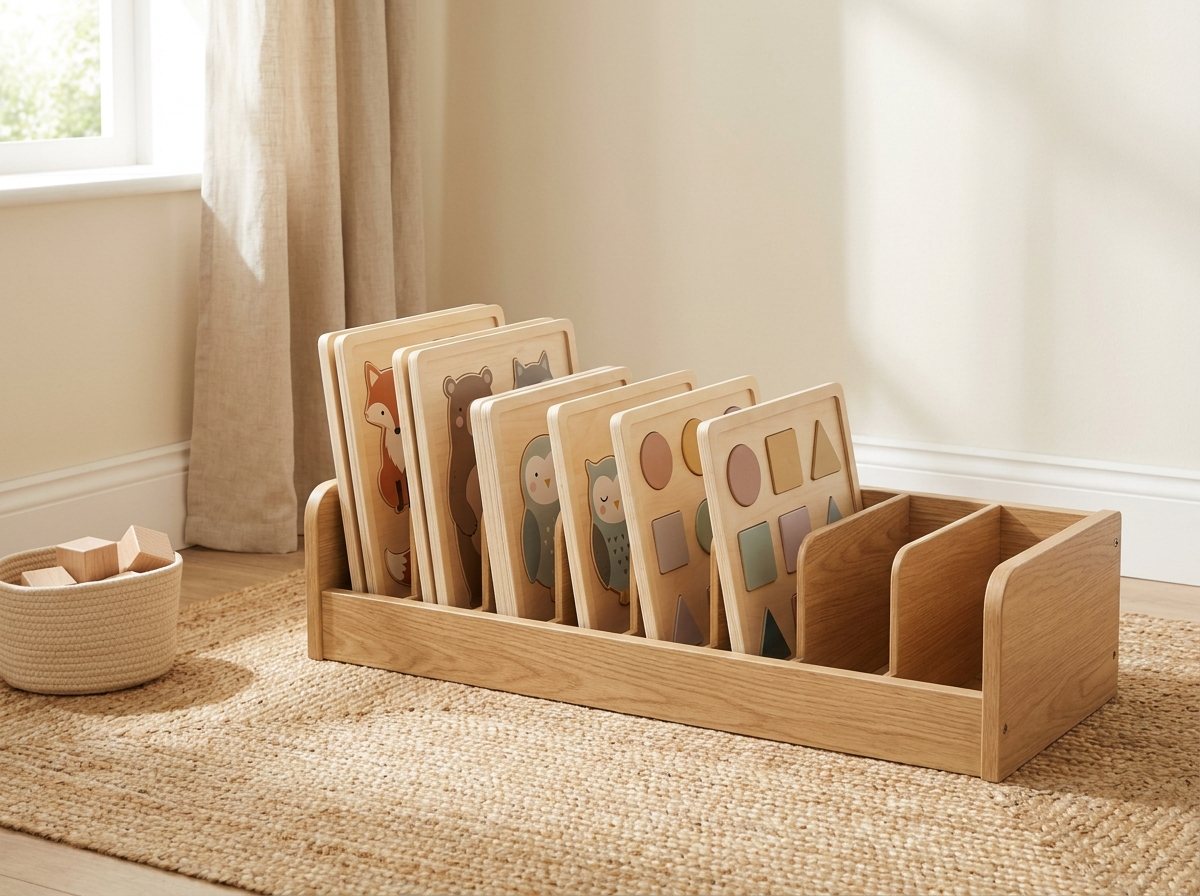
Tray puzzles have one rule: never pile them. In a stack, every puzzle below the top one is buried, and toddlers paw through the pile and knock it to the floor. Give each tray its own level or slot instead.
Whether a tray can stand upright depends on how its pieces sit. Many chunky pieces slide out the moment the tray tips, which is exactly how sets lose pieces. So flat is the default here, and upright is only for trays that pass a quick test.
How to do it:
- Do the tip test. Hold each tray on its long edge over a table. If every piece stays seated, it can stand upright. If anything drops, that puzzle gets stored flat.
- Store the rest flat, one per level. Use a wire puzzle rack that holds each tray flat on its own rung, or give each tray its own cubby or shelf. Racks run roughly $15–40. Check that the spacing clears your chunkiest puzzle, and never stack one tray on another.
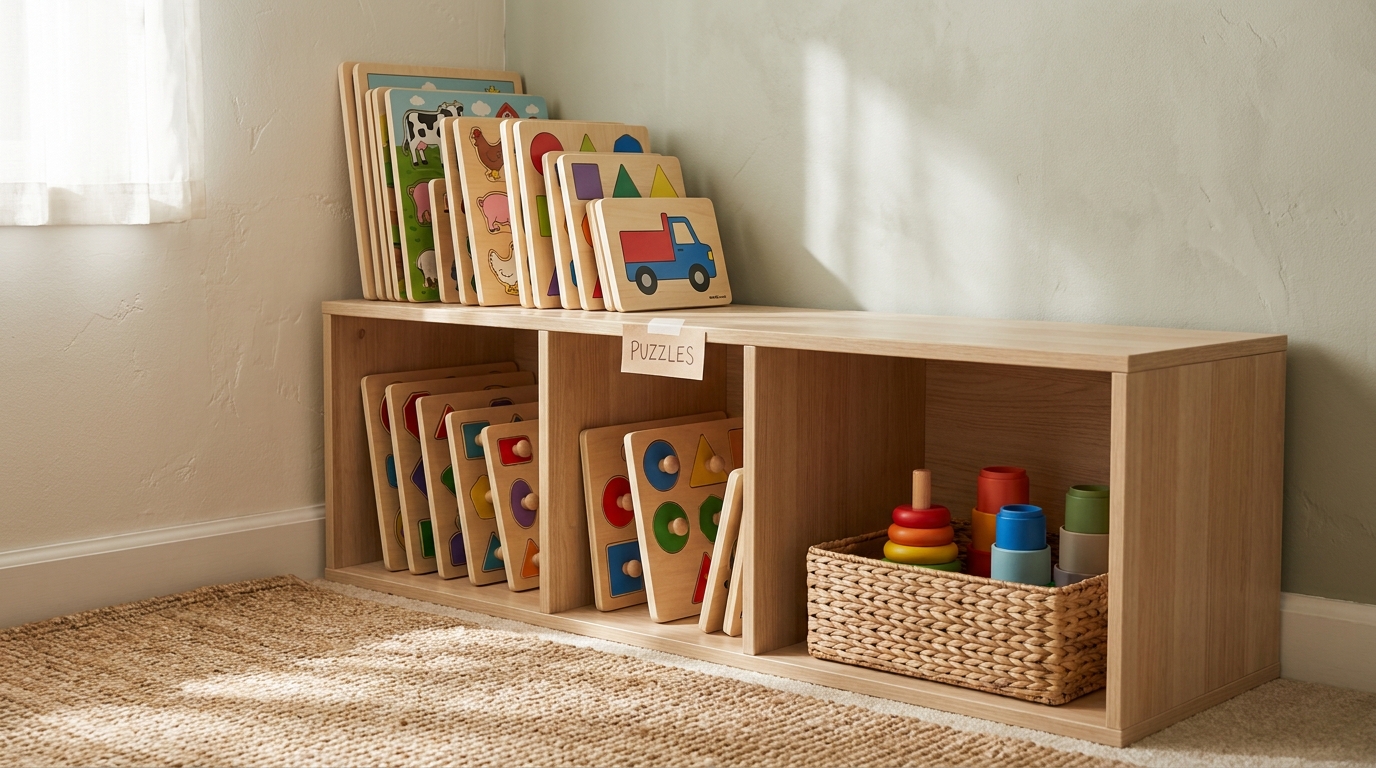
- Stand tip-test passers snugly. Trays that pass can go on their long edge in a magazine file or a snug bookshelf slot, like books. A snug fit keeps a bumped tray from tipping far enough to shed pieces.
- Group by theme. With more than eight or so, keep animals, shapes and numbers together so a toddler can find “the one with the truck” without pulling every tray.
- Leave spare slots. Birthdays and holidays bring new puzzles, and a system with no slack gets abandoned quickly.
Why it works: grabbing one puzzle doesn’t disturb the others, no puzzle gets buried under a stack, and pieces stay in their cutouts. Many two-year-olds can pick a puzzle and put it back on their own.
If you don’t want to buy a rack, tip-test passers can stand in a cheap wire dish drying rack, the same way plates do. Everything else still needs its own flat spot, even if that’s just a clear stretch of shelf.
Cubby Storage for Knob Puzzles
Knob puzzles are the heaviest and bulkiest type, and toddlers use them most. Their pieces sit loosely and slide out when the tray tips, so give them dedicated flat space: one puzzle per cubby or shelf, nothing stacked on top.
Open cubbies (one puzzle lying flat in each) suit knob puzzles for three reasons:
- Knobs on one puzzle can’t snag pieces of the puzzle next to it.
- Lying flat, the pieces stay seated, and the cubby walls stop a tray from being knocked off the shelf.
- Toddlers can slide one puzzle out at a time and self-select, which helps cut down on pulling everything out, a common way pieces get lost.
Safety firstAnchor every shelf and bookcase to the wall with anti-tip hardware. Keep heavy wooden sets on low shelves, follow the manufacturer’s weight limit, and discourage climbing.
Setups that work well:
- A 9-cube or 12-cube storage shelf, the kind sold for fabric bins, used without the bins. An interior of about 13 in fits 8–12 in puzzles lying flat, so measure your biggest puzzle first. Expect roughly $40–100.
- A low IKEA-style bookshelf with adjustable shelves, spaced just high enough for one puzzle lying flat, so each gets its own level.
- A rolling cart with open bins, if floor space is tight. Give each puzzle its own bin, lying flat, since a shared bin is how a rooster piece ends up under the dinosaur puzzle.
Add one habit: “flip and check.” Before a knob puzzle goes back, an adult or older sibling flips the tray to see that no pieces slid underneath. It takes about five seconds. If you already run the 15-minute evening reset, add it as a rotating task.
Baskets for Stacking Puzzles
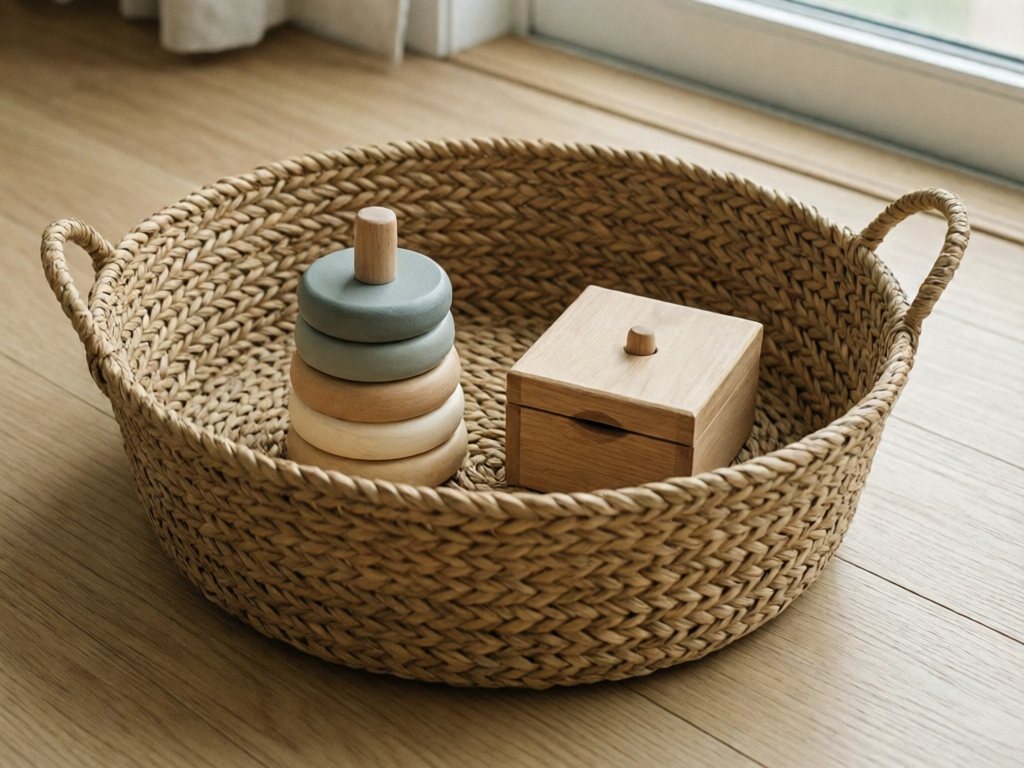
Stacking and nesting puzzles include rings, nesting cups and shape-sorter blocks. They don’t lie flat, so racks and file slots don’t suit them.
An open basket or low bin works best (about $10–25). Store them upright, the way you’d store building blocks:
- A woven basket on the floor or a low shelf looks intentional in a neutral playroom.
- Give stacking puzzles their own basket, apart from knob and tray puzzles, so nobody dumps the whole basket to find one piece.
- If a puzzle has a base plus loose rings or cups, keep its parts together in a cordless fabric pouch or a small lidded box inside the basket. Similar cup sizes invite a 3-year-old to “fix” a set with the wrong cup.
Safety firstSkip drawstring bags in any basket a baby or toddler can reach. Cords are a strangulation and entanglement risk. A fabric zip pouch with no cord, or a small lidded box, keeps parts together just as well.
Labels help here, since from a distance a stacking puzzle basket looks a lot like a basket of blocks. A simple tag — “Stacking Puzzles” — keeps a well-meaning grandparent or sitter from lumping the pieces in with unrelated toys during cleanup.
The Complete Sets System: A Piece-Tracking Method That Actually Sticks
Storage solves where puzzles live, not whether the pieces are all there. That needs a light system that takes about five seconds per puzzle.
The three-part system:
- Count once, mark it. When a puzzle is new, or when you first organize your collection, count the pieces. Write the number in tiny pencil or a sticker dot on the underside of the tray. A toddler won’t see it, and you can flip and check in about five seconds. “9” or “12” is all you need.
- Give each puzzle one home. Every puzzle gets exactly one slot, cubby or spot in a basket. A puzzle without one ends up half-under the couch.
- Do a weekly missing-piece sweep. Sunday night works for us. It takes under five minutes and catches strays before they’re truly lost. Toddlers tend to drop things in the same places, so you’ll soon learn your house’s hot spots. Ours are the reading nook rug and, somehow, one kitchen drawer.
Your sweep list:
- Flip each tray and check underneath
- Couch and chair cushions
- Bottom of the toy box
- Car seat area and coat pockets
- Your house’s usual hot spot
Piece lost for good? Don’t toss the puzzle. Search the maker’s site with the puzzle name and SKU, and ask about replacement pieces. Keep the tray for parts. Don’t swap in a lookalike or craft-made piece for an under-3, since it may be a choking risk.
Set Up a Puzzle Zone on One Shelf
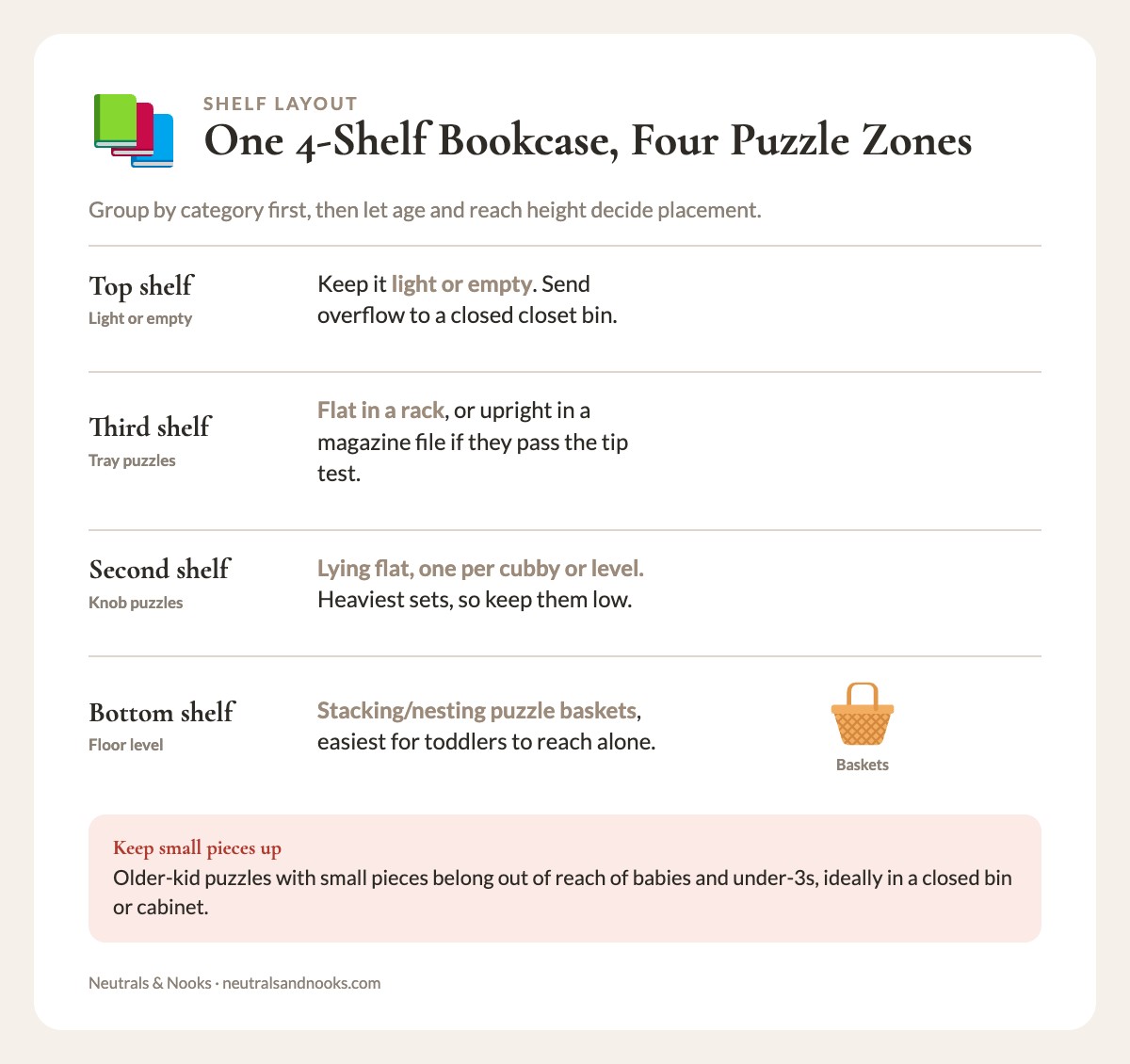
You don’t need furniture just for puzzles. Give them their own zone on a shelf that already works for other things, and anchor it to the wall as noted above.
A workable layout, using a standard 4-shelf bookcase or cube shelf as the example:
- Bottom shelf (floor level): stacking/nesting puzzle baskets. Toddlers reach floor-level storage most easily on their own.
- Second shelf up: knob puzzles lying flat, one per cubby or shelf level. They’re the heaviest sets, so keep them low and toddler-reachable.
- Third shelf: tray puzzles, flat in a puzzle rack or upright in a magazine file if they pass the tip test. They sit a little higher because they often suit an older sibling or need more careful handling.
- Top shelf: keep it light or empty. Send overflow and “not right now” puzzles from your toy rotation to a closed closet bin instead.
Safety firstPuzzles meant for older kids, especially any with small pieces, belong out of reach of babies and under-3s. A closed bin or cabinet is safest. Everything on the toddler-reachable shelves should pass the small-parts test.
It’s the same zoned logic as organizing toys by type. Group by category first, then let age and reach height decide where each thing goes.
If the shelf is already packed, ask whether each puzzle earns its space right now or goes into rotation storage. A playroom reset works through that question room-wide.
Toddler-Friendly Labels
Kids as young as 18 months can match a picture label to a puzzle’s home if the system is consistent.
- Photo labels on cubbies or baskets: print a small photo of the puzzle picture and tape or laminate it to the slot. It works before a child can read.
- Color-coded dots for difficulty: green for easy, yellow for medium, red for hardest.
- Word labels such as “Animals” or “Farm” once your child recognizes sight words.
The same photo-label method works for organizing craft supplies.
Montessori-Style Shelving
A Montessori-inspired setup means open, child-height shelving and one activity per tray. Put one puzzle on each shelf tray, lying flat and picture up, with nothing stacked on top.
Rotate instead of displaying everything. Fewer puzzles out looks calmer and makes choosing easier. Wood, woven baskets and neutral bins keep the look quiet. For a bedroom, see this Montessori toddler bedroom setup.
What to Do With Puzzles the Kids Have Outgrown
Chunky wooden puzzles have a limited window. Many kids move on from 4–9 piece knob puzzles around age 3 or 4, and from simple tray puzzles a bit later. As new puzzles come in, move outgrown ones out, or the shelf fills up fast.
A few options:
- Box and label for a younger sibling or future baby. A labeled closet bin (“Wooden Puzzles — Ages 1-3”) is useful storage, not clutter. That holds if a second child or a friend’s toddler is likely to use them.
- Pass along or donate complete sets only. This is where the piece count pays off. Check that a puzzle is whole before you hand it down. Secondhand shops may not accept incomplete puzzles, and a full set is kinder to the next family. If you receive hand-me-downs, check them for splinters, chipped paint and recalls before a young child plays with them.
- Keep one or two as keepsakes, let the rest go. You don’t need to store every wooden puzzle forever. Pick a favorite, like the first one or the one with the most-worn corners. Pass along the rest so the collection doesn’t become permanent overflow.
If you’re storing outgrown puzzles with other gear for a future sibling, use the same bin-and-label logic as seasonal clothing storage. Clear labels now save guessing in two or three years.
Small-Space Solutions: When You Don’t Have a Playroom
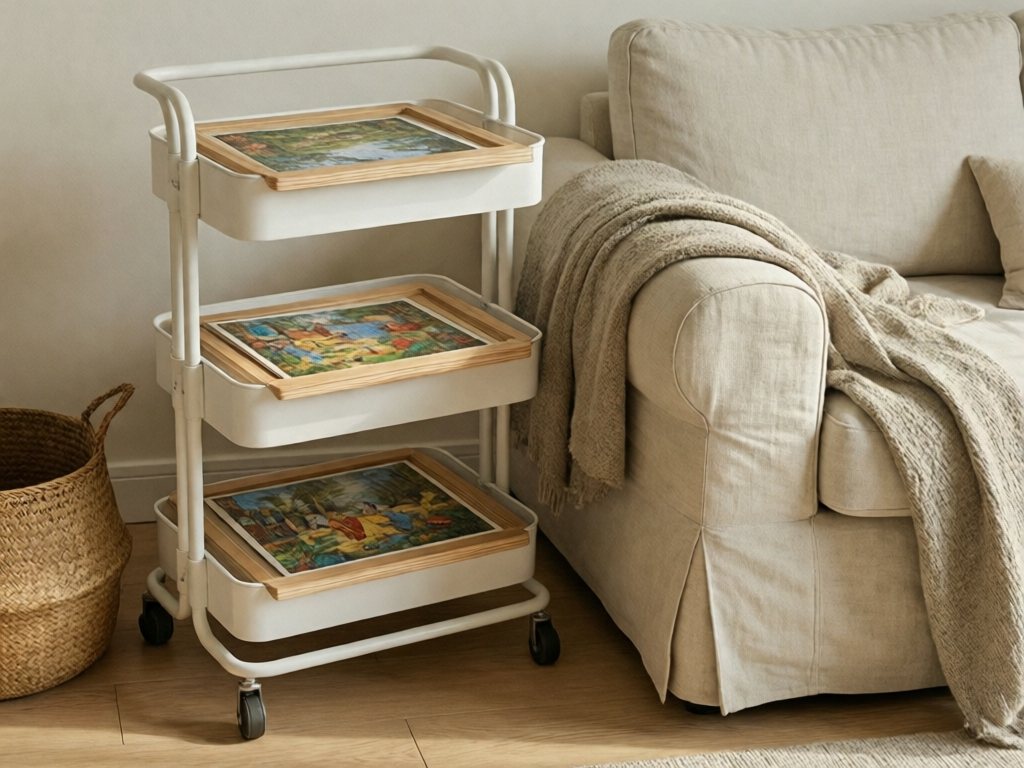
Not every family has a playroom. Your puzzle “shelf” might be a corner of the living room or a closet in a shared kids’ bedroom. These adaptations work in tight spaces:
- Under-bed storage bins with dividers suit tray puzzles. The flat, rigid shape fits a shallow bin well. Give each tray its own divided section so nothing gets stacked.
- A rolling cart tucked beside a couch or reading chair gives puzzles a defined spot. It can roll into a closet when you want the living room to look “adult” for the evening.
- A closet shelf, repurposed. A closet shelf with a couple of cheap dividers or shoebox-style bins can hold a full collection out of sight. Bring puzzles out only for play time.
- A single designated drawer, if space is really tight. Organize within it: puzzles lying flat side by side, never piled, and stacking-puzzle parts in a small lidded box. Don’t toss them in loose.
If your shared kids’ space feels this squeezed, zoom out to the whole room. The same “give every category its own zone” logic is the backbone of good shared bedroom organization for siblings. Puzzles are just one category competing for the same square footage.
Frequently Asked Questions
What’s the best way to store wooden puzzles so pieces don’t get lost?
Give every puzzle one dedicated spot based on its shape. Tray and knob puzzles lie flat, one per cubby or rack rung, and stacking puzzles stand upright in their own basket. Only stand a tray on edge if its pieces stay put when you tip it. Avoid shared bins, which get dumped to find one puzzle.
How do I store wooden puzzles in a small space or without a playroom?
Under-bed bins with dividers work well for flat tray puzzles, since the rigid shape suits a shallow bin. A rolling cart beside a couch, a closet shelf with small dividers, or one organized drawer can also work. Whatever the container, give each puzzle its own section and keep types separate.
What’s a good toddler puzzle storage solution for ages 1-3 specifically?
Open cubbies with one knob puzzle lying flat in each work best, because toddlers can slide one out and self-select. Keep the shelf low and anchored, put out four or five puzzles, and rotate the rest.
Should I store wooden puzzle pieces separately from the tray?
No. The tray is part of the puzzle, not just packaging, so keep pieces and tray together as one unit. If loose parts need extra containment, as stacking and nesting puzzles often do, use a cordless fabric pouch or a small lidded box. Skip drawstring bags, since cords are a strangulation risk for little ones. Keep it with that puzzle’s tray or base, never in a shared “loose pieces” bin.
How can I tell if a wooden puzzle is missing pieces before I donate or pass it down?
Write the piece count on the tray’s underside in small pencil or on a tiny sticker dot. Do it when the puzzle is new, or when you first organize your collection. Before you donate or pass a puzzle down, count the pieces in the tray and compare them to that number. It takes about five seconds and saves handing someone an incomplete set.
What kind of shelf or organizer works best for a puzzle organizer setup?
It depends on your dominant puzzle type. A cube shelf with open cubbies suits knob puzzles. A wire puzzle rack or closely spaced shelves suit tray puzzles lying flat, one per level. Open baskets suit stacking puzzles that don’t lie flat. Most households have a mix, so zone one shelf into two or three sections rather than forcing every puzzle into the same container.
How do I keep my toddler from mixing up pieces from different puzzles?
Store puzzles far enough apart that a toddler handles one at a time. Individual cubbies or a rack with one puzzle per rung both do this. Build the habit of finishing, or at least clearing, one puzzle before pulling out the next. Sweep nearby toy bins now and then, since stray knobs migrate into the closest container.
Wrapping Up: Keep Wooden Puzzle Sets Complete
You don’t need a big storage budget. A shelf you already own, some sorting by shape, and a habit of flipping the tray before it goes back will keep a collection complete. Start with whichever puzzle type is causing the most chaos, sort that one zone, and let the rest follow at your own pace. The giraffe piece stays found once there’s finally somewhere for it to belong.