Seasonal Gear Rotation System for the Family Garage
Last October, I stood in my garage looking for the soccer cleats my son needed in twenty minutes, and instead I found: a deflated kiddie pool, three sleds, a bag of Halloween decorations from two years ago, and a single roller skate with no partner in sight. The cleats were eventually located inside a beach bag, wedged behind the lawnmower. We made it to practice four minutes late, and I stood in the driveway afterward and admitted to myself that the problem wasn’t clutter, exactly — it was that everything we owned lived in the garage at the same time, all year round, regardless of whether we’d need it that week or not touch it for eight months.
That’s the piece most garage organization advice skips. You can buy the nicest slat wall system or the sturdiest set of shelving units, and if you’re still storing snow boots next to sand toys next to bike helmets in one undifferentiated pile, you’ll be digging through the same chaos in July that you were digging through in January — just with different items on top. A garage doesn’t need better containers nearly as much as it needs a rhythm. Gear should move through the space the way the seasons move through the year: in, out, up front, into deep storage, and back again.
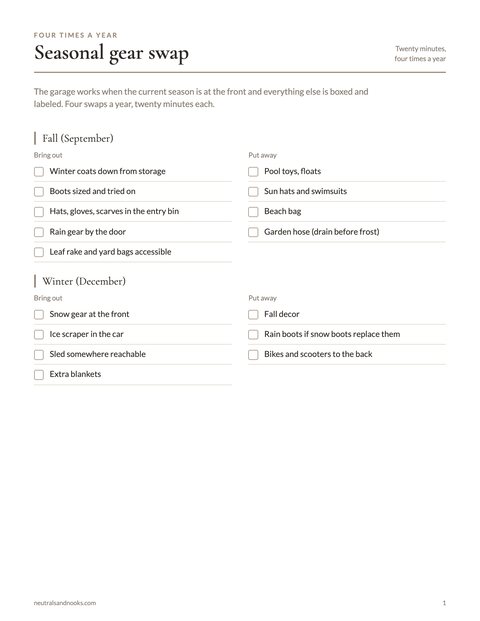
Free printable · 2 pages
Seasonal Gear Swap Checklist
What comes out and what goes away, four times a year — twenty minutes per swap.
Free. Your download link appears right here. You'll also join the Monthly Home Reset. Unsubscribe anytime. Privacy
This is what a seasonal gear rotation system does. It’s not a one-time garage overhaul — it’s a repeatable process you run four times a year (or twice, if your climate only really has two seasons) that keeps only the current season’s gear at arm’s reach, while everything else gets tucked into labeled, out-of-the-way storage until it’s needed again. Below is the full system: how to zone your garage for rotation, a printable season-by-season swap checklist, and answers to the logistical questions that come up once you actually try to live this way.
In this article (11 sections)
- Why Static Garage Shelving Isn’t Enough
- The Two-Zone Framework: Front Access vs. Deep Storage
- Setting Up Your Rotation Calendar
- The Printable Season-by-Season Swap Checklist
- Building the Physical Infrastructure That Makes Rotation Easy
- Sports Equipment: The Trickiest Rotation Category
- Making the Swap Day Itself Manageable
- Handling the In-Between: What to Do With Gear That Doesn’t Fit a Season
- Troubleshooting: When the Rotation Starts to Slip
- Frequently Asked Questions
- A Garage That Works With the Calendar, Not Against It
Why Static Garage Shelving Isn’t Enough
Most garage organizing systems are built around categories — bikes here, tools there, sports gear on this shelf, seasonal decor on that one. That’s a completely reasonable starting point, and if you haven’t done that foundational sorting yet, it’s worth pausing to set it up first; our guide to garage organization for bikes, sports gear, and outdoor toys walks through zoning the space by activity type, and garage organization for family storage covers the shelving and bin infrastructure that makes any system work.
But categories alone don’t account for time. A garage organized purely by category still has snow gear and pool gear occupying prime real estate simultaneously, competing for the same eye-level shelves and easy-reach hooks, even though only one of them is relevant on any given day. The result is a garage that always looks “pretty organized” and always feels slightly wrong to use — you’re constantly moving other things aside to get to the thing you actually need.
A rotation system adds a second axis to your organization: not just what kind of thing is this but is this in season right now. Once you’re sorting along both axes, the garage does something static shelving never quite manages — it gets easier to use as the year goes on, not harder.
The core idea in one sentence: at any given time, roughly 70-80% of your garage’s easy-access space should hold only the current season’s gear, and everything else should be one step removed — in bins, on a top shelf, or in back-of-garage storage — clearly labeled and easy to retrieve when its season arrives, not before.
The Two-Zone Framework: Front Access vs. Deep Storage
Before you touch a single bin, it helps to mentally (and eventually physically) split your garage into two zones. This is the backbone the whole rotation system hangs on.
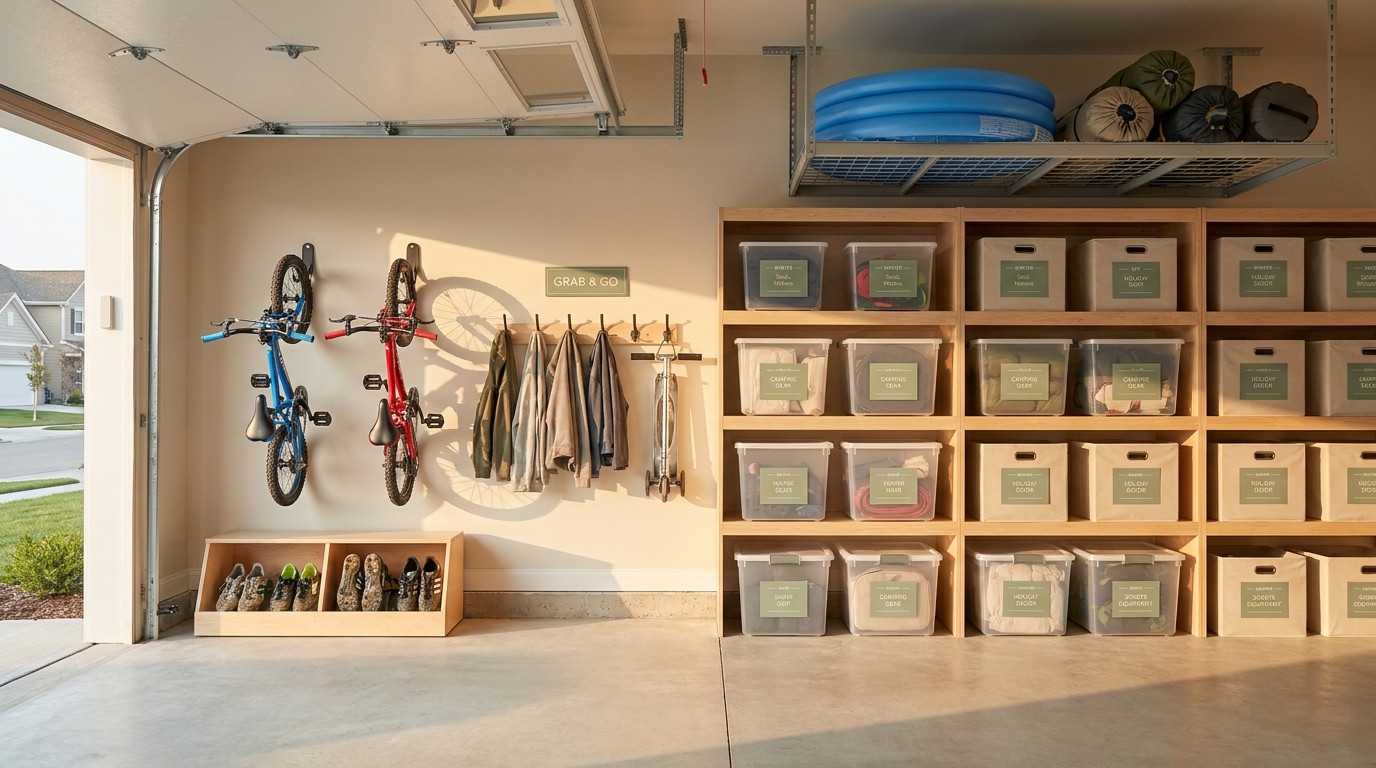
Front Access Zone — This is the gear you or your kids need to grab without asking for help, moving anything, or hunting. Think: the bikes that get ridden weekly, the sports gear for whatever’s currently in season, the coats and boots for the current weather. This zone should be at kid height where relevant (a 7-year-old should be able to get their own soccer ball) and near the door you actually use to leave the house.
Deep Storage Zone — Everything not currently in season lives here: top shelves, wall-mounted overhead racks, the back third of the garage, or clearly labeled bins stacked against a wall you don’t walk past daily. This gear doesn’t need to be convenient — it needs to be findable, which is a different requirement. You’re optimizing for “I can locate this in under two minutes when the season changes,” not “my toddler can reach it.”
Here’s how that split typically looks across a garage’s real estate:
| Zone | Typical Location | What Lives Here | Access Frequency |
|---|---|---|---|
| Front Access | Eye-to-knee height, near the door, first 6 feet of garage depth | Current season’s bikes, sports gear, outdoor toys, current coats/boots | Daily to weekly |
| Deep Storage | Overhead racks, top shelves, back wall, garage attic if you have one | Off-season gear, holiday decor, camping equipment used a few times a year | Seasonally |
The physical setup for this doesn’t require a full renovation. A single overhead storage rack (the kind that mounts to ceiling joists) can absorb an enormous amount of off-season volume — sleds, kiddie pools, patio cushions — and get it entirely out of walking-around space. If you haven’t installed one yet, it’s one of the highest-leverage purchases for this system, because it turns “ceiling” into a third storage zone you’re not currently using at all.
Setting Up Your Rotation Calendar
The rotation itself runs on a schedule tied to your actual climate and activities, not a rigid four-season calendar that doesn’t match your life. A family in Minnesota and a family in Georgia are rotating completely different gear at completely different times, and a family with a kid in year-round competitive swimming has a different rotation rhythm than a family that does seasonal rec league sports.
Start by mapping your own year. Grab a piece of paper and, month by month, jot down what gear category is “hot” (in active use) versus “cold” (dormant). Most families find their garage gear falls into four natural clusters even if their actual seasons blur together:
- Cold-weather cluster: snow gear, sleds, ice skates, winter coats/boots if stored in garage, holiday decor
- Mud-season cluster: rain boots, umbrellas, garden tools waking up, bikes coming out of hibernation
- Warm-weather cluster: pool toys, sprinklers, camping gear, bikes at peak use, sports equipment for spring/summer leagues
- Transition cluster: back-to-school sports gear, Halloween decor, raking/yard tools, layering gear as it cools down
Your rotation days are simply the four points where you swap one cluster out for the next. For most of the U.S., that lands somewhere close to:
| Rotation Point | Approximate Timing | What Moves to Front Access | What Moves to Deep Storage |
|---|---|---|---|
| Spring Swap | Late March–early April | Bikes, rain gear, garden tools, warm-weather sports gear | Sleds, snow gear, holiday decor |
| Summer Swap | Late May–early June | Pool/water toys, camping gear, sprinklers, summer sports | Rain boots (if space-limited), spring-only tools |
| Fall Swap | Mid-to-late September | Fall sports gear (soccer, football), yard tools, Halloween decor | Pool toys, camping gear, sprinklers |
| Winter Swap | Late November | Snow gear, sleds, holiday decor | Fall sports gear, most yard tools |
If you’re doing the fall swap right now, in late September, this is exactly the moment to be pulling soccer cleats and shin guards to front access and boxing up the kiddie pool — which, not coincidentally, is the swap most families are mid-way through when the first pumpkin shows up on the porch. It’s also a natural moment to handle your Halloween decor storage at the same time, since you’re already elbow-deep in bins.
Put these four dates on your household calendar now, as a recurring event, so the rotation doesn’t rely on you remembering — it relies on a notification.
The Printable Season-by-Season Swap Checklist
This is the heart of the system: a checklist for each of the four rotation points, telling you exactly what to pull forward and what to tuck away. Print this, laminate it if you’re feeling ambitious, and hang it inside a cabinet door in the garage so it’s there every time you do the swap — you genuinely don’t want to be reconstructing this list from memory twice a year.
🌱 Spring Swap Checklist (Late March–Early April)
Move to Front Access:
- [ ] Bikes, helmets, and pads (tune up tires and brakes while you’re at it)
- [ ] Rain boots and umbrellas
- [ ] Garden tools: trowels, gloves, kneeling pad, watering cans
- [ ] Sidewalk chalk, bubbles, jump ropes
- [ ] Spring sports gear (baseball, softball, track cleats)
- [ ] Kite and outdoor games
Move to Deep Storage:
- [ ] Sleds and snow toys
- [ ] Ice scrapers, snow shovels (unless you get late-season snow — check your almanac)
- [ ] Holiday decor, fully packed and labeled
- [ ] Heavy winter coats and snow pants (if garage-stored)
- [ ] Space heaters, if used in garage workspace
☀️ Summer Swap Checklist (Late May–Early June)
Move to Front Access:
- [ ] Pool toys, floats, and sprinklers
- [ ] Camping gear: tent, sleeping bags, cooler, camp chairs
- [ ] Sunscreen station supplies, bug spray, citronella
- [ ] Water table or kiddie pool
- [ ] Summer sports gear (swim bag, tennis/pickleball rackets)
- [ ] Bikes stay out, but check for a second inspection if daily use has picked up
Move to Deep Storage:
- [ ] Rain boots (if garage space is tight — otherwise, leave for summer storms)
- [ ] Gardening tools not in active weekly use
- [ ] Spring-only sports gear once the season ends
🍂 Fall Swap Checklist (Mid-to-Late September)
Move to Front Access:
- [ ] Fall sports gear: soccer cleats, shin guards, football gear, volleyball kneepads
- [ ] Rakes, leaf bags, yard waste tools
- [ ] Halloween decor (pull the bin, don’t unpack everything at once)
- [ ] Layering gear: light jackets, rain boots back into rotation
- [ ] Backpacks and gear for new sports seasons/activities
Move to Deep Storage:
- [ ] Pool toys, floats, sprinklers, water table
- [ ] Camping gear (unless you’re a fall-camping family — adjust accordingly)
- [ ] Kiddie pool, deflated and dried before storage
- [ ] Summer-only sports gear
❄️ Winter Swap Checklist (Late November)
Move to Front Access:
- [ ] Sleds and snow toys
- [ ] Snow shovels, ice scrapers, ice melt
- [ ] Snow pants, extra mittens/hats if garage-stored
- [ ] Holiday decor (already partway out from Halloween swap — now the full set)
- [ ] Winter sports gear (skates, ski/snowboard equipment)
Move to Deep Storage:
- [ ] Rakes and yard waste tools
- [ ] Halloween decor, repacked and labeled clearly for next year
- [ ] Fall sports gear once the season officially wraps
- [ ] Any lawn/garden equipment not needed until spring
A note on the checklist format itself: don’t just move gear and call it done. As you pull something out of deep storage, take fifteen seconds to check it’s still functional — bike tires holding air, sled runners not cracked, holiday lights not blown a fuse. It’s a much better time to discover a broken zipper on the snow pants than the first snow day morning.
Building the Physical Infrastructure That Makes Rotation Easy
A rotation system lives or dies on how easy the physical swap is. If moving gear from front access to deep storage requires wrestling with mismatched boxes and no clear “home” for anything, you’ll do the swap once with enthusiasm and then let it slide by June. The infrastructure needs to make the swap itself nearly effortless.
Use uniform, stackable bins — and buy more than you think you need. Clear or labeled bins in one or two sizes let you stack efficiently in deep storage and grab a whole bin at once during the swap, rather than handling loose items one by one. I’d recommend a minimum of one bin per gear cluster (so, at least four to six bins total), sized to what actually needs to move.
Label by season AND by contents. A bin labeled “Winter” is fine. A bin labeled “Winter — Sleds, Ice Scraper, Ice Melt, Extra Mittens” saves you from opening three bins to find the ice melt on the one morning you actually need it fast. Include the label on two sides of the bin, since bins get stacked and turned.
Install real overhead storage before your next rotation, if you haven’t already. This is the single highest-impact structural change for a rotation system, because it takes bulky, awkward-to-store items (sleds, kiddie pools, folding camp chairs) completely off your floor and wall space and puts them somewhere you’re not fighting for room. A basic ceiling-mounted rack handles several large bins’ worth of volume in space you weren’t using for anything else.
Reserve one low, easy-access shelf specifically for “gear coming into season next.” This sounds like a small thing, but it changes the whole feel of the rotation. Instead of the swap being a single overwhelming day where everything moves at once, you can start staging next season’s gear on this shelf a couple of weeks early — pulling the fall sports bin down from deep storage in early September so it’s ready and half-unpacked by the time the actual swap day arrives.
Give kids their own labeled bin or hook zone within front access. Rotation systems tend to fail specifically at the kid-gear layer, because kids don’t rotate gear on your schedule — they want their scooter in August and their sled in January, full stop, and if it’s not easy for them to find and put away themselves, it ends up on the garage floor. A low bin or a row of hooks at kid height, containing only currently-in-season kid gear, keeps this from becoming a constant point of friction.
Sports Equipment: The Trickiest Rotation Category
Sports gear deserves its own section because it’s the category most likely to break a rotation system. Unlike sleds or pool toys, which have clean seasonal boundaries, sports schedules overlap, vary by kid, and change year to year as interests shift.
The fix is to rotate by active roster, not by generic calendar season. Before each swap, take two minutes to actually check what each kid is currently doing, rather than assuming “it’s fall, so soccer gear comes out.” A kid who does swim year-round needs swim gear in front access permanently, regardless of season — that gear simply doesn’t rotate the way seasonal-sport gear does.
A useful way to think about it:
| Gear Type | Rotation Behavior |
|---|---|
| Single-season sport (soccer, baseball, ice hockey) | Rotates fully — front access during season, deep storage the rest of the year |
| Year-round activity (swim team, gymnastics) | Stays in front access permanently, gets its own dedicated bin or hook zone |
| Multi-season sport (basketball often runs fall through winter) | Front access for its full active window; don’t force it into a single-season slot |
| Outgrown gear | Doesn’t rotate to storage — donate or hand down immediately, don’t let it take up a storage slot for a “maybe next kid” that isn’t imminent |
That last row matters more than it might seem. Sports gear is one of the fastest categories to accumulate phantom volume in deep storage, because cleats and shin guards get outgrown every year or two, and it’s tempting to store “just in case” rather than deal with the decision. If you don’t have a younger sibling who’ll grow into it within the next twelve months, it shouldn’t be occupying a bin — pass it along and free the space for gear that’s actually going to be used again.
If your household is deep in multiple kids’ overlapping activities, it’s worth cross-referencing how you’re handling gear transitions in the car too, since a lot of sports equipment lives in transit between the garage, the car, and the field; our guide to family car organization for school pickup and after-school activities covers the other half of that loop.
Making the Swap Day Itself Manageable
Four times a year, you’re going to set aside an hour or two to do the physical swap. Here’s how to keep that from becoming a dreaded chore that keeps getting pushed to “next weekend.”
Do it in one sitting, not spread across a week. A rotation that’s “in progress” for days tends to leave both seasons’ gear out simultaneously, which recreates the exact clutter problem you’re trying to solve. Block ninety minutes on the calendar, ideally when kids can help (more on that below), and finish the whole swap start to finish.
Work zone by zone, not item by item. Clear the front access zone completely first — pull everything currently out and set it in the driveway or on the lawn. Then sort into three piles: goes to deep storage, stays out, needs to be inspected/repaired/donated. Only then start refilling front access with the new season’s gear from deep storage. This “empty first” approach prevents you from just shuffling things around the existing mess.
Use the printable checklist as your literal script. Don’t rely on memory for what needs to move — work down the list for the relevant season, checking items off as you place them. This is especially useful if a spouse, partner, or older kid is doing part of the swap independently; the checklist means you don’t have to be present for every decision.
Photograph the “after” of each rotation. A quick phone photo of the finished front-access zone, taken each swap, becomes a fast reference for “this is what it’s supposed to look like” the next time things start creeping back into chaos mid-season. It also makes it obvious, three months in, if something has drifted — snow gear that migrated back to the front shelf in July, say — because you can compare against the photo.
Involve kids in age-appropriate pieces of the swap. Younger kids can carry bins, sort like items together, and identify “this is mine, this is my brother’s.” Older kids can own their own sports bag transitions entirely — pulling their own cleats out, checking they still fit, flagging anything that needs replacing before the season starts. This does double duty: it lightens your load and builds their sense of ownership over the gear, which tends to reduce the daily “where’s my ___” questions once the season’s underway.
Handling the In-Between: What to Do With Gear That Doesn’t Fit a Season
Not everything in a garage rotates cleanly. Tools, everyday equipment, and multi-use items need a home that isn’t part of the seasonal swap at all — otherwise you’ll find yourself trying to force a permanent front-access item into a bin during the fall swap and wondering where it’s supposed to live come spring.
Create a third, unofficial zone for year-round permanent gear: the lawnmower, the everyday tool bench, trash and recycling bins, the family bikes if they genuinely get ridden in every season, and anything used weekly regardless of month. This zone doesn’t rotate — it just needs its own fixed spot so it never gets swept up into the seasonal shuffle by accident.
A simple gut check for whether something belongs in year-round permanent storage versus the rotation system: has it been used in the last 30 days in more than one season this year? If yes, it’s permanent. If it’s used heavily for a stretch and then not touched for months, it’s a rotation candidate.
Craft supplies, art materials, and kids’ creative gear sometimes get stored in the garage too, especially in smaller homes, and those categories behave more like “permanent, but needs its own containment system” than “seasonal.” If that’s part of your garage’s job, our guide to kids’ craft supply organization tackles containing that mess without a rotation calendar being necessary.
Troubleshooting: When the Rotation Starts to Slip
Even a well-designed system drifts. Here’s what to do when it does, rather than scrapping the whole thing and going back to a permanent pile.
Problem: The swap keeps getting skipped because it feels overwhelming.
This almost always means the deep storage side has gotten disorganized enough that pulling the right bin feels like a project instead of a five-minute task. The fix isn’t more willpower — it’s a mid-season five-minute tidy of deep storage, so the next swap starts from an organized baseline instead of chaos layered on chaos.
Problem: Off-season gear keeps reappearing in front access.
This is usually a kid (or, honestly, an adult) grabbing something out of convenience mid-season and never putting it back where it belongs. Rather than fighting this, build in a small “amnesty” habit: once a week, do a two-minute scan of front access and relocate anything obviously out of season back to its bin. It’s much less overwhelming as a weekly micro-task than as a quarterly discovery.
Problem: You genuinely don’t have space for a deep storage zone.
If overhead racks and back-wall shelving still aren’t enough, the honest answer is that you likely have more gear volume than your garage can hold across all seasons, and the rotation calendar is a good forcing function to finally donate or sell true off-season duplicates — the second sled nobody uses, the pool toys from three summers of birthday party favors. Rotation systems have a way of surfacing genuine excess that a single big declutter day sometimes misses, because you’re forced to look at everything twice a year instead of once.
Problem: Different family members have different ideas about what’s “in season.”
This is a communication gap more than an organization gap. A quick household check-in at each swap — thirty seconds of “okay, soccer’s done, skating starts next week, anyone still using the bikes?” — prevents the awkward scenario where you’ve boxed up gear someone else was still actively using.
Frequently Asked Questions
How often should I rotate garage gear?
Four times a year works well for most climates with distinct seasons — roughly late March, late May, mid-September, and late November. If you live somewhere with only two real seasons (a wet season and a dry season, for example), two rotations a year is plenty. The right frequency is whatever matches how often your family’s actual gear needs change, not a fixed number — some households do better with three checkpoints, others need a mid-season check-in added for a particularly gear-heavy sport.
What size bins work best for seasonal garage storage?
Uniform, stackable bins in the 27-40 quart range handle most seasonal clusters well without becoming too heavy to lift when full. Go slightly larger (45-60 quart) for bulky-but-light items like pool floats or holiday decor, and keep sports gear in slightly smaller bins or bags so individual kids can carry their own. Clear bins help with quick visual ID, but labeled opaque bins work just as well if you’re consistent about labeling both contents and season on two sides.
How do I store bikes that get used in every season?
Bikes that see year-round use belong in the permanent, non-rotating zone rather than the seasonal system — give them a fixed spot near the door, ideally on a wall-mounted rack or floor stand, so they never compete for space during a swap. If your bikes genuinely go dormant for a season (say, a family that only rides spring through fall), they can rotate into deep storage during the off months, but that only works if you have a way to store them that doesn’t damage tires or gears from months of a flat surface — a wall hook that lifts the wheels off the ground is worth the small investment.
What’s the best way to store a deflated kiddie pool or water table?
Let it dry completely before folding or storing — even a small amount of trapped moisture leads to mildew smell over a few months in a sealed bin. Fold loosely rather than tightly creasing along the same lines every year, which extends the life of the vinyl. A large, clearly labeled bin or a heavy-duty bag on an overhead rack keeps it out of the way without crushing anything stored beneath it.
How do I keep kids from putting things back in the wrong spot?
Keep the front-access zone visually simple with one clear “home” per item — a labeled hook or bin, not a shared shelf where things get lumped together. Kids follow labeled systems much more reliably than unlabeled ones, even before they can read well, if you pair text labels with a simple picture or color code. A weekly two-minute reset, where an adult or older kid does a quick scan and relocates strays, catches the drift before it becomes a full-blown mess again.
Do I need to buy new storage products to start this system?
No — the rotation system is a process, not a product, and it works with whatever bins, shelving, or hooks you already have as long as they’re used consistently by season. If you’re starting from scratch, prioritize one overhead rack for bulky off-season items and a handful of uniform bins over anything fancier; you can add labeled shelving, wall-mounted systems, or dedicated kid-height storage later once you’ve confirmed the rotation habit itself is sticking.
What should I do with gear my kids have outgrown?
Don’t let it occupy a rotation bin “just in case” unless a younger sibling will genuinely use it within the next year — outgrown sports gear and bikes are one of the biggest sources of phantom clutter in a garage rotation system. Donate, sell, or hand down outgrown items during the swap itself, rather than storing them, so deep storage only ever holds gear that has a real future use.
A Garage That Works With the Calendar, Not Against It
The garage doesn’t have to be the room where everything goes to be forgotten. Once gear moves through your space on the same rhythm the seasons do, the whole family starts to feel it — the cleats are where they should be in September, the sled is right there the morning after the first real snow, and nobody’s digging through a beach bag looking for something that should’ve been up front all along. Print the checklist, pick your four dates, and let the next rotation be the one that actually sticks.