Cozy Neutral Family Room Ideas for Small Spaces This Fall
Discover how to create a cozy, neutral fall family room in a small space by prioritizing an open play zone, ensuring your decor enhances rather than hinders family activities.
- Prioritize an open play zone; measure your kids' actual play area (aim for 5×8 ft for two kids).
- Use the rug-fit table to select a rug that leaves your play zone clear.
- Ensure a 30-inch clear walking path from doorways to key furniture.
- Layer coziness up and out to the edges, leaving the room's center open.
- Download the free 'Cozy Small Family Room Planner' for detailed guidance.
This post contains affiliate links. As an Amazon Associate I earn from qualifying purchases.
Last October I styled our living room with a chunky throw, bouclé pillows, and a jute rug. It looked like a magazine page for about eleven minutes, until my four-year-old dragged her train set into the hallway because the new rug sat right where the track goes.
My rule for cozy living room ideas in a small space is now simple: in a shared family room, cozy cannot cost you floor. Take away the open play space, and the family will undo your fall refresh within a week.
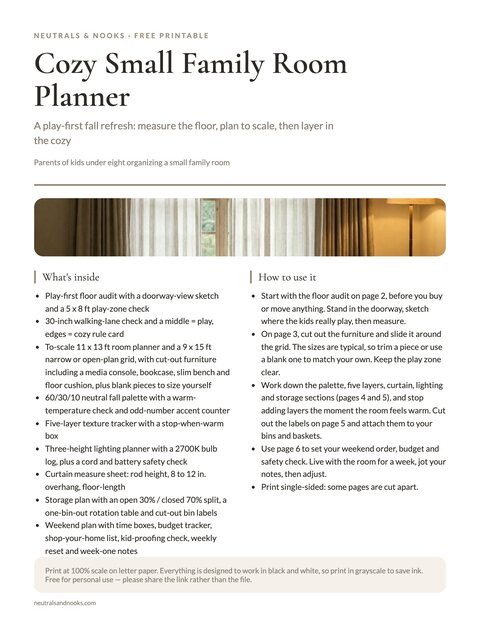
Free printable · 6 pages
Cozy Small Family Room Planner (Play-First Fall)
A play-zone floor audit with a 5 x 8 ft check and 30-inch lane, a to-scale room planner with cut-out furniture, a neutral fall palette and five-layer tracker, lighting, curtain and storage plans with a toy rotation table and cut-out labels, and a weekend plan with budget tracker, safety check and week-one notes.
Free. Your download link appears right here. You'll also join the Monthly Home Reset. Unsubscribe anytime. Privacy
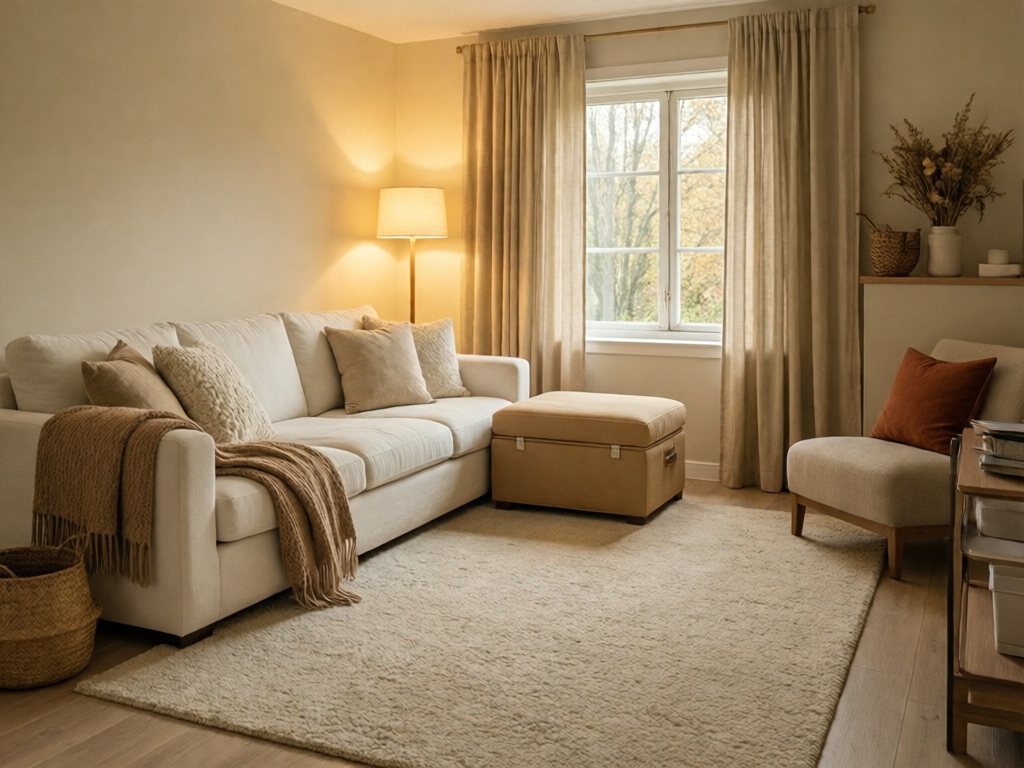
This guide layers coziness up and out to the edges and leaves the middle alone. You’ll get a layout map, a rug-fit table by room width, a neutral fall palette, a five-layer texture method, kid-safe lighting, and a weekend plan with a budget table.
In this article (14 sections)
- Small Family Room Layout: Play Zone First
- Small-Space Layout Map
- Neutral Fall Color Palette for a Small Room
- How to Make a Small Living Room Cozy: 5 Layers
- Lighting: Warm, Layered, and Out of Reach
- Seating and Furniture That Pull Double Duty
- Storage That Looks Cozy, Not Cluttered
- Fall Decor That Doesn’t Take Over
- Kid-Proofing the Cozy
- Small Living Room Layout Variations (Narrow, Open-Plan, Rental)
- A Weekend Plan and Budget Guide
- Keeping It Cozy Past October
- Frequently Asked Questions
- A Cozy Room That Still Has Room to Play
Small Family Room Layout: Play Zone First
Before you buy or move anything, measure what you’re protecting. Most families with small living rooms are surprised by how little open floor they really have, and by how much of it they could reclaim.
Here’s the quick audit I use in my own living room, and when I help friends with theirs:
- Stand in the doorway and picture your kids playing. Where do they actually end up? Not where you wish they’d play, but where they do. That patch is your play zone.
- Measure it. For two kids under eight, I aim for at least 5 by 8 feet, which a 5 by 8 rug fits exactly. That is the minimum that keeps building and car-track play off the sofa. In our 11-foot-wide room, that fits with about half a foot to spare. In a smaller room, shrink the rug and the reading nook before you shrink the lane. The rug-fit table below shows what fits at each room width.
- Mark the walking path. There should be a clear lane (about 30 inches) from the doorway to the sofa and from the sofa to the window or whatever else you use daily. Nothing cozy goes in the lane.
- Note what’s on the perimeter. Walls, corners, windows, the space above the sofa, and the vertical inches above your furniture are all available for fall. The center is not.
Rug fit by room width
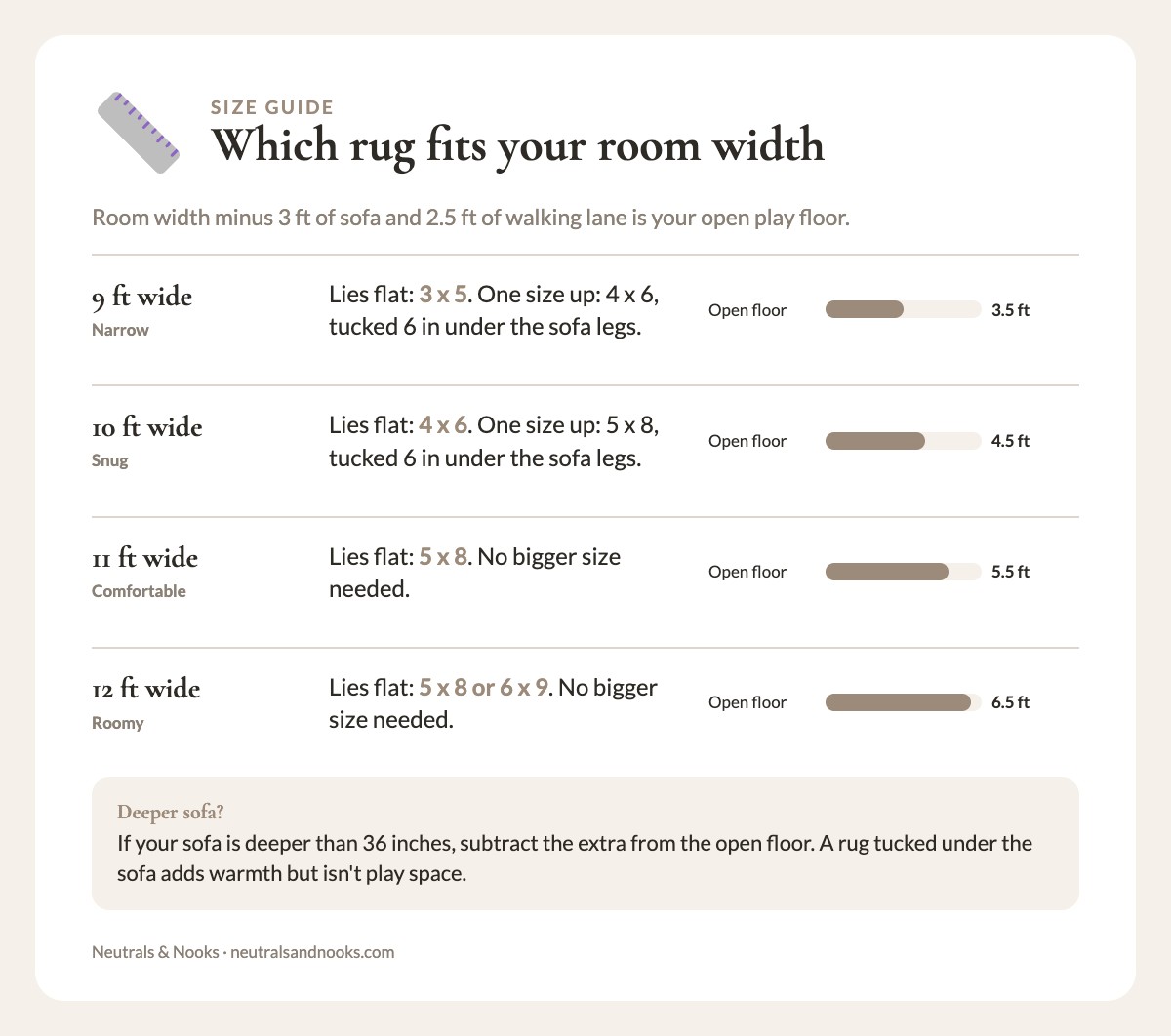
Here is the math for a sofa on the long wall. Take the room’s width, subtract 3 feet for a 36-inch-deep sofa and 2.5 feet for the walking lane, and what’s left is your open play floor.
| Room width | Open floor left | Rug that lies flat | One size up, if you want it |
|---|---|---|---|
| 9 ft | About 3.5 ft | 3 x 5 | 4 x 6, tucked 6 inches under the sofa’s front legs |
| 10 ft | About 4.5 ft | 4 x 6 | 5 x 8, tucked 6 inches under the sofa’s front legs |
| 11 ft | About 5.5 ft | 5 x 8 | Not needed |
| 12 ft | About 6.5 ft | 5 x 8 or 6 x 9 | Not needed |
Good to knowIf your sofa is deeper than 36 inches, subtract the extra from the open floor. The part of a rug tucked under the sofa adds warmth, but it doesn’t count as play space.
The result is a simple map: middle = play, edges = cozy. Everything else in this article follows from that.
If your room is also doing double duty as a playroom, the planning logic in small playroom ideas that maximize space pairs well with this one. Its best advice is to keep a single flexible open area rather than carving the room into mini-zones.
Why the middle matters more than the corners
Children play in the center because it’s the only place they can spread out and see everything. When we crowd the middle with a pouf, a floor lamp, or a “decorative” basket, kids don’t play around it. They move the play to a different room, or they move the object.
Parents then feel the room “doesn’t work.” The fall styling gets blamed when the real problem was placement.
Small-Space Layout Map
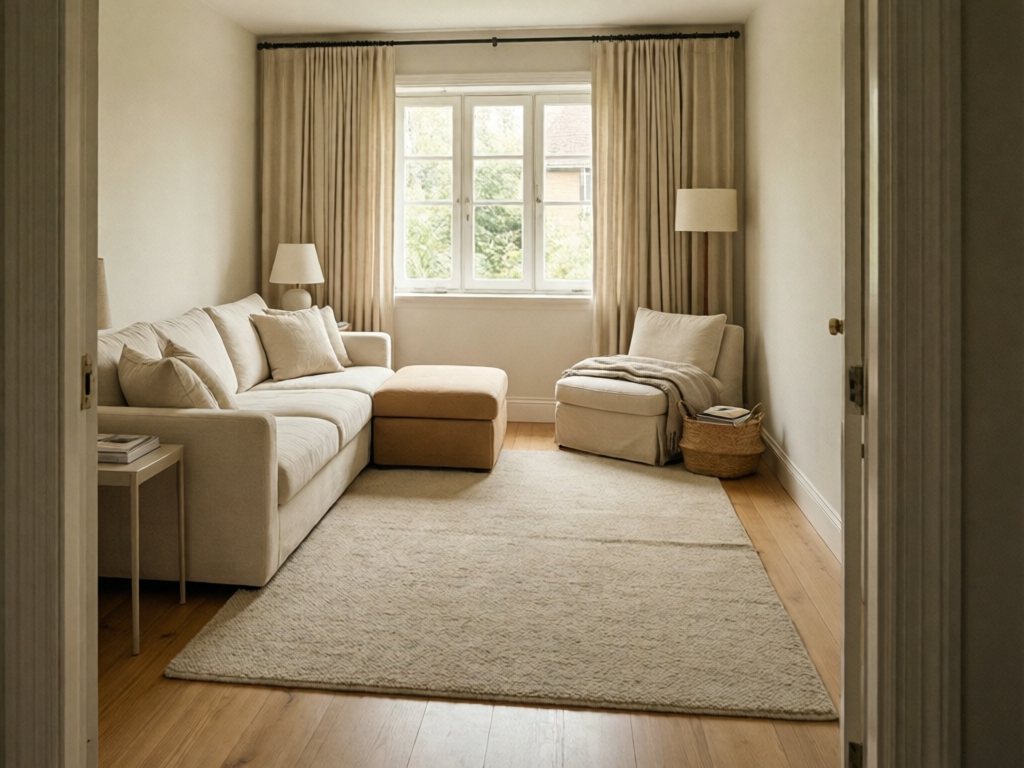
This is the layout I started from in our own living room, which is about 11 by 13 feet. Our sofa sits on the 13-foot wall, so the 11-foot side is the room width I use in the rug math above. Yours will differ, but the logic transfers.
Put the sofa on the long wall and the reading nook in a corner on the wall beside the window, not under it. Protect an open play zone in the middle, and push every cozy layer to the edges or up high.
| Zone | What goes there | What stays clear |
|---|---|---|
| Window wall | Layered curtains on a high rod, and nothing else | The floor under the window: no chair, basket, ottoman, or lamp a child could climb |
| Corner beside the window | The reading nook (chair, throw, book basket) and a floor lamp, on the adjoining wall | Cords, and enough distance that a child standing on the chair can’t reach the sill |
| Center | The play zone with a low-pile rug, about 5 x 8 ft | No furniture, baskets, or poufs |
| Door side | A 30-inch walking lane from the door to the sofa | Everything cozy |
| Sofa wall | Sofa with its back to the wall, storage ottoman, narrow side table | The rug edge, and the wall within reach of a child standing on the sofa: no sconce, cord, or shelf there |
| Side wall | Wall shelf, framed art, and the plug-in wall sconce, all mounted high and away from the sofa | The floor beneath it |
The sofa sits flush against the wall, because even a few inches of float eat into the play zone. The reading nook is a real place to sit, not a corner styled for show.
The nook gets its daylight from the side. I keep the chair, the book basket, and the lamp off the window wall, because all three are things a child can climb.
Safety firstA window screen keeps bugs out, but it will not stop a child from falling. On any window that opens, fit window stops or guards that limit the opening to less than 4 inches, and choose ones an adult can release quickly in an emergency. Keep chairs, ottomans, baskets, and anything else climbable away from windows. This matters most in upper-floor apartments.
If your room is narrower than this layout assumes, the same logic applies. Rotate the play zone to run parallel to the longest wall, and shrink the reading nook to a single chair-and-basket pairing. The narrow, open-plan and rental variations further down go into detail.
If you have a rental where the sofa can’t go on the long wall because of a vent or radiator, put the sofa on the short wall and keep the long axis open. Open floor length is more useful for play than width.
If that short wall has a window that opens, choose the other short wall if you can. A sofa back is an easy climb, so a sofa under a window needs window stops or guards fitted first.
The same principle runs through apartment living with kids, where every piece has to earn its footprint. If you’re in a smaller place, that’s worth a read alongside this layout.
Neutral Fall Color Palette for a Small Room
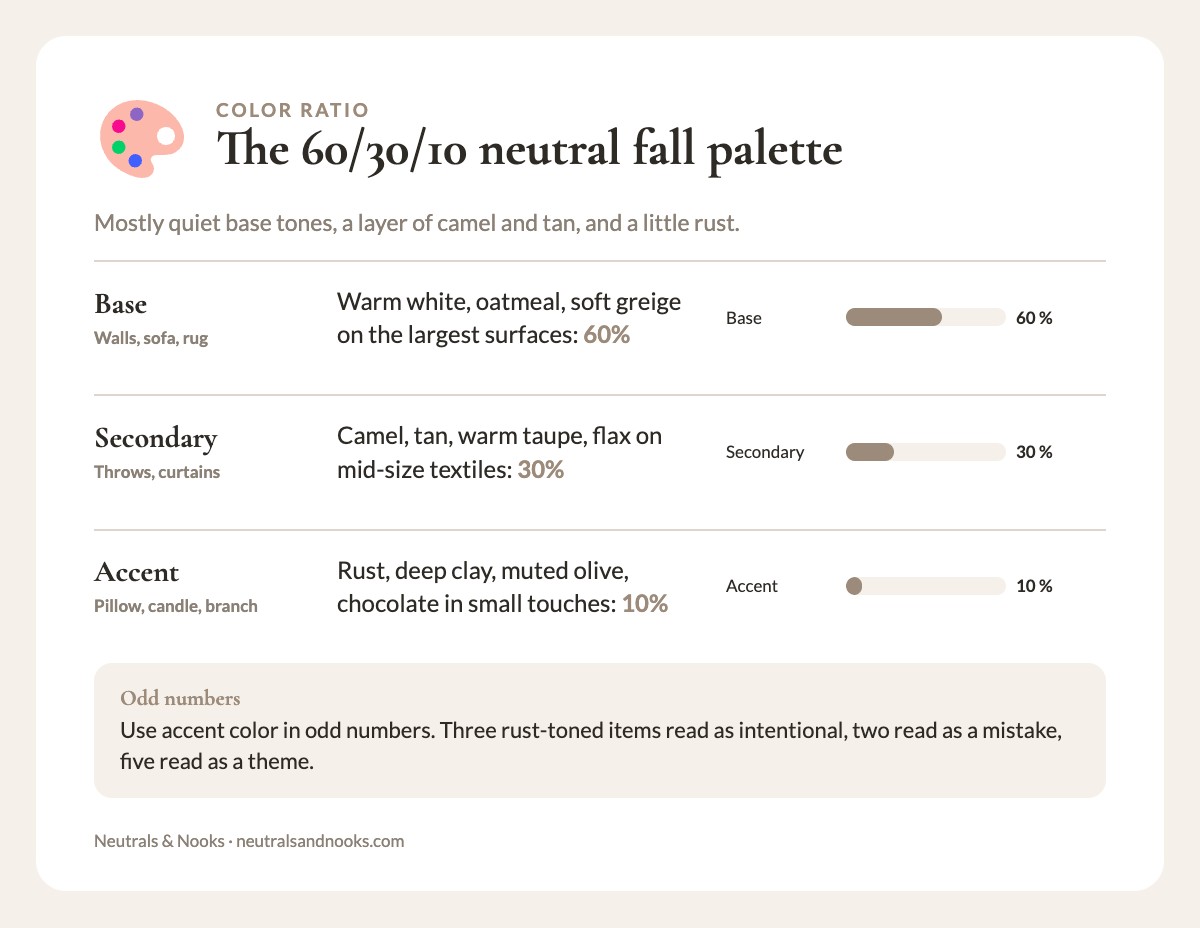
Fall doesn’t have to mean orange. In a small room, a lot of saturated color makes the walls feel closer. A neutral fall palette gives you the warmth of the season while keeping the room visually quiet and spacious. This is a common reason people love neutral fall decor for small spaces: you get the mood without the visual noise.
Here’s the palette I keep coming back to:
| Role | Color family | Examples | Where to use it |
|---|---|---|---|
| Base (60%) | Warm white, oatmeal, soft greige | Walls, sofa, large rug | Largest surfaces |
| Secondary (30%) | Camel, tan, warm taupe, flax | Throws, curtains, baskets | Mid-size textiles |
| Accent (10%) | Rust, deep clay, muted olive, chocolate | A pillow, a candle, a single branch | Small, repeatable touches |
A few rules that keep this from going flat or going muddy:
- Stay within one temperature. Warm creams with warm tans. Don’t mix a cool gray throw with a warm camel pillow and expect them to agree.
- Use accent color in odd numbers. Three rust-toned items read as intentional. Two read as a mistake. Five read as a theme.
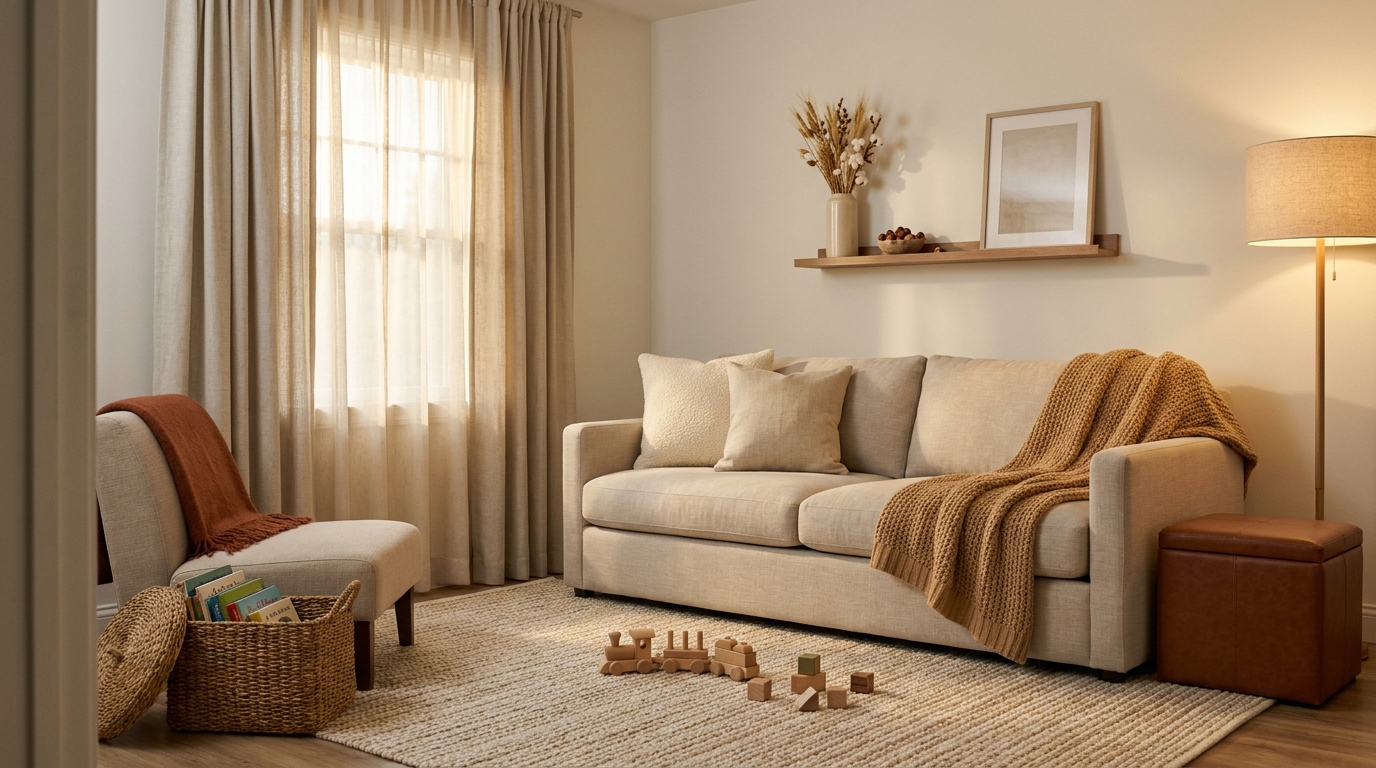
- Let texture do the work color would do. A cream bouclé pillow next to a cream linen pillow next to a cream knit throw has visual depth with zero added color.
- Keep the biggest pieces the quietest. Sofa and rug in the base tones. Seasonal color goes on the pieces you can swap in ten seconds.
TipAim for roughly 60% base, 30% secondary and 10% accent. Have a gray sofa? Warm it with camel, oatmeal and one rust accent, and it reads as a grounded neutral instead of a cold one.
How to Make a Small Living Room Cozy: 5 Layers
When people ask how to make a small living room cozy, they usually expect a list of products. What actually works is a system. I think about coziness in five layers, added from the floor upward, and I stop adding the moment the room feels warm. In a small space, stopping early is the skill.
Layer 1: The floor
The rug is the single biggest cozy lever, and the single biggest place to go wrong with kids.
- Pick low pile. High-pile and shag rugs feel luxurious but trap crumbs, make block towers wobble, and make toy cars stall. A flat weave or low-pile wool-blend or polyester rug gives you warmth underfoot without ruining play.
- Choose a pattern or heathered texture. Solid cream shows every juice drip. A tonal weave in oatmeal or a subtle stripe hides a day’s worth of life.
- Add a rug pad. It makes the rug cushier for floor play and stops the corners from curling and tripping a toddler.
- Check machine-washability. Washable rugs have become common and make a family room dramatically easier to live with. If the rug can go through the wash, you’ll actually let kids use it.
If you want a warmer base on a hard floor without replacing your main rug, a second smaller layered rug (a jute or flat-weave runner) can sit along the sofa edge. That puts texture in the perimeter, where it doesn’t compete with play.
Layer 2: The seating
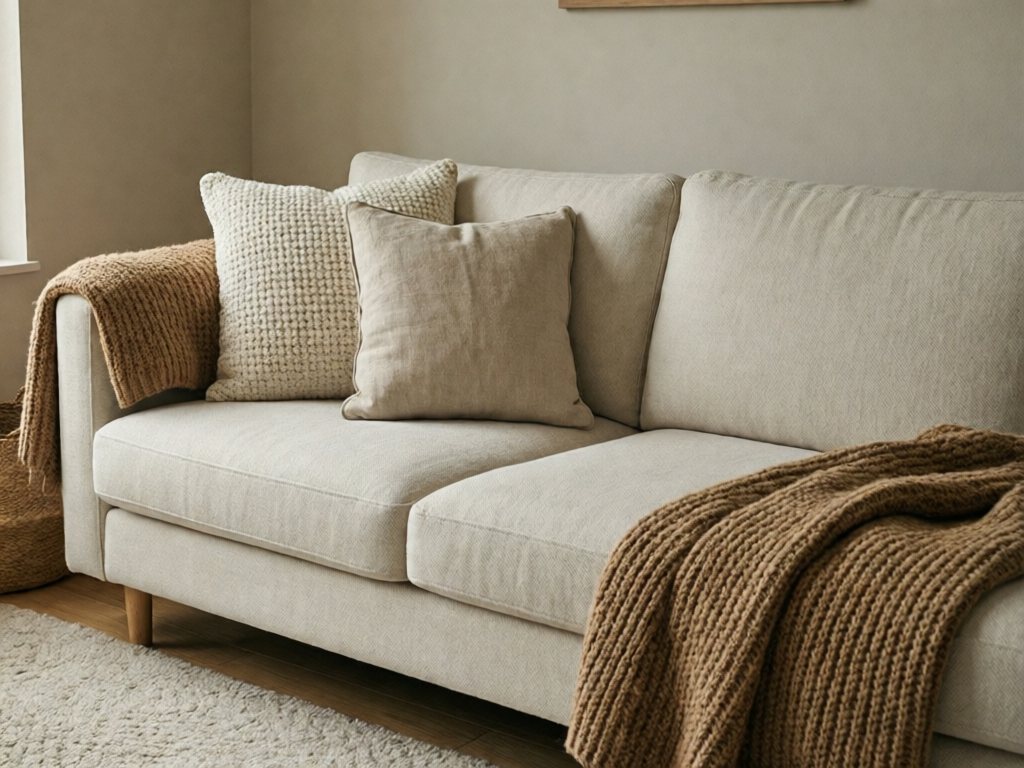
The sofa is where coziness is most felt, and where small rooms most often overdo it.
- Two pillows plus one throw is the starting formula. For a standard three-seat sofa, I use two pillows in different textures and one throw draped over an arm or folded on the back. That is enough to look styled and still leaves seat room for three people.
- Vary scale. One larger pillow (20 inches) and one smaller (16 or 18 inches) feels collected rather than matchy.
- Use removable covers. Zippered covers in linen, cotton-velvet, or a washable bouclé can go straight into the wash after a snack spill.
- Keep one throw “kid-grade.” I store a soft, machine-washable fleece or cotton knit in the ottoman for actual use, and display one nicer throw only when guests come. Two throws, two jobs.
Layer 3: The windows
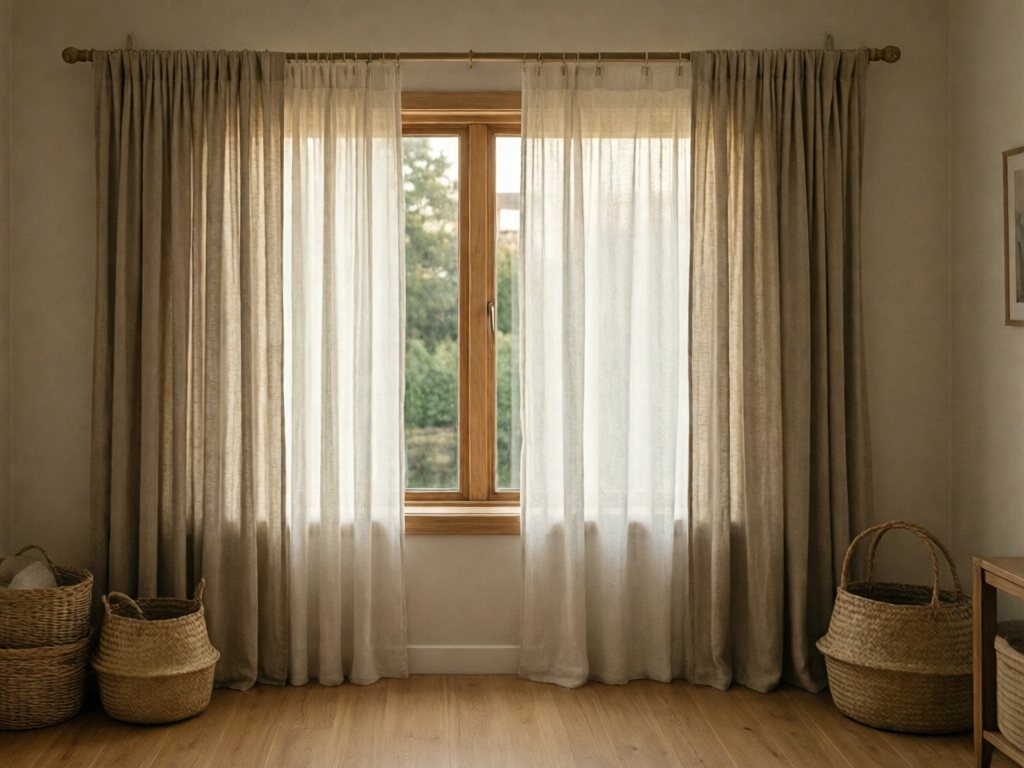
Curtains are the most underused cozy tool in a small room, because they add enormous warmth and take up no floor at all.
- Hang the rod high and wide. Mount it a few inches below the ceiling (or at least well above the window frame) and extend it 8 to 12 inches past the window on each side. This makes the window look larger and the ceiling look taller.
- Go floor-length. Curtains that hover a few inches above the floor look unfinished; ones that just brush it look intentional.
- Layer sheer plus heavier. A linen-look sheer underneath a heavier oatmeal or camel panel gives you daytime glow and evening coziness. If you only add one layer, make it the heavier one for fall and winter, which also helps with drafts.
Safety firstCordless window coverings are safest in any home with young children. If you already have corded blinds, anchor a cord tension device or cleat to the wall so no loop is reachable. Tie up curtain wands and pull cords high, out of a child’s reach. Keep sofas, chairs, and anything else climbable away from windows. Furniture under a window is also a climbing route, so follow the window-stop note in the layout map section above.
Layer 4: The walls and surfaces
The wall is where fall styling belongs because it’s free real estate.
- One shelf, styled sparingly. A single floating shelf on the side wall, mounted into studs and high out of reach, can hold three items: something tall (a branch in a lightweight, unbreakable vase), something low (a small bowl or a flameless USB-rechargeable candle), and something personal (a framed photo). Keep it away from the sofa, where kids climb, and away from windows.
- Large art beats many small frames. One oversized print in warm neutrals feels calmer than a gallery wall in a small room.
- A woven wall piece adds texture. A flat basket or a macramé panel adds warmth without protruding more than an inch or two.
Layer 5: The details
This is where the season shows up, and where less is genuinely more.
- Dried stems (pampas, wheat, eucalyptus, cotton branches) in one tall vase.
- A single large ceramic bowl of fist-size pinecones on a high shelf.
- USB-rechargeable flameless candles in a tray, kept out of reach.
- A scent: an adult-attended simmer pot (cinnamon sticks, orange peel, a few cloves) rather than a candle on the coffee table, or a no-heat sachet of dried orange slices and cinnamon sticks kept out of reach.
Safety firstKeep dried stems, pinecones and acorns high and out of reach. Eucalyptus and some dried plants are toxic if eaten, pampas and wheat shed, and small natural items are choking hazards under age 4, so skip the pinecone bowl if you have a child that young.
Safety firstA simmer pot is an adult-attended job. Run it on a back burner with the handle turned inward, or in a slow cooker set well back on a high counter with the cord out of reach. Never leave it unattended, and keep kids out of the kitchen zone while it’s on. For a no-heat option, put dried orange slices and cinnamon sticks in a closed jar or sachet, out of reach.
TipThe room can look done after three or four layers. Stop as soon as it feels warm, and make sure each layer you add is soft and sits where it won’t get stepped on.
Lighting: Warm, Layered, and Out of Reach
Light is half of cozy. A small room with one overhead fixture feels like a waiting room at 6 p.m. in October when it’s already dark. Change the light and you change the whole mood, and you can do it without touching the floor.
Three heights, three jobs
| Height | Fixture | Job | Kid-safety note |
|---|---|---|---|
| High | Wall sconce (plug-in with cord cover) or ceiling fixture with a warm bulb | Ambient glow | Mount well above reach and away from the sofa, where a climbing child could reach it or its cord; keep the cord short and in a rigid, flush cover |
| Mid | Floor lamp in the corner | Reading light | Behind furniture or anchored to the wall; cord clipped or covered flush |
| Low | Battery or rechargeable flameless candles, small lamp on a high surface | Accent glow | Shelves above toddler height; battery doors screwed shut |
A few practical specifics:
- Bulb color matters most. Look for bulbs labeled “warm white” or around 2700K (or lower). Cooler bulbs make a neutral palette look flat and clinical.
- Use dimmers or dimmable bulbs. A dimmer is the cheapest way to turn a bright morning room into an evening one. LED bulbs run cooler, so pair them with a dimmer rated for LED. Smart bulbs or a plug-in dimmer work in rentals.
- Plug-in sconces are renter-friendly. They mount with two screws and plug into the nearest outlet, so you get wall lighting without hardwiring. Placement and cord rules are in the table above.
- Skip real candles in a play room. Flameless candles have gotten convincing, and they remove the open-flame worry. If you do light a real one, never leave it unattended, put it out when you leave the room, and keep it on a stable heat-safe holder away from curtains, dried stems, and textiles.
- String lights are a nice fall touch. Warm-white micro LED strands around a window frame or along a shelf add glow with no floor impact. Choose UL-listed strands, keep cords short, and clip them out of reach.
Safety firstMany flameless candles and string lights use button or coin cell batteries, which are a serious swallowing hazard. Choose USB-rechargeable ones or ones with screw-secured battery compartments, and lock spare batteries away. If a child swallows one, get emergency care immediately and call poison control or emergency services.
Two lamps at different heights will do more for coziness than any amount of decor. If you only change one thing, change the light.
Seating and Furniture That Pull Double Duty
In a small family room, every piece needs to do at least two jobs. The goal isn’t to buy more furniture; it’s to make what you have work harder, or to replace one piece with a smarter version.
The storage ottoman
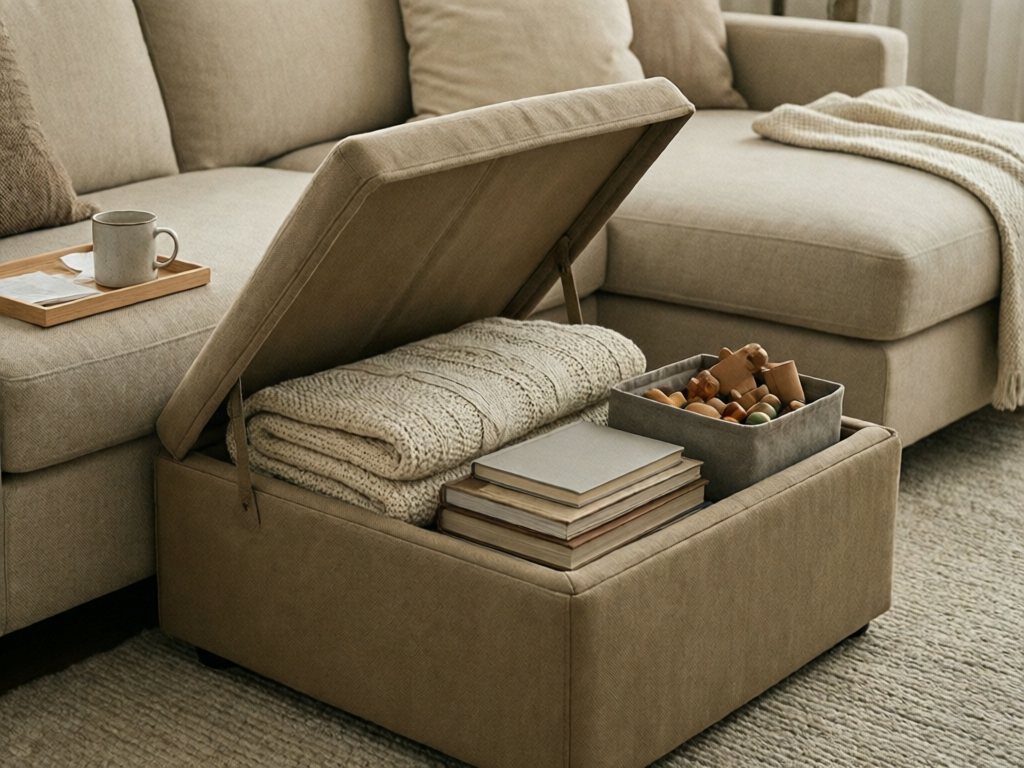
If I could put only one piece of furniture in a small family room, it would be a storage ottoman. It works as a seat, a footrest, a snack-tray surface, and storage for blankets and toys.
Safety firstA lidded box is an entrapment and entanglement risk for young children. An ottoman is storage, not a place to play, and children under about 5 should never climb inside one. A hinged lid can also pinch fingers, so choose a lid that lifts off completely or one with a slow-close or hinge-stop mechanism, and skip latches.
- Go upholstered in a performance fabric or a wipeable faux-leather in a camel or cognac tone, which adds a fall note by itself.
- Place it at the end of the sofa, not in the center of the room, so the play zone stays open. When it’s time to play, it can slide to the side.
- Fill it with what you use daily: kid-grade throws, a few board books, a small basket of the day’s toys.
A small chair instead of a second sofa
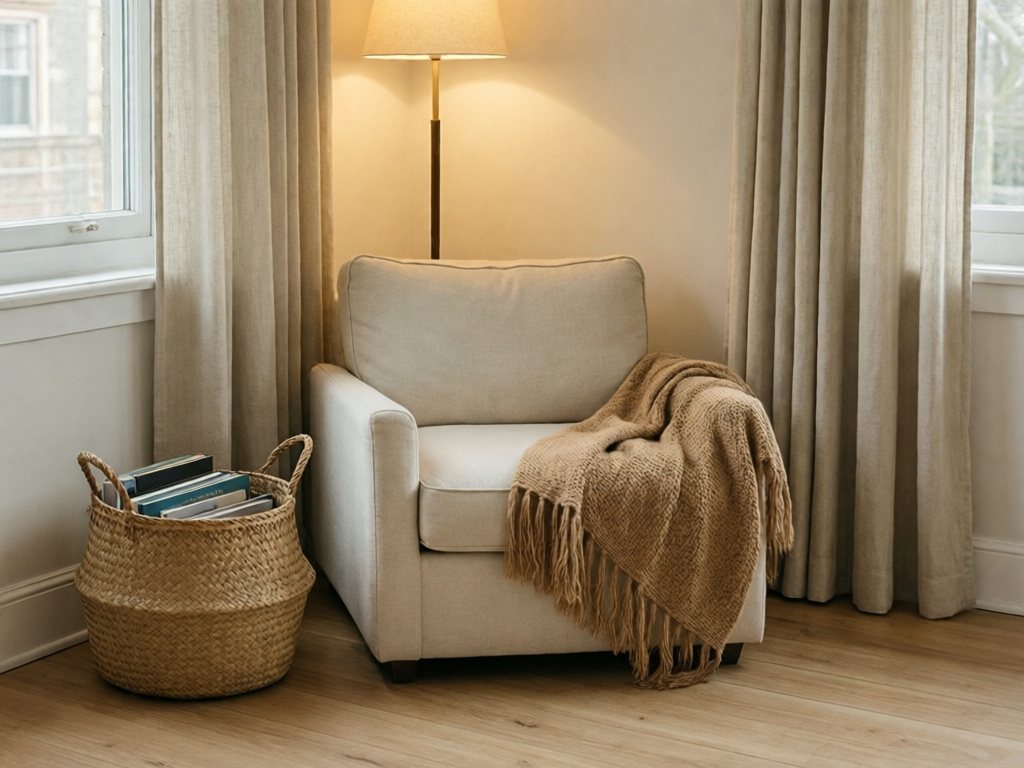
If you have the space for one reading corner, a compact accent chair (like a slipper chair or a small armchair) is much more flexible than a loveseat. It tucks into the corner, it can be moved in two seconds, and it makes the room feel like it has a “spot” in addition to the sofa.
Set it on a wall beside the window, not under one, so it never becomes a step up to the sill. Add a throw over the arm and a basket nearby and you have your reading nook.
Nesting or slim side tables
Side tables are where you put your tea, a lamp, and a phone. In a small room, choose rounded or oval ones with no sharp corners, and consider nesting tables you can pull apart for a game night and tuck together afterward. If the room is tight, a C-shaped table that slides over the sofa arm uses almost no floor.
What to leave out
- A large coffee table. In many small family rooms, a big coffee table blocks the play zone and has sharp corners at exactly toddler head height. A soft round ottoman, a pair of nesting tables, or no coffee table at all gives more floor and fewer bumps.
- A second sofa or sectional “just in case.” In a room under about 12 by 14 feet, I stick to one sofa and one chair, plus an ottoman.
- Floor poufs scattered around. They look cozy in photos, but in real life they become obstacles, and kids tend to launch them across the room.
For a deeper look at furniture choices that stand up to real family life, kid-friendly living room ideas walks through fabrics, finishes, and layout trade-offs.
Storage That Looks Cozy, Not Cluttered
The enemy of cozy is visible clutter. A small room can’t hide toys the way a big house can, so storage has to be both effective and good-looking. The trick is choosing storage that adds to the texture story rather than fighting it.
Baskets that earn their place
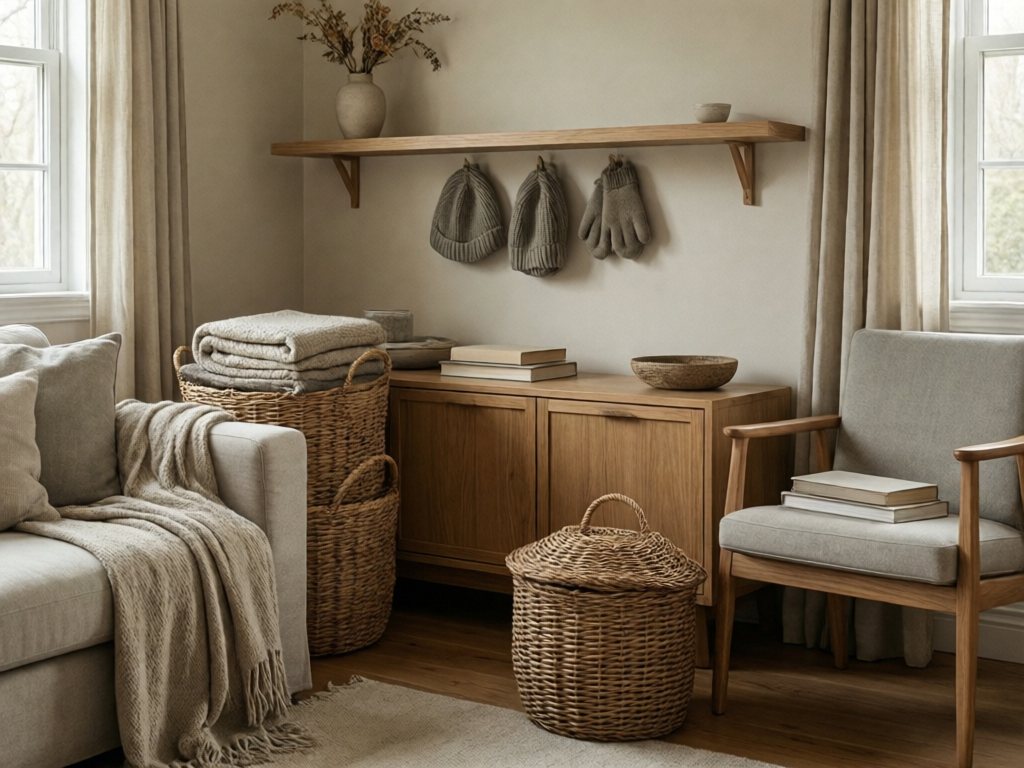
Woven baskets are the classic cozy-storage move, and they work, but only if you place them intentionally.
- Put the basket where the item is used. Blankets in a basket beside the sofa. Books in a basket beside the reading chair. Toys in a lidded bin or the ottoman.
- Choose lidded or deep baskets for anything you don’t want on display. An open basket of tangled toys is not cozy.
- Match the weave and tone. Stick to two basket materials at most (say, seagrass and cotton rope) so the room feels curated.
- Use wall-mounted baskets or hooks for lightweight items (hats, mittens, a few board books), which moves storage off the floor.
Closed storage for the visual quiet
If your room has a media console or low cabinet, use it. A closed door hides a surprising amount of life. A simple rule: open shelves for 30% of items, closed storage for 70%. Open shelving looks good only when it’s mostly empty.
A “daily toy” limit
The most effective storage strategy in a small room isn’t a container; it’s having fewer toys out. Rotating toys in and out, instead of keeping everything accessible at once, keeps the room calm and keeps kids more engaged with what’s there. If you want a method to follow, how many toys should be out at once gives a practical rotation guide.
A simple version for a small family room:
| Storage spot | What lives here | Rule |
|---|---|---|
| Ottoman | Today’s toys (one small bin) | One bin out at a time |
| Basket by chair | Books and the current favorite 5 to 8 | Swap weekly |
| Closed cabinet | The next rotation | Switch on Sunday |
| Other room or closet | Everything else | Not in the living room |
Make cleanup a two-minute act
Cozy rooms stay cozy only if reset is easy. The best system is one where the “put away” step is just dropping things into a bin, with no sorting required. Keep the bins big, open at the top (or with a lid that flips back), and located at kid height. A daily two-minute reset before dinner keeps the room looking intentional. For a routine you can actually keep, the 15-minute evening reset is a good model.
Fall Decor That Doesn’t Take Over
Seasonal decor in a small room should be easy to put up, easy to store, and small in volume. The temptation in October is to buy five of everything. Here’s what I keep to, and what I’d skip.
What to keep
- A single dried-stem arrangement in a tall vase, placed on a high shelf or a console. It adds height and texture without eating surface area.
- One wreath or a woven wall piece on the wall or the back of the door.
- A bowl of fist-size pinecones on a high surface, following the safety note under Layer 5.
- Pillow covers swapped for the season. Cover swaps are cheaper and store flat. Two fall covers can change the whole sofa.
- A heavier throw. Chunky knit, waffle cotton, or a sherpa-lined option in camel, cream, or clay.
- A fall scent. A simmer pot works only while an adult is with it. Keep the water topped up and follow the simmer-pot rules in the Layer 5 safety note. For a no-heat option, use a closed jar or sachet of dried orange slices and cinnamon sticks, kept out of reach.
What to skip in a small room
- Large floor pumpkins that sit in a walking path.
- Table runners and layered centerpieces on a coffee table that’s also a play surface.
- Heavy garlands draped over furniture where kids pull on them.
- Anything with small detachable pieces at floor level (faux berries, loose acorn caps).
Keep the Halloween question separate
October decor can get complicated if your household also does Halloween. A few thoughtful touches can bridge the two without turning the living room into a costume shop. If that’s your situation, neutral Halloween decor ideas that still feel fun for kids shows how to keep the palette calm while letting kids contribute something playful.
Let the kids add one thing
A small but effective trick: give each child one spot to contribute. A low basket where they drop leaves they collect. A single paper garland they made hung on one wall. A cluster of small gourds they get to arrange on a tray. It personalizes the room, and the kids tend to protect what they’ve helped create.
Kid-Proofing the Cozy
Nothing here matters if it doesn’t survive a normal Tuesday. Here is how I make a cozy room durable.
Fabrics that forgive
| Item | Look for | Avoid |
|---|---|---|
| Sofa | Performance fabric, tight weave, removable cushion covers | Loose-weave linen, light velvet that shows every mark |
| Pillows | Zippered, machine-washable covers | Dry-clean-only silks or delicate embroidery |
| Throws | Cotton knit, fleece, or washable acrylic blends | Hand-wash-only wool at kid-height |
| Rug | Low pile, flat weave, washable | High-pile shag, thick fringe |
| Curtains | Machine-washable cotton or linen blend | Heavy lined drapes that need professional cleaning |
Safety quick-checks
Safety firstAnchor bookshelves, dressers, and media cabinets into wall studs with anti-tip hardware, and wall-mount or anchor TVs. Mount floating shelves into studs with rated hardware. Keep climbable furniture away from windows, and fit window stops or guards so no window opens 4 inches or more.
- Keep cords short and out of reach. Use cord covers on lamp cords. For window coverings, go cordless or fit a wall-fixed cord tension device or cleat so no loop is reachable, and tie curtain wands and pull cords up high.
- Check for small parts. Decorative items with small detachable pieces belong high up, especially with toddlers around.
- Choose rounded edges on tables and low furniture where possible, or add corner guards for crawlers and early walkers. Check that guards stay firmly attached.
- Don’t overload outlets or power strips with sconces, lamps, and string lights. Keep extension cords short and clipped out of reach.
- Weight or secure floor lamps. A stable base or a wall anchor keeps a lamp from becoming a hazard when a four-year-old does a victory lap.
Make the nook work for older kids too
If you have a school-age child, the reading nook can double as a homework or quiet-time spot. A small lap desk or a clipboard in the book basket, a lamp with a warm bulb, and a throw are enough to make it feel like the kid’s own place. If you’re still shaping that corner, a calm-down corner approach (soft seating, dim light, a few sensory items) works beautifully inside a small family room.
Small Living Room Layout Variations (Narrow, Open-Plan, Rental)
Because every small family room is different, here are three common setups and how I’d adapt the layout.
1. The long, narrow room (about 9 by 15 feet)
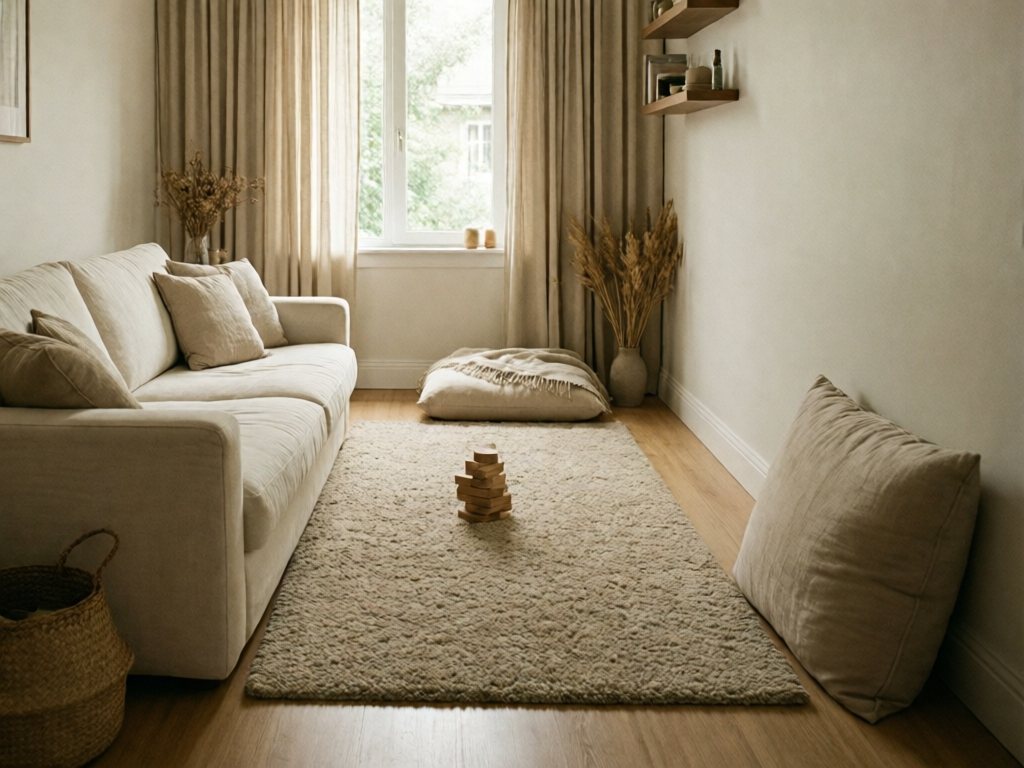
- Put the sofa on one long wall and leave the opposite wall as clear as possible.
- Run the rug lengthwise as the play zone. A 3-foot-deep sofa and a 30-inch lane leave about 3.5 feet of open floor in a 9-foot width, so a 5 by 8 rug won’t lie flat. Use a 3 by 5, or tuck a 4 by 6 about 6 inches under the sofa’s front legs.
- Make up the width in length. A strip 3.5 feet wide and 8 or more feet long still holds a train track or a row of block towers. If you want a bigger rug for warmth, let the walking lane cross its edge, and keep furniture and baskets off that edge.
- Skip the corner chair and use a slim bench or a large floor cushion against the end wall as a reading spot. If the end wall has a window that opens, use the floor cushion, not the bench.
- Use vertical styling: tall curtains, a tall plant or stem arrangement, and a wall shelf to draw the eye up.
2. The open-plan living and dining combo
- Use the rug to define the living zone so the space doesn’t read as one big muddle.
- Keep the play zone on the side away from the dining table, so chairs scooting out don’t collide with toy cars.
- Choose a sofa with a low back (or float a low console behind it) so the dining area still feels connected visually.
- Echo the same palette across both zones, so the whole space reads as one calm area rather than two.
3. The rental with no wall-mount allowed
- Lean on freestanding cozy: a floor lamp, a plug-in lamp on a high shelf, and curtain panels on tension rods.
- Use a sturdy tension rod rated for the curtain weight, set tight and high, and check it regularly. A child’s pull can bring it down.
- Use removable adhesive hooks for lightweight wreaths and woven pieces.
- Lean art on a high shelf or the top of a bookcase rather than hanging it.
- Add texture through textiles (pillow covers, throws, a layered rug) because those move with you.
- Ask your landlord about fitting window stops or guards if the windows open wide, and keep seating away from them in the meantime.
Shop the Setup: The 10-Foot Cozy Wall
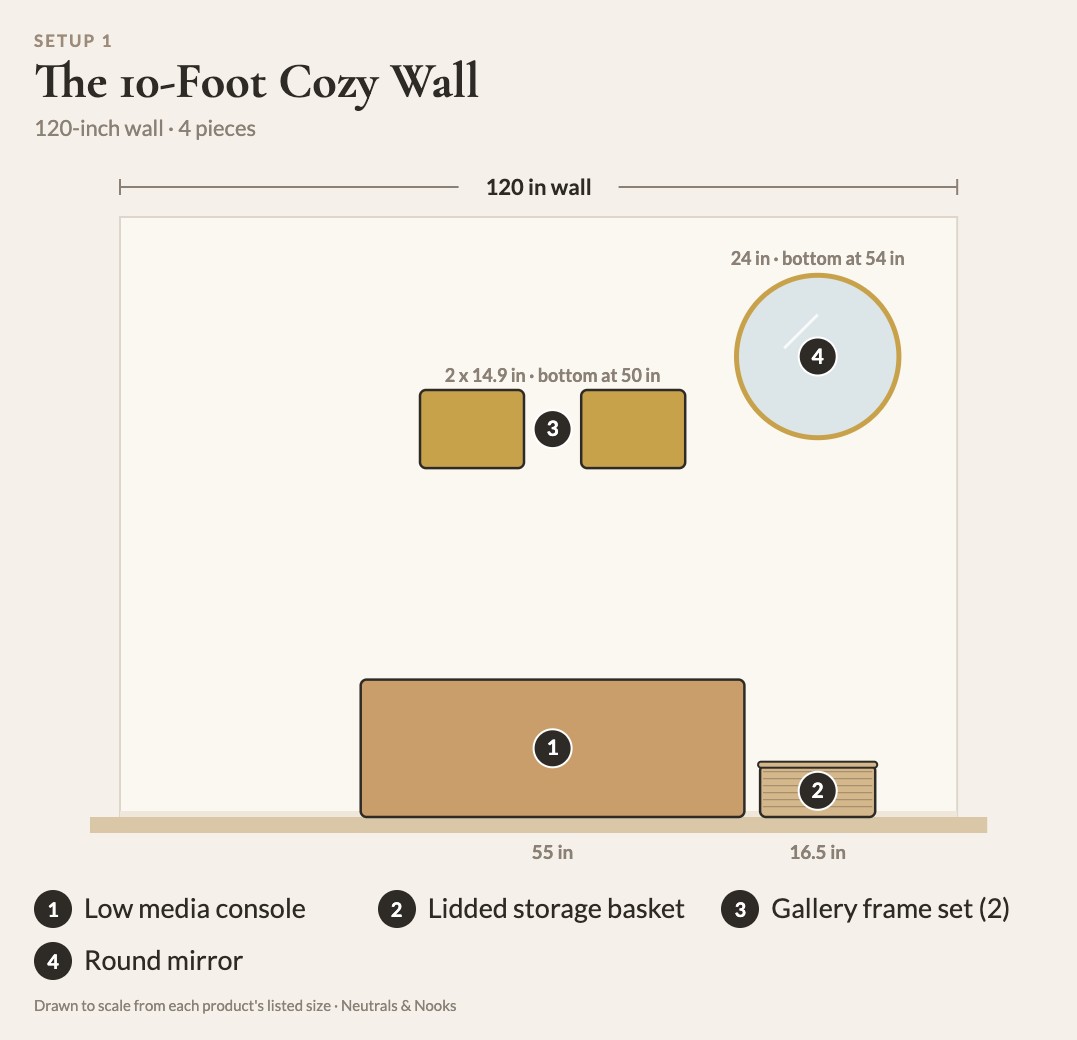
This one's for the small living room with a young child, where you want closed storage and a calm fall look on a single 10-foot wall without crowding the walkway. It keeps the floor mostly clear and puts the cozy up high.
Shop this setup

1. Low media console
TEENFON fluted 55" media console
55" W x 14.4" D x 19.7" H · Nature Oak
View on Amazon
2. Lidded storage basket
StorageWorks lidded hyacinth basket
16.5" W x 13" D x 7.5" H · Natural(Water Hyacinth)
View on Amazon
3. Gallery frame set · use 2
upsimples 11x14 gold frame set
14.9" W x 11.9" D x 11.2" H · Gold
View on Amazon
- Why it works: The low media console (1) and lidded basket (2) hide the clutter at floor level, while the gallery frames (3) and round mirror (4) pull the eye up so the wall feels warm instead of heavy.
- Hang it: Hang the two gallery frames (3) with their bottom edge 50 inches above the floor, just above the 19.7-inch media console (1), and set the 24-inch round mirror (4) with its bottom edge at 54 inches, above the lidded basket (2).
- Heads-up: The 19.7-inch media console (1) is short enough that a climbing toddler can use it as a step, so use the anchor kit it comes with, and keep the frames (3) and mirror (4) well above reach with secure hardware rated for their weight.
A Weekend Plan and Budget Guide
You don’t need to do this all at once. Here’s an order of operations that front-loads the biggest impact, with rough budget tiers.
The order I’d do it in
- Clear and measure (30 minutes). Protect the play zone, mark the walking lane.
- Fix the light (30 minutes). Swap bulbs to warm white, add a lamp or plug-in sconce.
- Hang the curtains high and wide (45 minutes).
- Style the sofa with two pillows and one throw (10 minutes).
- Set up the reading nook (20 minutes). Put the chair beside the window, not under it.
- Add one shelf of fall decor (15 minutes).
- Organize storage into the ottoman, baskets, and a closed cabinet (45 minutes).
- Live in it for a week, then adjust.
Where a little money goes the furthest
| Budget tier | What to buy | Impact |
|---|---|---|
| Free | Shop your house: move a lamp, repurpose a basket, borrow a throw from a bedroom | High |
| Under $25 | Warm-white bulbs, pillow covers, a bunch of dried stems, a cord cover | High |
| $25 to $75 | Curtains and a rod, a plug-in sconce, a chunky throw, a lidded basket | Very high |
| $75 to $200 | A low-pile washable rug, a storage ottoman, an accent chair (secondhand is great) | High, long-lasting |
| Splurge | A new performance-fabric sofa | High, but only if the current one is failing |
If you’re on a tight budget, the best use of the first $50 is almost always lighting and curtains. Those two changes do more for coziness than any amount of small decor.
A shop-your-home checklist
Before you buy anything, walk through your house with this list:
- A throw or blanket from a bedroom that fits your palette
- A woven basket you’re using somewhere less useful
- Pillow covers or a pillow from another room
- A lamp that’s living in a closet or a guest room
- A branch from the yard, a few stems from the grocery store
- A candle, a ceramic bowl, or a vase you already own
Much of a cozy fall room is already hiding in other rooms.
Keeping It Cozy Past October
A good small-room setup isn’t a one-time styling event. It needs to flex with the seasons and with your kids’ ages. Here’s how I keep it working.
- Do a 10-minute weekly reset. Return throws to the ottoman, rotate the toy bin, clear surfaces.
- Rotate textiles by season. In winter, swap in a heavier throw and darker pillow covers. In spring, lighten up. The sofa, rug, and curtains stay put.
- Edit as kids grow. A room for a toddler is different from a room for a seven-year-old. The play zone shrinks as the reading nook grows. Don’t be afraid to move things as they change.
- Plan ahead for the holidays. Once the fall styling comes down, you’ll want to have a place for the next set. If winter storage is a challenge, thinking through how to organize holiday decor storage before the rush saves a lot of stress.
Frequently Asked Questions
How do I make a small living room cozy without making it feel cramped?
Add coziness through soft light, textiles, and vertical elements instead of extra furniture. Warm-white bulbs at two or three heights, curtains hung high and wide, one low-pile rug, and two pillows plus a throw on the sofa will do far more than adding another chair or table. Keep the center of the room clear, and place anything decorative on the walls, shelves, or edges.
What colors work best for neutral fall decor in a small space?
Stick to a warm base of cream, oatmeal, or soft greige, then layer in camel, tan, and warm taupe, with small touches of rust, clay, or muted olive as accents. Keep everything within one temperature (warm with warm) so the room feels cohesive, and use texture such as bouclé, linen, knit, and woven baskets to create depth without adding visual noise.
How can I add cozy elements without taking away my kids’ play space?
Follow the “middle for play, edges for cozy” rule. Keep a clear zone of about 5 by 8 feet in the center of the room, or a longer, slimmer strip in a narrow room. Put curtains, shelves, sconces, art, and the reading nook around the perimeter. Choose a storage ottoman to hide toys and blankets, and avoid placing poufs, baskets, or floor decor on the rug where kids play.
What kind of rug is best for a small family room with young kids?
A low-pile or flat-weave rug in a heathered or lightly patterned neutral is the most practical choice. It stays flat for block towers and toy cars, hides everyday messes, and is easier to clean than high-pile or shag. A rug pad adds cushioning and keeps corners from curling, and a machine-washable rug is worth considering if your budget allows.
Is it safe to use candles and string lights in a room where kids play?
Flameless candles are the safer option, but choose USB-rechargeable ones or ones with screw-secured battery doors, because a swallowed button battery is an emergency. I skip real candles where kids play. If you light one, never leave it unattended and keep it away from curtains and dried stems. For string lights, use low-heat LED strands, keep cords short and out of reach, and avoid draping them anywhere a child can pull them down.
How many fall decorations are too many in a small living room?
A good guide is one tall arrangement (like dried stems in a vase), one small grouping on a high surface, one wall piece, and a seasonal swap of pillow covers or a throw. If the surfaces start to feel busy, or if you’re moving items to find space to put things down, you’ve passed the line. Edit until the room feels calm, and save a few favorites to rotate in next year.
What if I rent and can’t drill into the walls?
You can still get the full effect with freestanding and removable options. Use sturdy tension rods rated for the curtain weight, plug-in lamps on high shelves, removable adhesive hooks for lightweight wreaths, and lean art on a high shelf or the top of a bookcase. Set each rod tight and high and check it regularly, because a child’s pull can bring it down. Most of the cozy comes from textiles and light anyway, which move with you.
A Cozy Room That Still Has Room to Play
The best fall living rooms aren’t the most styled. They’re the ones where a kid can build a block tower at 4 p.m., a parent can sink into the sofa with tea at 8, and nobody has to move a basket to do either. Start with the floor, protect the play zone, and let the warmth come in through light, fabric, and the edges of the room.
You don’t need to finish everything this weekend. Tonight, swap in warm-white bulbs and measure your play zone (5 by 8 feet if your room allows), then add one layer at a time.