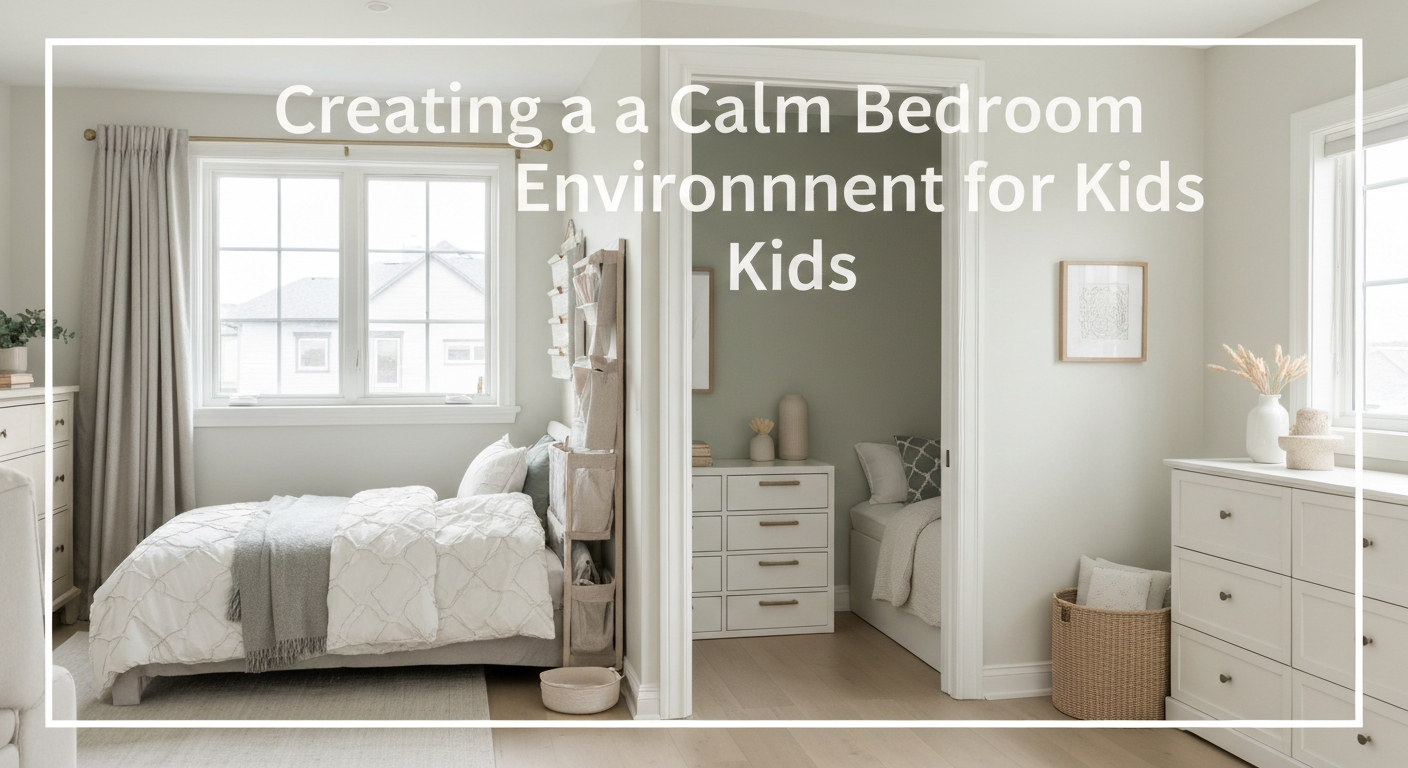
Creating a Calm Bedroom Environment for Kids
Discover how to transform your child's bedroom into a calming sanctuary by choosing muted colors and warm lighting, which can significantly improve their sleep and reduce overstimulation.
- Choose cool, muted wall colors like soft blue, sage green, or warm gray.
- Avoid bright, stimulating wall colors such as hot pink or fire-engine red.
- Swap bright overhead lights for warm-toned 2700K LED bulbs to aid melatonin production.
- Consider painting your child's ceiling a shade lighter than the walls for a cocooning effect.
- Reduce visual clutter from posters, figurines, and flashing lights to prevent overstimulation.
In this article (6 sections)
- The Night My Daughter Could Not Stop Staring at Her Walls
- Color Psychology: Painting a Room That Whispers
- Lighting Layers: From Daylight to Dreamlight
- Decluttering the Visual Field: What Your Child Sees from the Pillow
- Sound and Scent: The Invisible Calm Builders
- The Calm Bedroom Checklist: Putting It All Together
The Night My Daughter Could Not Stop Staring at Her Walls
My six-year-old came to me at 9:45 PM, an hour past bedtime, with tears streaming down her face. She said she could not sleep because her room was “too loud.” Not noise loud. Visually loud. Her bright fuchsia walls were covered with posters, her shelves overflowed with plastic figurines, a strand of flashing LED lights pulsed rainbow colors above her bed, and her comforter featured an explosion of cartoon characters. She was overstimulated, and her bedroom was the source. That night, she slept in our room, and the next morning I started researching what makes a bedroom genuinely calming for children. What I found changed not just her room but my entire approach to kids’ bedroom design.
It turns out that environmental psychology has quite a bit to say about how bedrooms affect children’s sleep quality, anxiety levels, and ability to self-regulate. Color temperature, visual clutter, lighting type, scent, and even the arrangement of furniture all play measurable roles in how quickly a child falls asleep and how well they stay asleep. A calm bedroom is not about creating a boring or minimalist space. It is about designing a room that signals to your child’s nervous system that it is safe, quiet, and time to rest. Here is how to do it, one layer at a time.
Color Psychology: Painting a Room That Whispers
The color of your child’s bedroom walls is the largest single influence on the room’s overall feeling. Bright, saturated colors like fire-engine red, electric blue, or hot pink are stimulating to the nervous system. They literally raise heart rate and alertness, which is the opposite of what you want at bedtime.
Cool, muted tones are the gold standard for calming bedrooms. Soft blue, sage green, lavender, and warm gray have all been shown to lower perceived stress and promote relaxation. Benjamin Moore’s “Quiet Moments” (1563) is a gorgeous blue-gray-green that lives up to its name. Sherwin-Williams’ “Sea Salt” (SW 6204) has become one of the most popular calming bedroom colors in the country, a barely-there green with cool gray undertones. For lavender lovers, Behr’s “Dusty Lilac” (660E-3) is gentle enough for a full room without veering into purple territory.
Warm neutrals work equally well for families who prefer earth tones. Benjamin Moore’s “White Dove” (OC-17) is a warm white with just enough creaminess to feel cozy rather than clinical. Farrow & Ball’s “Jitney” (293) is a gorgeous warm beige that feels like a cashmere blanket on the walls. These neutrals let the textiles and soft furnishings create the warmth while keeping walls soothing.
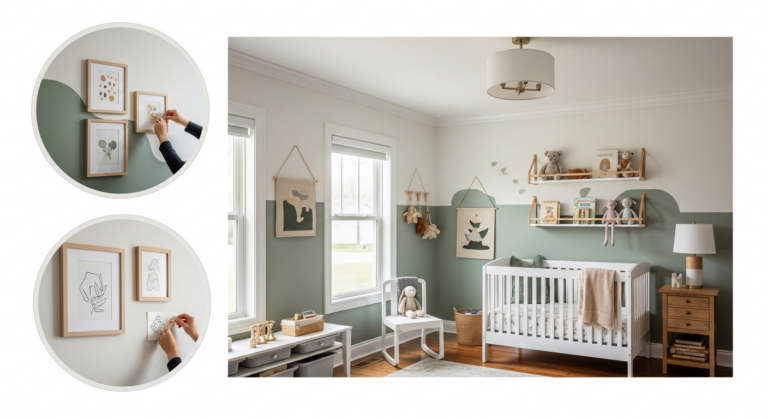
If your child desperately wants color, consider painting three walls in a calm neutral and one accent wall in a muted version of their preferred color. A child who loves purple can have three walls in soft gray and one wall in dusty lavender. This satisfies the desire for color while keeping the overall room feeling serene.
One often-overlooked detail: ceiling color matters too. A ceiling painted in a shade one or two tones lighter than the walls creates a subtle cocooning effect. Your child looks up from their pillow and sees a soft, enveloping color rather than stark white. This is a $20 investment (one gallon of ceiling paint) that makes a surprisingly large impact on the feeling of the room at bedtime.
Lighting Layers: From Daylight to Dreamlight
Lighting is arguably even more important than color in creating a calm bedroom environment. The wrong lighting, too bright, too blue, or too harsh, directly suppresses melatonin production and makes it biologically harder for your child to fall asleep.
Eliminate overhead fluorescent or bright white LED lights. If your child’s room has a ceiling fixture, swap the bulb for a warm-toned LED in the 2700K color temperature range. This produces a soft, amber-toned light similar to incandescent bulbs. A Philips warm glow LED bulb ($5 to $8 at Home Depot) is an excellent choice and is dimmable with a compatible switch.
Install a dimmer switch if you do not already have one. A Lutron Caseta dimmer ($25 at Home Depot) is a straightforward DIY installation that transforms your child’s room lighting. Begin dimming the lights 30 to 45 minutes before bedtime to signal to your child’s body that sleep is approaching. This gradual dimming mimics the natural sunset and supports healthy melatonin production.
A warm-toned bedside lamp is essential for the wind-down routine. Choose a lamp with a fabric shade (not glass or metal, which produces harsher light) in a warm tone. The IKEA FADO table lamp ($25) with its frosted globe produces a beautiful, diffused glow that is perfect for bedtime reading. Pair it with a smart bulb like the IKEA TRADFRI ($10) that can be dimmed with a remote and set to the warmest color setting.
Night lights should be warm amber, not white or blue. Many popular kids’ night lights use white or cool-toned LEDs that are stimulating rather than soothing. The Hatch Rest+ ($70) is the gold standard for children’s sleep lights, offering customizable colors, a sound machine, and a programmable schedule that can shift from warm reading light to deep red sleep light at a set time. For a budget option, the VAVA night light ($20 on Amazon) produces a warm, adjustable amber glow and charges via USB.
Remove all screens from the bedroom if possible. If your child uses a tablet or device before bed, ensure it has a blue light filter enabled (most modern devices have a “night shift” or “bedtime” mode) and that all screen use ends at least 30 minutes before lights out.
Decluttering the Visual Field: What Your Child Sees from the Pillow
Here is an exercise that changed my perspective completely: lie down on your child’s bed and look around the room from their point of view. What do they see as they try to fall asleep? Every visible object, poster, toy, and piece of clutter is a potential stimulus for a young brain that is trying to quiet down.
The ceiling and the wall directly across from the pillow are the two most important visual zones in a child’s bedroom. These are what your child stares at while falling asleep. Keep these areas minimal and soothing. One piece of calm artwork, a simple mobile, or nothing at all is ideal. Avoid placing busy bookshelves, toy displays, or colorful posters in the direct line of sight from the pillow.
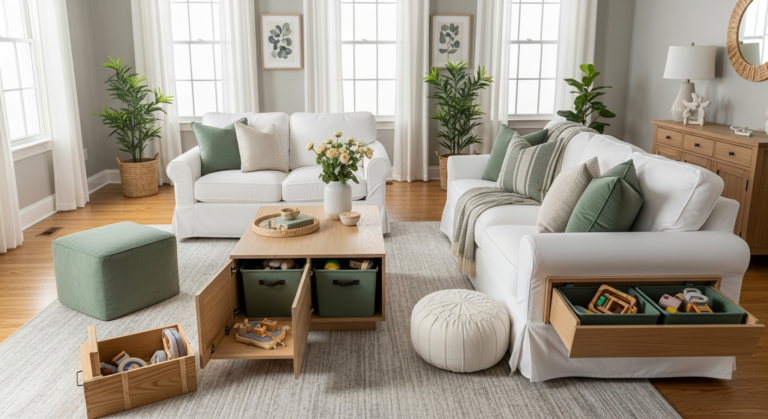
Closed storage is calmer than open storage. Open shelving displays every item visually, which creates stimulation even when toys are neatly organized. Where possible, replace open shelves with closed cabinets, fabric bins with lids, or curtained alcoves. If you love your KALLAX shelving, add DRONA fabric boxes ($7 each at IKEA) to every cube. The visual noise drops dramatically when toys and books are behind a solid front.
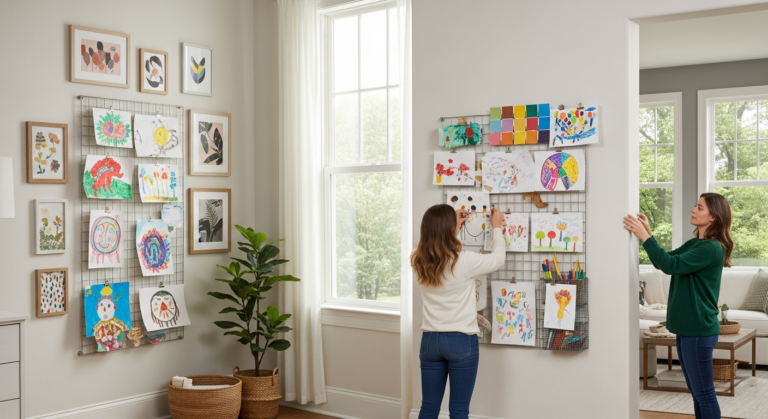
Reduce wall decor to three to five meaningful items. A gallery wall of twenty frames might look beautiful on Pinterest, but for a child trying to settle down, it is visual overload. Choose a small number of calm, meaningful pieces: a favorite family photo, a nature print, a single shelf with three treasured objects. Quality over quantity applies to wall decor as much as anything.
A canopy or bed tent creates a cocoon effect that many children find deeply calming. The IKEA KURA bed tent ($35) fits over a twin bed and creates a cozy enclosed space. For a softer approach, sheer curtains draped from a single ceiling hook create a canopy that narrows the visual field and blocks out peripheral stimuli. This is especially effective for children who are easily distracted or who have sensory processing differences.
Sound and Scent: The Invisible Calm Builders
Visual design gets all the attention, but the auditory and olfactory environment of your child’s bedroom plays an equally important role in creating calm. These invisible elements can be the difference between a child who takes ten minutes to fall asleep and one who takes sixty.
White noise or nature sounds mask disruptive household sounds and create a consistent auditory background that the brain learns to associate with sleep. The Yogasleep Dohm Classic ($45) has been the gold standard in white noise machines for decades, producing genuine fan-based white noise rather than a digital loop. The LectroFan ($50) offers a wider variety of sounds including multiple white noise frequencies and fan simulations. For a budget option, the Dreamegg D1 ($25 on Amazon) is compact, has a warm night light built in, and offers over 20 sound options.
Place the sound machine across the room from the bed, not directly on the nightstand. This creates a more immersive, room-filling sound rather than a directional blast. Set the volume to a level where you can still have a normal conversation over it, about 50 to 60 decibels. The American Academy of Pediatrics recommends keeping nursery sound machines below 50 dB, so for infants, keep the volume lower and the machine farther from the crib.
Lavender is the most researched calming scent for sleep. Studies have consistently shown that lavender reduces heart rate and blood pressure and promotes deeper sleep. A few drops of pure lavender essential oil on a cotton ball placed inside the pillowcase (not directly on skin) is the simplest approach. For a more ambient option, a passive reed diffuser from Target ($10 to $15) provides a gentle, continuous scent without the safety concerns of a candle or heated diffuser in a child’s room.
Avoid plug-in air fresheners and synthetic fragrance products in children’s bedrooms. These often contain phthalates and volatile organic compounds that can irritate airways and trigger headaches. Stick with pure essential oils, natural linen sprays like Caldrea or Mrs. Meyer’s lavender room spray ($8 at Target), or simply open the window for fresh air during the day and close it at bedtime.
The Calm Bedroom Checklist: Putting It All Together
Transforming a stimulating bedroom into a calm one does not have to happen overnight or cost a fortune. Here is a phased approach that lets you make the biggest impact first and refine over time.
Phase 1: Quick wins (under $50, one afternoon)
- Remove or relocate 50% of wall decor, especially from the ceiling and the wall facing the pillow
- Swap bright or cool-toned light bulbs for warm 2700K LEDs ($5 to $10)
- Add fabric bins to open shelving to hide visual clutter ($7 each)
- Move toys and stimulating items out of the direct line of sight from the bed
- Introduce a lavender scent element ($8 to $15)
Phase 2: Moderate upgrades ($50 to $200, one weekend)
- Paint the room in a calming color ($30 to $60 for paint, one day project)
- Install a dimmer switch ($25 plus basic tools)
- Add a warm-toned bedside lamp ($20 to $70)
- Replace busy or character-themed bedding with solid, muted tones ($30 to $60)
- Add a white noise machine ($25 to $50)
Phase 3: Full transformation ($200 to $500, over a month)
- Replace or add blackout curtains in a calming neutral color ($30 to $80)
- Add a bed canopy or tent for cocooning effect ($35 to $60)
- Invest in a Hatch Rest+ for programmable light and sound ($70)
- Upgrade bedding to organic cotton or linen in calming tones ($80 to $150)
- Add one or two pieces of curated, calming wall art ($20 to $50)
After our bedroom transformation, my daughter went from taking 45 minutes to fall asleep to averaging about 12 minutes. She stopped coming to our room at night. She started saying she loved her room, that it felt “soft” and “quiet.” Those words, from a six-year-old, told me everything. Children feel their environment more intensely than adults do, and when we design their bedrooms with calm as the guiding principle, we are giving them a tool for emotional regulation that serves them every single night. The investment in a calm bedroom is really an investment in your child’s wellbeing, and there is no design trend more worthwhile than that.
Neutral Nina
Neutral Nina is an interior design enthusiast and mom of three who proves that beautiful, organized spaces and family life can coexist. She shares practical strategies for creating calm, functional homes that work for kids and grown-ups alike.