Basement Playroom Ideas That Still Feel Warm and Neutral
Transform your cold basement into a warm, kid-friendly playroom by addressing moisture, flooring, 2700K layered lighting, and insulation in a calm neutral palette.
- Perform a plastic-sheet moisture test on your slab across multiple seasons before flooring work.
- Fix moisture, flooring, lighting, and warmth before investing in decor or toy storage.
- Install raised subfloor panels or dimpled membranes to insulate against concrete slab chill.
- Layer 2700K warm dimmable fixtures, lamps, and accent lights to eliminate harsh basement shadows.
- Target 30-50% humidity with a dehumidifier and keep storage elevated off bare concrete.
This post contains affiliate links. As an Amazon Associate I earn from qualifying purchases.
The first winter in our basement, I walked down in socks and felt the cold come up through the concrete into my ankles. The room was finished, but my kids called it “the cave” and went back upstairs.
This guide covers how to fix moisture, the floor, light, and warmth first, then add layout, storage, cozy details, and a realistic budget, all in a calm neutral palette.
In this article (14 sections)
- Start With the Four Real Basement Playroom Problems
- Basement Playroom Flooring: Making Concrete Soft, Warm, and Quiet
- Basement Lighting: Layering Warm Light Where There Is No Window
- Basement Moisture: The Quiet Problem to Solve First
- How to Warm Up a Cold Basement Playroom
- Choosing a Warm Neutral Palette That Works in Low Light
- Layout and Zones: Giving a Big Open Basement a Shape
- Storage That Handles Basement Realities
- Cozy Details That Make It Feel Like a Real Room
- Ideas by Age and Stage
- A Realistic Budget Plan
- A Simple Weekend Plan to Get Started
- Frequently Asked Questions
- A Basement Can Be the Coziest Room in the House
Start With the Four Real Basement Playroom Problems
Most basement playroom complaints come down to four things: the floor, the light, the moisture, and the warmth. The table below is the quick version; each gets its own section.
| Basement problem | What it looks and feels like | Neutral-toned fix | Kid-friendly bonus |
|---|---|---|---|
| Flooring | Cold, hard concrete; bare slab hurts knees and echoes | Raised subfloor tiles or a dimpled membrane, then a layered natural-fiber or wool-blend rug over a dense pad | Soft landing for block towers and tumbles |
| Lighting | One harsh overhead fixture, no daylight, shadows in corners | Three layers: warm dimmable ceiling lights, a few plug-in lamps, and under-shelf or picture lighting, all around 2700K | Dimmers double as a calm-down mode at dusk |
| Moisture | Musty smell, chalky white residue on walls, cardboard that goes limp | Dehumidifier, sealed or breathable wall finishes, storage lifted off the floor, plastic or wood instead of cardboard | Toys and books stay in good condition |
| Warmth | Cold walls, cold floor, drafts near the foundation | Insulated floor layer, textiles on walls and floor, warm-toned paint, heat checked by a pro if needed | Kids will actually stay down there in January |
If you only have budget for one purchase this season, make it the floor, after you’ve checked moisture. It changes how the room feels more than anything else on this list.
Basement Playroom Flooring: Making Concrete Soft, Warm, and Quiet
Concrete is the single biggest reason basement playrooms feel unwelcoming. It’s cold because it’s in direct contact with the ground, it’s hard on little knees, and it bounces sound around like a gym. The goal is to put several layers between the slab and your kid without trapping moisture underneath.
Check the slab first
Do the old plastic-sheet test before you spend money, and start it a few days before you plan to lay anything.
- Tape it down. Seal a roughly two-foot square of clear plastic tightly to the floor on all sides. Test two or three spots, including one near an exterior wall.
- Wait. Leave it for 24 to 72 hours.
- Check the underside. Lift a corner and look at the plastic and the concrete beneath it.
- Decide. Dry at every spot means you can probably go ahead; condensation or darkened concrete at any spot means fix the moisture first.
Condensation or darkening under the plastic means moisture is coming through the slab, so deal with that before covering it. Moisture on top of the sheet is just room humidity. A dry result in one season doesn’t rule out problems in another, so repeat the test across seasons.
TipA dry patch in one spot says little about the whole slab, so don’t skip the extra test sheets. Write down the date, spot, and result for each one so you can compare when you repeat the test next season.
This is a rough home check, not a professional assessment. If the floor has ever flooded or you see active seepage, call someone who does moisture work.
Your realistic flooring options
| Option | Warmth | Moisture tolerance | Softness | Neutral look | Notes |
|---|---|---|---|---|---|
| Raised subfloor panels (dimpled membrane with plywood or OSB top) | Good, adds an air gap | Good, designed to let the slab breathe | Hard unless topped | Needs a finish layer | Raises the floor height by about an inch, so check stair and door clearances |
| Luxury vinyl plank, over a subfloor system (directly on the slab only after a passing moisture test, with a moisture-barrier underlayment) | Moderate | High, waterproof | Low | Excellent in warm oak, light greige, or natural wood tones | Easy to wipe, durable under toys |
| Interlocking foam tiles (low-VOC, phthalate-free; chewed foam and edge pieces are a choking hazard, so supervise babies and toddlers) | Good | Good, though check for trapped moisture | Excellent | Mixed; look for oatmeal, gray, or wood-grain tiles | Best for a defined tumble zone rather than the whole room |
| Cork | Very good | Moderate; needs a good sealant | Good | Beautiful natural tone | Pricier, but it’s quiet and warm underfoot |
| Carpet tile | Good | Moderate; avoid in damp basements | Good | Plenty of neutral options | Replaceable by the tile when a juice box wins |
| Bare sealed concrete with rugs | Poor on its own | High | None until rugs go down | Modern and minimal | The cheapest start, and many families layer from here |
The rug strategy that actually works
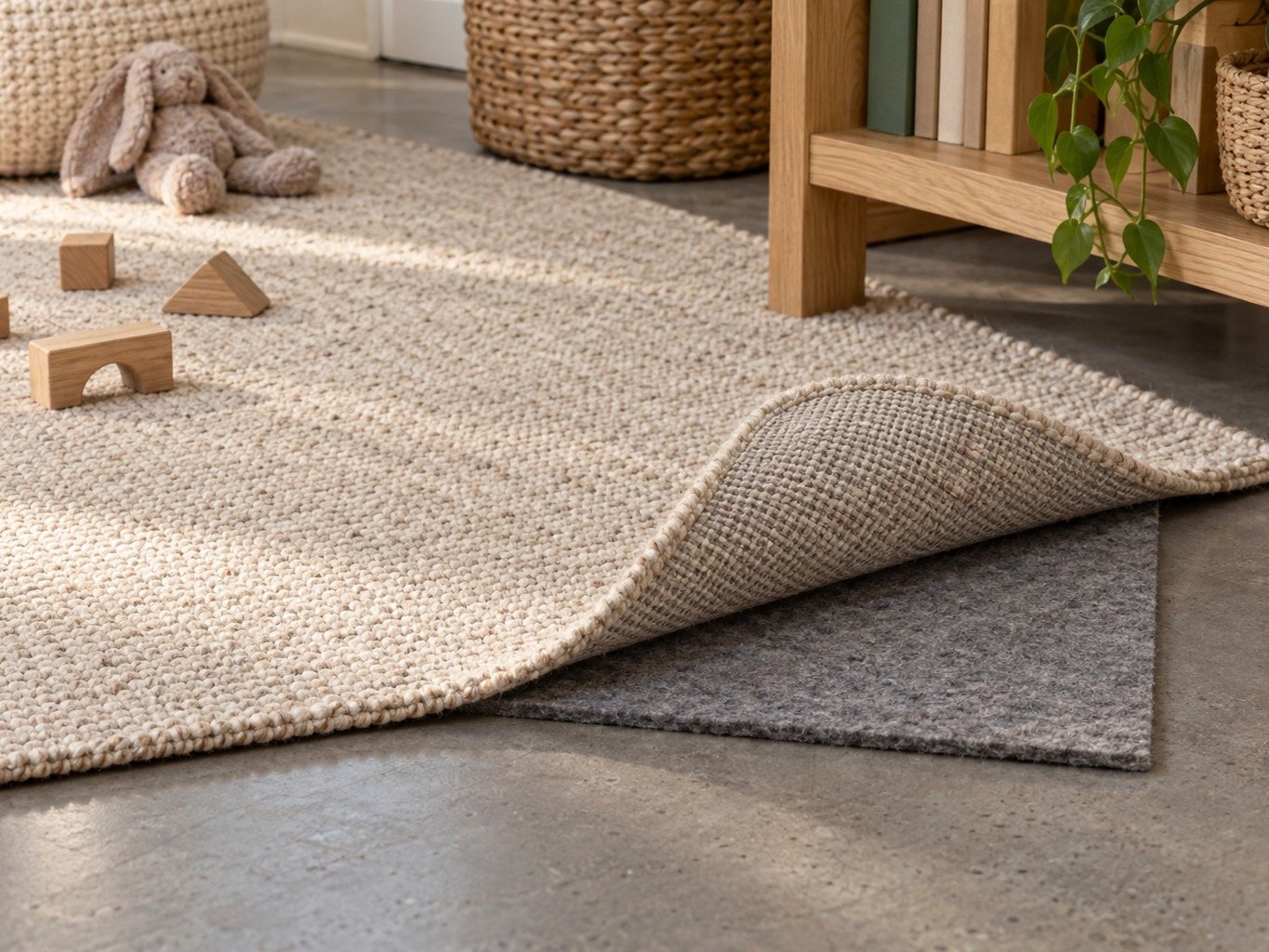
In my own room, the approach that finally worked was a floor in two parts: a hard, warm-toned base layer across the whole room, and then rugs placed only where the children actually sit.
- Under every rug, use a dense felt or rubber-and-felt pad. The pad does a surprising share of the insulation work, and it stops the rug from migrating when kids slide on it.
- Choose natural or wool-blend fibers in oatmeal, sand, warm gray, or soft ivory. Wool is naturally springy and holds warmth. A flatweave or low-pile cuts down on trapped crumbs.
- Avoid shaggy rugs in a play zone. They’re gorgeous in photos and miserable when you’re hunting for a tiny puzzle piece in them.
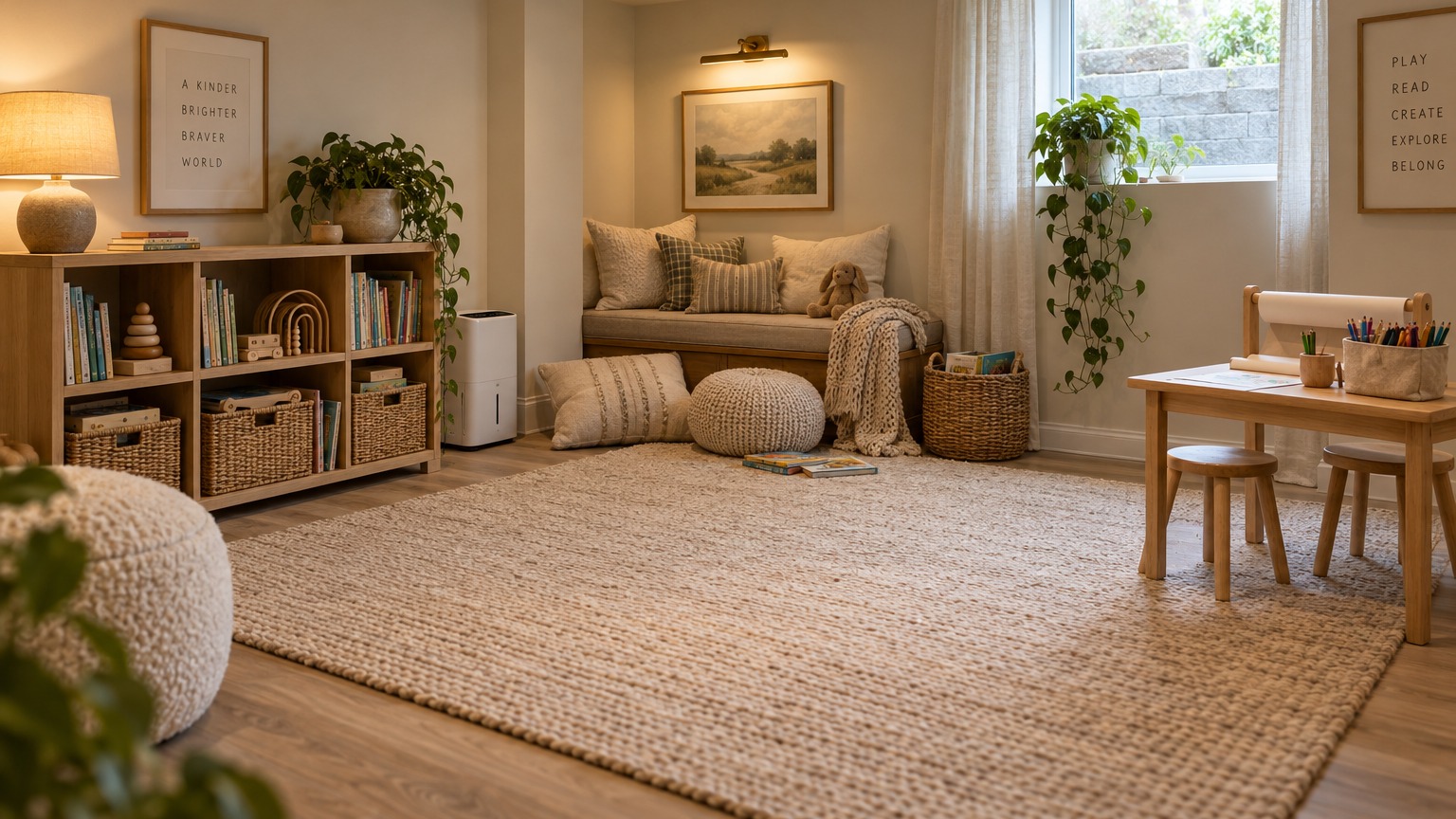
- Go larger than you think. A rug that’s too small makes the room feel chopped up. In a basement, a big rug in a quiet tone reads as one calm surface, which is exactly the visual effect you want.
- Choose washable when you can. Washable rugs in a neutral palette have come a long way, and a basement playroom is the place to use one.
If your budget allows only one of these, I’d lean toward a good pad plus a large rug on top of sealed concrete. It’s not the most dramatic upgrade, but it’s the fastest way to turn the floor from hostile to inviting.
Basement Lighting: Layering Warm Light Where There Is No Window
The most common basement lighting mistake is a single bright overhead fixture, or a grid of recessed cans on one switch. It feels like a waiting room. Neutral rooms depend on warm light even more, because there’s no color to do the work for you.
Think in three layers
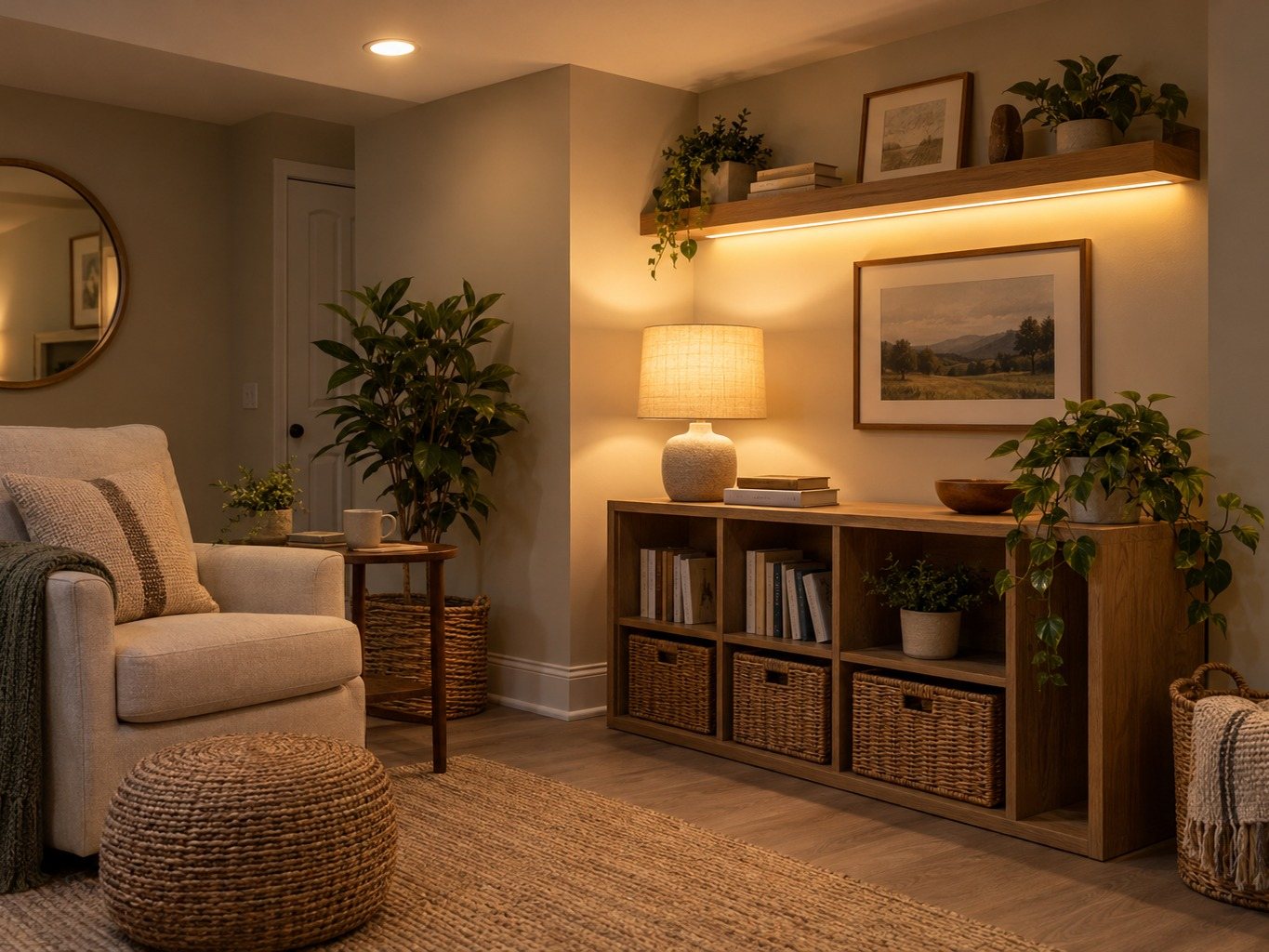
- Ambient light is the general glow. Warm-white recessed lights on a dimmer work well here, or flush-mount fixtures with a soft diffuser.
- Task light is for the places where focus happens: the art table, the reading nook, the Lego shelf. A clamp lamp or a swing-arm lamp can be added without any electrician.
- Accent light is what makes the room feel designed. Picture lights over a framed print, LED strips tucked under shelves, or a small lamp on a console create pools of warmth that make walls feel less like walls.
For more fixture and bulb ideas by room, see our guide to lighting ideas for kids’ spaces. If you like to plan on paper, our Kids’ Room Lighting Planner printable can help you map each zone’s ambient, task, and accent light.
Color temperature and quality matter more than brightness
Look for bulbs around 2700K, the warm, soft white you’d find in a living room lamp. Cooler bulbs (4000K and above) make a basement feel clinical and cast that slightly green look I was fighting that first winter. If you can, choose bulbs with a high color rendering index (CRI), 90 or above, because they make wood tones, skin tones, and neutral paint look richer and truer.
Use paint and surfaces to bounce the light you do have
Light-reflective paint helps, but “reflective” doesn’t mean stark white. Warm whites, soft creams, and pale greige have a decent light reflectance value (LRV) and keep a creamy warmth. A few ideas:
- Paint the ceiling a warm white and keep it matte so it diffuses light rather than glaring.
- Use a satin or eggshell finish on lower walls in the play zone for wipe-ability, and matte above where hands don’t reach.
- Add a large mirror on the wall opposite a lamp or window well to amplify the glow of a single light source. Choose a shatter-resistant mirror, anchor it to the wall, and mount it out of reach of falls and thrown toys.
- Keep window wells clear of stuff and wash them. A clean egress window gives you more daylight than you’d think.
Plan for evening play
Safety firstKeep lamp and LED-strip cords short and secured, route them behind furniture or cord covers, and cover unused outlets. Keep lamps stable and out of reach of crawlers and toddlers.
Basements often get used most in the late afternoon and winter evenings, when daylight is gone anyway. Put the lamps on a smart plug or a simple timer so the room is already glowing when kids come down. Putting the lights on dimmers also gives you an easy way to signal wind-down time without a single “it’s time to clean up” speech.
Basement Moisture: The Quiet Problem to Solve First
I put moisture before styling in my own order of operations for one reason: a damp basement ruins everything you put in it. Books warp, wood swells, cardboard bins collapse, and that musty smell sticks to every plush animal. A room that smells off won’t feel cozy, no matter how pretty it looks.
Signs to take seriously
| Sign | What to do |
|---|---|
| A musty or “earthy” smell that doesn’t go away when you air the room | Check humidity with a hygrometer and run a dehumidifier. If the smell stays once the air is dry, look for a hidden damp spot or mold. |
| Chalky white deposits on concrete or block walls (efflorescence, a sign that water is moving through the wall) | Brush it off and find the water source, often gutters, grading, or drainage outside. Don’t paint over it until the source is fixed. |
| Peeling paint, bubbling, or dark spots on lower walls | Dark spots can be mold. If they spread or come back after cleaning, have a moisture or mold professional take a look. |
| Condensation on windows, pipes, or the floor | Lower the humidity with a dehumidifier and better airflow. Sweating cold-water pipes can also be wrapped with pipe insulation. |
| Rust on metal furniture feet or tools | A sign of steady humidity. Dehumidify and lift metal pieces off the slab. |
| Active leaks, standing water, or mold growth | Call a professional. This is repair and remediation before any decorating. |
If you’re seeing active leaks, standing water, or mold growth, this is a repair-and-remediation job first and a decorating project second. Gutters, grading, and drainage fixes outside the house often do more than anything you can do inside.
What’s reasonable to do yourself
Ours was the humid kind. The first time I set a hygrometer on a shelf down there, it read well above 50 percent, which explained why the stuffed animals smelled stale. Once a dehumidifier was running on a drain hose, the smell faded.
For an otherwise dry basement that just runs humid, these steps are common and manageable:
- Run a dehumidifier. The EPA recommends keeping indoor humidity between 30 and 50 percent, and below 60 percent at most, to limit mold. A small hygrometer (inexpensive and worth owning) tells you where you are. A unit with a continuous drain hose saves you from emptying a bucket daily.
- Keep air moving. A quiet fan or a ceiling fan on low prevents stagnant corners.
- Pull furniture a few inches off the walls, especially exterior walls, so air can circulate behind it.
- Choose breathable or moisture-appropriate finishes. Skip heavy vinyl wallpaper on exterior walls. Fix the moisture source and clean off any efflorescence before sealing, because paint over active moisture fails. Then use paints made for masonry or basements on bare block. In a home built before 1978, test for lead before sanding or scraping.
- Store off the floor. Put bins on shelves, risers, or furniture with legs rather than directly on the slab.
- Skip cardboard. Use plastic, wood, metal, or fabric bins in a neutral palette instead.
Radon, sump pits and utility areas
Basements are where radon tends to accumulate, because they’re closest to the soil. Testing is inexpensive and worth doing in any home where children spend regular time in the lowest level. Use a short-term radon test kit in the lowest lived-in level, and follow the kit’s instructions for a follow-up test if the first result is 4 pCi/L or higher.
Safety firstA confirmed radon result at or above 4 pCi/L (the EPA action level) should be handled by a certified radon mitigation professional. The EPA also suggests considering a fix for results between 2 and 4 pCi/L.
If your basement has a sump pit, utility closet, or water heater, make sure those areas are closed off or latched from small hands.
How to Warm Up a Cold Basement Playroom
A room can be technically heated and still feel cold. That’s usually because the surfaces around you are cold, which makes your body radiate heat toward them. Concrete walls and a slab floor do that. So, warmth in a basement has two parts: actual temperature and the feeling of warmth.
Actual warmth
- Check your heat supply. Many basements get less warm air than upstairs rooms because they’re often at the far end of the ductwork. If the room is chronically cold, an HVAC professional can tell you whether a register or return needs adjusting. Fixing the supply is better than relying on a portable heater (see the safety note below).
- Insulate where you can. Insulating the floor with a subfloor system and the walls with appropriate materials makes a bigger difference than adding more heat. Wall insulation in a basement needs to be done in a way that suits your moisture situation, so this is worth getting advice on.
- Seal drafts around windows, rim joists, and the door at the top of the stairs. A door sweep at the stair door is a small fix that keeps cold air from sliding down.
Safety firstSpace heaters are a burn and fire risk in a kids’ play area. Fix the HVAC supply first. If a heater is unavoidable, use a UL/ETL-listed model with tip-over and overheat shutoff. Plug it directly into a wall outlet and never leave it running unattended. Keep a gate or barrier in place so children can’t reach the hot surface.
The feeling of warmth
This is where the neutral palette earns its keep. You’re not adding color, you’re adding texture and warm undertones.
- Choose warm neutrals over cool ones. Cream, oatmeal, putty, soft clay, and warm tan read as cozy. Blue-leaning grays and stark white read as cold in a low-light room.
- Add wood. Open shelves, a wood-top table, a small bench, and wooden toys all bring in the warm tone that a drywall-and-concrete room lacks.
- Use layered textiles. Linen curtains over a window well, a chunky knit throw on the sofa, wool or cotton cushions, a woven basket for blankets.
- Cover some wall. Large framed prints, a wall-hung fabric piece, or a felt pinboard soften the bare-surface feeling.
- Bring in something with a flame-like glow, like an electric candle-style lantern with a warm bulb. Choose one with a screw-secured battery compartment, since button and coin batteries are a serious swallowing hazard, and keep it out of reach of children under 4. Salt lamps have cords and warm bulbs, so they belong out of reach too.
If winter is your main concern, our guide to a winter indoor play space covers the seasonal side of this, including how to keep kids moving during the months when no one wants to go outside.
Choosing a Warm Neutral Palette That Works in Low Light
Neutral doesn’t have to mean beige and boring. In a basement, the right neutral palette is the difference between “calm” and “cave.” Here’s how I think about it.
Pick one warm base and two supporting tones
A simple formula: one dominant warm neutral on the walls, one natural wood tone, and one deeper accent for contrast. For example:
- Walls: a soft warm white or creamy greige
- Wood: light oak, ash, or birch
- Accent: a deeper tone such as warm charcoal, dusty olive, or terracotta in small doses
Palette ideas
| Palette name | Walls | Wood and textiles | Accent | Good for |
|---|---|---|---|---|
| Oat and oak | Warm cream | Light oak, oatmeal linen | Soft black hardware | Rooms with very little daylight |
| Sand and sage | Pale greige | Natural rattan, wool | Muted sage cushions | A calm, nature-leaning room |
| Clay and cream | Soft ivory | Walnut tones, rust-toned throw | Terracotta basket | Families who want a bit more warmth |
| Mushroom and moss | Light mushroom gray | Ash wood, cotton | Deep green plant or print | A slightly moodier, grown-up feel |
Testing paint in a basement
Always test paint swatches on the wall you’re painting and look at them at different times of day with the lights you’ll actually use. A color that looks perfect in the paint aisle can turn gray or green under basement lighting. Paint a large sample patch, live with it for a couple of days, and check it in the morning, afternoon, and evening light.
Bring in color through the toys, then edit
Kids’ toys come in every color imaginable. Rather than fight it, contain it. Keep the room’s permanent elements neutral and let the toys be the color. When bins and shelving are in calm tones, a handful of bright toys looks charming rather than chaotic. We go deeper into this in our playroom organization ideas post, including how to choose storage that fades into the background.
Layout and Zones: Giving a Big Open Basement a Shape
Basements are often one big rectangle, which is a gift and a challenge. Without walls to divide the space, a playroom can feel like an empty warehouse with toys scattered across it. Zones fix that.
The zones that earn their space
- Active zone: An open area with a big rug or foam tiles for building, tumbling, and floor play. Keep it near the stairs if you want sound to stay contained, or farther from the stairs if you want to keep noise from traveling up.
- Quiet zone: A reading nook with a small sofa, floor cushions, or a window-seat-style bench, a lamp, and a low shelf for books. This is the part that makes the room feel like a retreat, and it’s a natural spot for a calm-down corner.
- Creative zone: A table and chairs sized for kids, with art supplies in open bins, paper on a roll, and wall space for displaying artwork.
- Imaginative zone: A play kitchen, dollhouse, or puppet theater, ideally against a wall so you don’t lose floor space.
- Family zone: If this is also a family room, a sofa, a TV or projector area, and a low table. This is where parents can sit and be in the room without feeling like they’re guests in a toy store.
Using furniture to divide without walls
- A low, open bookcase works as a divider while keeping sightlines clear, so you can see the kids from across the room.
- A sofa floated in the middle of the room, back to the play area, creates a natural boundary.
- A large rug defines each zone in a way that’s easy to rearrange as kids grow.
- A tall plant or a woven screen can soften a corner, such as the one that holds the utility closet.
Family-room mode
Plenty of families want this to work as a family room in the basement and not just a kids’ room. The trick is making grown-up seating comfortable and keeping the room from reading as “kids only.”
- Pick a durable performance-fabric sofa in a warm neutral. Look for a tightly woven, stain-resistant fabric with removable, washable cushion covers, so spills go in the wash instead of setting. Our guide to kid-friendly fabrics and materials has more options.
- Keep the “adult” shelves higher up with books and a couple of objects, and the kid-level shelves low with bins and toys.
- Add a basket for the remote, a tray for the coffee table, and a hook for blankets. Small touches signal that this room belongs to everyone.
If your basement is on the compact side, the vertical storage and multi-use furniture tips in our small playroom ideas post apply directly.
Storage That Handles Basement Realities
Basement storage has to do more than hold stuff. It has to keep things off damp surfaces, be easy for kids to use, and look calm. Here’s what tends to work in basements.
The basics
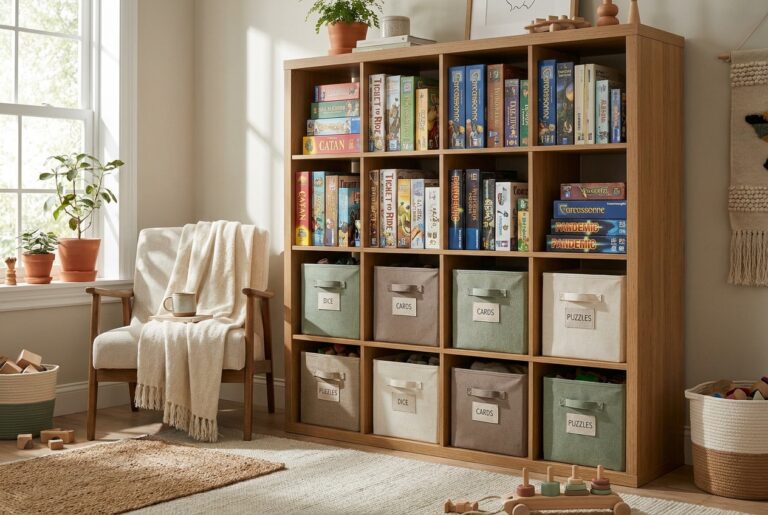
- Closed storage at kid height for the chaotic stuff. Think doored cabinets or lidded baskets for things like loose cars, costume bits, and tiny parts.
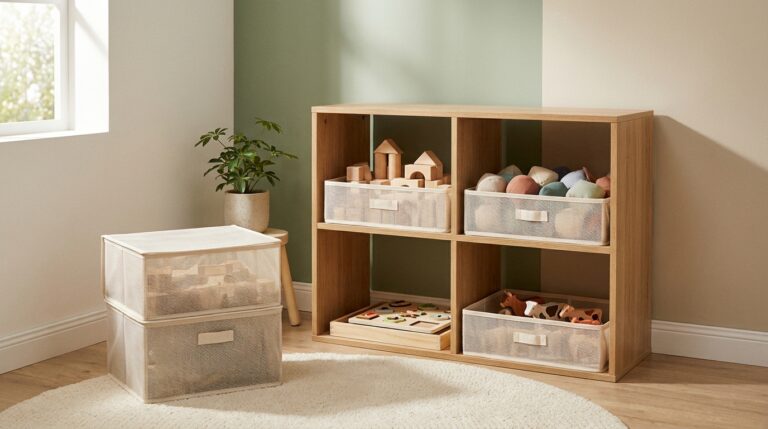
- Open storage for the loved items. Shelves with a few bins and a few displayed favorites make the room feel curated.
- One bin per category, with a label. Picture labels help pre-readers, and a text label helps older kids. Keep the labels simple and in a consistent font and color.
- Everything off the floor. Even a half inch of airflow under a cabinet helps. Furniture on legs is better than furniture that sits flat.
Materials to choose
| Material | Pros in a basement | Watch for |
|---|---|---|
| Solid wood or quality plywood | Warm, sturdy, repairable | Seal or paint the bottoms if the room runs humid |
| Metal shelving | Moisture-resistant | Can look industrial; pick a matte, warm finish |
| Woven baskets (seagrass, rattan, cotton rope) | Soft look, breathable | Natural fibers can mildew in very damp rooms |
| Plastic bins with lids | Moisture-proof, stackable | Choose neutral colors and avoid glossy finishes |
| Fabric cubes | Soft, quiet, lightweight | Not ideal for heavy toys or damp rooms |
Safety notes you shouldn’t skip
- Anchor all tall furniture to the wall. Bookcases, dressers, and cabinets should be anchored, and TVs, projector stands, and media consoles in the family zone must be anchored or wall-mounted too. Use hardware rated for the load and the wall type: studs in framed walls, masonry anchors in block or concrete, and proper hardware through furring or drywall.
- Keep heavy items low. Put the heavy bins on the bottom shelf and the light, soft items up high.
- Gate the stairs if you have a baby or toddler, and secure any door to the utility area. For the rest of the house, see our baby-proofing guide.
- Keep smoke and carbon monoxide detectors working. Put a detector on every level, with CO near the furnace and water heater. Test monthly and replace units by the manufacturer’s date (about 10 years for smoke, 7 to 10 for CO).
Keep the toy volume in check
Basements tend to collect the overflow from the rest of the house, so it’s easy to end up with far more toys than anyone can use. The fix is rotation: keep a portion of toys out, store the rest, and swap them every few weeks.
Our toy rotation system guide includes a simple method for deciding what stays and what rotates, and the Toy Rotation System printable puts it on paper. For a starting number, see how many toys to keep out at once.
Cozy Details That Make It Feel Like a Real Room
A reading nook with real comfort
- A low platform or window-seat-style bench with a thick cushion
- Floor cushions or a pouf in oatmeal or cream
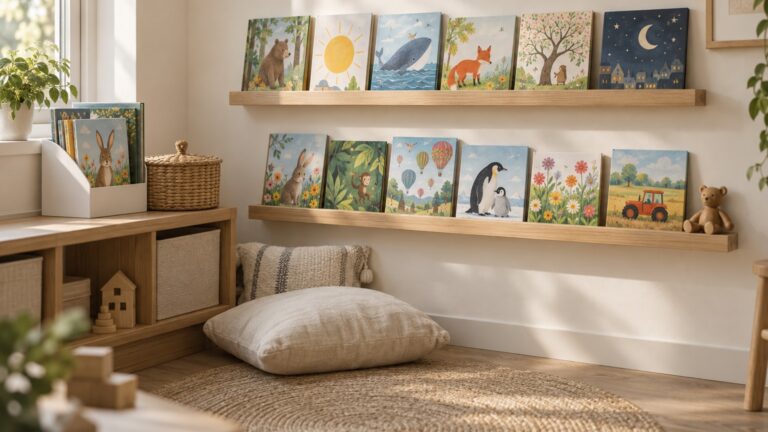
- A wall-mounted shelf or ledge for front-facing books
- A warm lamp on a dimmer
- A basket of throws within reach
For book storage at kid height and more nook setups, see our kids’ bookshelf and reading nook guide.
A “fake window” if you have none
If your basement is mostly below grade, you can bring in the feeling of a window:
- A large framed landscape print or a piece of nature photography in warm tones
- A backlit light panel or a mirror with a warm lamp beside it
- A sheer linen curtain on a faux window frame, with a warm LED behind it
Textures to layer in
- Linen or cotton curtains, even where there’s no window, to soften a wall
- A framed print, woven wall hanging, or framed fabric piece
- Chunky knit blankets in cream and oatmeal
Safety firstSkip bead garlands and macrame in rooms used by babies and toddlers. If you use them, hang them well out of reach with no long dangling cords or loose beads, which are strangulation and choking hazards.
Plants that tolerate low light
Pothos, snake plants, and ZZ plants tolerate low light well, but all three are mildly toxic if chewed or swallowed. With toddlers or pets, choose spider plant or parlor palm instead. Both are generally listed as non-toxic to children and pets, but check the ASPCA list before you buy. A good faux plant is a fine alternative, and it won’t mind the lack of sun.
Sound comfort
Basements can echo, especially with concrete and drywall. Rugs help, but you can also add:
- Heavy curtains
- Upholstered furniture
- Felt wall panels or a large piece of fabric art
- A bookcase against a shared wall, which absorbs sound surprisingly well
Ideas by Age and Stage
A setup that works for a one-year-old will look different when that child is eight. Here’s what to prioritize, and what to skip, at each stage.
| Stage | What to prioritize | What to skip |
|---|---|---|
| Babies and toddlers | Soft, clean flooring, low open shelves, a gated stair, minimal small parts | Floor lamps with cords, heavy furniture that isn’t anchored |
| Preschoolers | Imaginative play zone, a table for art, picture-labeled bins | Tiny-part toys without a closed storage solution |
| School-age | Building and project space, a homework or craft table, bigger shelving | Babyish decor that kids reject by age six |
| Tweens and teens | A hangout zone, a snack area, comfy seating, good lighting and sound | Zones that feel too childlike |
| Whole family | A sofa, game table, and movie setup that works for everyone | Anything that only works for one age |
If you plan well from the start, you can keep the shell of the room (floor, walls, big furniture) neutral and swap out only the contents as the kids age. That’s the real benefit of a neutral palette: you won’t have to start over.
A Realistic Budget Plan
Not every family can renovate a basement. Here’s how I’d phase the project depending on how much you want to spend. The dollar figures are rough US estimates; your prices will vary.
| Tier | Rough cost | What you get | Buy in this order |
|---|---|---|---|
| Starter fix | Under about $300 | Rug and pad, dehumidifier and hygrometer, warm bulbs and lamps, basic bins, a few textiles | Hygrometer and dehumidifier, then pad and rug, then bulbs and lamps, then bins and textiles |
| Mid-range refresh | Roughly $1,000 to $4,000, or built up one item at a time | New floor (foam tiles or floated vinyl plank), fresh paint in a tested warm neutral, dimmable overhead light, performance-fabric sofa, built-in or modular shelving | Paint before the new floor goes down, then lighting, then sofa and shelving |
| Full finish | Varies widely; get quotes | Subfloor and insulated walls, dedicated HVAC supply and return, recessed dimmable lighting on multiple circuits, custom built-ins and a reading nook, egress window | Moisture and drainage repairs, then subfloor, insulation and HVAC, then lighting, then built-ins |
Landing between two tiers? Add mid-range items one at a time, in the order shown in the table. The starter items are on the shopping list in the weekend plan below.
Safety firstIf anyone sleeps down here, the room needs a code-compliant egress window (confirm the requirements with your local building department) and working smoke and carbon monoxide detectors. Infants should sleep on a firm, flat, bare surface in a crib or bassinet, per AAP guidance.
Whatever your budget, I’d tackle it in this order: moisture first, then floor, then light, then warmth and styling. It’s tempting to start with the pretty part, but a room that smells damp or feels freezing won’t get used.
A Simple Weekend Plan to Get Started
Here’s a two-day plan that gets most of the starter fix done. Shop from the list below first, and start the slab test on Friday evening if you can.
Before the weekend: the shopping list
- Clear plastic sheeting and tape for the slab test
- A hygrometer
- A dehumidifier with a continuous drain hose
- A dense felt or rubber-and-felt rug pad
- A large rug in a warm neutral, washable if you can
- Warm 2700K bulbs, CRI 90 or above if you can find them
- Two or three plug-in lamps
- Basic shelving and neutral fabric or plastic bins
- Furniture anchors rated for your wall type
- A throw blanket and a couple of cushions
- A short-term radon test kit, if you’ve never tested
Day one: the foundation
- Clear and sort. Sort toys into keep, rotate, and donate.
- Start the tests. Ideally you started the plastic-sheet test on Friday evening; if not, start it now. Place the hygrometer, and set out the radon kit if you’ve never tested.
- Dry the air. Set up the dehumidifier if the reading is high.
- Clean. Wipe down walls, vacuum, and clean the window wells.
- Wait on the floor. Leave the plastic in place until the test is done. If the slab is wet, skip the floor and fix the moisture first.
Day two: the feel
- Lay the floor. Only if the slab test came back dry, put down the pad and the largest rug.
- Light it. Swap in warm bulbs and place your lamps.
- Set the zones. Active, quiet, creative.
- Make it safe. Put the heavy items low and anchor tall furniture.
- Add warmth. Bring in textiles, a plant, and one or two framed pieces.
- Restock. Bring back only the toys that fit your rotation plan.
The Basement Playroom Setup Planner below keeps your slab-test log, humidity readings, zone sketch, and shopping list in one place.
Frequently Asked Questions
How do I make a basement playroom feel less cold and damp?
Start with moisture, because warmth won’t fix a damp room. Use a dehumidifier to keep humidity in a comfortable range, keep air moving, and store things off the floor. Then address the cold: put a pad and a large rug over concrete, seal drafts around windows and the stair door, and add warm textiles. If the room stays cold despite those steps, have an HVAC professional check the airflow to the basement.
What is the best flooring for a basement playroom?
It depends on your moisture level and budget. For a dry basement, a floated luxury vinyl plank over a subfloor layer gives you a warm-looking, waterproof, easy-clean surface. Interlocking foam tiles are great for a defined tumble zone, and a large rug over a dense pad on sealed concrete is the most budget-friendly start. If the slab shows signs of moisture, solve that first and choose a flooring that lets the slab breathe or tolerates humidity.
How do I light a basement playroom with no windows?
Use layers. Combine dimmable ambient lights, plug-in lamps for task and accent lighting, and small picture or under-shelf lights. Choose bulbs around 2700K with a high color rendering index so the room looks warm rather than clinical, and use light-reflective warm whites on the ceiling and walls. A large mirror opposite a lamp can also help spread the light.
Can a basement playroom also work as a family room?
Yes, and it’s one of the best uses of the space. Divide the room into zones, with an open play area at one end and a comfortable sofa and low table at the other. Choose durable performance fabrics, keep adult items higher and kid items lower, and use rugs to define each zone. Good lighting and sound softening make the room comfortable for everyone.
What colors work best in a basement playroom?
Warm neutrals work best in low light: soft cream, warm white, oatmeal, putty, and light greige. Cool grays and stark whites can read cold and clinical in a basement. Always test paint samples in the room under the lighting you’ll actually use, and look at them at different times of day. Let the toys bring the color while the walls and big furniture stay calm.
Is a basement safe for kids to play in?
It can be, with a few precautions. Test for radon, make sure smoke and carbon monoxide detectors are working, gate the stairs for little ones, and secure access to the utility area, sump pit, and water heater. Anchor tall furniture to the wall, address any moisture or mold before kids spend time there, and make sure there’s a safe way out if the basement has any sleeping area. If you’re unsure about any of these, a local professional can assess your specific space.
How do I stop toys from taking over the basement?
Basements tend to collect overflow, so set a limit and rotate. Keep a portion of toys out on open shelves, store the rest in labeled bins, and swap them every few weeks. Give each category a home so cleanup is simple, and do a seasonal purge to keep the volume manageable. Fewer toys out also makes the room feel calmer and more neutral.
A Basement Can Be the Coziest Room in the House
That cold, flat room eventually became where our family gathers on rainy Saturdays. It took a warmer floor, better light, a quiet dehumidifier, and a few textures, not a gut renovation. Start with the problems you can feel, fix them one at a time, and your kids will find their way down the stairs.