The Family Thanksgiving Hosting Prep Timeline, Week by Week
Master your Thanksgiving hosting with a 4-week timeline covering home decluttering, guest prep, turkey thawing, and day-of schedules.
- Prep your entry, guest room, and home zones alongside meal planning.
- Calculate your turkey thaw time and shopping trips weeks in advance.
- Assign age-appropriate jobs to kids and set up dedicated activity tables.
- Follow a back-from-serving-time schedule on Thursday for stress-free timing.
This post contains affiliate links. As an Amazon Associate I earn from qualifying purchases.
The first year I hosted Thanksgiving, I planned the food and forgot the house. My in-laws arrived at 11:40 a.m. for a 2:00 meal. They found a hall closet full of scooters, nowhere to set a purse, and a guest room my five-year-old said “smelled like crayons.” The food was fine. The house was not.
This page is a 4-week plan that covers the house, the guest room, the kids’ table, decor, the turkey thaw and a day-of schedule, all in one timeline. Take what fits and skip what doesn’t.
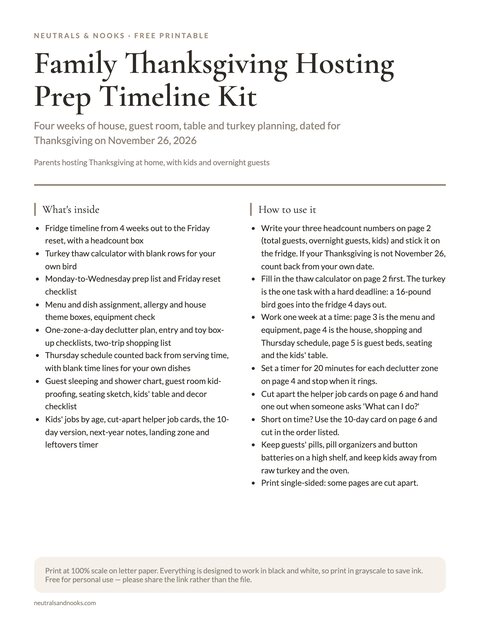
Free printable · 6 pages
Family Thanksgiving Hosting Prep Timeline Kit
A dated fridge timeline with a headcount box, turkey thaw calculator, Monday-to-Wednesday prep and Friday reset, a menu and dish sheet with allergy and theme boxes, an equipment check, a one-zone-a-day declutter plan, entry, toy and guest room checklists, a two-trip shopping list, a Thursday back-from-serving-time schedule, a guest sleeping and shower chart, a seating sketch, a kids' table and decor checklist, kids' jobs by age, and cut-apart helper job cards with a 10-day version and next-year notes.
Free. Your download link appears right here. You'll also join the Monthly Home Reset. Unsubscribe anytime. Privacy
Hosting with kids is mostly a logistics problem wearing a menu costume. Food is one lane. The house is another: the entry, the guest bed, the table and the bathroom. Plan them together and the house is ready before the groceries come home, not at 9 p.m. on Wednesday.
In this article (12 sections)
- The Timeline at a Glance
- Four Weeks Out: Decide, Count, and Protect Your Energy
- Three Weeks Out: Declutter the Zones Guests Will See
- Two Weeks Out: The Guest Room and Sleeping Plan
- One Week Out: Table, Seating, Decor, and Shopping
- Thanksgiving Week, Day by Day
- Hosting Thanksgiving With Kids
- If You’re Starting Late: The Compressed Timeline
- After the Meal: The Friday Reset
- A Quick Printable Checklist You Can Copy
- Frequently Asked Questions
- One Last Thought Before You Start
The Timeline at a Glance
Here is the whole plan in one table. In 2026 Thanksgiving falls on November 26, so the dates below use that. Count back from your own date if it is different.
| When | Focus | Key tasks | Go deeper |
|---|---|---|---|
| 4 weeks out (week of Oct 29) | Decide and count | Confirm guest list, set the menu, assign dishes, pick your “house theme” for the day | This page |
| 3 weeks out (week of Nov 5) | Declutter | Clear entry, living room, kids’ spaces, pantry and fridge shelves, one zone per day | Pre-Thanksgiving declutter checklist |
| 2 weeks out (week of Nov 12) | Guest room and sleeping | Make up beds, stock the room, plan bathroom and towel logistics | Small guest room ideas for Thanksgiving |
| 1 week out (week of Nov 19) | Table, seating, shopping | Table plan, kids’ table, decor, linens, big grocery shop, borrowed chairs | Neutral Thanksgiving table decor that survives kids |
| Monday–Wednesday | Stage and prep | Thaw, chop, set the table, clear the fridge, prep the “landing zone” | Day-by-day plan below |
| Thursday | Host | Run the schedule, delegate, enjoy it | Day-of plan below |
| Friday | Reset | Leftovers, laundry, linens, quick tidy, put the house back | Reset section below |
Notice how little of the house work lives on Thanksgiving week itself. That’s the whole point. By the time the groceries come home, the house should already be 80 percent ready.
Four Weeks Out: Decide, Count, and Protect Your Energy
This week is almost entirely thinking, and it’s the most valuable one. Every decision you make now removes a dozen small decisions later.
Lock the guest list and the headcount
Know exactly who is coming, who is staying overnight, and how many are kids. These are three different numbers, and they drive different parts of the plan:
- Total headcount drives table seating, chairs, serving dishes, and the grocery list.
- Overnight guests drive the guest room, bedding, towels, and bathroom schedule.
- Number of kids and their ages drive the kids’ table, activities, nap timing, and how much you need to child-proof.
TipWrite all three numbers on a sticky note and put it on the fridge. When someone texts “can my cousin come?”, you’ll know instantly what it changes.
Set the menu, and hand out dishes
Decide on the menu now, even if it’s a loose one. Then assign dishes. People generally want to contribute, and guests who bring something feel less like guests and more like family. Be specific when you assign. “Bring a side” leads to four potato dishes. “Can you bring a green vegetable that travels well?” leads to dinner.
A simple way to organize it:
| Category | You | Guest assignment |
|---|---|---|
| Turkey and gravy | You | |
| Stuffing | You | |
| Potatoes | You | |
| Vegetable side | Assigned | |
| Cranberry sauce or relish | Assigned | |
| Rolls and butter | Assigned | |
| Pies and dessert | Assigned | |
| Drinks | Assigned | |
| Kids’ snack tray | Assigned |
Keeping the turkey, gravy, stuffing, and potatoes yourself means the core of the meal stays under your control, while everything else gets shared. Also ask about allergies and dietary needs now, not on Wednesday.
Pick a “house theme” in one sentence
This sounds fussy, but it’s the trick that keeps the aesthetic side of hosting from spiraling. Choose one sentence that describes how you want the house to feel on Thursday. Mine is usually something like: warm, uncluttered, soft light, nothing precious within toddler reach.
When you’re standing in a store looking at a gold-leaf turkey centerpiece, the sentence helps you decide. Does it fit the sentence? If not, skip it.
Check your equipment
Go through the things you’ll need and see what you don’t have:
- A roasting pan big enough for your bird, plus a rack
- A meat thermometer (the single most useful tool for a calm Thanksgiving)
- Enough serving spoons, one per dish
- Extra chairs, folding tables, or a table extension
- Enough plates, glasses, and flatware, or a plan for good disposable ones
- A large cooler for drinks, which frees up fridge space
- Foil, parchment, storage containers for leftovers
Borrow or buy now. Everyone is out of folding chairs by the weekend before.
Do a one-time energy audit
Look at your calendar for the next four weeks. Where are the soccer games, school events, work deadlines, and sick-kid risks? Pick the two or three evenings you actually have capacity and mark them for house tasks. Hosting prep should fit into the margins of your life, not replace it.
Three Weeks Out: Declutter the Zones Guests Will See
This is the week where the house starts to change. The goal is not a magazine-perfect home. It’s a home where guests can move, sit, and set things down without negotiating your stuff.
The key idea is to declutter by guest path, not by room. Walk the route a guest takes, from the front door to the table, the bathroom, and the guest bed, and clear only the places on that route. Your bedroom closet is not on the guest path. Leave it alone.
For the full, detailed version of this, including what to toss, donate, and relocate, my Pre-Thanksgiving Declutter Checklist for Busy Parents goes zone by zone. Here’s the overview.
The one-zone-a-day plan
| Day | Zone | The 20-minute goal |
|---|---|---|
| 1 | Entryway and coat storage | Clear the hooks, shoe pile, and bench so guests have somewhere to land |
| 2 | Living room | Clear surfaces, corral toys into one bin, thin out throw blankets and magazines |
| 3 | Kids’ play spaces | Do a quick toy rotation, put away half, and set up one calm activity zone |
| 4 | Dining area | Clear the table of mail, homework, and craft supplies; check chair count |
| 5 | Kitchen counters | Clear everything that doesn’t need to live there; free up landing space |
| 6 | Guest bathroom | Clear the counter, restock supplies, empty the cabinet under the sink |
| 7 | Rest, or catch up | Finish whatever slipped |
Twenty minutes a day is enough. If it takes longer, you’re doing too much. Set a timer and stop when it rings.
Entryway first, always
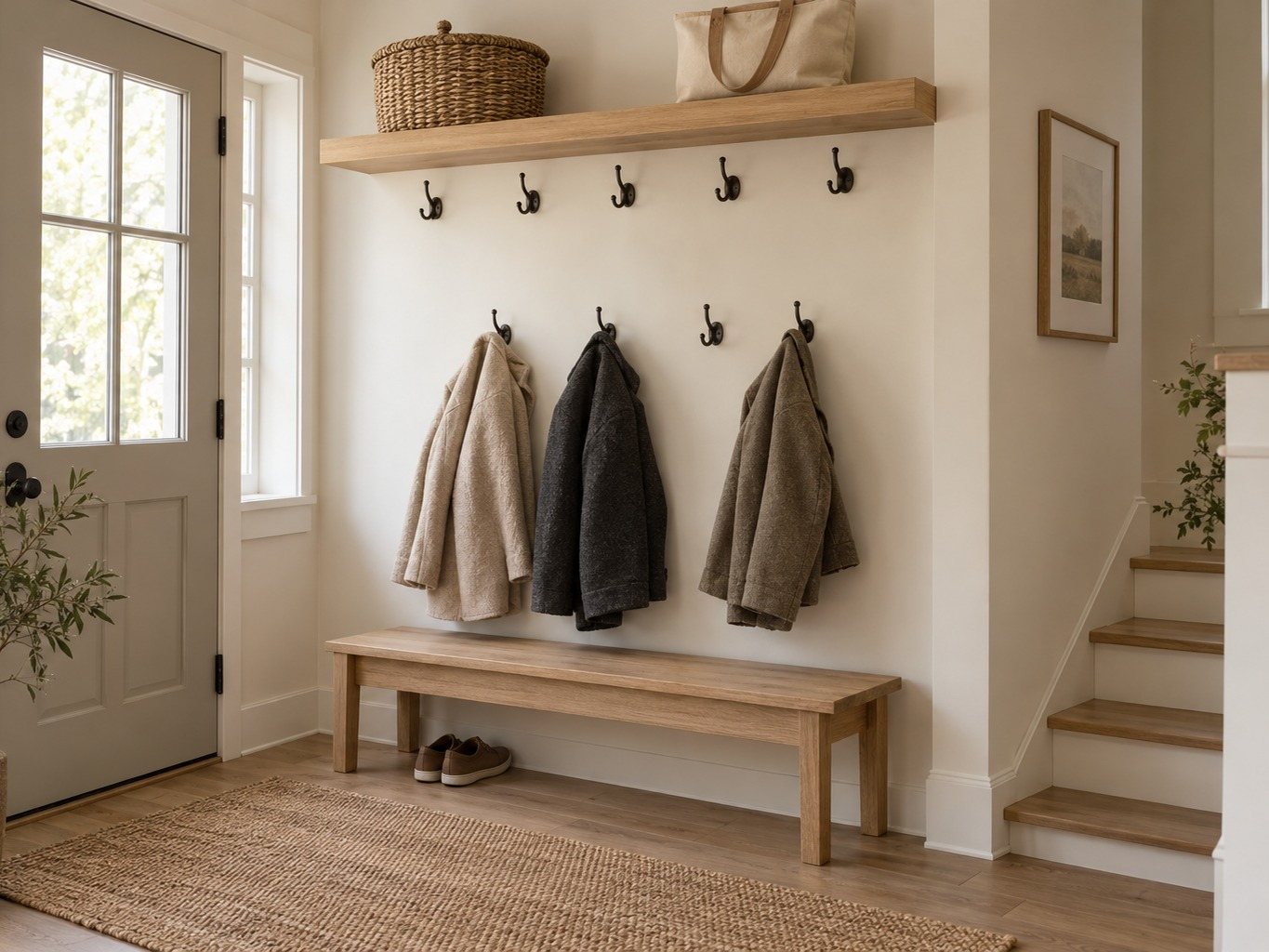
The entry is the one place where your decluttering has an immediate, visible payoff. It’s the first impression, and it’s where eleven coats will arrive within five minutes. Here’s what I clear before anything else:
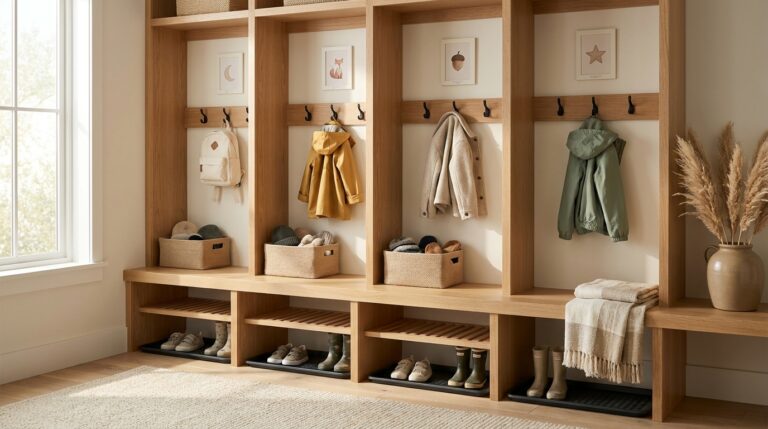
- Remove 70 percent of what lives on the hooks. Family coats, backpacks, and bags go to bedroom closets for the week. Leave only what’s needed for the daily routine.
- Clear the shoe pile. Keep one pair per person near the door and move the rest.
- Create a guest coat solution. Wall hooks, a stable freestanding rack, or a bed in a closed nearby room all work. Keep racks from being top-heavy, put heavy coats on the lower hooks, and keep the rack away from climbing kids. Guests should never have to ask where their coat goes.
- Add a high spot for bags and purses. A closet shelf, a high hook, or a bed in a closed room all work. Guest bags often hold medications, button batteries and coins, so keep them off low benches and baskets when toddlers are around. This is the thing I forgot that first year.
Safety firstWhen young children will be in the house, ask guests to keep medications up high. Weekly pill organizers and loose vitamins are not child-resistant. If you think a child has swallowed medication or a battery, call Poison Control at 1-800-222-1222 or 911 right away.
If your entry is tiny or you have no coat closet, the same logic applies at a smaller scale. Reduce what’s on display. Designate one clear guest zone, even if it’s just a few hooks and a high shelf. My guide to a small entryway with no closet has layouts for tight spaces.
The toy question
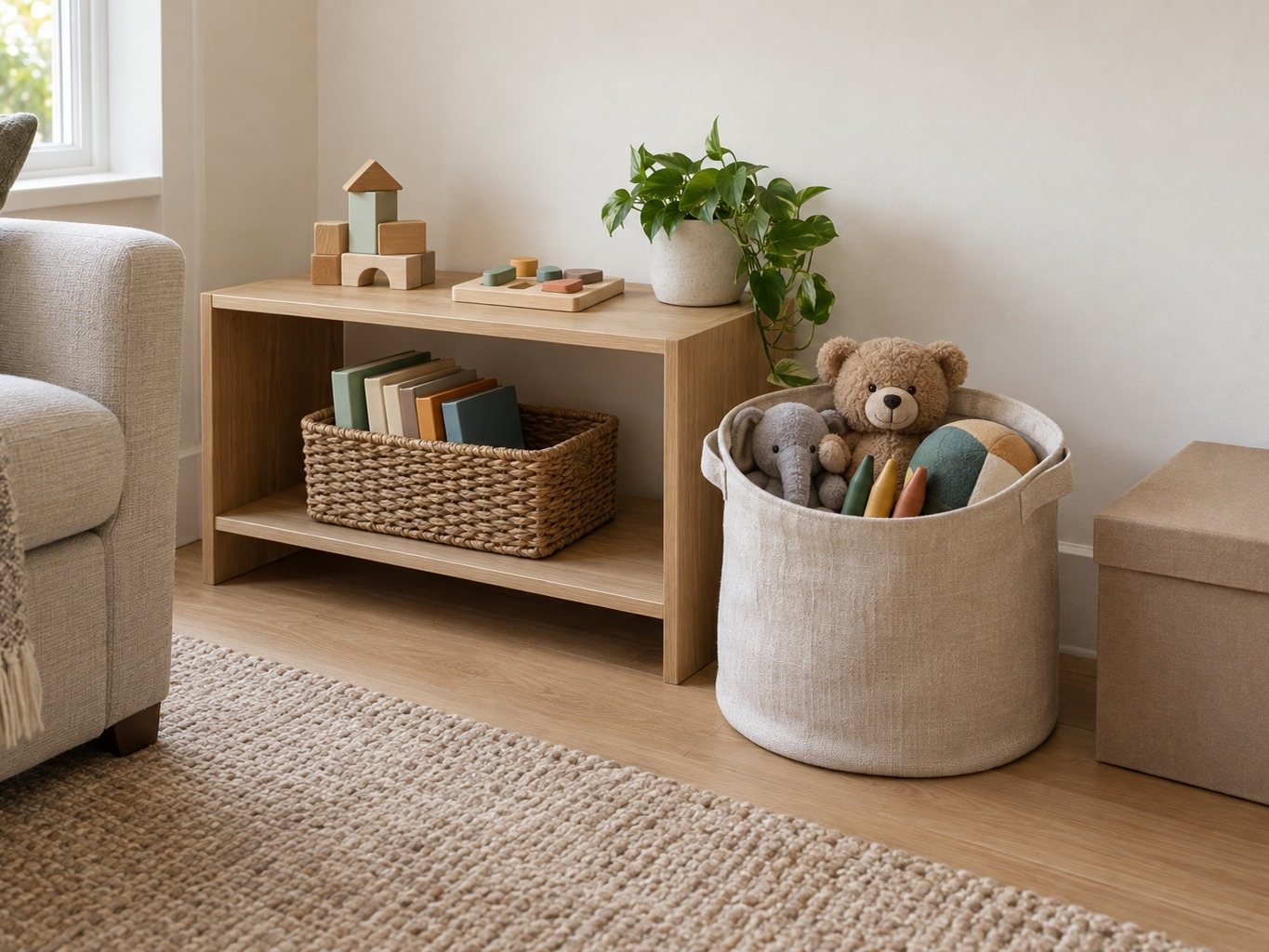
Kids’ stuff is the biggest source of visual noise in a family home, and it’s the easiest to solve with a rotation. Do not try to organize every toy. Instead:
- Pull out everything the kids haven’t touched in the past month.
- Box up half of what remains and store it out of sight.
- Leave two or three open-ended toys in the living area, such as blocks, a puzzle, and a basket of books.
- Keep one “guest kid” activity bin ready for visiting children, because they arrive without toys and get bored fast.
The box you pack away now doubles as a small gift for your own kids in December. They’ll have forgotten about half of it by then.
Clear a little fridge and pantry space now
Thanksgiving week is a fridge Tetris nightmare. Three weeks out, start eating down the odds and ends: the half jars, the mystery leftovers, the three open bags of shredded cheese. By the weekend before, your fridge should have empty shelves, and your freezer should have a few open spots for ice and prepped items.
A good target is two entire fridge shelves, fully empty, by the Saturday before. If you’ve got a second fridge in the garage, wipe it down now too.
Two Weeks Out: The Guest Room and Sleeping Plan
If you have overnight guests, this is the week to get them sorted. If you don’t, use this week to finish up decluttering and move ahead to table planning.
Sleeping logistics are where small homes struggle most, and where a little planning makes the biggest difference to how welcome people feel. My post on small guest room ideas for Thanksgiving covers layouts and clever setups for tight spaces. Here are the core steps.
Decide who sleeps where
Write it down. Seriously. A simple sleeping chart prevents awkward Wednesday-night conversations:
| Guest | Where | Notes |
|---|---|---|
| Grandparents | Guest room, real bed | Easy access to a bathroom, extra blanket |
| Aunt and uncle | Pull-out sofa or air mattress in the office | Door that closes, a lamp |
| Teen cousins | Kids’ room floor, sleeping bags | Fun, not a hardship |
| Baby of a guest | Pack-and-play in parents’ room | Baby sleeps on their back, firm flat mattress, no blankets or pillows; room-sharing is safest |
Ask guests what they need. Some people need a firm mattress, some need a quiet room, and some need to be near a bathroom. It’s much easier to adjust now than at midnight.
Make the room genuinely comfortable
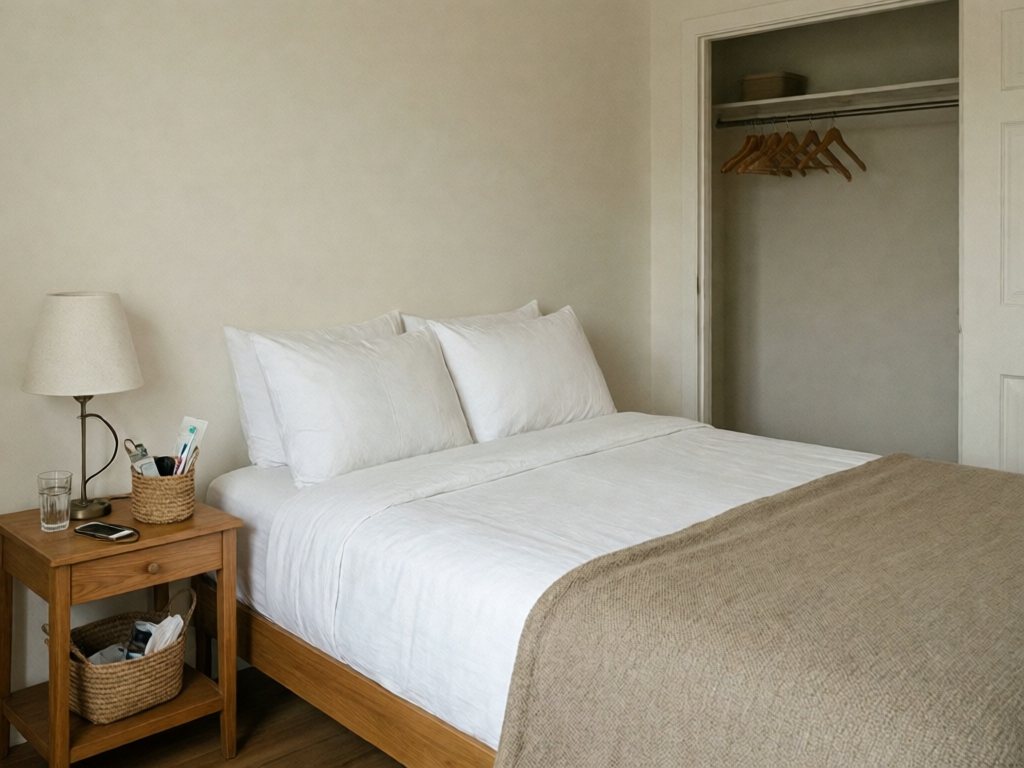
You don’t need a boutique hotel, but a few small touches make a guest room feel intentional:
- Clean, fresh bedding, washed and aired out. If you use an air mattress, put a real mattress topper on it and use real sheets.
- A flat surface, even a small one, for a phone, glasses, and water.
- A lamp or reading light within reach of the bed.
- Empty space: a few empty hangers, an empty drawer, or a clear section of closet. People hate living out of a suitcase on the floor.
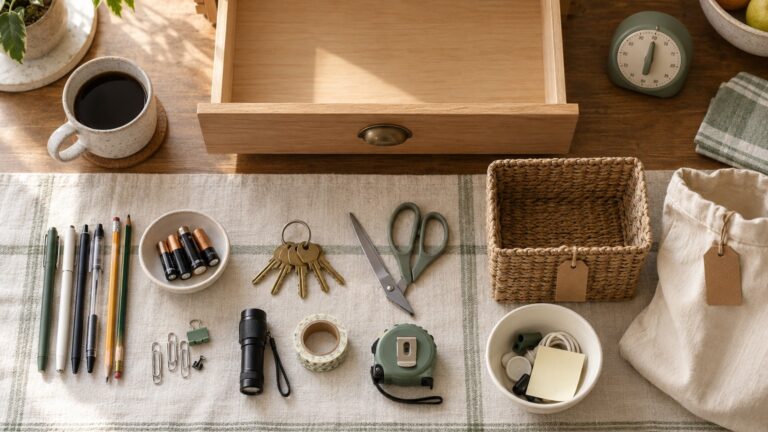
- A small basket of essentials: phone charger, extra toothbrush, travel toothpaste, lip balm, tissues.
- A basic welcome note with the Wi-Fi password and bathroom schedule.
If your guest room doubles as an office, a nursery, or a storage room, clear it down to bare bones. Anything you can’t comfortably move should be edited, not hidden under a throw.
Plan for the bathroom
The bathroom is where hosting gets quietly stressful. With more people, more showers, and more mornings, a little structure goes a long way:
- Put out a clearly marked set of towels per guest. A hook per person with a name tag or a color works nicely for kids too.
- Stock extra toilet paper where it can be seen, not in the back of a cabinet.
- Offer a simple shower schedule if you have more than four overnight guests. A friendly “mornings are busy, so grandparents have 7 a.m. and cousins have 8 a.m.” avoids a queue.
- Put a small trash can in the guest bath, and a spare hand soap.
Kid-proof the guest zone
If young children will be in the house, yours or a guest’s, walk through the guest room and bathroom at kid height. Move medications, cleaning supplies, and anything fragile. Check cords, outlets, and breakable lamps. A ten-minute crawl-through will find what you missed.
Then ask overnight guests to do the same with their own things. Pills, pill organizers and vitamins belong in a zipped bag on a high shelf or in a closed suitcase, not on the nightstand or the bathroom counter.
Consider the combo room
If your guest room has to share space with a crib, a desk, or a nursery, don’t try to hide it. Make it clean and functional. A tidy room that does two jobs is better than a half-hidden room that confuses everyone. Pack up anything that isn’t essential, and add one or two warm touches such as a plant, a throw, and a small lamp so it reads as welcoming rather than leftover.
One Week Out: Table, Seating, Decor, and Shopping
This is the week where it all comes together visibly. It’s also where parents tend to overspend on decor. Resist. The most memorable Thanksgiving tables are warm and simple.
Work out your seating
Count chairs and count bodies. Then sketch the layout on paper:
- Main table: adults and older kids, ideally with a mix of ages so no one is isolated.
- Kids’ table: a separate spot for kids roughly 4 to 10, close enough for you to see and hear them. Children under 4 sit at the main table with an adult within arm’s reach.
- Highchair or booster spot: next to a parent, with easy wipe-clean space around it.
- Spill-prone spots: place the youngest kids and the cranberry sauce on the end, not in the middle.
Don’t push the kids’ table into a distant room. The best version sits in the same space as the adults, even if it’s lower and smaller, so kids feel included and parents can eat with one eye on them.
Build a kids’ table that works
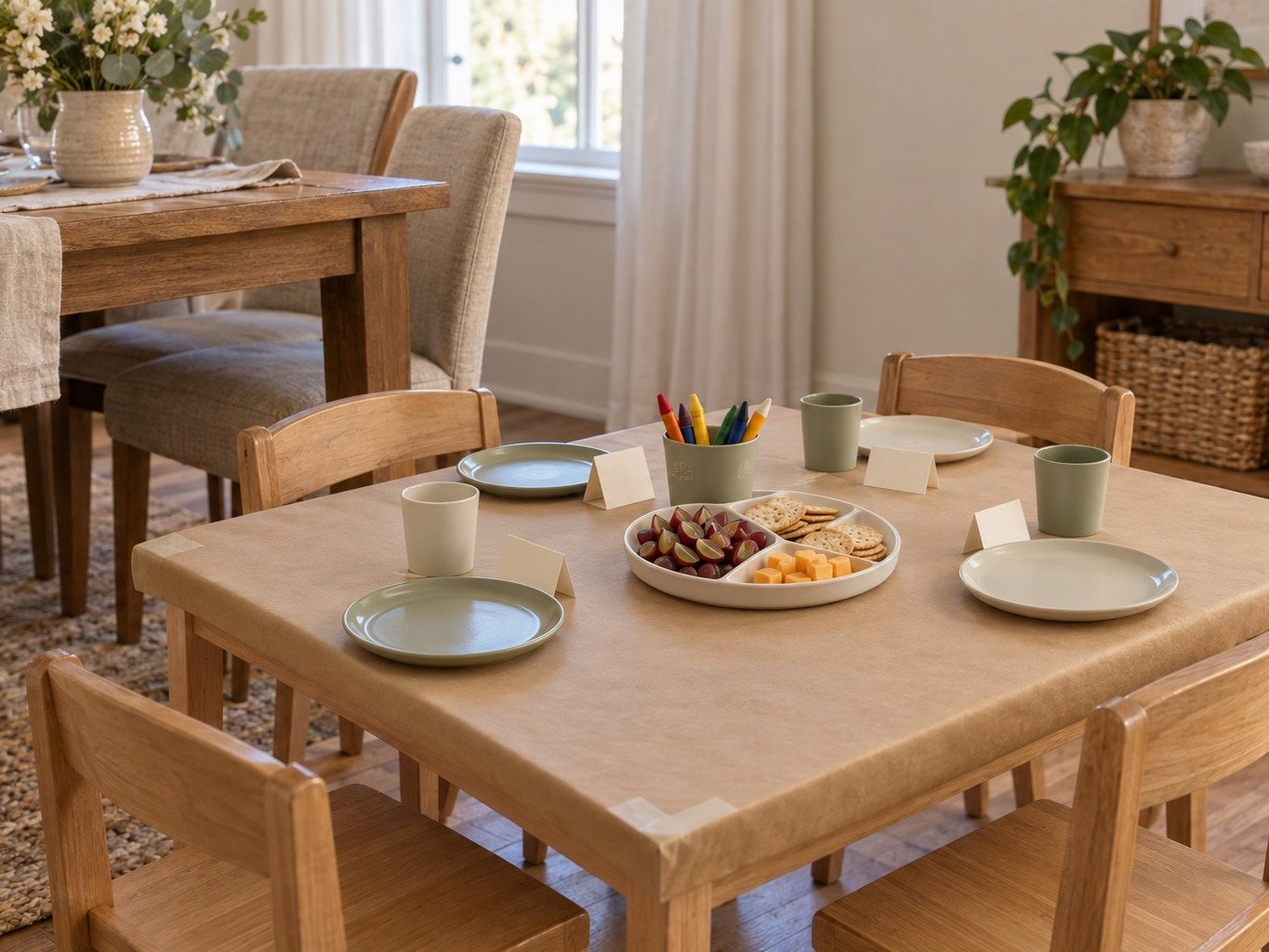
A kids’ table is more than a folding table with paper plates. Done well, it’s the reason adults get to eat a hot meal. Here’s what makes one work:
- A sturdy, wipeable surface. Use butcher paper taped down, or a fitted or secured cover with no hanging edges. Dangling cloths are a pull hazard for little ones.
- Real activity built in. Crayons and a paper tablecloth, a printable placemat, or a “what I’m thankful for” card for each kid.
- Unbreakable dishes. Silicone plates, melamine, or sturdy paper. Save the heirloom china for the adult table.
- A small snack tray ahead of time, such as cheese, crackers, and fruit, so hungry kids don’t melt down before the turkey is carved. Cut everything small for little ones (see the safety note below).
- An adult “table host.” Assign a teen cousin or an uncle to sit with the kids. It’s a job, not a punishment, and it makes everything smoother. The host is a helper, not a substitute for an adult watching the toddlers.
Safety firstFor children under 4, quarter grapes and cherry tomatoes lengthwise. Cut cheese into pieces 1/2 inch or smaller. Cut sausages and hot dogs lengthwise into strips, then into small pieces, never into round coins. Keep whole nuts, whole berries, popcorn, raw carrot sticks and hard candy off their plates. Children under 4 sit at the main table with an adult within arm’s reach.
Keep the decor simple and kid-proof
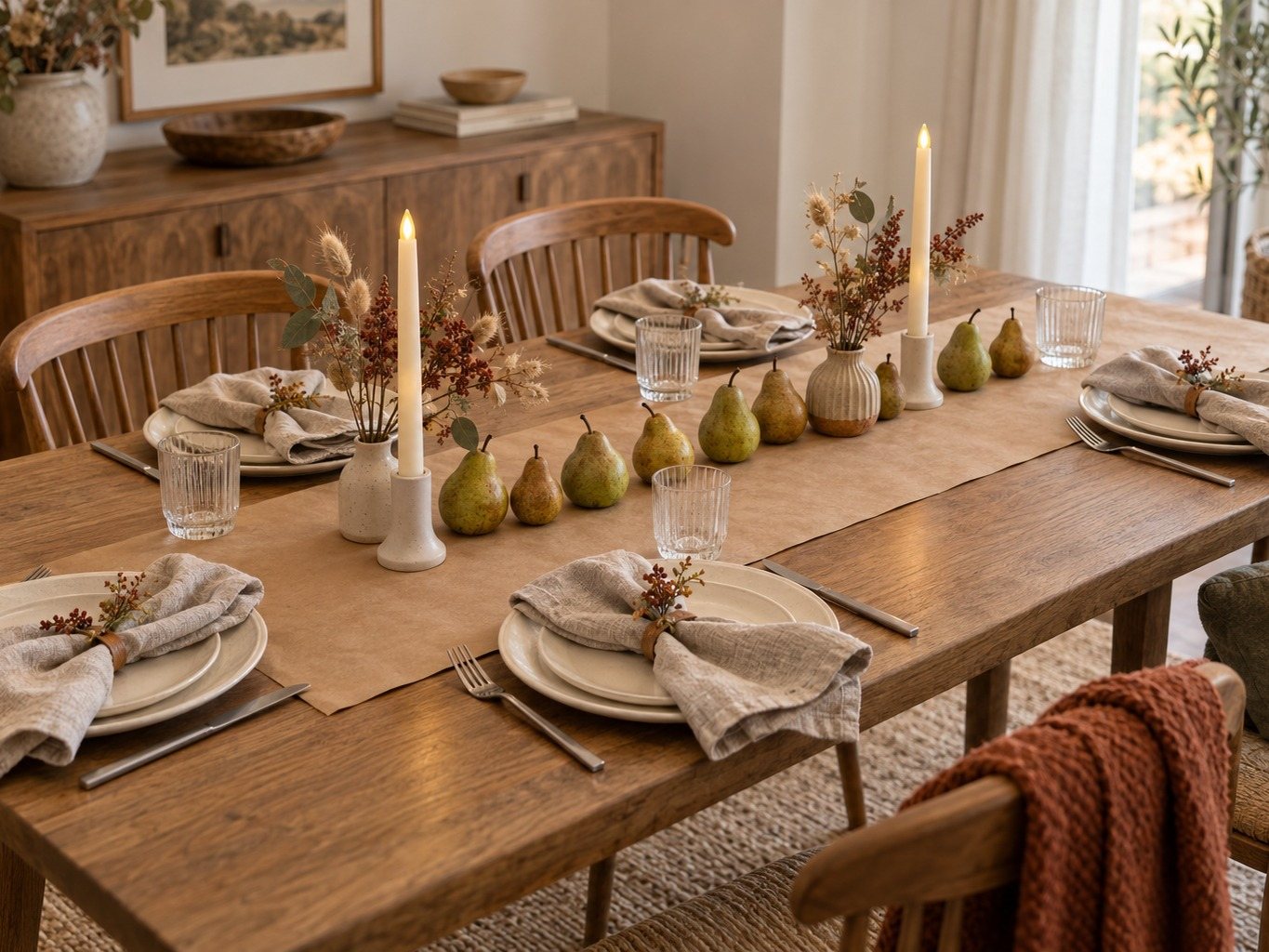
My full guide to neutral Thanksgiving table decor that survives kids has specific ideas. The principles are what matter most:
| Principle | What it looks like |
|---|---|
| Low and soft | Short arrangements, so people can see across the table and nothing topples |
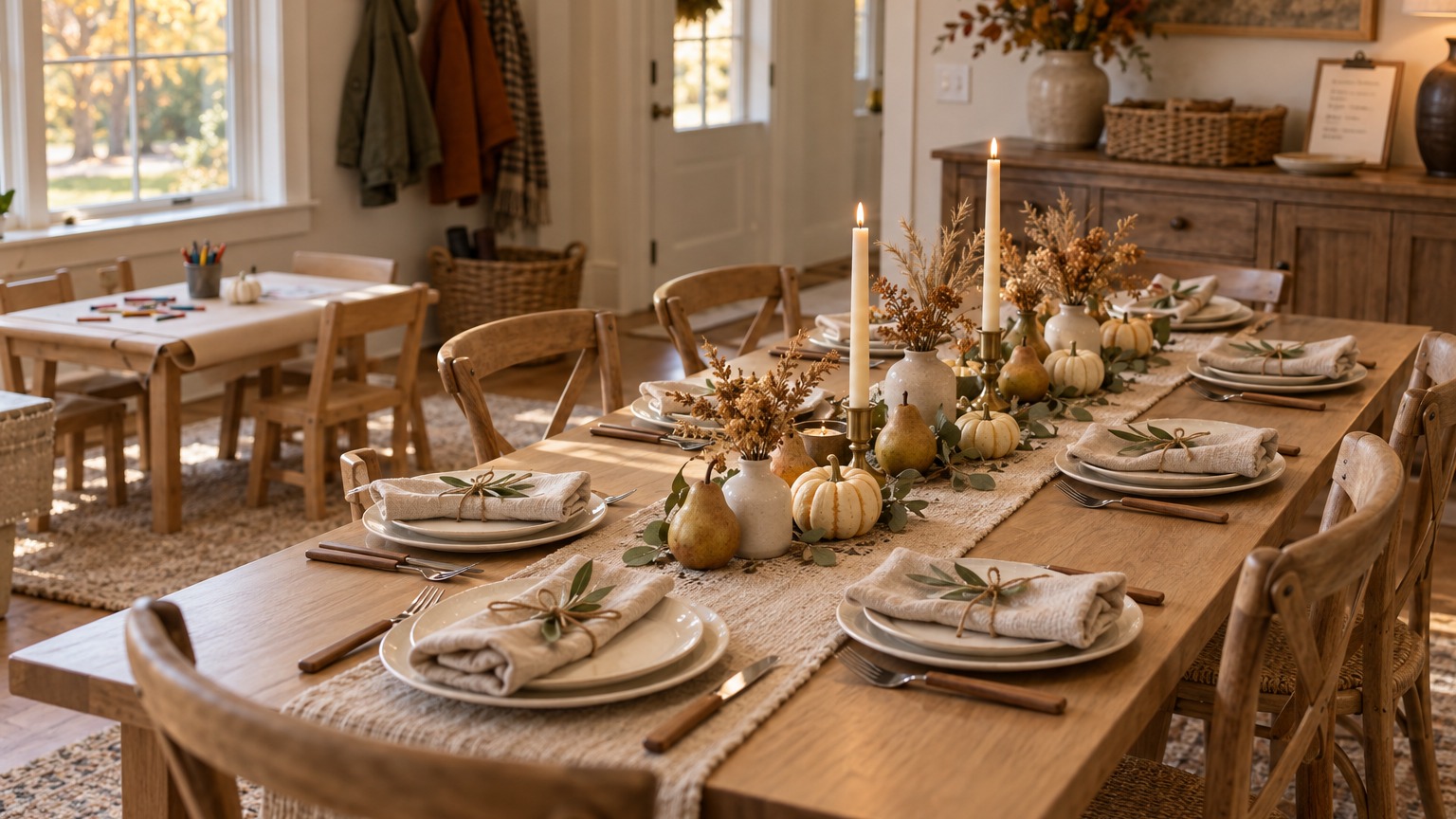
| Natural materials | Linen, wood, ceramic, dried stems, pears and small gourds |
| Restrained palette | Cream, oat, warm brown, sage, a touch of rust |
| Nothing precious at kid height | Candles on high shelves or in LED form, glass kept off the kids’ table |
| Washable everything | Cloth napkins that can be thrown in a hot wash, runners that tolerate spills |
A few budget-friendly decor moves I come back to every year:
- A row of small pears down the center. Pears, or pumpkins labeled edible, are fine to eat afterward. Ornamental gourds are for decoration only and belong out of toddler reach.
- Simple brown craft paper as a runner, with place names written directly on it.
- A few dried stems in bud vases, spread along the table.
- LED taper candles with a screw-secured or taped battery compartment. They look warm and have no open flame. Keep them out of reach of children under 6.
- Pinecones, dried stems or ornamental branches as filler.
Safety firstCheck that LED candles have no loose batteries. A swallowed button battery can cause severe internal burns within hours. If a battery may have been swallowed, go to the ER at once or call Poison Control at 1-800-222-1222. If you keep nuts as decor, use a sealed jar and flag nut allergies to guests.
If you already have decor from the last few years, shop your own house first. A neutral palette makes everything you own work together.
Set up the “landing zone” for guest items
Create one spot for things guests will arrive with: casserole dishes, wine, flowers, and coolers. A clear counter or a folding table near the kitchen works. Put a few pieces of masking tape and a marker nearby so guests can label their dishes with their names, which saves a lot of confusion at cleanup.
Do the big shop, in two trips
Split your shopping into two:
Trip one (a week out): non-perishables and frozen
- Canned goods, broth, flour, sugar, spices
- Foil, parchment, plastic wrap, storage containers
- Drinks, ice, paper goods
- The frozen turkey, if you’re buying frozen
Trip two (Monday or Tuesday): perishables
- Fresh vegetables, herbs, dairy
- Fresh bread and rolls
- Anything you want to be at its freshest
Avoid the Wednesday store entirely. It’s chaos, and you’ll lose an hour.
Plan the thaw
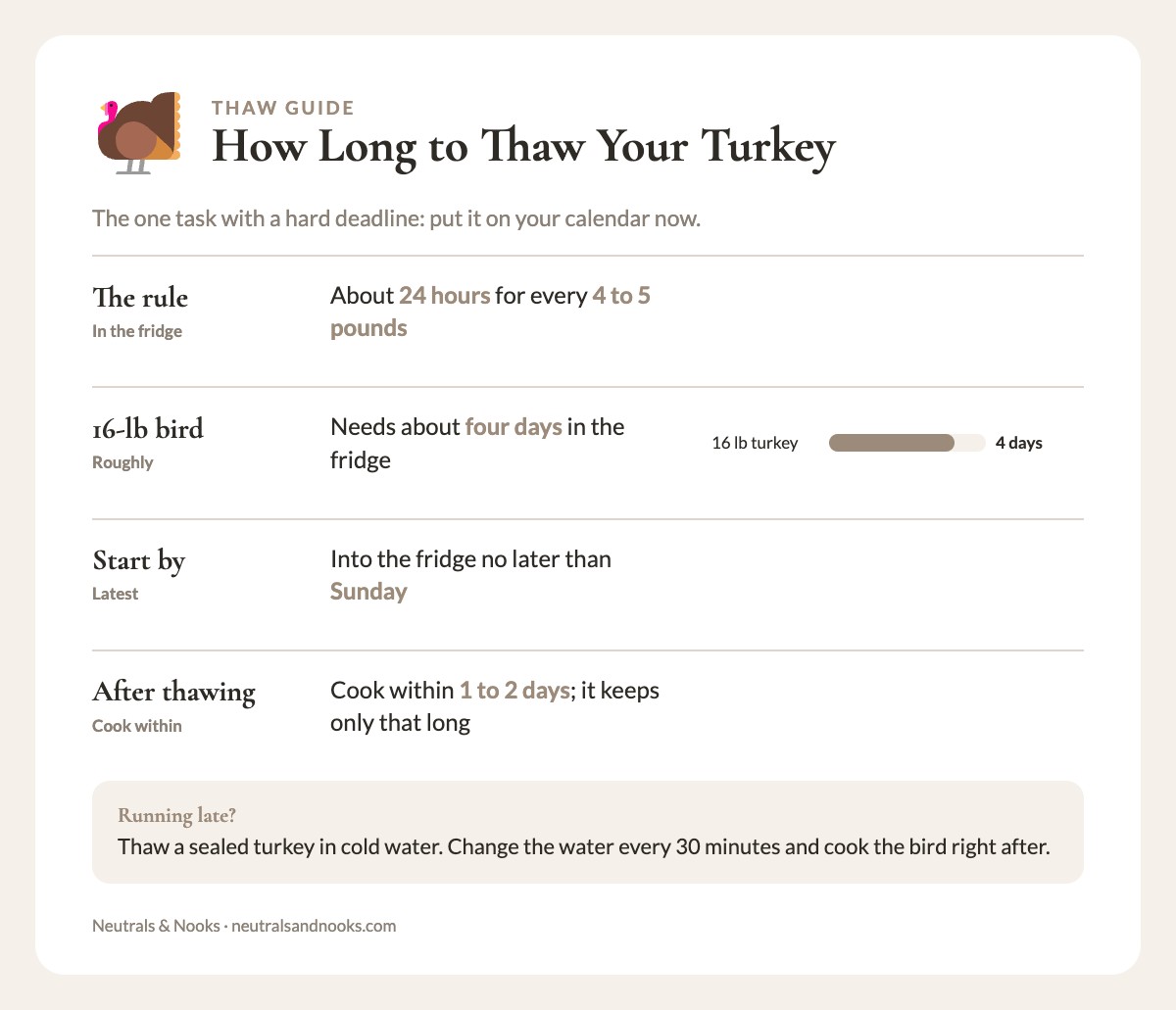
A frozen turkey needs about 24 hours in the refrigerator for every 4 to 5 pounds. This is the single task in the whole timeline with a hard deadline, so put it on your calendar now.
- Weigh the bird. A 16-pound turkey needs roughly four days.
- Count back from Thursday. It goes into the fridge no later than Sunday.
- Use a pan on the bottom shelf. It catches drips away from other food.
- Cook within 1 to 2 days of thawing. A thawed turkey keeps only that long in the fridge.
Good to knowRunning late? You can thaw a sealed turkey in cold water instead. Change the water every 30 minutes and cook the bird right after.
Thanksgiving Week, Day by Day
Now you cash in everything you’ve done. If the previous weeks went even moderately well, this week should feel manageable.
Monday: Stage the house
- Do a final 20-minute sweep of the guest path: entry, living room, bathroom.
- Confirm the turkey is thawing in the fridge.
- Do the second shopping trip for perishables.
- Wash and iron or steam napkins and the tablecloth.
- Write out your cooking schedule for Thursday, working backward from the time you want to eat.
Tuesday: Prep ahead
Tuesday is for the things that taste fine, or better, made early:
- Chop onions, celery, and carrots
- Make cranberry sauce
- Prep pie crust or bake pies; refrigerate pumpkin and custard pies once cooled
- Make any dips, spreads, or soups
- Toast bread cubes for stuffing
- Set out serving dishes with sticky notes showing what goes in each, which is one of the best Thanksgiving tricks I know
Wednesday: Set the table and clear the decks
- Set the table. Do it fully: plates, flatware, glasses, napkins, centerpiece. It makes the house feel ready, and Thursday morning is calmer when it’s done.
- Set up the kids’ table with paper, crayons, and name cards.
- Make up the guest beds if guests arrive tonight.
- Do a full fridge check. Is there room for what’s coming? Move drinks into the cooler.
- Prep the make-ahead sides: mashed potatoes can be made today and reheated, and casseroles can be assembled and refrigerated.
- Run the dishwasher tonight so it’s empty in the morning, and empty the trash.
- Pick your outfit and put it somewhere you can reach it. You’ll thank yourself.
Go to bed at a decent hour. A rested host is better than a perfect centerpiece.
Thursday: Run the day
Work backward from your serving time. Here’s a sample schedule for a 3:00 p.m. dinner, with a turkey of about 14 to 16 pounds:
| Time | Task |
|---|---|
| 8:00 a.m. | Breakfast for the family, kids dressed, quick tidy |
| 9:00 a.m. | Heat the oven; season the turkey (no more than 30 minutes out of the fridge) |
| 10:00 a.m. | Turkey into the oven |
| 11:00 a.m. | Guests start arriving; set out snacks and drinks; give the kids an activity |
| 12:30 p.m. | Check turkey with a thermometer; baste if you like |
| 1:30 p.m. | Turkey should be nearing done; confirm it reaches 165°F in the thickest part of the thigh and breast |
| 1:45 p.m. | Turkey rests under foil; oven is free for sides |
| 2:00 p.m. | Reheat sides, make gravy, warm the rolls |
| 2:45 p.m. | Carve; transfer everything to serving dishes |
| 3:00 p.m. | Sit down, together |
Safety firstDon’t rinse raw poultry. Wash hands and surfaces after handling it, and keep kids away from it and from the oven and stove zone.
Roasting times vary by oven and bird size, so rely on the thermometer, not the clock. Build in a buffer of 30 minutes. A turkey that finishes early rests happily. A turkey that finishes late makes everyone cranky.
Delegate on the spot. When someone says “What can I do?”, have an answer ready. Keep a list of small jobs: fill water glasses, carve, mash potatoes, turn on the candles, wrangle the kids to the table. People genuinely want to help, and giving them a job makes them feel useful. If you use real candles, only adults light them and they stay out of kids’ reach.
A note on leftovers
Get the food into the refrigerator within two hours of serving. It’s easy to lose track of time after a long meal. Set a phone timer when you sit down. Have containers ready, or ask guests to take plates home. It’s an easy, generous exit.
Hosting Thanksgiving With Kids
Most of the hosting advice you’ll find assumes an adult-only guest list. When kids are in the mix, there are a few things that really help, whether they’re yours or your guests’.
Give them jobs by age
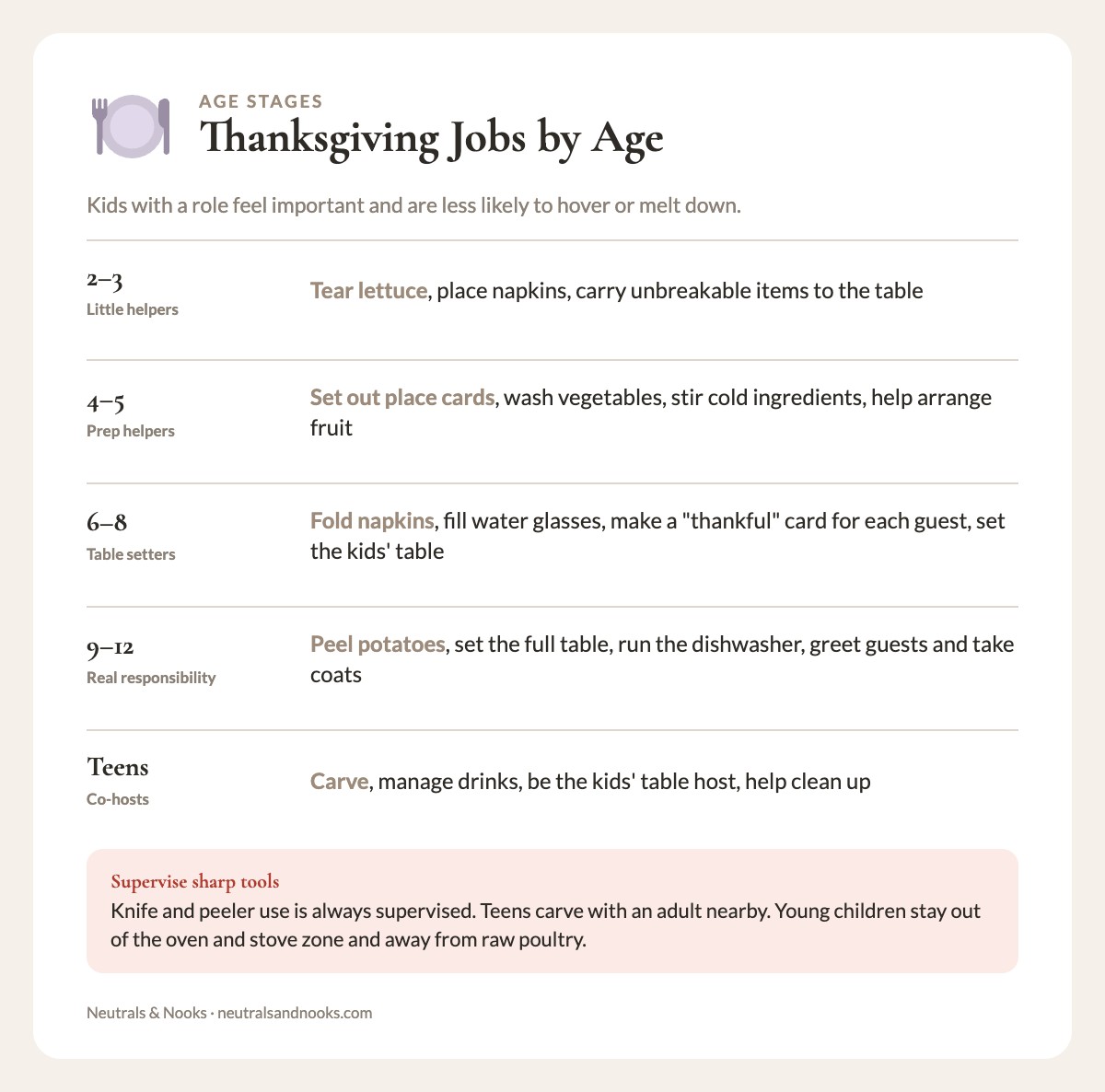
Kids who have a role feel important, and they’re also less likely to hover or melt down. Here are some age-appropriate jobs:
| Age | Job |
|---|---|
| 2–3 | Tear lettuce, place napkins, carry unbreakable items to the table |
| 4–5 | Set out place cards, wash vegetables, stir cold ingredients, help arrange fruit |
| 6–8 | Fold napkins, fill water glasses, make a “thankful” card for each guest, set the kids’ table |
| 9–12 | Peel potatoes, set the full table, run the dishwasher, greet guests and take coats |
| Teens | Carve, manage drinks, be the “kids’ table host,” help with cleanup |
Knife and peeler use is always supervised. Teens carve with an adult nearby. Young children stay out of the oven and stove zone and away from raw poultry.
Plan for the hour before dinner
The hour before the meal is when every child is hungry, every adult is busy, and every nerve is frayed. Plan for it:
- Put out a healthy snack tray at about 1:30, enough to take the edge off but not fill them up.
- Set up a quiet activity in a corner: a puzzle, coloring, a movie in another room.
- Take the kids outside for a walk or a game before dinner if the weather allows. Burn the energy off before everyone sits down.
Make room for the babies and toddlers
Little ones need their own logistics. Keep a baby-gate on any stairs. Put hot dishes at the center of the table, and don’t leave cords or tablecloths hanging within toddler reach. A runner is safer than a full tablecloth for the table that has a crawler nearby.
Safe sleepInfants nap on their back in a pack-and-play or crib with a firm, flat mattress and no blankets, pillows or bumpers. Adult beds are only for older kids. Room-sharing is safest. If the nap room is separate, use a monitor.
Talk to your own kids ahead of time
A few days before, explain what’s going to happen: who’s coming, where they’ll sleep, which toys are for sharing. If your child has a favorite item that’s not for sharing, let them put it away in their room. It prevents tears later. Be honest, too, about the schedule. “Grandma will be here for three nights, and you’ll have the whole family together on Thursday” sets a better expectation than a surprise.
Lower your own bar, deliberately
A child who spills cranberry sauce on the rug is not a ruined holiday. Pick one or two things to care about and let the rest go. For me, it’s the food being hot and the kids feeling included. Everything else is negotiable.
If You’re Starting Late: The Compressed Timeline
Maybe you’re reading this with less than two weeks to go. That’s okay. Here’s how to compress the plan into about ten days, still keeping the order.
| Days out | What to do |
|---|---|
| 10–9 | Confirm headcount and menu, assign dishes, buy non-perishables, order or borrow chairs |
| 8–7 | Declutter the entry, living room, and bathroom (20 minutes each) |
| 6–5 | Make up the guest room, plan the sleeping chart, and move the turkey to the fridge if it’s frozen |
| 4 | Plan the table and kids’ table; pick simple decor |
| 3 | Do the perishable shop |
| 2 | Prep ahead: chop, bake, assemble |
| 1 | Set the table, clear the fridge, empty the dishwasher |
| Day | Run the schedule and delegate |
If you have to cut something, cut in this order:
- Decor. A cloth, candles, and a few pears are plenty.
- The full decluttering. Do only the entry and the bathroom.
- The perfect guest room. Fresh sheets, a lamp, and a clear surface are enough.
Don’t cut the turkey thaw, the headcount, or the delegation. Those are what keep the day running.
After the Meal: The Friday Reset
It’s easy to treat the reset as an afterthought, but a calm Friday morning makes the whole holiday feel better. Spend an hour or so on these:
- Strip the guest beds and start the laundry. If guests are still here, do this the moment they leave.
- Wash the table linens while stains are fresh. A quick soak in cold water helps with cranberry and gravy.
- Consolidate the leftovers. Combine half-empty containers and label them with the date. Eat or freeze leftovers within 3 to 4 days of cooking, which means by Monday at the latest.
- Put the house back. Return the toys you boxed up, hang the coats on the hooks again, and move the extra chairs.
- Make a note for next year. Write down what worked and what didn’t: how much turkey you needed, which dish ran out, what you’d do differently. Keep it in a folder or on your phone.
Then, if you’re tackling Christmas, your decluttering is already half done. It makes the next stretch much easier. The extra boxed-up toys, the cleared entryway, and the empty fridge shelves all carry forward.
A Quick Printable Checklist You Can Copy
If you like a single list to tape to the fridge, here it is.
4 weeks out
- Confirm guest list and overnight guests
- Set menu and assign dishes
- Note allergies and dietary needs
- Check equipment, borrow or buy what’s missing
- Pick a one-sentence house theme
3 weeks out
- Declutter entry and coat storage
- Clear living room surfaces
- Rotate toys, box half
- Clear dining table
- Clear kitchen counters
- Reset guest bathroom
- Start eating down the fridge
2 weeks out
- Make a sleeping chart
- Wash and make up guest beds
- Stock the guest room basket
- Plan bathroom and towel logistics
- Kid-proof the guest zone
1 week out
- Sketch seating plan
- Plan the kids’ table and its activities
- Shop for decor, or shop your own house
- Do non-perishable shopping
Sunday (4 days out)
- Turkey into the fridge to thaw (about 24 hours per 4–5 lbs); a thawed turkey keeps 1–2 days
Monday to Wednesday
- Perishable shopping
- Prep ahead: chop, bake, assemble
- Set the table
- Clear two fridge shelves
- Empty the dishwasher
Thursday
- Follow the schedule, use the thermometer
- Delegate small jobs
- Refrigerate leftovers within two hours
Friday
- Laundry, linens, and beds
- Consolidate leftovers
- Reset the house
- Write notes for next year
Frequently Asked Questions
How far in advance should I start preparing to host Thanksgiving?
Four weeks is the sweet spot for a full, unhurried plan: it gives you time to count guests, set the menu, declutter in small daily chunks, and prepare a guest room without ever having a stressful evening. That said, plenty of people host successfully with just ten days. If you’re short on time, focus on the headcount, the turkey thaw, the entry, and the bathroom, and let decor be as simple as a cloth and some candles.
What should be on a Thanksgiving hosting checklist for families?
A good family checklist covers five areas. People: headcount, allergies, who’s sleeping where. Food: menu, shopping, thaw, prep schedule. House: decluttering, entry, bathroom, guest room. Table: seating, kids’ table, decor, dishes. Aftercare: leftover plan, laundry, a reset day. The timeline above, plus the printable list near the end, walks through each one in order so nothing sneaks up on you in the final days.
How do I prepare my house for guests without a major cleaning marathon?
Declutter by guest path instead of by room. Walk the route a guest takes, from the front door to the table, the bathroom, and the guest bed, and clear only what’s on that route. Twenty minutes a day for one zone each day, starting three weeks out, is enough. Then do one final sweep on Monday and a quick wipe of the bathroom on Wednesday. Your closets, drawers, and basement don’t need to be touched.
How do I keep kids occupied while I’m cooking and hosting?
Give them real jobs matched to their age, set up one calm activity zone with puzzles, coloring, or a movie, and plan a burst of outdoor play before dinner. A simple snack tray around 1:30 p.m. heads off the pre-dinner meltdown. For the kids’ table, assign a teenager or a relative as the “table host” so you’re not the only adult responsible for them.
How can I fit overnight guests in a small home?
Start with a written sleeping chart and ask your guests what they need. Use the best bed for the guests who need it most, such as older relatives, and put flexible sleepers like teens or cousins on pull-outs, air mattresses, or sleeping bags. Clear a small section of closet space, add a lamp and a surface for a phone, and put real sheets on every bed. A simple, tidy setup feels more welcoming than a crowded room trying to look like a hotel.
How do I make the table look nice without worrying about kids wrecking it?
Keep it low, soft, and washable. Use short arrangements, natural materials such as linen, wood, and small gourds, LED candles, and cloth napkins you can launder. Keep glass and anything precious off the kids’ table and out of toddler reach. A restrained neutral palette looks calm even when something gets spilled, and you can shop your own house for most of it.
What if something goes wrong on the day?
Something small usually does: the gravy is lumpy, a pie cracks, the rolls burn. Guests rarely notice, and if they do, they’ll remember your warmth long after they forget the gravy. Keep a backup plan for the big failures, such as a store-bought pie in the freezer and a few extra cans of broth, and trust your thermometer. The goal is a day where people feel welcome, not a day where everything is flawless.
One Last Thought Before You Start
A good Thanksgiving doesn’t come from a perfect house. It comes from a house where people can walk in, find a place to put their coat, sit down at a table with room for everyone, and feel like they belong. Every task in this timeline is aimed at that, and none of it needs to be done perfectly. Pick the week you’re in, do the next small thing, and let the rest wait its turn. You’ve got this, and the people coming through your door are mostly just glad to be invited.