
Small Nursery Ideas: Maximize Space in a Tiny Room
Maximize every square inch of your tiny nursery with smart design. This guide helps you choose essential furniture like mini cribs and dual-purpose dressers, plus clever storage solutions to create a beautiful, functional space.
- Reframe your mindset: Babies need essentials, not a large room.
- Prioritize only must-have items; skip separate changing tables or large gliders.
- Choose space-saving cribs like mini cribs or minimalist standard options.
- Utilize dual-purpose furniture, like a dresser for changing and storage.
- Maximize vertical space and closet organization to store baby's items.
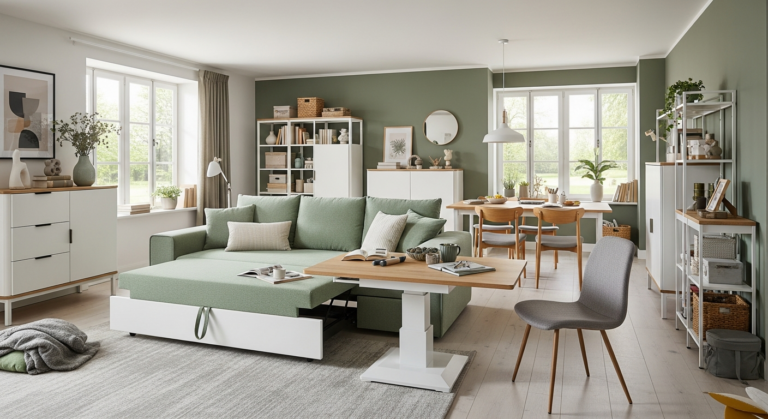
Not everyone has a spacious room to dedicate to their baby. Maybe the nursery is a converted closet, a corner of your bedroom, or a room so small you wonder if anything will fit. Babies don’t need much space. With smart design, even the tiniest nursery can be beautiful and functional.
This guide covers safe crib options for tight rooms, dresser and closet storage, layouts, closet and alcove nooks, and a realistic budget. Every idea comes with the safety checks that matter in a small space. If you are still deciding what to buy, start with nursery essentials you actually need.
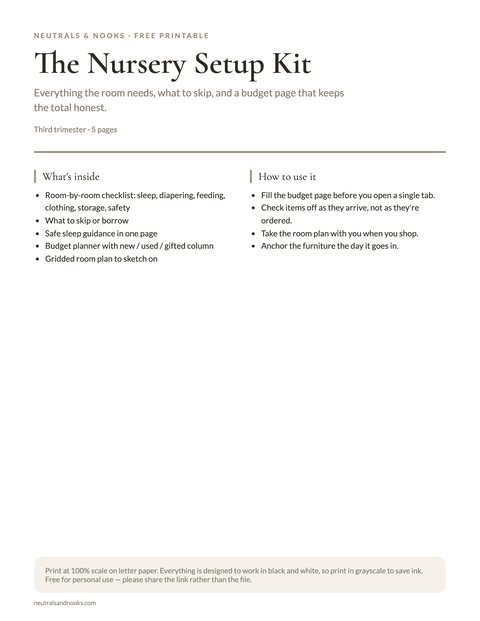
Free printable · 6 pages
The Nursery Setup Kit
Everything the room needs, what to skip, safe sleep in one page, and a budget planner that keeps the total honest.
Free. Your download link appears right here. You'll also join the Monthly Home Reset. Unsubscribe anytime. Privacy
In this article (11 sections)
- The Small Nursery Mindset
- Essential Elements Only
- Best Cribs for a Small Nursery
- Dresser and Storage Strategies
- Small Nursery Layout Ideas
- Sharing a Room: Nursery Corner Ideas
- Small Nursery Decor and Color Ideas
- Closet Nursery Ideas and Nooks
- Budget Breakdown: Small Nursery
- Frequently Asked Questions
- Conclusion
The Small Nursery Mindset
First, let’s reframe how you think about small nurseries:
Babies don’t need big rooms. They need a safe sleep space, a place to be changed, and storage for their things. That’s it.
Cozy can be beautiful. Small spaces feel intimate and warm. Embrace that.
Less stuff = less chaos. Small spaces force intentionality. You’ll only keep what you actually use.
This season is temporary. Nursery needs change quickly, so design for the first 2-3 years, not forever.
Essential Elements Only
In a small nursery, every item must earn its space. Here’s what you actually need:
Must Haves
- Safe sleep basics: a bassinet, mini crib, or standard crib, depending on space.
- Changing surface: the top of a dresser works, so no dedicated table is needed.
- Storage for clothes and diapers: a dresser, a closet system, or both.
- Comfortable seat: for night feeds, though this can be elsewhere in the home.
Safe sleep basicsPut baby to sleep on their back, on a firm, flat mattress with only a fitted sheet. No pillows, bumpers, blankets, or soft toys in the sleep space. Keep baby on a separate sleep surface in your room for at least the first 6 months, as the AAP recommends. Any mobile must be out of baby’s reach and removed once they can push up on hands and knees (about 5 months).
Nice to Haves (If Space Allows)
Small bookshelf or book display
Decorative elements
Skip Entirely
Separate changing table (use dresser top)
Duplicate storage solutions
Best Cribs for a Small Nursery
The crib is the largest furniture piece. Choose wisely.
Mini Cribs
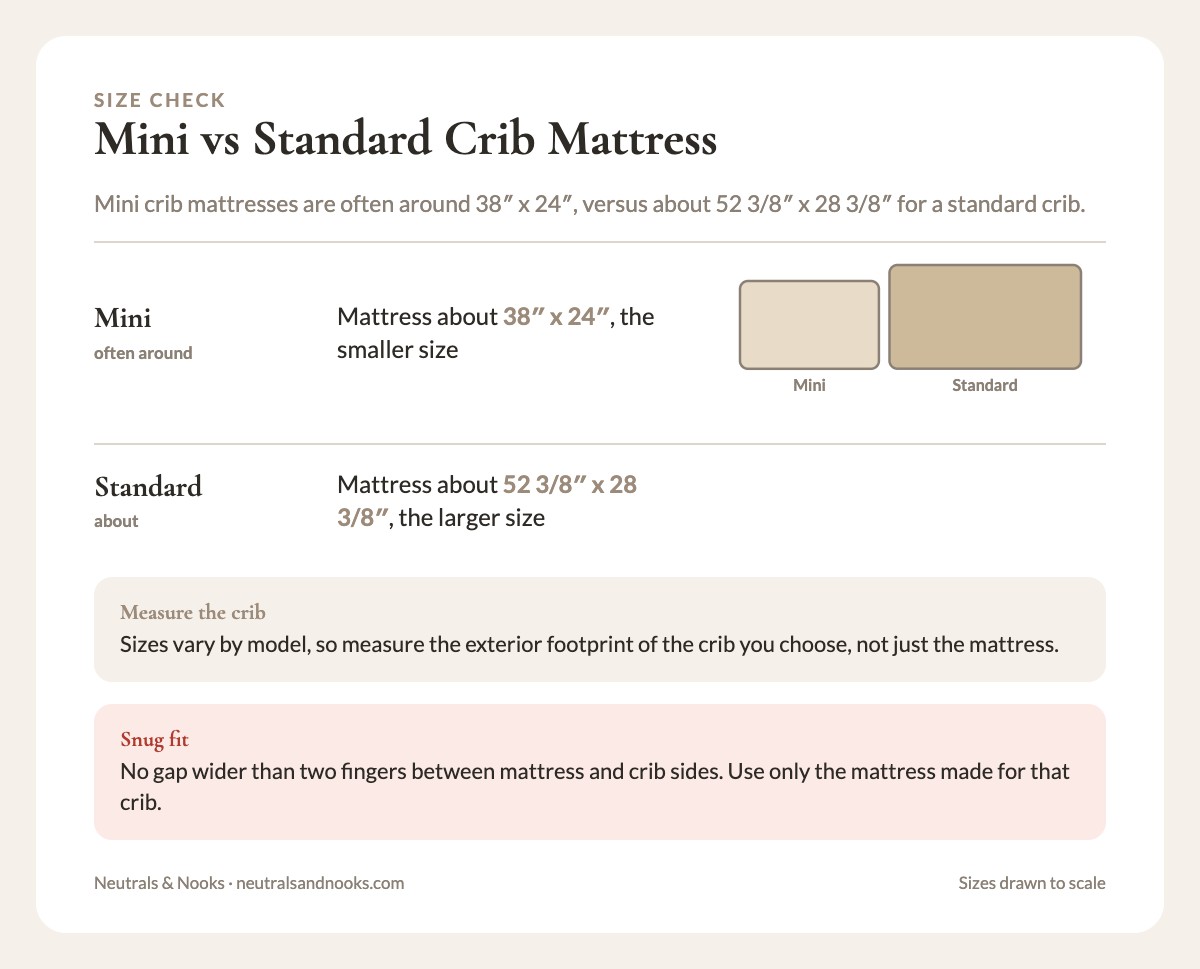
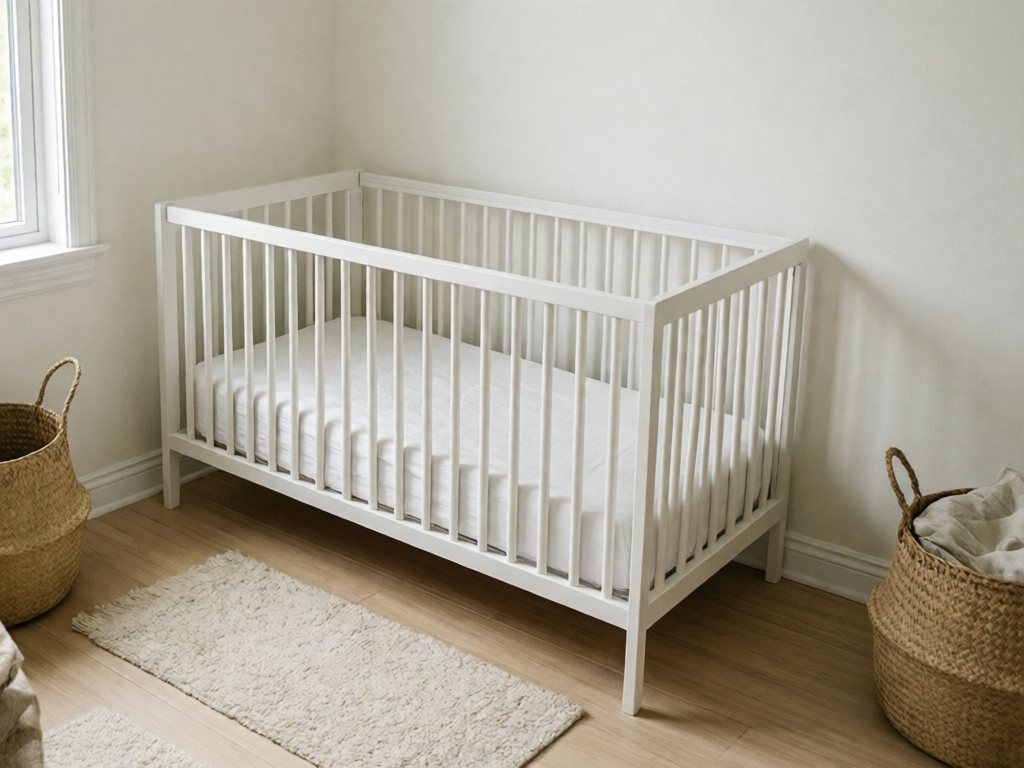
Mattress size: Mini crib mattresses are often around 38″ x 24″, versus about 52 3/8″ x 28 3/8″ for a standard crib. Sizes vary by model, so measure the exterior footprint of the crib you choose.
Best for: Truly tiny rooms, cribs that need to fit in specific spots, and apartment nurseries.
Pros:
- Fits in much smaller spaces.
- Many are on wheels for repositioning.
- Choose a current CPSC-compliant, JPMA-certified crib and use only the mattress made for it.
- Many children outgrow a mini crib between about 18 months and 3 years, depending on height and the manufacturer’s limit.
Cons:
- Move to a toddler bed sooner, as soon as your child can climb out.
- Fewer mattress options.
- May feel cramped for large babies.
Recommended: Babyletto Origami or Dream On Me Folding Mini Crib.
Safety firstThe mattress should fit snugly, with no gap wider than two fingers between mattress and crib sides. Folding models need extra care: check that every lock is fully engaged and the mattress fits properly.
Standard Cribs (Space-Saving Styles)
Look for:
- A minimal footprint, with no curved or ornate details that take extra space.
- A design that converts to a toddler bed, which saves a future purchase.
- A low profile that won’t overwhelm the room.
Recommended: Babyletto Hudson (converts to a toddler bed). IKEA Sniglar has a simple, small footprint but does not convert.
Bassinets First
Strategy: Start with a bassinet in your bedroom and delay the nursery crib purchase.
Benefits: The AAP recommends room-sharing on a separate sleep surface, ideally for at least the first 6 months, so the nursery can wait. Bassinets have manufacturer weight and developmental limits (usually until baby pushes up or rolls over), so check the label and move to a crib by then.
Budget bonus: It gives you time to save for nursery purchases.
Compare Your Sleep Options
| Option | Best for | Trade-offs |
|---|---|---|
| Mini crib | Closets, corners, apartments | Outgrown sooner; size varies by model |
| Standard space-saving crib | Rooms that can fit one full piece | Biggest footprint, but lasts longest |
| Bassinet first | The first months, in your bedroom | Has weight and developmental limits |
Small Nursery Picks
| Item | Approx. price | Why it suits a small room |
|---|---|---|
| IKEA Sniglar crib | $80 | Small footprint, but does not convert |
| Babyletto Origami mini crib | $200 | Compact and on wheels |
| Dream On Me mini crib | $130 | Folds and fits tight spots |
| HALO Bassinest | $200 | Keeps baby beside your bed |
Prices are approximate and change often. A crib plus a bassinet is a good pairing for tight rooms and twins.
Good to knowBuying a used crib? Only buy one made after June 2011, not recalled (check cpsc.gov), complete with all hardware and instructions, with no drop side and no damaged slats. Otherwise buy new.
Dresser and Storage Strategies
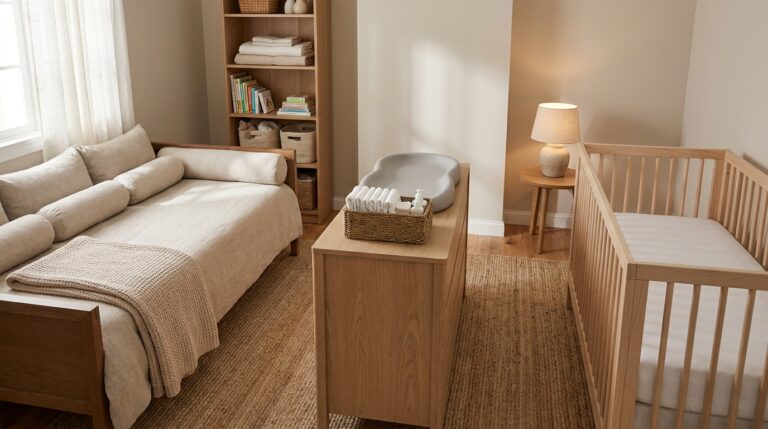
Dual-Purpose Dresser
A dresser does triple duty:
- Clothes storage. This is its main job.
- Changing station. Add a changing pad on top.
- Display surface. It holds a lamp and a little decor.
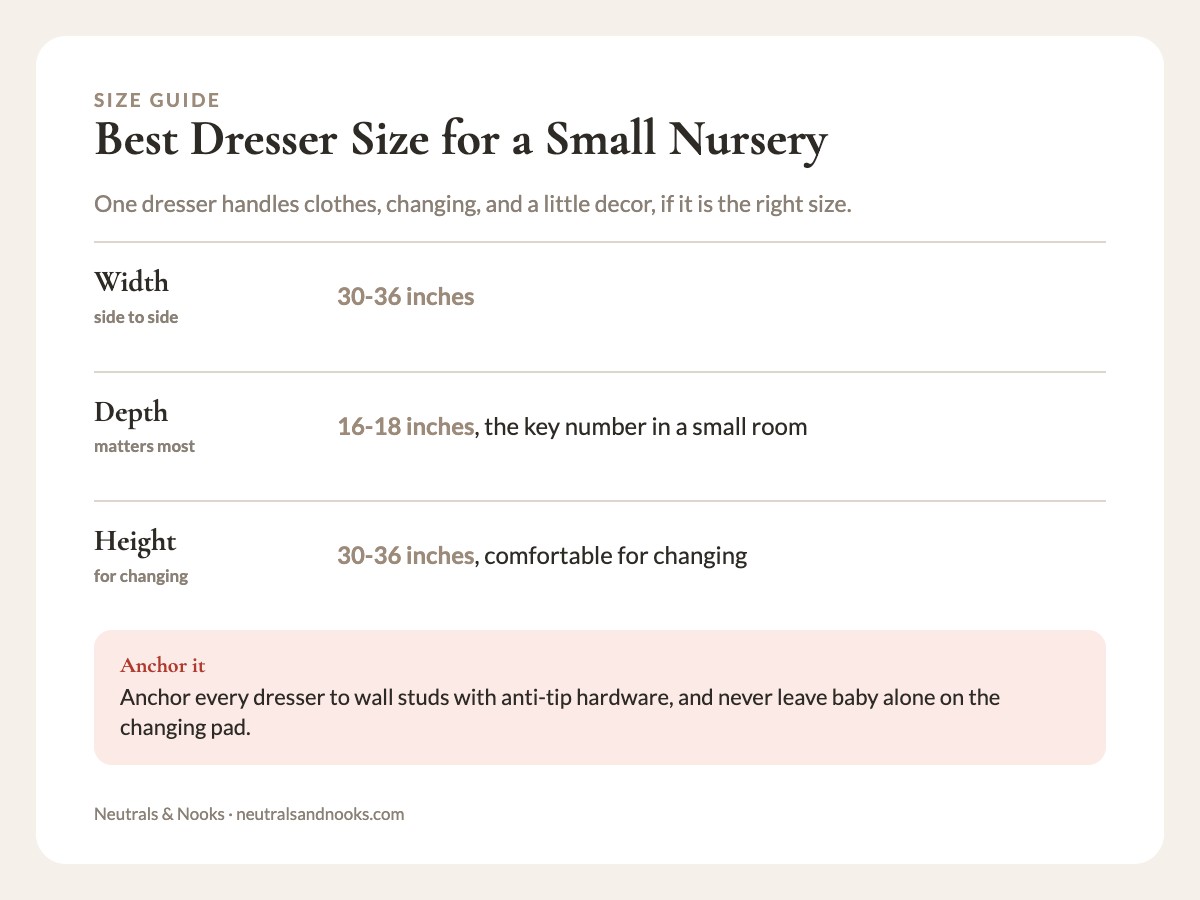
Best dimensions for small nurseries:
- Width: 30-36 inches
- Depth: 16-18 inches. This matters most in a small room.
- Height: 30-36 inches, which is comfortable for changing.
Recommended: IKEA MALM 3-drawer or IKEA HEMNES 3-drawer.
Safety firstAnchor every dresser, bookshelf, and tall piece to wall studs with anti-tip hardware. Keep heavy or climbable items off the dresser top, and never leave baby alone on the changing pad.
Maximize Closet Space
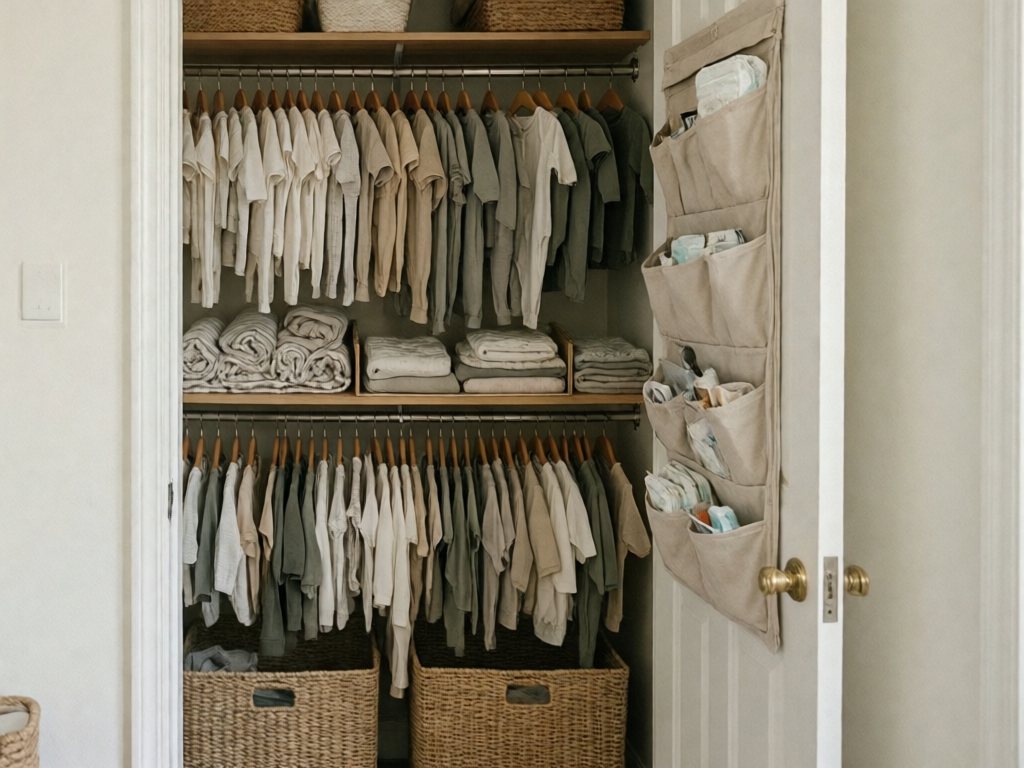
Even a small closet can hold everything if it is organized well.
Closet strategies:
- Add a double rod (upper and lower) for baby clothes.
- Use shelf dividers for folded items.
- Hang door-mounted storage for diapers and small items.
- Keep bins on the floor for less-used items.
- Remove the closet doors for an open-storage feel.
If you have a closet, you might not need a dresser at all.
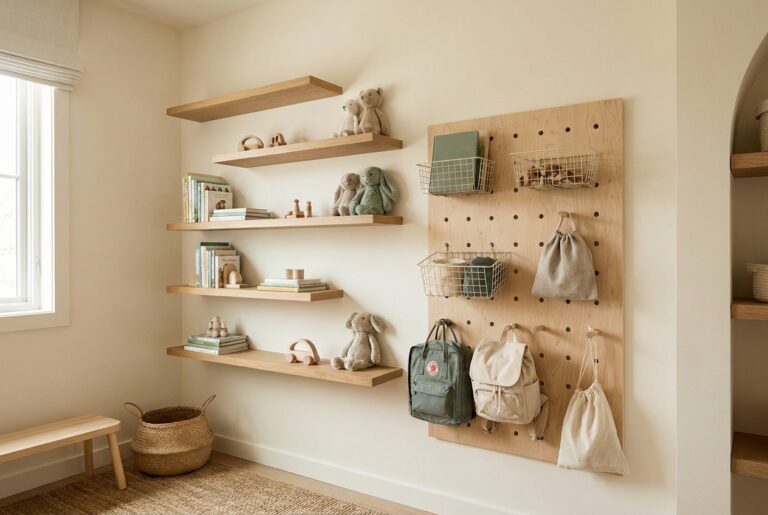
Vertical Storage
Go up, not out:
- Floating shelves for books and small items.
- Wall-mounted baskets or pockets.
- Over-door organizers.
- Tall, narrow bookshelves, anchored to wall studs.
For more low-cost ideas, see Budget Nursery Makeover: Designer Look for Less.
Small Nursery Layout Ideas
- Measure the room. Note windows, doors, outlets, and closet swing.
- Mark the crib footprint. Use painter’s tape on the floor.
- Place the dresser. Choose a spot where you can open drawers fully.
- Check clearances. Keep the crib away from windows, heaters, and cords.
- Anchor furniture. Secure every tall piece to studs before you load it.
Corner Crib Placement
Placing the crib in a corner maximizes floor space. Leave enough room on one side for changing sheets.
Make sure there is no gap baby could get trapped in between the crib and the wall or other furniture. Keep the crib away from windows, heaters, and cords.
Floating Furniture
Furniture that doesn’t touch the floor feels lighter:
- A wall-mounted changing surface that folds down when not in use. Install it into wall studs per the manufacturer and respect the weight limit. Use a strapped changing pad, and keep a hand on baby at every change.
- Floating shelves instead of bookcases.
- A wall-mounted diaper organizer.
Multi-Functional Pieces
Every item should serve multiple purposes:
- A dresser that doubles as a changing table.
- An ottoman with storage inside.
- A crib that converts to a toddler bed.
Sharing a Room: Nursery Corner Ideas
Sharing your bedroom is a good fit for most families. For a fuller plan, see our guest room nursery combo guide.
Nursery Corner in Parents’ Bedroom
What you need:
- A crib or mini crib.
- A small dresser or closet space for baby items.
- Some visual separation, which is nice but not required.
Creating separation:
- A ceiling-mounted curtain track with a cordless curtain, hung well away from the crib and left open while baby sleeps.
- A rug that defines the nursery “zone.”
- A different wall color or treatment.
Benefits: Night feeds are easier and you don’t need a dedicated room. It also matches the AAP advice to room-share on a separate sleep surface, ideally for at least the first 6 months.
Nursery in Living Space
Safety firstIdeally for at least the first 6 months, baby’s sleep space belongs in the room where you sleep. In those early months, use a living-room setup for daytime naps while you are nearby, and move baby to your bedroom overnight.
What you need:
- A bassinet or crib that fits. A mini crib is ideal.
- Contained storage, so baby things aren’t scattered everywhere.
- A way to make the space darker for naps.
Making it work:
- Choose nursery furniture that matches your living area style.
- Use cordless blackout window coverings for nap times. Keep tiebacks and cords well out of reach and the crib away from windows.
- Add a portable white noise machine, placed as far from the crib as possible (at least 7 feet). Keep the volume low, below 50 dB, about a quiet conversation, and don’t run it all night at high volume.
- Keep diapering supplies in attractive containers.
Small Nursery Decor and Color Ideas
Light Colors Expand Space
Soft white, light gray, pale blush or blue, and soft sage all help a small room feel bigger. Use darker colors sparingly, as accents rather than whole walls.
Mirrors Create Illusion of Space
Safe ways to use mirrors:
- Choose shatter-resistant or acrylic mirrors only, secured into studs with proper hardware.
- Hang them on a wall opposite the crib and away from it. Never hang one above the crib or changing area.
- Treat a securely mounted mirror as a decorative element in its own right.
Minimal but Meaningful Decor
Choose:
- One statement piece, such as an art print or name sign. Skip a mobile over the crib, or keep it out of reach and remove it once baby can push up on hands and knees.
- A few high-impact items over many small ones.
- Decor that serves a function, like a lamp, clock, or hooks.
Avoid:
- Cluttered gallery walls.
- Too many competing elements.
- Items that collect dust without purpose.
Transparent and Light Furniture
- Acrylic or lucite: It visually disappears.
- Light wood: It feels airy.
- White or light paint: It brightens and opens the room.
Closet Nursery Ideas and Nooks
Safety firstThe AAP recommends keeping baby’s sleep surface in your room, ideally for at least the first 6 months. So a closet or alcove nursery works best inside your own bedroom, or once baby is past that stage. Never close a curtain or door around a sleeping baby. Keep the space well ventilated and not hot, and use a baby monitor. Use cordless window coverings, keep cords out of reach, and leave no gap between crib and walls.
Closet Conversion
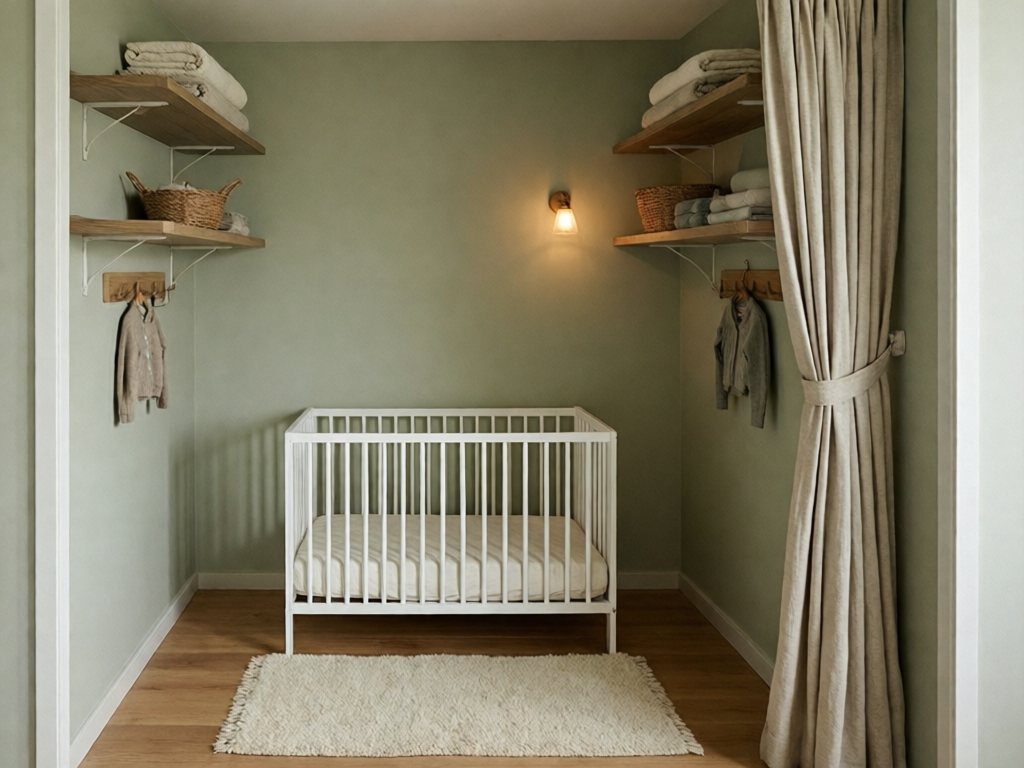
A closet can become a complete nursery, especially one that opens onto your own bedroom.
Remove doors: Instant room extension.
What fits:
- A mini crib at the back, with no gap baby could get trapped in against the wall.
- Shelving on the sides for storage.
- Hooks for the diaper bag and clothing.
- A small rug.
Add:
- Good lighting, since closets often have none. Choose cool-running LED bulbs and battery or wall-mounted lights, with no loose cords.
- Wallpaper or paint for personality.
- A curtain to tuck the nook away when baby isn’t in it. Leave it open and well clear of the crib whenever baby sleeps, with good airflow and a baby monitor.
Alcove Nursery
If you have an alcove or bump-out:
- It makes a naturally contained nursery space.
- The walls give it visual definition.
- A curtain across the opening can hide the nook when it’s not in use. Keep it open while baby sleeps and well clear of the crib. For darker naps, use cordless blackout window coverings instead.
Room Within a Room
Build a nursery zone:
- Use furniture placement to create boundaries.
- Add a ceiling-mounted, cordless curtain track for separation, away from the crib and left open while baby sleeps.
- Lay a rug to define the space.
- Keep the style coordinated but distinct.
Budget Breakdown: Small Nursery
Small nurseries often cost less because there is less room to fill. Prices are approximate and change.
| Item | Minimal setup | Complete setup |
|---|---|---|
| New mini crib | $130-200 | $200 |
| Dresser | $100-150 | $150-200 |
| Changing pad | $25 | $25 |
| Bedding (fitted sheet) | $50 | $50-100 |
| Closet organization | $30-50 | Included above |
| Glider or chair | Skip | $150-250 |
| Cordless blackout curtains | Skip | $50 |
| Small rug | Skip | $50 |
| Total | about $335-475 | about $700-900 |
Budget a little extra for anti-tip hardware. For more savings, see our nursery setup budget guide.
Neutral Nina
Neutral Nina is an interior design enthusiast and mom of three who proves that beautiful, organized spaces and family life can coexist. She shares practical strategies for creating calm, functional homes that work for kids and grown-ups alike.
Frequently Asked Questions
Will my baby outgrow a mini crib too fast?
Many children outgrow a mini crib between about 18 months and 3 years, depending on height and the manufacturer’s limit. Move to a toddler bed once your child can climb out.
Can I fit a nursing chair in a small nursery?
Maybe, but consider whether you need one in the nursery at all. You might prefer feeding in bed, on the living room couch, or in a chair elsewhere. The nursery chair is not mandatory.
If you might fall asleep, feed in a firm bed with no pillows or blankets near baby, never on a couch or armchair. Move baby to their own sleep surface as soon as you wake.
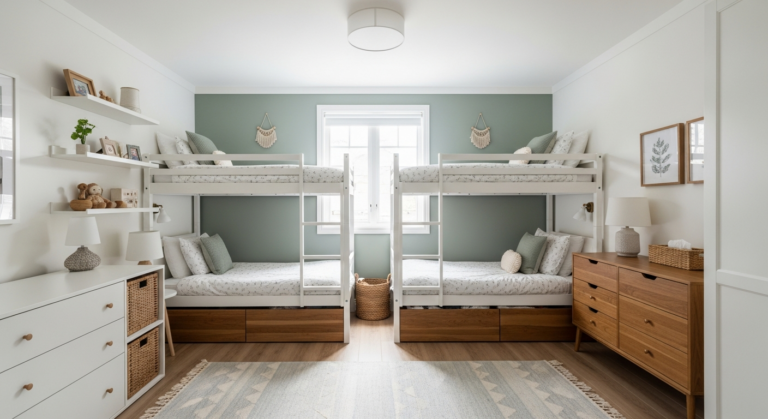
How do I fit twins in a small nursery?
Each twin needs their own sleep surface from day one: two bassinets, two mini cribs, or one crib plus one bassinet. Twins can share a room. A crib plus a bassinet works well in tight rooms. See our baby proofing guide for more safety checks.
What if there’s no closet?
Use a dresser plus an open clothing rack. Freestanding wardrobes work too. Wall-mounted hooks and shelves maximize vertical space.
Conclusion
A small nursery can be cozy, functional, and beautiful. The tight footprint makes you intentional about what earns space, and the result is often more peaceful than an overstuffed large room.
Start with the essentials (a safe sleep space, a changing surface, and storage), choose pieces that work double-duty, and embrace vertical space. Your baby will be perfectly happy, and you might find you prefer the simplicity.
Our Nursery Setup Kit can help you plan it, and nursery organization for small rooms goes deeper on storage.
On a tight budget? Read Budget Nursery Makeover: Designer Look for Less next.