Guest Room Nursery Combo: Keep the Guest Bed and Add a Crib
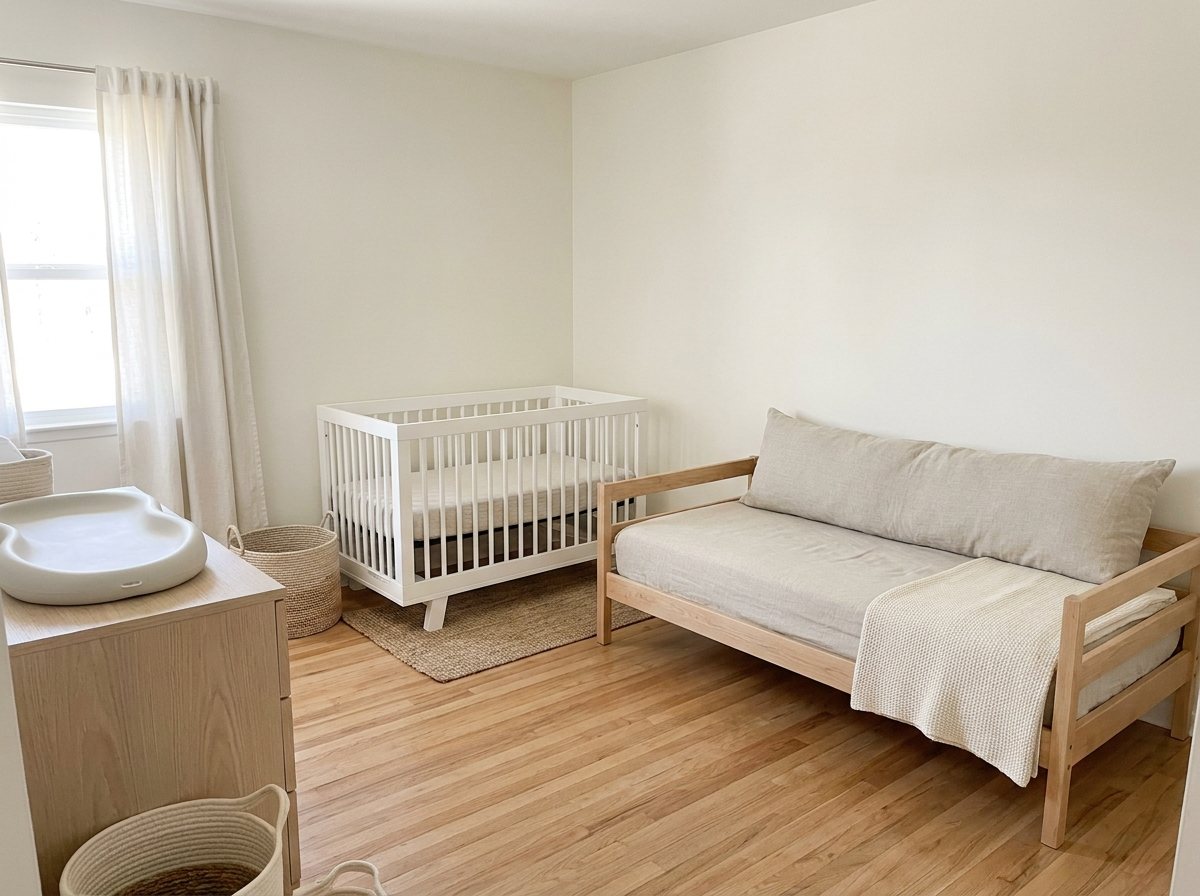
Picture three bedrooms, a baby on the way, and a mother who stays every Thanksgiving and every July. It looks like a choice between a nursery and a guest room. It isn’t.
You can keep the guest bed and add a crib. This guide compares a daybed, a murphy bed, and a trundle, then covers crib placement, a 10×10 layout, storage, safe-sleep basics, and a realistic budget.
Free printable · 6 pages
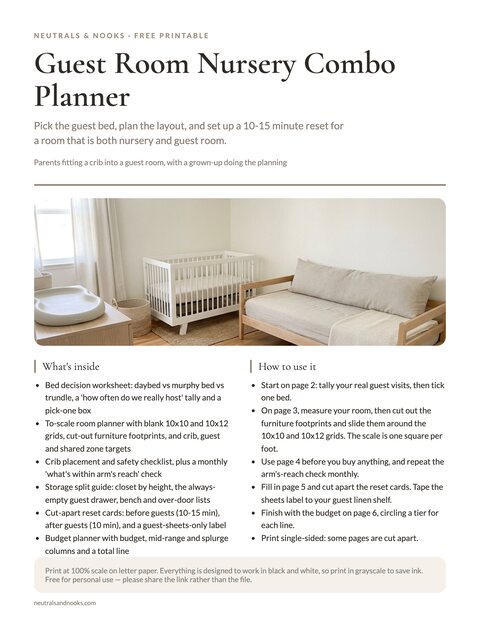
Guest Room Nursery Combo Planner
A bed decision worksheet (daybed vs murphy vs trundle), a to-scale 10x10 and 10x12 room planner with cut-out furniture, a crib placement and monthly safety check, a closet and storage split, nursery-mode and guest-mode reset cards with a guest-sheets label, and a three-tier budget planner.
Free. Your download link appears right here. You'll also join the Monthly Home Reset. Unsubscribe anytime. Privacy
One note up front: the AAP recommends that the baby sleep in your room, on a separate surface, for at least the first 6 months and ideally up to a year. So this room is mainly for daytime, naps, and later overnight sleep. Check the specifics with your pediatrician.
In this article (12 sections)
- Daybed vs. Murphy Bed vs. Trundle for a Guest Room Nursery
- Crib Placement in a Guest Room
- Small Nursery Layouts for a Combo Room
- The Changing Station: Skip the Dedicated Table
- Storage That Serves Both Functions (Not Two Separate Sets of Storage)
- The Reset Routine: Switching Between Nursery Mode and Guest Mode
- Safety Non-Negotiables When a Crib Shares a Room With Guest Furniture
- Budget Breakdown: What This Room Actually Costs
- How to Keep a Combo Room From Becoming Clutter
- When to Reconsider the Combo Setup
- Frequently Asked Questions
- Bottom Line: Guest Room Nursery Combo
Daybed vs. Murphy Bed vs. Trundle for a Guest Room Nursery
Before you buy a crib, decide what your guest sleep surface will be. This choice drives the rest of the room. It sets how much floor space you keep and how you store bedding. It also sets how long the switch from nursery mode to guest mode takes.
There are three realistic options for a dual-purpose guest room nursery: a daybed, a murphy bed, and a trundle bed. Each one solves the space problem differently, and each one comes with tradeoffs that matter more once a baby is actually sleeping in the room.
| Feature | Daybed | Murphy Bed | Trundle Bed |
|---|---|---|---|
| Floor space when not hosting | Full bed footprint, always visible. | Nearly zero; it folds into the wall. | Full bed footprint; the lower bed hides under the upper. |
| Setup time for guests | None; always ready. | 30 seconds to unfold. | 1–2 minutes to pull out the lower bed. |
| Works as adult seating on non-guest days | Yes, easily, with bolster pillows. | No. | Somewhat, if the upper bed has a daybed-style frame. |
| Typical cost range (2026 estimates) | $250–$900 | $1,200–$4,000+ (often needs pro install). | $400–$1,000 |
| Best for | Rooms where guests visit often or the bed needs to double as daytime seating. | Rooms where you want the space to feel like a full nursery most of the time. | Rooms hosting multiple guests occasionally, or families who want the option later. |
| Noise/vibration near crib | None; static frame. | Can be loud folding down; avoid during nap times. | Minimal, but trundle glides can squeak. |
| Renter-friendly | Yes. | Usually needs wall anchoring; check your lease. | Yes. |
If guests visit often, the daybed’s zero setup usually wins.
If a parent visits twice a year for a week at a time, a murphy bed can be worth the upfront hassle. It gives you most of your floor back the rest of the year. There’s no universally correct answer, only the one that matches how often you actually host.
Daybed: The Low-Effort, Always-Ready Option
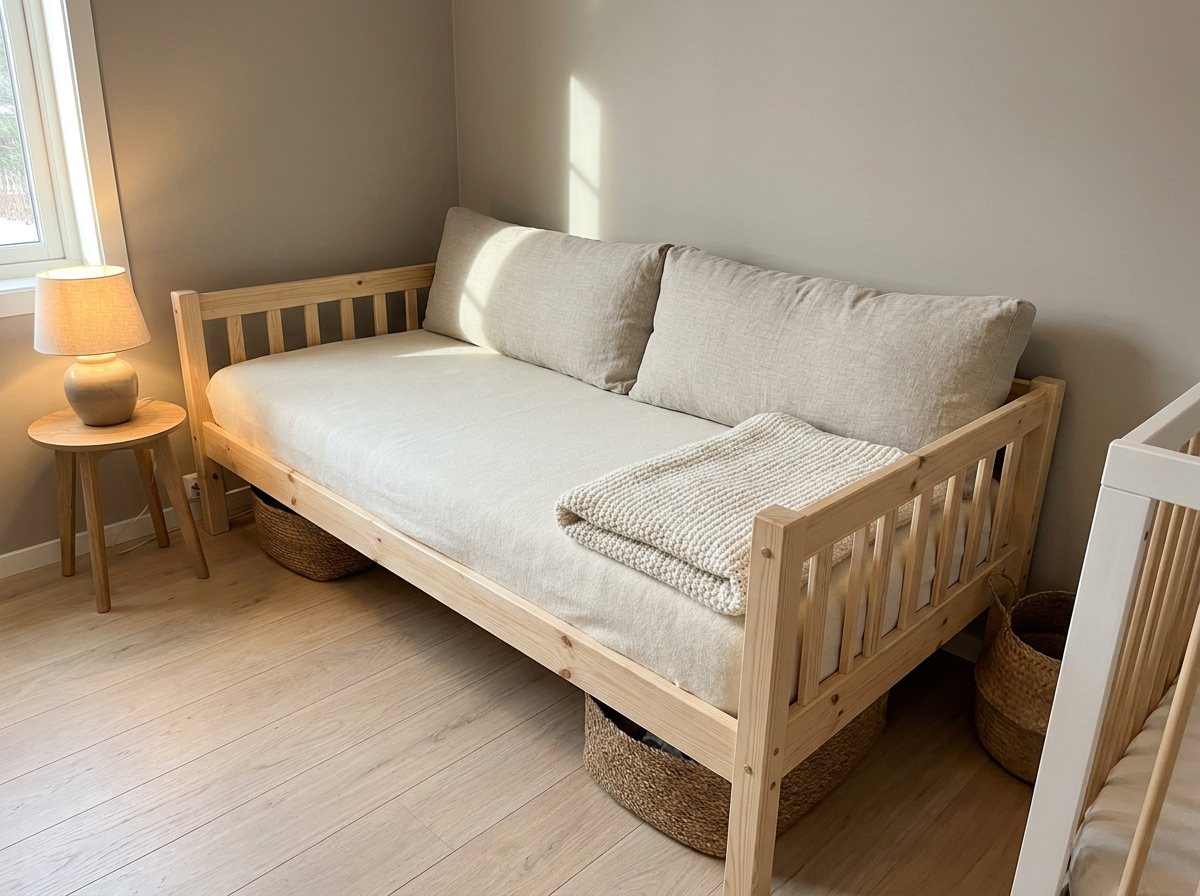
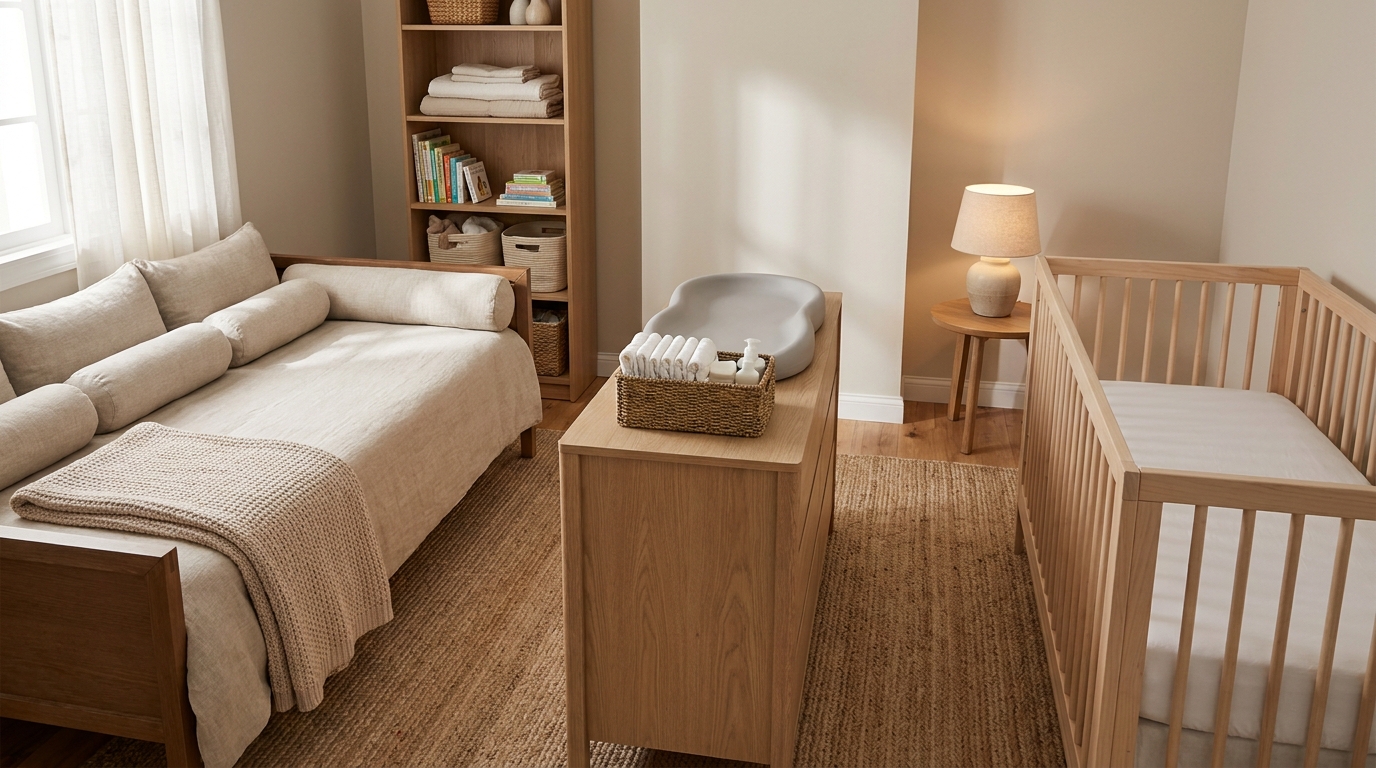
A daybed is essentially a twin bed frame with a back and often side rails, styled to look like a couch. This is the option many families land on for a guest room nursery combo. It needs zero setup for guests. On days when no one is staying, it’s adult seating: a place for you to sit, read, or fold laundry while the baby naps.
Safety firstDon’t feed the baby on a daybed or any soft, cushioned seat, and keep bolsters and pillows away from the baby. A tired parent can fall asleep, and the AAP warns against feeding on sofas and soft surfaces. Feed in a firm, upright spot, then put the baby back in the crib or bassinet.
What to look for in a daybed for this specific use case:
- A twin or twin-XL frame, not full. A full-size bed eats the floor space the crib and dresser need.
- A trundle option built into the base, which turns a daybed into a two-guest solution. Some daybeds ship with a pop-up trundle that raises to full height for two adults side by side.
- A solid, simple frame. Ornate scrollwork or a high canopy competes with the nursery. A plain wood or low-profile metal frame recedes.
- Washable or removable bolster covers. A daybed used as daytime seating will get spit up on eventually.
The daybed’s biggest limitation: it’s always visible and always takes up its footprint, even when no guest is in sight. In a room under 100 square feet, that permanent frame can make the nursery half feel cramped. A folding option leaves more open floor.
Murphy Bed: Maximum Daily Floor Space, Bigger Upfront Investment
A murphy bed (wall bed) folds up into a cabinet or wall unit. You get back nearly the whole footprint of the bed when it’s not in use.
For a nursery, this is the closest you can get to a room that looks like a full nursery most days, with a guest bed that appears only when needed.
The tradeoffs are real, though:
- Cost. Even a basic murphy bed kit runs $1,200 and up; a built-in unit with integrated shelving can run well past $4,000 installed.
- Installation. Most murphy beds need to be anchored to wall studs for safety. For most people that isn’t a weekend DIY, and it’s a harder sell if you’re renting.
- Noise near a sleeping baby. The folding mechanism can be loud. You won’t fold the bed down while the baby sleeps, which limits late-night guest arrivals.
- Swing path and latches. Leave clearance between the bed’s swing path and the crib, and confirm the latches or locks work reliably. Don’t let toddlers play on or near a wall bed.
- Combo units. Some murphy bed and shelving units double as a bookshelf or changing surface when folded up. That adds storage, since the wall unit works as nursery shelving most days.
Murphy beds make the most sense when the room should read as a nursery most days and a guest room only occasionally. If you’re the kind of household that pairs this room with multi-functional furniture throughout the house, a murphy bed is consistent with that whole-home approach.
Trundle Bed: The Middle Ground, With One Extra Perk
A trundle bed is a twin (or daybed-style twin) with a second, lower bed frame on wheels that slides out from underneath. It splits the difference between the other two options. Guests get a real bed with a little setup effort: pulling out the trundle takes 1–2 minutes. When it’s tucked away, the upper bed frame still takes up its footprint.
The trundle’s underrated advantage for a guest room nursery combo: it can grow with your family. Once your child is ready to leave the crib, often around 2½ to 3 years, the lower trundle can become a first “big kid” bed. Move sooner only if your child starts climbing out of the crib. Use the trundle as a stationary low bed, with the wheels locked or removed and the gaps checked, as the safety note below explains.
Families who know they’ll need two kids in one room, even temporarily, often pick a trundle for this reason alone.
Safety firstA wheeled trundle can roll away from the wall and leave gaps a small child could get caught in. Before anyone sleeps on it:
- Lock the wheels, or remove the trundle and use it as a stationary low bed.
- Check the gaps between the mattress and the frame.
- Add rails only if they are rated for that bed.
- Don’t use a low, wheeled bed for a child who isn’t ready to leave the crib.
- An older sibling should never share the crib or sleep surface with an infant. Keep the trundle clear of the crib.
The downside: trundle wheels and glides can squeak. Pulling one out at 11 p.m. for a surprise guest, with a baby asleep ten feet away, is not ideal. If you go this route, test the glide in the store or read reviews that mention noise before you buy.
The Bottom Line on Furniture
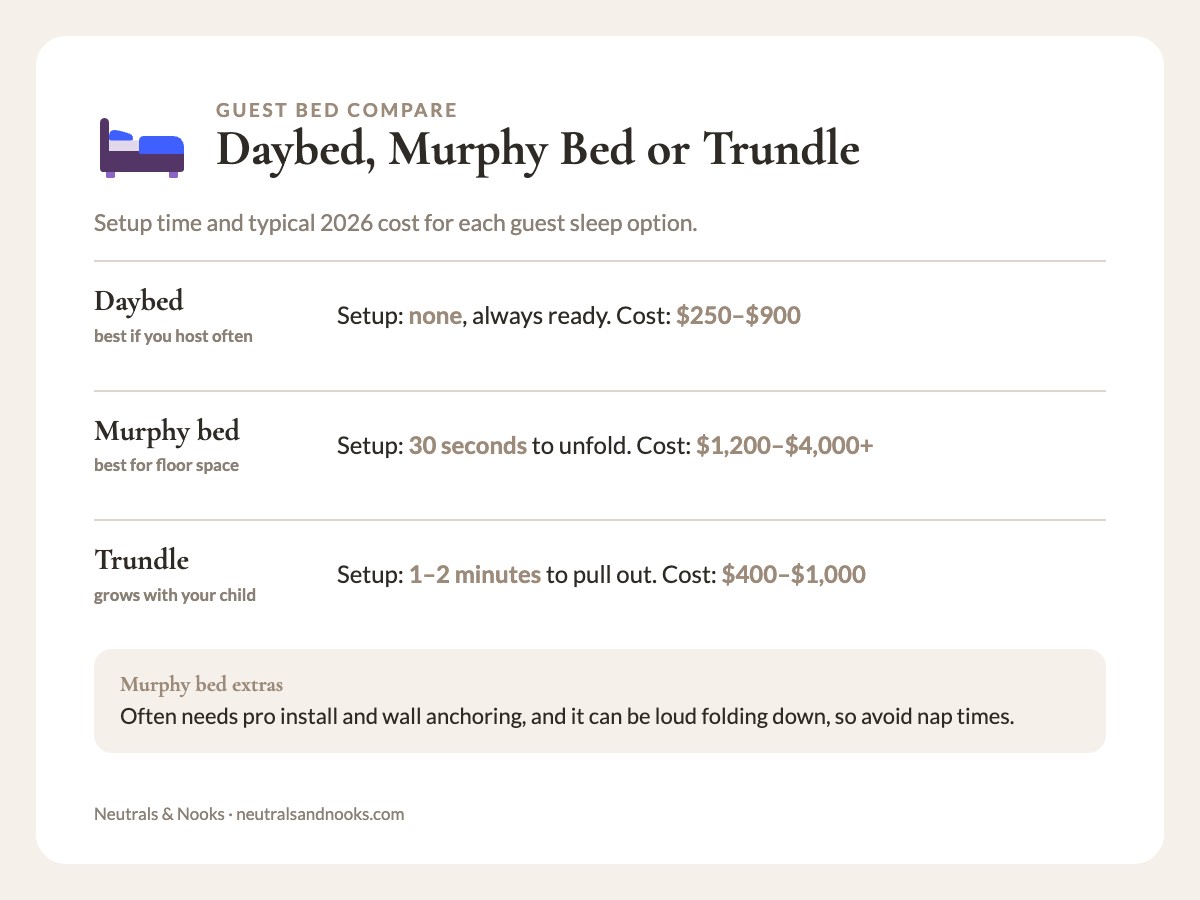
Choose based on how often you actually host. Host often: daybed. Host rarely and want the floor back: murphy bed, if the budget allows. Want a bed that grows with your child: trundle.
Crib Placement in a Guest Room
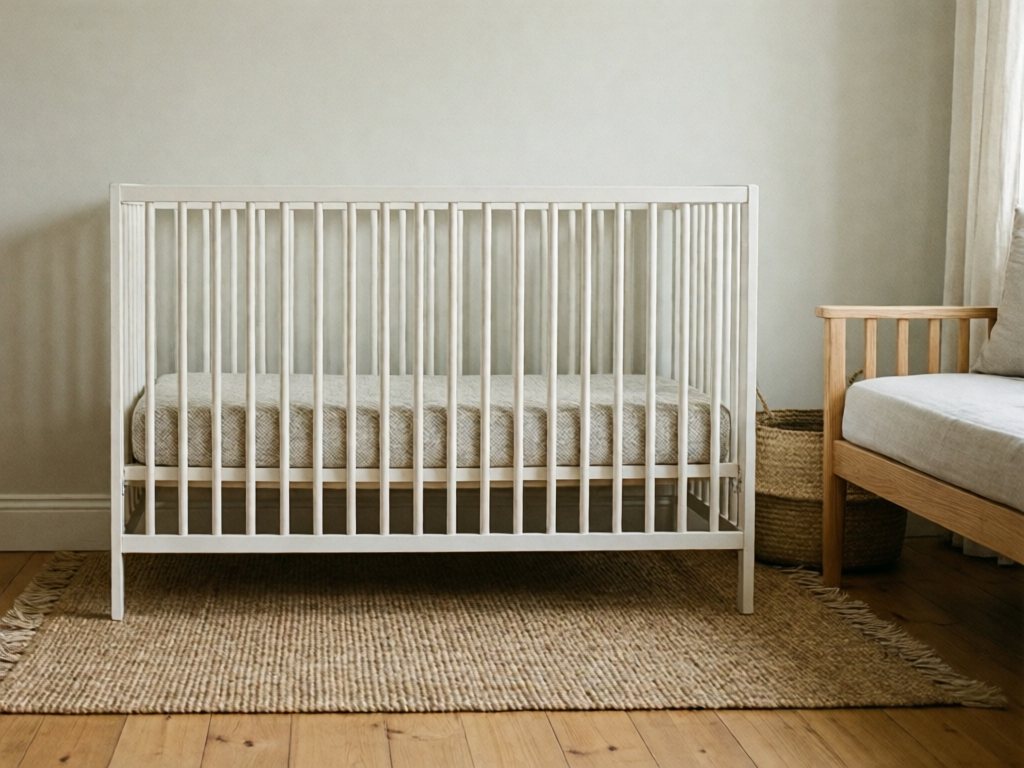
Once you’ve settled on the guest bed, the crib placement decision is next — and it’s not just about what fits. A shared room adds three concerns a standalone nursery doesn’t have. They are guest sightlines, outlet access, and keeping the crib zone distinct from the guest zone.
Away from the door, not facing it
In any nursery, keep the crib away from windows, blind cords, and direct HVAC vents. In a combo room, add one more consideration. Position the crib so it isn’t the first thing a guest sees, and so the crib area doesn’t feel like a walkway.
A crib tucked into a corner, perpendicular to the guest bed, keeps the two zones from competing for the same 10 square feet.
Near an outlet, with cords well away from the crib
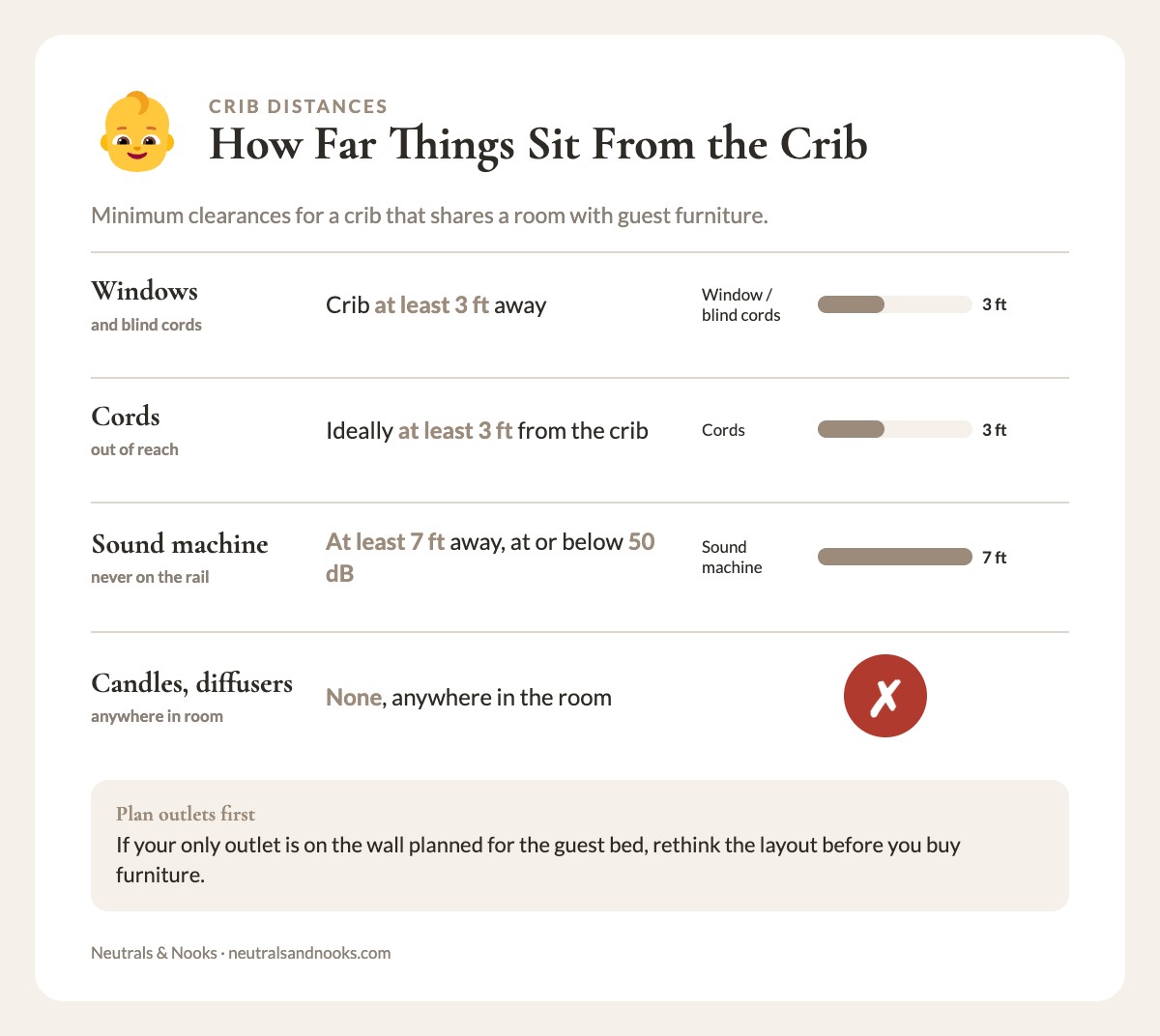
Plan where the sound machine, lamp, and any chargers will plug in before the furniture arrives. The checklist below has the distance for each.
Skip extension cords across the room, which trip guests in the dark.
If your only outlet is on the wall you’d planned for the guest bed, rethink the layout before you buy furniture, not after.
Give the crib its own edge
Even in a small room, a rug remnant or a change in wall color on just the crib’s corner helps the space read as the nursery zone. You don’t need a wall or divider.
This matters more than it sounds. A guest sleeping in a room that is 100% nursery, with a bed shoved in the corner, can feel like an afterthought. That’s worth avoiding if the guest is your mother-in-law staying for two weeks.
Run through these crib placement checks before you buy anything else. Every distance rule for the room lives in this list, so the later sections point back here.
- Crib at least 3 feet from windows and blind cords.
- Crib off the path of any heat vent.
- Cords out of the baby’s reach, ideally at least 3 feet from the crib.
- Sound machine at least 7 feet from the crib, never on the rail, at or below 50 dB.
- No candles or diffusers anywhere in the room.
- Dresser and tall pieces anchored to the wall.
- No furniture a toddler could climb from the crib.
Here’s a simple zone split for an average 10×10 to 10×12 guest room nursery combo.
| Zone | Square footage (approx.) | What lives here |
|---|---|---|
| Crib zone | 25-35 sq ft | The crib on its own rug section. |
| Guest sleep zone | 30-45 sq ft | Daybed, murphy bed or trundle, plus a side table or bench and a reading lamp. |
| Shared/flex zone | Remaining | Dresser (changing station on top, guest drawer inside), closet and walking path. |
TipKeep the side table and lamp out of the crib’s reach, and avoid heavy or framed art above it. Both become reach or fall hazards as the baby grows.
If your room is smaller than 100 square feet, you’ll likely get two overlapping zones instead of three, and that’s fine. The goal is a defined, safe footprint for the crib that guest luggage doesn’t take over.
Small Nursery Layouts for a Combo Room
Many guest rooms turned nursery measure between 8×10 and 10×10. A few layout patterns work well in rooms that small. My honest trade-off: I would give up a second nightstand before I crowded the crib zone.
A 10×10 plan, wall by wall
Leave at least 30 inches for a walking path, and keep the door swing clear of both the crib and the daybed. Here’s the math for a 10×10 room, which is 120 inches on each wall.
This is the L-shape from the table below. It assumes one 32-inch door at the left end of the front wall and one window on the back wall, so the door and window sit on separate walls. Measure your own pieces, since frames vary.
| Piece | Typical footprint | Where it goes |
|---|---|---|
| Standard crib | About 30 × 54 in. | Right wall, front corner. |
| Twin daybed | About 39 × 76 in. | Back wall, left corner. |
| Dresser (changing station) | About 18 × 36 in. | Back wall, right corner. |
| Storage bench | About 16 × 36 in. | Left wall, beside the daybed. |
| Door swing | About 32 × 32 in. | Front wall, left corner. Keep it clear. |
- Back wall: The daybed takes 76 inches in the left corner and the dresser takes 36 inches in the right corner, leaving 8 inches between them. The window sits above the daybed.
- Right wall: The dresser is 18 inches deep, then comes 48 inches of clear wall, then the 54-inch crib in the front corner (18 + 48 + 54 = 120).
- Left wall: The daybed is 39 inches deep and the bench runs 36 inches beside it. That leaves 13 inches before the 32-inch door swing (39 + 36 + 13 + 32 = 120).
- Front wall: The door takes the left 32 inches and the crib is 30 inches deep, leaving 58 inches of wall between them.
The open middle is about 74 inches across (120 minus the 16-inch bench and the 30-inch crib) and 81 inches deep (120 minus the 39-inch daybed). A 30-inch path from the door fits with room to spare.
The crib and daybed come closest at their corners, about 30 inches apart. The crib sits 66 inches from the window wall and 48 inches from the dresser. There’s no nightstand in this plan; the bench does that job, which is the trade-off I mentioned above.
| Layout | Best for | How it works | Watch out for |
|---|---|---|---|
| L-shape | Rooms with a daybed | Crib on one wall, daybed on the perpendicular wall, dresser in the remaining corner. Nothing floats in the middle, so walking space stays clear. | Keep the crib out of reach of the daybed and dresser. |
| Closet-flanked | Rooms with a centered closet | Crib on one side of the closet, a narrow chair or side table on the other, guest bed on the opposite wall. It creates a natural visual split without a rug or divider. | Side tables near the crib become reach hazards later. |
| Vertical storage | Very small rooms | Skip the second low dresser. A tall, narrow shelf unit holds more per square foot, the same idea behind good small-nursery layouts. | Tall units need anchoring; see the checklist above. |
| No-glider setup | Rooms where a glider eats 15-20 sq ft | Use a firm, upright chair for feeding. The storage bench works for short soothing sessions. | Don’t feed on a soft daybed with bolsters. |
A full glider-and-ottoman set can eat 15-20 square feet that a combo room often can’t spare. A closed storage bench works for soothing, and a firm, upright chair handles daytime feeds. Nighttime feeding in the early months happens in your own room anyway.
The Changing Station: Skip the Dedicated Table
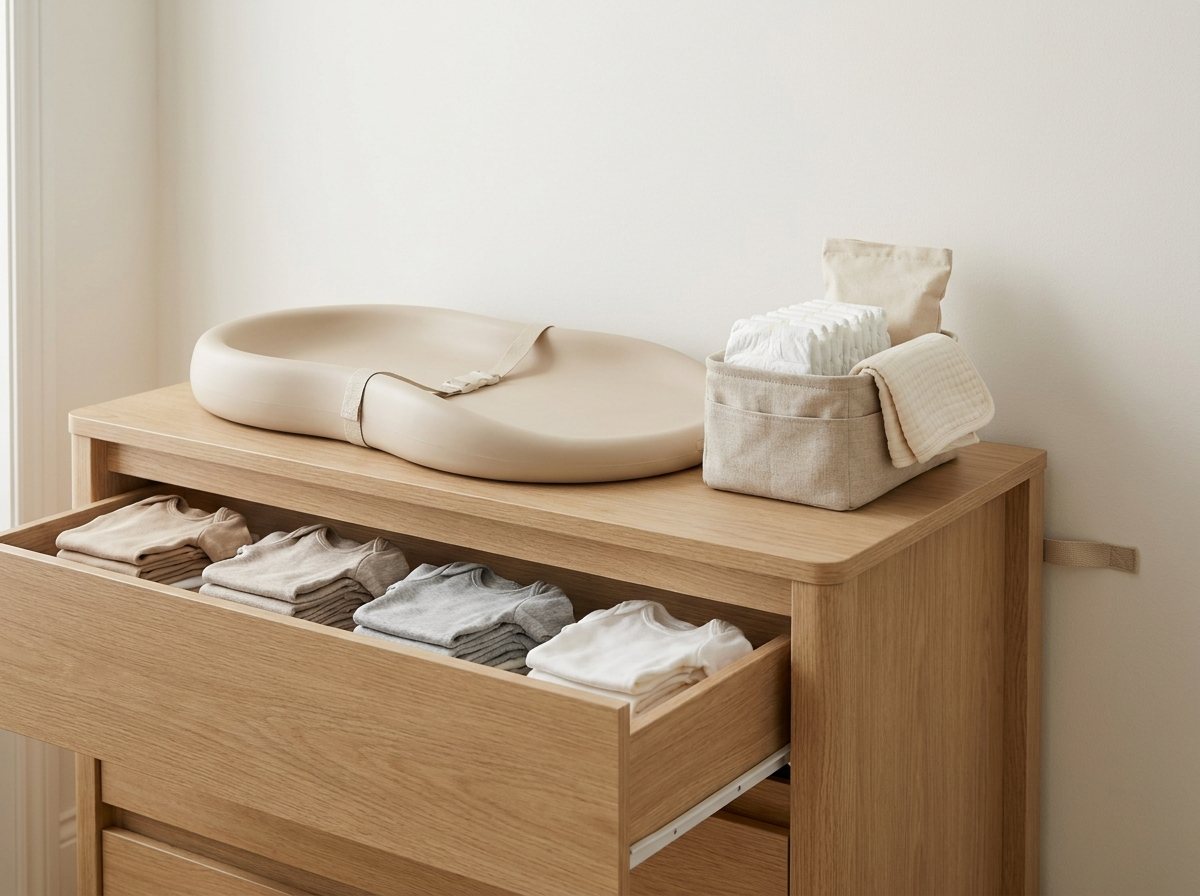
Here’s where a combo room benefits from its constraints. There’s no room for a standalone changing table, so you solve the problem more efficiently than many standalone nurseries do.
Use a dresser with a changing pad on top
A dresser does double duty as guest storage and nursery storage in the footprint a changing table would take alone. One empty drawer holds a visitor’s clothes, and the others hold onesies, swaddles, and diapers.
The top belongs to the baby all year, though. The pad stays strapped in place during visits, so guests get the storage bench and that empty drawer instead.
Most contoured changing pads fit on a standard 30–34 inch dresser, but they need securing.
Safety firstFasten the pad’s straps to the dresser, or use a topper tray screwed to the frame. Check that the dresser is anchored, per the checklist above. Keep one hand on the baby at all times, and keep supplies within your reach but not the baby’s.
Keep a small, portable caddy
A fabric or wire caddy holds diapers, wipes, a change of clothes, and a burp cloth. It lives on the dresser next to the pad and stays there when a guest visits.
Add a second caddy for your own bedroom
Since the baby sleeps in your room at first (see the note up top), overnight changes happen there. The combo room’s station gets used mostly during the day.
Keep a small caddy and a portable changing mat by your bed rather than building an elaborate setup in a room the baby won’t sleep in overnight for a while.
That bedroom spot is also your plan during a visit. Daytime changes happen at the dresser while the guest is out of the room, and on the mat, on your bedroom floor, while they’re resting.
Storage That Serves Both Functions (Not Two Separate Sets of Storage)
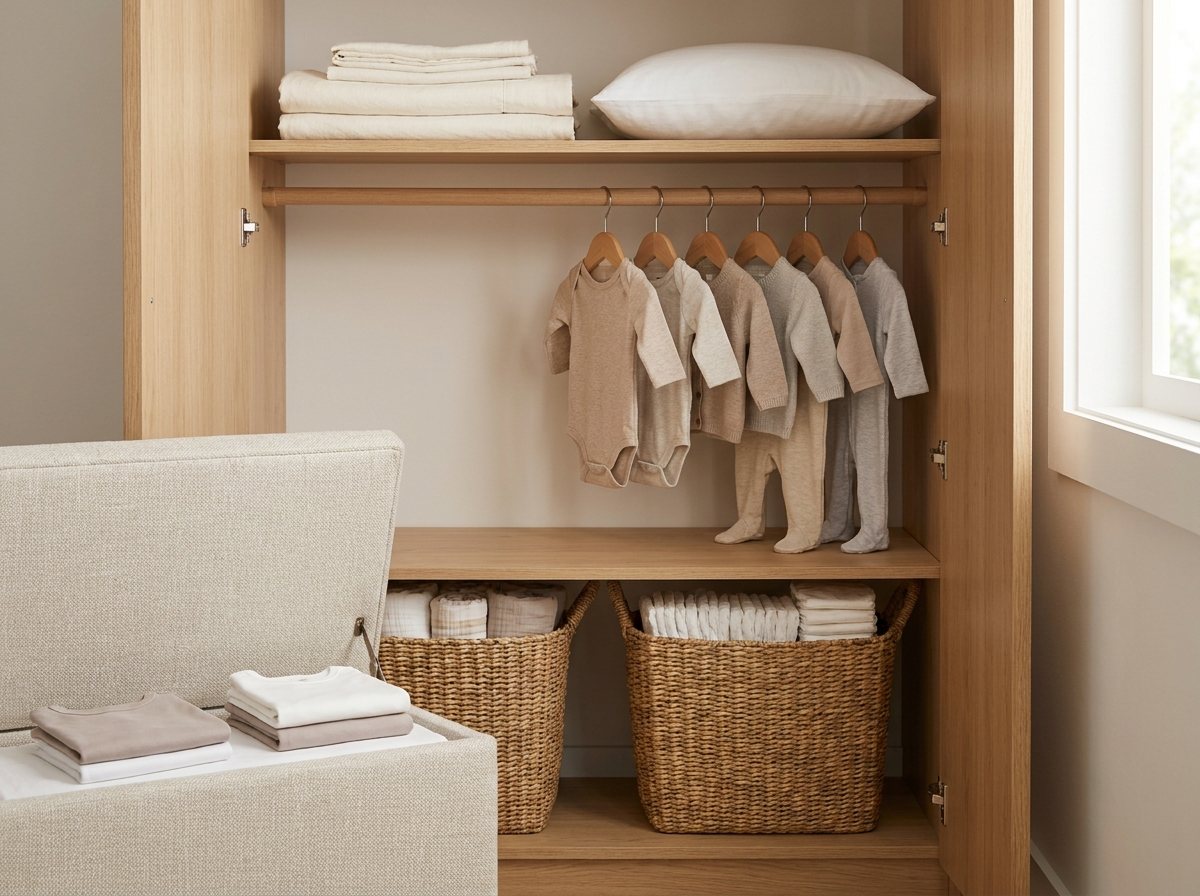
The biggest mistake in a combo room is buying nursery storage and guest storage as if they were unrelated. Almost every piece should serve both functions, just at different times.
Split the closet by height
Don’t give half the closet to baby stuff and half to guest stuff. That wastes vertical space, since baby clothes are tiny. Use the upper shelves for guest linens, like spare sheets, extra pillows, and a folded blanket.
Use the lower rod or shelves, within easy reach, for baby clothes, swaddles, and diaper stock. Guests rarely need their linens, but you’ll be in the baby’s section many times a day.
One empty drawer, always
Keep one dresser drawer permanently empty and call it the guest drawer. It spares a visitor from living out of an open suitcase on the floor for a week. It also means you never scramble to clear space when someone arrives in a few days.
A closed storage bench at the foot of the daybed
This is one of the highest-value single pieces for this kind of room. It gives you somewhere other than the floor to sit while you’re with the baby. It also hides extra crib sheets, blankets, or a rotation of toys.
When guests are staying, it becomes their surface for a bag, folded clothes, or a water glass, with no luggage rack needed.
Behind-the-door storage for diapers
An over-the-door organizer holds diapers and wipes and costs you zero floor or shelf space. Keep it for baby supplies only.
Ask guests to keep medications, toiletries, chargers, and other small items in a closed bag or a high drawer, out of a future crawler’s reach.
This is the same idea as multi-use pieces elsewhere in the house, like a bookshelf that also organizes a reading nook or a closet system built to grow with a child. For more ideas, see our nursery organization ideas for small rooms.
The Reset Routine: Switching Between Nursery Mode and Guest Mode
A combo room needs a fast, repeatable reset routine, not a redecorating project, whenever a guest arrives or leaves. Families who find this room stressful are usually treating each visit as a one-off scramble instead of a system.
Before guests arrive (10–15 minutes)
- Clear the guest spots. Empty the guest drawer, since baby socks end up everywhere, and clear the storage bench for the guest’s bag. The dresser top stays the changing station.
- Stock your bedroom station. Check that the caddy by your bed is full and the changing mat is out. Changes move there whenever the guest is resting in the room.
- Make the bed. Use the dedicated guest set from the upper closet shelf, kept apart from your regular linens.
- Soften the baby-room look (optional). Swap nursery-specific decor for something neutral if you like. Many families skip this, which is fine.
- Plan for naps. Tell guests when the baby naps so they can keep voices low. Leave the sound machine where it is.
After guests leave (10 minutes)
- Wash the sheets. Strip the guest bed, wash, and return the set to the closet shelf.
- Reset the bed. Fold up the trundle or murphy bed, or straighten the daybed bolsters.
- Restock both caddies. Refill diapers and wipes at the dresser and by your bed.
- Sweep and check. Vacuum the floor and look for stray medications, chargers, or small items a guest left behind. A crawling baby needs a clean floor, not just a guest-tidy one.
A dedicated set of guest sheets means no emergency laundry run when someone texts “can we crash Friday night?” It’s a small habit, and it keeps the room ready in 10–15 minutes.
If your family already runs an evening tidying routine, fold this reset into that rhythm. It keeps guest prep from feeling like extra work.
Safety Non-Negotiables When a Crib Shares a Room With Guest Furniture
A guest room nursery combo has a few safety considerations that a standalone nursery doesn’t. There’s more furniture and more foot traffic, and sometimes an unfamiliar adult moves through the room in low light.
Safe sleep in the cribThese rules apply to every nap and night your baby sleeps in this room. Confirm the specifics with your pediatrician.
- Place the baby on their back to sleep.
- Use a firm, flat mattress with only a fitted sheet. The mattress should leave no more than a two-finger gap at the sides.
- Keep bumpers, pillows, loose blankets, and plush toys out of the crib.
- Skip sleep positioners.
- For a younger baby who is still swaddled for naps, stop swaddling at the first signs of rolling and switch to a wearable blanket.
- Use a crib that meets current CPSC standards, with no drop-sides. Cribs made before June 2011 predate the current federal crib standard, so skip them.
- Check the manufacture date label and search the CPSC recall list for the model. Skip any crib with missing or broken hardware.
- Avoid secondhand cribs you can’t verify. If you can’t confirm the model, manufacture date, and recall status, buy new.
For crib placement, cords, the sound machine, and anchoring, use the checklist in the crib placement section above. The points below cover only what’s specific to sharing the room with guest furniture and guests. For the rest of the house, see our baby-proofing guide for the whole home.
Crib and furniture
- Put guest things back after each visit. A pulled-out trundle, a suitcase, or a bench nudged toward the crib can become a launching point once your baby pulls to stand.
Guests in the room
- Brief guests who share the room with the baby. Give a two-sentence heads-up. Ask them not to leave bags near the crib, touch or wake the baby, or adjust the thermostat or space heater.
- Set health and air rules. Ask anyone who is sick to keep their distance. Keep smoke, vape residue, and pets out of the room. No adult should ever share a bed with the baby.
Cords and small items
- Watch guest chargers. Guests plug in phone chargers without thinking of them as nursery gear. Point them to an outlet on the daybed side of the room, where the checklist’s cord rule is easy to keep. A humidifier cord follows the same rule.
- Keep button-cell devices and loose batteries out of reach. Guest key fobs, small remotes, and hearing aids often hold them. The emergency steps are in the safety note below.
- Rethink decor at floor and low-shelf level. A dish of potpourri or a small plant becomes a choking or tipping hazard once a baby starts exploring. Each month, check what’s within arm’s reach of the crib.
Safety firstA swallowed button battery can cause serious injury within about 2 hours. If a child may have swallowed one, go to the emergency room right away, without waiting for symptoms. Call the National Battery Ingestion Hotline (800-498-8666) or Poison Control (800-222-1222) on the way. Don’t give the child food or drink unless the hotline or the ER tells you to.
Budget Breakdown: What This Room Actually Costs
Costs vary by furniture choice. These are typical retail estimates for 2026, for outfitting an empty room in three tiers with a daybed. Your local prices will differ.
| Item | Budget-friendly | Mid-range | Splurge |
|---|---|---|---|
| Guest bed (daybed) | $250-350 | $450-650 | $800+ |
| Crib | $150-250 | $300-500 | $700+ |
| Crib mattress | $60-100 | $120-180 | $250+ |
| Dresser (doubles as changing station) | $150-250 | $350-500 | $700+ |
| Storage bench/ottoman | $60-100 | $120-200 | $300+ |
| Rug | $40-80 | $100-200 | $300+ |
| Bedding (crib sheets x3, guest sheets x2) | $80-120 | $150-220 | $300+ |
| Lighting (lamp, nightlight) | $30-50 | $60-100 | $150+ |
| Approximate total | $820-1,300 | $1,650-2,550 | $3,500+ |
A murphy bed would add $1,200-4,000+ on top of (or in place of) the daybed line. It is the biggest cost lever in the room.
Budget-level picks land at roughly $820–1,300, and mid-range picks run closer to $1,650–2,550. The figure in the glance box above covers those two tiers, not the splurge tier. The dresser will get years of use past the nursery stage. For more ways to trim costs, see our nursery setup budget guide.
Saving with a hand-me-down crib? Run it through the crib checks in the safe-sleep box above first, and buy new if you can’t verify it.
How to Keep a Combo Room From Becoming Clutter
A combo room can easily become a catch-all. Once the setup excitement wears off, it turns into a landing zone for things with no other home yet. A few habits keep that from happening:
- Give every surface a job, and only one job. The dresser top is the changing station, and the storage bench is where guests set their things. Neither is a landing spot for extra hangers, unread mail, or a box of baby clothes waiting for donation.
- Do a monthly “does this still belong here” pass. Outgrown clothes and gear should leave the room soon. If you’ll need them later, label and box them for the garage or attic.
- Treat the guest experience as real, not an afterthought. A folded blanket at the foot of the guest bed, a small lamp with a warm bulb, and a water glass within reach of the bed take minutes. They make the room feel intentional.
It’s the same philosophy behind good drop zones. A well-run family command center works because every item has an assigned spot and a clear job, not because the space is large. A guest room nursery combo applies that logic to a room with two very different visitors: your baby, and whoever’s sleeping over.
When to Reconsider the Combo Setup
A combo room can work well through the infant stage. Needs shift after that, so it helps to have a rough plan.
- Around 6-12 months, many babies settle into more predictable naps and longer stretches of sleep. Guest noise, like a late arrival or an early departure, becomes a bigger disruption than it was with a newborn.
- If you’re expecting frequent, longer guest stays, such as a parent moving in temporarily, take a second look. Once the baby’s sleep is more schedule-sensitive, weeks of shared use can be hard on everyone.
- If a second child is on the way, the guest function is often the first thing to go. The room becomes a two-kid bedroom, and guests move elsewhere, such as an air mattress in the living room or a nearby hotel.
None of this means the combo setup was a mistake. It did its job for the window it needed to cover, which for many families is a year or two. Furniture that transitions well makes the next step easier. A trundle can serve as a stationary low bed once your child is ready to leave the crib, and a good dresser lasts well past the nursery stage. The end of the combo era becomes a rearrangement, not a full furniture replacement.
Frequently Asked Questions
Can a crib and a guest bed really fit in a standard 10×10 bedroom?
Yes, in most cases. A 10×10 room fits a crib, a twin daybed, a dresser that doubles as a changing station, and a storage bench, and still keeps a 30-inch walking path. The wall-by-wall plan above shows the math.
Choose a daybed or trundle over a full or queen bed, favor tall narrow storage, and skip a bulky glider set.
What’s the best guest bed option if I don’t have room for a full-size bed?
A twin daybed is generally the best fit for smaller guest room nursery combos. It uses a standard twin footprint, needs no setup for guests, and doubles as adult seating on non-guest days. It isn’t a feeding seat, so use a firm, upright chair for feeds. If you want more floor space back and don’t mind the upfront cost, consider a murphy bed. It usually needs wall anchoring and professional installation.
Should the crib and guest bed be in the same sightline from the door?
It’s better if they’re not. Place the crib so it isn’t the first thing visible from the door, often perpendicular to the guest bed. That helps the room read as two distinct zones and gives the crib area some privacy.
How do I keep the room from feeling cluttered with two functions in one space?
Give every surface and storage spot one clear job. Put guest linens on the upper closet shelves and baby clothes lower, and keep one dresser drawer empty for guests.
Do a monthly pass to remove outgrown baby items and stray clutter. A closed storage bench at the foot of the bed hides overflow.
Is it safe to have a guest sleeping in the same room as a crib?
It can be, with a few precautions. Keep bags, suitcases, and chargers away from the crib zone, give your guest a quick heads-up on the house rules, and run through the crib placement checklist above. The safety section lists the rest of the guest rules.
Do I need a full changing table, or can the dresser handle it?
A dresser with a contoured changing pad works about as well as a dedicated changing table in most cases and saves floor space. Secure the pad as the safety note in the changing-station section describes, and keep a hand on the baby. The top stays the changing station during visits, and one empty drawer gives a guest somewhere to unpack.
What’s the fastest way to switch the room from nursery mode to guest-ready?
Keep a dedicated set of guest sheets in the closet and use them for nothing else. Then there’s no emergency laundry before a visit. A basic reset takes about 10–15 minutes: make up the bed, clear the guest drawer and bench, stock the changing spot in your room, and do a quick tidy. A consistent routine keeps it that short.
Bottom Line: Guest Room Nursery Combo
A good combo room matches the guest bed to how often you host, gives the crib its own corner, and uses a simple reset routine. Start with the bed decision and let the rest of the room follow. After the first guest visit, adjust the layout.