How Many Toys Should Be Out at Once? A Rotation Guide
I counted once. Genuinely got down on the floor of my son’s playroom with a notepad and counted every single toy within reach — not stored in a closet somewhere, but out, visible, technically “available” for play at any given moment. The number was 61.
Sixty-one toys, and on any given afternoon he was playing with maybe three of them. A wooden spoon from the play kitchen he’d repurposed as a sword. The box a puzzle came in, which was somehow more interesting than the puzzle. And whatever toy his older cousin happened to be holding, regardless of what it was. The other 58 sat there like set dressing — present, ignored, and quietly making the room feel like chaos every time I walked past it.
That count was the thing that finally made toy rotation click for me. Not the vague advice to “rotate toys” that I’d read a dozen times, but the actual number. How many toys should genuinely be out at once, for a kid this age, doing this kind of play? Because once I had a target number, the whole system became obvious. Too many options doesn’t create more play — it creates the toy equivalent of standing in front of an open fridge for ten minutes and closing it without eating anything.
This guide is the answer I wish I’d had that day: specific bin counts, specific toy counts, broken down by age and category, so you’re not guessing at “some” toys and “a rotation schedule” — you’re working from numbers that actually match how kids this age play.
In this article (11 sections)
- How Many Toys Should Kids Have Out? The Short Answer
- The Bin-Count Table: Toys Out by Age and Category
- Toy Rotation for a 1-Year-Old: A Special Case
- Toy Rotation Categories: What Actually Belongs in Each Bin
- Building a Toy Rotation Shelf That Works
- How Often to Rotate (and How to Tell It’s Time)
- Choosing Toy Rotation Bins: What to Buy and How to Label Them
- Common Mistakes That Sabotage Toy Rotation
- A Sample Week: What Rotation Looks Like Day to Day
- Frequently Asked Questions
- A Calmer Shelf, One Small Swap at a Time
How Many Toys Should Kids Have Out? The Short Answer
Before the full breakdown, here’s the number parents actually want: most toddlers and preschoolers do best with somewhere between 5 and 15 toys visible at once, depending on age, with younger toddlers on the lower end and preschoolers on the higher end.
That range feels almost uncomfortably small if you’re picturing a “well-stocked” playroom. But the research on children’s play behavior backs it up pretty consistently — when children are given fewer toys at a time, they engage more deeply, play longer with each item, and show more creative, varied use of the toys they do have. When they’re given a large pile, they sample more items but spend less quality time with any single one, and free play more often collapses into wandering or asking a parent for the next thing.
The number also isn’t arbitrary — it maps to a child’s actual capacity to hold options in mind and choose meaningfully between them. A one-year-old genuinely cannot process fifteen choices; four or five is already a lot. A four-year-old can hold more, plan more, and sustain more complex play across more materials, so the number climbs. That’s the whole logic behind rotation: you’re not reducing how many toys your child owns, you’re reducing how many they’re asked to choose from at any one time, and storing the rest where they can come back later feeling new again.
The Bin-Count Table: Toys Out by Age and Category
This is the table I wish existed when I started. It answers the specific question — not “should I rotate toys” but “how many bins, how many toys per bin, and how many categories” — broken out by developmental stage.
| Age Stage | Toys Visible at Once | Number of Categories Represented | Suggested Bin Count | Rotation Frequency |
|---|---|---|---|---|
| 12–18 months | 4–6 toys | 2–3 categories | 2–3 bins | Every 1–2 weeks |
| 18 months–2.5 years | 6–8 toys | 3–4 categories | 3–4 bins | Every 2 weeks |
| 2.5–4 years (preschool) | 8–12 toys | 4–5 categories | 5–6 bins | Every 2–4 weeks |
| 4–5 years | 10–15 toys | 5–6 categories | 6–8 bins | Every 3–4 weeks |
| 5–6 years | 12–18 toys | 6–7 categories | 8–10 bins | Monthly, or child-led |
A few notes on reading this table correctly, because the numbers only work if you understand what they’re counting:
“Toys visible at once” means individual play items, not sets. A 20-piece block set counts as one toy. A basket of 15 board books counts as one category, not fifteen items. This is the detail that trips people up — they count every Lego brick separately and panic that they’re wildly over the number, when really a full bin of blocks is one “slot” in the count.
Category count matters more than raw toy count for older kids. A four-year-old with twelve toys spread across six categories (blocks, art, pretend play, puzzles, books, sensory) is in a much better spot than a four-year-old with twelve toys that are all vehicles. Variety of type drives longer, richer play more than sheer quantity does.
Bin count includes what’s stored, not just what’s out. If your rotation system has 6 bins total and 2 are out at a time, that’s a 3-cycle rotation — every toy gets roughly 2-3 weeks of rest between appearances, which is usually enough for it to feel new again without being forgotten entirely.
If you haven’t set up a rotation system at all yet and want the step-by-step mechanics — how to physically divide toys into bins, where to store the rest, how to introduce the swap to your child — the toy rotation system guide walks through the full setup from scratch. This article assumes you have (or are about to build) that structure and focuses specifically on getting the numbers right.
Toy Rotation for a 1-Year-Old: A Special Case
One-year-olds get their own section here because the advice for them is genuinely different from the advice for a three-year-old, and most general rotation guides blur the two together.
At 12-18 months, a child’s play is almost entirely about repetition and mastery of a small set of actions: stacking, dropping, opening, closing, fitting one thing inside another. They are not browsing a shelf and selecting a toy the way a four-year-old does. They’re picking up whatever is closest and doing the same three things to it — putting it in their mouth, banging it, and handing it to you.
This means the “how many toys should be out” answer for a one-year-old isn’t really about choice at all — it’s about not overwhelming a floor space that a mobile, crawling or newly-walking baby has to physically navigate. 4 to 6 toys is the sweet spot, and I’d lean toward the low end of that (4) for a child who just started walking, since a cluttered floor is also a tripping hazard at this stage.
What those 4-6 toys should be, specifically:
- One or two cause-and-effect toys — a shape sorter, a stacking cup set, a simple push-button toy. These reward repetition, which is exactly what this age wants.
- One gross-motor toy — a push walker, a soft ball, something that invites moving around the room rather than sitting still.
- One or two open-ended pieces — large soft blocks, a basket of silicone or wooden rings, nothing with “right” way to use it.
- One board book — out and accessible, even if it lives on the floor rather than a shelf at this stage.
Rotate this small set every one to two weeks. At this age, “rotation” is less about preventing boredom (a one-year-old genuinely doesn’t get bored of a shape sorter the way an older kid gets bored of a puzzle) and more about periodically refreshing what’s on the floor so you’re not stepping on the same six things for two months straight, and so your child keeps encountering “new” cause-and-effect challenges as their fine motor skills develop week to week.
One practical note specific to this age: because everything goes in the mouth, keep the rotation bins for 12-18 month-olds separate from anything with small parts that belongs to an older sibling. If your one-year-old has an older brother or sister, this is usually the first real test of your toy storage system, and it’s worth reading through Kids’ Closet Organization: Systems That Grow With Your Child if you’re also working out shared storage for two very different play stages at once.
Toy Rotation Categories: What Actually Belongs in Each Bin
The bin-count table above tells you how many categories to represent, but not which categories. Here’s the breakdown I use, and it holds up pretty well across the toddler-to-preschool range — you’re just adding more categories and more toys per category as your child gets older.
| Category | Examples | Why It Earns a Spot |
|---|---|---|
| Building/construction | Blocks, Legos, Magna-Tiles, stacking toys | Builds spatial reasoning, holds attention longer than almost any other category once a child hits 2.5+ |
| Pretend play | Play kitchen items, dolls, dress-up, small figures | Drives language development and social-emotional processing through role play |
| Art/sensory | Crayons, playdough, sensory bins, water beads | Needs closer supervision but offers the most open-ended creative output |
| Puzzles/fine motor | Puzzles, lacing cards, threading beads, shape sorters | Short-session toys — good for the 10-15 minute independent play window |
| Books | Board books, picture books | Should almost always stay out, not rotated, especially before age 4 |
| Gross motor | Balls, ride-ons, tunnels, balance boards | Often lives outside the “shelf” system entirely but still counts toward total toys visible |
| Vehicles/action | Cars, trains, action figures | Frequently overrepresented in playrooms — a good category to trim first if you’re overwhelmed |
A pattern worth naming here: books are usually the one category that shouldn’t rotate the same way everything else does. Kids benefit from a stable, always-available relationship with a smaller set of favorite books, refreshed only occasionally (say, monthly, or seasonally) rather than swapped every two weeks like an active-play toy. If you’re setting up a dedicated reading spot alongside your rotation shelf, Kids’ Bookshelf and Reading Nook Organization: A Cozy System That Encourages Reading covers how to keep that space separate from the rotating toy categories so it doesn’t get swept into the same cycle.
Building/construction toys deserve a special mention too, because they’re usually the single biggest category by volume in most homes and the easiest to mismanage. A tub with 400 mixed Lego pieces isn’t “one toy” for counting purposes in the way a shape sorter is — it functions more like an entire play station. If Legos and blocks are eating a disproportionate share of your shelf and floor space, LEGO and Building Block Storage Solutions Kids Will Actually Use has specific containment approaches that keep a large block collection from sprawling across every other category’s real estate.
Building a Toy Rotation Shelf That Works
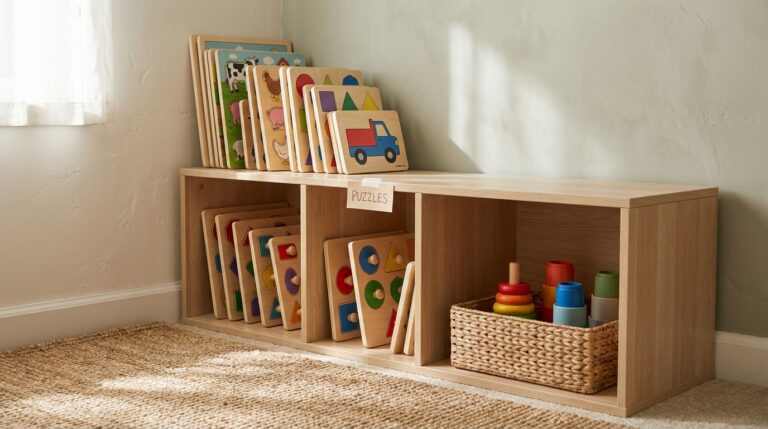
A “toy rotation shelf” is exactly what it sounds like — a single shelf, cube unit, or low bookcase that displays only the current rotation, distinct from the storage bins holding everything else. The shelf is what makes the whole system visible and manageable for both you and your child, and getting its size right matters more than most people expect.
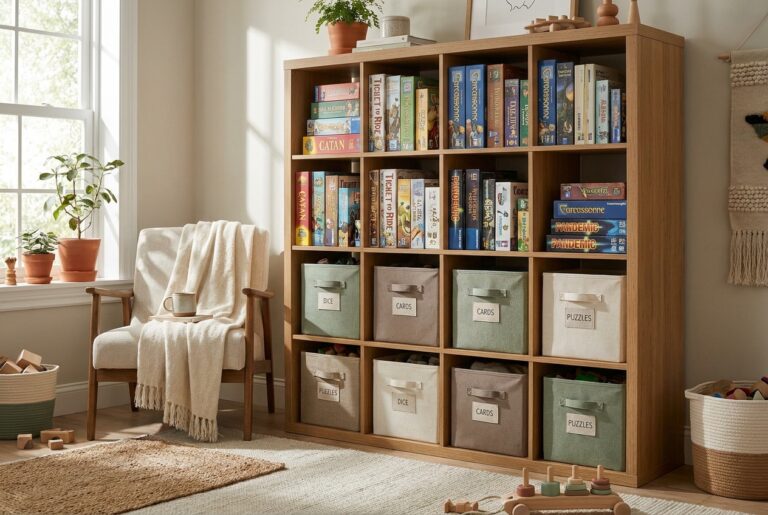
Size the shelf to your target toy count, not the other way around. This is the single biggest mistake I see: people buy a big, beautiful nine-cube storage unit because it looks organized in photos, then feel obligated to fill all nine cubes, which puts them right back at 18-27 toys out — no better than the pile they started with. Work backward from your age-appropriate number instead:
| Target Toys Out | Shelf Size That Fits |
|---|---|
| 4–6 toys | 2–3 cube shelf, or one low open shelf |
| 6–8 toys | 3–4 cube shelf |
| 8–12 toys | 4–6 cube shelf, or a shelf + one floor basket |
| 10–15 toys | 6-cube shelf plus a separate small table for one “station” (art or building) |
One toy per cube or shelf slot, displayed rather than stacked. This is a Montessori-influenced principle that holds up regardless of what philosophy you follow: a toy that’s visible in full — puzzle pieces in a shallow tray, blocks in an open basket, a single toy fully out rather than three toys crammed into one bin — gets chosen and played with more than a toy buried in a deep bin under two other things. If your child has to dig, they’ll default to whatever’s on top, every time.
Keep the shelf low and open. Toddlers and preschoolers should be able to see and reach every item on the shelf without asking for help. A rotation system only works if your child can independently choose from it; if you’re the one retrieving everything, you’ve built a display shelf, not a rotation system.
Leave visible empty space. Somewhat counterintuitively, a shelf that looks “not quite full” reads as calmer and more inviting than one that’s packed edge to edge, and it also gives you room to add a special or seasonal item without breaking the system.
If your rotation shelf lives in a shared or multi-purpose room rather than a dedicated playroom, the same “fewer things, fully visible” principle scales down nicely — the same logic that governs a rotation shelf works for a single toy basket in a living room corner, which is often the more realistic setup for younger toddlers who nap and play in whatever room the family is actually using that day.
How Often to Rotate (and How to Tell It’s Time)
The table above gives frequency ranges, but the actual “is it time” signal should come from your child’s behavior, not a calendar reminder. Watch for these three signs:
- Toys are getting dumped rather than played with. If your child walks past the shelf, pulls three bins onto the floor without settling into any of them, and wanders off, that’s saturation. The current rotation has gone stale.
- You’re hearing “I’m bored” near the toy shelf specifically. Boredom near the shelf (as opposed to general end-of-day crankiness) is a pretty reliable signal that the current options have lost their novelty.
- A toy from storage gets specifically requested. If your child asks for something you know is packed away, that’s actually a great cue — it means enough time has passed for that toy to feel exciting again, and it’s a natural moment to swap it back in.
In practice, most families land on a rhythm somewhere between every two weeks and once a month, and it doesn’t need to be rigid. A useful approach: rotate on a loose schedule (say, the first Sunday of every two weeks) but also do an unscheduled swap any time you notice sign #1 or #2 happening for more than a couple of days in a row.
Seasonal and life-stage moments are also natural rotation triggers even outside your usual schedule — after a birthday when new toys arrive and old ones need to make room, at the start of a school year when interests shift, or heading into a season change. If you want a more structured, once- or twice-a-year deep rotation event rather than the ongoing every-two-weeks swap, The Spring Playroom Reset: How to Do a Toy Rotation Before Spring Break walks through that larger-scale version — think of it as the seasonal overhaul that resets your whole bin system, versus the smaller biweekly swap this guide focuses on.
One thing worth saying plainly: don’t rotate mid-play or mid-obsession. If your child has been building the same elaborate block city for four days straight, that’s not staleness — that’s deep, valuable play, and swapping the blocks out on schedule would undo it. The schedule is a default, not a rule. Watch the actual play before you swap.
Choosing Toy Rotation Bins: What to Buy and How to Label Them
The bins matter more than people expect, mostly because the wrong bin quietly sabotages the whole system. A few concrete guidelines, based on what actually holds up:
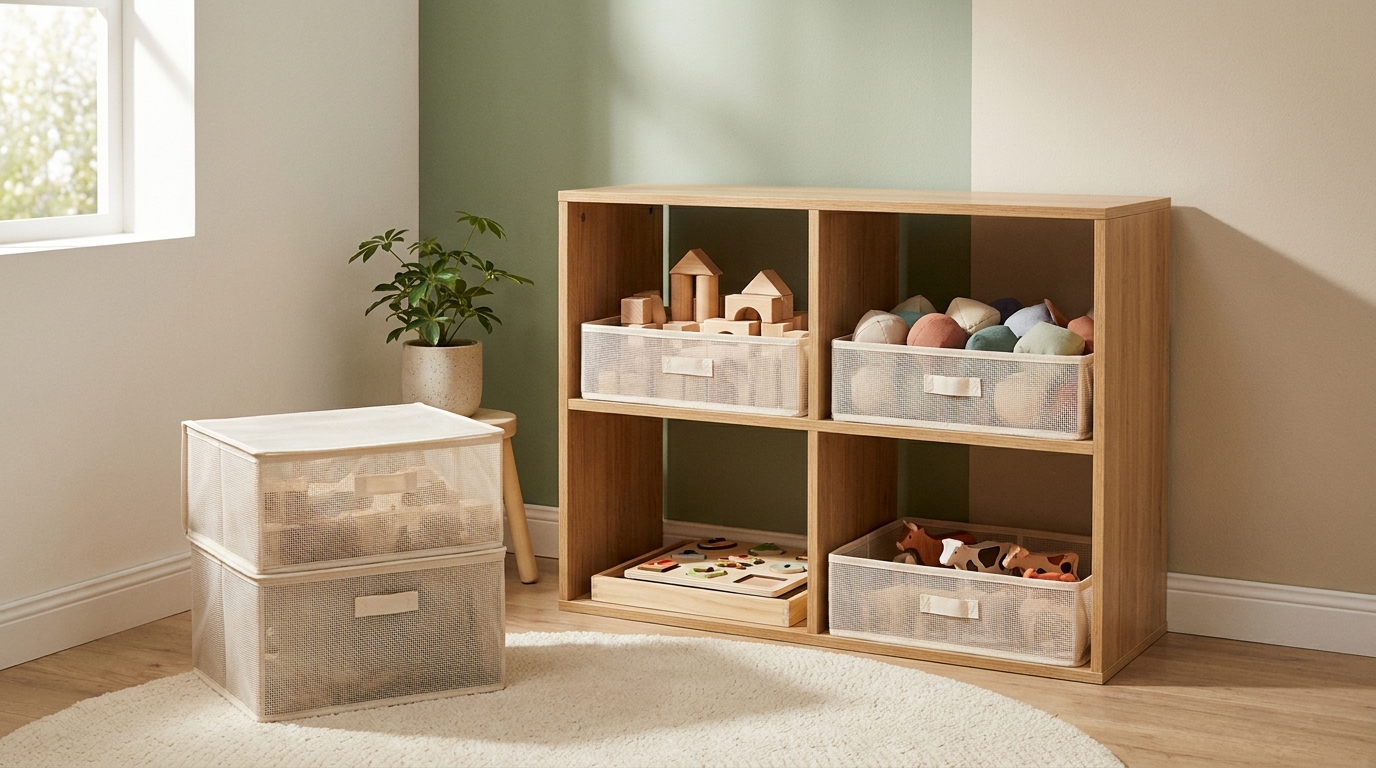
Clear bins for stored rotation, not opaque ones. If you can’t see what’s inside a stored bin, you and your child will forget what’s in rotation entirely, and “out of sight, out of mind” works against you here — the whole point of storage is that your child gets excited to see something come back, and that’s hard to anticipate if the bin is opaque and unlabeled.
Shallow, wide bins over deep ones, on the shelf itself. Deep bins encourage digging and dumping. A shallow bin or open basket where every toy is visible at a glance keeps kids choosing intentionally instead of upending the whole container to find one specific piece.
Label by category, not by rotation number. Skip “Bin 1, Bin 2, Bin 3” labeling — it tells you nothing when you’re standing in a closet trying to decide what to swap in. Label by category instead: “Building,” “Pretend Play,” “Puzzles,” “Sensory.” That way you can rotate deliberately (swap out the tired building bin, swap in a fresh one) rather than randomly.
Size bins to match your target count from the table above, not to whatever containers you already own. A bin sized for 15 toys, half-filled with 6, looks and feels neglected even when it’s organized correctly. Buying (or repurposing) bins that are actually sized to your target count makes the shelf look intentional rather than sparse.
A rough sizing guide by age:
- 12–18 months: Small, shallow bins, roughly shoebox-sized — easy for a toddler to carry and dump without help, since dumping and re-filling is itself a favorite activity at this age.
- 18 months–3 years: Medium bins, 3-5 gallon range, still shallow enough that a preschooler can see the full contents at a glance.
- 3–5 years: Slightly larger bins are fine here since kids can search and sort more independently, but keep at least the displayed bins shallow, even if storage bins in a closet are deeper.
If you’re building out the bin system alongside a broader plan for sorting toys that don’t fit neatly into “rotation” — outgrown toys, gift overflow, toys split across bedroom and playroom — Kids’ Craft Supply Organization: How to Contain the Mess Without Killing Creativity covers a closely related version of this same shallow-bin, visible-categories approach specifically for art and craft materials, which tend to sprawl even faster than toys do.
Common Mistakes That Sabotage Toy Rotation
Most rotation systems that fail don’t fail because the parent didn’t try — they fail for a handful of very specific, very fixable reasons:
Rotating too many categories at once. If you swap out every single bin on rotation day, your child effectively gets a brand-new playroom every two weeks, which sounds fun but actually resets their play skills to zero each time — there’s no continuity, nothing to build on, and the novelty becomes exhausting rather than engaging. Rotate one or two bins at a time instead, leaving the rest of the shelf stable.
Storing the “extra” toys somewhere your child can still see or access. If the storage bins live in a clear tub on the closet floor where your child walks past them daily, you haven’t actually reduced the choice overload — you’ve just relocated it. Storage needs to be genuinely out of sight: a closed closet, a bin under a bed with a lid, a garage shelf, somewhere your child isn’t passively encountering the “hidden” toys throughout the day.
Treating rotation as a one-time project instead of a habit. The single biggest predictor of whether a rotation system survives past month one is whether it’s tied to an existing routine, rather than something you have to remember to do from scratch. Pairing your toy swap with an existing weekly or biweekly reset — even a quick five-minute swap folded into The 15-Minute Evening Reset — makes it far more likely to actually keep happening past the first enthusiastic week.
Keeping every toy in rotation “because they might want it.” This is the trap that quietly inflates the numbers back up over time. A toy that hasn’t been requested in three or four full rotation cycles isn’t a rotation candidate anymore — it’s either outgrown, or it should live somewhere less prominent than your active bin system (a keepsake box, a donation pile, or a relative’s house for the next visit).
Ignoring toys that live outside the “toy” category entirely. Kitchen tools in a toddler-accessible drawer, craft supplies on an open shelf, books on a separate shelf — these all count toward your child’s total daily choice load even if they’re not sitting in the official rotation bins. If your child has a toddler-friendly kitchen setup with pots, pans, and pretend food that’s always out in addition to the rotation shelf, that’s worth factoring into your total “how many things is my child choosing between” count. Creating a Toddler-Friendly Kitchen: Safety Meets Independence is useful context here if that’s a significant chunk of your child’s daily play options.
Sorting purely by toy type instead of by how your child actually plays. A rigid category system (all vehicles together, all animals together) sounds tidy but doesn’t always match how a child’s brain organizes play — many kids combine categories naturally (the dollhouse and the animal figures and a few blocks, all in the same pretend-play scene). If your current sorting system feels like it’s fighting your child’s actual play patterns rather than supporting them, Organize Toys by Type covers how to strike that balance between categorized storage and flexible, combinable play.
A Sample Week: What Rotation Looks Like Day to Day
Numbers and tables are useful, but it can still be hard to picture what this actually looks like lived out. Here’s a realistic week for a 3-year-old on an 8-10 toy, 5-category rotation, swapping one bin roughly every two weeks:
Monday–Wednesday: The current rotation shelf holds a building bin (Magna-Tiles), a pretend-play bin (small farm animals and a barn), a puzzle bin (three age-appropriate puzzles in a shallow tray), an art bin (crayons and a small pad, supervised use only), and a sensory bin (kinetic sand in a shallow tub). That’s five categories, roughly nine to eleven individual items, well within the 8-12 target for this age. Play is a mix of independent stretches during quiet time and parent-involved sessions after school pickup.
Thursday: You notice the puzzle bin has been ignored for four straight days — all three puzzles have been solved enough times that they’re no longer a challenge. That’s the “time to rotate” signal from earlier in this guide.
Friday: Quick five-minute swap during the evening reset. The puzzle bin gets stored (labeled, in the closet), and a fresh puzzle bin comes out — different difficulty level, maybe a themed puzzle tied to something your child’s currently into. Everything else on the shelf stays exactly where it is, because it’s still being used.
Following week: Same pattern repeats with a different category — maybe the sensory bin gets refreshed with a different fill material, or the pretend-play bin swaps farm animals for dinosaurs. One category rotates roughly every week to ten days, meaning any single toy is out of rotation and resting for about six to eight weeks total before its turn comes back around — plenty of time to feel new again.
That’s really the whole system in motion: a stable shelf with a fixed, age-appropriate number of items, one small swap at a time, driven by actual play behavior rather than a rigid calendar. It sounds almost too simple written out like this, which is honestly a good sign — the systems that survive in a real house with a real kid tend to be the boring, low-effort ones, not the elaborate ones.
Frequently Asked Questions
How many toys should a toddler have out at once?
For 18 months to 2.5 years, aim for 6-8 toys visible at once, spread across 3-4 categories (something for building, something for pretend play, one sensory or fine-motor item, and a book or two that stay out consistently). For toddlers just under 18 months, drop to 4-6 toys since fewer choices and more floor space matter more than variety at that stage.
How many toy rotation bins do I actually need?
Most families do well with 4-8 total bins for a toddler-to-preschool rotation system, with only 2-4 of those bins out and displayed on the shelf at any given time. The rest stay stored (in a closet, garage, or under-bed container) until their turn comes back around. You don’t need a bin for every single toy category your child owns — start with the 4-6 categories that get played with most, and store the rest in a general “extras” bin until you see what’s actually getting used.
What is the ideal toy rotation schedule?
Every two weeks is the most common sweet spot for toddlers and preschoolers, though it’s fine to stretch to monthly for a four- or five-year-old whose play sessions run longer and deeper. The better signal than any fixed schedule is behavior: rotate when a toy’s been ignored for several days in a row, or when your child specifically asks for something you know is currently stored away.
Should I rotate every category at once, or just one bin at a time?
One or two bins at a time, not the whole shelf. Rotating everything at once resets your child’s play environment completely, which sounds exciting but actually removes the continuity kids need to build on previous play (like a block structure they were mid-project on). Swap one tired category, leave the rest of the shelf stable, and let your child’s actual interest level guide which bin gets refreshed next.
Does toy rotation work for a 1-year-old, or is it too young?
Yes, though it looks different than rotation for an older toddler. At this age it’s less about preventing boredom (one-year-olds happily repeat the same action with the same toy for weeks) and more about keeping the floor uncluttered and periodically refreshing cause-and-effect challenges as fine motor skills develop. Stick to 4-6 toys out, rotate every 1-2 weeks, and prioritize one or two toys per category rather than variety for its own sake.
My kid has way more than the recommended number of toys. Do I need to get rid of most of them?
No — rotation is about storage, not disposal. The recommended numbers describe how many toys should be visible and accessible at once, not how many your child is allowed to own total. It’s completely normal to have dozens of toys split across an active rotation shelf and several stored bins in a closet. That said, if a toy hasn’t come up in conversation or gotten chosen across two or three full rotation cycles, that’s a reasonable moment to consider donating it rather than cycling it back in indefinitely.
What toys should never be part of the rotation?
Books are the main exception — most families do better keeping a stable, always-available set of favorite books rather than rotating them on the same schedule as active-play toys, since the comfort of a familiar story is different from the novelty-seeking that drives toy play. Comfort items (a favorite stuffed animal, a security blanket) should also stay fully exempt from any rotation system for the same reason.
A Calmer Shelf, One Small Swap at a Time
If you take one thing from all of this, let it be the number, not the theory: fewer toys out, chosen intentionally for your child’s age and stage, almost always beats a full shelf. You don’t need a Pinterest-perfect playroom or a rigid rotation calendar to get there — just a bin count that fits your child’s age, categories that match how they actually play, and a shelf sized honestly for what you’re trying to display. Start small, watch what actually gets picked up, and let that tell you when it’s time to swap. The system gets easier every single time you do it.