
How to Organize a Garage for Family Storage
Reclaim your garage by learning a strategic plan to organize family storage. You'll discover how to perform a full cleanout, create functional zones, and utilize wall space to keep your floor clear for your car.
- Perform a full cleanout: empty your garage and sort items ruthlessly into four zones.
- Create a zone plan: designate areas for frequently used, seasonal, tools, and bulk storage.
- Utilize wall systems: maximize vertical space with panels, hooks, and shelving to clear your floor.
- Purge specific items like expired car seats, old paint, and outgrown baby gear.
Open your garage door right now. Can you park a car in there? If you’re like 25% of American homeowners, the answer is no—the garage has been consumed by a growing mountain of bikes, strollers, sports equipment, holiday bins, outgrown baby gear, and that treadmill someone was definitely going to use. The garage is where family stuff goes to hide, and without a deliberate system, it just keeps piling up until you’re parking in the driveway and squeezing past towers of bins to reach the lawn mower. But here’s the thing: your garage is probably the largest storage space in your home, and with a strategic plan, it can hold everything your family needs while still fitting the car. Let’s reclaim it.
In this article (6 sections)
The Full Garage Cleanout: Start From Zero
You cannot organize a cluttered garage by shifting piles around. You need to pull everything out. Yes, everything. Pick a dry weekend morning, enlist help (bribe teenagers with pizza, rope in a spouse, ask a friend), and empty the entire garage onto the driveway.
This is the moment of truth. Seeing everything in daylight reveals just how much you’ve been storing. Sort ruthlessly into four zones right on the driveway: Keep, Donate/Sell, Trash, and Relocate (items that belong inside the house, not the garage). Be honest about that broken camping chair, the skis nobody has touched in five years, and the high chair your youngest outgrew two years ago.
Common garage items that families hold onto too long: outgrown baby equipment (strollers, bouncers, walkers), old paint cans with an inch of dried-up paint, broken tools, outdated car seats (these expire and cannot be donated), and sports gear from hobbies nobody pursues anymore. Let them go. A lighter garage is a functional garage.
- Expired car seats should be destroyed and trashed—never donated or sold
- Old paint can be taken to a hazardous waste collection center for free disposal
- Working sporting goods sell quickly on Facebook Marketplace or at Play It Again Sports
- Baby gear in good condition can go to a local women’s shelter or consignment shop like Once Upon A Child
Zone Planning: Mapping Your Garage Layout
Before anything goes back into the garage, create a zone plan. Think of your garage as a room with dedicated areas, not a catch-all void. Sketch it out on paper or use blue painter’s tape on the floor to mark zones.
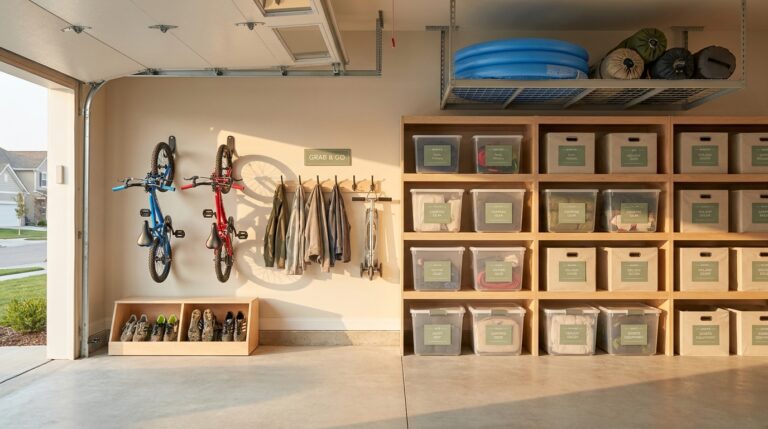
Zone 1 – Frequently Used (most accessible): Bikes, scooters, the stroller, sports gear in current season, and anything you grab daily or weekly. This zone should be closest to the door you use most and should require zero bin-digging—everything is visible and grab-and-go.
Zone 2 – Seasonal and Occasional: Holiday decorations, camping gear, seasonal sports equipment (ski stuff in summer, beach gear in winter), luggage. This zone can be higher on shelving or deeper in the garage since you only access it a few times a year.
Zone 3 – Tools and Home Maintenance: Hardware, paint, gardening supplies, lawn care equipment. Keep this zone near the workbench or along one wall. Tools should be visible and organized so you can find the right screwdriver without dumping a toolbox.
Zone 4 – Overflow and Bulk Storage: Bulk household supplies (paper towels, water bottles from Costco), large items like the folding table and extra chairs, and anything you access rarely. This zone can be the hardest-to-reach areas: high shelves, ceiling-mounted storage, or the back corners.
The most critical rule: leave the center of the garage clear for the car. Everything lives on the walls, ceiling, or in the back. If your zones encroach on the parking area, you have too much stuff and need to purge more.
Wall Systems: The Foundation of Garage Organization
Walls are your garage’s greatest asset. Every square foot of wall space is potential storage that keeps your floor clear. Invest here first and you’ll get the biggest return on your time and money.
Slatwall Panels: These horizontal-groove panels mount to your garage walls and accept a huge variety of hooks, shelves, bins, and holders. Proslat slatwall panels ($60–80 for a 4×8-foot panel at Home Depot) are durable and moisture-resistant. Add hooks for bikes ($8–15 each), tool holders ($5–10), and shelf brackets ($15–20). The advantage over pegboard is that slatwall handles heavy items and the accessories lock securely in place.
French Cleat Systems: For a DIY-friendly alternative, a French cleat wall (angled strips of plywood) lets you hang custom tool holders, shelf brackets, and bins that slide on and off. You can build an entire wall system for $50–75 in lumber from Home Depot. There are excellent tutorials on YouTube.
Heavy-Duty Shelving: For bins and bulky items, freestanding metal shelving is essential. The IKEA BROR shelving unit ($70–$115) is sturdy, adjustable, and looks clean. For maximum capacity, Muscle Rack 5-shelf steel shelving ($55–75 at Walmart or Home Depot) holds up to 4,000 pounds per unit. Place these along the back wall or side walls, and use them to get everything off the floor.
Ceiling Storage: Don’t forget to look up. Fleximounts overhead garage storage racks ($100–$180 on Amazon) mount to ceiling joists and hold 400–600 pounds. Perfect for holiday decoration bins, luggage, and camping gear—things you need only a few times a year. The Racor ceiling-mount bike hoist ($20–25) lifts a bike overhead with a simple pulley system, freeing up enormous floor space.
Kid-Specific Garage Storage Solutions
Family garages have unique challenges that a single adult’s garage doesn’t: bikes in three different sizes, helmets, scooters, ride-on toys, sidewalk chalk, bubbles, balls, and an ever-rotating assortment of outdoor toys. These items need their own dedicated system.
Bike Storage: Bikes are the biggest space hogs. For families with multiple bikes, a vertical bike hook system is the most efficient. Gladiator vertical bike hooks ($12 each at Lowe’s) mount to the wall or slatwall and store bikes upright, taking up about 18 inches of wall space instead of 6 feet of floor space. Teach kids (age 7+) to hang their own bikes—it’s surprisingly easy once they learn the motion.
Scooter and Ride-On Storage: A simple floor-standing rack made from a wooden pallet (free from hardware stores) stores scooters upright. Or mount a row of large J-hooks ($3–5 each at Home Depot) low on the wall for scooters and balance bikes. For ride-on toys like Power Wheels, designate a specific floor zone and use painter’s tape to mark the “parking spot”—kids love parking their cars in their designated space.
Sports Equipment: A ball storage rack like the IKEA PINNIG bench with shoe storage ($75) or a DIY bungee-cord ball corral keeps basketballs, soccer balls, and footballs from rolling around. For bats, sticks, and rackets, a vertical wall-mounted holder ($15–25 at Dick’s Sporting Goods or Amazon) keeps them upright and organized by sport.
Outdoor Toy Bin: For the small stuff—chalk, bubbles, jump ropes, water guns—a large weatherproof bin by the garage door works perfectly. The Suncast 50-gallon deck box ($60–80 at Home Depot) is waterproof, sturdy enough for kids to sit on, and holds a huge volume of outdoor toys. Label it “Outdoor Fun” and make it the one-stop grab for backyard play.
Labeling and Maintaining the System
A beautifully organized garage stays that way for approximately one week unless you label everything and build maintenance into your routine.
Label every single bin, shelf, and zone. Use large, clear labels that can be read from several feet away—this is a garage, not a pantry, so subtlety is wasted. The Brother P-Touch label maker ($20–30) produces waterproof laminated labels that hold up in garage conditions. For bins, label both the front and the lid (so you can identify them when stacked). For zones, use blue painter’s tape with bold Sharpie labels until you’re sure the layout works, then switch to permanent labels.
Use clear or translucent bins for seasonal storage so you can see contents without opening. The Sterilite 66-quart ClearView latch box ($10 at Walmart) is the workhorse of garage organization—affordable, sturdy, stackable, and see-through. Buy them all in the same brand and size so they stack cleanly. Avoid cardboard boxes in the garage; they attract pests, absorb moisture, and disintegrate over time.
Schedule two garage resets per year: one in spring (swap winter gear for summer, check for pest damage) and one in fall (swap summer gear for winter, donate outgrown bikes and sports equipment). Each reset takes about an hour if the system is already in place. Add it to your phone calendar and protect the time—it’s the difference between a garage that slowly declines and one that stays functional year-round.
The Parking Test and Final Touches
When everything is back in the garage, perform the parking test: pull your car in. Can you open all four doors? Can you walk between the car and the shelving without turning sideways? Can kids reach their bikes without your help? If yes, you’re golden. If not, reassess your zones and consider whether some items should be stored elsewhere (a basement, an attic, or a small outdoor shed).
Add a few finishing touches that make the garage more livable. A retractable extension cord reel ($25–40 at Home Depot) mounted to the ceiling keeps cords untangled and accessible. A shop broom hung on the wall makes quick sweeps easy. A small trash can near the door catches recycling and junk that would otherwise pile up on surfaces.
Consider adding a rubber garage floor mat or epoxy floor coating to the parking area. This protects the concrete, makes sweeping easier, and gives the whole space a finished look that motivates you to keep it clean. Costco’s Gorilla Grip garage flooring ($80–$120 for a two-car roll) installs in an afternoon.
An organized garage changes your daily life in ways you don’t expect. Mornings are faster because bikes and sports gear are grab-and-go. Weekends are smoother because you can find the camping cooler or the birthday party canopy without a 45-minute excavation. And there’s a quiet satisfaction in pulling into a clean garage at the end of a long day—a sense that your home is working with your family, not against it. That feeling alone is worth every minute you invested in the cleanout.
Neutral Nina
Neutral Nina is an interior design enthusiast and mom of three who proves that beautiful, organized spaces and family life can coexist. She shares practical strategies for creating calm, functional homes that work for kids and grown-ups alike.