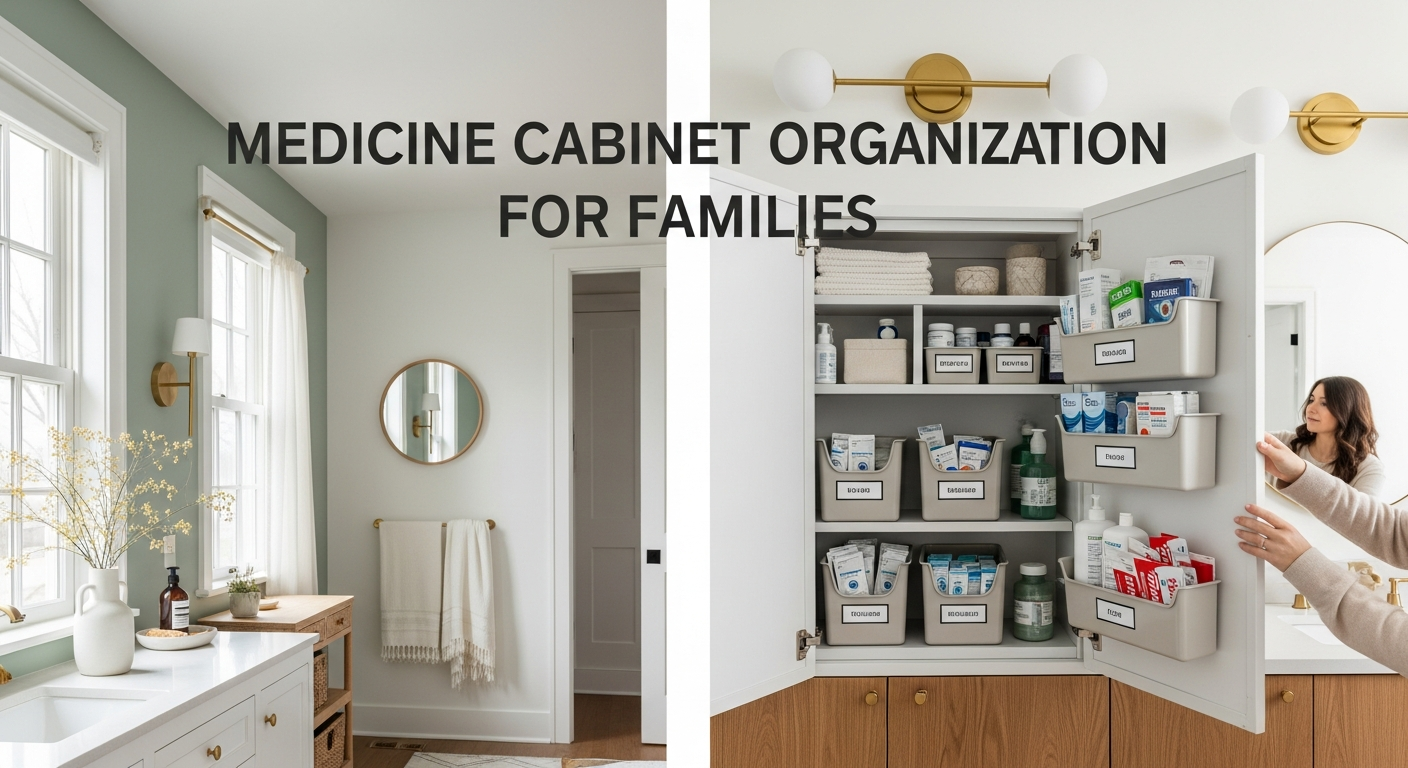
Medicine Cabinet Organization for Families
You can organize your family's medicine cabinet to quickly find essential items, even during emergencies. Learn how to purge expired products, categorize medications, and choose safer storage solutions for your family's health needs.
- Purge your medicine cabinet of expired items and duplicates, disposing of them safely.
- Organize medications into essential categories like Pain/Fever, Allergy/Cold, and First Aid.
- Relocate your medicine storage from the bathroom cabinet to a higher, safer, and roomier spot.
- Always check for measuring devices and write open dates on liquid medications.
A sick kid at 2 a.m. is a stressful time to discover a jumbled cabinet and a missing dropper. This guide covers what to toss, how to group what stays, how to lock it up, and how to find anything fast in the dark. It is general organizing advice, not medical advice, so confirm ages and doses with your pediatrician.
The Family Medicine Cabinet Organization Kit on this page includes a caregiver chart you can fill in with your pediatrician’s doses.
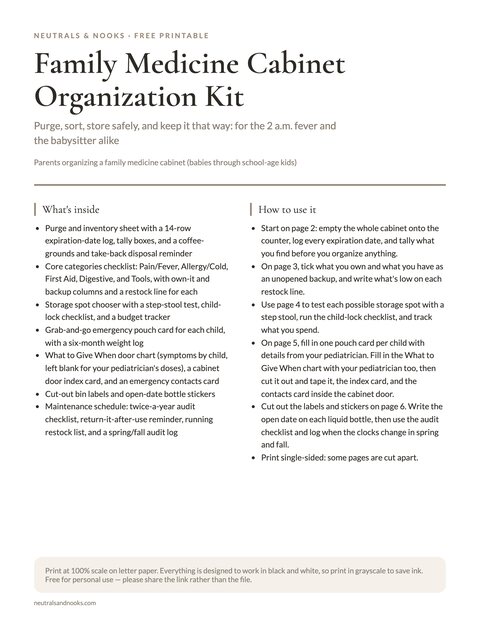
Free printable · 6 pages
Family Medicine Cabinet Organization Kit
A purge and expiration log with open-date bottle stickers, a five-category checklist, a storage and child-lock safety check with budget tracker, grab-and-go pouch cards, a what-to-give-when dosing grid to fill in with your pediatrician, a door index card, cut-out bin labels, and a twice-a-year maintenance schedule with a multi-year audit log.
Free. Your download link appears right here. You'll also join the Monthly Home Reset. Unsubscribe anytime. Privacy
In this article (8 sections)
What to Throw Out of Your Medicine Cabinet
Before you organize a single thing, empty everything out onto the counter. You will probably find expired bottles, duplicates, and a loose pill or two. That is normal, and it is exactly why this step comes first.
Check every expiration date. Expired medicines can lose potency, which matters most for epinephrine auto-injectors. Don’t keep leftover antibiotics. Discard them as the label or your pharmacist directs.
Ask your allergist or pharmacist what to do about an expired epinephrine device. In a severe reaction, if it is all you have, many allergists advise using it and calling 911 rather than waiting. Replace it before the date whenever you can.
I always find more duplicates than I expect at this stage, usually bought mid-illness because nobody could find the first bottle.
Safety firstNever combine or decant medicines. Keep each one in its original labeled, child-resistant container. To dispose of expired medicine, use a drug take-back program first. If none is available, mix the medicine with something unappealing like coffee grounds or kitty litter, seal it in a bag, and scratch personal information off the label. A few medicines are on the FDA flush list, so check it before you toss anything.
While you’re purging, take inventory of what you actually use. Most cabinets hold far more than a family needs, and fewer products means fewer chances for a mix-up. The checklist below covers the whole purge in order.
- Toss anything expired, discolored, or with a broken seal.
- Toss loose pills with no container, and anything with an unreadable label.
- Remove items that don’t belong, like beauty products and hair ties. Move vitamins and supplements to the locked spot.
- Check that every liquid medication still has its measuring device. Replace any missing dropper, syringe, or cup.
- Replace expired epinephrine auto-injectors.
- Find a take-back site through the DEA’s take-back locator or your pharmacy, and bag up what is going there.
How to Organize Medicine by Category: A Family Checklist
Sort what is left into five categories, so every item has one home: pain and fever, allergy and cold, first aid, digestive, and tools and devices.
Every medicine, including vitamins and supplements, goes in the locked spot, with adult and child products on separate shelves. Bandages and other non-medicine first aid supplies can sit in an open bin on a high shelf, out of kids’ reach. Dosing devices stay with the medicines they match.
The one exception is an epinephrine auto-injector, which stays accessible. See the safety box in the storage section below.
Give any over-the-counter medicine only at the age and weight on the label, or as your pediatrician directs. Dose with the device that came with the bottle.
| Category | Typical items | Age and safety notes |
|---|---|---|
| Pain & fever | Children’s acetaminophen (Tylenol), children’s ibuprofen (Motrin/Advil), adult versions kept separate | Dose by weight. No ibuprofen under 6 months. Check combination products for duplicate acetaminophen before giving a second medicine. |
| Allergy & cold | Children’s Zyrtec or Claritin, saline spray, bulb syringe or NoseFrida, Vicks VapoRub, honey for coughs | Children’s Zyrtec and Claritin: use only the product and dose for your child’s age and weight on the label. Under age 2, give only if the pediatrician directs, and ask for the dose. Benadryl: not under age 6 without medical direction, and never to make a child sleepy. Vicks VapoRub: ages 2 and up, never in or near the nose or mouth, and toxic if swallowed. Honey: over 12 months only. |
| First aid | Bandages in several sizes, antibiotic ointment, hydrocortisone cream, gauze, medical tape, tweezers, instant cold pack | Keep small items away from babies and toddlers. |
| Digestive | Pedialyte packets and simethicone drops. Tums only if your pediatrician recommends it. | Ask the pediatrician before using any of these for an infant. Mix Pedialyte exactly per the label, and discard mixed solution after the time on the label. Pepto-Bismol contains a salicylate and carries a Reye syndrome concern, so keep it adults-only. |
| Tools & devices | Digital thermometer, dosing syringes or droppers, nail clippers, small flashlight | Check the thermometer’s age range on the box. For babies under 3 months, ask the pediatrician which type to use and to show you how. Lock up spare button batteries, and check that battery doors are screwed shut. |
- Fever in a young baby: a fever of 100.4°F (38°C) or higher in a baby under 3 months means calling the doctor right away. Take the temperature rectally at this age, and ask your pediatrician to show you how before you ever need to.
Write the open date on each liquid bottle with a marker, and follow the label’s expiration and “discard after” instructions.
Liquid antibiotics are mixed by the pharmacy with a short shelf life. Finish the course as prescribed, then discard any leftover as the label or pharmacist directs.
How to Store Medicine Safely Around Kids
The standard bathroom medicine cabinet—that shallow mirrored box above the sink—is a poor fit for family medication storage. It’s small, hard to organize, and within reach of curious toddlers. Consider relocating your family’s medications to a better spot.
A locked cabinet in the hallway, or a locking box on a high shelf in the linen closet, is safer and roomier. For more on securing the rest of the house, see our baby proofing guide.
Inside the locked spot, plain stackable bins group medicines by category. Bins organize but do not secure, so they never replace the lock.
The mirrored bathroom cabinet can still hold everyday non-medicine basics. A small tiered shelf riser makes use of the height on those narrow shelves, and our family bathroom counter organization guide covers the rest of that room.
Keep all medications locked up, except an epinephrine auto-injector, which stays accessible. A locked cabinet or a locking box both work. Put it on a shelf kids cannot reach even with a step stool. Height alone is a backup, not the rule.
Which Lock to Choose
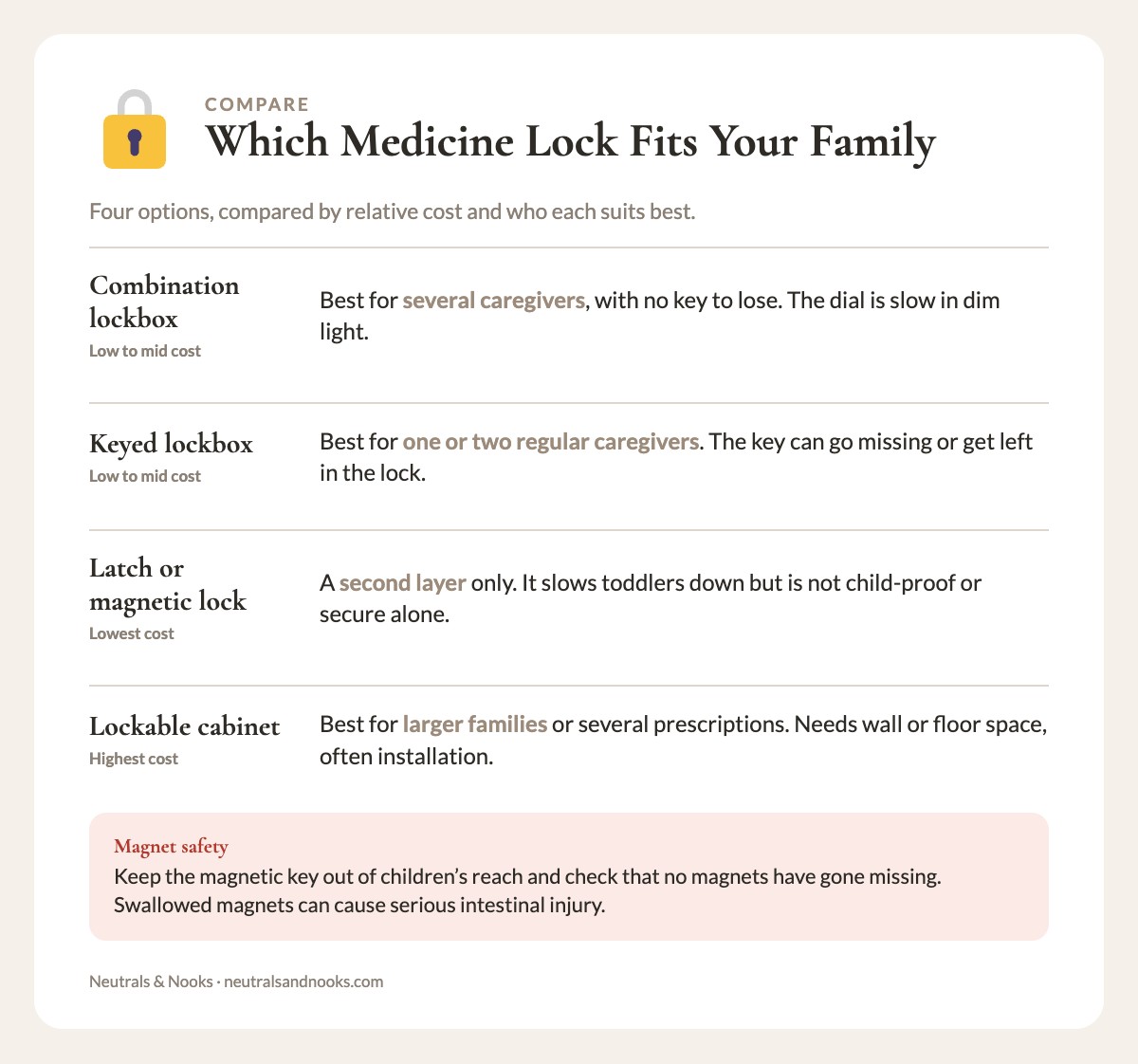
Prices vary widely by size and store, so the table compares relative cost.
| Lock option | Relative cost | Best for | Main drawback |
|---|---|---|---|
| Combination lockbox | Low to mid | Several caregivers, since there is no key to hand over or lose. | The dial is slow in dim light, and the code needs changing if a child learns it. |
| Keyed lockbox | Low to mid | One or two regular caregivers. | The key can go missing or get left in the lock. |
| Cabinet latch or magnetic lock | Lowest | A second layer on the cabinet that holds the lockbox. | It slows toddlers down but is not child-proof or secure on its own. |
| Lockable cabinet | Highest | Larger families, or several people’s prescriptions in one place. | It needs wall or floor space and often installation. |
Magnetic cabinet locks, such as the Safety 1st line, mount inside the door, so nothing shows from the outside. They slow toddlers down, but a latch is not child-proof or secure by itself. Treat one as a second layer on the cabinet that holds your lockbox.
Keep the magnetic key out of children’s reach, and check that no magnets have gone missing. Swallowed magnets can cause serious intestinal injury.
Safety firstPoison Help (US): 1-800-222-1222. Close and re-lock caps after every dose, keep medicines in their original containers, and store them out of sight. The exception is an epinephrine auto-injector, which should stay accessible at room temperature and not be locked away.
Pick a cool, dry spot away from the stove and sink, since heat and humidity degrade medications. Adults who use a weekly pill organizer should treat it as adult-only. Fill it just before use or keep it in the locked spot, and never use one for children’s medicines. Pill organizers are not child-resistant, and iron-containing vitamins and gummy supplements are especially dangerous to children.
TipVisitors’ medicines are a common gap. Give guests and grandparents a high shelf or hook for purses and bags, and ask them to use it. Store adult prescriptions, vitamins, and supplements in the same locked spot as the children’s medicines.
Make It Work at 2 a.m.
A good setup is one you can use half asleep. Plug a motion-sensor night light in near the storage spot so you are not flipping on a bright overhead light.
TipBring only what you need to the bedside, and return it right away. Items that leave the cabinet rarely find their way back on their own.
- Put fever and pain items at the front, with the thermometer and dosing syringes beside them.
- Use large-print category labels you can read in dim light.
- Check the mg/mL on the label before every dose, since infant and children’s formulas differ.
- Keep the dosing chart inside the locked area, where every caregiver knows to look.
- Tell every caregiver where the key or code lives, and keep a spare in a spot adults know but kids cannot reach.
Build a Grab-and-Go Medicine Pouch
Make one grab-and-go pouch for each child. It helps in the middle of the night, on a trip to the ER, or when a grandparent or babysitter needs to give something quickly.
The part that goes stale fastest is the weight card, so I date mine every time I update it.
The pouch lives in the locked spot with the main kit, so you grab it together with the key. Use a sturdy zippered pouch, not a plastic bag, because plastic bags are a suffocation hazard for babies and toddlers.
Safety firstOne thing stays out of the locked box: an epinephrine auto-injector, like an EpiPen. Keep it accessible and carried with the child. Store it at room temperature, never in a hot car or the fridge. Check the expiry date and look for discoloration. Make sure every caregiver knows how to use it.
- A thermometer.
- Medicines in their original labeled packaging, each with its matching dosing device.
- Any prescription medications the child takes.
- A card with the child’s current weight.
- An up-to-date allergy card, if your child has allergies.
- Emergency contacts and your pediatrician’s after-hours number.
- Label a pouch. Write each child’s name and date of birth on their own pouch.
- Ask for a dosing chart. Have the pediatrician write a dated dosing chart for each child’s current weight.
- Pack it. Add everything on the checklist above. Never pre-pour doses.
- Keep weight and dose current. Update the weight card at every pediatric visit, and every 1–2 months for infants and toddlers. Have the pediatrician update the dosing chart after each change, because a stale weight can mean a wrong dose. Caregivers should still confirm any dose with the pediatrician or Poison Help.
How to Label Your Medicine Cabinet
Labels keep a medicine cabinet organized, because they show everyone else in the house how the system works.
I like matching neutral bins with one label style. A locked cabinet that looks calm rather than clinical is one I actually keep tidy.
For bins and baskets, a DYMO LetraTag label maker (roughly $20–30) creates clean, professional labels that stick to plastic containers. If you prefer a warmer look, Avery Kraft Brown labels (a few dollars a pack) with a black marker suit a neutral look. Prices vary by store.
Label by category, not by person. “Pain/Fever,” “Allergy/Cold,” “First Aid,” and “Digestive” are intuitive categories that any caregiver can navigate. Inside each bin, face medication labels outward so you can read them without picking up every bottle.
Make a caregiver-only “What to Give When” chart for babysitters and partners who freeze up when a kid is sick. Keep it inside a locked cabinet or with your printable, never at a child’s eye level, so kids can’t self-dose. Have the pediatrician supply the doses for each child. The caregiver chart in the Family Medicine Cabinet Organization Kit on this page leaves space for those doses, not generic ones.
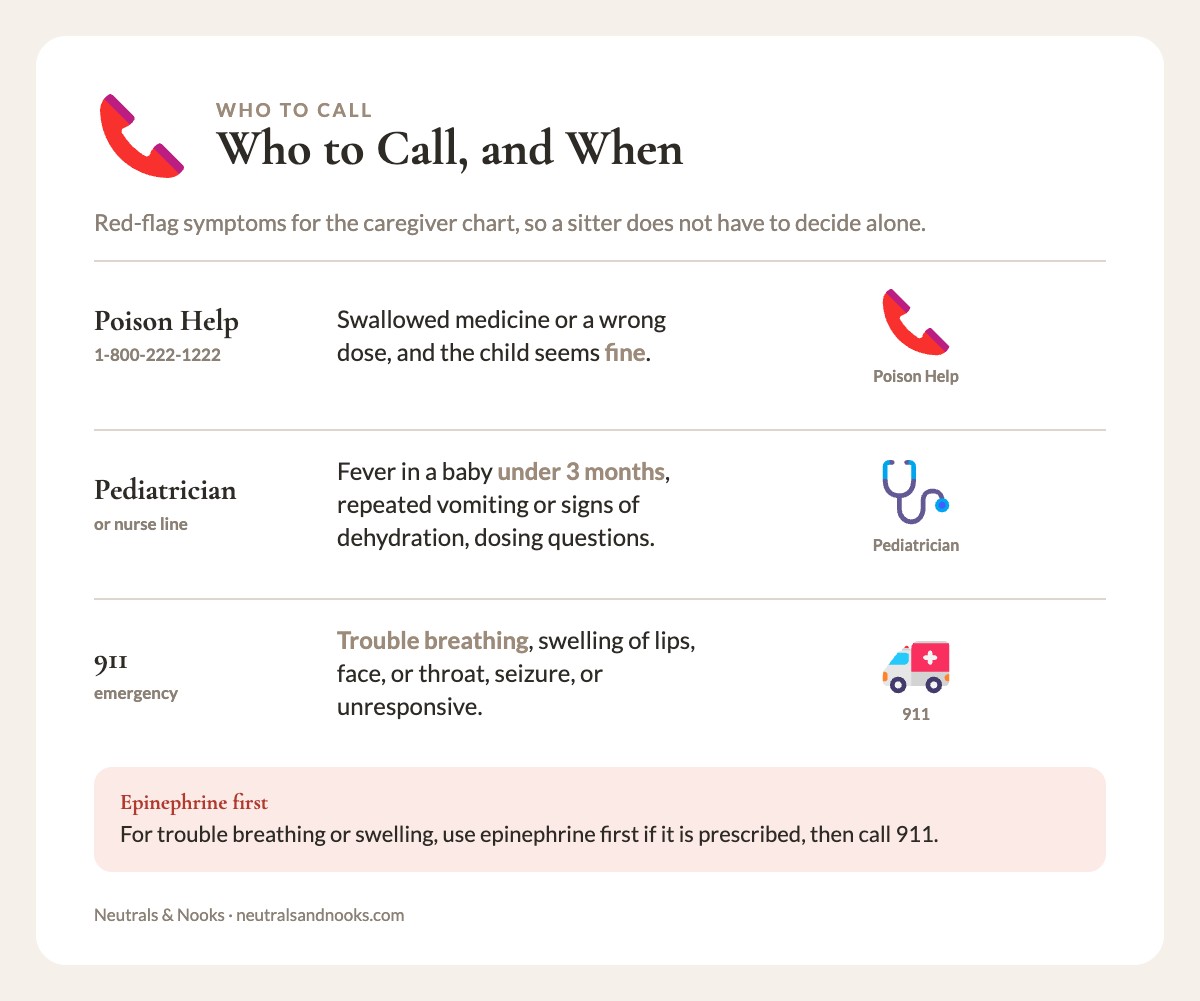
Add red-flag symptoms to the chart so a sitter does not have to decide alone. Use this table as a starting point.
| Call | When |
|---|---|
| Poison Help 1-800-222-1222 |
Swallowed medicine or a wrong dose, and the child seems fine. |
| Pediatrician or nurse line | Fever in a baby under 3 months, repeated vomiting or signs of dehydration, dosing questions. |
| 911 | Trouble breathing, swelling of the lips, face, or throat, seizure, or unresponsive. Use epinephrine first if prescribed. |
Keep an index card inside the locked cabinet listing every family member’s current medications, allergies, and the pediatrician’s number. Pair it with your family command center so emergency numbers live in one place.
Maintaining the System Long-Term
Schedule a medicine cabinet audit every six months. Tie it to the daylight saving time changes, and test your smoke and CO detectors at the same time.
It also pairs well with a family fridge and freezer clear-out, since both jobs are mostly checking dates.
- Check expiration dates, and move the earliest date to the front to use first.
- Check open-date and discard-after labels.
- Replace missing dosing devices.
- Update each child’s weight and dosing chart.
- Check epinephrine expiry and color.
- Dispose of expired items safely.
- Add anything low to the restock list.
Keep a running list on your phone’s notes app of medications that need restocking. When you use the last dose of something, add it to the list immediately. This prevents those panicked midnight pharmacy runs.
Medicine Cabinet FAQ
Where should I store medicine?
Keep it in a locking box or locked cabinet, high and out of children’s sight, in a cool, dry spot. Skip the bathroom mirror cabinet and keep epinephrine auto-injectors accessible at room temperature.
How often should I audit the cabinet?
Every six months works well. Check expiration dates and discard-after labels, and update weights and dosing charts.
How do I dispose of expired medicine?
Use a drug take-back program first. Otherwise mix it with coffee grounds or kitty litter, seal it in a bag, and scratch personal information off the label. Check the FDA flush list for the few exceptions.
When do I call Poison Help versus 911?
Call Poison Help at 1-800-222-1222 if you suspect a child swallowed medicine but they seem fine. Call 911 if they are unresponsive, having trouble breathing, having a seizure, or have swelling of the lips, face, or throat.
Can I keep medicine in the bathroom?
It is best not to. Heat and humidity degrade medicines, and the mirrored cabinet is easy for small hands to reach. A locked box on a high shelf in a cool, dry spot is a better home.
How long does liquid children’s medicine last once opened?
It depends on the product, so follow the label’s expiration and “discard after” instructions and write the open date on the bottle. Liquid antibiotics have a short shelf life once the pharmacy mixes them, so finish the course as prescribed and discard any leftover as the label or pharmacist directs. Ask your pharmacist if you are unsure.
What medicines should I have at home for a newborn?
Ask your pediatrician, because newborns have strict age and dosing limits and a fever in a baby under 3 months means calling the doctor. The printable kit on this page has space to record exactly what your pediatrician recommends.
Neutral Nina
Neutral Nina is an interior design enthusiast and mom of three who proves that beautiful, organized spaces and family life can coexist. She shares practical strategies for creating calm, functional homes that work for kids and grown-ups alike.