The Four Gift Rule: Want, Need, Wear, Read Ideas by Age
Discover the 'Four Gift Rule' (Want, Need, Wear, Read) to simplify holiday gifting and reduce clutter. You'll get ideas by age, planning tools, and understand why this method creates a more meaningful Christmas morning for your kids.
- Understand the 4 gift categories: Want, Need, Wear, Read, for simplified gifting.
- Get gift ideas by age (1-10) for each category to make shopping easier.
- Reduce clutter and overwhelm by focusing on fewer, more meaningful gifts.
- Utilize free printables like a gift planner and wish list for easy planning.
- Simplify your budget and shopping with a fixed number of gifts per child.
This post contains affiliate links. As an Amazon Associate I earn from qualifying purchases.
Two Januaries ago, I stood in our playroom doorway holding a laundry basket with nowhere to put a single thing. Somewhere under the pile was a gift my daughter had loved for ten minutes before moving on to the next one.
So I wrote four words at the top of a page: want, need, wear, read. This guide explains the four gift rule in about two minutes, then gives you ideas for every slot at ages 1 to 10, grandparent scripts, a copyable wish list, and a January reset. If you want to start today, jump to the wish list and the October-to-Christmas timeline near the end.
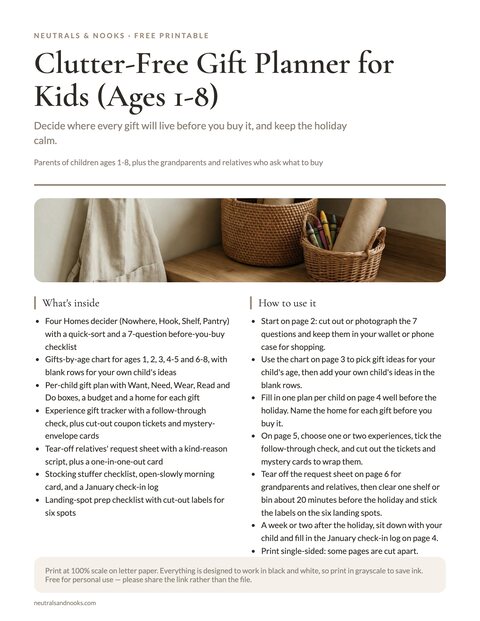
Free printable · 6 pages
Clutter-Free Gift Planner for Kids (Ages 1-8)
A Four Homes gift decider with a 7-question before-you-buy checklist, a gifts-by-age chart, a per-child Want/Need/Wear/Read/Do plan, an experience tracker with coupon and mystery-envelope cards, a relatives' request sheet, a stocking-stuffer list, cut-out landing-spot labels, and a January check-in log.
Free. Your download link appears right here. You'll also join the Monthly Home Reset. Unsubscribe anytime. Privacy
The four gift rule gives each child four presents at Christmas: something they want, something they need, something to wear and something to read.
In this article (15 sections)
- The Four Gift Rule in Two Minutes
- Why It Works (Beyond the Clutter)
- The Want, Need, Wear, Read Table by Age
- Want, Need, Wear, Read Ideas for a 1 or 2 Year Old
- Want, Need, Wear, Read Ideas for a 3 Year Old (and 4)
- Want, Need, Wear, Read Ideas for a 5, 6 or 7 Year Old
- Want, Need, Wear, Read Ideas for an 8, 9 or 10 Year Old
- How to Bring Grandparents Into the Four Gift Rule
- After Christmas: What Four Gifts Do to Your Playroom (and a January Reset)
- Making the Four Gift Rule Work for Siblings, Stockings and Two Homes
- Your One-Page Four Gift Wish List (Copy and Use)
- Four Gift Rule Timeline: October to Christmas
- Want, need, wear, read: picks from our sister brands
- Frequently Asked Questions
- A Quieter Christmas Is Still a Full One
The Four Gift Rule in Two Minutes
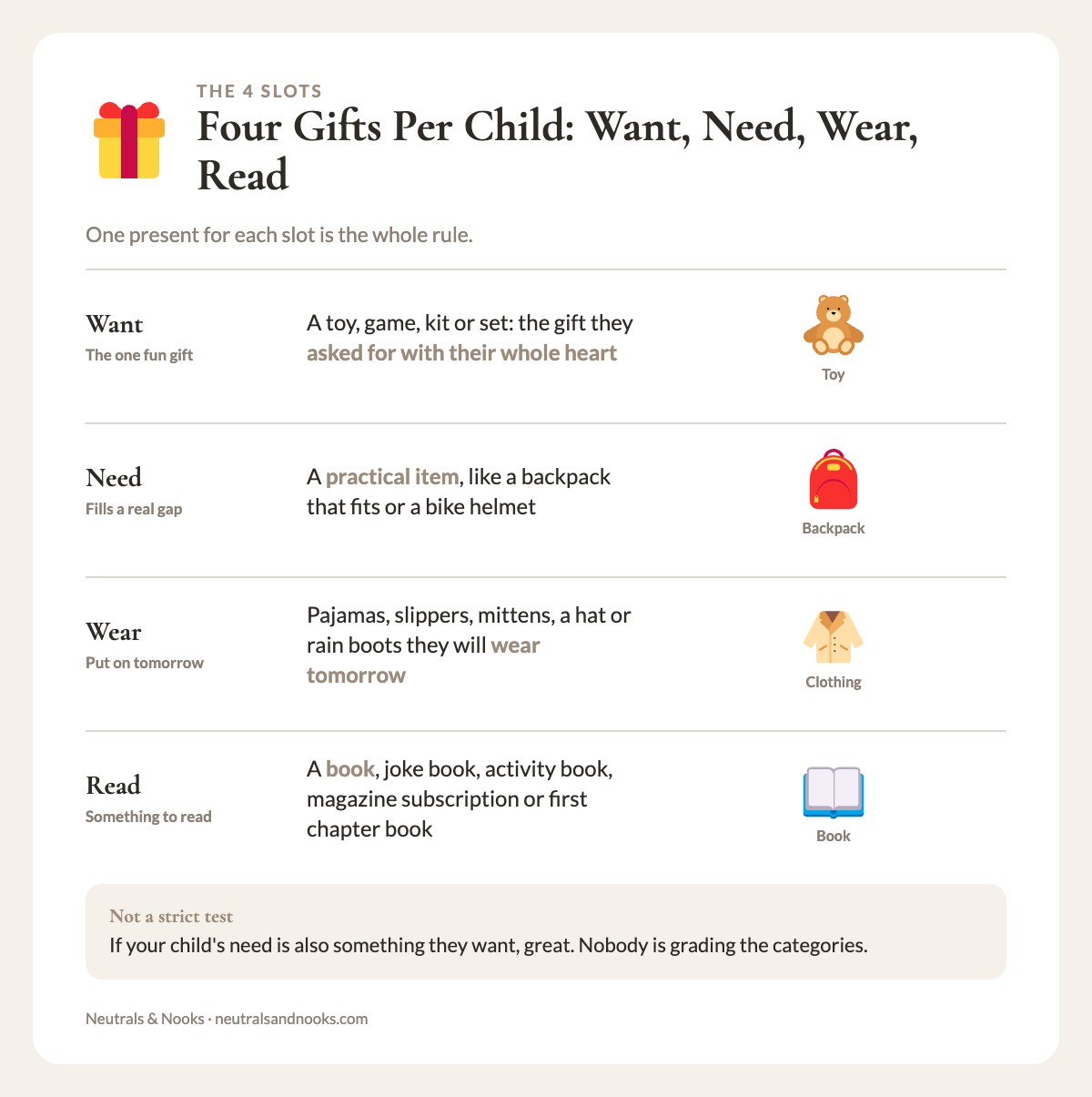
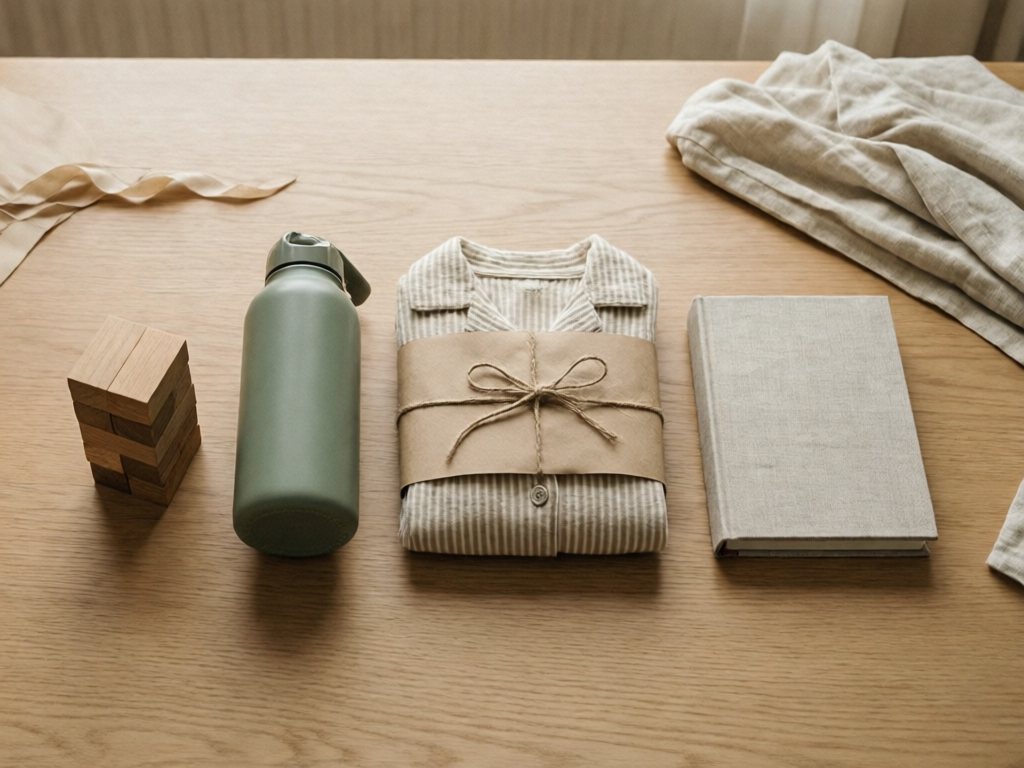
The four gift rule (you will also see it searched as the 4 gift rule, or “want, need, wear, read”) limits each child to four presents at Christmas, one for each category:
- Something they want. The one fun gift. A toy, a game, a kit, a set. This is the gift they asked for with their whole heart.
- Something they need. A practical item that fills a real gap, such as a water bottle that actually seals, a backpack that fits, a bath towel, a lunch container, a bike helmet.
- Something to wear. Clothing, pajamas, slippers, mittens, a hat, rain boots. Something they will put on tomorrow.
- Something to read. A book, a magazine subscription, a joke book, an activity book, a first chapter book.
A few things the rule does not say, which matter more than people think:
- It does not say the gifts must be small, cheap, or boring. The “want” slot can hold the big thing.
- It does not say you can never give anything else. Plenty of families add a stocking, a shared family gift, or an experience on top. The four-gift list covers what goes under the tree for each child.
- It does not require perfection. If your child’s “need” is also something they want, great. Nobody is grading the categories.
What the rule does is give you a built-in filter. When a relative asks what to buy, you have an answer. When you are standing in a store aisle or scrolling at midnight, you have a stopping point. And when your child sits down on December 26th, there are four things to explore instead of a pile competing for attention.
Why It Works (Beyond the Clutter)
The rule works because of how children respond to presents. It is less a minimalism trick than a way to give each gift more attention and the morning less noise.
Attention gets a chance to land. In my experience, kids get overwhelmed when presents arrive in a flood, and the opening becomes a race. With four gifts, children slow down. They read the tag, they hold the thing, they say something about it.
The categories do the planning for you. “What should I get?” is a huge question. “What is one book they would love?” is small enough to answer in a minute.
It quietly teaches something. The categories show children that gifts come in different kinds, and that clothes and books are real presents, not consolation prizes. At our house, the book is no longer the gift that gets set aside.
It makes a budget easier to hold and shortens the shopping list. With a fixed count, you can set one spending number per child and divide it across the four slots, rather than buying extra and returning half of it on Boxing Day. The shopping is finished earlier, and the week before Christmas feels less frantic.
If you want a longer runway, the Christmas Planning Checklist for Families: An 8-Week Timeline pairs well with this rule.
The Want, Need, Wear, Read Table by Age
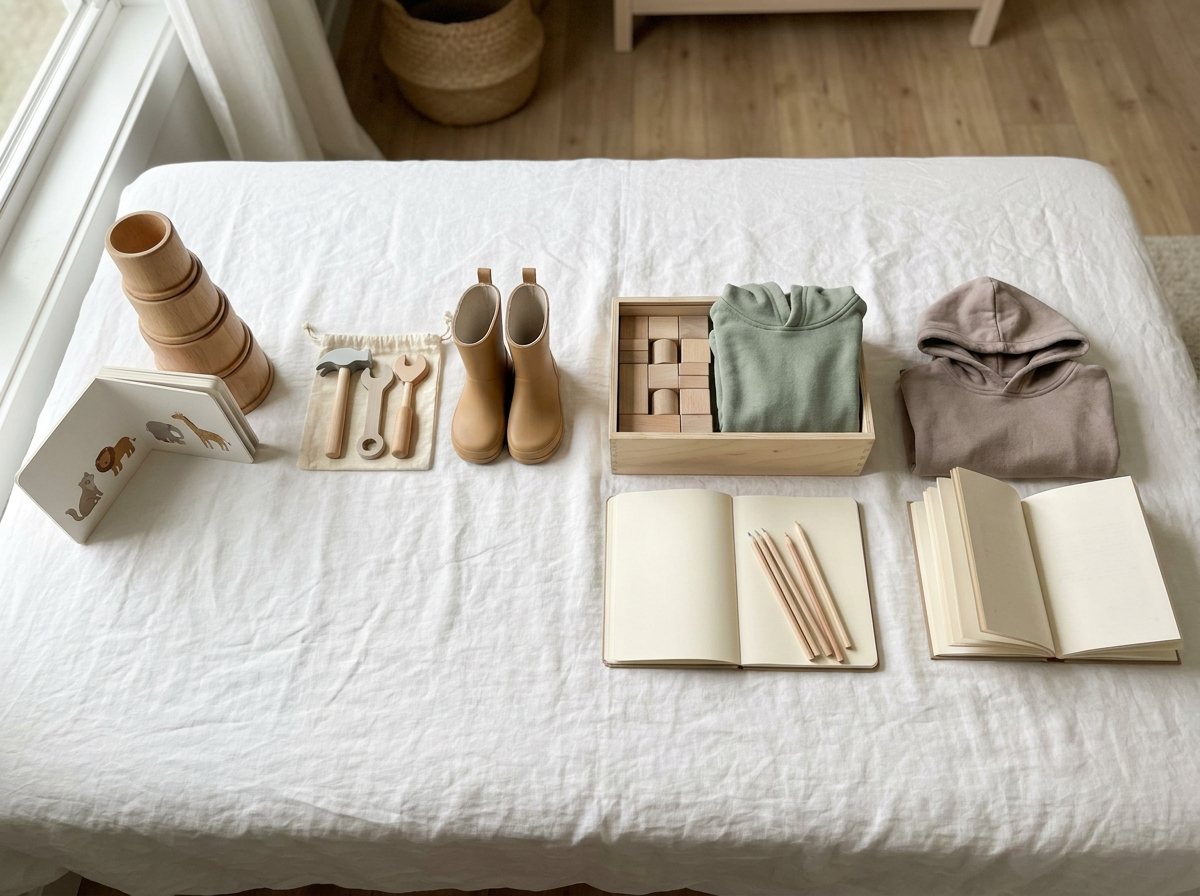
Here is the at-a-glance version. The cells are ideas, not rules, and the full lists by age follow. You can copy this table into a notes app, paste it into a shared family document, or write it out by hand.
| Ages 1–2 | Ages 3–4 | Ages 5–7 | Ages 8–10 | |
|---|---|---|---|---|
| Want | Stacking cups, large wooden blocks, a ride-on or push toy, a simple shape sorter | A pretend-play set (kitchen tools, doctor kit, tool bench), a beginner puzzle, a dress-up piece | A construction set, a board game for the family, a craft or science kit, a doll or figure set with real play potential | A larger building project, a strategy game, a sketchbook-and-pencil set, a sports item they asked for, a musical instrument to try |
| Need | A sturdy open cup, a soft bath toy set, a good bib set, a sleep sack | A step stool, a real water bottle, a small backpack, a lunch container with compartments | A school-day water bottle, a bike helmet that fits, a pencil case, a flashlight for reading | A real alarm clock, a sturdy backpack, a sports bottle, a bike lock, a desk lamp |
| Wear | Cozy pajamas, warm socks with grip, a sun hat or winter hat | Pajamas they chose, rain boots, mittens, a favorite-color sweatshirt | A dress-up or costume item they will actually wear, slippers, a coat that fits this year | A hoodie they picked out, comfortable sneakers, a robe, a scarf and hat set |
| Read | Board books with texture or flaps, a simple rhyming book | A picture book series, a seek-and-find book, a book about a favorite interest | A first chapter book, a graphic novel, a nature field guide, a joke book | A longer novel in a series, a how-to or drawing book, a magazine subscription, a book of facts |
Want, Need, Wear, Read Ideas for a 1 or 2 Year Old
Toddler Christmas is the easiest year to overdo, because one-year-olds cannot ask for anything and every relative has an opinion. The rule makes the most obvious difference here, because a toddler needs very little and a big pile can overwhelm them.
Want (ages 1–2)

For this age, “want” really means “what will they come back to every day for the next six months.” Look for open-ended toys with simple moving parts.
- Large wooden blocks or soft stacking blocks. These are used for building, knocking over, carrying, sorting, and eventually pretend food. Look for pieces too big to fit through a toilet paper tube.
- Stacking and nesting cups. One of the best-value toys in any home with a toddler. They work in the bath, in the sandbox, and at the table.
- A push or ride-on toy. Something sturdy and low to the ground that supports early walking. Choose a stable, wide-wheelbase push toy and use it on a flat indoor surface away from stairs.
- A shape sorter or a simple peg puzzle. One with big chunky pieces, pegs too big to fit through a toilet paper tube, and clear pictures.
What to look for: no tiny parts, no loud electronic sounds, nothing that requires a battery to be interesting. If it is only fun when it is switched on, it will go quiet fast.
Safety firstSkip anything with a battery compartment that opens without a screw, and keep button batteries and loose magnets away from toddlers.
Need (ages 1–2)
- A good open cup or straw cup that your child can hold and that leaks little.
- A sleep sack or wearable blanket if you are not already using one. Follow the manufacturer’s size and weight guidance rather than buying one to grow into.
- A set of bath toys that drain well and do not trap water, which saves you from a moldy surprise.
- A sturdy learning tower if your child is ready to join you at the counter. If your kitchen is part of the plan, Creating a Toddler-Friendly Kitchen: Safety Meets Independence walks through how to do it safely.
Safety firstChoose a wide-base tower with guard rails. Use it only at the counter with an adult within arm’s reach, keep it away from the stove and hot pots, and never leave a toddler unattended on it.
Wear (ages 1–2)
Choose comfort and function: soft pajamas with easy closures, thick socks with grip on the bottoms, a warm hat or a sun hat depending on where you live. Sizing up is fine for everyday clothes.
Safety firstPajamas should be snug-fitting or labeled flame-resistant, so skip sizing up for sleepwear. A sleep sack should match your child’s current weight and size so it cannot ride up over the face.
Read (ages 1–2)
Board books are the whole category. Look for sturdy pages, large simple illustrations, rhymes, repeating phrases, and lift-the-flap or textured elements. Choose one that you will not mind reading forty times, because you will.
Want, Need, Wear, Read Ideas for a 3 Year Old (and 4)
Three is the age where wish lists suddenly appear. A three-year-old has opinions. They have seen an ad, a friend’s toy, or something in a store window, and they would like it, thank you.
Three is also when the four-gift rule becomes easy to explain out loud. You can tell a three-year-old, “Santa brings four things: something you want, something you need, something to wear, and something to read.” Many kids accept it more easily when they hear it the same way every year.
Want (ages 3–4)
This is the peak pretend-play window. The best “want” gifts at this age invite stories.
- A pretend-play set. A play kitchen tool set, a doctor kit, a toolbench, a tea set, a grocery stand. Pick one that matches what your child already does with real objects.
- A dress-up piece. One good cape, a set of fabric scarves, a firefighter hat. Resist the temptation to buy a whole costume trunk.
- A beginner puzzle with 12 to 24 pieces and a clear picture.
- Building materials. Bigger blocks, large sealed magnetic tiles (see the safety note below), or interlocking pieces.
The “want” slot is where your child’s current obsession goes. If they love trucks, pick the truck. If they are fixated on the bakery, pick the baking set. Specific beats trendy every time.
Safety firstCheck the age label. Skip sets with small detachable pieces for children under 4 or in homes with a younger sibling, and test play food and accessories against a toilet paper tube: if a piece fits inside, it is too small. For magnetic tiles, choose large ones with securely sealed magnets, discard any that crack or open, and keep them away from toddlers and mouthing siblings.
Need (ages 3–4)
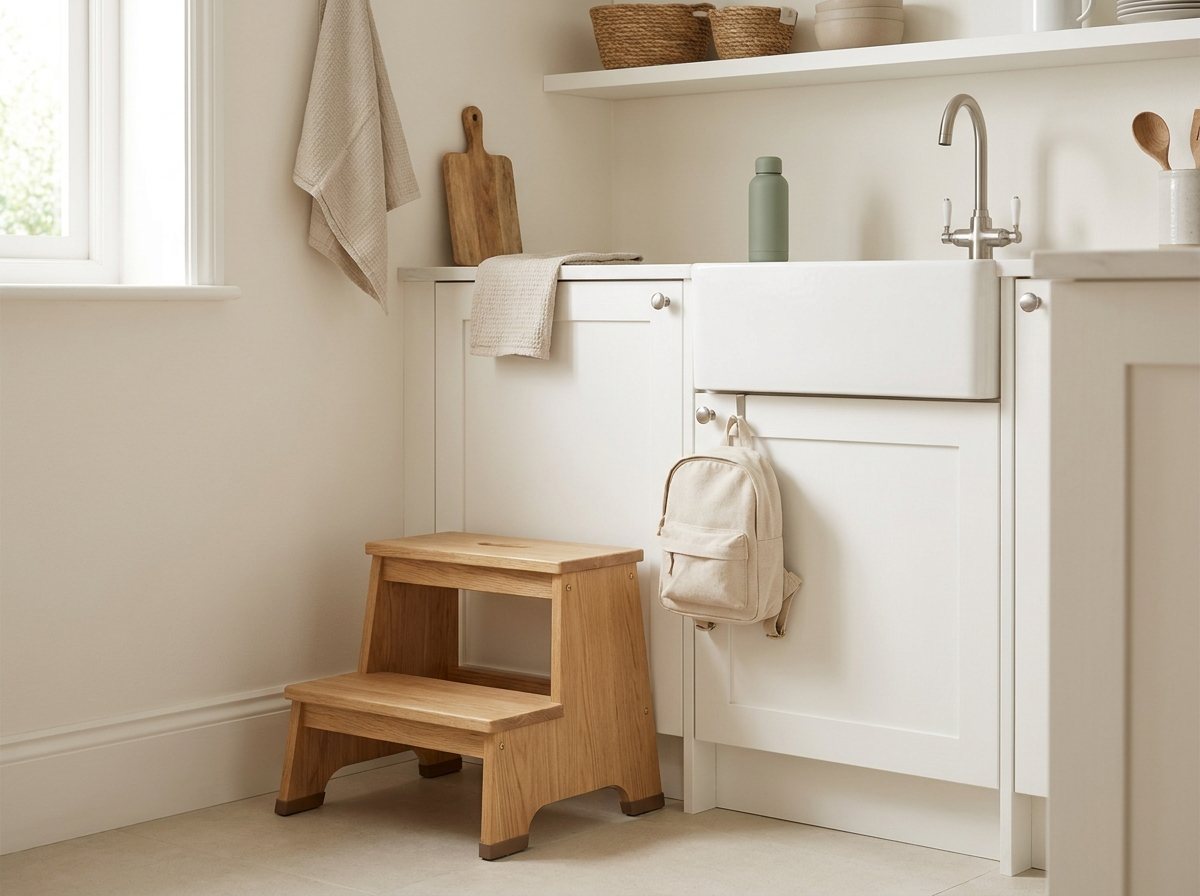
- A step stool so they can reach the sink and the counter. Choose a wide, non-slip base, stay within arm’s reach around the stove, knives and hot water, and never let a child use it unattended.
- A real water bottle they can open and close themselves.
- A small backpack for preschool or the library bag.
- A lunch container with compartments, if they are heading to a program.
- A child-sized broom, dustpan, or watering can. Real, small tools are a great “need” at this age because children at three and four want to help.
Wear (ages 3–4)
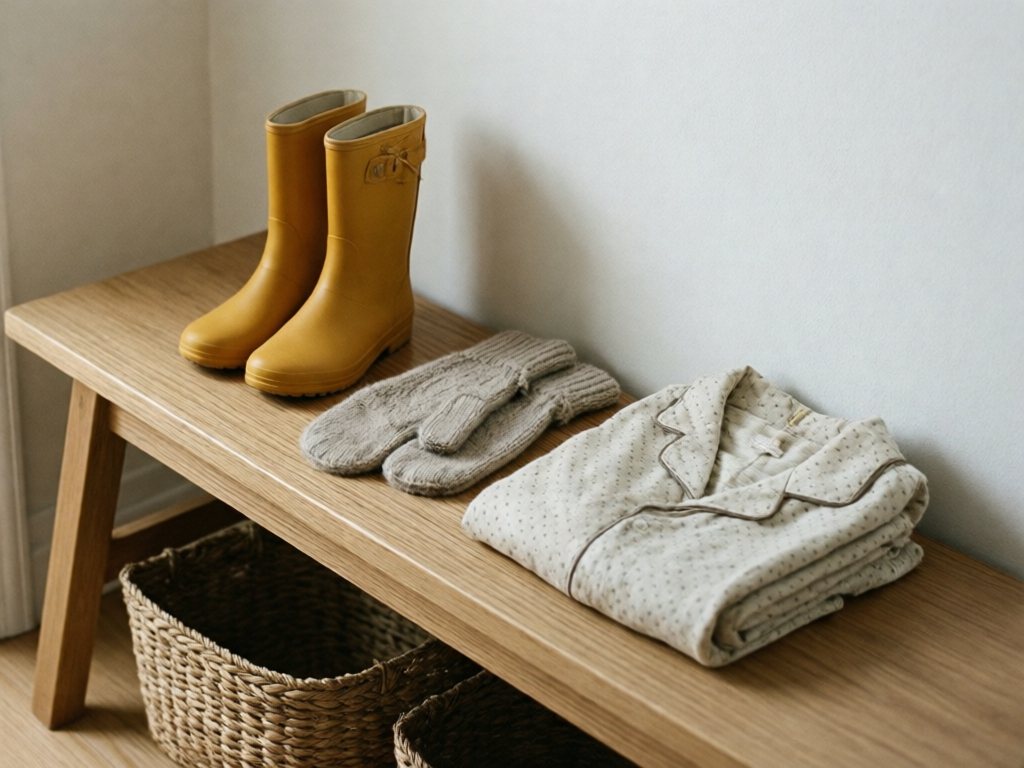
Rain boots, mittens, and pajamas are the stars here. Let your child choose the pajamas if you can, even if the choice is limited to two options. Wearing something they picked makes the gift feel like theirs.
Read (ages 3–4)
This is the golden age of picture books. A story with a strong character, a seek-and-find book, a book about a topic they love (diggers, bakeries, owls), or the next book in a series they already know all work well. If your child has a favorite library book they keep asking for, buy it. Owning it changes how they treat it.
Want, Need, Wear, Read Ideas for a 5, 6 or 7 Year Old
Kindergarten through second grade is where the rule gets interesting. Children start comparing, school friends mention things, and the wish list gets longer. Kids this age can also begin to see that Christmas is about more than quantity, if you give them the framework.
Want (ages 5–7)
- A construction or engineering set with a clear goal: a vehicle, a marble run, a bridge.
- A board game for the family. Cooperative games work well at this age, since children are still learning to lose gracefully.
- A craft or science kit with a defined project, not a bin of random supplies.
- A doll, figure, or animal set with real play potential. Look for pieces that fit together into a world: a small barn and animals, a dollhouse room, a set of play people.
- A beginner instrument or music maker. A xylophone, a simple keyboard, a ukulele.
For many families, this is the age where the “want” slot is the hardest to hold the line on. A child might have six things they want. The rule is that they pick one. I have found it helps to let the child do the picking from a short list, rather than asking an open question.
Safety firstIf a set includes marbles or tiny connectors, keep it away from children under 4 and store it out of a younger sibling’s reach.
Need (ages 5–7)
- A school water bottle that survives the bottom of a backpack.
- A properly fitting bike helmet if your child rides.
- A pencil case or a small art caddy.
- A flashlight for reading under the covers. It sounds like a want, but it solves a real bedtime problem.
- A set of hooks or a bag for their own gear. If the entryway is where your gear gets lost, Mudroom Cubbies for Multiple Kids: Sizing, Labels, and Layout can help you think through where a gift like that will live.
Safety firstFlashlights, reading lights and alarm clocks often use coin or button batteries. Choose devices with screw-secured battery compartments, lock spare batteries away, and get emergency care right away if a button battery may have been swallowed.
Wear (ages 5–7)
A coat that fits this winter, slippers, a costume or dress-up item they will wear on purpose, or a sweatshirt in the exact color they requested. At this age, children can have strong feelings about clothing, so letting them weigh in on one item is a gift in itself.
Read (ages 5–7)

A first chapter book, a graphic novel for a newly confident reader, an illustrated field guide to birds or insects, a joke book, or an activity book with mazes and drawing prompts. If your child is not yet reading independently, a longer picture book or a read-aloud chapter book you will enjoy together is a lovely choice.
Want, Need, Wear, Read Ideas for an 8, 9 or 10 Year Old
Older children are the ones most likely to push back on the rule, and they are also the ones who benefit most when they help shape it. A nine-year-old who picks their own four gifts feels respected. A nine-year-old who is handed a limit with no input feels managed.
Want (ages 8–10)
- A larger building or hobby project. A detailed model, a robotics kit, a big set that takes a weekend to complete.
- A strategy game for the family or for playing with friends.
- An art set with real materials: a sketchbook, good pencils, and a few paints rather than a mixed bag of supplies.
- A sports item they specifically asked for.
- A musical instrument to try, or the next step up from the first one.
At this age, the “want” is often the item that supports an emerging interest. Look for gifts that let them go deeper, not wider.
Need (ages 8–10)
- A real alarm clock so mornings become a little more their responsibility.
- A sturdy backpack that suits the amount they now carry.
- A sports water bottle or insulated bottle.
- A desk lamp or a good reading light. If you are building a place for homework, How to Set Up a Homework Station Kids Will Actually Use offers ideas for making the space feel like theirs.
- A bike lock or other gear that comes with independence.
Wear (ages 8–10)
A hoodie or sweatshirt they chose themselves, comfortable shoes for the activity they do most, a robe, or a scarf-and-hat set. At this age, children care about what clothing says about them. If you have a child who is picky, a small gift card to put toward an item of their choice can work in this slot, as long as the family agrees it counts as “wear.”
Read (ages 8–10)
A longer novel, the next book in a beloved series, a drawing or how-to book connected to a hobby, a book of facts, a puzzle book, or a magazine subscription that arrives all year. A subscription is a good one for this age, because it makes January feel less empty.
How to Bring Grandparents Into the Four Gift Rule
Grandparents and extended family love your children and want to show it. The goal is not to block that. It is to point it somewhere useful.
Start early and keep it simple
Send the message in October or early November, not December. Early gives people time to adjust without feeling rushed. Keep the message short and positive.
TipCopy this message: “We’re doing a four-gift Christmas this year: something they want, something they need, something to wear, and something to read. Would you like to take one of the slots? Here’s a short list of ideas for each.”
Offering to assign a slot is the single most effective step. Instead of “please don’t buy too much,” you are saying “here is a way to give.” People who love to shop feel included. People who feel anxious about getting it wrong get a clear task.
Give each person a lane
A simple way to divide a family:
| Who | Slot | Why it fits |
|---|---|---|
| One grandparent | Read | Books are easy to buy from afar and easy to feel proud of. |
| Another grandparent | Wear | Give sizes and favorite colors. |
| An aunt or uncle | Want | Offer a short list of two or three approved options. |
| You | Need | You know best what your child lacks. |
If you are using the one-page wish list further down, you can copy the relevant lines straight into a message.
Offer an alternative for people who want to do more
Some relatives will not be able to stop at one gift, and that is okay. Offer a different outlet:
- A shared experience. A trip to a museum, a zoo, a skating rink, or a movie, planned for later in winter when the house is quiet.
- A contribution to a bigger family gift. A single shared item, like a family board game or a backyard play item for spring.
- Time. A standing weekend visit, a baking afternoon, a regular video call to read a chapter together.
- Consumables. Art supplies, a special treat, a seasonal activity.
For more ideas that give the giver something to do without adding to the pile, the post on non-toy gifts for kids, with clutter-free ideas by age is a good one to share with relatives who want options.
When someone ignores the plan
It will happen at least once. A well-meaning relative will arrive with a large bag of extra gifts. A few ways to handle it:
- Say thank you, warmly, and mean it. The person is expressing love, not breaking a rule.
- Add the gifts to the “later” pile. Set a couple aside and hold them for a birthday, a rainy day, or the spring. Younger children often don’t notice. With older kids, say honestly that some gifts are being saved for later.
- Don’t correct in front of the child. If you want to talk about it, do it privately, after the holiday, and frame it as “here is what worked for us.”
The rule is a tool for your household. It is not a test for your family.
After Christmas: What Four Gifts Do to Your Playroom (and a January Reset)
This was the part I was most curious about when we tried it, so I paid close attention.
Fewer things to find a home for
The immediate effect is the one you would expect. On December 26th, you have four new items per child, not a mountain. That means you can walk into the playroom and put things away in a few minutes. There is no “where do I put all this” moment. If you have been wrestling with a small space, the Small Playroom Ideas That Maximize Space post is a good companion.
Gifts get played with
This is the part that surprised me. With fewer new things, each one got longer attention at our house. The “want” gift was used for days, sometimes weeks. The book got read at bedtime. The new pajamas got worn. Nothing was buried under the next thing.
The old toys come back out
When a child is not overwhelmed by new items, the toys already in the house stay in play. I noticed older toys, ones I had stopped seeing, return to the floor in January. If you are using a toy rotation, a smaller Christmas makes it much easier. The How Many Toys Should Be Out at Once? A Rotation Guide post can help you decide how much to display and how much to store.
A simple January reset
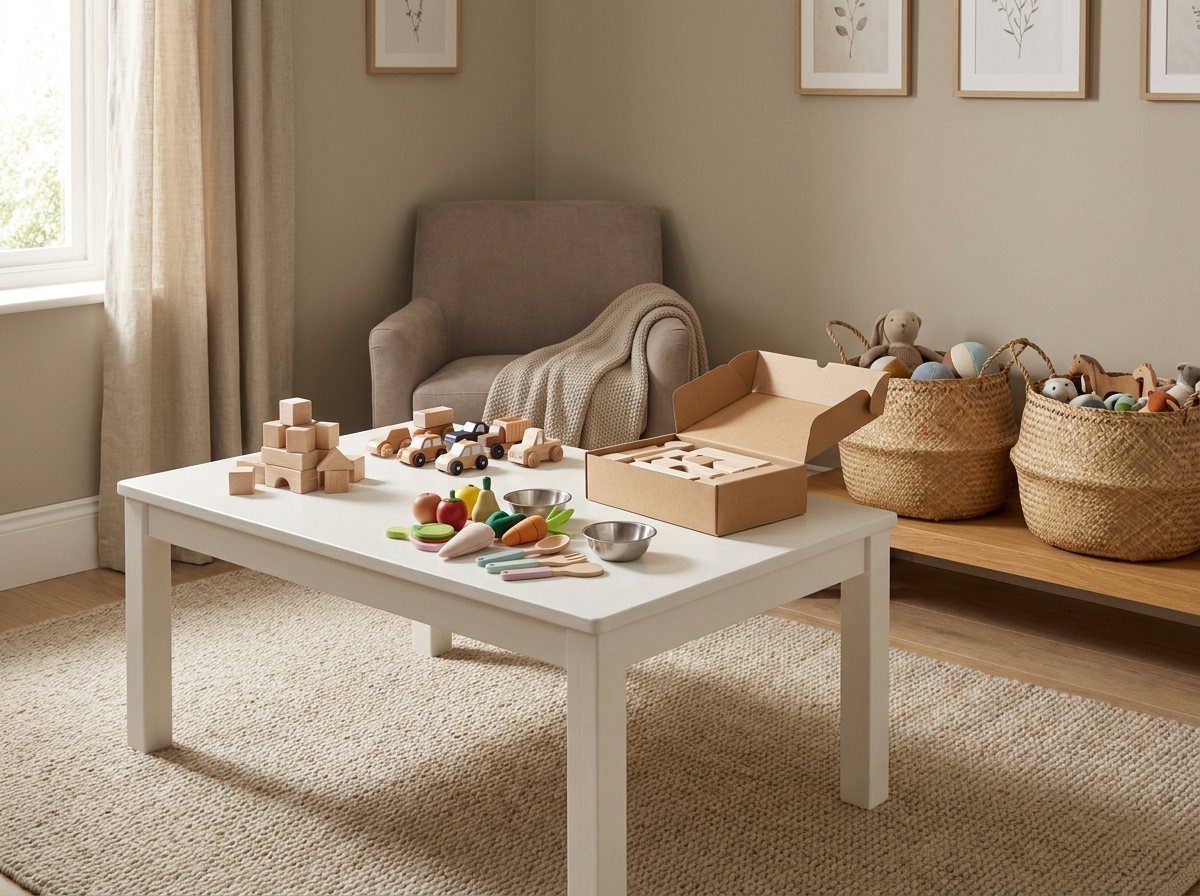
Here is the routine I follow in the first week of January.
- Clear a flat surface. A table or a spare bed works.
- Bring in the new “want” gift and decide where it will live. Give it a clear home before anything else.
- Do a quick sweep for broken, incomplete, or outgrown toys. Remove them.
- Sort what remains by type. Blocks with blocks, vehicles with vehicles, pretend play with pretend play. If you want a system for this, the guide to organizing toys by type walks through it step by step.
- Rotate. Put roughly half of the toys away, including a few of the older favorites, and keep the new gift in the active group.
- Shelve the new books with the existing ones, near where your child reads.
Because the volume is lower, the whole process takes an hour or two instead of a weekend.
What the rule does not fix
A four-gift Christmas does not solve toy clutter for good. Birthdays, party favors, school prizes, and hand-me-downs all keep arriving. The rule gives you a calmer starting point, but you still need a toy rotation system for what comes in the rest of the year.
Making the Four Gift Rule Work for Siblings, Stockings and Two Homes
Siblings with different ages
If you have a toddler and a nine-year-old, the rule applies to each child separately, but the feel will differ. The toddler’s four gifts may be small and quickly opened. The older child’s might include one larger item. Fairness is about attention, not matching piles.
If two children share a room, think about where each one’s four items will land after the holiday. Shared Kids’ Bedroom Organization: Storage Solutions for Siblings Sharing a Room covers ways to keep each child’s things distinct.
Stockings
Stockings are the most common question. Some families keep stockings completely separate from the four gifts. Others count the stocking as part of one category, such as “want.” My advice is to decide in advance and stick with it. A few useful stocking ideas: art supplies, a small treat, a new toothbrush, a hair accessory, a deck of cards, a small book of jokes.
Santa gifts versus family gifts
If your family includes Santa, decide whether Santa brings all four, or whether Santa brings the “want” and parents bring the rest. Either works. What matters is that the story is consistent from year to year, especially for older siblings who may be keeping the secret.
Blended and two-household families
When a child celebrates in more than one home, the rule gets tricky. A workable approach is to treat each household as having its own four, or to split the categories between homes (one home covers “want” and “read,” the other covers “need” and “wear”). The key is to talk about it in advance so gifts do not double up.
When your child pushes back
If you have an older child who is unhappy about the rule, try this:
- Involve them in the planning. Let them pick the “want,” choose their own “wear” item, and name a “read” they are excited about.
- Acknowledge the feeling. “I know it feels like less. I get it.”
- Point to what they gain. Their gifts will be things they actually asked for.
- Offer something to look forward to. A family outing, a special breakfast, or a game night.
You are not trying to win an argument. You are trying to build a tradition.
Your One-Page Four Gift Wish List (Copy and Use)

You can write this by hand on paper, copy it into a notes app, or paste it into a message for relatives. Fill in one list per child. Keep the answers short; they are prompts, not promises.
Child’s name: ______________________ Age: ________
Sizes (for the “wear” slot):
- Clothing: ____________ Shoes: ____________ Hat/glove: ____________
- Favorite colors: ______________________________
1. Want (the one fun gift)
- Top choice: ______________________________
- Backup choice: ______________________________
- Why they would love it: ______________________________
- Where it will live at home: ______________________________
2. Need (something useful they lack)
- What is missing or worn out? ______________________________
- Idea: ______________________________
- Does it replace something we can donate? Yes / No
3. Wear (something they will put on tomorrow)
- Item: ______________________________
- Size/color: ______________________________
- Let the child choose between: ______________ or ______________
4. Read (a book or something to read)
- Favorite topic right now: ______________________________
- A series they are partway through: ______________________________
- Book ideas: ______________________________
- Books they already own (so we do not duplicate): ______________________________
Who is covering which slot?
- Want: ______________________
- Need: ______________________
- Wear: ______________________
- Read: ______________________
A shared or experience gift (optional): ______________________________
Notes for January: What will we donate or rotate out to make room?
______________________________________________
TipFill in the “where it will live at home” line for the “want” gift before you buy it. If you cannot name a spot, the item may be too large, or something else needs to move first.
Four Gift Rule Timeline: October to Christmas
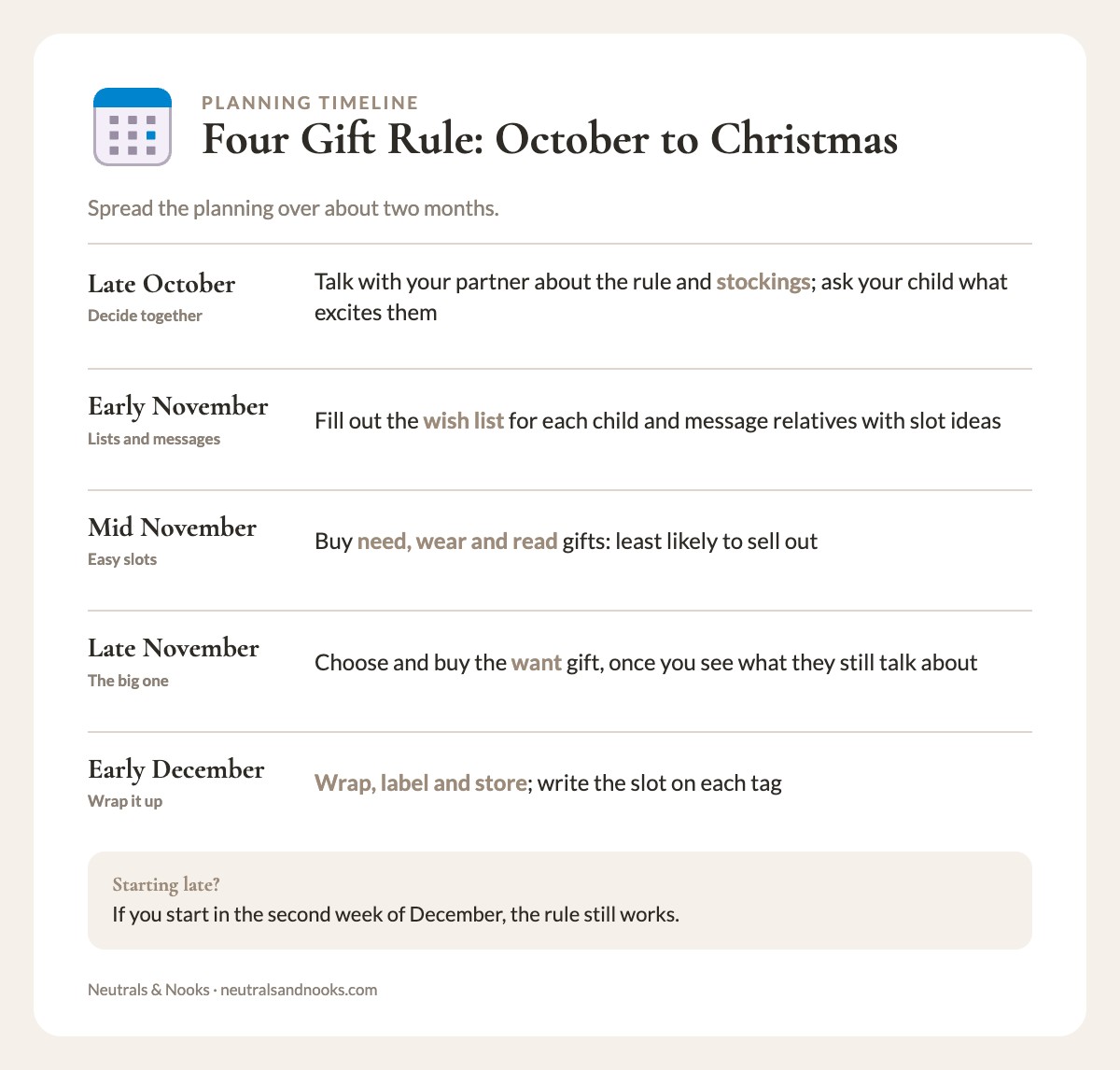
If you are reading this in mid-October, you have time. Here is how I would spread it out.
- Late October. Talk with your partner about whether you will do the rule and how you will handle stockings. Ask your child what they are excited about, without promising anything.
- Early November. Fill out the wish list for each child. Send a short message to relatives with slot ideas.
- Mid November. Buy the “need,” “wear,” and “read” gifts. These are the easiest and least likely to sell out.
- Late November. Choose and buy the “want” gift. By now you will have seen what your child is still talking about.
- Early December. Wrap, label, and store. Write the slot on each tag if it helps you keep track.
- After Christmas. Do the January reset described above.
None of this has to be perfect. If you start in the second week of December, the rule still works. Four gifts is a simple enough idea to pick up at any point.
From our sister brands
Want, need, wear, read: picks from our sister brands
One for the read slot, one that keeps the wear gifts in order, and a set that can stand in for the need gift.
Akoni Books and White Loft are sister brands of this site. When you buy through these links we may earn a portion of the revenue, at no additional cost to you.

Akoni Books
Read: a Christmas storybook starring your child
You upload one photo and pick from nine art styles, and the pictures are drawn to look like your child. For ages 2 to 10. You see the cover and first pages before paying, and every book comes with a 19-page Hero Pack of printables. Order a printed copy by December 5 and most US orders arrive before Christmas.
Digital $9.99 · Softcover $29.99 · Hardcover $39.99, shipping included
First book? Code WELCOME5 takes $5 off at checkout.
Preview it free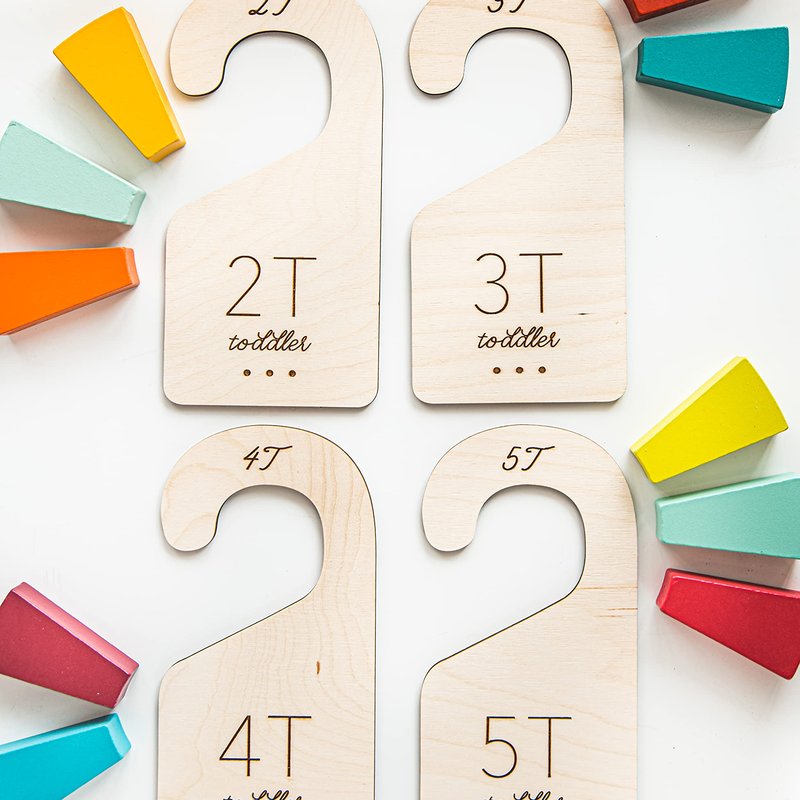
White Loft
Wear: Toddler Closet Dividers, set of 4
Not something to wear, but where the wear gift lives. Four birch dividers etched 2T to 5T hang on the closet rod and keep this year's size apart from the next one up.
$22.95 on Amazon
See it on Amazon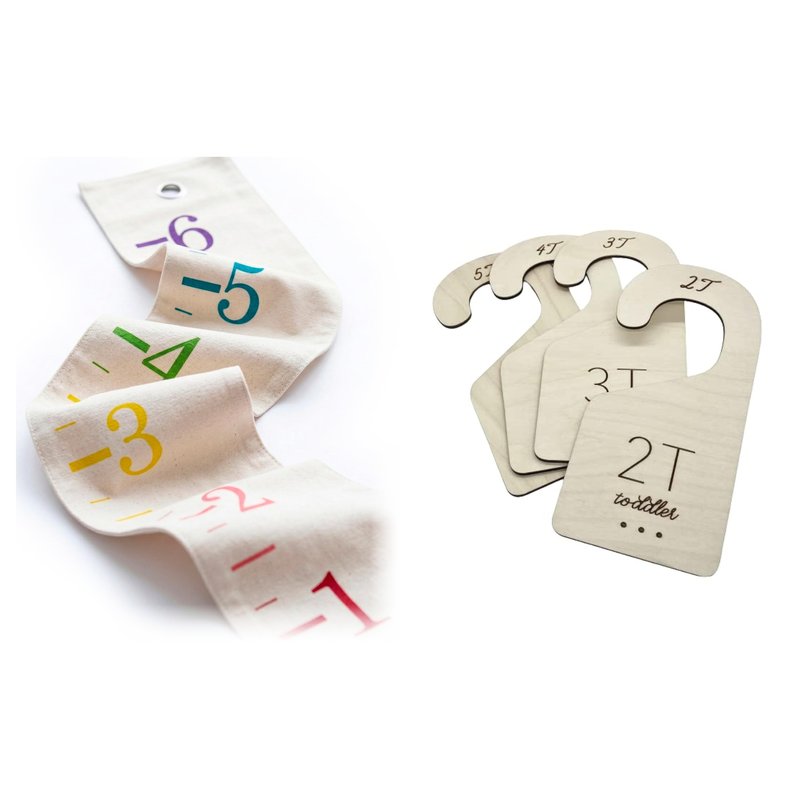
White Loft
Need: Rainbow Toddler Room Set
The rainbow growth chart and the toddler dividers together, for 15% less than buying them separately. It suits a child who is moving into a big-kid room.
$53.50 on Amazon
See it on AmazonPrices checked October 2026; they can change.
Frequently Asked Questions
What is the four gift rule for Christmas?
The four gift rule limits each child to four presents: something they want, something they need, something to wear, and something to read. It is also called want, need, wear, read, or the 4 gift rule. The aim is to focus attention on a few well-chosen gifts instead of a large pile, which also makes the weeks after Christmas much easier to manage at home.
What are good want, need, wear, read ideas for a toddler?
For ages 1 to 2, a good “want” is a set of large blocks or stacking cups, and a “need” might be a leak-resistant cup or a sleep sack. “Wear” can be snug pajamas or grippy socks, and “read” is a sturdy board book with simple pictures or rhymes. Choose items without small parts and avoid toys that are only interesting when a battery is running.
What are want, need, wear, read ideas for a 3 year old?
For a 3-year-old, a pretend-play set or beginner puzzle works well as the “want” gift, and a step stool or small backpack covers the “need” slot. Rain boots or pajamas they picked make a good “wear” gift, and a picture book about a current interest suits the “read” slot. Letting your child choose between two clothing options helps the gift feel like theirs.
Do stockings count toward the four gifts?
That is up to your family. Some households treat the stocking as separate and keep it to small items like art supplies, a treat, or a deck of cards. Others count it as part of one category, usually “want.” The most important step is to decide ahead of time and tell relatives, so everyone is working from the same plan.
How do I tell grandparents about the four gift rule without hurting feelings?
Share the plan early, in October or early November, and frame it as an invitation. Offer to assign each grandparent a slot, such as “read” or “wear,” and include sizes and a short list of ideas. For people who want to give more, suggest shared experiences, time together, or one combined family gift. Warm thanks for any extra gifts that still arrive goes a long way.
What if my older child thinks four gifts is not enough?
Involve them in choosing. Let a child aged 8 to 10 pick their own “want,” help select the “read,” and weigh in on the “wear” item. Acknowledge that it feels like less, then point to what they gain: gifts that are actually things they asked for. Adding a family outing or a special breakfast gives them something else to look forward to.
Will the four gift rule really reduce playroom clutter?
It helps a great deal in the first weeks of January, since far fewer new items need a home. Children also tend to play with each gift longer and revisit older toys. It does not remove clutter from birthdays, party favors, or hand-me-downs, so pair it with a simple rotation and sorting system to keep the playroom calm through the rest of the year.
A Quieter Christmas Is Still a Full One
When I look back at that January doorway, laundry basket in hand, I do not feel guilty about the toys anymore. I feel grateful that I found a way to change it. Our last Christmas had four gifts per child, one cup of hot chocolate per person, and a slow morning instead of a twelve-minute rush. My kids did not seem to miss the pile.
If you try the four gift rule this year, start small. Fill in the list, send one gentle message, and choose the gifts that make you picture your child’s face. Then, in the first week of January, do the reset and notice how quickly the playroom comes back together.