
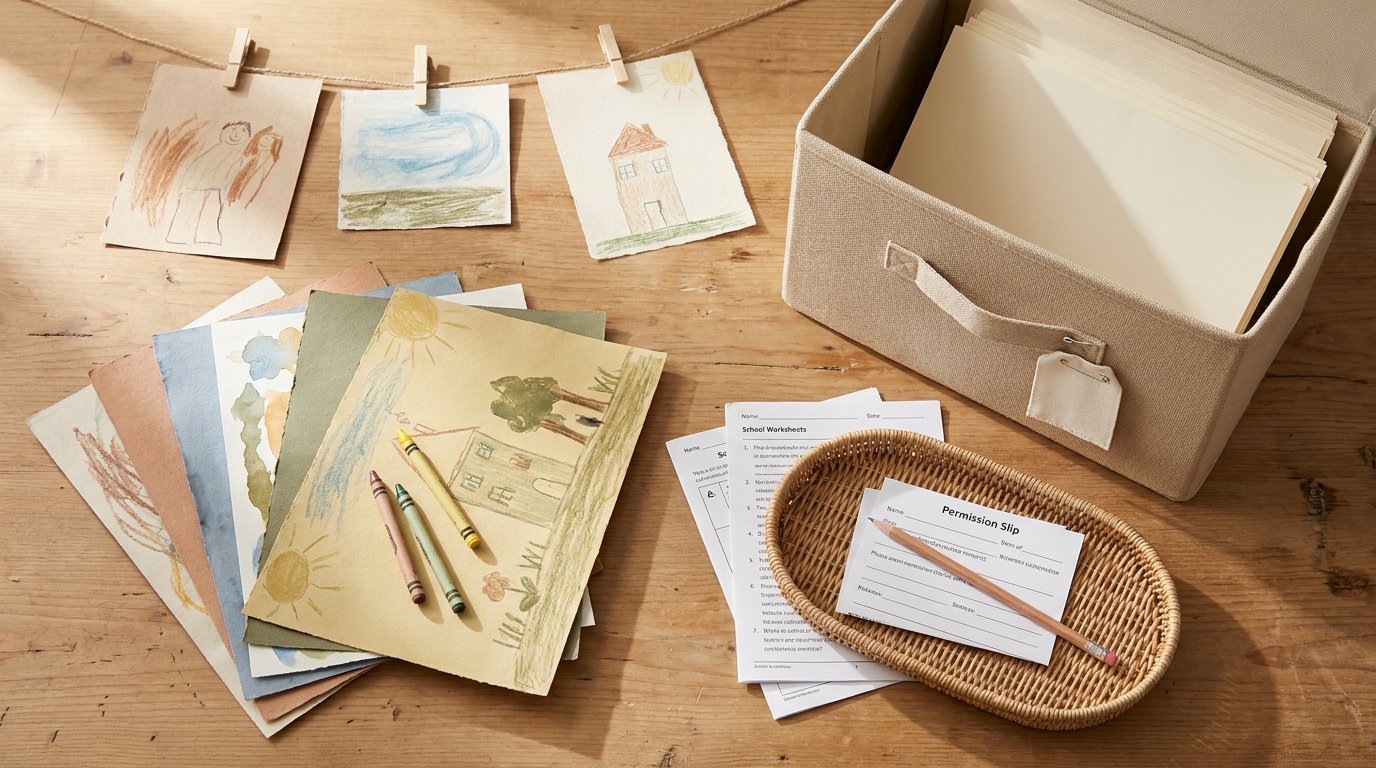
Kids’ Artwork and School Papers: A Simple System for Sorting and Storing
You can conquer the overwhelming piles of kids' artwork and school papers by implementing a simple, consistent system. Learn how to sort weekly, decide what to keep, display cherished pieces, and archive the rest without guilt.
- Implement a weekly sorting ritual to prevent paper pile-up.
- Develop a system to decide what art to keep, display, or discard.
- Separate your system for artwork from school papers.
- Utilize digital backups for art you choose to let go of.
- Set up a rotating display for cherished artwork.
The first Tuesday of school, my daughter came home with a backpack that wouldn’t zip. Inside: a construction-paper self-portrait with yarn hair glued at odd angles, a “getting to know you” worksheet, a supply list I’d already fulfilled, a half-finished coloring page of a sunflower, and a folder so crumpled it had become origami. By Friday of that same week, the pile on my kitchen counter had tripled. By the following Monday, I had a stack I couldn’t look at without feeling a specific kind of dread — not because any single piece mattered that much, but because I had no idea what to do with all of it, and it was already back for round two.
If you’re in that same spot right now, you’re not behind. You just don’t have a system yet. And the truth is, most of us don’t — we default to “put it somewhere for now” and then wonder, six weeks later, why the dining table has a paper glacier creeping across it. School generates an enormous, relentless stream of paper: art, worksheets, notices, reading logs, book fair flyers, permission slips, awards, invitations. None of it stops arriving once you fall behind, which is exactly why “I’ll deal with it eventually” never actually works. You need a system that runs on autopilot, makes the keep-or-toss decision before the pile forms, and gives every piece of paper a real home — whether that’s a frame, a bin, a photo, or the recycling bin, guilt-free.
That’s what this guide is: a full, practical system for sorting, displaying, and storing your kids’ artwork and school papers, built to survive an entire school year (or several) without turning into a project you dread. We’ll cover the weekly sorting ritual, the framework for deciding what’s actually worth keeping, how to set up a rotating display, the long-term archive method, digital backups for the art you let go of, and how to handle school papers separately from art — because they’re not the same problem and don’t deserve the same system.
Why the Paper Pile-Up Happens So Fast
It helps to understand why this specific kind of clutter is so relentless, because it’s different from toy clutter or clothing clutter. Toys accumulate slowly, over birthdays and holidays. School paper accumulates daily, sometimes multiple times a day if you’ve got more than one kid in the house. A single elementary schooler can generate 3 to 8 pieces of paper on an average school day between classwork, art, and handouts — multiply that by a five-day week, a nine-month school year, and however many kids you have, and you’re looking at hundreds, sometimes thousands, of individual pieces of paper flowing into your home every year.
There’s also an emotional trap built into all of it. Every piece of art your child hands you comes with a hopeful little face attached, and it feels almost cruel to put it straight in the recycling bin while they’re watching. So we don’t. We say “I’ll put this somewhere safe” and set it on the counter, and the counter becomes a paper graveyard nobody wants to sort because sorting means making a hundred tiny decisions about what has actual sentimental weight and what’s just… paper.
The fix isn’t to feel less sentimental about your kid’s art. It’s to build a system that makes the sentimental pieces easy to honor — through display and a curated keepsake collection — while making it painless to let go of the rest. When you don’t have to make each decision individually, in the moment, under a small hopeful gaze, the whole thing gets dramatically easier.
The Weekly Sorting Ritual: Catch It Before It Becomes a Pile
The single biggest shift that fixes school paper clutter isn’t a better bin or a fancier folder — it’s frequency. If you sort once a semester, you’re facing an overwhelming, guilt-inducing project. If you sort once a week, you’re facing five minutes of easy decisions on paper that’s still fresh in your mind.
Pick one consistent time — Friday afternoon when backpacks get emptied for the weekend, or Sunday night while you’re prepping the week ahead. This pairs well with any existing tidying rhythm you already have; if you’re using something like The 15-Minute Evening Reset, just fold “empty the backpack” into one evening’s rotation so it isn’t a separate thing to remember.
Here’s the weekly ritual, start to finish:
- Empty every backpack completely onto one surface — don’t let papers stay balled up inside folders where they’ll get missed.
- Sort into three physical piles: Art, School Papers (worksheets, tests, handouts), and Action Items (permission slips, forms needing a signature, event flyers with dates).
- Handle Action Items immediately — sign what needs signing, note the date somewhere you’ll actually see it, and return it to the backpack that night so it doesn’t get forgotten on a Tuesday morning.
- Run the Art pile through the Keep/Display/Photograph/Toss framework (below).
- Skim the School Papers pile for anything with a grade pattern worth noting, then recycle the bulk of it — worksheets and daily practice sheets very rarely need to be kept.
Five to ten minutes, once a week, and you never face a towering backlog. This is the whole game. Everything else in this guide is just refining what happens within that five minutes.
What to Do When You’ve Fallen Behind
If you’re reading this with a pile that’s already knee-deep, don’t try to catch up in one sitting — that’s how the whole system gets abandoned by hour two. Instead, set a timer for 20 minutes, sort through as much as you can using the framework below, and stop when the timer goes off. Bag or box whatever’s left, and finish it over two or three more short sessions. A backlog took months to build; it’s fine if it takes a few sessions to clear.
The Keep, Display, Photograph, Toss Framework
This is the core decision system, and it works because it gives every piece of art exactly four possible destinations — no vague “maybe” pile allowed, because maybe piles are where clutter goes to live forever.
| Decision | What It Means | Where It Goes |
|---|---|---|
| Keep | Genuinely special — a milestone piece, unusually detailed, tied to a specific memory | Archive bin (long-term storage) |
| Display | Good enough to enjoy now, not necessarily forever | Rotating gallery wall, frame, or clip display |
| Photograph | Sweet, but doesn’t need to take up physical space | Digital archive, then recycle the original |
| Toss | A worksheet with a smiley face, a scribble, a duplicate of something already kept | Recycling bin |
Run every piece of art through these four questions, in order, and stop as soon as one applies:
- Does this represent a real milestone or leap in ability? First time writing their name, first recognizable drawing of a person, a piece from a specific meaningful unit at school. → Keep.
- Would I genuinely enjoy looking at this on a wall for a few weeks? Not “is my child proud of it” (they’re proud of all of it) — would you enjoy the color, the composition, the effort? → Display.
- Is this cute but ordinary — the fortieth stick-figure family portrait? → Photograph, then let the paper go.
- Is this mostly blank space, a coloring-book page, or something with no real content? → Toss, no photo needed.
A helpful gut check: about 5% of what comes home is Keep-worthy, maybe 15-20% is Display-worthy at any given time, another 30-40% is worth a quick photo, and the rest — often close to half — can go straight to recycling. Those numbers will feel harsh the first time you do this. They get easier every week, because you stop treating “did my child make this” as the bar for keeping something, and start treating “is this actually special” as the bar instead.
Talking to Your Kid About the Toss Pile
If your child is old enough to notice papers disappearing, loop them in rather than doing it in secret — secrecy around this stuff tends to create more anxiety about it, not less. A simple script works well: “We can’t keep every single piece of art or every worksheet, or we’d run out of room in our whole house. Let’s pick your favorites from this week to keep, and the rest can go so we have room for new ones.” Kids are often far less attached to the bulk of their output than parents assume — they made it, they moved on, and it’s usually the adult in the room clutching the crayon drawing of an unidentifiable animal.
What’s Actually Worth Keeping (a Real Checklist)
“Genuinely special” is subjective until you have concrete criteria. Here’s what tends to hold up over time — the pieces that are still meaningful five or ten years later, not just meaningful in the moment:
- First-of-its-kind pieces: first time writing their full name, first self-portrait, first piece with a story or narrative attached to it
- Milestone-marked work: anything dated at a meaningful age or grade transition (first day of kindergarten art, end-of-year portfolio pieces)
- Anything with their own words on it: a caption, a story, an interview response, a “what I want to be when I grow up” — these age incredibly well because handwriting and phrasing change so much year to year
- Work tied to a specific memory you’d otherwise forget: art from a themed unit, a project connected to a trip or event, something made during a hard season worth remembering
- Pieces that show a genuine leap in skill: the first time proportion, shading, or perspective shows up unprompted
- Anything your child specifically asks you to save: their instinct about what matters to them is worth honoring even when it doesn’t match your own criteria
And here’s what almost never holds up, no matter how guilty it feels to toss in the moment:
- Worksheets with a coloring element (tracing letters with a rainbow border)
- Anything mass-produced from a whole-class project where every kid’s looks nearly identical
- Duplicates — the third “family portrait” of the month
- Anything already blurred in memory by the time you’re sorting (if you can’t remember when or why it was made, it’s not the keepsake it felt like at pickup)
Setting Up a Rotating Display System
Display solves the emotional need — the desire to celebrate what your child made — without requiring permanent storage. The trick is treating display as temporary by design, not a growing gallery that expands forever.
The clip-and-cable method is the easiest to maintain: string a thin cable, ribbon, or wire along a hallway or the side of a bookshelf, and use small clothespins or bulldog clips to hang art. New pieces clip in front; older ones move down the line and eventually clip out. No holes in the wall, no frames to source, and swapping art takes ten seconds.
The frame-and-swap method works well for a more polished look — a handful of matching frames (even 3-4 is enough) hung in a cluster, where new favorites simply replace old ones. This tends to suit calmer, more curated spaces, since it caps the display at a fixed number of pieces no matter how much art comes home.
The magnetic panel or corkboard method is the most flexible for younger kids who produce a high volume of art, since it can hold a dozen pieces loosely without needing individual frames or clips for each one.
Whichever method you choose, set a simple rule: when new art goes up, the oldest displayed piece comes down and gets run back through the Keep/Photograph/Toss framework. Display should never be a one-way accumulation — it’s a rotation, the same logic behind toy rotation systems like the one in The Spring Playroom Reset, where only a limited set is out at once and everything else cycles through on a schedule instead of piling up.
A realistic cadence: rotate display art every 2-3 weeks for younger kids who produce constantly, or monthly for older elementary kids whose output slows down and gets more involved per piece.
The Long-Term Archive: One Bin Per Kid
For the genuinely Keep-worthy pieces, resist the urge to use an ever-expanding storage system. An archive with no size limit isn’t an archive — it’s just delayed clutter. The fix is a fixed-size container per child, full stop. When it’s full, something has to come out before something new goes in.
A flat, under-bed storage box (roughly 24″ x 18″ x 6″) works well for most families — it holds a genuinely generous amount of flat artwork per school year without overflowing, and it slides out of sight instead of taking up shelf space. For 3D projects (the inevitable clay pinch pot, the popsicle-stick birdhouse), a separate, smaller keepsake box per child keeps oddly shaped items from crushing the flat paper archive.
Archive bin rules that actually hold up over time:
- One bin per child, sized to fit under a bed or on a closet shelf — not a rotating cast of boxes that multiply
- Label each bin with the child’s name and the school year range, so ten years from now you’re not guessing
- Add a large envelope or folder inside for oversized or oddly shaped pieces so they don’t get crumpled
- When the bin is full, that’s the cue to do a full review — pull everything out, re-sort against current standards (your bar for “special” gets more selective as the collection grows), and keep only the very best
- Consider a lighter annual pass at the end of each school year even before the bin is full, so the review never has ten years of backlog at once
If you’re also managing where the bin physically lives alongside off-season clothes, extra bedding, or other family storage, the same bin logic that works for Seasonal Clothing Storage for Kids applies here too — fixed containers, labeled clearly, reviewed on a schedule rather than left to expand indefinitely.
A Note on “But What If I Regret Tossing Something”
This fear is real and worth naming directly, because it’s the thing that quietly sabotages most paper systems. Here’s the honest answer: you will, occasionally, feel a small pang about something you let go of. It happens rarely, and it’s a far smaller cost than the alternative — a home so full of paper that you can’t find or appreciate the pieces that are truly special, because they’re buried in five hundred worksheets. A curated collection of 40 meaningful pieces you’ll actually revisit is worth more than an unsorted box of 2,000 you’ll never open again.
Digital Archiving: Photographing What You Let Go Of
The Photograph category is what makes the Toss category emotionally possible — you’re not erasing the memory, you’re just changing its format. A quick, consistent digital system means you can let go of the physical paper without losing the record of it.
Keep the photographing process dead simple, or it won’t happen:
- Use your phone, not a scanner — good enough beats perfect, and a scanner adds friction that kills the habit within a month
- Lay the art on a plain, neutral surface (a light wood floor or plain table works better than a busy countertop) and shoot straight down in natural light
- Include your child in the frame occasionally, holding their own art — these photos tend to become the ones you actually revisit, more than the art-only shots
- Batch it during the weekly sorting session rather than photographing piece by piece throughout the week
For organizing the digital archive, a simple folder structure beats a fancier app for most families:
“`
Kids Art/
├── [Child Name]/
│ ├── 2025-2026 Kindergarten/
│ ├── 2026-2027 First Grade/
“`
Drop photos straight into the current school-year folder as you go. If you want them off your phone and backed up, a shared photo album (Google Photos or iCloud shared albums both work) that grandparents can also see turns the archive into something the whole family enjoys, not just a backup nobody looks at.
Some families take this a step further and turn a year’s worth of photographed art into an annual printed photo book — a genuinely nice way to compress a whole school year of art into one slim volume that takes up far less shelf space than the paper ever would, while still being something to page through.
Sorting School Papers Specifically
Art and school papers feel similar when they’re both piled on the counter, but they need different handling because they carry different kinds of information — and most school papers have a much shorter useful life than artwork does.
The three real categories of school paper:
| Type | Examples | What to Do |
|---|---|---|
| Time-sensitive action items | Permission slips, forms needing signatures, event flyers, book orders | Handle same-day; route through a family command center or designated spot so they don’t get lost |
| Reference material | Class newsletters, supply lists, calendars, syllabi | Keep only until the date passes, then recycle |
| Completed work | Worksheets, tests, quizzes, homework | Skim for patterns, recycle almost all of it; keep only report cards and standout tests if you want a record |
For action items specifically, the fix isn’t a better filing system — it’s a single, visible, consistent landing spot so a permission slip never gets lost inside a backpack pocket for two weeks. If your home doesn’t have one yet, setting up something like the approach in Family Command Center Ideas gives every form, flyer, and signature request one obvious home instead of letting it compete for space with the art pile.
For completed schoolwork, most of it can be recycled the same week it comes home — a worksheet with a checkmark on it rarely needs to exist past the day you glance at it. The exceptions worth keeping in a simple end-of-year folder (separate from the art archive bin): report cards, standardized test summaries, and any writing sample substantial enough to show real growth year over year. Everything else is noise dressed up as a record.
Making It a Family Habit, Not a Solo Chore
Systems fail when they depend entirely on one parent remembering to run them every single week for nine months straight. Building in redundancy and involving your kids — even young ones — makes the whole thing far more durable.
- Let your child do the first sort. Even a five-year-old can point to their two favorite pieces from the week. This does double duty: it teaches them that not everything gets saved, and it takes the emotionally loaded decision partly off your plate.
- Make the backpack-empty step part of an existing routine rather than a standalone task — right after the after-school snack, right before Friday dinner, whatever already happens reliably in your house.
- Put the archive bin somewhere visible enough to remember, but not so visible it becomes a landing zone for everything. Under a bed in the child’s own room works well — close enough to feel personal, out of the main traffic flow.
- Revisit your own standards once a year. What felt “keep-worthy” in the chaos of a first school year sometimes looks different with distance. An annual light review of the archive bin — not just adding to it, but occasionally thinning it — keeps the collection meaningful instead of just large.
If different family organizing styles are creating friction over this (one parent wants to keep everything, the other wants to toss aggressively), it can help to get specific about the underlying instincts at play — something like the Declutter Score Quiz can be a low-stakes way to name the pattern and find a middle ground you both actually agree to.
Handling the End-of-Year Flood
No matter how well the weekly system runs, the last two weeks of school will still hand you an avalanche — cleaned-out desks, year-end portfolios, awards, yearbooks, and a folder of “everything we didn’t send home all year.” Treat this as its own separate, planned event rather than something the weekly system needs to absorb.
Block off 30-45 minutes sometime in the two weeks after school ends. Run the flood through the exact same Keep/Display/Photograph/Toss framework — it doesn’t need a different process, just a bigger time block. This is also the natural moment to do the annual archive bin review mentioned earlier, since you’re already elbow-deep in the current year’s paper and can see the whole year’s worth of work at once for context.
One extra step worth adding at year-end specifically: ask your child to help pick a single “best of the year” piece before the bin goes back under the bed. It’s a nice ritual, it takes two minutes, and it turns an otherwise purely logistical task into something that feels a little celebratory instead of just administrative.
Frequently Asked Questions
How much of my kid’s artwork should I actually keep?
Most organizers land somewhere around 5-10% of total output for the long-term “Keep” archive — the genuine milestones and standout pieces. Another 15-20% is worth displaying temporarily even if it doesn’t go in the permanent archive. The rest can be photographed or recycled. It sounds strict at first, but a smaller, curated collection is one you’ll actually revisit — a massive unsorted box tends to just get pushed to the back of a closet and forgotten.
What size bin or box should I use for the artwork archive?
A flat under-bed storage box, roughly 24″ x 18″ x 6″, fits most kids’ flat artwork for a full school year without overflowing. Size it to a space you already have (under a bed, a closet shelf) rather than buying something oversized “just in case” — a fixed size is what forces the periodic edit that keeps the collection meaningful instead of endless.
Should I keep every worksheet or test my child brings home?
No — almost all completed classwork and worksheets can be recycled the same week, since they rarely hold long-term meaning once you’ve glanced at them. The exceptions worth a simple end-of-year folder are report cards, standardized test summaries, and any longer writing sample that shows real growth. Keeping everything just buries the few papers that actually matter.
My child gets upset when art gets recycled. How do I handle that?
Involve them in the decision instead of doing it behind their back — even young kids can point to their favorites for the week, and being part of the choice reduces the sting significantly. It also helps to photograph pieces before they’re recycled, so the framing shifts from “this is gone forever” to “we kept a picture of it, and the real one made room for new art.” Most kids adjust to the rhythm within a few weeks once it becomes routine rather than a surprise.
How often should I sort through the backpack and art pile?
Weekly is the sweet spot for most families — frequent enough that it never becomes an overwhelming backlog, but infrequent enough to not feel like a daily chore. Pick one consistent day (Friday afternoons or Sunday evenings both work well) and pair it with a routine you already have, like emptying backpacks before the weekend.
What’s the best way to store 3D art projects like clay pieces or dioramas?
Keep 3D projects in a separate, smaller keepsake box from your flat-paper archive, since odd shapes tend to crush flat artwork if they’re mixed together. Photograph bulkier or more fragile 3D projects before deciding whether to physically keep them at all — many families find a good photo is enough for anything beyond a small handful of true favorites, since 3D pieces take up disproportionate space relative to how often they get revisited.
Should each kid have their own archive bin, or can siblings share one?
Give each child their own labeled bin, even if space is tight. A shared bin makes it much harder to hand each child their own collection later — for a graduation gift, a move, or just a nostalgic afternoon together — and it can unintentionally create a sense that one sibling’s work “counts” more if their pieces end up more visible in a mixed pile. Separate, clearly labeled bins keep things fair and far easier to sort by memory later.
A Small System, a Lot of Relief
None of this requires a Pinterest-perfect setup or a weekend of deep organizing — just one small, repeatable ritual and a framework that turns a hundred tiny emotional decisions into four simple categories. Start with this week’s backpack, run it through Keep, Display, Photograph, Toss, and let the rest go. The pile didn’t build itself in a day, and it won’t need to be solved in one either — just handled a little bit, every week, before it has the chance to grow back.