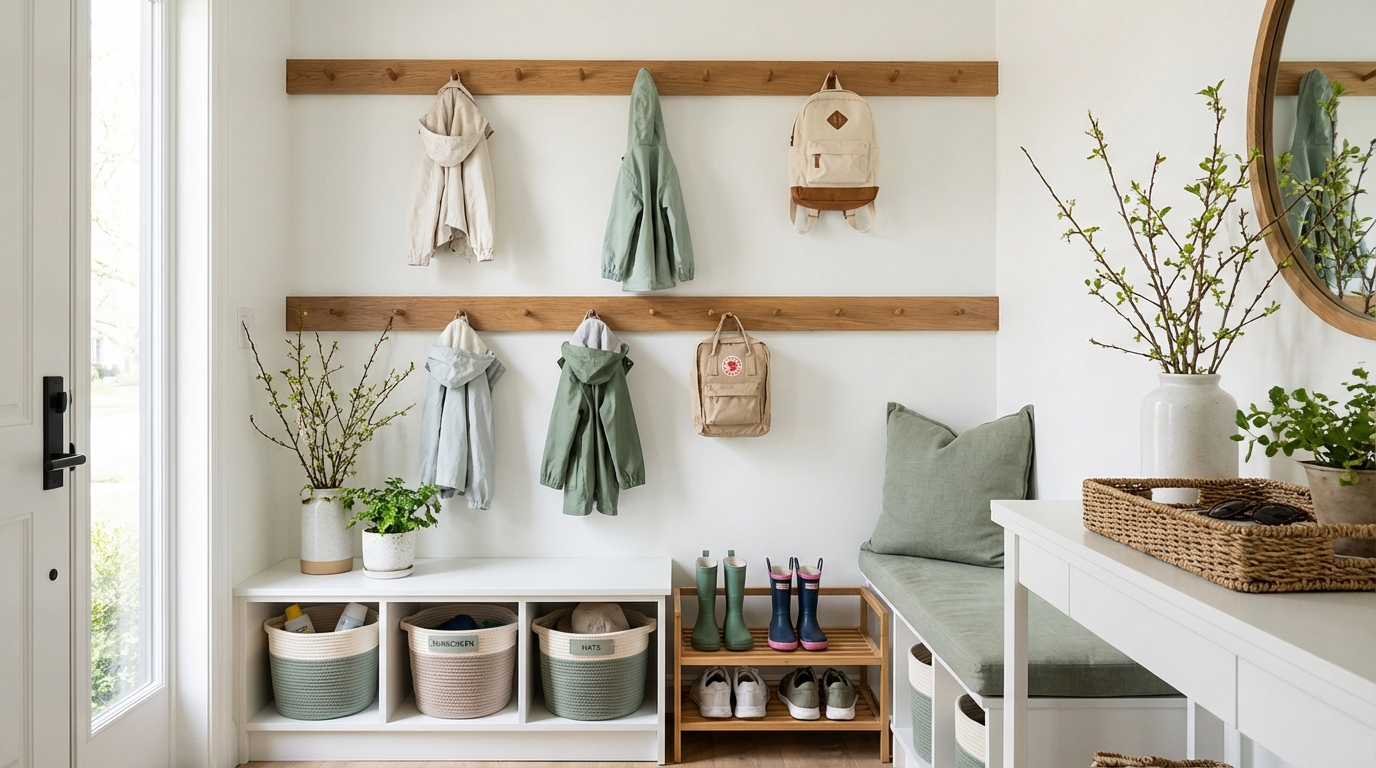
The Family Mudroom Reset: How to Organize Your Entryway for Spring and Summer
Discover a zone-by-zone system to organize your family's entryway for spring and summer, preventing seasonal clutter. You'll get specific product recommendations and a 30-minute seasonal swap checklist to keep your space functional.
- Understand why your entryway is the most important space to organize in your home.
- Address the 'spring entryway avalanche' by building a system for seasonal swaps.
- Implement a zone-by-zone organization system designed for family entryways.
- Utilize a 30-minute seasonal swap checklist for efficient transitions.
- Adapt organization strategies for any entryway, even if you lack a mudroom.
I opened our front hall closet last Saturday and a snow boot fell on my foot. It was 72 degrees outside.
The boot was sitting on top of a pile that included two puffy winter coats (one missing a zipper pull), a fleece neck gaiter nobody has worn since February, a mitten that lost its partner sometime around Presidents’ Day, and a hat with a broken pom-pom. Underneath all of that were three umbrellas, a dried-out bottle of sunscreen from last summer, and my daughter’s rain boots from two sizes ago.
Meanwhile, on the bench by the door: four pairs of flip flops (it was the first warm week), a baseball cap, a half-empty bottle of bug spray with the cap off, two pairs of sunglasses belonging to children who were not wearing sunglasses, a reusable shopping bag, and somebody’s library book that was due three days ago.
This is the spring entryway avalanche, and it happens in virtually every family home at the same time each year. Winter hasn’t fully left the building, but spring and summer have already started moving in, and nobody has brokered a peace agreement between the two seasons. The entryway—whatever form yours takes—becomes a collision zone of everything that was supposed to leave and everything that just arrived.
I’ve organized our entryway through enough seasonal transitions now to know that the fix isn’t just cleaning it out. The fix is building a system that accounts for the transition itself—a set of zones and habits that handle the seasonal swap efficiently and keep the space functional through the chaos of summer.
That’s what this guide covers: a complete, zone-by-zone mudroom organization system designed for families, with specific product recommendations, adaptations for every kind of entryway (including no mudroom at all), and a 30-minute seasonal swap checklist you can use every time the seasons change.
In this article (8 sections)
- Why the Entryway Is the Most Important Room to Organize
- The Seasonal Swap: What Needs to Change from Winter to Spring/Summer
- The 5-Zone Mudroom System
- Mudroom Solutions for Every Space
- The 30-Minute Seasonal Swap Checklist
- Maintaining the System Through Summer
- Product Summary by Budget
- Frequently Asked Questions
Why the Entryway Is the Most Important Room to Organize
I know that’s a strong claim. The kitchen gets more traffic. The living room gets more visual attention. The kids’ rooms are where the real entropy lives. But I stand by it: the entryway is the single most important space to organize in a family home, and here’s why.
It’s the daily bottleneck. Every person in your household passes through the entryway at least twice a day—usually more. Morning departure, afternoon return, quick runs to the car, taking the dog out, checking the mail, answering the door. No other room in your home sees that volume of traffic from every family member, every single day. When the entryway is disorganized, it creates friction at the exact moments when you’re already in a hurry.
It sets the emotional tone. The entryway is the first thing you see when you walk in and the last thing you see when you walk out. When it’s cluttered, you leave your home feeling slightly behind and return feeling slightly overwhelmed. When it’s calm and functional, you leave feeling prepared and return feeling welcomed. This isn’t aspirational nonsense—it’s the practical reality of walking past a mess versus walking past order several times a day.
It’s where the most time-sensitive items live. Keys, backpacks, permission slips, library books, the sunscreen you need to apply before everyone gets in the car, the umbrella you need to grab when it’s raining—these are all items that matter at a specific moment and are useless if you can’t find them in that moment. A disorganized entryway turns every departure into a scavenger hunt.
It’s the first impression of your home. Not just for guests—for you. For your family. The entryway communicates whether this household is running smoothly or barely holding it together. I’m not saying it needs to look like a catalog. I’m saying it needs to look like someone is in charge.
If you’ve already tackled other organizational systems in your home—a family command center, a pantry system, closet organization—the entryway is where those systems meet the real world. It’s the interface between your organized home and the chaos outside. It deserves the same level of intentional design.
The Seasonal Swap: What Needs to Change from Winter to Spring/Summer
The reason entryways collapse in spring isn’t laziness—it’s because two seasons’ worth of gear are occupying the same finite space. The fix starts with a clear-eyed assessment of what stays, what goes, and what comes in.
Here’s the swap table I use every year:
| Category | What Goes to Storage | What Stays Year-Round | What Comes In for Spring/Summer |
|---|---|---|---|
| Outerwear | Puffy coats, heavy parkas, snow pants, ski gear | Light rain jackets, one hoodie per person | Sun hats, baseball caps, light layers |
| Footwear | Snow boots, insulated boots, heavy rain boots | Sneakers, everyday shoes | Sandals, flip flops, water shoes, light rain boots |
| Accessories | Scarves, heavy gloves, wool hats, neck gaiters | — | Sunglasses, hair ties, visors |
| Gear | Ice scraper, hand warmers, snow brushes | Umbrellas (compact), reusable bags | Sunscreen, bug spray, water bottles, bike helmets |
| Kid-Specific | Snowsuit, ski mittens, boot liners | Backpacks, lunch boxes | Swim gear bag, camp supplies, sports equipment |
| Seasonal Decor | Winter wreath, heavy doormat | Key hooks, mirror, bench | Lighter doormat, seasonal wreath |
The key principle here: every item that goes to storage creates space for an item that’s coming in. If you try to add spring and summer gear without removing winter gear first, you’ll end up with exactly the mess I described at the top of this article.
I store off-season items in labeled bins in our basement, but a closet shelf, the top of a bedroom closet, or under-bed storage works just as well. The important thing is that winter gear physically leaves the entryway. For more on managing the seasonal clothing rotation, the seasonal clothing storage guide covers this in detail.
Timing tip: Do the swap when you have a full week of temperatures above 55 degrees in the forecast. Not the first warm day—that’s a tease. Wait for the sustained shift. In most places, that’s mid-April, which is why I’m writing this now.
The 5-Zone Mudroom System
After years of tweaking our entryway setup, I’ve landed on a five-zone system that handles every category of item that passes through the front door. Each zone has a specific purpose, specific boundaries, and specific products that make it work.
The beauty of a zone-based approach is that it scales. Whether you have a dedicated mudroom, a narrow hallway, or literally just a wall next to your front door, you can implement all five zones—they just take different physical forms depending on your space.
Zone 1: Hooks and Hanging
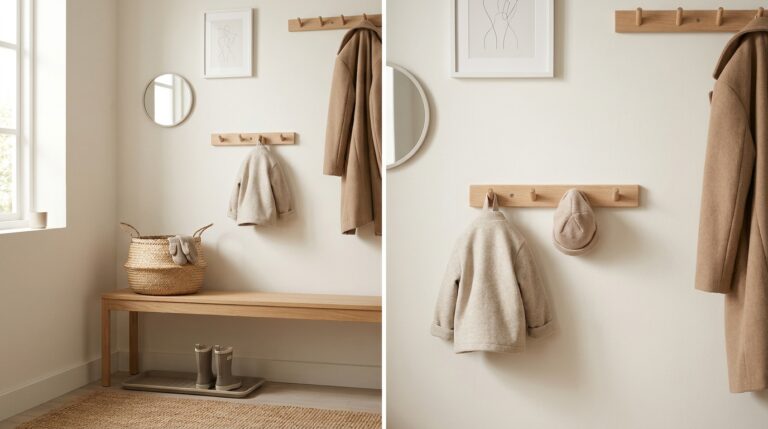
This is where jackets, bags, hats, and anything that hangs lives. It’s also where most entryways fail, because they either have too few hooks, hooks at the wrong height, or no per-person allocation.
The per-person rule: Every household member gets their own designated hook section. This is non-negotiable if you have kids. When hooks are communal, nobody is responsible for anything, and the hooks become a pile of everybody’s everything. When each person has their own section, you can identify whose jacket is on the floor in approximately two seconds.
Height matters more than you think. Adult hooks should be at 60-66 inches from the floor. Kid hooks should be at 36-42 inches for ages 3-7, and 42-48 inches for ages 8-12. The reason is obvious but often ignored: kids can’t hang things on hooks they can’t reach, so they drop them on the floor, and then you’re hanging up four jackets every evening instead of zero.
I installed a double row of hooks in our entryway—adult height and kid height—and the amount of floor clutter dropped by about 80% within the first week. It’s one of the highest-ROI organization moves I’ve ever made.
Product recommendations:
- Budget ($8-15): Liberty Hardware heavy-duty coat hooks, sold individually. Matte black or brushed nickel. Each holds up to 35 lbs. Mount them in a row with 8-10 inches between hooks. Simple, sturdy, neutral finish.
- Mid-range ($25-60): A mounted hook rail like the DOKIS wall-mounted coat rack (5 hooks, 27 inches wide, about $35) or the Spectrum Diversified wall mount (6 hooks, 19.5 inches wide, about $25). These are easier to install than individual hooks—one mounting rail instead of five separate anchors.
- Higher end ($60-150): A wall-mounted hook shelf combo, like the Entryway Organizer by Latitude Run (shelf on top, 4-5 hooks below, typically 24-36 inches wide, $60-90). The shelf adds hat and sunglasses storage above the hooks. Or go custom with a peg rail—Shaker-style peg rails from Rejuvenation or Schoolhouse run $80-150 and look beautiful in a neutral palette.
Aesthetic tip: Stick to one finish for all hardware in the entryway. I use matte black throughout ours—hooks, shelf brackets, basket labels—and it creates visual coherence even when the stuff hanging on the hooks is colorful kid chaos. Brushed brass and oil-rubbed bronze also work well for a warm neutral palette.
For spring/summer specifically: Each person’s hook section should hold one light jacket or rain coat, one bag (backpack, tote, or purse), and one hat. That’s it. If more than three items are hanging in one person’s section, something needs to be put away or moved to storage.
Zone 2: Shoe Storage
Shoes are the entryway’s biggest challenge, and they get worse in warm weather because everyone suddenly owns five types of footwear instead of two. Sneakers, sandals, flip flops, water shoes, rain boots, cleats—and they all end up in a pile by the door.
The rotation principle: Each person gets space for two pairs of shoes in the active entryway zone—one “everyday” pair and one “current activity” pair (the sandals they wear to the pool, the cleats they wear to practice). Everything else goes in a closet or bedroom. I know this sounds strict, but two pairs per person times four or five family members is already eight to ten pairs of shoes in your entryway. That’s plenty.
The drying problem: Spring and summer bring wet shoes—pool shoes, shoes worn in sprinklers, shoes worn in mud. You need a system that handles wet footwear without destroying your floor.
Product recommendations:
- Budget ($15-30): A simple boot tray, like the Ottomanson rubber boot tray (32 x 16 inches, about $15). Drop it on the floor by the door. Wet shoes, muddy shoes, sandy shoes—everything goes on the tray, and the tray catches the mess. I keep one of these year-round and it’s probably the best $15 I’ve spent on organization.
- Mid-range ($40-80): A shoe bench with storage underneath, like the Songmics 3-tier shoe rack bench (28 inches wide, $45-55). The bench gives you a sitting surface for putting shoes on and off (critical for small kids), and the rack underneath holds six to nine pairs. Bamboo versions are slightly more expensive but hold up better to moisture.
- Higher end ($80-200): A closed shoe cabinet that keeps everything hidden. The IKEA STÄLL shoe cabinet (about $100, 31 inches wide, holds 8-12 pairs) is a classic for a reason—slim profile, tilt-out doors, clean look. Or the Prepac Shoe Storage Cubbie Bench ($120-150), which gives you individual cubbies per person with a bench seat on top.
Kid-height consideration: If you’re using a shoe rack, put the bottom tier at floor level so even toddlers can reach it. Label each section with a name or a color if kids are too young to read. My youngest has a green dot sticker on her cubby, and she’s been putting her own shoes away since she was three.
The flip flop problem: Flip flops and sandals don’t stay on shoe racks well because they’re flat and floppy. I added a small wall-mounted magazine holder (the IKEA KVISSLE, about $10, or any wall file holder) turned sideways next to the shoe area. Flip flops slide right in vertically. It looks tidy and uses zero floor space.
Drying system for summer: For families who deal with regular wet shoes (pool days, sprinkler play, beach trips), place a small drying mat or an absorbent boot mat inside the boot tray. The DryGuy boot and glove dryer ($35-45) is overkill for summer, but a simple absorbent mat insert ($10-15) handles the moisture without the shoes sitting in a puddle.
Zone 3: The Grab-and-Go Station
This zone changed our daily routine more than anything else. It’s a dedicated spot for the items you need to grab on the way out the door—items that aren’t clothing or shoes but that you need regularly and urgently.
What lives here:
- Sunscreen (the big family bottle, not individual tubes)
- Bug spray
- Keys (each family member’s set)
- Dog leash and waste bags
- Hand sanitizer
- Lip balm with SPF
- Spare hair ties
- A pen (for signing permission slips at the last second)
The container matters. This isn’t a junk drawer by the door—it’s a curated, visible, grab-and-go station. I use a shallow basket or tray on a shelf near the door, with everything visible from above. When items are buried in a drawer, they don’t get grabbed.
Product recommendations:
- Budget ($10-20): A simple woven basket or tray on a console table or shelf. Target’s Brightroom line has woven seagrass baskets in neutral tones ($8-15) that look good and hold up. Choose one that’s shallow enough (3-4 inches deep) that you can see everything inside without digging.
- Mid-range ($25-50): A wall-mounted organizer with compartments, like the mDesign wall mount entryway organizer with mail sorter and key hooks ($25-35). This keeps the grab-and-go items at eye level and off the surface below. Or a tiered tray organizer on a console table—the YouCopia UpSpace shelf riser ($20-25) creates visible tiers in a small footprint.
- Higher end ($50-100): A custom floating shelf with hooks below and a lip on the shelf to contain items. IKEA’s MOSSLANDA picture ledge ($10-15, 21 inches or 45 inches) works well as a shallow shelf, and you can mount small hooks below it. For a more finished look, the Pottery Barn entryway shelf with hooks ($80-120) combines both in one piece.
The sunscreen station specifically: I keep one large pump bottle of SPF 50 on the grab-and-go shelf from April through September. Not in a bathroom cabinet, not in a beach bag—right by the door, where it gets used. We apply sunscreen as part of leaving the house, the same way we put on shoes. Since moving the sunscreen to the entryway, we’ve gone from “did anyone put on sunscreen?” arguments in the car to a 30-second routine at the door. It’s a small change that made a disproportionate difference.
Key management: Each family member’s keys get a designated hook within or adjacent to the grab-and-go station. Color-coded key rings for kids help—my son has a blue carabiner and my daughter has a green one. They always know which set is theirs.
Zone 4: The Drop Zone
This is where incoming items land—mail, school papers, permission slips, things that need to be dealt with but not right this second. The drop zone is essential because without it, these items end up scattered across the kitchen counter, dining table, or piled on top of whatever surface is nearest the door.
The inbox model: Think of the drop zone as a physical inbox. Items come in, get processed, and leave. Nothing lives there permanently. If something has been in the drop zone for more than a week, it either needs to be acted on, filed, or recycled.
If you’ve set up a family command center, the drop zone feeds directly into it. Papers arrive in the drop zone, get sorted during your evening reset, and either go to the command center for display, to a file for storage, or to the recycling bin.
Product recommendations:
- Budget ($10-20): A simple wall-mounted file holder or letter sorter. The IKEA KVISSLE wall magazine rack ($15) holds mail, papers, and school flyers vertically. One slot per family member, plus one for “shared/household.” Label the slots.
- Mid-range ($25-50): A desktop file sorter on a console table, like the SimpleHouseware mesh file organizer (5 sections, about $15) combined with a small tray for non-paper items (receipts, small packages, things to return). Or the Threshold woven paper sorter from Target ($20-30) for a more aesthetic option.
- Higher end ($50-100): A wall-mounted cubby system with one cubby per family member. Each cubby gets a small bin for papers and items. The Martha Stewart wall-mounted cubby organizer ($60-80) or a custom set of open boxes mounted at adult eye height works well.
The daily processing rule: The drop zone only works if it gets emptied regularly. I process ours every evening during our 15-minute reset—mail gets opened and recycled or acted on, school papers get signed or displayed, and the zone starts fresh the next morning. Without this habit, the drop zone becomes a permanent pile, and then it becomes invisible, and then you miss the field trip permission slip deadline. Ask me how I know.
For spring/summer specifically: Summer brings a different kind of paper—camp schedules, pool membership cards, vacation packing lists, summer reading logs. I add a dedicated “summer” slot to our drop zone in May, specifically for seasonal documents that need to be referenced repeatedly. It comes down in September.
Zone 5: Overflow Storage
This is where the items live that you need regularly but not daily—seasonal gear, sports equipment, umbrellas, backup supplies.
What belongs in overflow:
- Umbrellas (keep one compact umbrella in the grab-and-go station, but extras live here)
- Sports gear bags (soccer bag, swim bag, baseball bag)
- Seasonal accessories (extra sunscreen bottles, citronella bracelets, cooling towels)
- Reusable shopping bags
- Dog walking supplies beyond the leash
- Backup items (extra hair ties, spare sunglasses, emergency snack stash)
Product recommendations:
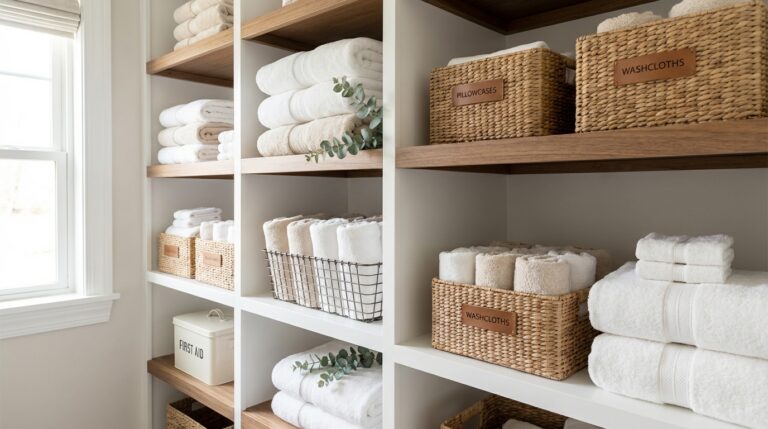
- Budget ($15-40): Fabric storage cubes in an existing cubby shelf or closet. The IKEA DRÖNA boxes ($5-7 each) fit KALLAX shelving and work well labeled by category (“Sports,” “Pool,” “Extras”). If you don’t have cubby shelving, stacking bins on the closet floor or a shelf work fine—just label them.
- Mid-range ($40-80): An over-the-door organizer on the coat closet door. The Simple Houseware over-door pantry organizer ($25-30) gives you multiple clear-pocket tiers for sunscreen bottles, bug spray, small items. Combined with a floor basket for larger items (sports bags, umbrellas), this maximizes closet door space that’s usually wasted.
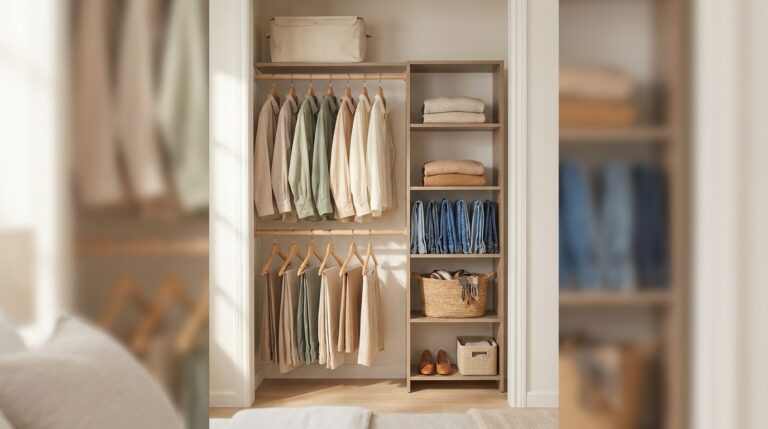
- Higher end ($80-200+): A custom closet system for the entryway closet. ClosetMaid’s adjustable shelf and rod kits ($60-100) let you configure the interior of a hall closet with specific zones—high shelf for off-season items, mid-level for current season, low level for kid-accessible sports gear. The Container Store’s Elfa system is pricier ($150-300 for a small closet) but extremely configurable.
The rotation principle: Overflow storage should be reviewed at each seasonal transition. When winter sports gear comes out of active use, it goes to long-term storage (basement, attic, under-bed). When summer sports gear comes out of long-term storage, it goes to overflow. This prevents the overflow zone from becoming a permanent archive of every activity your family has ever done.
Kid accessibility: Store frequently needed kid items (swim goggles, bike helmets, bug spray) at kid height in the overflow area. If they can grab it themselves, you don’t have to stop what you’re doing to hand it to them every time you leave the house. This is a small independence win that adds up to significant time savings over a summer.
Mudroom Solutions for Every Space
Everything I’ve described so far assumes you have some kind of dedicated entryway space—a mudroom, a front hall, a closet by the door. But I know that many families don’t have that luxury. Here’s how to implement the five-zone system in three common challenging scenarios.
Scenario 1: The Apartment Entryway (2-4 feet of wall space)
You open the front door and you’re basically in the living room. Maybe there’s a small stretch of wall, maybe a couple of feet of tile before the carpet starts. That’s your entire entryway.
The solution: Go vertical and go narrow.
- Zone 1 (Hooks): A vertical hook rail mounted on the wall directly next to or behind the door. The Command decorative hook rail (no holes, adhesive mount, about $12) works if you can’t drill into walls. Mount it at adult height and add a second set of adhesive hooks at kid height below.
- Zone 2 (Shoes): A slim shoe tray (the Mohawk Home boot tray, 14 x 28 inches, about $20) placed directly inside the door. Room for four to six pairs. Rotate weekly.
- Zone 3 (Grab-and-go): A small floating shelf or wall-mounted basket above the hooks. The IKEA MÅLERÅS picture ledge ($7, 14 inches) holds keys, sunscreen, and a small dish for essentials.
- Zone 4 (Drop zone): A wall-mounted letter holder right next to the door, at adult eye height.
- Zone 5 (Overflow): A slim storage bench (look for models 36 inches wide or less with interior storage) doubles as a shoe-changing seat and holds overflow items inside.
Total footprint: Under 6 square feet of floor space, and everything else is on the wall.
I set this up for a friend who lives in a two-bedroom apartment with two kids, and she said it was the first time she’d ever been able to find her keys consistently. The wall-mounted approach uses space that was just drywall before.
Scenario 2: The Narrow Hallway (3-4 feet wide, leading to the rest of the house)
This is common in older homes—you walk in the front door and there’s a hallway leading to the living room or stairs. The hallway is too narrow for furniture but too long to ignore.
The solution: Use one wall only, and keep everything above 12 inches from the floor.
- Zone 1 (Hooks): A long hook rail running the length of one wall, 60 inches high. A second rail at 36 inches for kids. This gives you plenty of hooks without protruding into the hallway—hooks stick out 3-4 inches from the wall, which is fine even in a 36-inch-wide hall.
- Zone 2 (Shoes): A wall-mounted shoe rack (the Yamazaki tower wall-mounted shoe rack, about $35, holds 6 pairs) keeps shoes off the floor entirely. Mount at a height where the bottom pair is 12-14 inches off the floor so you can still sweep underneath.
- Zone 3 (Grab-and-go): A floating shelf at 48-52 inches (above kid-reach for anything breakable, accessible to adults without stretching) with a small tray for daily essentials.
- Zone 4 (Drop zone): Wall-mounted letter slots at the end of the hallway nearest the kitchen or living area—so papers flow from the door toward where they’ll be processed.
- Zone 5 (Overflow): If there’s a closet anywhere along the hallway, use it. If not, a slim rolling cart (the RASKOG from IKEA, $30, 14 inches wide) can slide into the end of the hallway and hold overflow items in three tiers.
Key principle: Nothing on the floor except a small doormat and possibly one slim shoe tray. The hallway needs to flow, and anything on the floor creates a bottleneck.
Scenario 3: No Mudroom at All (Front Door Opens Into Living Space)
This is increasingly common in open-concept homes and small houses. The front door opens directly into the main living area, and there’s no hallway, closet, or transitional space whatsoever.
The solution: Create a virtual mudroom using furniture to define the zone.
- The anchor piece: A console table or narrow entryway bench placed 2-3 feet from the door, parallel to the wall. This physically creates a boundary between “entryway” and “living space.” Choose one that’s 36-48 inches wide and 12-15 inches deep. The Threshold Promontory console table from Target ($100-130) is slim and comes in neutral finishes.
- Zone 1 (Hooks): Mounted on the wall behind the console table. The table creates visual distance between the hooks and the rest of the room.
- Zone 2 (Shoes): A basket or bin under the console table. The table’s surface hides what’s underneath from living room sight lines.
- Zone 3 (Grab-and-go): A tray on top of the console table, styled to look intentional from the living room side (a nice ceramic tray, a small plant next to it).
- Zone 4 (Drop zone): A decorative box or letter holder on the console table.
- Zone 5 (Overflow): A nearby closet, or a storage ottoman that doubles as living room seating.
Aesthetic is critical here because the entryway is visible from the living space at all times. Choose furniture and containers that match your living room’s style. Everything should look like it belongs in the room, not like a mudroom invaded the living room. Neutral tones, natural materials (rattan, wood, linen), and clean lines help the entryway zone blend seamlessly.
This is where the “Neutral Nina” philosophy really pays off—when your organizational tools are in a cohesive neutral palette, they can live anywhere in your home without creating visual discord.
The 30-Minute Seasonal Swap Checklist
Here’s the exact process I follow every spring and fall to transition our entryway between seasons. Print this out, set a timer, and do it all in one session.
Before you start, gather:
- One large bin or bag for items going to seasonal storage
- One trash bag for items to donate or discard
- A damp cloth for wiping down surfaces
- The incoming season’s items (pulled from storage)
Minutes 0-5: The Full Purge
Remove everything from all five zones. Every hook, every shoe, every item in the grab-and-go tray, every piece of paper in the drop zone, everything in overflow storage. Pile it all on the floor or a table nearby.
Wipe down all surfaces, hooks, shelves, and the inside of the shoe tray. You’ll be amazed how much dust, dirt, and mystery crumbs accumulate.
Minutes 5-15: Sort Into Four Piles
Go through every item and sort into:
- Stays (current season): Items you’ll use in the next three months. Light jackets, sneakers, current sports gear, sunscreen, active papers.
- Seasonal storage: Items you won’t need until fall/winter. Heavy coats, snow boots, scarves, wool hats. These go in the storage bin.
- Donate/discard: Items that are broken, outgrown, expired, or unused. Be honest. If nobody wore that jacket all winter, nobody is wearing it next winter either. Expired sunscreen and dried-out bug spray get tossed.
- Relocate: Items that don’t belong in the entryway at all. That library book. The toy car. The screwdriver someone left on the shelf three months ago. These go back to their actual homes.
Minutes 15-25: Reload by Zone
Put the “stays” items back into their zones, adding incoming seasonal items:
- Zone 1: Hang one light jacket and one bag per person. Hats and caps on the shelf above.
- Zone 2: Two pairs of shoes per person—everyday pair and activity pair. Flip flops in the magazine holder if you use one.
- Zone 3: Reload the grab-and-go station with warm-weather essentials. New sunscreen bottle, bug spray, SPF lip balm. Check that key hooks are current.
- Zone 4: Empty the drop zone completely. Fresh start.
- Zone 5: Stock overflow with summer gear—swim bags, sports equipment, extra outdoor supplies.
Minutes 25-30: Final Check and Labels
Step back and look at the whole setup. Is each zone clearly defined? Can each family member identify their section? Are the most-used items at the most accessible height?
Update any labels if needed. If you use a label maker, fresh labels for the season (swapping “Snow Gear” for “Swim Gear” on the overflow bin) take thirty seconds and prevent the slow drift of items into the wrong zones.
Take a photo of the finished setup. When things inevitably drift over the summer, the photo gives you a visual reference for what “reset” looks like. I keep mine in a “Home Organization” album on my phone and reference it about once a month.
The whole process shouldn’t exceed 30 minutes. If it takes longer than that, you likely have too many items in the entryway and need to relocate some to bedrooms, closets, or other storage areas.
Maintaining the System Through Summer
Setting up the zones is the easy part. Maintaining them through three months of summer chaos—swim lessons, camp gear, beach trips, playdates, popsicle-sticky fingers on everything—is where the real challenge lives.
Here’s how I keep our entryway functional from June through August.
The Weekly 5-Minute Reset
Every Sunday evening, I do a fast pass through all five zones. This takes five minutes, not fifteen, because the zones contain the chaos—you’re just putting things back in their designated spots, not reorganizing from scratch.
The Sunday scan:
- Zone 1: Re-hang anything that’s fallen. Remove any item that’s accumulated beyond the per-person limit.
- Zone 2: Pull shoes that haven’t been worn that week. They go back to bedrooms. Replace with any shoes that are currently living in the wrong spot (the sandals that migrated to the living room).
- Zone 3: Check sunscreen and bug spray levels. Replace anything that’s running low. Toss expired items.
- Zone 4: Process all papers. Nothing should survive in the drop zone from one week to the next.
- Zone 5: Quick scan for anything that belongs elsewhere. Return sports gear that was supposed to go to the garage.
I tie this to our broader evening reset routine—the entryway scan happens as part of the whole-house evening tidying loop.
Kid Involvement (How to Make It Stick)
Kids are the primary users of the entryway and the primary source of its disorder. Getting them to maintain the system requires three things: accessibility, ownership, and consistency.
Accessibility: If kids can’t physically reach their hooks, shoe cubbies, or grab-and-go items, they won’t use them. Period. I’ve already covered height guidelines for each zone, but it’s worth repeating: every item a child is expected to manage must be at a height they can reach without help. This includes the sunscreen. If you want your seven-year-old to apply sunscreen before going outside (and you do), the sunscreen needs to be on a shelf she can reach.
Ownership: Each child has labeled, color-coded, or otherwise visually identified sections in Zones 1, 2, and 4. My kids have small name tags on their hooks and color-matched bins for their shoes. This makes “put your stuff away” actionable—they know exactly where “away” is.
Consistency: The expectation is simple and doesn’t change: when you come in the door, shoes go in your bin, jacket goes on your hook, backpack goes on your hook, papers go in the drop zone. Every single time. We started this with our kids when they were three, and at five and seven, it’s automatic for them about 80% of the time. The other 20% gets a gentle redirect. I’ll take that ratio.
The visual checklist: For younger kids (3-5), I taped a simple picture checklist at their eye level near the door. Four pictures: shoes in bin, jacket on hook, backpack on hook, hands washed. No words needed. They “read” it every time they come in, and it reinforces the routine without me having to narrate it.
Dealing with Summer’s Unique Challenges
Summer brings entryway problems that don’t exist in other seasons:
Sand. If your family goes to the beach or has a sandbox, sand will invade your entryway. My solution: a small outdoor mat immediately outside the door (the Gorilla Grip outdoor mat, $15-20, fine bristle type) plus the indoor boot tray. Shoes get a shake on the outdoor mat before they come inside. Sand-heavy items (beach bags, towels) don’t enter the entryway at all—they go directly to the laundry area via the side or back door if possible.
Wet everything. Pool towels, wet swimsuits, damp shoes, water bottles dripping condensation. I added a set of three over-the-door hooks on the back of our front closet door specifically for hanging wet items to dry. A small tension rod inside the closet also works for draping wet swimsuits. The key is giving wet items a place that isn’t “draped over the bench” or “in a pile on the floor.”
Volume. Summer activities generate more gear than winter. Between swim lessons, soccer camp, playdates, and weekend trips, the entryway can feel like a sporting goods store. The overflow zone (Zone 5) is critical here—pre-pack activity bags (the swim bag has goggles, swim cap, and towel; the soccer bag has cleats, shin guards, and water bottle) and store them ready to grab. This prevents the frantic “where are the goggles” scramble and keeps loose items from colonizing every surface.
The “going to the pool” staging area. For the weeks when your family is going to a pool or beach multiple times per week, I designate a specific spot in the overflow zone as the pool staging area. Clean towels, sunscreen, swim gear, and a change of clothes all live there in one grab-and-go bag. After a pool trip, wet items go to the drying hooks, dry items go back in the bag. The bag is always ready for the next trip.
Integration with Other Home Systems
The entryway doesn’t exist in isolation. It works best when it connects to your other organizational systems.
Connection to the command center: Our family command center is in the kitchen, about 15 feet from the entryway. Papers from the entryway drop zone get processed to the command center during the evening reset. Summer schedules posted on the command center (camp pickup times, pool hours, activity calendars) inform what needs to be in the grab-and-go station and the overflow zone.
Connection to the closet system: Off-season items from the entryway go to closets and storage. Having an organized closet system means the seasonal swap is faster—you know exactly where winter items go and where summer items are coming from.
Connection to laundry: Dirty items from the entryway (muddy socks, sweaty hats, sand-covered towels) need a direct path to the laundry area. In our house, there’s a small laundry basket in the front closet specifically for entryway items. It gets carried to the laundry room when it’s full. This prevents the “wet swimsuit in the shoe bin for three days” problem.
Product Summary by Budget
Here’s a quick reference for outfitting your entire entryway at three different budget levels:
| Zone | Budget ($50 total) | Mid-Range ($150 total) | Investment ($300 total) |
|---|---|---|---|
| Zone 1: Hooks | Individual adhesive or screw-mount hooks ($8-15) | Mounted hook rail ($25-40) | Shelf-and-hook combo or peg rail ($60-150) |
| Zone 2: Shoes | Rubber boot tray ($15) | Shoe bench with storage ($45-55) | Closed shoe cabinet ($100-150) |
| Zone 3: Grab-and-Go | Basket or tray on existing surface ($8-15) | Wall-mounted organizer ($25-35) | Floating shelf with hooks ($50-80) |
| Zone 4: Drop Zone | Wall-mounted file holder ($10-15) | Desktop file sorter + tray ($15-25) | Wall-mounted cubby system ($60-80) |
| Zone 5: Overflow | Fabric storage cubes ($5-7 each) | Over-door organizer + floor basket ($25-40) | Closet system kit ($60-150) |
All prices are approximate and based on mid-2026 retail. The budget tier is enough to create a fully functional five-zone system. The higher tiers add better aesthetics, more durability, and integrated design.
Frequently Asked Questions
How do I organize a mudroom for a family of five or more?
The five-zone system scales well, but you’ll need to be stricter about per-person limits. With five or more family members, each person gets one hook (not two), one pair of active shoes in the entryway (not two), and one slot in the drop zone. Consider a double row of hooks on a longer wall to accommodate everyone. The grab-and-go station and overflow zone don’t scale by person—they scale by activity, so they stay roughly the same size. The biggest adjustment is usually shoes: a larger shoe cabinet or a dedicated shoe closet becomes nearly essential with five or more people.
What’s the best way to handle sports equipment in the entryway?
Sports equipment should live in the overflow zone (Zone 5), pre-packed in activity-specific bags. Don’t let cleats, shin guards, helmets, and bats sprawl across the entryway. Each sport gets its own bag or bin, packed and ready to grab. The bag lives in the overflow zone when it’s home and goes straight back there after practice. For bulky items (hockey sticks, baseball bats, lacrosse sticks), a tall bin or umbrella stand near the overflow zone keeps them upright and contained. If you have a garage, that’s often the better home for sports equipment, with only the current day’s bag staged in the entryway.
How do I keep the entryway smelling fresh with kids’ shoes and sports gear?
Three strategies that work together. First, use a boot tray with a drip mat underneath—containing the mess contains the smell. Second, place a small mesh bag of cedar chips or an activated charcoal deodorizer (Moso Natural air purifying bags, about $10 for two) in the shoe zone. They’re unscented but absorb odors effectively. Third, air out shoes weekly: once a week, take the shoe tray outside for an hour of sunlight and fresh air. For particularly offensive sports shoes, stuff them with crumpled newspaper overnight to absorb moisture and odor, then swap in fresh insoles monthly.
Can I create a mudroom system in a rental where I can’t drill into walls?
Absolutely. Use adhesive hooks (Command brand makes heavy-duty versions that hold up to 7.5 lbs each), a freestanding coat rack, an over-the-door hook organizer, and freestanding furniture (shoe bench, console table, storage ottoman). The 3M Command strip product line is extensive enough to mount shelves, hooks, baskets, and even small cabinets without any holes. A freestanding narrow bookshelf or cubby unit (IKEA KALLAX 1×4, about $50, 16 inches wide) provides Zones 3, 4, and 5 vertically with no wall damage. When you move out, everything comes with you.
How often should I do a full seasonal swap of the entryway?
Twice a year is the minimum—spring and fall, timed to when your region has a sustained temperature shift. I do mine in mid-April and mid-October. Some families in regions with a distinct summer-to-fall and winter-to-spring transition benefit from four swaps (roughly every three months), but that’s usually only necessary if you have very limited storage space and need to rotate aggressively. Each swap should take no more than 30 minutes using the checklist in this guide. Between full swaps, the weekly 5-minute reset keeps things maintained.
What’s the single most impactful mudroom organization change I can make?
Per-person hooks at the right height. If I could only do one thing in an entryway, it would be mounting a row of hooks at adult height and a row at kid height, with each person’s section clearly marked. This alone eliminates the pile of jackets on the floor, the “whose backpack is this” confusion, and the bottleneck of everyone trying to access the same overloaded hooks. It costs under $20 and takes 15 minutes to install. Everything else builds on this foundation.
How do I handle the entryway when my kids have friends over?
Designate one “guest” hook and one guest spot in the shoe zone. When friends come over, their shoes go on the guest spot and their jacket goes on the guest hook. This prevents guest items from mixing with family items and makes departure easier—no one is hunting for shoes in a pile of twelve pairs. For bigger gatherings (birthday parties, playdates with multiple kids), I temporarily set out an extra shoe tray or bin by the door and hang a temporary over-the-door hook organizer. It takes 60 seconds to set up and prevents the entryway from being completely overwhelmed.
The entryway is the most honest room in your house. It shows you exactly how your daily systems are working—or not working. But unlike a messy closet or a chaotic garage, the entryway is fixable in an afternoon, maintainable in five minutes a week, and impactful from the very first day. Start with the hooks. Add the shoe tray. Build from there. By the time summer hits full swing, you’ll have a system that handles the daily chaos without you having to think about it.