Coat Closet Shoe Storage: Fitting Shoes Without Losing Coat Space
Learn to organize your coat closet for shoes without losing coat space by first measuring your closet and counting only the shoes you actually use. This helps you create a functional system for 10-14 pairs of shoes.
- Redistribute vertical space in your closet to fit both coats and shoes.
- Measure your closet's dimensions and door clearance before buying any organizers.
- Count only shoes worn in the last month to determine actual storage needs.
- Plan for 10-14 pairs of shoes at the door, storing seasonal pairs elsewhere.
This post contains affiliate links. As an Amazon Associate I earn from qualifying purchases.
Last October, on the first rainy Tuesday of the season, I opened our coat closet for an umbrella and a rubber boot fell on my foot. The coats above were fine. The six square feet of floor underneath had quietly become a landfill with a door.
I had been treating coats and shoes as two problems, when the closet needed to be one space where both live. This post covers just that: one closet and one door, with no bench and no mudroom. You will measure and count first, then use six zones that run from the floor to the back of the door. After that come rack picks and the weekly routines that keep it from collapsing by Thursday.
In this article (15 sections)
- Why the Coat Closet Becomes a Shoe Pile
- Before You Buy Anything: Measure and Count
- The Floor-to-Door Shoe Zone Layout
- Choosing a Coat Closet Shoe Rack
- Putting the Door to Work
- Who Gets What: Zones by Age and Height
- Protecting Your Coat Space
- Seasonal Rotation: The Real Trick
- Managing Wet Shoes, Mud, and Smell
- The Five-Minute Weekly Reset
- A Realistic Example: One Closet, Four People
- When the Closet Simply Isn’t Big Enough
- Small Styling Details That Make It Feel Calm
- Frequently Asked Questions
- Where to Start Organizing Your Coat Closet Shoes
Why the Coat Closet Becomes a Shoe Pile
Most coat closets are built for one job, hanging long things, with a single rod, one shelf above it, and a bare floor. Builders do not plan for the three to five pairs of shoes per person that a family accumulates, so the floor becomes the overflow.
Three things make it worse:
- Shoes have no natural home. Coats have hooks and hangers, and hats and gloves have a bin. Shoes get dropped wherever someone stood when they took them off, and the closet floor is the nearest flat surface.
- Kids kick them in rather than place them. An adult sets a shoe down. A six-year-old launches it toward the closet from four feet away and calls it done. Any system that needs careful placement fails within a week.
- Coats and shoes compete for the same footprint. A long parka can hang low enough to touch anything below it, so boots piled under it dirty the hem and keep the door from closing. You end up giving up coat room or banishing shoes elsewhere.
Buried shoes also mean duplicate purchases, wet pairs that never dry, and smells that creep into coats. The fix is not choosing between coats and shoes. It is redistributing the vertical space so each gets what it needs.
Before You Buy Anything: Measure and Count
I know the pull of a cart full of organizers. Resist it for one evening. Two numbers will save you from returning half of what you order.
Step one: measure the closet
Grab a tape measure and write down:
- Interior width (wall to wall at floor level, and again at shelf height, since they can differ)
- Interior depth (back wall to the inside of the door frame)
- Door swing clearance (can the door open fully, or does it hit something?)
- Height from the floor to the bottom of your longest coat (hold it up as it hangs)
- Rod height from the floor
- Door thickness and gap (for over-the-door products, measure the top of the door and the clearance to the frame)
For a ready-made measure-and-zone sheet, the Kid-Height Coat Hook & Closet Setup Kit printable pairs well with this post, and our kid-height coat hook guide explains the hook heights it uses.
Most standard reach-in coat closets are about 24 inches deep and anywhere from 30 to 60 inches wide. A shallow closet changes your choices significantly, because a rack that works at 24 inches deep may not leave room for the door to close at 18.
Step two: count the shoes you actually use
Do not count every shoe in the house. Count the shoes that need to be at the door right now, using one rule: a pair stays only if someone wore it in the last month. Pull everything out, sort it, and be honest.
| Person | Worn in the last month (keep at the door) | Seasonal or rarely worn (store elsewhere) |
|---|---|---|
| Adult 1 | 2 to 3 pairs | 3 or more |
| Adult 2 | 2 to 3 pairs | 3 or more |
| Child (school age) | 2 pairs (school, play) + 1 boots | cleats, sandals, dress shoes |
| Child (toddler) | 1 to 2 pairs + 1 boots | next size up |
| Guest | 2 to 4 pairs of spare slippers or a bin |
For a family of four, the “worn in the last month” count often lands between 10 and 14 pairs. A family might believe they need 40 pairs near the door. Sorted by that rule, the count can drop to around 12, with the rest out of season, outgrown, or broken.
A closet cannot hold 40 pairs gracefully. It can hold 12 beautifully.
Step three: decide who needs access
A five-year-old needs to reach their own shoes. A toddler needs help. Adults can use the high spots. Map that out now, because it decides which shelf belongs to whom. We will get to that in the zone layout.
The Floor-to-Door Shoe Zone Layout
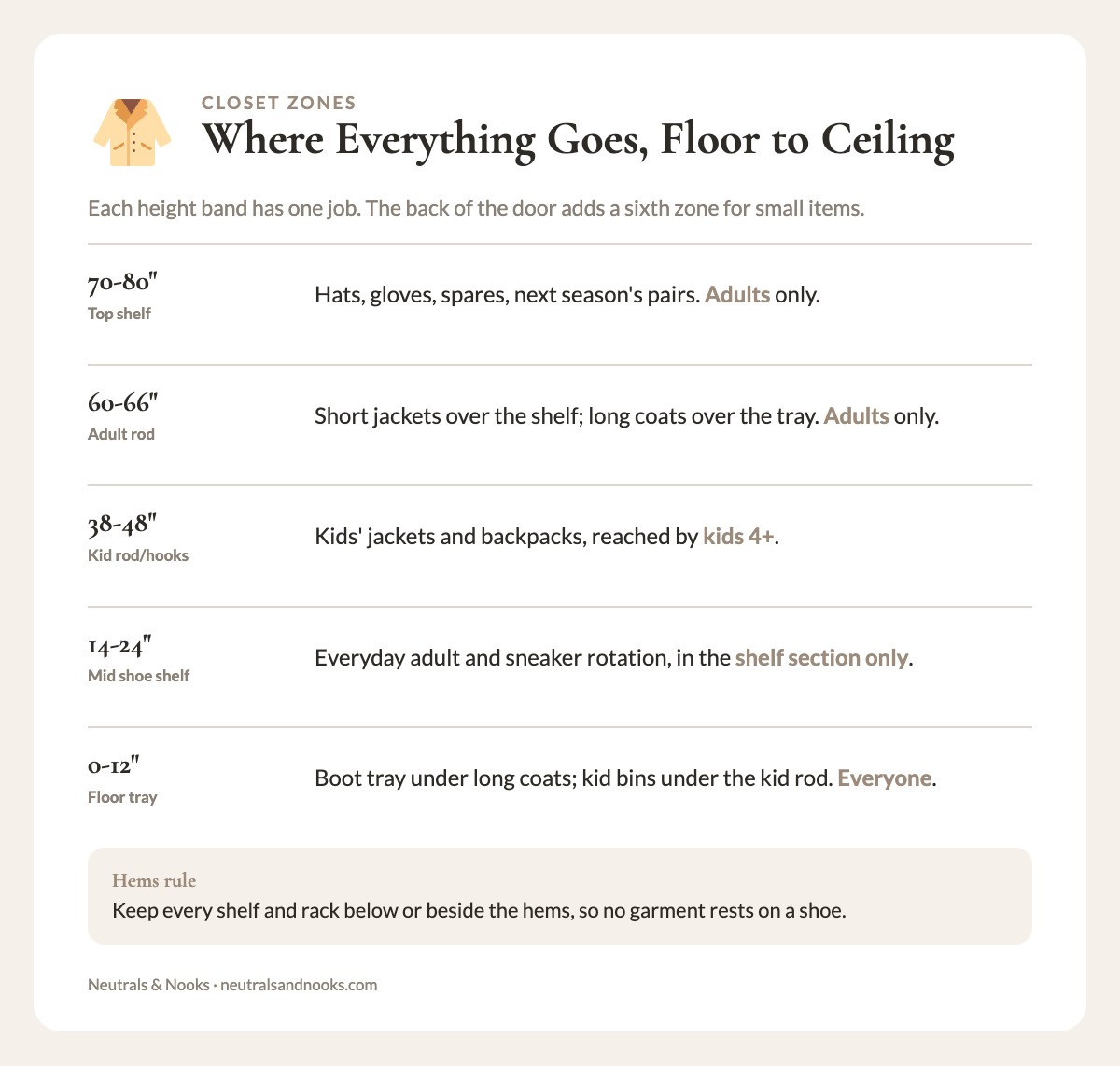
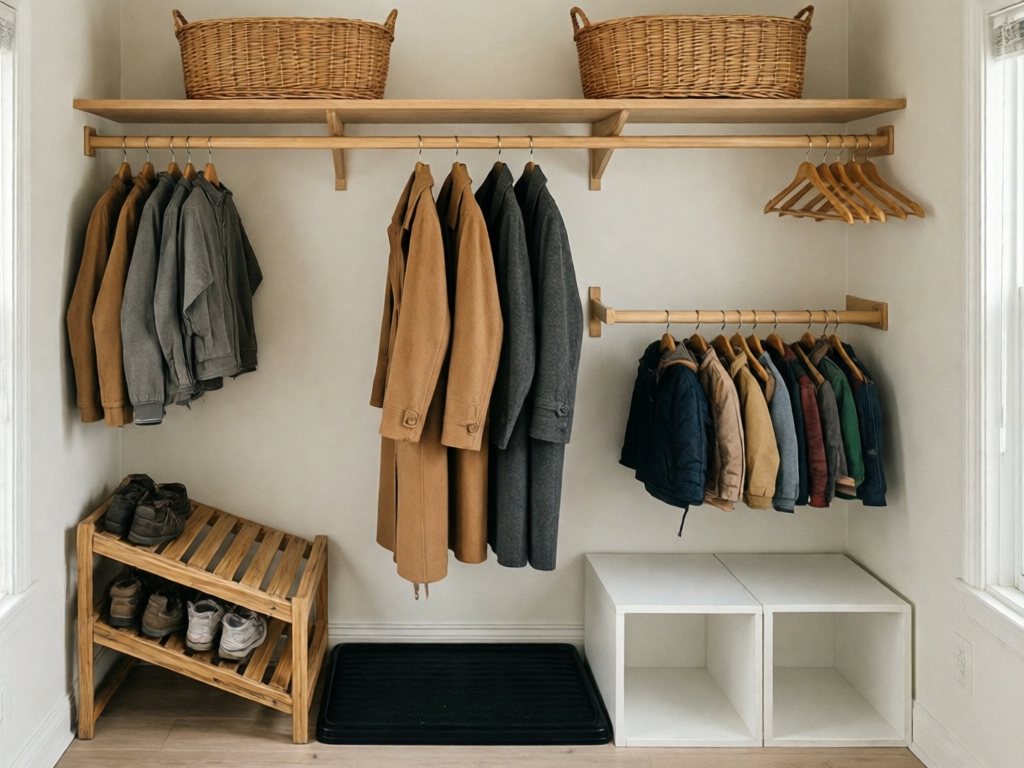
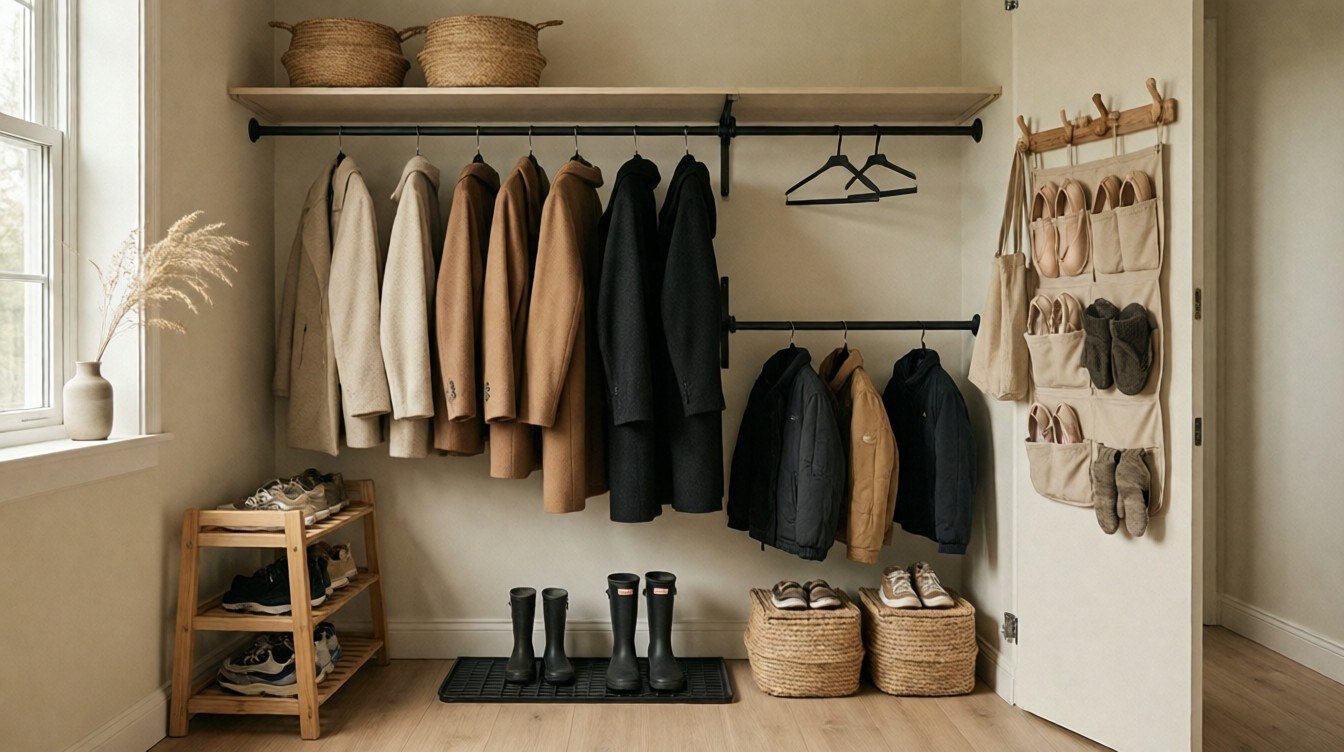
Here is the core idea. Instead of one flat shoe area on the floor, treat the closet as a series of horizontal bands from the floor up, plus a separate vertical band on the back of the door. Each band has a job.
Then split the closet side to side. A shoe band only works if nothing on the rod above it hangs down into it, so plan three sections along the rod:
- Shelf section: short adult jackets on the rod, the mid-level shoe shelf below them, and floor space under the shelf for overflow.
- Long-coat section: long coats and parkas on the rod, with only the low floor tray beneath.
- Kid section: a kid rod or hooks, with nothing on the adult rod above it and only low cubes or bins below.
In a narrow closet, drop the kid section and put kid hooks on the back of the door. The cheat sheet below lists all six zones with their heights and sections. Use it as a template and adjust it to your own measurements.
| Zone | Height from floor | Closet section | What lives here | Who reaches it |
|---|---|---|---|---|
| 1. Top shelf | 70-80″ | Full width | Hats, gloves, spares, next season’s pairs | Adults |
| 2. Adult rod | 60-66″ | Shelf and long-coat sections | Short jackets over the shelf; long coats, parkas, and rain jackets over the tray | Adults |
| 3. Kid rod/hooks | 38-48″ | Kid section, or the door | Kids’ jackets, drawstrings out; backpacks only if no toddler can reach these hooks | Kids 4+ |
| 4. Mid shoe shelf | 14-24″ | Shelf section only | Everyday adult and sneaker rotation | Adults and older kids |
| 5. Floor tray | 0-12″ | All three, kept below the hems | Boot tray under the long coats; toddler and kid bins under the kid rod | Everyone |
| 6. Door | Pockets 12-60″; hooks 36-42″ | Back of the door | Flats, slippers, sandals, mittens, umbrella | Mixed, by pocket height |
The principle matters more than the inches: keep every shelf and rack below or beside the hems, so no garment rests on a shoe.
Zone 1: The top shelf (roughly 70 to 80 inches)
This is where the least-used items go. Baskets of hats and gloves, a bin of spare shoelaces and insoles, a box of next season’s pairs, a basket of guest slippers. Nothing in daily use. If you cannot reach it without a stool, it is for backup stock.
I like a pair of matching fabric or woven baskets here. Closed storage keeps the visual calm, which matters because this is the first thing guests see when you open the door.
Zone 2: The adult coat rod (roughly 60 to 66 inches)
Leave this alone as much as you can. This is your coat space, and the layout exists to protect it. Keep the floor tray low, and put the Zone 4 shelf only in the shelf section, under short jackets.
Hang your longest coats in the long-coat section, so they fall over nothing but the flat floor tray. Shorter jackets go above the shoe shelf. Hold each coat up and note where its hem lands, since a long hem can fall into the shelf band.
Zone 3: The kid rod or hooks (roughly 38 to 48 inches)
If you have school-age children, a second lower rod or a row of hooks lets them hang their own jackets, off the floor and off the adult rod. Give it its own section, with nothing on the adult rod above it and only single, unstacked cubes or bins below. Kids’ jackets on a 38 to 48 inch rod hang down to roughly 16 to 25 inches. This is the same principle behind kid-height coat hooks in a Montessori-inspired coat closet setup, and it works whether you use hooks, a tension rod, or a short second rail.
If your closet is too narrow for a kid section, put three or four sturdy hooks at child height on the back of the door instead. Bulky kids’ jackets still come off the adult rod, which frees up hanging inches.
If a toddler shares the closet, these low hooks are within their reach too. Keep them for jackets with the drawstrings pulled out. Backpacks have long straps, so hang them on a hook above toddler reach.
Zone 4: The mid-level shoe shelf (roughly 14 to 24 inches)
This is the band most families skip. They put shoes on the floor and leave a hollow gap above. A mid-level shelf or angled shoe rack can add a lot of shoe capacity, but only in the shelf section, under short adult jackets. Keep it out from under the long coats and the kid rod, since both hang down into this band.
Adult and everyday shoes go here, toes pointing out, so you can read the whole lineup at a glance.
Zone 5: The floor tray (0 to 12 inches)
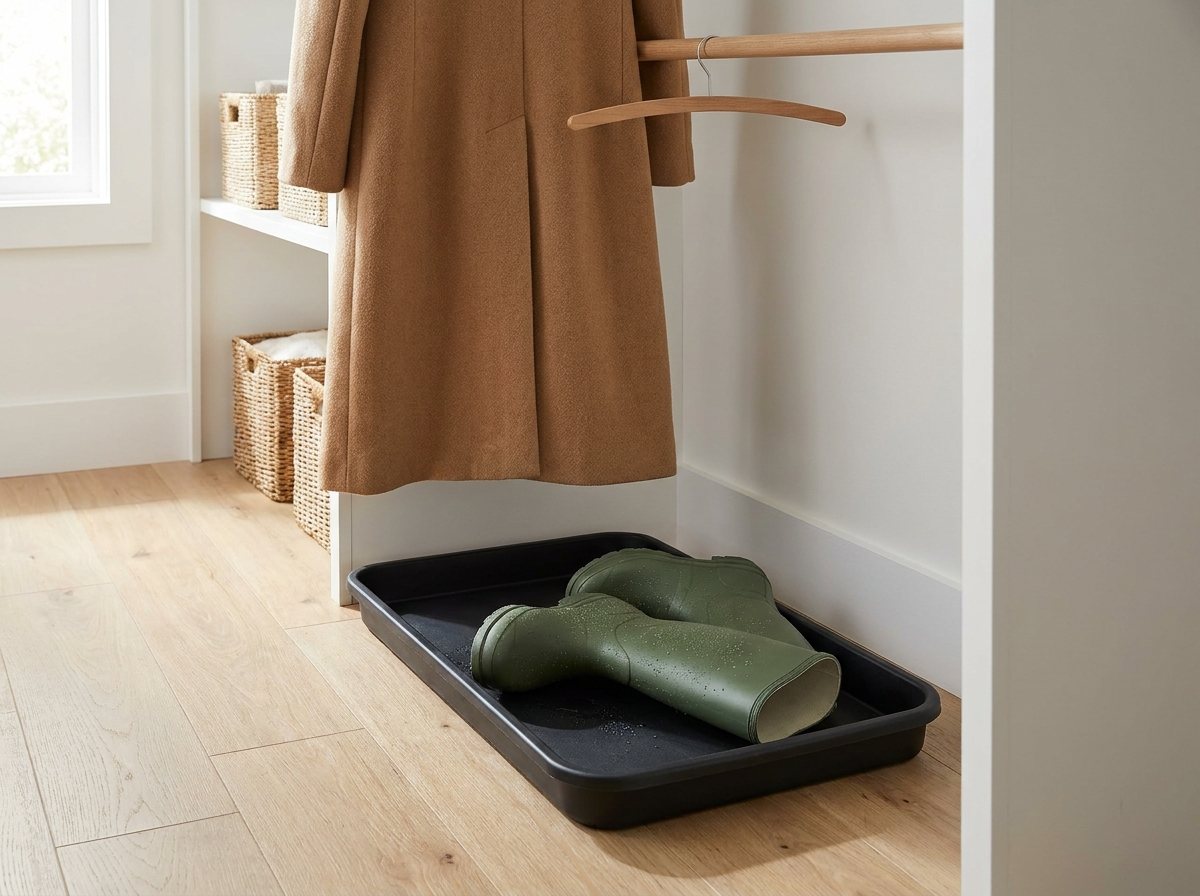
Wet, muddy, and bulky footwear lives on the floor, in a waterproof boot tray with a raised lip. The tray sits under the long coats, and the floor under the shoe shelf takes any overflow. Kid shoes live in a shallow bin or open cube in the kid section. A standard cube is about 13 inches wide, so two side by side need roughly 26 inches. In a narrower kid section, use one divided bin with a side per child.
The tray wipes clean, so wet pairs always go there first. Before you stand tall boots upright, check the lowest hem above them. If a coat would touch them, lay the boots on their sides instead.
Zone 6: The back of the door
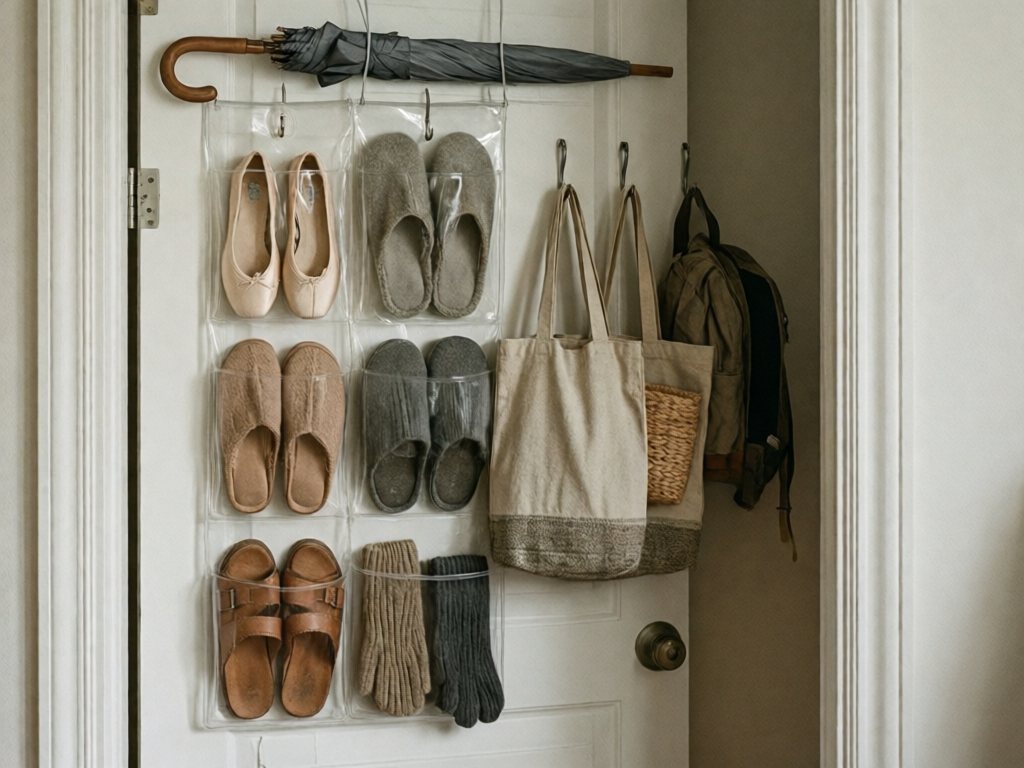
The door is the most underused surface in the closet, and it is where flats, slippers, sandals and mittens go. A shallow over-the-door pocket organizer holds them; pocket heights, hooks and weight limits are in Putting the Door to Work below.
Choosing a Coat Closet Shoe Rack
A good coat closet shoe rack for a reach-in closet needs three things. It must be shallow enough that the door closes and stable enough that kids cannot topple it. It should also be tiered, so you use vertical space instead of sprawling across the floor.
Safety firstAnchor shelves, bookcases, and tall racks to wall studs with furniture straps, and fasten stacked cubes together. Keep heavy items low and never let kids climb on them. Do not remove a bookcase’s fixed shelves, since they help keep it rigid.
Option 1: The angled tiered rack
These hold shoes at a tilt, toes down and heels up, so you see the whole pair. They are excellent for adult shoes and everyday sneakers.
- Pros: Shows every pair, high capacity in a small footprint, easy to see what is missing.
- Cons: Bulky boots do not fit well, and the tilt can tip small shoes forward if the rack is shallow.
- Best for: The mid-level shelf (Zone 4), adult and teen shoes.
Option 2: The stackable cubby or cube
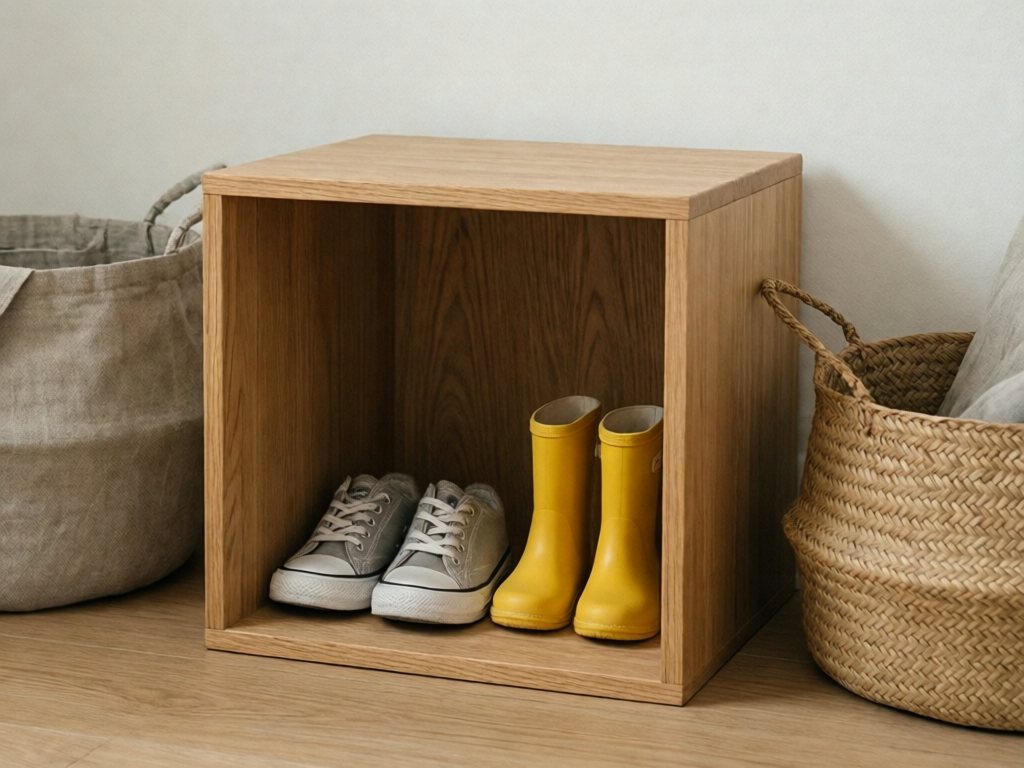
Open cubes, one per person. A child puts their shoes in their own cube, and it doubles as a natural boundary between family members.
Where a cube sits decides how high it can go. In the kid section, use single, unstacked cubes, roughly a foot tall, so they stay under the kid jackets’ hems. Two stacked cubes reach about two feet, which is where those jackets hang. Two-high stacks belong only in the shelf section, under short adult jackets.
Width matters too. A standard cube is about 13 inches wide, so a 16-inch kid section fits only one. For two children in that space, use one low divided bin with a side each, or widen the kid section to about 26 inches.
Safety firstFasten a two-high stack together and anchor it to a wall stud before you load it. Stacked cubes can tip when a child tugs a shoe out or climbs them.
- Pros: Easy for kids, clear ownership, flexible.
- Cons: Slightly less dense than a tilted rack, and cubes can drift out of alignment.
- Best for: Families with school-age children who need to find their own shoes.
Option 3: The expandable two-tier rack
A simple adjustable shelf that sits on the floor and lifts a second layer of shoes above the first. Many are adjustable in width, which suits an odd-sized closet.
- Pros: Budget-friendly, adjusts to the closet, easy to move.
- Cons: Lightweight models can slide or tip when a child tugs a shoe out.
- Best for: Renters, odd closet widths, a first trial before buying something bigger.
Option 4: The boot tray
A flat, rimmed tray, usually rubber or PVC, that catches meltwater, mud, and salt.
- Pros: Protects the floor, wipes clean, cheap.
- Cons: Holds nothing by itself, since it is a surface, not storage.
- Best for: Zone 5, always.
Option 5: The shelf you already own
A sturdy low bookcase you already own works too. Set it in the shelf section, below the jacket hems, and anchor it to the wall. Space its adjustable shelves for shoes but leave any fixed shelves in place. Look around the house before you buy.
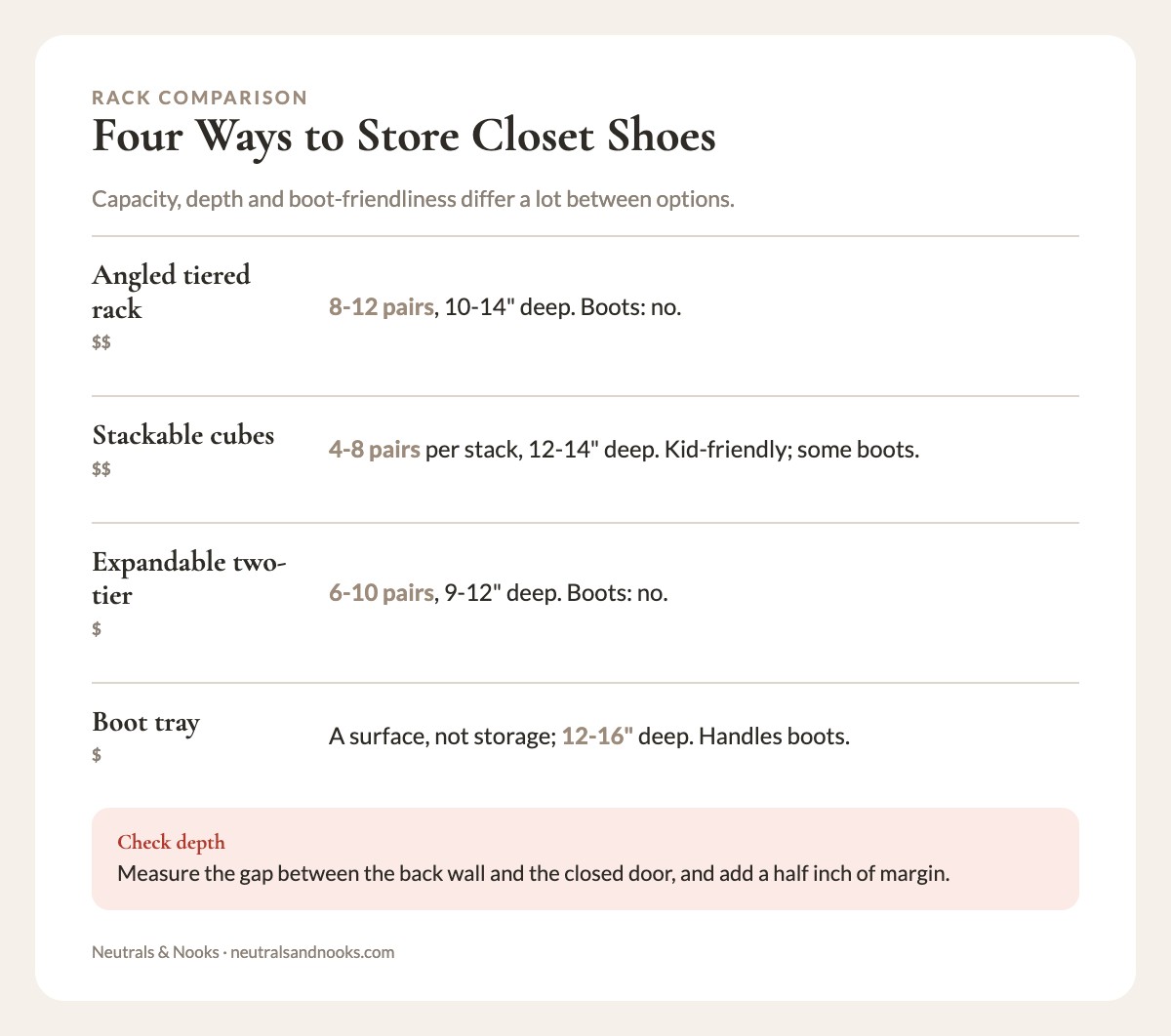
Quick comparison
| Type | Capacity (pairs) | Footprint depth | Kid-friendly | Handles boots | Approx. price |
|---|---|---|---|---|---|
| Angled tiered rack | 8-12 | 10-14″ | Medium | No | $$ |
| Stackable cubes | 4-8 (per stack) | 12-14″ | High | Some | $$ |
| Expandable two-tier | 6-10 | 9-12″ | Medium | No | $ |
| Boot tray | n/a (surface) | 12-16″ | High | Yes | $ |
| Repurposed shelf | 6-12 | varies | High | Some | Free |
What to avoid
- Racks deeper than your door clearance. Measure the gap between the back wall and the closed door. Add a half inch of margin.
- Flimsy plastic that bows under weight. A rack holding a dozen pairs gets heavy once boots are involved.
- Fully enclosed shoe cabinets in a damp climate. Shoes need airflow. A closed cabinet can trap moisture, and the smell follows.
- One big, undifferentiated bin. A single bin invites a pile. Dividers or separate bins prevent it.
Putting the Door to Work
The back of the door deserves its own section because it solves a problem the floor cannot: the odds and ends. Slippers, ballet flats, flip-flops, a spare pair of rain boots in a kid’s size, or gloves that are never in the same place twice.
Over-the-door pocket organizers
A clear or fabric pocket organizer hangs over the top of the door. Each pocket holds a pair of shoes or a bundle of accessories.
A few things I have learned the hard way:
- Check the door gap first. Some closets have very little clearance at the top, and a thick hook will stop the door from closing.
- Place the heavy stuff low. A pocket with chunky sneakers pulls the whole organizer sideways. Put lighter things up top, and heavier ones near the bottom, where the weight sits against the door.
- Use clear pockets for kids. If they can see the item, they use it. Fabric opaque pockets become mystery pouches.
- Label by person if you share it. A strip of tape and a marker is plenty.
- Keep it for small, light items. Boots in door pockets sag the whole thing and fall out constantly.
Hooks on the door
A single row of hooks at 36 to 42 inches turns the door into extra coat space for small jackets and hats. That height is within a toddler’s reach. If you have a little one, backpacks, totes, and reusable grocery bags go on a higher hook.
You can still mount one hook at toddler height and make it theirs, for a light jacket with the drawstring pulled out.
Safety firstKeep cords, drawstrings, dog leashes, and long straps off any hook a child can reach, and pull drawstrings out of hoods. Use short, light items only on toddler-height hooks.
Keep loads on over-the-door hooks and organizers light so they do not pull on the door. In rentals, a slim hook that hangs over the top of the door works well for the lightest items.
The umbrella problem
Umbrellas are the item that never has a home. A narrow tube or a single hook at the top of the door keeps them from migrating to the floor, where they get stepped on. Hang only a closed, dry umbrella on the hook, above the shoe pockets. Let wet ones drain in a tube or on the boot tray first so they do not drip on your slippers.
What the door should NOT hold
Heavy winter boots, anything dripping wet, or anything that rubs against the door and scuffs the paint. A closed, dry umbrella on its hook is fine. If the closet door gets closed against a stuffed organizer all winter, check the paint come spring.
Who Gets What: Zones by Age and Height
A family closet is not a single-user space. The best layouts assign territory so everyone can reach what is theirs.
Toddlers and preschoolers (ages 1 to 4)
Toddlers cannot manage shoes alone, but they can participate. Give each toddler one low bin or one cubby on the floor, at the front. The routine becomes: shoes off, shoes in the bin. A parent handles the rest.
Keep their shoe count tiny. One everyday pair and one pair of boots in season is enough. Toddlers outgrow shoes every few months, so a small set goes further.
School-age kids (ages 5 to 10)
This is where the system really pays off. A school-age child can put their own shoes in their own cube, hang their own jacket on a low hook, and even grab the right pair from the door pocket.
Two pairs of shoes per child at the door is a strong rule: one for school, one for play or sports. Boots join them in the cold months. Cleats and dance shoes live in the bag they travel with, not in the closet.
If you want more guidance on building a system that adapts as they grow, our post on mudroom cubbies for multiple kids covers sizing and labeling in depth, and the principles transfer neatly to a closet cube.
Teens
Give a teenager one shelf or one rack tier, and let them own whatever happens inside that boundary.
Adults
Adults get the mid-level shelf and the top of the door. Keep the daily pairs in front and rotate seasonal shoes to a bin elsewhere.
Guests
If you are a shoes-off house, a small basket of clean guest slippers on the top shelf gives visitors a place to change.
Protecting Your Coat Space
The whole point of the post is that shoes should not eat your coat room. Here are the specific moves that keep the rod usable.
Keep the hem line clear
Hold your longest coat up by its hanger and note where the hem falls. Anything under it must stay below that line, or move to the shelf section under the short jackets.
If a hem will not clear the shelf, move that coat to the long-coat section, where only the low tray sits below.
Good to knowIn a 48-inch closet, the three sections are about 16 inches each. Left: short jackets over the shoe rack. Middle: long coats over the boot tray. Right: the kid rod at about 42 inches over one low divided bin, a side per child, with nothing on the adult rod above it. Two standard cubes, about 13 inches wide each, need roughly 26 inches, so save them for a wider kid section. In a narrower closet, drop the kid section and move kid hooks to the door.
TipMeasure the hem of your longest coat and the bottom of the kid jackets. Then put the mid shelf only under the short adult jackets, never under the long coats or the kid rod.
Slim hangers, always
Bulky plastic hangers waste inches. Switching to slim felt-covered or thin wooden hangers can recover noticeable rod space. Changing hangers alone can make room for a few more coats. Coats also stay on the hanger instead of slipping off.
One in, one out for coats
Hang only the coats currently in use. A family of four typically needs one or two active coats per person at any given time. Heavy winter coats rotate in once temperatures drop, and light jackets rotate out.
Use the shelf for non-hanging items
Scarves, gloves, and hats should not hang on the rod. They go in labeled baskets on the top shelf, which keeps the rod for things that actually need to hang.
Add a double rod where the height allows
A lower second rod at around 40 inches gives kids a hanging area of their own. In a standard closet, keep the adult rod above it clear, since adult jackets would hang into the kid tier. If your closet is tall enough to raise the adult rod, short jackets can share that section as a true second tier.
What each move gains, and what it costs your coat space
| Move | Shoe space gained | Coat space affected |
|---|---|---|
| Add mid-level shelf under short jackets | +4 to 8 pairs in a 16 in. section (rough; scales with section width) | None |
| Swap to slim hangers | None | Some extra hanging room |
| Add door pocket organizer | One small pair per pocket, up to the organizer’s pocket count | None |
| Add kid hooks on side wall | None | Frees adult rod |
| Remove seasonal coats | None | Frees substantial rod length |
| Split the rod: shelf under short jackets, long coats over the tray | Moderate | Protects long coats |
Seasonal Rotation: The Real Trick
A closet that works in July often fails in October, because coat and boot volume doubles at once. The solution is not a bigger closet. It is rotation.
The fall shift
October is the ideal time to run this reset, though any change of season works. Here is the order I follow:
- Empty the whole closet. It takes twenty minutes and shows you what you have.
- Pull sandals, flip-flops, and water shoes. Wipe them, dry them fully, and box them for a high shelf elsewhere.
- Try on kids’ boots and coats. Anything that does not fit goes into a donate bag or a hand-me-down bin for a younger sibling.
- Bring out the tray. Set the boot tray in Zone 5 before the first wet day arrives.
- Swap the door pockets. Sandals out, mittens and slippers in.
- Reload the baskets. Gloves, hats, and scarves, sorted by person.
If you are already in the middle of switching kids’ clothes, our fall closet organization swap system for kids’ clothes pairs well with this, since the same Saturday can cover both closets.
The spring shift
Reverse it. Boots get cleaned and stored, heavy coats go to the winter bin, and sandals return to the door. A seasonal swap that takes thirty minutes twice a year prevents the slow creep that turns an organized closet into a pile.
Where the off-season stuff goes
Store off-season footwear in labeled boxes or a lidded bin on a high shelf, a bedroom closet, or under a bed. Write the size and the person’s name on the box. Next fall, you will thank yourself when you open a box marked “Theo, boots, size 11” and everything is ready.
Do not store leather shoes in a sealed plastic bin without a silica packet or a bit of airflow, since trapped moisture is how mildew starts.
The seasonal footprint table
| Season | Shoes at the door | Where the rest lives |
|---|---|---|
| Summer | Sandals, sneakers, water shoes | Boots and winter shoes in boxes |
| Fall | Sneakers, rain boots, school shoes | Sandals boxed, heavy boots staged |
| Winter | Insulated boots, indoor slippers, sneakers | Sandals and cleats boxed |
| Spring | Rain boots, sneakers, light shoes | Winter boots cleaned and stored |
Managing Wet Shoes, Mud, and Smell
A shared closet means shared odors. A single damp pair can make the whole space smell, and that smell settles into coats. A few habits stop it before it starts.
Give wet shoes a separate zone
The boot tray in Zone 5 is the right home. Wet boots go in the tray with laces loose, upright if no hem touches them, otherwise on their sides. If a pair is soaking, set it on newspaper or a drying mat near a vent for a few hours before it goes in the closet.
Let shoes breathe
Do not shove damp sneakers into a bin and close the lid. Air them overnight on the mid-level shelf where air can move, and push them toward the back only once dry. If the closet has no airflow, leave the door ajar for an hour after a rainy day; in a humid climate, a small moisture absorber on the top shelf helps.
Use natural deodorizers
Sewn-shut cloth sachets filled with baking soda or dried lavender absorb odor. Keep them in a lidded basket on the top shelf, and set an especially smelly adult pair up there overnight with a sachet tucked inside. A cedar block on the top shelf also helps. Skip sprays with heavy fragrance, which tend to cling to wool coats.
Safety firstSachets, cedar blocks, silica packets, and moisture absorbers are ingestion and choking hazards. Store them on the top shelf or in a closed container, and use only sachets that are sewn shut. A top shelf is not out of reach for a child who climbs, so keep the closet door latched if you have a climber.
Clean the tray weekly
During rainy months, wipe the boot tray once a week. A damp cloth and a drop of dish soap does it. In snow country, salt residue needs a vinegar-and-water wipe to keep it from staining the floor.
Muddy shoes stay out until cleaned
Our house rule: if a shoe is muddy enough to leave a print, it goes on the porch or by the back door to be knocked off first. This single rule did more for our closet than any product we bought. For homes with a back entry, a mudroom reset is the better primary system for mud, with the coat closet serving as the clean, everyday overflow.
The Five-Minute Weekly Reset
A system holds only if it is easy to maintain. I do not believe in elaborate daily routines. I believe in one short reset on a day when the household is already moving, usually Sunday evening.
The routine
- Pull strays. Any shoe that is not in its zone goes back.
- Pair them up. Match every shoe with its partner. Lone shoes get a bin by the door for a week, and anything still orphaned gets tossed or hunted down.
- Check the tray. Empty any water, wipe the tray if it is dirty.
- Reset the door. Straighten the pockets and put the umbrella back on its hook.
- Scan for outgrown pairs. If a child’s shoe looks tight, pull it out now rather than discovering the problem on a school morning.
Do this reset in the five minutes before dinner or while a kid brushes their teeth, and the closet never falls far from order.
The two-minute daily habit
Teach one rule: shoes go in the closet, in your zone, when you walk in. For toddlers, that means a parent places the shoes in the bin together with them. For older kids, it becomes automatic with repetition. A visual cue helps. A small photo of each child’s shoes taped above their cube is a gentle reminder, and little ones love finding their own.
I have never had success scolding a child into shoe tidiness. What works is making the right habit the easy one: a cubby, bin, and hook at their height.
The “one in, one out” rule for shoes
When a new pair comes into the house, an old pair leaves. Kids’ feet grow quickly, so the old pair usually goes to a donation bag or a younger sibling. This rule prevents the slow inflation that overwhelms every shoe system sooner or later.
A Realistic Example: One Closet, Four People
To make this concrete, here is an illustrative setup (a composite, not a specific client) for a standard reach-in, 48 inches wide and 24 inches deep, shared by two adults and two children (ages 3 and 7).
Before: A single rod crowded with coats, a floor piled with roughly 20 pairs of shoes, and a top shelf holding a vacuum cleaner and a tangle of cords.
The setup:
- Moved the vacuum to a utility closet and gave the top shelf over to two baskets (hats and gloves, and “guest slippers”).
- Cut the coats to 8 active ones (4 adult, 4 kid) and the shoes from roughly 20 pairs to the 12 worn in the last month, then boxed the rest.
- Split the rod into three sections. A short second rod at 42 inches on the right holds the kids’ jackets, with nothing on the adult rod above it. Long adult coats hang in the middle and short adult jackets on the left.
- Added a row of three hooks on the door for hats and other light, strap-free items. The seven-year-old’s backpack went on one higher hook, above the three-year-old’s reach.
- Placed a two-tier angled rack on the left for adult shoes, under the short jackets, so no hem touches it.
- Put one low divided bin on the floor under the kid rod, a side per child, since two standard cubes would not fit the 16-inch section. A rubber boot tray went under the long coats for wet days.
- Hung a clear pocket organizer on the back of the door for flats, sandals, and mittens.
The result: The coats had room to hang without touching anything. The seven-year-old put her own shoes away within a week. The toddler got her own side of a bin she could drag out, which she thought was the best thing in the world. And the closet door closed with no push or shove.
Much of it was repurposed from things they already owned, which kept the spending modest.
The shopping list, if you’re starting fresh
| Item | Purpose | Zone |
|---|---|---|
| Slim hangers | Recover rod space | 2, 3 |
| Boot tray | Catch wet and mud | 5 |
| Tiered shoe rack or cubes | Everyday shoes | 4 |
| Over-the-door pocket organizer | Small shoes and accessories | 6 |
| Two lidded baskets | Hats, gloves, spares | 1 |
| Door hooks | Small jackets; bags on hooks above toddler reach | 6 |
| Optional: lower rod or hooks | Kids’ jackets | 3 |
When the Closet Simply Isn’t Big Enough
I want to be honest here, because not every closet can do this. Some are 24 inches wide. Some are filled with a water heater or a vacuum. If you have run the zones, edited the shoes, and still cannot make it fit, the problem is not your effort. It is the square footage.
Your options:
- Move part of the shoe load elsewhere. A slim bench or shoe cabinet by the front door can take the everyday pairs while the closet keeps boots and guest shoes. Our guide to entryway organization for families walks through those options in detail.
- Use a second closet or a hall cabinet. A hallway linen closet or a bedroom closet can hold off-season and spare pairs.
- Give each person a bedroom-based shoe spot. Kids’ everyday shoes can live in their own rooms, with only the in-and-out pairs near the door.
- Use the garage or back door for the dirtiest shoes. If you have a side entry, give muddy and sporty footwear a bench there.
- Edit harder. Honestly, this is often the right answer. Cutting from 20 pairs to 12 is not a loss. It is the system working.
If your coat closet is the only storage near the door and it is already tight, consider the mudroom approach. Even a small corner with hooks and a bench can function as a mini-mudroom. The techniques in our family mudroom organization guide scale down surprisingly well.
Signs your closet is overloaded
- The door does not close without a shove
- You cannot find a matching pair in under a minute
- Coats hang crumpled or touch the floor
- You buy duplicates because you cannot see what you own
- The closet smells stale
If three or more of those are true, the closet is carrying more than a closet should. Edit first, then reorganize.
Shop the Setup: The Shallow Closet Door
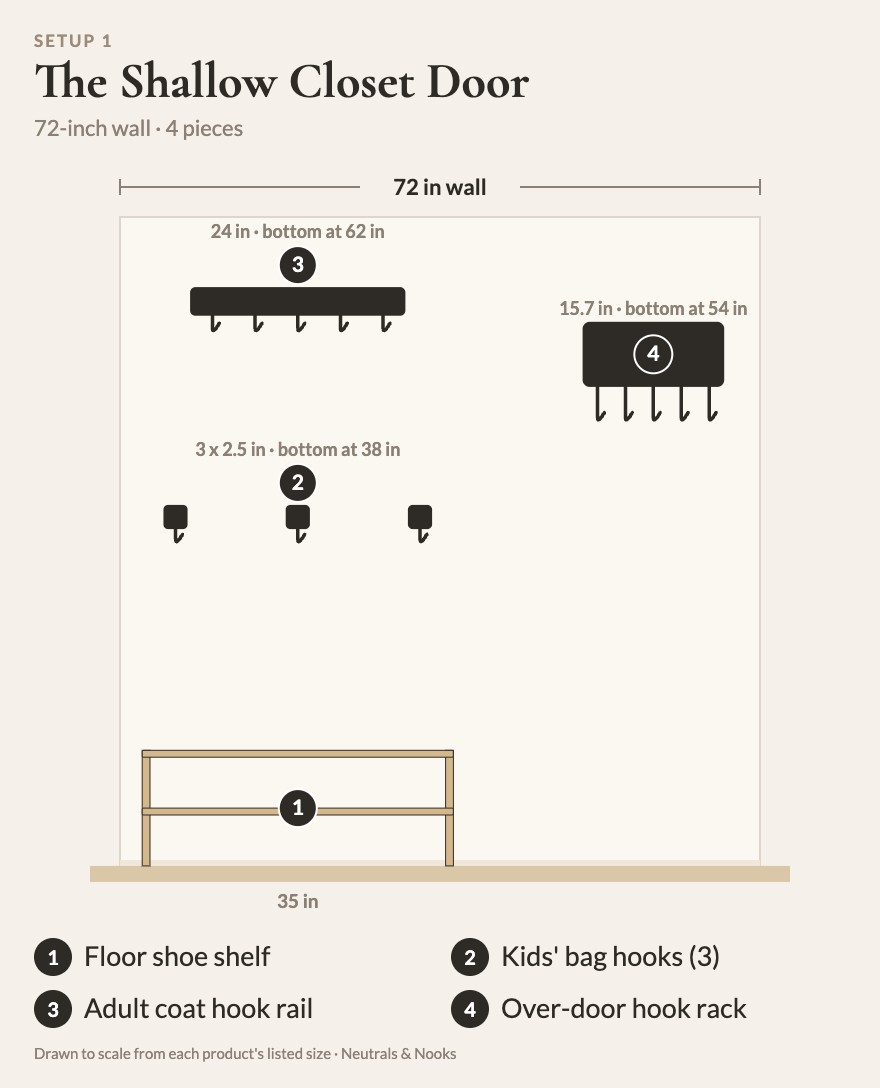
If your coat closet is only 24 inches deep and there's no room for a shoe bench, this is the setup for you. The shoes drop to a low shelf and the door starts doing some of the hanging.
Shop this setup

1. Floor shoe shelf
ROMGUAR CRAFT 2-tier bamboo shoe rack
35" W x 11" D x 13" H · Natural
View on Amazon
2. Kids' bag hooks · use 3
IBERDE black stainless wall hooks
2.5" W x 1.4" D x 2.5" H · Black L
View on Amazon

4. Over-door hook rack
Optish black over-door hook rack
15.7" W x 1.8" D x 7.1" H · Black
View on Amazon- Why it works: The 35-inch floor shoe shelf (1) uses dead floor space under the coats, while the over-door hook rack (4) and the coat hook rail (3) pull bags and extra layers off the rod so the closet stops feeling stuffed.
- Hang it: Set the adult coat hook rail (3) with its bottom edge 62 inches above the floor, the over-door hook rack (4) at 54 inches, and the kids' bag hooks (2) at 38 inches, so each person can reach their own spot without a step stool.
- Heads-up: The floor shoe shelf (1) is only 13 inches tall so it doesn't need anchoring, but the over-door rack (4) adds weight to the door, so keep it to light bags and scarves and leave the heavy coats on the rod.
Small Styling Details That Make It Feel Calm
A closet you see every day should feel quietly good to open.
- Keep the palette tight. Natural wood, woven baskets, and soft white or black hangers. Mismatched plastic is the fastest way to make a closet feel cluttered.
- Use baskets with a purpose. Closed baskets on the top shelf hide visual noise. Label them with a simple tag.
- Choose a consistent hanger. It is the single cheapest style upgrade, and it makes a closet look intentional.
- Add a little warmth. A small hook with a woven bag, a stem of dried grass in a jar on the shelf. One thoughtful touch is enough.
- Light it. A battery-powered motion light inside the closet makes the space feel more finished and helps kids find their shoes on a dark winter morning. Choose one with a screw-secured battery compartment and mount it out of reach, since button batteries are dangerous if swallowed.
- Label gently. Small tags in a neutral typeface, or a strip of linen tape with a name written in pencil. Labels reduce arguments more than anything else.
If you are in the mood to carry that calm into the rest of the house, our small primary closet organization guide uses a similar zone approach for bedroom closets.
Frequently Asked Questions
How many pairs of shoes should fit in a family coat closet?
For a family of four, plan on roughly 10 to 14 pairs at the door: the pairs worn in the last month, usually two or three per adult and two per child, plus boots in season. That fits comfortably in a standard reach-in closet using a mid-level shoe shelf, a floor tray, and a door organizer. Anything beyond that is probably seasonal, outgrown, or rarely worn, and belongs in storage elsewhere.
What is the best coat closet shoe rack for a shallow closet?
For a shallow closet, choose a slim angled rack or an adjustable two-tier shelf with a depth of 9 to 12 inches. Measure the gap between the back wall and the closed door first and leave about half an inch of margin. If the closet is under 20 inches deep, skip floor racks and lean on the back of the door and a boot tray instead.
How do I keep shoes from touching the bottom of long coats?
Give long coats their own section of the rod, with only a low boot tray beneath, and keep the tray’s contents below the hem of your longest coat. Put the shoe rack under short jackets instead. Slim hangers and fewer active coats leave enough rod width for that split.
Can kids really manage their own shoes in a coat closet?
Yes, with the right setup. School-age children do well with one cube or bin at floor level, a hook at their height, and a two-pair limit. Toddlers need help, but they can still participate by placing their shoes in a low bin. The key is making the correct action physically easy: low, open, and clearly theirs.
How do I stop a coat closet from smelling like wet shoes?
Give wet shoes a separate boot tray, let damp pairs air out before they go in, and leave the closet door ajar after rainy days. Sewn-shut sachets of baking soda or a cedar block, kept on the top shelf or in a closed container, absorb odor without leaving a heavy fragrance on your coats. Wipe the tray weekly during wet or snowy months.
Should I store off-season shoes in the coat closet?
Generally no. The closet works best when it holds only what you are wearing this season. Store off-season pairs in labeled boxes in a bedroom closet, under a bed, or on a high shelf elsewhere. Label each box with the person’s name and size so the fall or spring swap takes minutes.
What if my coat closet is too small for everyone’s shoes?
Edit first, then split the load. Keep the everyday pairs and boots in the closet, and move spares to a bench by the door, a hall cabinet, or each person’s bedroom. If it is still crowded, a small entryway bench or a mini-mudroom corner can take the overflow without changing your coat setup.
Where to Start Organizing Your Coat Closet Shoes
These days when I open our coat closet, nothing falls. It took one evening of measuring, one afternoon of editing, and a decision to treat the closet as one space with several zones.
Start with the count and the tape measure, then add one shelf, one tray, and one door organizer. The Kid-Height Coat Hook & Closet Setup Kit printable can hold your measurements and zone map while you work.
Give the new layout a few Sunday resets before you buy anything else. Most of the calm comes from the editing, not the products.