Setting Up Your Family Backyard for Summer: A Room-by-Room Outdoor Guide
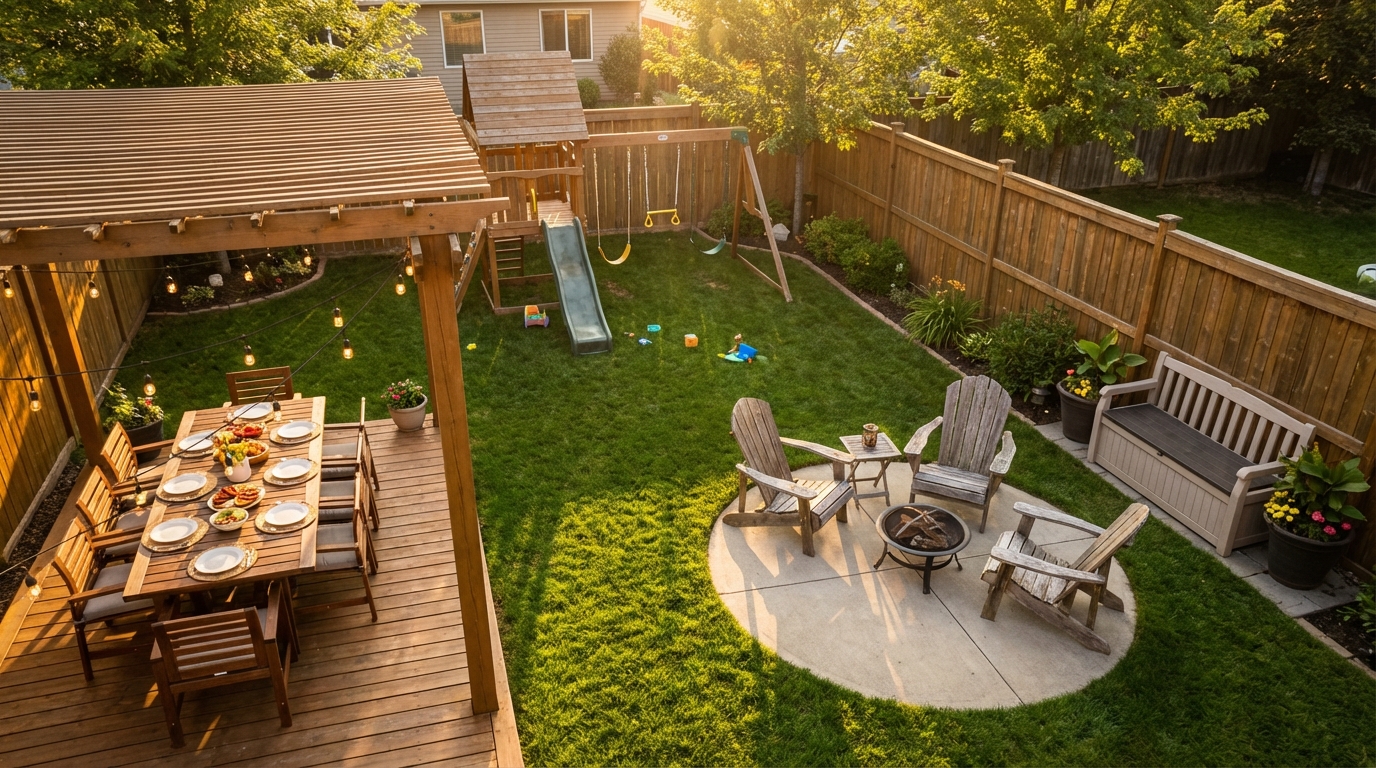
Transform your backyard into a functional summer oasis by organizing it into intentional zones, just like rooms in your home. You'll learn how to create distinct areas for dining, play, relaxation, activities, and storage.
- Organize your backyard into distinct zones, just like rooms in your home.
- Create dedicated areas for dining, play, relaxation, activities, and storage.
- Ensure clear sight lines between zones for easy supervision of kids.
- Adapt the 'room' concept to your space, even if zones need to overlap.
The first warm Saturday arrived, my kids bolted for the back door, ran outside, and then stopped.
The backyard was a wasteland: a tarp holding a pond, a sandbox full of leaves, and a toy bin growing moss.
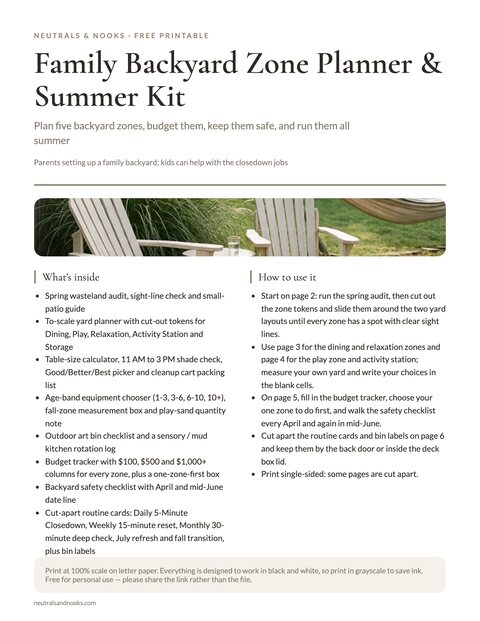
Free printable · 6 pages
Family Backyard Zone Planner & Summer Kit
A five-zone yard map with cut-out zone tokens, dining, play, activity and storage worksheets, a budget tracker, a safety checklist and daily-to-fall routine checklists.
Free. Your download link appears right here. You'll also join the Monthly Home Reset. Unsubscribe anytime. Privacy
A backyard that gets used all summer is set up in zones, the way you arrange rooms inside. This guide covers five: dining, play, relaxation, activity and storage. You’ll find budget picks at every level, a safety callout in each zone, a full backyard safety checklist and a summer upkeep plan.
In this article (10 sections)
- The Room-by-Room Approach to Outdoor Living
- Outdoor Dining Area for Kids: Table, Shade and Cleanup
- Backyard Play Area Setup and Safety Surfacing
- The Relaxation Zone: An Adult Retreat Kids Can Share
- The Activity Station: Water Play, Art and Mud Kitchen
- Backyard Storage Zone: Toys, Gear and Cleanup
- Backyard Setup Budget: Three Price Levels
- Backyard Safety Checklist for Families
- Maintaining Your Outdoor Rooms All Summer
- Frequently Asked Questions
The Room-by-Room Approach to Outdoor Living
Inside, every room has a job, furniture to match and clear boundaries. Outdoors, most family yards have none of that. The kids play on the patio where you’re trying to eat, and the hose ends up tangled around the play structure.
Divide the yard into zones, each with its own purpose and setup. Zones don’t need walls, just defined areas, the right furniture and sight lines so you can supervise from a different zone.
The five outdoor rooms I recommend for families:
- The Outdoor Dining Zone — where meals, snacks, and messy eating happen
- The Play Zone — where kids play independently with appropriate equipment
- The Relaxation Zone — where adults recharge (and kids are welcome on calm terms)
- The Activity Station — where messy, creative, and sensory activities happen
- The Storage Zone — where everything gets put away at the end of the day
Small yards can combine zones, such as dining with relaxation or activity with play. Even a patio benefits from areas designated by purpose.
The Family Backyard Zone Planner & Summer Kit on this page helps you map all five zones before you buy anything. Let’s set up each room.
Safety firstA fence does not replace adult supervision. Young children need an adult watching at all times, and within arm’s reach of any water. The backyard safety checklist later in this guide covers fencing, plants, water, sun and equipment.
Outdoor Dining Area for Kids: Table, Shade and Cleanup
The dining zone handles everything from weeknight dinners to Saturday pancakes to a toddler eating watermelon. I keep the palette to sand, white and natural wood so the whole yard reads calm.
Choosing Your Table
The dining zone starts with a table that fits your family size and how you actually live. Kids will spill on it, drop food under it and color on it with markers, so pick a surface that wipes clean.
Table sizing: Plan on about 24 inches of table edge per person. A family of four needs roughly 48-60 inches of table length with seating on two sides. A family of five or six needs 60-72 inches. Round tables work well for families with small kids because there are no corners at eye level.
Product recommendations:
- Good ($80-150): A 6-foot folding table ($80-100). It’s utilitarian, but it seats six, wipes clean in seconds and folds flat for winter. Add a fitted outdoor tablecloth with elastic edges (about $20) in a neutral color and it looks fine.
- Better ($300-450): A resin or recycled-plastic-lumber table, about 37×72 inches ($350-400). It looks like painted wood, doesn’t splinter or rot, never needs sealing and cleans with a hose. It seats six adults; I’d pick sand, slate gray or white.
- Best ($500-1000): A teak or eucalyptus hardwood table, often $500-800 for a six-seater. It weathers to a silver-gray patina. The tradeoff is upkeep: oil it yearly to keep the color, or let it weather. It can still stain from food and markers.
Seating That Survives Kids
Benches are better than individual chairs for families with small kids. They are often more stable, easier to slide in and out of, and fit more bodies in less space. Kids under 6 squirm and shift, and a bench accommodates that movement while a chair invites tipping.
Children should sit on benches, not stand on them. Keep an adult close for kids under 3.
If you prefer individual chairs, look for stackable or folding outdoor chairs with wide, stable bases. Lightweight stackable resin chairs run about $30-40 each and come in neutral colors. For higher budgets, Adirondack-style dining chairs ($80-150 each) are stable and comfortable.
High chair solution for outdoor dining: We used a portable clip-on high chair (about $70) that clamps onto the table edge. It travels to restaurants and grandparents’ houses too.
Safety firstFollow the clip-on chair’s tabletop thickness range, minimum age (the child must sit unaided) and weight limit. Never clip one onto a glass, pedestal or wobbly table.
Shade Is Not Optional
Eating in direct sun is miserable for everyone, especially kids. You need shade over the dining zone through peak sun, roughly 10 AM to 4 PM.
- Budget shade ($30-80): A 9-10 foot patio umbrella ($30-40) with a 50-lb weighted base ($25-35) shades a 4-6 person table. Crank-tilt models let you angle the shade as the sun moves. A 12×12-foot triangle shade sail ($30-60) costs about the same and looks modern, if you can string it between the house, a fence or trees. Pick tan, gray or natural fabric so nothing clashes.
- Better shade ($100-150): A 10-foot cantilever (offset) umbrella. Its base sits to the side, so there’s no pole in the middle of the table.
- Best shade ($500-1,000+): A permanent pergola over the patio dining area. Aluminum pergola kits typically start around $500 for a 10×10 foot structure. Add climbing plants such as true jasmine or a grape vine for dappled shade that improves every year. Skip wisteria, whose seeds and pods are poisonous.
The Cleanup Station
This detail separates a dining zone that gets used nightly from one that feels like too much hassle. You need a way to handle sticky hands, spilled drinks and sand on everything without trekking to the kitchen every five minutes.
My setup: A small outdoor utility cart ($50-80) stationed next to the dining table, stocked with:
- A roll of paper towels
- A small trash bag hanging from the side
- A tub of wet wipes for sticky hands
I also keep a stack of outdoor-safe plates and cups there. We use wheat straw plates (about $15 for a set of 8) that are light and don’t shatter when a four-year-old drops them. Check the label for food-safety and dishwasher claims.
If you keep a cleaning spray on the cart, store it out of toddler reach or in a locked cabinet between uses.
This station lets you serve, eat and clean up without leaving the dining zone.
Backyard Play Area Setup and Safety Surfacing
The play zone is where kids run, climb, swing, dig and occasionally fall, so it needs both freedom and safe surfacing.
Location and Sight Lines
The play zone should be visible from the dining zone and ideally from the relaxation zone and the house. The goal isn’t hovering. It’s being able to glance up from your book and see where everyone is.
Place the play zone where you can see it from the most spots. In most backyards that means the center or far end of the yard, viewed from the patio or dining area.
Avoid putting play equipment behind the house, a garage or dense landscaping that blocks your view.
Age-Appropriate Equipment
The play zone looks different at every age. Here’s what works well by developmental stage:
| Age | Equipment ideas | Supervision and safety notes |
|---|---|---|
| 1-3 | Low play structure with wide steps and a short slide (roughly $150-250); covered sandbox; push toys, bubble machine, water table; soft balls; a bucket-style swing | An adult within arm’s reach at all times, especially near water. Anchor any swing set. |
| 3-6 | Swing set with 2-3 belt swings; climbing structure with multiple access points; balance beam or stepping stones; a playhouse or pop-up tent | Active supervision. Anchor the swing set and test hot surfaces by hand. |
| 6-10 | Full swing set, possibly with a disc swing or trapeze bar; climbing wall or rope ladder; flat space for soccer or catch; a slack line hung under 2 feet high over soft ground | Check weight ratings. An adult present for slack lines, water and anything with fire or tools. |
| 10+ | Portable basketball hoop ($100-300, no concrete needed); an easy-setup badminton set (about $30); hammock or hanging chair; fire pit area for evening hangouts | Hammocks and hanging chairs need the right anchoring and weight rating. A fire pit always needs an adult. |
Safety firstA fire pit needs continuous adult supervision at any age, a kid-free perimeter and water or an extinguisher nearby. Put it out fully after use, because embers stay hot for hours. AAP recommends against home trampolines, even with nets.
Safety Surfacing
This is the most important safety decision in the play zone. The surface under and around play equipment determines whether a fall results in a bruise or a broken bone.
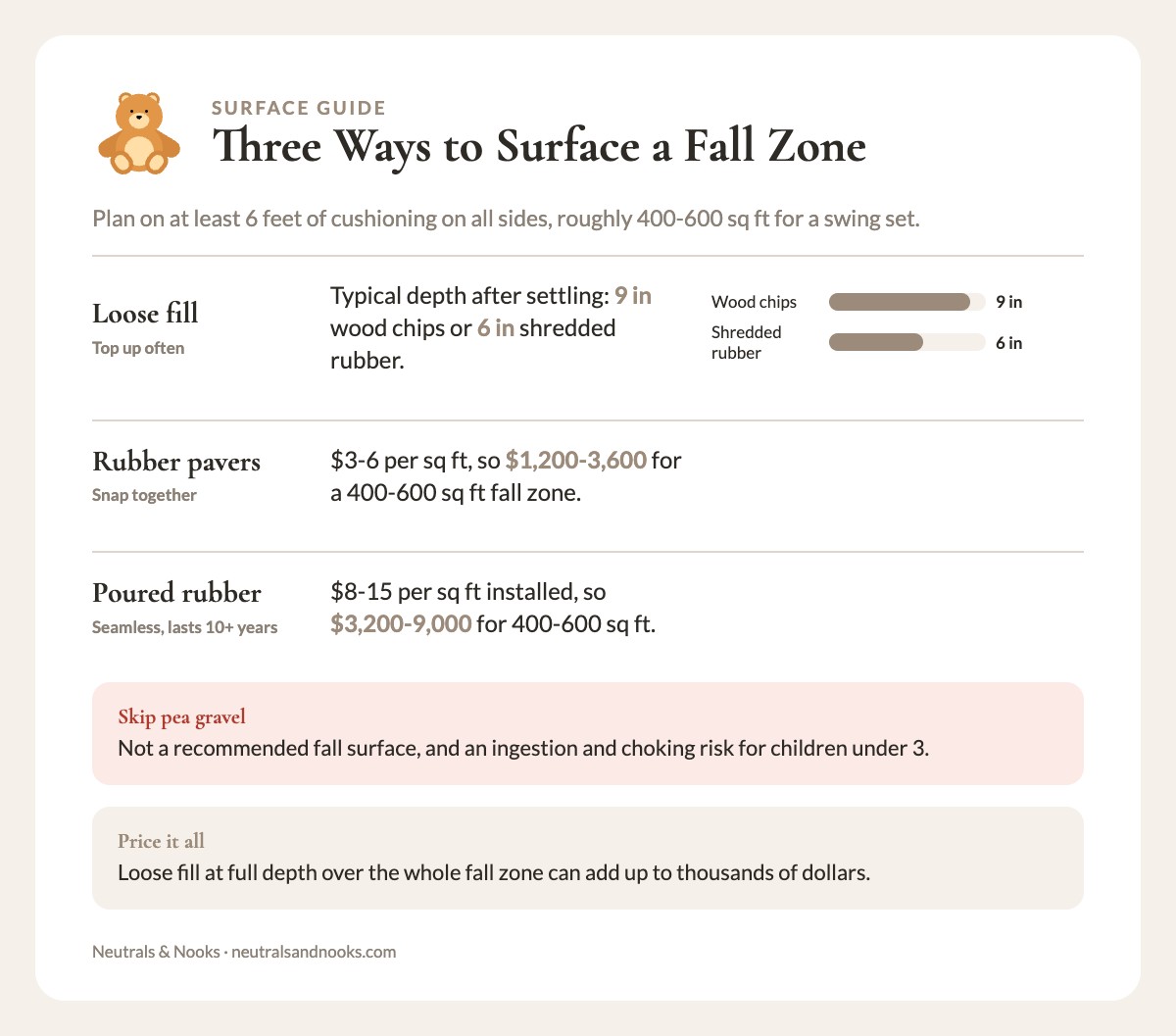
The fall zone: Every piece of play equipment needs a fall zone, a cushioned surface extending at least 6 feet on all sides of stationary equipment (more for slides). For swings, allow twice the height of the pivot point (where the swing hangs from the top bar) in front of and behind the swing.
Add those distances up and a typical backyard swing set or play structure needs roughly 400-600 square feet of surfacing, and bigger sets need more. Measure your own fall zone before you price the options below, and cover every inch of it.
Safety firstFollow the equipment manufacturer and the CPSC/ASTM depth tables. Typical loose-fill depths are about 9 inches of wood chips or 6 inches of shredded rubber, measured after settling. Loose fill compresses, so top it up often, and rubber gets very hot in the sun.
Surface options: Loose fill needs regular topping up, and at full depth over a whole fall zone it isn’t always the cheapest choice. Poured rubber costs most and needs the least upkeep.
- Loose fill: Rubber mulch or engineered wood fiber (EWF). Rubber mulch runs roughly $15-25 per bag, and a full swing-set fall zone at the recommended depth takes many bags. For a 400-600-square-foot fall zone that can add up to thousands of dollars, so price the whole area at full depth before you buy. EWF is cheaper per bag but breaks down faster and needs annual topping up.
- Rubber pavers ($1,200-3,600): Interlocking rubber paver tiles ($3-6 per square foot). They snap together, drain well and look neat. Check that they carry an ASTM fall-height rating for your equipment. Covering a 400-600-square-foot fall zone costs $1,200-3,600 in pavers.
- Poured-in-place rubber ($3,200-9,000): This is the seamless surface many commercial playgrounds use. It’s level, drains well and can last 10+ years. Professional installation runs $8-15 per square foot, or about $3,200-9,000 for a 400-600-square-foot fall zone. It needs far less upkeep than loose fill, though you should still check it for wear.
What NOT to use: Concrete, packed dirt and grass alone, which compresses and wears away under equipment. Pea gravel is not a recommended fall surface under play equipment, and it is an ingestion and choking risk for children under 3.
The Sandbox Situation
I’m pro-sandbox with conditions, because an open one doubles as a litter box for neighborhood cats.
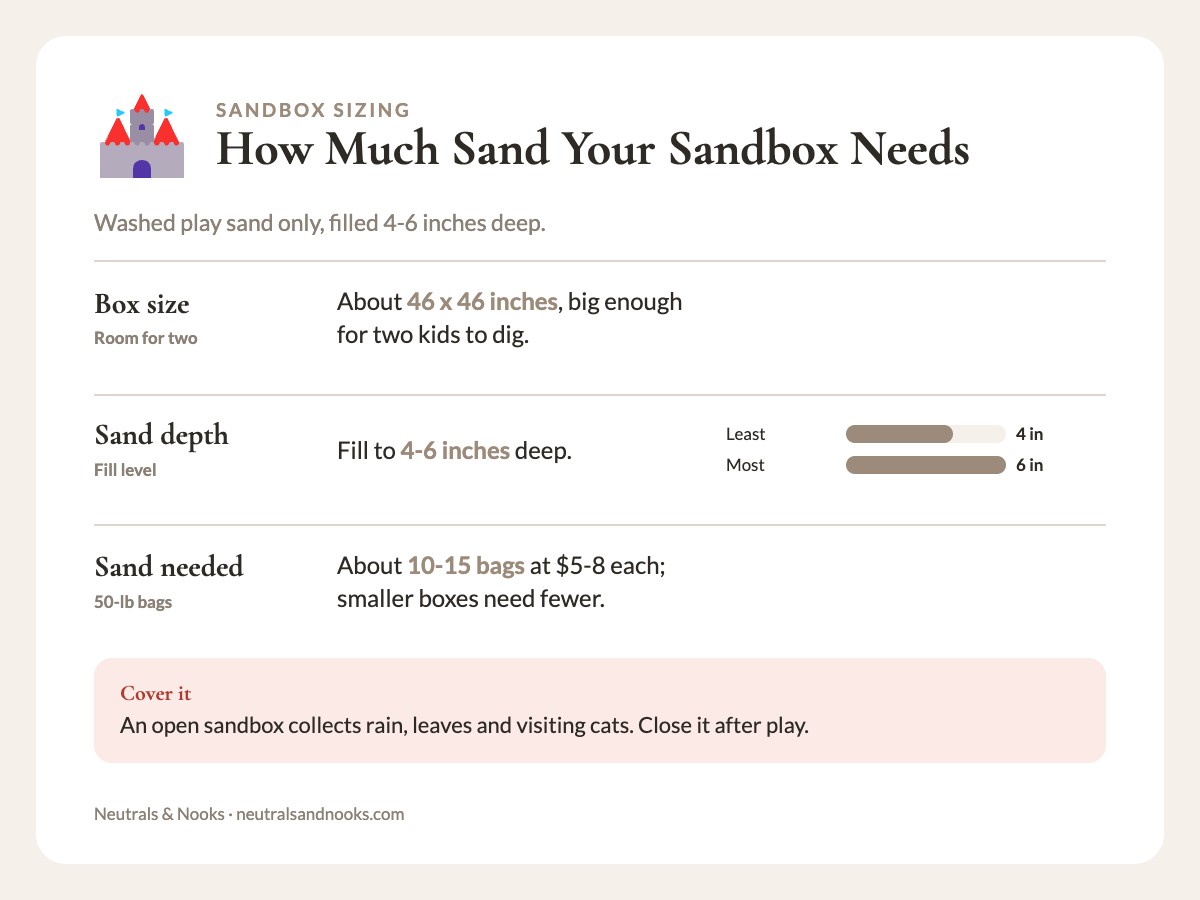
The condition: Your sandbox must have a cover. Uncovered, it collects rain, leaves and visiting cats. Opened for play and closed afterward, it stays clean and usable.
My recommendation: A covered cedar sandbox ($130-180) whose bench seats fold up to become the cover. Look for one about 46 x 46 inches, big enough for two kids to dig without territorial disputes. Cedar is naturally rot-resistant.
For a budget option, any sandbox with a fitted tarp cover works. Secure the cover with bungee cords around the frame so wind doesn’t turn it into a leaf collector.
Sand type matters. Use washed play sand, not builders’ sand or beach sand. Play sand is screened to remove debris and sharp particles.
A 50-lb bag costs $5-8 at most hardware stores. Fill to 4-6 inches deep: a 46 x 46-inch sandbox takes about 10-15 bags, and smaller boxes need fewer.
The Relaxation Zone: An Adult Retreat Kids Can Share
This is the adult retreat. Kids are welcome too when they want to slow down, read, cuddle or just be near you, away from the bustle of the play zone.
The relaxation zone should feel noticeably different from the rest of the backyard—calmer, softer, more enclosed. If the play zone is your family room, the relaxation zone is your reading nook.
Location
Place the relaxation zone at the periphery of the backyard, ideally with a view of the play zone but physically separated from it. Near a fence line, under a tree, in a corner with some natural screening—anywhere that feels slightly apart. This is the outdoor equivalent of the calm-down corner concept I’ve written about for indoor spaces—a designated area that signals “slower pace.”
If your yard is too small to separate zones by distance, change the surface instead. A raised deck section works, or a patio when the play zone is on grass.
A visual boundary also works: a row of potted plants, a low garden border or a different ground cover.
The Core Furniture
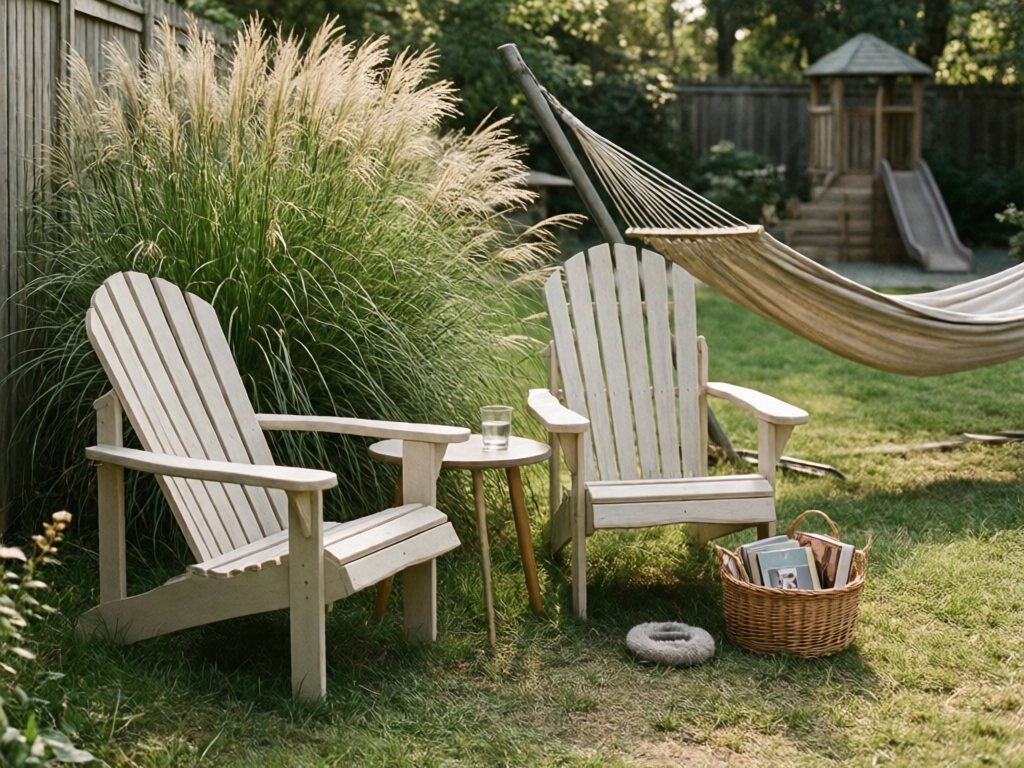
The relaxation zone needs comfortable seating, shade, and ideally a surface for a drink or a book.
Product recommendations:
- Good ($85-115): Two sturdy folding zero-gravity lounge chairs ($35-50 each) and a small folding side table (about $15) for drinks and phones. The chairs recline, fold for storage and are surprisingly comfortable.
- Better ($450-600): Two recycled-plastic Adirondack chairs ($200-280 each) and a matching side table. They weather well and come in many colors.
- Best ($800-1,150): A 4-piece conversation set with weather-resistant cushions ($400-600), a hanging egg or swing chair ($300-400) and a cantilever umbrella for this zone ($100-150). The set has two chairs, a loveseat and a coffee table, and the egg chair is a kid favorite. Designer sectionals and daybeds can top $2,000.
Prefer a hammock? A double cotton hammock with a steel stand ($100-150) doesn’t need trees and can replace the loungers at any tier.
Safety firstHammocks and hanging chairs have weight limits and need proper anchoring. Check the rating before a parent and child share one, and supervise young children.
The Shade Factor
The relaxation zone needs reliable shade, especially for afternoon use. If it’s under a mature tree, nature has handled this for you. If not, you have options.
- A second umbrella: One just for this zone, separate from the dining umbrella, means shade is always where you want it.
- A shade sail: Stretched between the fence and a post, it makes a permanent canopy with a modern look.
- Plants: Tall ornamental grasses like Miscanthus, or a trellis with climbing plants on the sunny side, give filtered, dappled shade that feels softer than fabric.
Making It Kid-Friendly Without Losing the Calm
The relaxation zone should welcome kids on different terms than the play zone. My rules for our relaxation zone:
- Books, puzzles, and quiet toys are welcome
- Running, climbing, and throwing are not (that’s what the play zone is for)
- Everyone uses an indoor voice
- Snacks are fine; full meals happen in the dining zone
I keep a small outdoor basket of books and a few fidget toys in the relaxation zone (a Koosh ball and a tactile ring, both labeled 3+). Kinetic sand and other small-parts items come out only when an adult is there and no child under 4 is nearby. My kids drift there when they’re winding down from active play. It has become our transition space between full-energy outdoor time and going inside.
The Activity Station: Water Play, Art and Mud Kitchen
This is the messy zone: water play, art projects, sensory bins, mud kitchens and science experiments. Set it up to contain the mess, and you can say yes to all of it.
Location (Messy Adjacent)
The activity station should be:
- On a surface that can get wet and dirty (grass, dirt, or a patio section you don’t mind hosing down)
- Near a water source (a hose bib or spigot within reach)
- Away from the deck and house, so splashes stay off siding and deck boards
- Visible from the relaxation zone and dining zone
I put our activity station in the back corner of the yard, on grass, about 15 feet from the patio. Splashes don’t reach the house, and the grass doesn’t mind getting stained, muddy or soaked.
I can watch art and mud play from the patio chair. For water play with little ones, I pull that chair right up to the water table so I’m within arm’s reach.
The Water Play Setup
Water play keeps kids occupied for long stretches, and even a basic setup gets used daily.
Safety firstToddlers can drown in an inch or two of water. Keep an adult within arm’s reach of water tables, splash pads and kiddie pools, and drain every water play item after each use, at any age.
Product recommendations:
- Good ($15-55): A basic two-tier water table with scoops and funnels ($40-55). It drains easily and suits kids from about 1 to 5 with an adult within arm’s reach. For older kids, use a sprinkler mat ($15-20) or a simple oscillating sprinkler on a timer.
- Better ($100-280): A larger water table with more interactive elements (about $80, often with a waterfall feature) combined with a water wall. A water wall is a vertical surface with funnels, channels, and buckets that kids pour water through. You can buy one ($100-200) or build one from a sheet of pegboard, plastic bottles, and zip ties for under $20. The DIY version lets kids rearrange the channels.
- Big-kid splash zone ($50-150): An inflatable water park ($60-150, depending on size) or a DIY sprinkler frame built from PVC pipe and a garden hose ($50-100 in materials). It’s a different setup rather than an upgrade, and a good pick once kids outgrow the water table.
- Splurge ($2,000+): A permanent splash pad, professionally installed. It’s a flat, textured concrete or rubber pad about 8×8 feet with a water feature.
The Outdoor Art Table
Kids do art differently outside—bigger, messier, more experimental. An outdoor art station should embrace this.
The table: Any sturdy, washable surface works. A small plastic folding table ($25-35) kept just for art is ideal. You can hose it off or wipe it with mild soap, and paint stains don’t matter.
An adjustable-height folding table ($50-60) is worth the extra cost, because you can set it low for small kids and raise it as they grow.
The supplies station: I keep an outdoor art bin (a lidded plastic tote, $10-15) stocked with supplies that can handle weather and mess:
- Washable tempera paints in squeeze bottles
- Large brushes (house-painting brushes from the hardware store, $1-3 each, are better than craft brushes for outdoor art)
- Sidewalk chalk
- Large rolls of paper (butcher paper or easel roll paper, $10-15 for 100 feet)
- Spray bottles filled with water and a tiny drop of food coloring
- Cups and containers for water
- Smocks or old t-shirts
TipTape the paper to the table with painter’s tape so it doesn’t blow away. Keep the art bin closed with a bungee cord between uses to keep out rain and critters.
The Sensory Area and Mud Kitchen
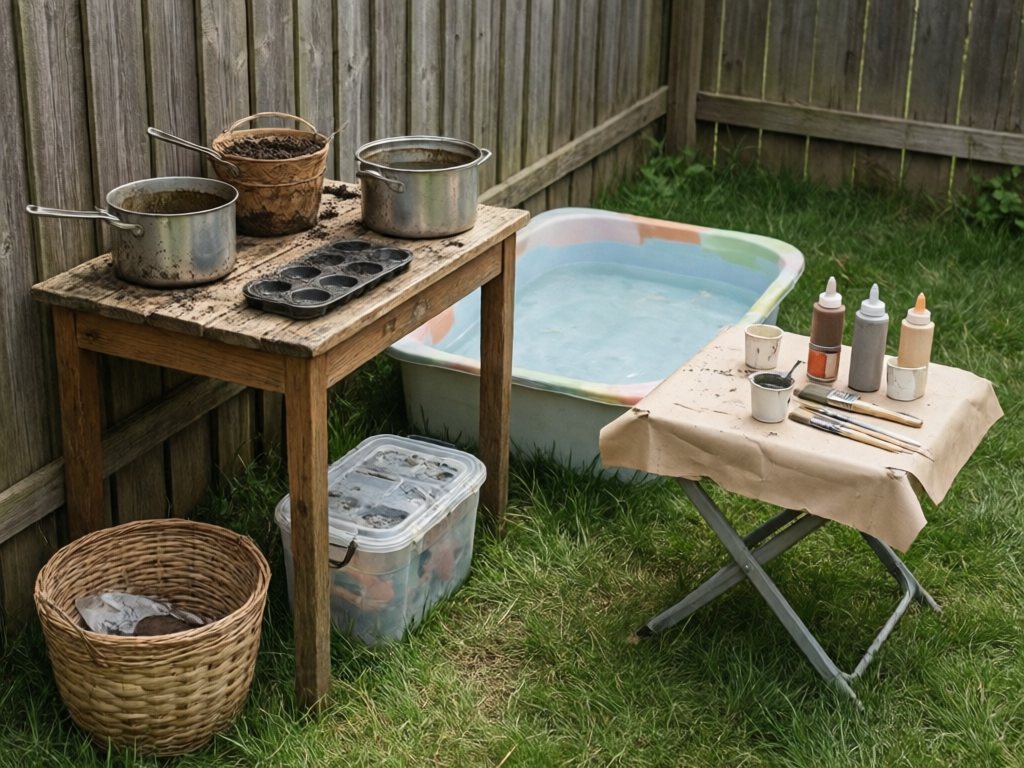
Match the sensory filler to the youngest child playing. Under 4, stick to water or a supervised sandbox, with an adult within arm’s reach. Keep small fillers like pasta shapes and kinetic sand for kids 4 and up, with an adult watching.
Safety firstSmall fillers and small toys are choking hazards under age 4 and need close supervision. Skip water beads entirely: swallowed beads swell and can cause intestinal blockages that need surgery.
Simple sensory station ($20-50): Fill a large under-bed storage bin ($10-15) with one material. Water or play sand works for toddlers with an adult within arm’s reach; kinetic sand or large pasta shapes are for kids 4 and up. Add big scoops, cups, funnels and spoons.
Rotate the material every week or two to keep it fresh. Drain water after each use, and keep the lid on dry fillers between uses.
Mud kitchen ($30-180): A mud kitchen is a child-sized outdoor pretend kitchen where the main ingredients are dirt and water. You can build one from a repurposed bookshelf or old desk against a fence, anchored so it can’t tip. Add thrift-store pots and pans, a few baking sheets, spoons and muffin tins, and kids will “cook” for hours. A purpose-built mud kitchen with a sink basin and shelf runs about $120-180.
My daughter’s mud kitchen is a $30 thrift store end table against our back fence. It holds two pots, a muffin tin and a bucket of water that gets emptied after play. She uses it more than any other single item in our backyard.
Toy rotation works here too. Swapping the tools (spoons one week, funnels the next, cookie cutters the week after) keeps the same setup feeling new. The toy rotation guide covers this in detail.
Backyard Storage Zone: Toys, Gear and Cleanup
Storage is what makes or breaks a family backyard. When everything has a home, cleanup takes five minutes.
Outdoor Toy Storage
The primary storage need is for the daily-use outdoor toys—balls, bats, jump ropes, chalk, bubbles, water toys, sand toys.
Product recommendations:
- Good ($40-60): A large 50-gallon deck box ($40-60). It’s weather-resistant, lockable and holds a lot of toys. Park it at the edge of the play zone or near the back door; the lid doubles as a bench seat. Keep it locked between uses so small kids can’t climb inside.
- Better ($135-150): A larger deck box (120-gallon, about $120) plus a mesh toy bag hung from a fence or hook. Wet toys dry in the bag before going in the box. A large mesh beach bag ($15-25) or a laundry mesh bag works well, because sand and water drain straight out.
- Best ($200-350): A dedicated outdoor storage cabinet or shed. A slim vertical cabinet ($200-300) holds brooms, pool noodles and bins of smaller toys. A horizontal shed ($250-350) has more floor space for ride-on toys and wagons.
The “Come Inside” Cleanup System
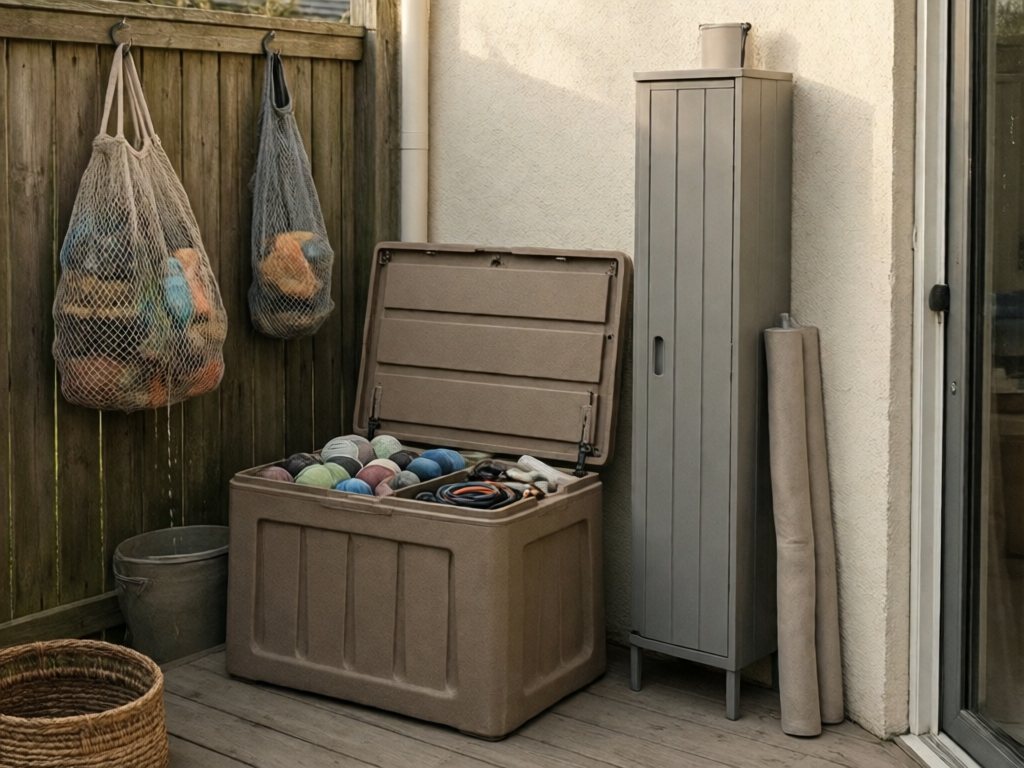
The end-of-day cleanup should be simple enough that kids can participate. Here’s the system that works for us:
- 5 minutes before going inside: Announce “cleanup in five minutes.” This prevents the whiplash of sudden transitions.
- Each kid handles their zone: My son is responsible for the play zone (balls back in the bin, equipment put away). My daughter handles the activity station (art supplies in the bin, sensory materials covered). This aligns with the ownership principle I use for indoor organization—when each person has a defined area, accountability is clear.
- Wet items go in the mesh bag. Anything that’s wet hangs in the mesh drying bag overnight.
- Dry items go in the deck box. Everything else goes in the main storage box.
- Quick scan. One adult does a final 30-second scan of the yard to catch anything the kids missed.
This takes about five minutes and stops the slow pile-up that led to the wasteland I described at the start.
For more on where the bigger gear lives, see outdoor toy storage ideas and the seasonal gear rotation for the garage.
Seasonal Storage Rotation
Outdoor toys benefit from rotation just like indoor ones. I keep about two-thirds of our outdoor toys in use and one-third in the garage or basement.
Each week I swap one set that has been out for about two weeks. The jump ropes come out and the hula hoops go in, or the chalk comes out and the bubble machine goes back. It keeps outdoor play fresh without buying anything new.
Here’s the full rotation rhythm for the yard:
| What to rotate | How often |
|---|---|
| One set of outdoor toys | Weekly |
| Sensory bin material | Every week or two |
| Art supplies | Monthly |
| A new outdoor game (lawn bowling one month, ring toss the next) | Monthly |
The novelty heads off the “there’s nothing to do outside” complaint that tends to arrive around mid-July.
Backyard Setup Budget: Three Price Levels
Here’s what you can accomplish at three budget levels, covering all five zones. Starter covers the basics, mid-range adds a play structure with rated surfacing and sturdier furniture, and premium adds a pergola, poured rubber surfacing and a shed.
| Zone | Starter ($370-515) | Mid-range ($2,500-5,475) | Premium ($5,850-13,500) |
|---|---|---|---|
| Dining Zone | Folding table + tablecloth + patio umbrella and base ($155-195) | Resin or recycled-plastic table + cantilever umbrella ($450-550) | Teak table + aluminum pergola kit ($1,000-1,800) |
| Play Zone | Sprinkler + balls + jump ropes + DIY obstacle course ($30-50) | Play structure + rubber pavers for a 400-600 sq ft fall zone ($1,350-3,850) | Play structure + poured-in-place rubber for a 400-600 sq ft fall zone + basketball hoop ($3,450-9,550) |
| Relaxation Zone | Two zero gravity chairs + side table ($85-115) | Two Adirondack chairs + side table ($450-600) | Conversation set + hanging egg chair + cantilever umbrella ($800-1,150) |
| Activity Station | Sensory bin + water table + sidewalk chalk ($55-80) | Water table + art table + mud kitchen + sensory station ($115-300) | Inflatable water park or DIY sprinkler frame + full art station + mud kitchen + water wall ($350-600) |
| Storage Zone | Deck box + mesh bag ($45-75) | Large deck box + mesh drying bag + bins ($135-175) | Storage shed + organized interior ($250-400) |
| TOTAL | $370-515 | $2,500-5,475 | $5,850-13,500 |
Good to knowEach column total is the sum of its row ranges, and every row steps up from one column to the next. Dining rows cover the table and shade, not seating. A permanent splash pad ($2,000+) isn’t in any column. Prices are approximate and change, so treat them as ranges.
Safety firstSurfacing is the biggest play-zone cost, and it scales with your fall zone. The mid-range row prices rubber pavers and the premium row prices poured rubber, both for 400-600 square feet, so measure yours before you budget. If you choose loose fill instead, price it for the whole area at full depth. On a tight budget, pick a smaller structure with a fully covered fall zone rather than a bigger one on thin surfacing.
Reality check on a tight budget: The starter column totals $370-515. If you already have a table and chairs to bring out, you can get a functional backyard for under $100. The non-negotiables:
- Shade: even a $30 umbrella on a weighted base
- A cleanup system: even a $10 tote bin
- Water play: even a $5 sprinkler
Kids don’t need expensive equipment. They need defined spaces and permission to be outside.
Where to spend if you can only invest in one zone: The play zone gives you the highest return on investment for families with kids under 8. The dining zone gives the highest return for families with kids over 8 (because older kids want to hang out where the food is). If you’ll eat dinner outside three or four nights a week all summer, put the money into the dining zone first.
Durable beats disposable: one sturdy table outlasts several cheap ones, and reusable plates and cloth napkins cut waste. The eco-friendly cleaning guide covers more of this for indoor and outdoor family spaces.
Backyard Safety Checklist for Families
Before summer kicks into full gear, walk your entire outdoor space with this safety checklist. I do it every April, then monthly through the summer.
Fencing and Boundaries
- Fence is intact with no gaps larger than 4 inches. That figure comes from CPSC pool-barrier guidance; it’s a sensible rule for any yard, but check your local code
- Gates self-close and self-latch, with the latch out of small children’s reach
- No climbable objects (chairs, bins, woodpiles) positioned near the fence
A fence does not replace adult supervision.
Plants and Landscaping
- No poisonous plants within reach of play areas. Common ones include foxglove, oleander, lily of the valley, castor bean, yew (all parts), hydrangea, sago palm, and wisteria seeds and pods. The list isn’t complete, so check the Poison Control plant list
- Unknown plants are identified before kids play near them, and poison ivy (a skin irritant, not an ingestion poison) is removed from play areas
- Thorny plants (roses, barberry, holly) are not bordering play zones or foot-traffic areas
- Mushrooms removed after rain, since young kids put everything in their mouths. If a child eats a mushroom or unknown plant, call Poison Control (1-800-222-1222) right away and don’t wait for symptoms
- Mulch in play areas is non-toxic (avoid cocoa mulch, which is toxic to dogs and smells enough like chocolate that kids may taste it)
Water Safety
- No standing water in buckets, containers, flower pots or low areas (toddlers can drown in an inch or two of water)
- If you have a pool, the fence is at least 4 feet high with a self-closing, self-latching gate. The latch sits at least 54 inches off the ground (CPSC pool-barrier guidance; check your local code)
- Water tables are drained after every use, and an adult stays within arm’s reach of young children at any water
- Kiddie pools are emptied and flipped over after each use
Sun Protection
- Shade covers all zones where kids spend more than 15 minutes at a time
- Under 6 months, prioritize shade and clothing; a small amount of sunscreen on exposed skin is acceptable if those aren’t enough. From 6 months, use SPF 30+ broad-spectrum sunscreen and reapply every 2 hours and after water play
- Outdoor time is planned around peak sun (10 AM to 4 PM), with shade and protective clothing for all kids
- You know the signs of heat illness: flushed skin, unusual tiredness, headache or vomiting
- Hats and UV-protective swimwear available for water play days
Equipment and Surfaces
- All play equipment is anchored and stable (check swing set anchors, climbing structure bolts, sandbox frame)
- No exposed bolts, sharp edges, or splintering wood on any equipment
- Loose-fill surfacing meets the depth your equipment manufacturer and the CPSC/ASTM tables call for. That’s typically about 9 inches of wood chips or 6 inches of shredded rubber, measured after settling. Rubber pavers carry a fall-height rating for your equipment
- Hot surfaces checked: metal slides, rubber surfaces and dark deck boards can cause burns in direct sun. Test with your hand before kids play on them
- AAP recommends against home trampolines. If you already have one: one jumper at a time, an adult watching, no somersaults, and regular checks of netting and padding
General
- Garden chemicals, fertilizers, pesticides, cleaning sprays and any lamp oil are stored in a locked cabinet or high shelf
- Garden tools (rakes, shears, saws) are stored out of reach
- Outdoor outlets are GFCI with weather covers, and cords are kept away from water play zones
- Fire pit (if present) has a screen cover, a clear kid-free zone, water or an extinguisher nearby, and is fully extinguished after use
- First aid kit accessible outdoors or just inside the back door. Ours hangs on a hook by the back door with bandages, antiseptic wipes, sting relief, an ice pack and tweezers. Kids with diagnosed allergies have prescribed epinephrine within reach
Maintaining Your Outdoor Rooms All Summer
Setting up the backyard is a weekend project. Maintaining it through three or four months of heavy family use requires a lightweight system—just enough structure to prevent the gradual slide back into chaos.
The Daily 5-Minute Closedown
Every evening, spend five minutes on the backyard closedown:
- All toys in the storage box or mesh drying bag (kids handle this)
- Dining table wiped down and chairs pushed in
- Umbrella closed (wind can shred an open umbrella overnight)
- Water play items drained
- Quick scan for anything that shouldn’t be outside overnight
This is the outdoor equivalent of the evening reset routine I use inside the house. Five minutes a day prevents the two-hour cleanup that becomes necessary when you skip it for a week.
The Weekly Outdoor Reset (15 minutes, weekend morning)
Once a week, go slightly deeper:
- Hose down the patio and dining area
- Check safety surfacing under play equipment—rake mulch back into place if it’s migrated
- Inspect equipment for loose bolts, wobbly joints, or wear
- Refill the sunscreen station and bug spray
- Rotate one set of outdoor toys (swap something from the garage for something that’s been out for two weeks)
- Check the sandbox for debris or animal evidence (if uncovered overnight by accident)
- Water any potted plants in the relaxation or dining zones
The Monthly Deep Check (30 minutes)
Once a month, walk the full safety checklist above: fencing, plants, water, sun and equipment. Then:
- Tighten any bolts that have loosened with use
- Top up loose-fill surfacing that has thinned below the recommended depth
- Hose out the deck box or storage container to prevent mildew
The Mid-Summer Refresh (July)
Around mid-summer, energy for outdoor play can dip. The backyard has been the same for eight weeks and the novelty has worn off. This is when I do a mini-refresh:
- Rotate zones slightly. Move the activity station to a different corner. Rearrange the relaxation zone. Even small changes create the feeling of “new.”
- Introduce a new activity. A new water toy, a new outdoor game, a new sensory material. Doesn’t need to be expensive—a $5 sprinkler attachment or a bag of water balloons can reignite enthusiasm. Balloons are a choking hazard for kids under 8, so supervise and pick up every broken piece.
- Deep clean everything. Hose down all furniture, scrub the play equipment, wash cushion covers, clean out the storage box. A clean backyard feels more inviting, even if the layout hasn’t changed.
- Reassess what’s working. Notice which zones get used and which sit empty, and reconfigure the ones that don’t work. Maybe the activity station needs to move closer to the water source, or the relaxation zone needs better shade.
It’s the same thinking I use indoors. If you’ve set up a pantry system or a toy rotation, you know small tweaks keep a system working better than big overhauls. The backyard is no different.
Preparing for Fall Transition
In September or October (depending on your climate), the reverse swap happens. Here’s the quick version:
- Clean all outdoor furniture before storing
- Drain and store water play equipment
- Cover or bring in cushions
- Store sandbox cover securely
- Move seasonal outdoor toys to long-term storage
- Bring in any items that can’t handle freeze-thaw cycles (ceramic pots, certain plastics)
- Final equipment inspection—note anything that needs repair or replacement for next year
Store items clean and dry, and next spring’s setup will be a half-day project instead of a multi-day excavation. If the garage is where it all lands, the family garage organization guide helps you give it a home.
Frequently Asked Questions
How do I set up a family backyard if we rent and can’t make permanent changes?
Focus on portable and removable elements. Freestanding furniture (folding tables, portable chairs, pop-up canopies) replaces built-in structures. A portable sandbox and a pop-up play tent replace permanent play structures.
Use potted plants instead of landscaping to define zone boundaries. Deck boxes and freestanding storage cabinets provide storage without mounting anything, and a hammock with a steel frame doesn’t need trees or posts.
When you move, everything comes with you. The room-by-room approach works the same way, using furniture and portable equipment instead of permanent installations.
What’s the best backyard surface for kids to play on?
Grass is the most versatile natural surface. It cushions small tumbles, stays cool and is comfortable for sitting and crawling, but it wears out under heavy foot traffic and play equipment.
Under climbing and swinging equipment, use rated safety surfacing: rubber mulch, engineered wood fiber or rubber pavers (see the safety surfacing section above). For high-traffic paths, stepping stones or decomposed granite hold up better than grass.
On a patio, outdoor rubber tiles or foam play mats add cushioning for floor play. Avoid bare concrete in play areas, since it’s unforgiving in a fall and gets extremely hot in direct sun.
How do I keep mosquitoes away from our outdoor living spaces?
Start by removing the places mosquitoes breed, then layer on protection.
- Empty saucers under plant pots, drain the water table after every use, and fix low spots that collect rainwater.
- Use repellent. AAP says DEET up to 30% is acceptable from 2 months old. An adult should apply it to exposed skin only, never on a child’s hands, cuts or skin under clothing. Apply sunscreen first and repellent on top, and skip combination sunscreen-repellent products. Skip oil of lemon eucalyptus under age 3; babies under 2 months need netting.
- A fan across the dining area can help; keep cords away from water play.
I skip torches and lamp oil around kids, since they are burn and poisoning hazards. Plants like lavender and marigold give little proven protection.
At what age can kids be unsupervised in the backyard?
Readiness varies by child and by yard, so there is no single age. Young children need an adult actively watching. Any yard with a pool, fire pit, trampoline, tools or water needs an adult present at any age.
Build independence gradually, starting with short stretches in a fully fenced, hazard-free yard. Ask your pediatrician and check AAP and Safe Kids guidance for your child’s age.
How do I keep outdoor toys from getting ruined by weather?
Store, cover and choose wisely. Put anything that isn’t weather-rated in the deck box or shed each evening. During heavy rain, cover large pieces like play structures and dining tables with fitted covers.
Choose resin over raw wood, stainless hardware over regular steel and marine-grade fabric for cushions. UV is the biggest damage factor, so shade reduces fading. Some items are semi-disposable, like a $5 pool noodle.
What if our backyard is very small — like a townhouse patio?
Small spaces benefit most from zoning. Combine zones: the dining table doubles as the art table (add a plastic tablecloth), and a storage bench doubles as seating.
Go vertical with wall-mounted planters, hooks for gear and a wall-mounted folding table. Skip the large play structure for portable play like balls, chalk and a fold-flat water table. Even a 10×12-foot patio can hold a dining zone, a play/activity zone and storage.
How do I handle neighbors or HOA restrictions on backyard setups?
Read your HOA guidelines before buying anything permanent. Common limits cover fence and structure height, shed placement and visible storage. Most HOAs allow furniture, umbrellas and portable play equipment without approval.
For swing sets, pergolas and fencing, submit your plan to the review board first and get approval in writing. If sheds are banned, use deck boxes; if height is capped, try a climbing dome or ground-level playhouse.
You don’t need a big budget to set up a backyard that works, just a clear purpose for each zone and a daily closedown habit. Start with the zone your family needs most, often the play zone, and expand from there.