Halloween Costume Storage Ideas for Kids (Free Printable Tracker)
Learn to organize your kids' Halloween costumes with a simple system. You'll sort, size, bag, and label them, then track everything with a free printable to keep sets complete and hand-me-downs findable.
- Sort costumes into "Wear again," "Pass down," and "Let go" piles.
- Size costumes by your child's fit, not the tag, for easier hand-me-downs.
- Bag each complete costume set individually to keep all pieces together.
- Store bagged costumes in labeled bins grouped by size band.
- Use the free printable tracker to know what costumes you own without opening bins.
This post contains affiliate links. As an Amazon Associate I earn from qualifying purchases.
Last November I found a tiny shark hoodie at the bottom of the linen closet. The matching tail was long gone.
That is the trouble with costumes. They come in pieces that travel apart, and a tag that reads “4-6” can fit like a 3T. They get worn for a few hours, then sit for a year, or three, until a younger sibling or a school character day calls them back.
The fix is a short method. Sort what you own, give each costume a size band, and bag one costume per set. Then store the bags in a few bins by band, label them, and track it all on the free printable. It takes about forty-five minutes, a few containers, and a label maker or marker.
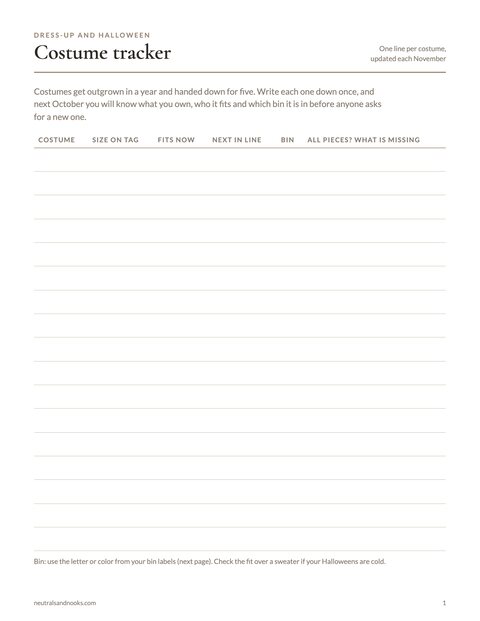
Free printable · 2 pages
Costume Size and Storage Tracker
A one-line-per-costume tracker (size, who it fits now, who is next, which bin), a year-by-year size grid for each child, twelve bin labels and a November put-away checklist.
Free. Your download link appears right here. You'll also join the Monthly Home Reset. Unsubscribe anytime. Privacy
Need only the timing or a fix for a musty bin? Jump to the storage schedule or the troubleshooting table.
In this article (15 sections)
- The System at a Glance
- Step One: Sort Halloween Costumes Before You Store Them
- Step Two: Size by the Child, Not the Tag
- Step Three: How to Store Halloween Costumes in Bags
- Step Four: Bins for Halloween Costume Storage
- Step Five: Label Halloween Costume Bins and Bags So Anyone Can Find Them
- Sibling Hand-Me-Down Costumes: Keeping the Chain Going
- Dress-Up Clothes Storage: Keep It Separate From Halloween
- The Printable Costume Size-and-Storage Tracker
- Halloween Costume Storage Schedule: When to Sort and Swap
- Small-Space and Budget-Friendly Variations
- Fixing Musty, Missing and Mismatched Costume Pieces
- What to Do With Costumes You No Longer Need
- Frequently Asked Questions
- Halloween Costume Storage: The Short Version
The System at a Glance
Here is the whole method in one table. It is built for roughly ages 2 to 10, when costumes multiply fastest and sizes jump the most, and it needs no special furniture or spare room. Each layer is explained below.
| Layer | What it is | Why it matters |
|---|---|---|
| 1. Sort | Split costumes into “Wear again,” “Pass down,” and “Let go” | Stops you from storing things nobody will use |
| 2. Size | Tag each costume by the child’s size, not the tag’s age range | Makes hand-me-downs findable |
| 3. Bag | One costume per bag, all pieces inside | Keeps sets complete |
| 4. Box | Bags go into bins grouped by size band | Gives you a few containers instead of fifty loose items |
| 5. Label | A short label on bag and bin | Lets anyone find anything |
| 6. Track | One printable tracker, updated yearly | Tells you what you own without opening a lid |
In short: store by size band, bag by costume, and track on paper.
Step One: Sort Halloween Costumes Before You Store Them
Sort before you buy a single container. The first costume bins I bought were a set of pretty matching boxes, and I filled them with outfits nobody had touched in two years. Gather every costume from every closet and toy bin, then spread them all on a bed or a clean floor.
Make three piles.
Wear again
These are costumes that fit now or will fit within a year, are in good shape, and that a child still likes. Ask the child: a costume they now call babyish can move to Let go.
Pass down
These are costumes that no longer fit the child who wore them but are in good condition and could fit a younger sibling, cousin, or neighbor. This pile is the heart of the hand-me-down chain, and it needs the most careful storage because it sits the longest.
Let go
Anything with broken zippers, ripped seams that are not worth mending, a missing key piece, or a smell you cannot wash out. Also include duplicates and single-use cheap costumes with thin, crackly fabric that will not survive another year. Donate what is clean and complete. Recycle or discard the rest.
A quick test for the borderline pile
When you are unsure about a costume, ask three questions:
- Has anyone asked for it or played in it in the last year?
- Is it complete, or can I replace the missing piece in five minutes?
- Would I be happy to see it in the bin next October?
Two “no” answers send it to the “let go” pile.
Safety firstBefore passing a costume down: check for loose or hanging cords, hems long enough to trip on, brittle elastic, masks that limit vision, and broken props.
On Halloween night: look for a flame-resistant label on new costumes. No costume is fireproof, so keep kids away from open flames, and use battery-operated LED tea lights in pumpkins. Add reflective tape to the costume and to the treat bag, keeping it clear of the face and eyes.
Keepsakes
Keep sentimental pieces, such as a first Halloween outfit or a hand-sewn cape, in a small keepsake box, and let each child add one favorite a year. That way they do not crowd the working bins.
Step Two: Size by the Child, Not the Tag
Costume tag age ranges overlap and vary between brands, so record a size band based on how the costume fits a real child in your house.
How to assign a size band
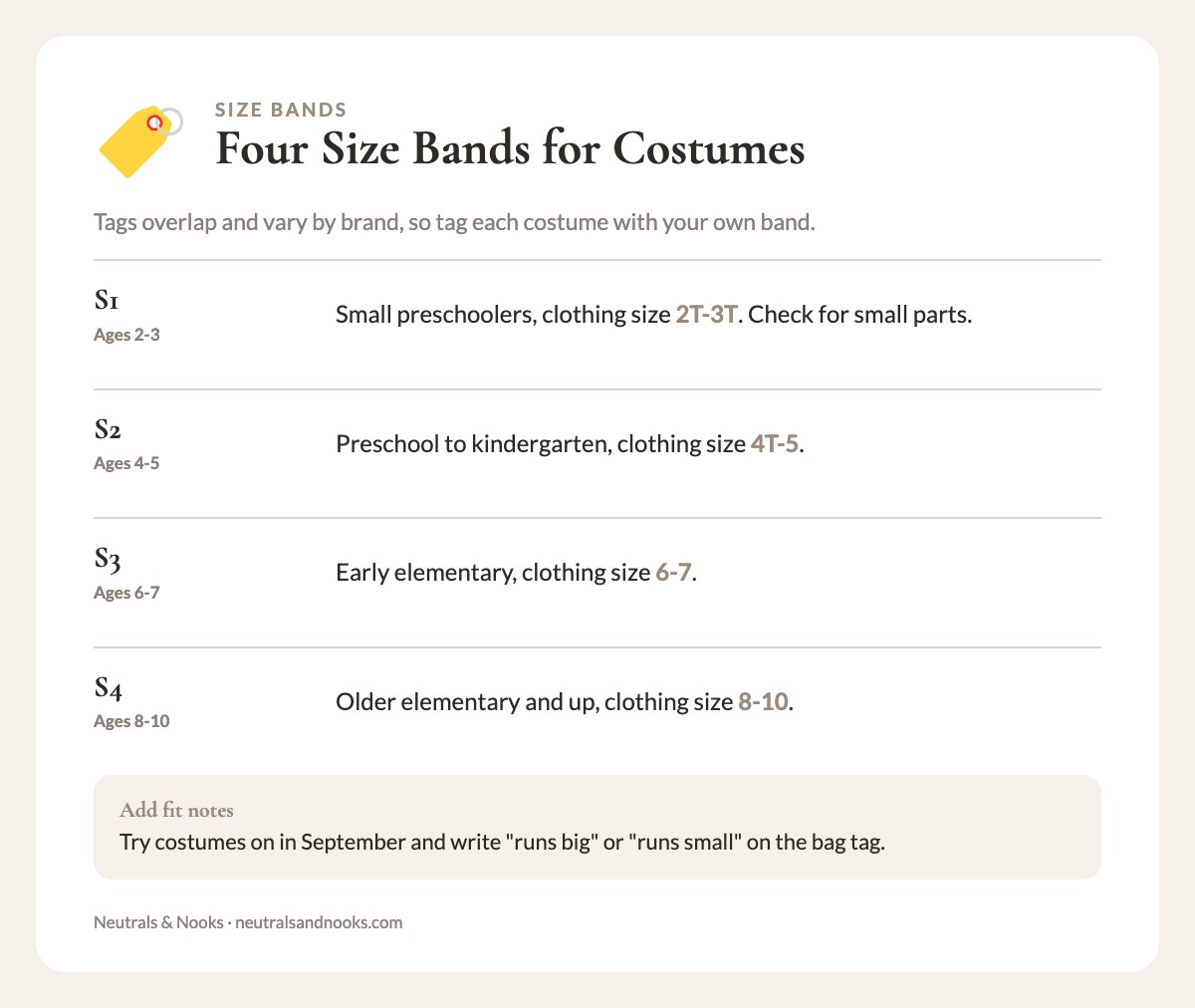
Try the costume on, or hold it against a child who is close in size. Then assign one of four bands:
| Band | Roughly fits | Approx. age | Common clothing size reference |
|---|---|---|---|
| S1 | Toddlers and small preschoolers (check for small parts; see the under-4 safety note in Step Three) | 2-3 | 2T-3T |
| S2 | Preschool to kindergarten | 4-5 | 4T-5 |
| S3 | Early elementary | 6-7 | 6-7 |
| S4 | Older elementary and up | 8-10 | 8-10 |
The bands are broad on purpose: they answer “Which child could wear this next year?” Tweens usually move into adult XS or S costumes, so add an S5 band if you need one.
Attach the size band the moment you decide to keep a costume. Write “S2” in marker on a label stuck flat to the bag, or on a sewn-in fabric tag. Skip dangling tags and strings, and keep the bags out of reach.
Include “runs big” and “runs small”
Write “runs big,” “runs small,” or “tight at shoulders” on the bag tag, and again in the tracker’s fit notes column. A note like “S2, fits 4 to 5, runs big” is the most useful line on the tag.
TipTry costumes on in September, not on October 30, and update the fit notes while the child is still wearing the costume.
Step Three: How to Store Halloween Costumes in Bags
Each costume gets its own bag, which takes about thirty seconds and prevents the most common failure: the half-costume.
What to use
You have a few reasonable options, and the right one depends on the costume.
| Bag type | Best for | Watch out for |
|---|---|---|
| Zip-top fabric garment bags | Long dresses, capes, structured costumes | Cheap ones can trap moisture if the costume is damp |
| Clear zip-top plastic bags (gallon or 2-gallon) | Simple costumes, accessories, small sets | Keep delicate and foam pieces in breathable bags instead |
| Breathable non-woven storage bags | Everything, especially long-term storage | Slightly more expensive, but they last for years |
For most families, a mix of clear zip bags for small sets and breathable fabric bags for larger costumes covers everything.
Safety firstPlastic bags and garment bags are a suffocation hazard for babies and toddlers. Keep bags inside closed bins on a high shelf, out of reach, and never let children play with them. Throw away torn or spare bags right away.
Avoid vacuum compression for costumes
Vacuum-seal bags save space, but they are hard on costumes. They can crush felt, flatten foam and padded pieces, crease sequins, and leave permanent wrinkles in tulle. Save compression bags for plain cotton clothing. Our seasonal clothing storage for kids guide covers how to use them for out-of-season basics. Costumes are better stored loosely and gently.
What goes in each bag
The rule is one costume, one bag, every piece included. That means:
- The main garment
- Hat, headband, mask, or wig
- Belt, gloves, shoes, or tights that belong to it
- Any small prop (a soft wand, a fabric tail)
- A small card or note listing the contents
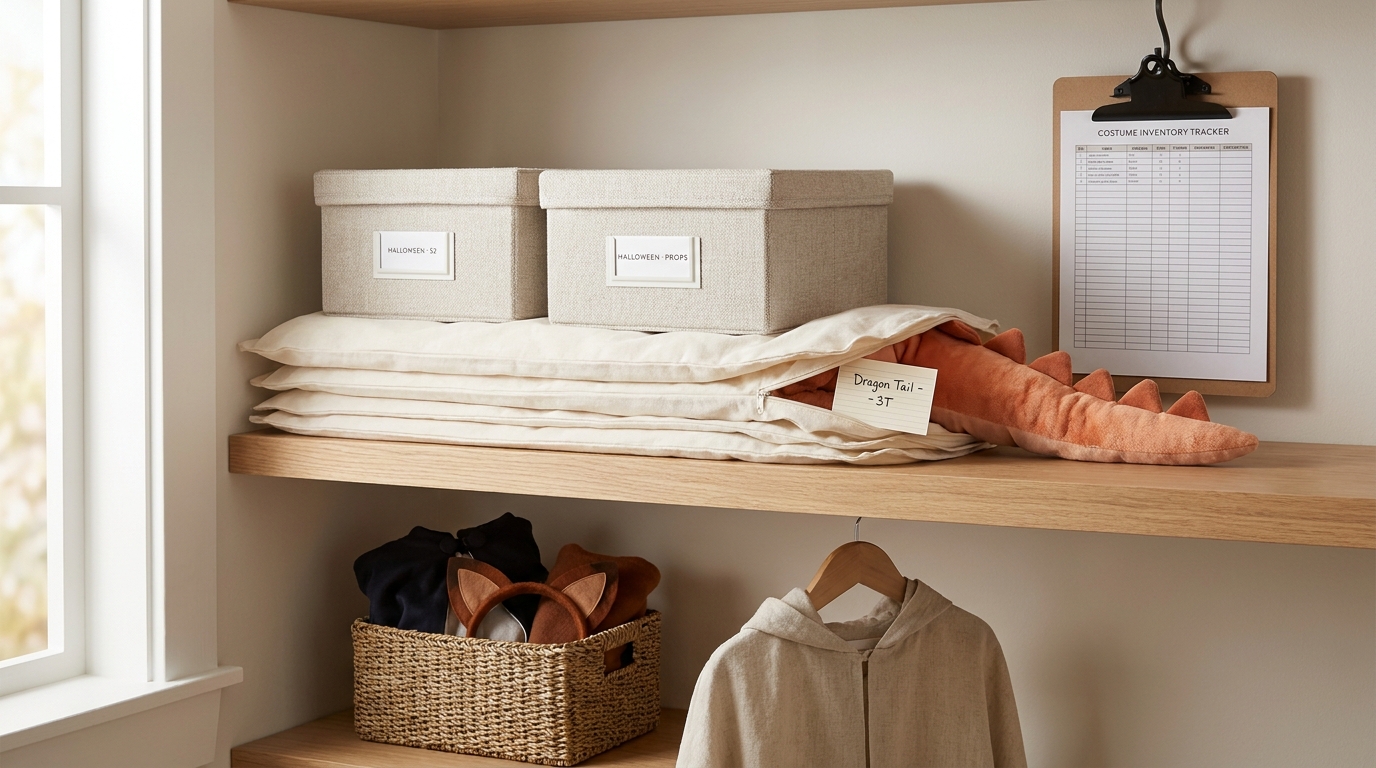
The contents card is the step worth doing. Slip an index card into each bag, written like this:
Good to knowLadybug · S1 · 4 pieces: dress, headband, wings, tights · wings detach, so stitch them on before a child under 4 wears it · hand wash only
Four pieces on the card means four pieces in the bag. Next year, you count in ten seconds and know whether anything is missing.
Safety firstFor children under 4 (mostly band S1 and the smaller S2 costumes), check every bag for small detachable parts such as buttons, gems, antennae, and pom-poms. Remove or secure them. Choose soft, flexible props over rigid or pointed ones.
Handling oversized props
Swords, wands, large wings, and capes with rigid frames do not fit in a bag. Store the soft pieces in the bag, and write the costume name on a flat label stuck to the prop. Keep props in a single tall bin or basket, labeled “Props,” sorted by costume name. A cardboard tube, an umbrella stand, or a tall narrow basket works well for upright storage.
Step Four: Bins for Halloween Costume Storage
Bags hold one costume each. Bins hold the bags. The goal is a small number of bins, grouped by size band. Keep them on a high closet shelf or another out-of-reach spot in a climate-controlled space.
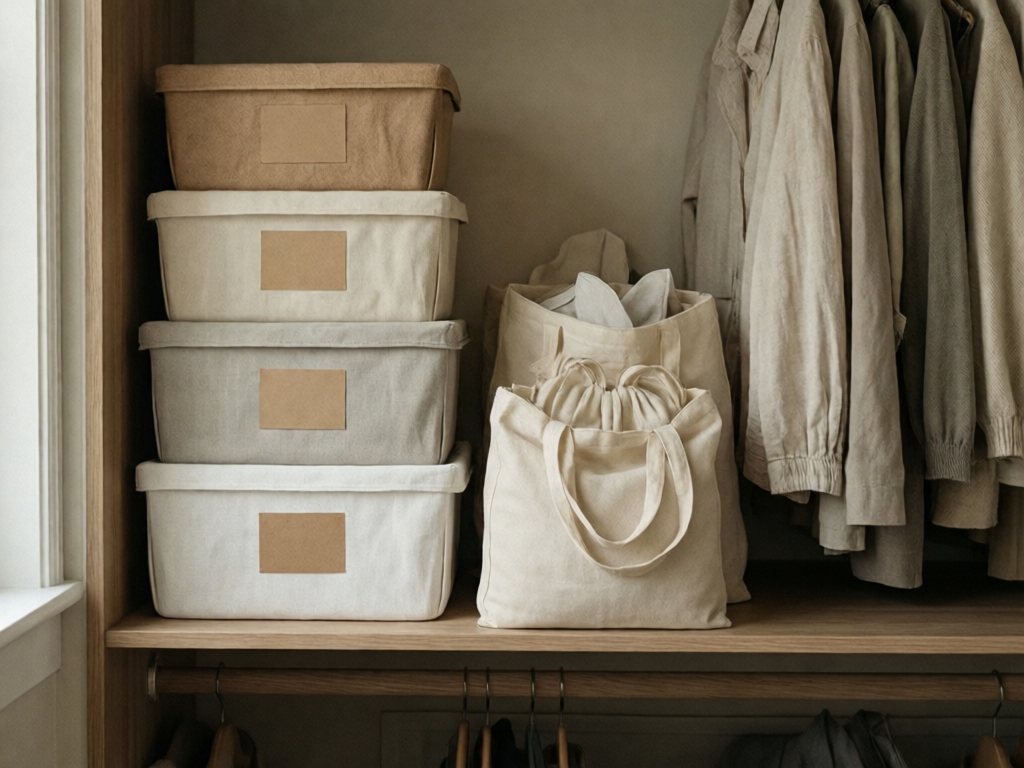
Choosing bins
Look for bins that are:
- Opaque or semi-opaque if the storage will be visible, since a wall of mismatched fabric looks busy. Calm neutrals look much better on an open shelf.
- Lidded, to keep out dust, moisture, and the curious.
- Stackable and sturdy, so the bottom bin does not crush the top.
- Sized for the shelf, not the dream. Measure your shelf depth and height before buying anything.
For a family with two or three kids, you will most likely need three to five bins total, because bagged costumes pack far tighter than loose pieces.
Suggested bin layout
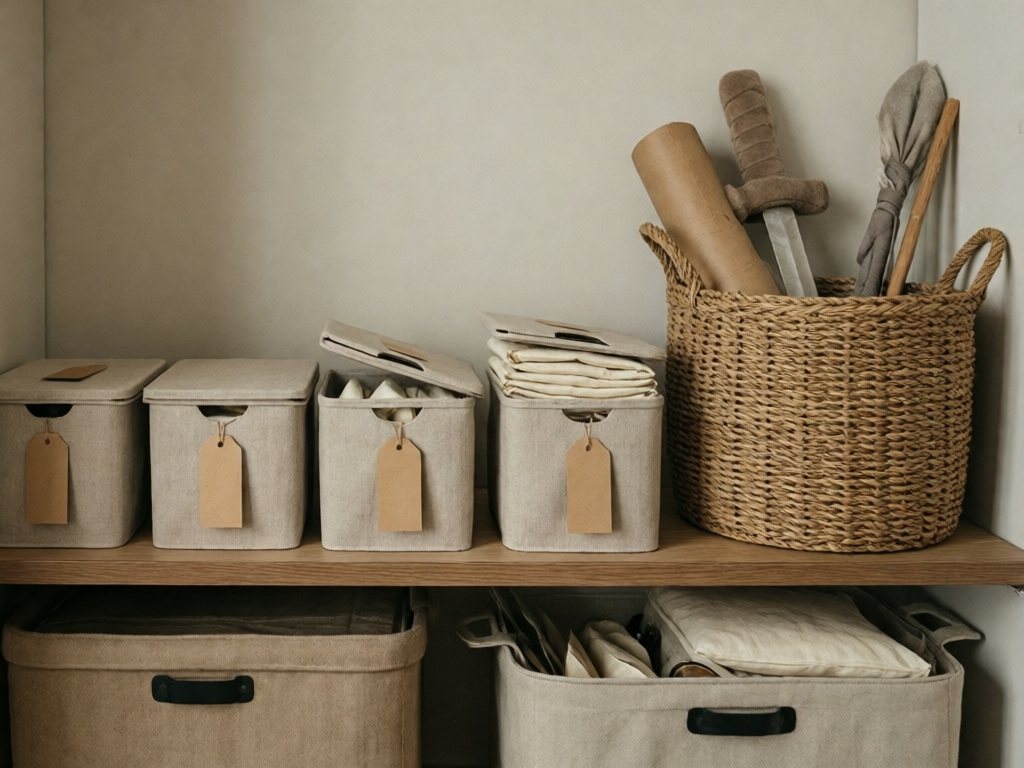
Here is a layout that works for most families with kids across the 2 to 10 range:
| Bin | Contents | Label |
|---|---|---|
| Bin A | S1 costumes (smallest) | HALLOWEEN · S1 · Small |
| Bin B | S2 costumes | HALLOWEEN · S2 |
| Bin C | S3 costumes | HALLOWEEN · S3 |
| Bin D | S4 costumes and up | HALLOWEEN · S4 |
| Bin E | Props, wigs, hats, and accessories | HALLOWEEN · PROPS |
If you have only a few costumes in a band, combine bands into one bin and use a divider or a larger bag to separate them. If you have many costumes in one band, split the bin by theme, for example “Animals” and “Characters.”
Bin placement
Keep every bin out of children’s reach. Put the bin for the band your youngest child will grow into next on the most convenient high shelf, since it is usually the first one you open. Keep each bin light enough to lift down safely (split a heavy one in two), secure tall shelves to the wall, and do not stack bins where they could fall on a child.
Avoid storing costumes in attics, garages, or basements without climate control. Heat and humidity can warp foam, discolor fabric, and invite mildew. A bedroom closet shelf or the top of a linen closet is almost always better. If you are rethinking the larger storage picture, our kids’ closet organization guide walks through zones that make room for a seasonal bin without crowding everyday clothes.
Protect the fragile bits
Safety firstButton and coin batteries are a swallowing and chemical-burn hazard. Store removed batteries in a sealed, child-resistant container out of children’s reach, never in the costume bag. If a child swallows one, go to emergency care immediately and call poison control (US 1-800-222-1222).
A few quick tricks for keeping costume pieces in good shape:
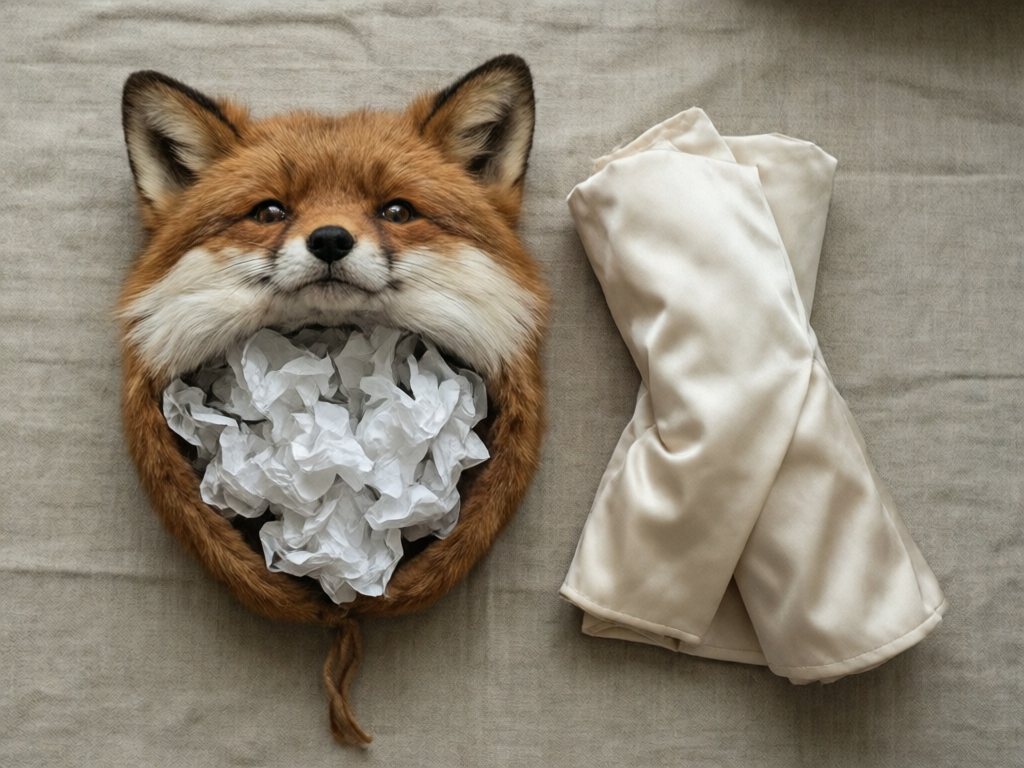
- Stuff hats and masks with tissue or a clean sock so they hold their shape.
- Roll capes and tulle loosely instead of folding sharply.
- Remove batteries from light-up costumes and store them separately, out of reach. Corroded battery contacts are a common casualty.
- Wash or spot-clean before storing. Fabric stored with candy smears or face paint attracts pests and sets stains.
- Handle face paint with care. Use only cosmetic-grade, skin-safe paint, patch test it on the inner arm first, and discard old or shared paint rather than storing it.
- Skip sachets and cedar if children can reach the bins. If you use them, keep them in sealed bins stored out of reach, never loose in a bag. Never use mothballs.
Step Five: Label Halloween Costume Bins and Bags So Anyone Can Find Them
Label every bin and every bag with what is inside and who it fits, so a grandparent or sitter can find a costume without calling you.
What to put on a bin label
Keep it short and consistent:
- HALLOWEEN (so it is clear this is seasonal and not everyday dress-up)
- Size band (S1, S2, S3, S4)
- Contents summary if useful (Animals, Characters, Props)
What to put on a bag label
- Costume name (“Ladybug”)
- Size band (“S1”)
- Piece count (“4 pcs”)
- Who last wore it (optional, but lovely for memories)
Label style
Pick one label style and use it everywhere. A simple label maker with a clean, small font works well. If you prefer handwritten, use a single marker color and a single style.
For a quiet, cohesive look, white or kraft labels with black text keep things calm on an open shelf. I learned this on my own linen-closet shelf: for one season I mixed printed labels with handwritten ones, and even the matching bins looked busy. Our mudroom cubbies guide goes deeper on label sizing and placement if you want a consistent look across the house.
If you want to use color, give each child a dot or a stripe so you can see at a glance whose costume it was. Do this only if it helps you. A single color is simpler and easier to maintain.
Sibling Hand-Me-Down Costumes: Keeping the Chain Going
For families with more than one child, costume storage becomes a kind of relay race. What fits the oldest this year will fit the next child in a year or two, and the third child a year after that. A good system makes the handoff nearly automatic.
The three-year view
Each costume is in one of four states:
- Active: currently fits and is liked.
- Waiting: outgrown by one child but a younger sibling will fit it in the next one to three years.
- Retired: too small for everyone in the house and in good condition, so it is ready to donate or gift.
- Gone: worn out or lost.
When a costume moves from “active” to “waiting,” it stays in its size-band bin. A note on the tracker says which sibling is next in line.
A worked example
Suppose you have three children: a 7-year-old, a 5-year-old, and a 3-year-old. Here is how a few costumes might move over time.
| Costume | Year 1 | Year 2 | Year 3 |
|---|---|---|---|
| Dragon (S2) | Worn by 5-year-old | Passed to 3-year-old (now 4) | Retired or loaned to a cousin |
| Astronaut (S3) | Worn by 7-year-old | Passed to 5-year-old (now 6) | Retired or passed to a cousin |
| Bumblebee (S1) | Worn by 3-year-old | Waiting for a future sibling or a friend | Donated |
Letting each child have a say
Give each child a vote:
- “First choice” rights. The child who first wore a costume gets to decide whether it gets passed along.
- Preview in September. Pull out the “waiting” costumes a month before Halloween and let younger siblings try them on. This avoids surprise disappointment on October 30.
When siblings are close in age
If your kids are within a year or two of each other, they will often wear the same size band at the same time. That means more “who wore it first?” arguments, so treat those costumes as shared inventory rather than a gift to one child. In my house the S2 bin is the one I open first every September, because two kids are in it at once. A shared bin labeled with the size band makes it clear that anyone in that band can pull from it.
If your children share a bedroom, a single shared costume bin on a shelf is a clean solution. Our guide to shared kids’ bedroom organization has more ideas for dividing space fairly.
Dress-Up Clothes Storage: Keep It Separate From Halloween
Keep dress-up clothes and Halloween costumes in separate systems. They overlap, but they behave very differently.
| Dress-up clothes | Halloween costumes | |
|---|---|---|
| Use | Daily or weekly play | Once a year, maybe twice |
| Access | Needs to be at kid height | Can live on a high shelf |
| Durability | Must survive rough play | Often delicate or themed |
| Storage | Open, easy, forgiving | Closed, protected, labeled |
| Replacement | Gets worn out and swapped | Reused across years |
If everything lives in the same bin, the delicate costumes get crushed during everyday play, and small costume pieces get lost in the dress-up pile.
Dress-up: open and easy
For everyday dress-up, aim for a low, open container that a three-year-old can use without help. A shallow bin, a hanging rack at child height, a basket, or a few hooks on the wall all work. Keep the pieces simple: capes, hats, scarves, a few tutus, play aprons, doctor coats, toolbelts.
We cover this in more depth in our dress-up clothes organization guide, including how to rotate pieces so the basket does not overflow.
Halloween: closed and protected
Halloween costumes, by contrast, live in the closed bins described above. The two systems meet in only two places. A Halloween costume gets “demoted” to dress-up after it has been worn. A dress-up piece gets “promoted” into a new costume.
The demotion rule
After Halloween, let each child decide which costume pieces they want to keep for everyday play. A cape, a mask, or a hat often becomes a favorite dress-up item. Move those pieces to the dress-up basket and record in the tracker that the costume now has fewer pieces. The rest goes into the Halloween bin. This keeps the dress-up basket lively and keeps the Halloween bin from turning into a junk drawer.
The Printable Costume Size-and-Storage Tracker
Fill in the tracker once a year, in about fifteen minutes. It records every costume you own, who it fits, and where it lives. Print it and keep it on a clipboard inside the closet door, or copy it into a notes app.
How to use it
- Print. Use the free tracker from the card on this page. If you have more than eight costumes, print a second page.
- Fill in one row per costume during your fall sort.
- Store the tracker in the lid of Bin A, or in a sheet protector taped inside the closet door.
- Update it every November, right after Halloween, when everything is fresh in your mind.
- Review it every September, before you start shopping for new costumes.
What is on the printable
The free printable has this page ready to fill in. Cross out any column you do not need, or add your own, such as “photo taken.”
- One row per costume: pieces, size band, fit notes, last worn by, next in line, status, bin, and what is missing
- A per-child sizing log for this fall
- The yearly checklist below
Yearly checklist
- All costumes sorted into Wear again / Pass down / Let go
- Every costume tagged with a size band
- Every costume bagged with a piece-count card
- Bins labeled by size band
- Props gathered in one bin
- Batteries removed and stored out of reach
- Tracker updated and stored with Bin A
- Donate pile dropped off
A filled-in example
Here is a sample tracker for a made-up family with three kids. Use it as a model.
Year: 2026 · Household: The Harper family
| Costume | Pieces | Band | Last worn by | Next in line | Status | Missing / notes |
|---|---|---|---|---|---|---|
| Dragon | 3 (suit, hood, tail) | S2 | Juno (5) | Wren (3) | Waiting | Complete |
| Astronaut | 4 (suit, helmet, gloves, patch) | S3 | Theo (7) | Juno | Waiting | Needs 1 glove |
| Bumblebee | 3 (dress, wings, headband) | S1 | Wren | Future sibling or donate | Waiting | Complete |
| Ladybug | 4 (dress, headband, wings, tights) | S1 | Wren | Donate | Retired | Wings detach; secure before under-4 wear |
What the sample tells you at a glance:
- The ladybug is retired because Wren outgrew it first and its wings are wearing out, so it goes in the donate pile; the bumblebee stays as a hand-me-down for a future sibling.
- The astronaut needs one replacement glove before it moves to Juno.
- The dragon and bumblebee stay in their band bins until September; the bumblebee waits for a future sibling, or goes to donate.
You can plan next October from a chair in September instead of from the closet floor on the 30th.
Halloween Costume Storage Schedule: When to Sort and Swap
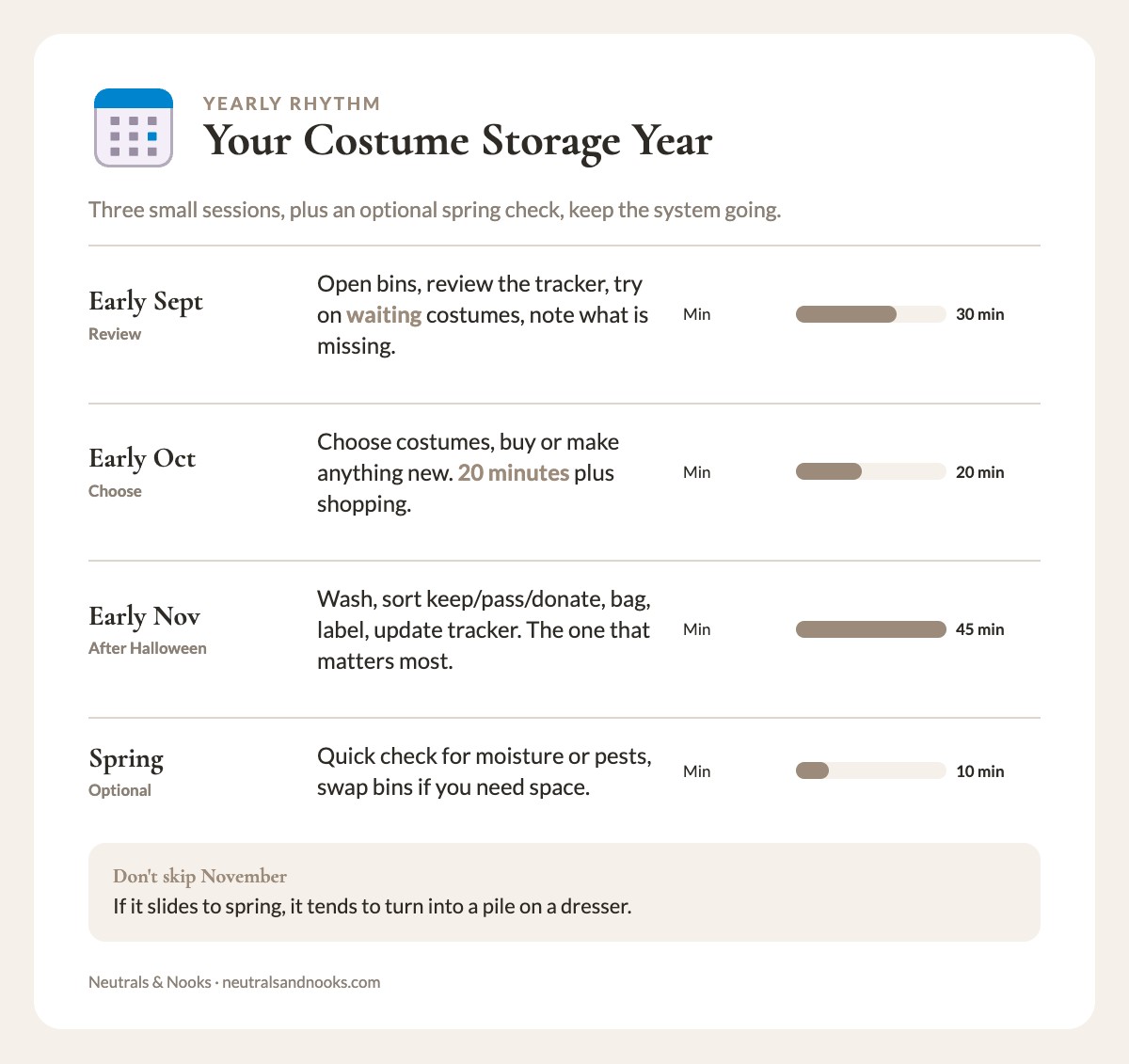
Put three short sessions on the calendar each year, plus an optional spring check.
| When | What to do | Time needed |
|---|---|---|
| Early September | Open bins, review the tracker, try on “waiting” costumes, note what is missing | 30 minutes |
| Early October | Choose costumes, buy or make anything new, set aside this year’s outfits | 20 minutes plus shopping |
| Right after Halloween (first week of November) | Wash and spot-clean, decide on keep/pass/donate, bag and label, update tracker, re-store bins | 45 minutes |
| Spring (optional) | Quick check for moisture or pests, swap bins if you need space | 10 minutes |
The November session matters most: do it while the costumes are still in the house and you remember what worked.
Pair it with other fall resets
If you are already moving winter coats forward and summer clothes back, fit our fall closet swap system for kids into the same afternoon. If candy is piling up in the kitchen, our Halloween candy storage ideas cover that side of the season.
Small-Space and Budget-Friendly Variations
No spare closet or budget for matching bins? The system still works with less.
If you live in a small home
In a small home I’d give costumes one deep bin on the highest shelf you have, and let the tracker do the remembering.
- Use under-bed storage only with a latching, child-resistant lid, and only in a room where the children are old enough to leave it alone. Costumes are lightweight and used once a year, so they suit the space. With babies or toddlers in the house, choose a high closet shelf instead.
- Use the top shelf of a bedroom closet. A single deep bin can hold a surprising number of bagged costumes.
- Hang the most-used costumes on a door hook or an over-door organizer during October only, then bag them in November.
- Compress the tracker to a single phone note or a photo of the printed page, so you do not need a clipboard.
- Consolidate bands. If you have fewer than ten costumes, one bin with two dividers (or two large bags) can hold everything.
If you are on a budget
- Reuse what you have. A cardboard box with a lid, a laundry basket, or a canvas tote can be a perfectly good bin. Cover it with kraft paper or a simple label for a cohesive look. On my linen-closet shelf, a kraft-wrapped shoebox sits beside the bought bins, and with matching labels it reads as one set.
- Use pillowcases as bags. A clean pillowcase held closed with a ribbon or a clip is a free, breathable costume bag.
- Ask for hand-me-downs on purpose. Swapping costumes with friends or neighbors extends your wardrobe without buying anything. Use the tracker to record what you lent and who has it.
- Make costumes from basics. Neutral, simple pieces such as a plain colored shirt, a headband, and a prop can be reassembled into many characters. These “base layers” are easy to store because they double as everyday clothing.
If you prefer a minimalist approach
If you keep only one costume per child per year plus a few favorites, the system shrinks to a single bin, a short tracker and the same size-band tags.
Fixing Musty, Missing and Mismatched Costume Pieces
Check this table when a bin smells, a piece goes missing, or a costume suddenly fits wrong.
| Problem | Likely cause | Quick fix |
|---|---|---|
| Pieces keep going missing | No record of what belongs together | Add a piece-count card to every bag and check it at pack-up. Keep one “Props” bin for loose accessories. |
| Costumes smell musty | Moisture | Wash and dry costumes fully, air the bin for a day, and move it away from damp walls. If you use an odor absorber, keep it sealed inside a bin stored out of children’s reach. Skip silica packets in any bin a child can open; they are a choking hazard. |
| Bins are too heavy to lift | Props mixed in with costumes | Split large bins in two and give props their own bin. |
| Kids dig through the bins | Bins are within reach | Move bins out of reach in the off-season and keep the dress-up basket at child height. |
| Duplicate purchases | No list of what you own | Keep a phone photo of the filled tracker and check it before buying. |
| Sizing changed overnight | Kids can grow a full band in a year | Use the fit notes column and try things on in September, not October 30. |
What to Do With Costumes You No Longer Need
Clear the “retired” pile every November so the bins never outgrow their shelf. Here is where it can go.
- Donate clean, complete costumes to a local school, daycare, drama club, or community theater. Call ahead before you drop anything off, since some thrift stores limit costume donations after Halloween.
- Swap with friends. A small costume swap in September is a lovely way to refresh everyone’s wardrobe at no cost.
- Gift specific costumes to a family you know will use them.
- Repurpose worn costumes into the dress-up basket, or cut up the fabric for craft projects.
- Recycle fabric where textile recycling is available, and discard anything that cannot be reused.
When a costume leaves the house, cross it off the tracker or move it to a “gone” list so you do not look for it next year.
Frequently Asked Questions
What is the best way to store Halloween costumes for kids?
Bag each costume separately with all of its pieces, and label the bag with the costume name and a size band. Group the bags into a few lidded bins by size band. Keep the bins on a high closet shelf, out of children’s reach, rather than in an attic or garage. A one-page tracker stored with the bins tells you what you own.
Should I use plastic bags or fabric bags for costume storage?
Both work, depending on the costume. Clear zip-top plastic bags are great for simple costumes and small accessory sets because you can see inside. For long-term storage of larger or more delicate costumes, breathable fabric or non-woven bags are gentler because they let air circulate and are less likely to trap moisture. Avoid vacuum compression bags for costumes, since they can crush foam, felt, and sequins.
How do I keep costume sets from getting separated?
Use one bag per costume and slip a small card inside listing every piece, for example “Dragon: 3 pieces, suit, hood, tail.” Count the pieces when you pack up each November. Keep oversized props in a single labeled props bin, and tie a note to each prop with the name of the costume it belongs to.
How do I size costumes when the tags are so inconsistent?
Ignore the age range on the tag and assign your own size band based on how the costume actually fits a child in your house. A simple four-band system (S1 through S4) is enough. Add a short note like “runs big” or “runs small” on your tracker so you know what to expect when a younger sibling grows into it.
Should dress-up clothes and Halloween costumes be stored together?
It is usually better to keep them separate. Dress-up clothes are used often and need to be easy for kids to reach, while Halloween costumes are used once a year and benefit from protected, labeled storage. After Halloween, let your kids choose which costume pieces to move into the everyday dress-up basket, and store the rest in the seasonal bins.
How many bins do I need for costumes?
For most families with two or three children, three to five bins is plenty. One bin per size band, plus a separate bin for props and accessories, covers most households. If you only have a few costumes, a single bin with dividers or large bags will do.
When is the best time to organize Halloween costumes?
The most useful time is the first week of November, right after Halloween, while the costumes are still in the house and you remember what worked. A short check in early September, before you start planning new costumes, makes sure everything still fits and nothing is missing.
Halloween Costume Storage: The Short Version
Do a quick sort, give each costume a size band, bag each set with every piece, group the bags in a few labeled bins, and fill in the tracker once. Next October you will open one lid and find the shark tail where it belongs.