Small Primary Closet Organization for Growing Families
Our primary closet measured forty-two inches wide, for two adults’ entire wardrobes. I found out on a Tuesday night, with a toddler on my leg and a tape measure on the floor. This post covers how to measure a small closet, a double-hang plus shelf-riser layout for closets under four feet wide, hardware that won’t waste inches, and a seasonal reset that keeps it from sliding back by December.
In this article (11 sections)
- Why a Family Primary Closet Runs Out of Room
- How to Measure a Small Closet Before You Buy Anything
- Double-Hang and Shelf-Riser Layout for a Closet Under 4 Feet Wide
- Choosing Hardware That Works With (Not Against) a Tight Footprint
- Zone by Height: What Goes Where From Floor to Ceiling
- Folded Storage That Holds Its Line: Shelves, Risers, and Bins
- Floor Space and Shoes Without Losing Walking Room
- Free Square Footage: The Door, the Walls, the Corners
- The Seasonal Reset That Keeps a Small Closet From Backsliding
- Frequently Asked Questions
- A Closet That Fits the Family You Actually Have
Why a Family Primary Closet Runs Out of Room
First, some primary closets are simply small. A walk-in is sometimes only about three feet deep. Plenty of primary closets aren’t walk-ins at all, just a standard reach-in with one rod and one shelf. If you’re working with 36-48 inches of width, you’re not under-organized. You’re under-square-footed.
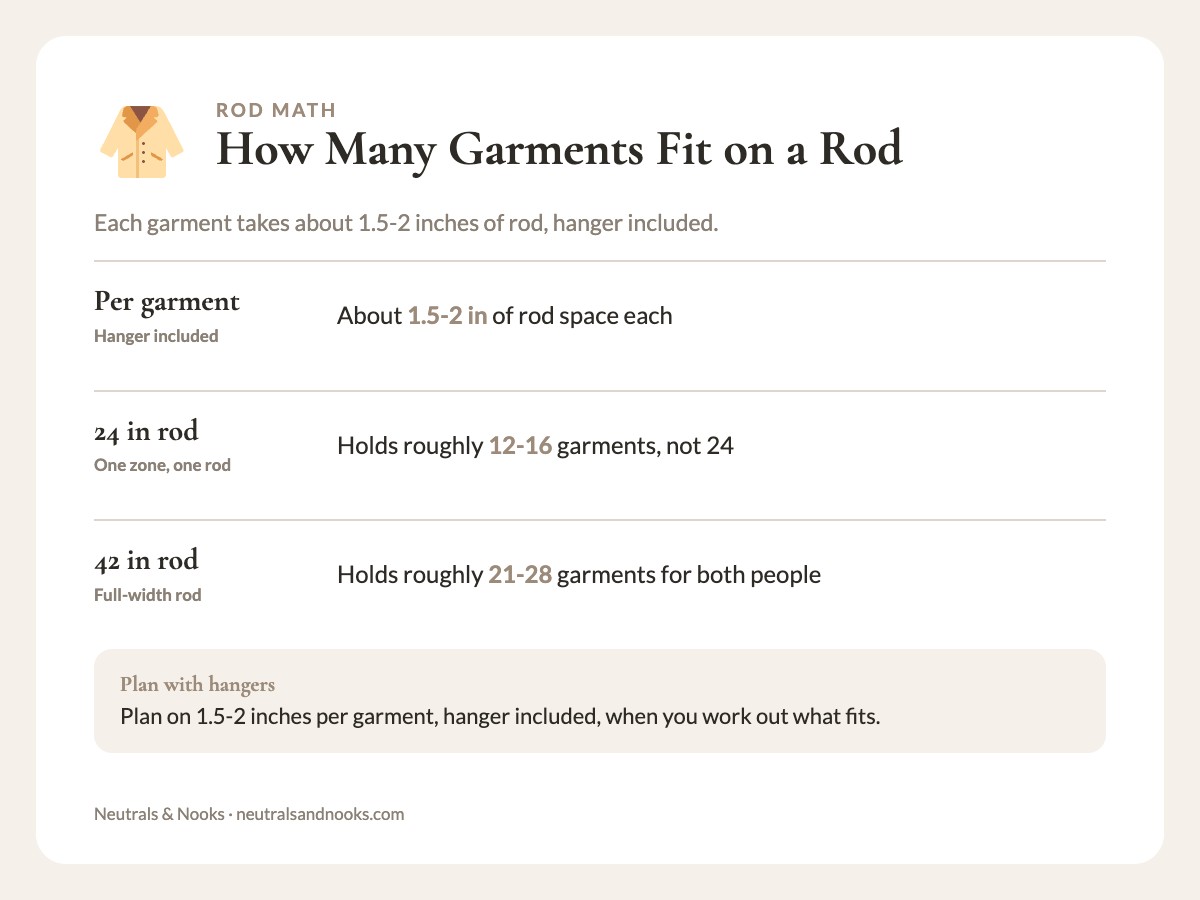
Second, two adults’ wardrobes take up more rod inches than most closets allow. Plan on about 1.5-2 inches per garment, counting the hanger and a little breathing room. A 42-inch rod then holds roughly 21-28 garments for both people. That’s not much once you count work clothes, weekend clothes, dressy items, and outerwear.
Third, and specific to family homes, a primary closet absorbs whatever has no other home. Gift wrap. Overflow linens. A tote of memorabilia. Kids get purpose-built storage, while the primary closet is expected to just work with what’s left over. It needs a layout that accounts for every inch.
How to Measure a Small Closet Before You Buy Anything
Every layout below depends on accurate measurements. Eyeballing it is how a plan falls apart mid-install. The shelf riser comes home two inches too wide, or the second rod clears the first rod’s hangers by half an inch.
Grab a tape measure, a notepad or your phone, and take these five measurements before you buy or build anything:
| What to measure | Why it matters |
|---|---|
| Interior width, wall to wall | Determines whether you can fit a double-hang zone plus a shelf-riser zone side by side, or need to stack differently |
| Interior depth, front to back | A standard hanger needs roughly 22-24 inches of depth; under about 22 inches, use angled hangers or swing-arm rods |
| Ceiling height inside the closet | Tells you how much vertical space is available above the top shelf — often the most wasted zone in a small closet |
| Height from floor to any existing shelf or rod | Lets you calculate exact clearance for a second, lower rod without ordering hardware that collides with what’s already there |
| Door swing and clearance | A door that swings into the closet steals working depth; bifold or sliding doors free up several inches you can actually use |
Write these down in a notes app, not on the back of a receipt. You’ll refer to them while comparing shelf-riser units and double-hang kits, and I’ve remeasured three times before learning that. The free Small Primary Closet Layout Kit has a measurement worksheet and zone diagram so you can fill these numbers in before you buy.
Good to knowA 24-inch rod holds roughly 12-16 garments, not 24. Plan on 1.5-2 inches per garment, hanger included, when you work out what fits.
Double-Hang and Shelf-Riser Layout for a Closet Under 4 Feet Wide
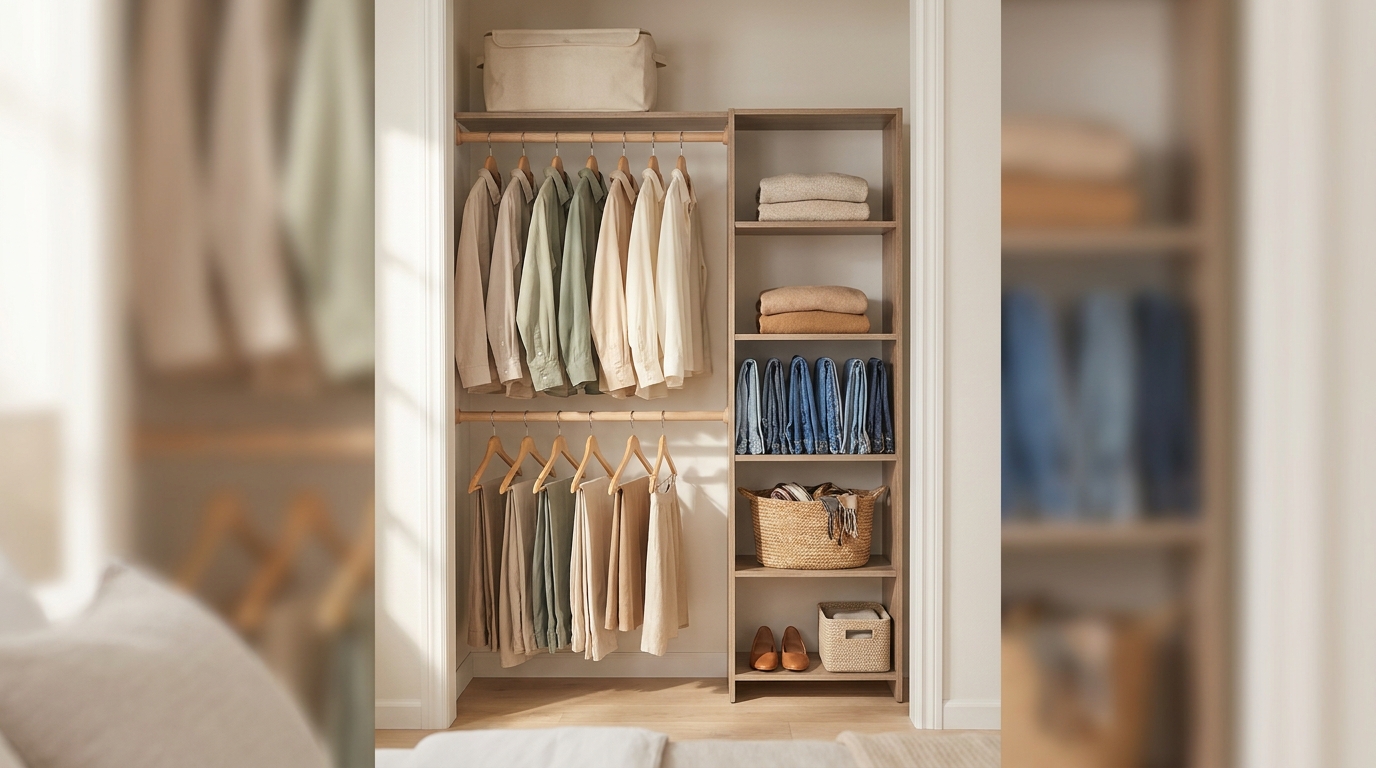
This is the layout that does the most work in a narrow primary closet. The idea is simple: split the width into two zones instead of treating the whole closet as one long rod. One zone gets a double hang (two rods, stacked, for shorter garments). The other zone gets a shelf-riser tower (a stack of shelves, often on a freestanding riser unit, for anything that folds).
Here’s how it lays out in a 42-inch-wide closet.
A 42-inch closet, front view. For 36 or 48 inches, narrow or widen each zone in proportion.
| Zone | Width | Height | What goes there |
|---|---|---|---|
| Upper rod | 24 in | Rod at about 80 in | Shirts and blouses (hems land around 44-52 in) |
| Lower rod | 24 in | Rod at about 40 in | Pants folded over hangers, skirts, shorter items |
| Floor, hang zone | 24 in | 0-12 in | Hamper or shoe bin |
| Shelf riser | 18 in | Floor to about 72 in, four or five tiers (anchored; see the safety note below) | Shoes low, jeans and leggings in the middle, sweaters above, lidded accessory bins on the top tier |
| Top shelf | Full 42 in | Above 84 in | Off-season bins, memory boxes |
Why the split works
A single rod running the full 42 inches gives you one long row of hanging space and nothing else. Every folded item then needs a dresser somewhere else in the room. Splitting the width gives you two rods’ worth of hanging space in half the footprint. Shirts and blouses drop only about 28-36 inches, which leaves a band of dead air below them that a second rod fills.
The math, roughly:
- Upper rod at about 78-80 inches from the floor holds shirts and blouses, anything with a drop of roughly 28-36 inches.
- Lower rod at about 38-40 inches from the floor holds pants (folded over the hanger), skirts, and shorter items that clear the floor from that height.
- That 24-inch zone holds two rows in the width of one, roughly 24-32 garments in total (12-16 per rod). The trade-off: long dresses and coats won’t clear the lower rod, so give them a full-height rod elsewhere, such as an entry closet or a freestanding rack.
Why the shelf-riser zone earns its keep
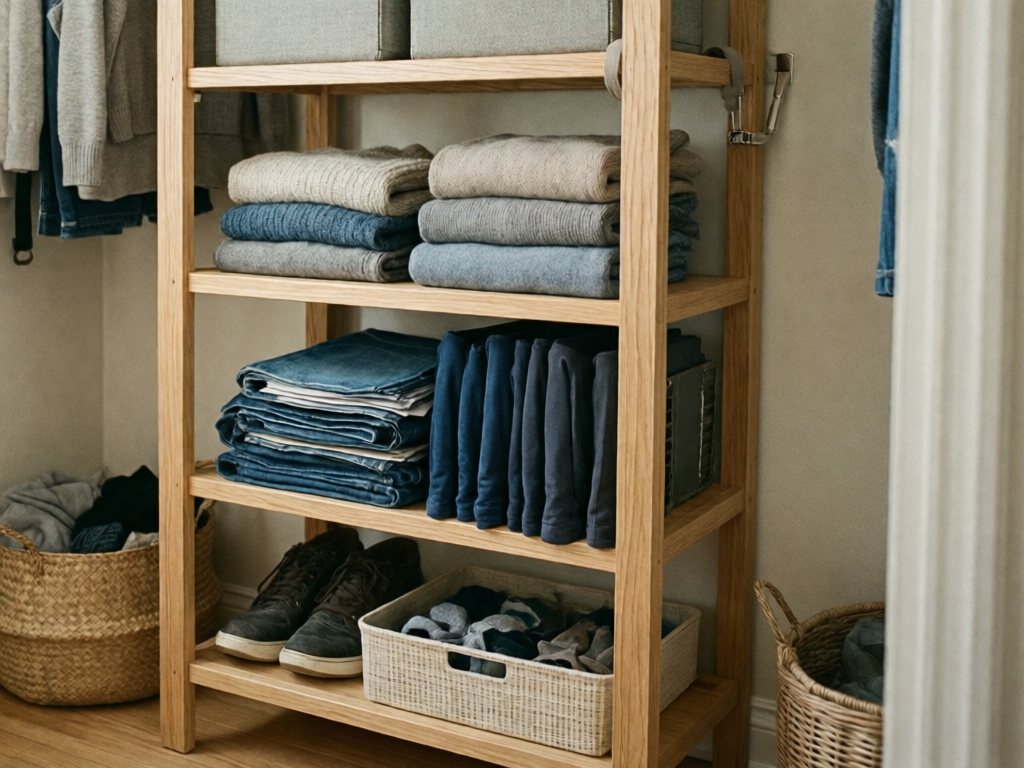
The remaining 18 inches goes to a shelf-riser tower rather than a second double-hang. Every household needs some flat storage, and folded sweaters, jeans, workout clothes and accessories pack onto shelves far more efficiently than they hang.
A four- or five-tier riser, either furniture-style shelving or a closet-system insert, turns those 18 inches into four or five separate storage zones.
Here is how I assign the tiers, from the floor up. Heavier folded clothes go low, and small accessories go up top, out of a toddler’s reach:
| Tier | What goes there |
|---|---|
| 1 (floor) | Shoes, or a low bin of socks and everyday basics |
| 2 | Jeans and leggings, file-folded so you see everything at a glance |
| 3 | Sweaters. Stack bulky knits flat in piles of three or four; file-fold thinner ones. |
| 4 (top) | Lidded bins for jewelry, belts, scarves and other small accessories |
Safety firstAnchor a tall freestanding riser to a wall stud with an anti-tip strap, and keep heavy items on the lower shelves. Toddlers climb open shelves, so treat a 72-inch tower like furniture, not a closet accessory. In a rental, ask your landlord about the strap; it takes a screw or two, and the hole patches at move-out. If anchoring isn’t allowed, use a low unit of about 30-36 inches and move the folded overflow to a dresser.
Safety firstKeep small accessories out of a toddler’s reach. Jewelry, cufflinks, hair clips and anything with a coin or button battery, such as a watch, are choking and swallowing hazards. Belts, scarves and other cords are strangulation risks. Store them in lidded bins on the riser’s top tier or the top shelf (on a low unit, the top shelf only), and leave only folded clothes and shoes within reach.
Anything above 84 inches on either side becomes the top shelf. Reserve it for things you touch a few times a year: off-season bedding, gift-wrap bins, memory boxes. The upper rod at about 80 inches is a reach-with-effort spot, so keep a small step stool nearby.
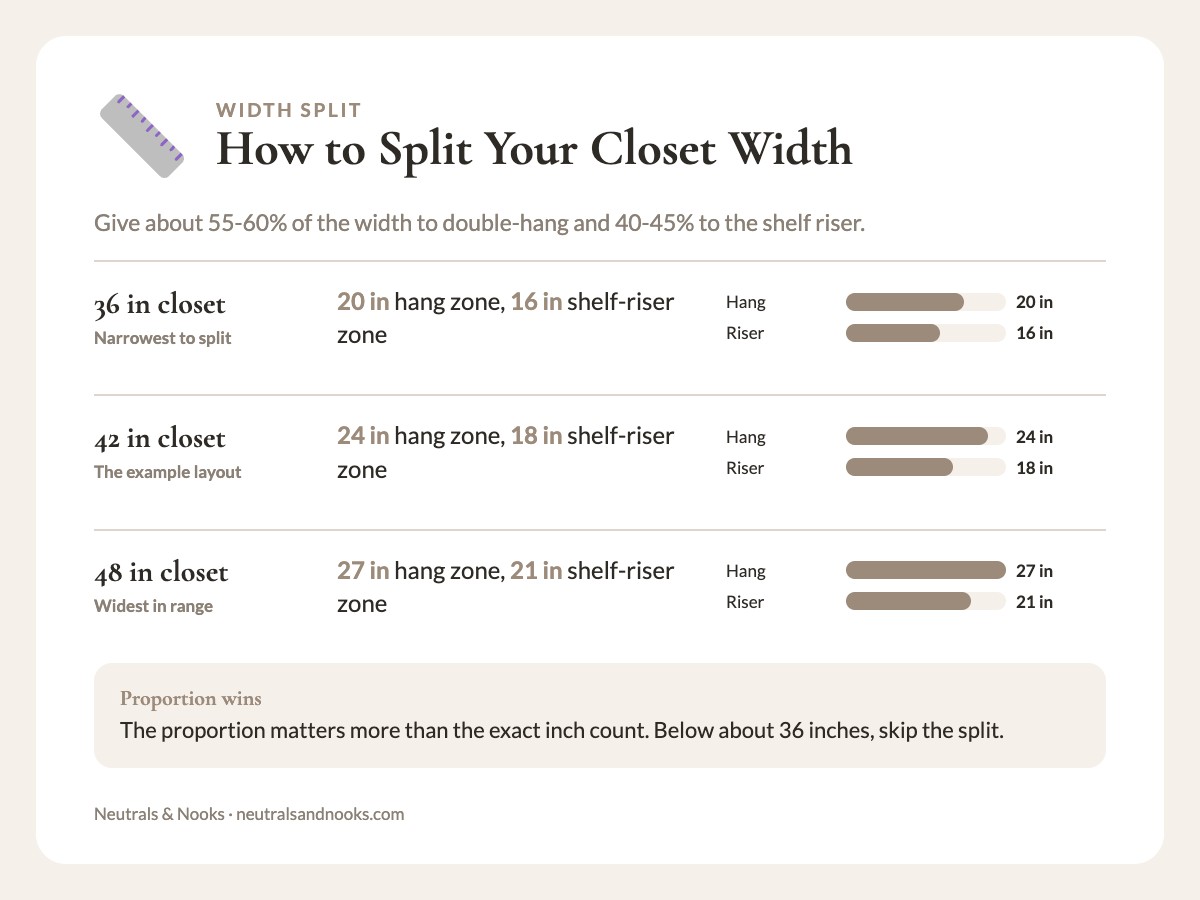
If your closet is narrower or wider than 42 inches, keep the ratio roughly the same: about 55-60% of the width to the double-hang zone, 40-45% to the shelf-riser zone. A 36-inch closet becomes a 20-inch hang zone and 16-inch shelf zone; a 48-inch closet becomes 27 and 21. The proportion matters more than the exact inch count. Below about 36 inches the hang zone gets too narrow, so skip the split (see the FAQ).
Choosing Hardware That Works With (Not Against) a Tight Footprint
Once the layout is decided, the hardware you pick either helps you hit those measurements exactly or eats inches you don’t have to spare. Here’s how the common options compare for a small primary closet specifically:
| Option | Best for | Watch out for |
|---|---|---|
| Wire shelving kits (the classic builder-grade white wire) | Budget installs, renters who need it removable | Sags under weight over time; wire baskets snag knits; visually busy in a small space |
| Wood or laminate closet systems (modular, cut to fit) | Custom-fit for odd widths, cleanest look | Higher upfront cost; some require professional install or precise DIY measuring |
| Freestanding shelf-riser units (furniture-style, no wall-mounted brackets) | Renters, anyone who wants to reconfigure later | Takes up floor depth (usually 12-16″), so measure before buying; tall units still need an anti-tip strap into a stud |
| Double-hang closet rod kits (add-a-rod brackets or full second-rod kits) | Adding a second rod to an existing single-rod closet cheaply | Cheap versions can bow under a full rod of clothes — check the weight rating |
| Over-the-door or wall-mounted racks | Supplementing, not replacing, your main layout | Easy to overload; best for lightweight, frequently-used items only |
For a closet under four feet wide, I’d choose a freestanding shelf-riser unit for the shelving zone. Pair it with an add-a-rod kit for the double-hang zone.
The riser is the easiest piece to return or resell if it doesn’t fit, and it needs no wall-mounted brackets. That suits renters and anyone testing a starter layout before a future renovation.
It still isn’t drill-free. A 72-inch tower needs an anti-tip strap screwed into a stud, especially with a toddler in the house. In a rental, ask your landlord first, or swap in a low unit of about 30-36 inches (see the rental question in the FAQ).
Some add-a-rod kits hang from the existing rod with no drilling, while wall-mounted ones need studs or anchors. Check the weight rating either way, and compare current prices at your local hardware store before buying.
If the plan doesn’t fit once it’s in: return the riser for a narrower unit, or drop the lower rod a few inches.
TipCount the hanger, not just the rod. A hanger’s hook and bar add about 2 inches above the rod, so a lower rod at 40 inches has hanger tops near 42. If your longest shirts hang to 44 inches, that leaves only about 2 inches of clearance, so the lower rod may need to drop 2-4 inches. Hang your longest shirt and measure before you drill.
Zone by Height: What Goes Where From Floor to Ceiling
Beyond the split, think of the closet as height zones with different jobs:
| Zone | Height range | What belongs here |
|---|---|---|
| Prime zone | Roughly 30″-65″ (comfortable reach without stretching or bending) | Everyday hanging clothes, shoes you wear weekly, anything you grab without thinking |
| Stretch zone | 65″-84″ | Less-frequent items — dressy clothes, bulkier sweaters, bags you use occasionally |
| Ladder zone | Above 84″ | Off-season storage, bins, anything accessed a few times a year |
| Bend zone | Below 30″, especially below 12″ | Shoes, hampers, floor bins — things that don’t mind being low and don’t need frequent bending to reach |
A common mistake is the reverse of this table. Prime, eye-level space gets storage bins “just for now,” while daily clothes are crammed into the stretch or bend zones.
Do a height audit: walk through each zone and ask whether what’s in it matches how often you use it. That usually frees up more space than new hardware does.
A small primary closet doesn’t have room to be the house’s catch-all. If a kid’s closet has outgrown its system, that’s a separate project. Kids’ Closet Organization: Systems That Grow With Your Child walks through a setup that flexes as sizes change.
Folded Storage That Holds Its Line: Shelves, Risers, and Bins
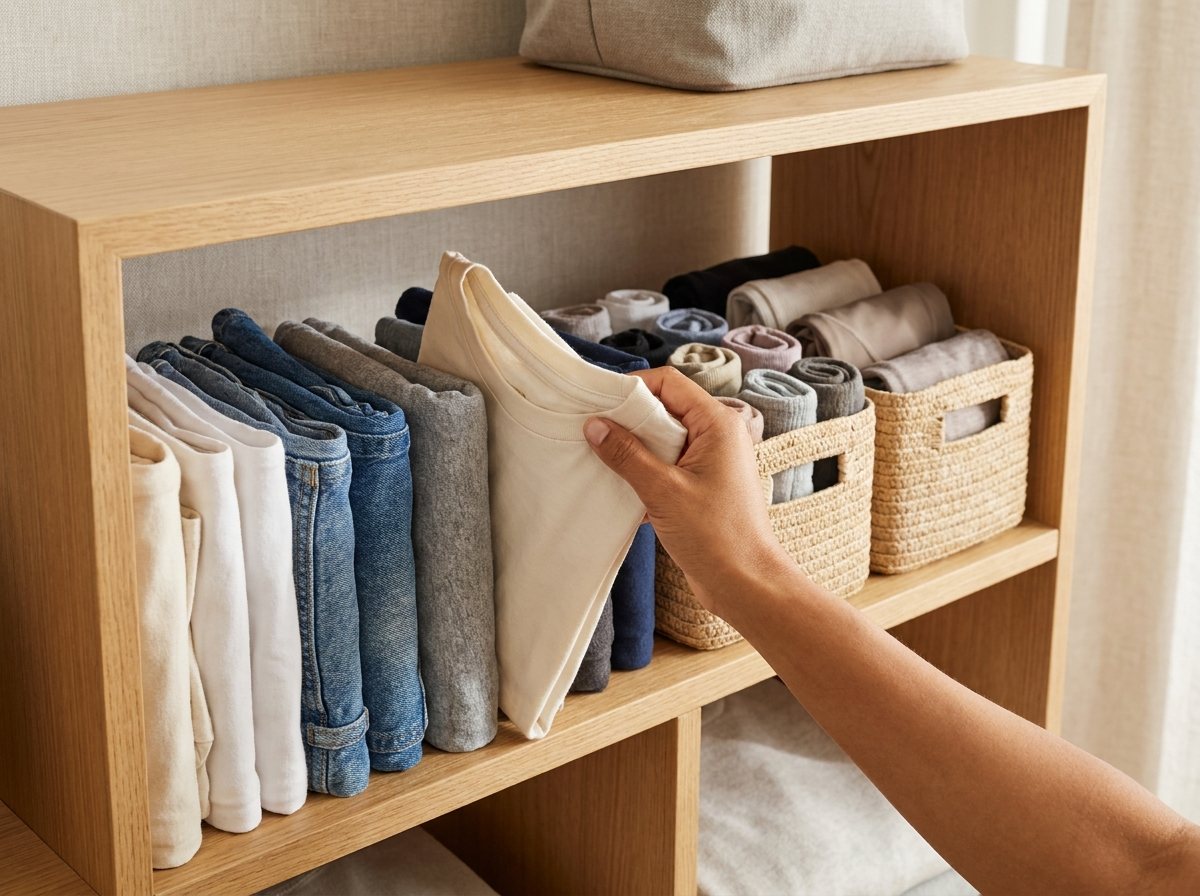
The shelf-riser zone only works long-term if the folding method survives daily use. Three habits keep it that way:
- File-fold what you reach for often. Fold each piece into thirds and stand it upright, side by side, like files in a drawer. Every item stays visible, and you can pull one out without toppling its neighbors. Save flat stacks for bulky knits, in short piles of three or four.
- Bin the small stuff. Socks, underwear and workout gear each get a bin, so one shelf becomes several tidy sections. Use open-top bins for everyday clothes. Jewelry, belts, scarves and other small accessories go in lidded bins on the riser’s top tier or the top shelf, out of a toddler’s reach.
- Match bin depth to shelf depth, not shelf width. A bin 2 inches too deep either won’t fit or sticks out past the edge, where it catches on the door or the clothes beside it. Measure shelf depth before you order bins.
A rough guide for what to bin, file-fold or hang in a two-adult wardrobe:
- Bin it: socks, underwear, workout gear, off-season swimwear, plus accessories, belts and scarves in lidded bins up high
- File-fold it: t-shirts, sweaters, jeans, leggings, casual button-downs
- Hang it: dress shirts, blouses, anything that wrinkles easily, dresses, structured jackets, work pants that need a crease
Floor Space and Shoes Without Losing Walking Room
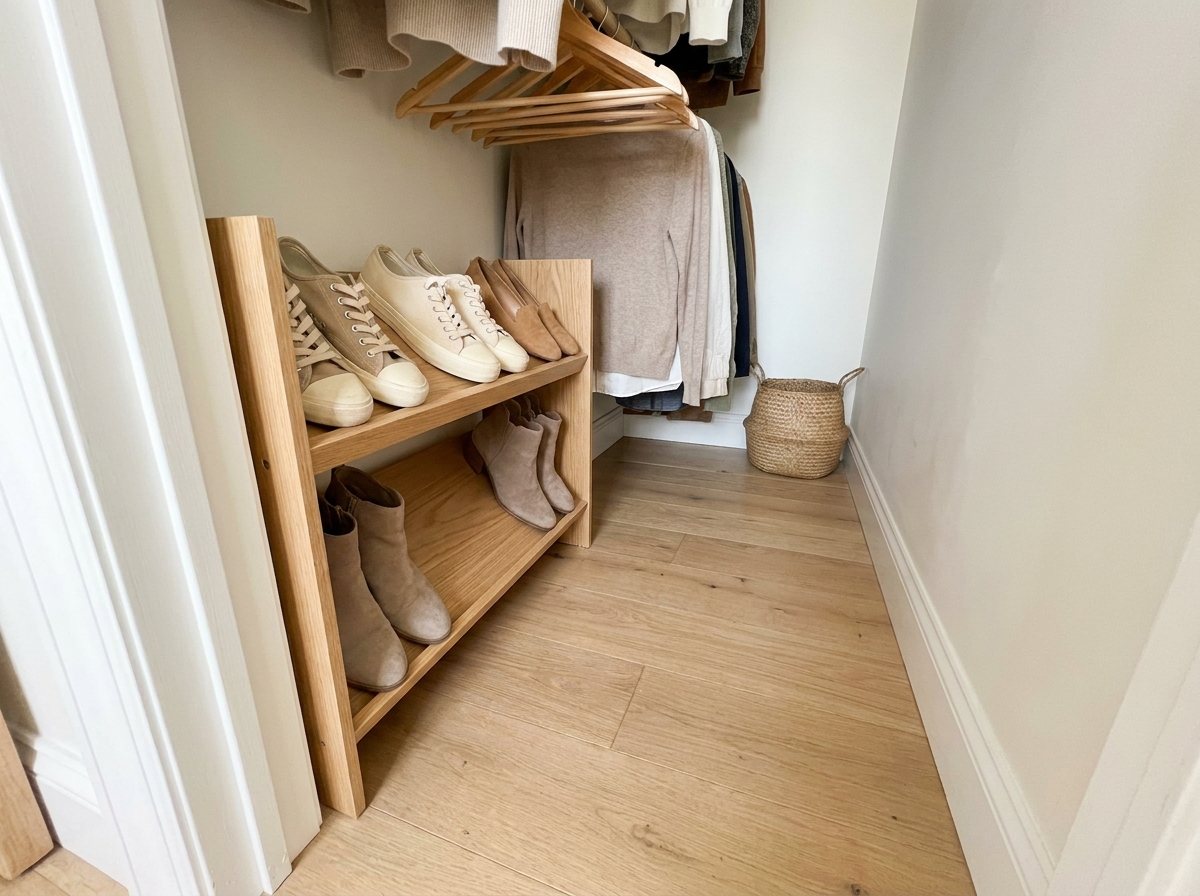
You need to be able to stand in front of the closet, not just store things in it. A closet with no walkable floor stops being usable. You end up dressing from a pile on the bed because reaching in feels like a chore.
A few floor-space rules that hold up in a tight footprint:
- Reserve at least 18-24 inches of clear floor in front of the zone you use most, usually the hanging zone. Fewer shoes on the floor is the trade.
- Use a slim shoe rack rather than loose pairs, even for four to six pairs. A rack against the back or side wall keeps shoes in a strip instead of across the floor.
- Rotate seasonal shoes out entirely rather than trying to fit every pair you own into the closet year-round. Off-season boots and sandals can live in a bin on the top shelf or in another closet’s overflow space.
- Skip freestanding shoe towers deeper than about 10 inches in a closet under four feet wide — they eat floor depth fast, and in a narrow closet, depth is often tighter than width.
If shoes keep sprawling, the real fix may be outside this closet. Many families have no landing spot for shoes anywhere in the house. The Back-to-School Drop Zone: Organizing Backpacks, Shoes, and Lunchboxes for Smooth Mornings tackles the entryway side of the problem.
Free Square Footage: The Door, the Walls, the Corners
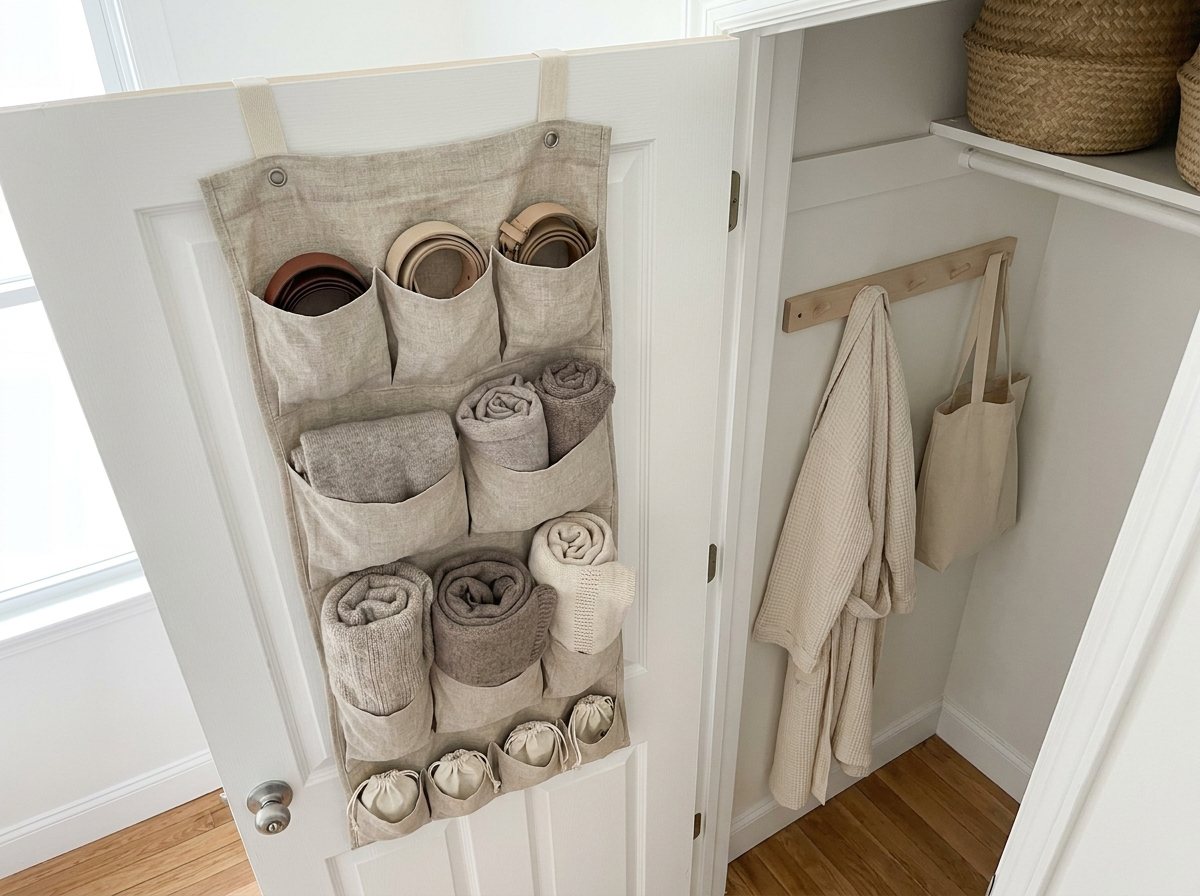
In a closet this size, every unused wall and door surface is free square footage. Most small primary closets leave plenty of it bare.
The back of the door. An over-the-door organizer with pockets or hooks adds storage without touching the closet’s footprint. Good uses: jewelry, ties, belts, scarves, or an “outfit for tomorrow” hook.
Keep it light, and keep it high. Jewelry, belts and anything with a cord belong in the upper pockets, above a toddler’s reach. Over-the-door hardware tolerates less weight than wall-mounted options, and an overloaded one will eventually pull away from the door.
Side walls. Even a strip 6-8 inches wide next to the doorframe can take a slim hook rail for robes and bags. It’s often the most overlooked space in a reach-in closet.
Keep hooks for light items like robes and bags, and mount the rail high enough that robe ties and bag straps hang out of a toddler’s reach.
Safety firstAnchor a full-length mirror to the wall or secure it firmly, since a fall is a real hazard with kids at home. Anchor any above-door shelf into the frame or studs, keep the load light, and never store heavy bins overhead.
Corners. In an L-shaped closet or any interior corner, a corner shelf unit (triangular shelves stacked vertically) turns dead space into a spot for folded items or shoes. It doesn’t compete with the double-hang or shelf-riser zones for width.
Above the door. If the closet is truly maxed out, a shallow shelf above the doorway, on the room side, can hold light bins of rarely used items like travel bags.
That frees the closet’s top shelf for things you reach for more often.
If the whole bedroom is tight, not just the closet, see our guide to small-space apartment storage for families.
The Seasonal Reset That Keeps a Small Closet From Backsliding
A small closet organized once in September and never revisited will be back to overflowing by December. The layout buys you capacity. That capacity holds only if you rotate what’s in it, because there isn’t room for every season’s wardrobe at once.
A rhythm that works for most family schedules:
- Twice a year (roughly spring and fall), swap the top-shelf bins. Whatever’s coming into season moves down into prime reach; whatever’s going out of season moves up to the top shelf or out of the closet entirely.
- Once a month, do a five-minute “does this still fit the plan” pass. Are the file-folded shelves still standing upright, or have they slumped into piles? Is the floor space still clear, or has something started colonizing it? Small corrections monthly are much easier than a full redo twice a year.
- After any big shift, remeasure. A job change, a move, or a stretch of storing a kid’s outgrown clothes can change what the closet holds. If it does, the roughly 55/45 zone split may need to shift too.
The same file-fold-and-bin logic works for kids’ clothes between seasons. A dedicated system elsewhere takes pressure off the primary closet as catch-all storage. Seasonal Clothing Storage for Kids: Rotate, Store, and Organize Like a Pro covers that side of the rotation.
If overflow tends to land in a hallway or linen closet instead, Linen Closet Organization for Families: From Chaos to Calm helps keep that space from absorbing what the primary closet can’t hold.
Frequently Asked Questions
What’s the minimum closet width the double-hang and shelf-riser layout works in?
This layout works down to about 36 inches wide, which gives a 20-inch hang zone. Below that, skip the split. Run double-hang the full width and keep folded items in a dresser elsewhere in the room.
Should the double-hang zone go on the left or right side of the closet?
Put it on whichever side is easier to reach when you’re standing in front of the closet getting dressed — usually the side closer to the door or the dresser you use most. There’s no functional difference between left and right; it’s purely about matching your daily movement pattern so you’re not reaching across the closet every morning.
How do I add a second rod without drilling into drywall I’m not sure can hold weight?
Some add-a-rod kits hang from the existing top rod, so there’s nothing to drill. Wall-mounted kits need screws into studs, not drywall alone, so read the install instructions and use a stud finder first. If your side walls have no studs at the right height, a freestanding double-hang rack sits on the floor and skips wall-mounting altogether. Load it evenly, and in a home with a toddler, strap a tall one to a stud on the back wall so it can’t tip.
Is a shelf-riser tower sturdy enough to hold sweaters and jeans without sagging?
Most furniture-grade shelf-riser units (wood, laminate, or coated metal) handle folded clothing weight without issue — sagging is mostly a wire-shelving problem, since wire flexes under sustained weight over months. If you’re using wire shelving for the riser zone, check the weight rating per shelf and avoid overloading the middle shelves, which bear the most stress.
What if my primary closet doesn’t have room for both a double-hang zone and a shelf-riser zone?
Under about 36 inches, double-hang the full width and move folded items to a dresser or a nearby linen or hallway closet.
If it’s shallower than about 22 inches, standard hangers won’t clear the back wall. Use turned or angled hangers or wall-mounted swing-arm rods instead of a standard double-hang.
How often should I actually be decluttering a small primary closet, not just reorganizing it?
A tight closet needs decluttering more often than a spacious one, simply because there’s less slack to absorb “maybe someday” items. A twice-yearly pass timed to the seasonal rotation (spring and fall) is usually enough to keep it functional — that’s also the natural moment to pull anything that hasn’t been worn in a full year.
Can I use this layout in a rental where I can’t drill or mount anything?
Mostly, yes. Swap wall-mounted hardware for freestanding versions: a double-hang rack for the hang zone and a shelf-riser unit for the shelf zone. Both move with you if you relocate.
Freestanding doesn’t mean tip-proof, though. In a home with a toddler, any tall riser or rack needs an anti-tip strap into a stud, so ask your landlord about a screw or two. If anchoring isn’t allowed, use a low shelf unit of about 30-36 inches instead of the 72-inch tower, and move the folded overflow to a dresser.
Load the rack evenly with the heavier pieces low, lock any wheels, and check that it doesn’t rock before you walk away. Over-the-door organizers also work well in rentals, since they hook onto the door rather than the wall.
A Closet That Fits the Family You Actually Have
A small primary closet needs its own layout, not a shrunken copy of a bigger one. Measure carefully, split the width on purpose, anchor anything tall, and revisit it each season.