Linen Closet Organization for Families: From Chaos to Calm
If your family linen closet is a disaster, this guide will help you create a real, maintainable system. You'll learn why your closet becomes chaotic and how to fix it without aiming for impossible perfection.
- Understand why your shared linen closet becomes chaotic.
- Stop using your linen closet as a catch-all for homeless items.
- Master folding fitted sheets to save space.
- Develop a system that adapts to your family's changing bedding.
Open the linen closet. Go ahead, I’ll wait. If you just met wadded fitted sheets, a stray shark beach towel and a box of Band-Aids from 2019, we can fix that.
This guide gives you exact sheet and towel counts for a family of four, a keep-or-toss rule and a shelf plan that keeps medicine and cleaners out of kids’ reach. It also covers folding, labels and a simple routine that keeps the closet tidy.
Free printable · 6 pages
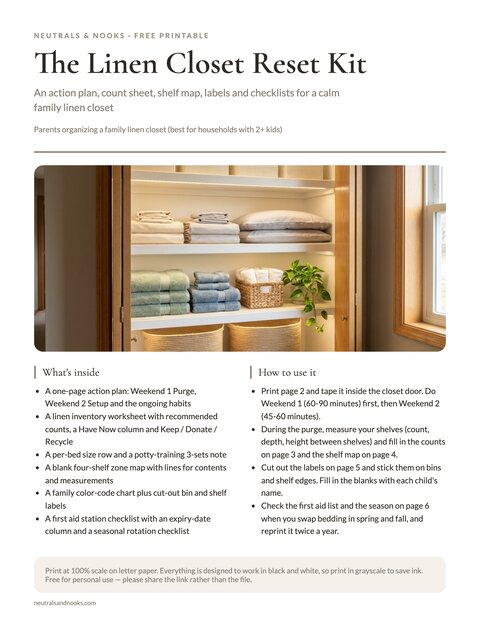
The Linen Closet Reset Kit
A two-weekend action plan to tape inside the closet door, a linen count worksheet, a four-shelf zone map, a color-code chart with cut-out bin labels, and first aid and seasonal rotation checklists.
Free. Your download link appears right here. You'll also join the Monthly Home Reset. Unsubscribe anytime. Privacy
Quick answerKeep 3 bath towels per person and 2 sheet sets per bed. For a family of four, add 2 emergency sheet sets and 2 emergency towels. Lock up medicines and cleaners, and never store them low.
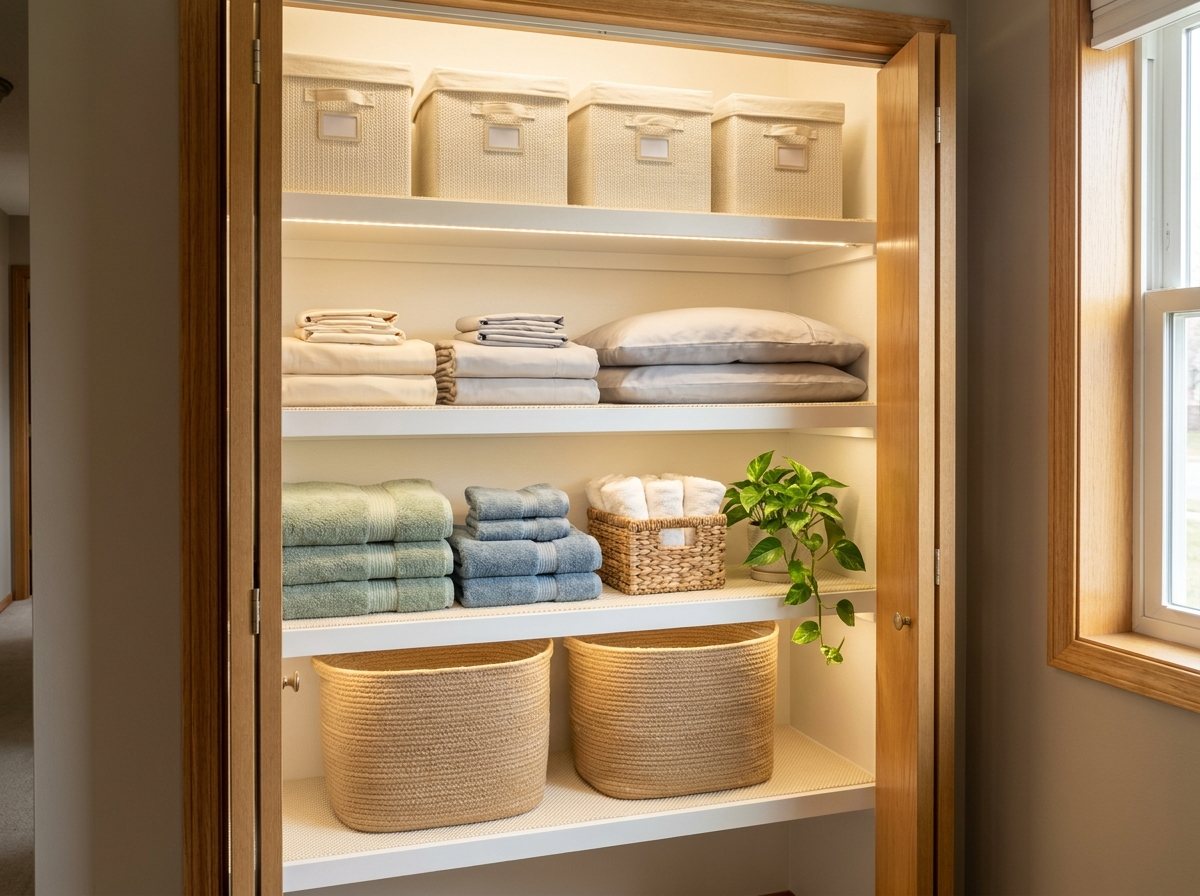
In this article (12 sections)
- Why the Family Linen Closet Is Always a Disaster
- How Many Sheets and Towels to Keep
- The Complete Linen Closet Clean-Out
- Linen Closet Shelf Layout
- Folding Methods That Save Space
- Color Coding and Labeling for Families
- Storage Products at Three Budget Tiers
- Adding Non-Linen Items (Without Creating Chaos Again)
- How to Keep a Linen Closet Organized
- Neutral Linen Closet Styling Ideas
- Frequently Asked Questions
- Linen Closet Action Plan (Checklist)
Why the Family Linen Closet Is Always a Disaster
It’s not because you’re bad at organizing. This closet has two built-in problems.
- Nobody owns it. Everyone pulls from the same shelves, so nobody maintains them. It also collects anything without a home, from first aid to the humidifier.
- Things come in but never leave. Worn towels and outgrown sheets stay because nobody gave them permission to go.
How Many Sheets and Towels to Keep
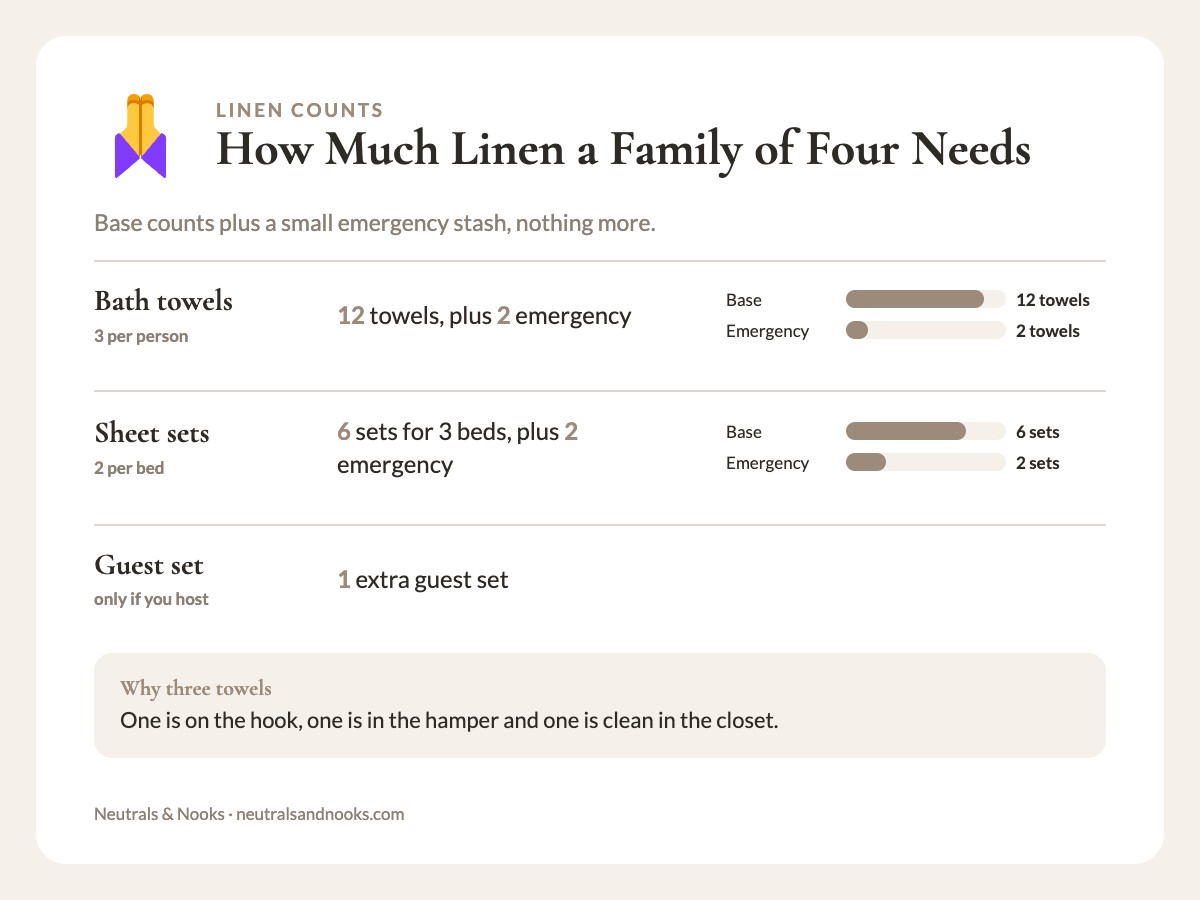
“Keep what you need” doesn’t help much when you’re staring at a pile of towels, so here are real numbers. They’re based on a family of four (two adults, two kids). Scale up or down for your household.
Treat these counts as a guideline, not a rule. They assume each towel gets 3-4 uses between washes and you do laundry every few days.
Bath Towels
| Category | Per Person | Family of 4 Total | Notes |
|---|---|---|---|
| Full-size bath towels | 3 | 12 | Two in rotation, one spare. |
| Hand towels | 2 per bathroom | 4-6 | Assumes 2-3 bathrooms. |
| Washcloths | 3-4 | 12-16 | Kids go through these fast. |
| Guest towels | — | 2-3 sets | Only if you host regularly. |
| Beach/pool towels | 1-2 per person | 4-8 | Top shelf in fall and winter, an accessible shelf in summer. |
The math: With 3 bath towels per person, one is on the hook, one is in the hamper and one is clean in the closet. That works if you do laundry every few days.
If you wash towels every other day, you could drop to 2 per person. Three gives you a buffer for sick days and for the kid who grabs a fresh towel every time.
Sheets
| Category | Per Bed | Notes |
|---|---|---|
| Sheet sets (flat, fitted, pillowcases) | 2 per bed | One on, one clean. |
| Mattress protector | 1-2 per bed | 2 for kids who are potty training or prone to nighttime accidents. |
| Extra pillowcases | 2-4 total | For fresh-pillowcase nights or when one set is in the wash. |
That means: A family of four with one primary bed and two kids’ beds has 3 beds x 2 sets = 6 base sheet sets. Add 2 emergency sets (see the “Just In Case” rule below) for 8 in all, plus one guest set if you host. If you own more than that, you’ve found the source of the overflow.
For kids specifically: During potty training, make one of your two emergency sets the spare for that child’s bed so the 2 AM swap is covered. It counts toward the 8, not on top of it. Once they’re past that stage, the emergency sets go back to serving the whole house.
Blankets and Throws
Safety firstFor babies under 12 months, a crib or bassinet gets only a fitted sheet on a firm, flat mattress. No blankets, quilts, comforters, pillows or bumpers. Use a wearable blanket or sleep sack. The quantities below are for children over 12 months.
| Category | Quantity | Notes |
|---|---|---|
| Seasonal bedding (comforters/quilts) | 1-2 per bed | Summer weight and winter weight. |
| Extra blankets | 2-3 total | Living room throws and emergency extras. |
| Guest bedding | 1 set | Only if you host overnight guests. |
The “Just In Case” Rule
Families keep extra linens for stomach bugs, bedwetting nights and surprise guests. A realistic emergency stash is two extra sheet sets and two extra towels.
That brings sheet sets to 8 in all (plus a guest set if you host) and bath towels to 14. Anything beyond that is surplus, and surplus is what turns a closet into chaos.
The Complete Linen Closet Clean-Out
Set aside 60 to 90 minutes and grab a couple of large trash bags and a laundry basket. You will touch every item in the closet, so this is a full edit, not a reshuffle.
Step 1: Pull Everything Out
Everything: every towel, every sheet and every mysterious bag tucked in the back corner. Pile it all on the floor or the bed.
It will look worse before it looks better, and that’s fine. You can’t make good keep-or-toss decisions while rearranging items on shelves. You need to see everything you own at once.
While the closet is empty, wipe down the shelves and vacuum any dust. Then measure how many shelves you have, how deep they are and how much height sits between them. You’ll use those numbers for the shelf plan and when you buy bins.
Step 2: Sort Into Categories
Sort the pile into these groups.
- Bath towels (full-size).
- Hand towels and washcloths.
- Sheet sets, grouped by bed size: crib, twin, full, queen and king.
- Blankets, quilts and comforters.
- Pillowcases that aren’t currently on beds.
- Mattress pads and protectors.
- Tablecloths and cloth napkins.
- Beach and pool towels.
- Non-linen items, like first aid, toiletries and cleaning supplies.
Step 3: The Ruthless Edit
Now go through each category and ask these questions:
- Is it stained, ripped, threadbare, or musty? If a towel has lost its absorbency or a sheet has pilling so bad it feels like sandpaper, it’s done. Textile recycling or rag pile.
- Does it fit a bed we currently own? Those queen sheets from the apartment you moved out of three years ago? Gone. The crib sheets when your youngest is now five? Pass them along.
- Do we have duplicates beyond what we need? Check the counts above.
- Would we actually use this for a guest? If that scratchy floral comforter never makes it onto the guest bed, it can go.
- Has it been in this closet, untouched, for more than a year? If you haven’t needed it in twelve months, you probably won’t.
Where the discards go:
- Stained or worn items. Use textile recycling, cut them into cleaning rags or offer them to an animal shelter. Call the shelter first; many accept old towels and blankets.
- Good-condition items you don’t need. Donate them to shelters, Goodwill or a Buy Nothing group.
- Expired medicines. Take them to a pharmacy kiosk or a DEA take-back event.
- No take-back option nearby? Follow FDA guidance. Mix the medicines with used coffee grounds or cat litter, seal the mix in a bag and put it in the trash. Scratch out your personal information on the label before you throw the container away. Don’t flush medicines unless the label or the FDA flush list says to.
- Expired toiletries. These can go in the trash.
Letting go of textiles is hard because they feel usable even when they’re worn. If that’s you, try decluttering in 10-minute sessions.
The mindset in that guide fits here: you aren’t wasting things by letting them go. You’re wasting space by keeping what you don’t use.
Step 4: Take Stock of What Remains
After the purge, count what’s left in each category and write it down. This is your real linen inventory.
Compare it with the counts above. If you’re close, you’re in great shape. If you’re well over, do one more round of editing.
Linen Closet Shelf Layout
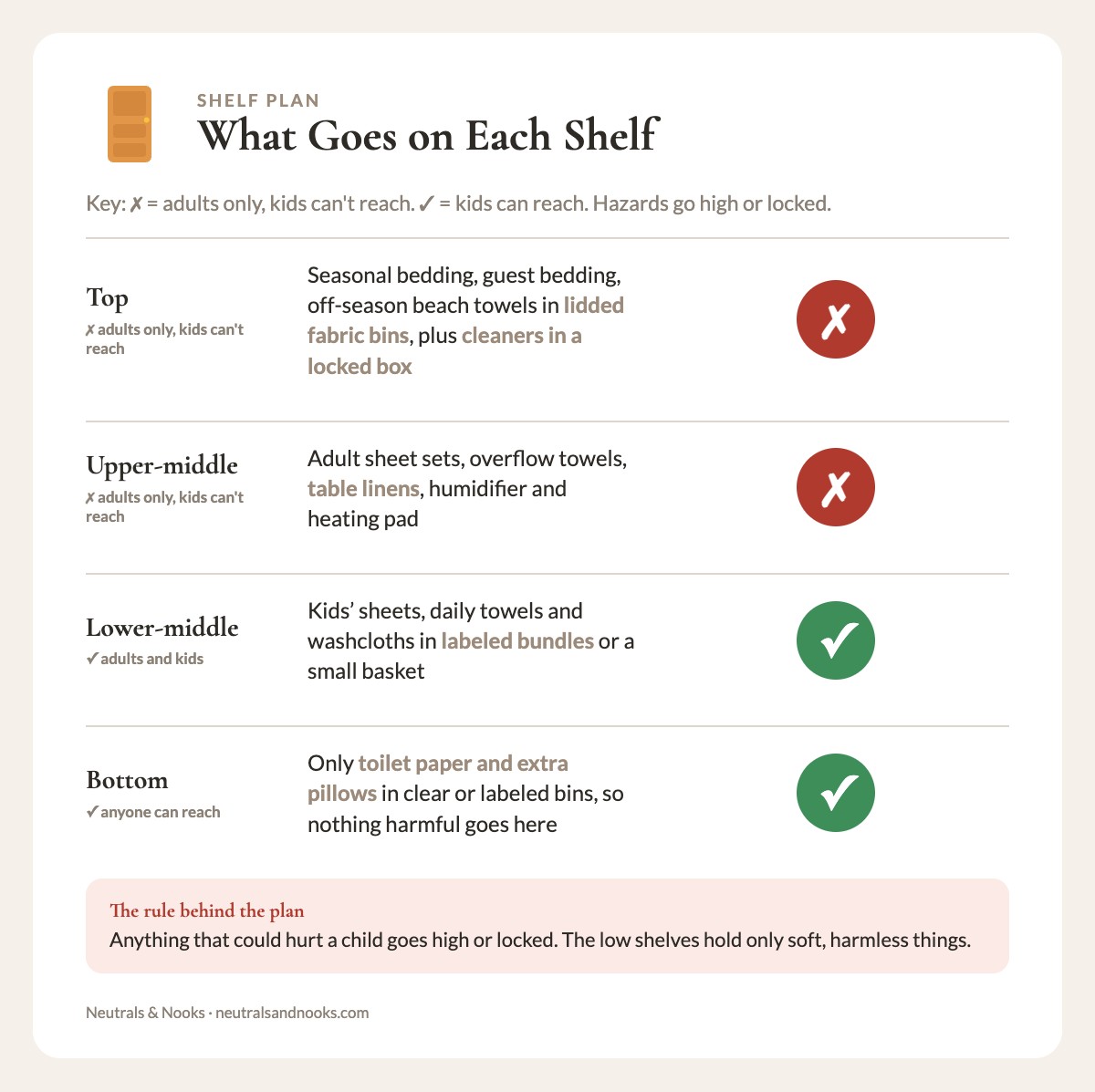
Now let’s put it all back on purpose. The key principle is frequency of use determines shelf height. Daily items go at eye level, monthly items go high or low, and seasonal items take the hardest-to-reach spots.
| Shelf | What goes here | Container | Reach |
|---|---|---|---|
| Top | Seasonal bedding, guest bedding, off-season beach towels, cleaners in a locked box | Lidded fabric bins | Adults only. |
| Upper-middle | Adult sheet sets, overflow towels, table linens, humidifier and heating pad | Pillowcase bundles; a lidded bin for the appliances and cords | Adults only. |
| Lower-middle | Kids’ sheets, daily towels, washcloths | Labeled bundles, small basket | Adults and kids. |
| Bottom | Toilet paper, extra pillows | Clear or labeled bins | Anyone, so nothing harmful goes here. |
| Door | Bandages, stain sticks, lint rollers, hair ties | Over-the-door organizer; top pockets only if kids are under 4 | Adults; no medicines. |
The rule behind this plan: anything that could hurt a child goes high or locked. The low shelves hold only soft, harmless things.
Top Shelf (Highest, Hardest to Reach)
- Use large lidded fabric bins or breathable cotton storage bags. Plastic storage bags are a suffocation hazard, so keep them out of children’s reach.
- Label every bin so you don’t pull down three to find the guest sheets.
- Stand items upright when you can, so labels are readable from below.
- On very high shelves, choose bins with handles you can grab easily.
- If cleaners live in this closet, keep them up here in a locked box, apart from the bedding.
TipStore seasonal comforters inside one of their own pillowcases. It keeps the set together, compresses the comforter slightly and makes it easy to identify at a glance.
Good to knowScented items such as cedar, lavender sachets and dryer sheets go only on high adult shelves, out of children’s reach and away from any child’s bedding.
Upper-Middle Shelf (Easy Reach for Adults)
- Bundle each adult sheet set inside one of its pillowcases, a trick many families like (steps below).
- Fold overflow towels in thirds, then stack them or file them upright.
- Group sheet sets by bed, with the primary bedroom in its own clearly separated section.
- Table linens can live here too, if you use them.
- The humidifier and heating pad go here in a lidded bin, with their cords coiled inside. This shelf sits above a child’s reach; the bottom one doesn’t.
Lower-Middle Shelf (Daily Use, Kid Height)
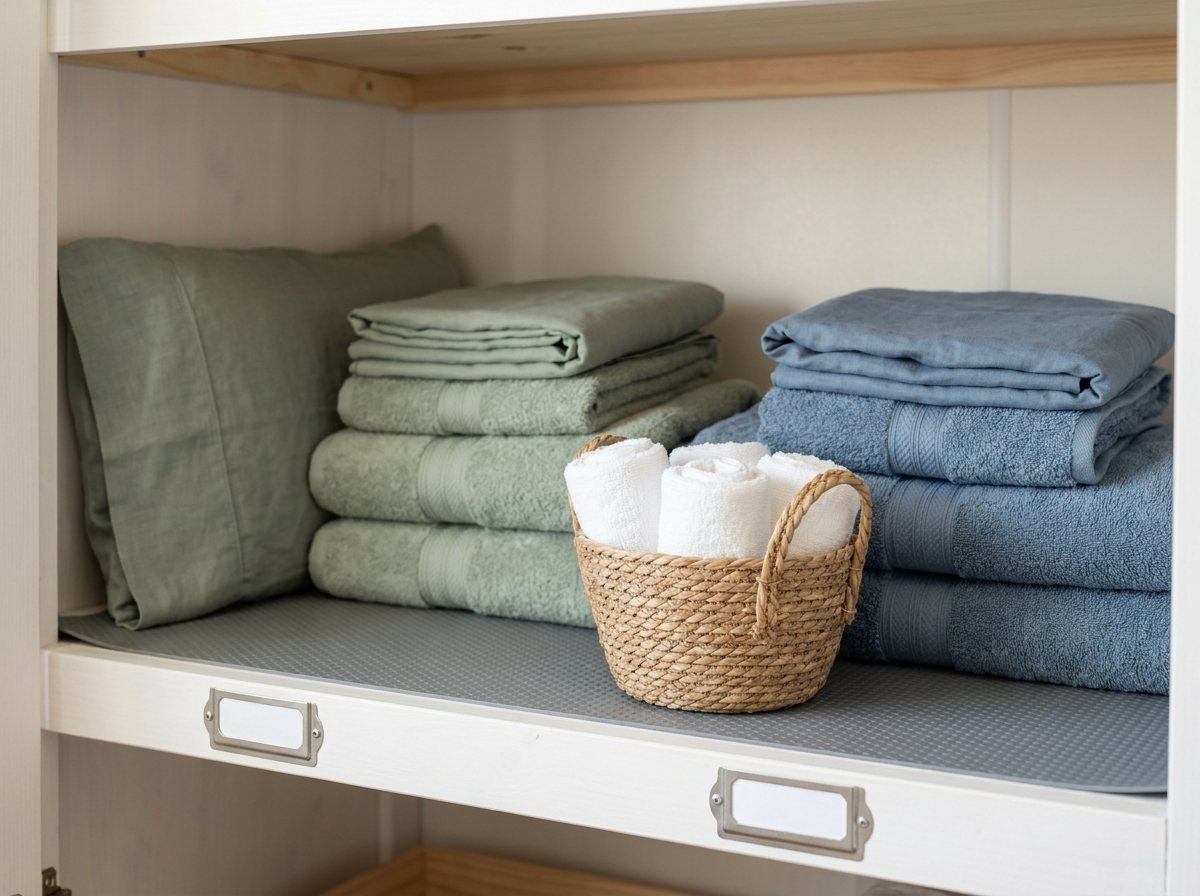
Why kids’ things go here: Adults can reach any shelf, but a seven-year-old helping make their bed needs to reach their own sheets. This shelf also holds the daily towels, washcloths and hand towels you grab most.
- Bundle and label each child’s sheets, or color-code them (more on that below).
- Stack towels by type with the folded edge out so they’re easy to grab.
- Keep washcloths in a small basket so they don’t topple.
Bottom Shelf (Low, Requires Bending)
- Use bins here. Loose items on a low shelf get shoved to the back and forgotten.
- Choose clear or labeled bins so you can see what’s inside without pulling everything out.
- Keep this shelf to toilet paper and extra pillows. It’s the one a toddler can reach, so everything here should be soft and harmless.
- Anchor any freestanding shelf or tower to the wall.
- Medicines, cleaners, cords and small first aid supplies like bandages never go on this shelf. With kids under 6, soap and shampoo refills go high or locked too.
Safety firstIf you have kids under 6, add a child-proof latch to the closet door, and don’t let kids climb the shelves. Unplug, cool and fully dry the humidifier before storing it. Keep it and the heating pad in a lidded bin on an adult shelf with the cords coiled inside, never on a low shelf.
The Back of the Door (Bonus Space)
If your linen closet has a standard swinging door, the back of it is free space. An over-the-door organizer with pockets or hooks keeps small, easily lost items visible without using shelf space.
- Bandages and other non-medicine first aid supplies.
- Stain sticks and lint rollers.
- Hair ties, bobby pins and other small bathroom items that need a home.
Safety firstBandages, hair ties and bobby pins are choking hazards for children under 4, and stain sticks contain chemicals. With a child under 4 at home, use only the top pockets, well above their reach, or wait until they’re older to use the door. Keep medicines off the door at any age.
Sunscreen, bug spray and travel toiletries belong on a high shelf, not the door. The door is for things you need fast. Nobody wants to dig through a bin for a Band-Aid when there’s a bleeding knee involved.
Folding Methods That Save Space
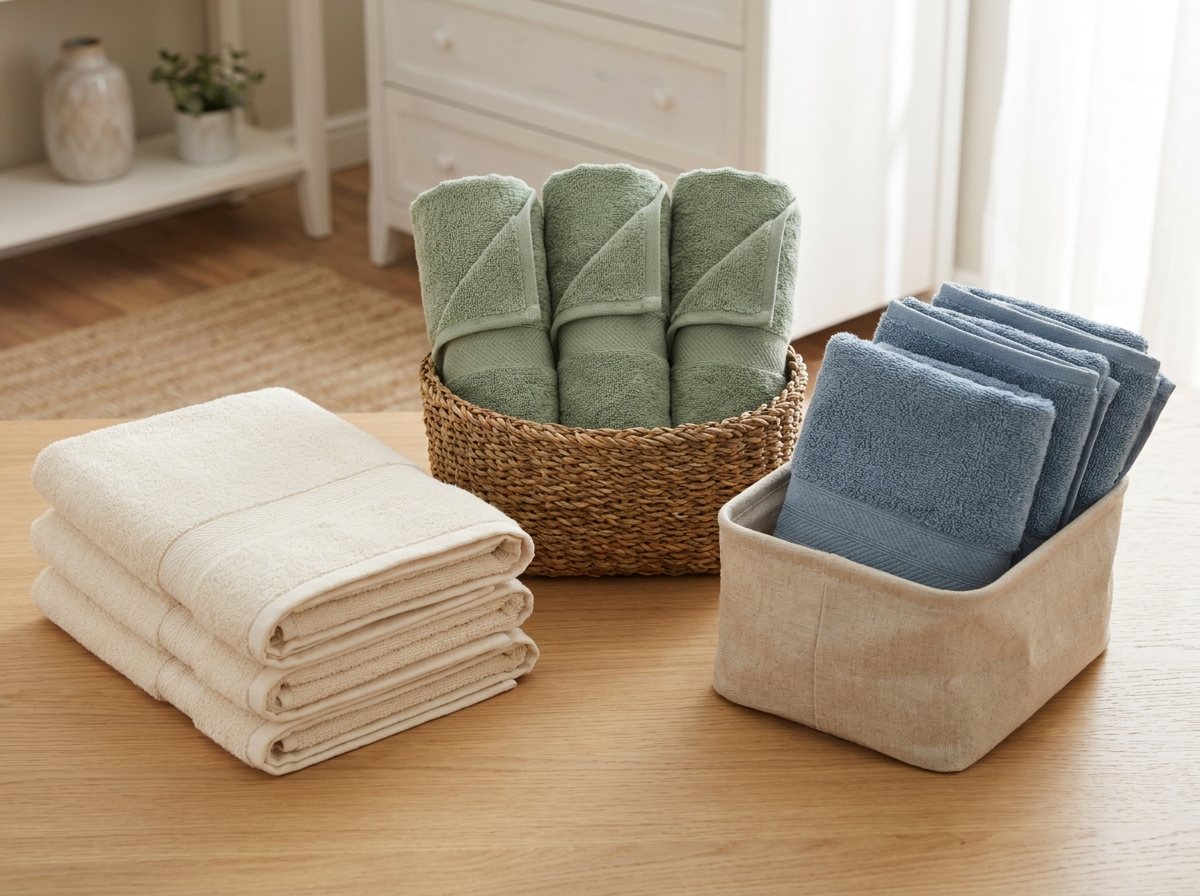
How you fold matters more than the number of shelves or the size of the bins. A well-folded towel takes up much less space than a loose one. A folded fitted sheet lies flat instead of taking over a shelf corner as a lumpy ball.
Towel Folding: Three Methods Compared
| Method | How | Difficulty | Best for | Needs a bin? |
|---|---|---|---|---|
| Tri-fold | Fold in half lengthwise, then in thirds; stack with the folded edge out. | Easy, and kid-friendly | Everyday towels | No |
| Spa roll | Fold in half lengthwise, then roll tightly and tuck the end. | Medium | Guest towels, deep shelves, upright baskets | Helpful |
| File fold | Fold into a narrow rectangle, then thirds; stand it upright. | Medium | Seeing every towel at once | Yes, or dividers |
Space savings vary with towel thickness, so treat any measurements as approximate.
My recommendation for families: Use the tri-fold for everyday towels, since it’s the fold your kids will actually do. Save the spa roll for guest towels or display. The file fold looks gorgeous in a bin but collapses without one.
How to Fold a Fitted Sheet: A Step-by-Step Truce
The fitted sheet has terrorized families long enough. Here’s a method that doesn’t require origami-level precision:
- Hold the sheet inside-out with your hands in two adjacent corners (the elastic pockets on your hands).
- Bring your right hand to your left hand and tuck the right corner over the left corner, so they’re nested.
- Repeat with the bottom two corners — same nesting motion.
- Now bring all four corners together so you have a neat-ish rectangle with all the elastic contained in one corner.
- Lay it on a flat surface (the bed works great). Smooth it into a rectangle.
- Fold into thirds lengthwise, then into thirds again. You’ll end up with a compact rectangle about the size of your folded flat sheet.
Will it be as crisp as the flat sheet? No. Elastic and curved edges resist precision. But this fold lies flat, stacks neatly and takes up about the same space as the flat sheet. You’re aiming for stackable, not perfect.
The Pillowcase Bundle Trick
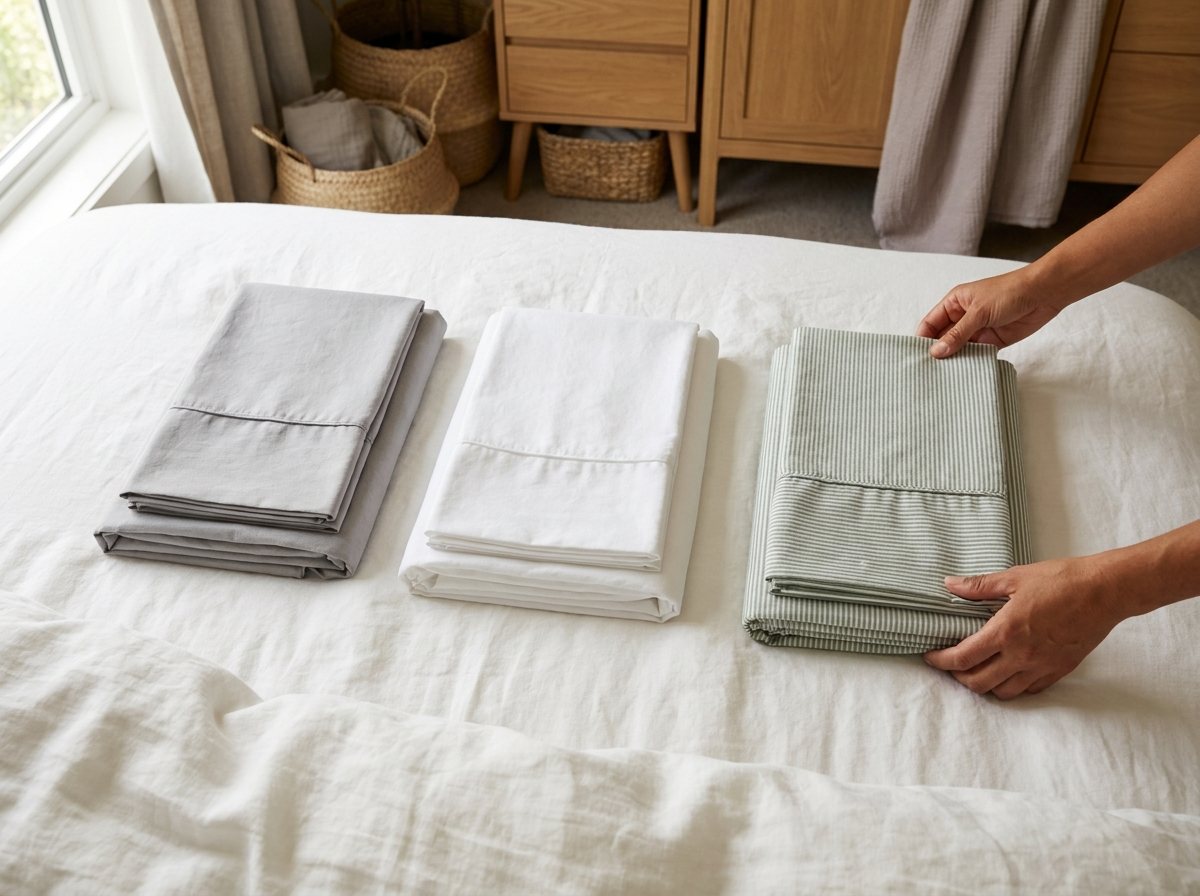
TipThis is my favorite linen closet trick, and once the sheets are folded it takes about ten seconds per set.
- Fold both sheets. Fold the flat sheet and the fitted sheet as described above.
- Stack them. Put the two folded sheets together.
- Grab a pillowcase. Take one of the matching pillowcases.
- Fit the stack. Fold the stacked sheets in half so they fit inside the pillowcase.
- Close it up. Tuck them in and fold the pillowcase flap over.
You now have one self-contained bundle per sheet set. No more hunting for the matching fitted sheet. The pillowcase pattern tells you which set it is.
Color Coding and Labeling for Families
If you have multiple kids in the same bed size, or you want a system that makes it easy to put things back, color coding helps.
The Color-Coded System
Assign each family member (or each bedroom) a color. This works especially well for towels and sheets.
| Family Member | Towel Color | Sheet Set Color/Pattern |
|---|---|---|
| Parents’ room | White or cream | Neutral solid or subtle stripe. |
| Child 1 | Sage green | Green or green-accented pattern. |
| Child 2 | Dusty blue | Blue or blue-accented pattern. |
| Guest | Gray | Gray or white. |
When everything has a color, anyone in the family can put towels and sheets away without asking. The sage towel goes with the sage towels, and the blue sheets go in the blue bundle.
This helps kids who are learning to do their own laundry. They can sort and shelve their own linens without knowing which twin set belongs to which room.
Not ready to give up an all-white towel look? Color-code only the bath towels and keep hand towels and washcloths white. Bath towels are the ones that get mixed up, while hand towels stay in their own bathrooms anyway.
Labeling
Labels help most on bins and baskets on high or low shelves, where you can’t see inside. Pick the style that suits you.
- Clip-on basket labels are removable, look clean and are easy to update.
- Label maker strips are the classic choice and stick to most surfaces.
- Chalkboard tags are reusable and suit a neutral look.
- Handwritten cardstock tags tied to basket handles are free and charming.
Label everything that isn’t immediately obvious. “Guest sheets — queen,” “First aid,” “Beach towels,” “Extra pillowcases.” Future you, rummaging at 11 PM because the kid threw up on their sheets, will be grateful.
Storage Products at Three Budget Tiers
You don’t need to spend a fortune to organize a linen closet. The right containers do help the system hold up, so here are picks at three price points.
Budget Tier: Under $30 (Pick Two or Three)
You probably already own half of these or can find them at Dollar Tree and Target. Prices throughout are approximate.
- Pillowcase bundles for sheet sets (free, using what you have).
- Shelf dividers ($8-12 for a pack of 4, acrylic or wire). They clip onto shelves and keep towel stacks from toppling into each other.
- A few dollar-store baskets for washcloths, first aid and small items.
- An over-the-door shoe organizer ($5-8) for bandages, stain sticks and other small supplies. The clear-pocket kind lets you see everything. If you have a child under 4, use only the top pockets.
- Rubber shelf liner ($5-8 per roll) to stop items sliding on wire shelves.
- Labels, which can be as simple as masking tape and a marker.
This tier works if: your shelves are decent and you just need containment. To make inexpensive bins look polished, see our guide to making cheap organization look expensive.
Mid-Range Tier: $30-100
This tier suits most families. The containers look good and last for years.
- Matching fabric bins with labels ($20-35 for a set of 4-6). Choose a neutral like cream, gray or natural linen. Use them on the top shelf for seasonal items and the bottom shelf for toilet paper and pillows. The matching set looks calm right away.
- Bamboo shelf dividers ($15-20 for a set). They’re sturdier and better-looking than wire or acrylic, and they don’t slide on most shelves.
- Small handled baskets ($10-15 for 2-3) for washcloths, hand towels and bathroom backstock.
- A door-mounted organizer ($15-25) with pockets or baskets, made for linen closets or pantries. It’s sturdier and better-looking than the shoe organizer.
- An adhesive label maker ($15-20, like the DYMO LetraTag) for clean, consistent labels.
This tier works if: you want the closet to look designed, not just tidied.
Investment Tier: $100-250+
Treat the linen closet like part of your home design. This tier is worth it if the closet is visible, since hall linen closets get opened in front of guests.
- Custom shelf inserts or extra shelving. Plan on $30-80 for adjustable shelf brackets and melamine boards, or $50-150 for a closet system kit like ClosetMaid or Rubbermaid. Adding a shelf or adjusting heights to fit your inventory often makes the biggest difference.
- Uniform woven or fabric bins ($40-70 for a set of 6-8) from brands like Open Spaces, mDesign or The Container Store’s own line. Keep the material, size and color consistent.
- Drawer inserts or pullout baskets ($20-40 each) for deep closets. On deep shelves, items get pushed to the back and forgotten, and pullout baskets help a lot.
- Cedar blocks or lavender sachets ($10-15) for a sensory touch, on high adult shelves only and never in kids’ bedding or near cribs.
- Integrated lighting ($15-30 for a plug-in or rechargeable LED strip or puck lights). Many linen closets have poor lighting or none at all. A motion-activated strip on the top shelf makes everything easy to see.
Safety firstMany battery lights use button or coin cells, which cause severe internal burns if swallowed. Choose lights with a screw-secured battery compartment, lock away spare batteries, and get emergency care right away if a child swallows one.
This tier works if: you’ve committed to the system and want it to last for years.
Adding Non-Linen Items (Without Creating Chaos Again)
Most family linen closets store more than linens, and that’s fine. The problem is non-linen items living there with no containment or designated space. Let’s fix that.
| Item | Where it lives | Why |
|---|---|---|
| Bandages, gauze, thermometer | Top door pockets or a labeled bin on an adult shelf | Needed fast, but small pieces are a choking risk for kids under 4. |
| Medicines and vitamins | Locked box, out of sight | Child-resistant caps are not childproof. |
| Cleaners | Locked box on the top shelf, or a locked cabinet | Poisonous, and leaks can reach linens. |
| Humidifier, heating pad | Lidded bin on the upper-middle shelf | Cords stay coiled inside, out of kids’ reach. |
| Toilet paper, extra pillows | Bottom shelf | Soft and harmless, so fine at kid height. |
| Bathroom backstock | One labeled bin, high or locked if kids are under 6 | The bin sets the limit. |
First Aid and Medications
Dedicate one bin or shelf section to first aid. When a kid comes in bleeding from a playground fall, you want bandages and gauze in one predictable spot. Split the kit in two: quick-grab supplies, and medicines that stay locked up.
Quick-grab supplies, on an adult shelf or in the top door pockets:
- Adhesive bandages in multiple sizes (kid-themed ones get used more willingly).
- Gauze pads and medical tape.
- Thermometer.
- Tweezers.
- Elastic bandage (ACE wrap).
- Ice pack (instant or reusable).
Medicines, locked up and out of sight:
- Antibiotic ointment and hydrocortisone cream.
- Children’s and adult pain relievers.
- Allergy medicine your pediatrician recommends. Ask which one and the right dose for your child’s weight. Never give diphenhydramine to a child under 2 or to help a child sleep.
- Vitamins and supplements.
Safety firstLock up all medicines and vitamins, out of sight and reach. Store cleaners the same way, plus soap and shampoo refills if you have kids under 6. Never keep any of them on the bottom shelf or the door, because kids climb and child-resistant caps are not childproof. Re-close the cap after every use and return each item to its locked spot right away. Overdoses of children’s pain relievers can be serious, even fatal. Doses go by weight and age, so ask your pediatrician or pharmacist. Poison Help: 1-800-222-1222.
For more on the medicine side, our medicine cabinet organization guide covers safe storage in detail.
Bathroom Supply Backstock
Bulk toilet paper, extra soap, shampoo refills, toothbrushes and toothpaste tend to end up in the linen closet. The key is containment and limits.
- Give bathroom backstock one bin and no other space. When it’s full, stop buying.
- A small turntable (lazy Susan) works well for toiletries, since you can spin it to see everything.
- If you have kids under 6, keep that bin, and any concentrated soap or shampoo refills, on a high shelf or locked.
- Toilet paper can stack on the bottom shelf or the closet floor if space is tight.
If the closet keeps absorbing overflow from a crowded bathroom counter, the fix may be in the bathroom. Our bathroom counter organization guide shows how to set it up so less ends up in the linen closet.
Cleaning Supplies
Cleaners need the most care in a closet kids can open. Keep them in a locked box on the top shelf or in a locked cabinet, never on the bottom shelf. Keep them apart from linens, food and medicine so a leak can’t reach your towels.
Keep the quantity minimal: all-purpose cleaner, bathroom cleaner, and a pack of microfiber cloths.
Safety firstNever mix bleach with ammonia or acidic cleaners. The fumes are toxic. Never use mothballs either; they’re poisonous.
What Should NOT Live in the Linen Closet
Even with the best organization, some items don’t belong here:
- Tools. The screwdriver from fixing the towel bar belongs in the toolbox.
- Electronics, like phone chargers and random cables.
- Snacks or food. It happens more often than you’d think.
- Seasonal decor. Give it another closet or a spot in the garage.
- Clothing. Off-season clothes belong in bedroom closets. If space is tight, the seasonal clothing storage guide shows how to store kids’ off-season clothes without taking over the linen closet.
How to Keep a Linen Closet Organized
A closet you organize on a Saturday can slide back into clutter within a few months. Keeping it tidy isn’t about willpower. It’s about tying small habits to routines you already have.
The “One In, One Out” Rule
When a new towel or sheet set comes home, an old one leaves. No exceptions.
Bought new bath towels in a holiday sale? Decide which old ones they replace, and move those to the donation bag the same day. This one rule stops the slow build-up that caused the chaos in the first place.
The Seasonal Check (15 Minutes, Twice a Year)
Twice a year, when you swap seasonal bedding in spring and fall, do a quick closet audit.
- Pull out seasonal items you’re rotating, such as the winter comforter out and summer blankets in.
- Check towel condition — any threadbare, stained, or musty? Replace and discard.
- Check sheet sets — still have the right sizes for current beds? Any worn-out fitted sheets?
- Check first aid supplies — expired medications? Used up Band-Aids? Restock what’s needed.
- Check backstock — do you still need six bottles of hotel shampoo? (No.)
While you’re there, refold anything that’s gotten sloppy, fix labels and wipe down the shelves. Fifteen minutes twice a year keeps the closet from reaching the “whole Saturday” stage again.
The Laundry-Day Integration
Laundry day is the easiest time to keep the linen closet in shape. You’re already handling the towels and sheets, so that’s the moment to put them back neatly.
Build the linen closet into your laundry room workflow so folding and shelving linens is part of laundry, not a separate task. Folding, bundling and shelving a sheet set takes about two minutes. A load of towels takes maybe three.
Putting linens back neatly instead of shoving them in is what makes the system last.
Get the Family Involved
If you’re the only one who puts linens away correctly, you’re the bottleneck, and you’ll burn out. Teach the system to everyone.
- Show kids where their sheets and towels live. Color coding makes this easy.
- Teach one folding method and accept imperfection. A slightly crooked tri-fold still stacks. Try not to refold behind them, so they keep helping.
- Make sheet-changing a shared chore. Most kids can help pull sheets off a floor-level bed around age 5 or 6, with an adult nearby. Every child is different, so adjust as they grow.
- Keep some jobs for adults. Kids under 6 shouldn’t lift heavy bins or handle the humidifier and heating pad cords.
- Post a simple visual guide inside the closet door, like a photo or drawing of how the closet should look. Then nobody can say they didn’t know where something went.
Safety firstChildren under 6 should not sleep on a top bunk. An adult should change top-bunk and loft bedding, and supervise anything involving a bunk or ladder.
Seasonal Linen Rotation
In climates with real seasons, what you need on hand shifts through the year. Here’s a simple rotation.
| Season | Bedding | Towels | Restock |
|---|---|---|---|
| Spring (March-April) | Lighter quilts; swap flannel for percale or cotton; check stored wool for moths. | Beach towels stay on the top shelf. | Sunscreen (kept high, with the other supplies). |
| Summer (June-July) | Lightest bedding; store extra blankets until October. | Beach towels on an accessible shelf. | Sunscreen and bug spray (kept high). |
| Fall (September-October) | Warmer bedding; flannel sheets if you use them. | Beach towels back to the top shelf. | Cold and flu supplies (medicines locked up). |
| Winter (December-January) | Heaviest bedding; a backup blanket per bed for kids over 12 months; sleep sacks for babies under 12 months. | Beach towels stay on the top shelf. | Holiday table linens (top shelf the rest of the year). |
Neutral Linen Closet Styling Ideas
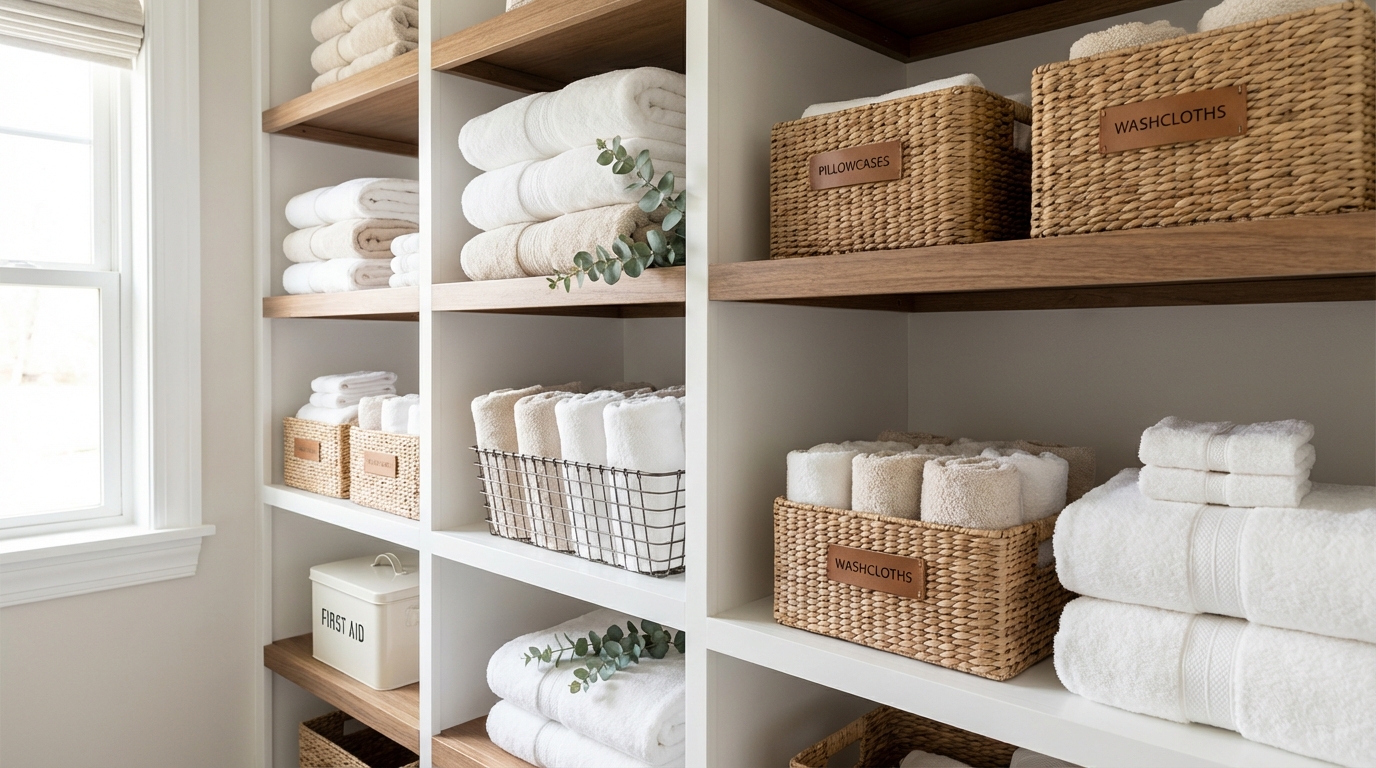
A closet that looks good is more motivating to maintain than one that’s merely functional. If you like your home to feel calm and intentional, the linen closet is worth designing, not just organizing.
The Neutral Palette Approach
If you’re choosing new towels or replacing worn ones, go neutral. White, cream, warm gray, sage, or dusty blue all photograph beautifully and create visual calm when stacked. A closet of coordinating neutrals reads as organized even when the folding isn’t perfect. Consistent color forgives inconsistent folds.
You don’t need to replace everything at once. As towels and sheets wear out, replace them within your chosen palette. Within a year or two, you’ll have a coordinated closet that happened gradually.
Design Touches That Make a Difference
- Shelf liner in a subtle pattern, like grasscloth, linen texture or a thin stripe.
- Matching bins. Even two or three in the same material make the shelves look pulled together.
- A small faux plant, such as eucalyptus or pothos, if there’s room.
- Cedar rings or lavender sachets, on high adult shelves only.
- Good lighting. A rechargeable puck light or LED strip turns a dark cave into a space you enjoy opening.
The same idea works all over the house. Our guide to multi-functional furniture for families follows the same principle: things can be beautiful and hardworking.
Neutral Nina
Neutral Nina is an interior design enthusiast and mom of three who proves that beautiful, organized spaces and family life can coexist. She shares practical strategies for creating calm, functional homes that work for kids and grown-ups alike.
Frequently Asked Questions
How often should I wash towels and sheets?
These are guidelines, not rules. Wash towels every 3-4 uses and sheets weekly, and check the care label. Wash kids’ sheets more often during illness, allergy season and potty training.
Wash mattress protectors every 1-2 months, or as the care label says, and right after any accident. Wash linens soiled by illness right away on the hottest setting the care label allows.
The counts in this guide (3 bath towels per person, 2 sheet sets per bed) assume this schedule and a laundry day every few days.
What’s the best way to store extra comforters and bulky blankets?
Use large, breathable cotton or canvas storage bags rather than vacuum bags, which can damage down and some synthetic fills. Store them on the top shelf of the linen closet or a bedroom closet, and keep bags out of children’s reach.
Make sure everything is clean first, because stains set during long storage.
My linen closet has wire shelves and everything slides around. How do I fix this?
Cut thick, rubberized shelf liner to fit each shelf so items stop catching on the wire grid. Then use bins and baskets instead of stacking linens directly on the wire.
For a sturdier fix, have melamine or wood covers cut to size at a hardware store, lay them on the wire, and add liner on top.
Should I store linens in the linen closet or in the room where they’re used?
Both work, so let your layout decide. A central linen closet suits homes where bedrooms and bathrooms are close together.
If the closet is downstairs and the bedrooms are upstairs, keep each bed’s sheets in that bedroom. Keep active towels in the bathroom, and use the linen closet for backstock and extras.
How do I deal with kids who have strong opinions about their bedding (character sheets, specific blankets, etc.)?
Let them have their favorites, within reason. One character sheet set and one neutral set per bed is a fair compromise. The beloved blanket stays on the bed or gets its own shelf spot.
You’re managing quantity, not taste. If your child wants a Minecraft sheet set, that’s fine, but it replaces the outgrown Paw Patrol set instead of adding to it. The “one in, one out” rule applies to kids’ bedding too.
What about linen closets in small homes or apartments where space is very limited?
Spread the storage out. Keep current sheet sets in flat under-bed bins and extra blankets on bedroom closet top shelves. Towels can live in the bathroom on a wall shelf, in a basket under the sink or on a narrow tower anchored to the wall.
A hanging organizer can turn a few inches of closet rod into a mini linen station. Store things near where they’re used, and keep only what you need.
How do I keep linens smelling fresh in a closed closet?
Make sure linens are bone dry before shelving, and don’t pack them so tightly that air can’t move. Leaving the door cracked open helps.
For scent, use cedar blocks, lavender sachets or dryer sheets on high adult shelves only. Keep them out of children’s bedding and reach, especially under age 4. Never use mothballs, which are toxic.
For a musty closet, try a small rechargeable dehumidifier. If you use moisture-absorbing crystals, put them in a leak-proof container on a high shelf, since the liquid can be corrosive.
Linen Closet Action Plan (Checklist)
If this guide feels like a lot, here is the short version. The Linen Closet Reset Planner printable puts it on paper: a count worksheet, a shelf map and cut-out labels you can tape inside the closet door.
Weekend 1: The Purge (60-90 minutes)
- Pull everything out.
- Sort into categories.
- Discard stained, worn and excess items using the quantity guide.
- Clean the empty shelves.
Weekend 2: The Setup (45-60 minutes)
- Fold all items using your chosen method.
- Bundle sheet sets in pillowcases.
- Arrange by shelf zone (top: seasonal, middle: daily use and appliances, bottom: toilet paper and pillows only).
- Add shelf dividers, bins and labels.
- Add a child-proof latch to the door if you have kids under 6.
Ongoing: The Maintenance
- Fold and shelve neatly on laundry day (2-3 extra minutes per load).
- One in, one out for all new purchases.
- 15-minute seasonal check twice a year.
- Teach the family the system.
You don’t need an expensive closet system or a professional organizer. You need a count of what you own, a plan for where it goes and a few habits to keep it there.
Now go open that closet. You know what to do.