

Christmas Planning Checklist for Families: An 8-Week Timeline
Two Decembers ago, I stood in the hallway at 9:40 on the night of the 23rd with a roll of kraft paper in one hand and a very large, unwrapped dinosaur in the other. The turkey was “spoken for,” the guest bed was stacked with laundry, and my best hiding spot was where the grandparents would hang their coats.
Nothing was a disaster. Every job was small, and every job landed in the same week.
This is an 8-week timeline that starts Friday, October 30, 2026. It has a week-by-week table, time estimates, who can help, a one-page checklist, and a free printable.
In this article (16 sections)
- The 8-Week Christmas Planning Timeline at a Glance
- Why Eight Weeks (and Not Four, or Twelve)
- Week 8 (Oct 30 – Nov 5): Decide Before You Do
- Week 7 (Nov 6 – 12): The Toy Purge and the Big Orders
- Week 6 (Nov 13 – 19): Guest Room, Hiding Spots, and Wrapping Supplies
- Week 5 (Nov 20 – 26): The Thanksgiving Pause
- Week 4 (Nov 27 – Dec 3): Decor Up, Cards Written, First Wrapping
- Week 3 (Dec 4 – 10): The Food Order and the Wrapping Push
- Week 2 (Dec 11 – 17): Last Shipping Window and Fridge Prep
- Week 1 (Dec 18 – 24): Finish Gently
- Christmas Planning Checklist for Families: 8 Weeks Out
- Making the Timeline Fit Your Family
- Calm December Habits for Busy Families
- After Christmas: A Quick Note for Next Year
- Frequently Asked Questions
- A Calmer December Starts Now
The 8-Week Christmas Planning Timeline at a Glance
Copy this table into your notes app, paste it into a shared document, or screenshot it for your phone. Further down there’s a one-page checklist version you can print straight from this page.
Dates are for Christmas 2026 (Friday, December 25). If your Christmas falls on a different day, count back from it and slide everything accordingly.
| Week | Dates (2026) | What to do | How long it takes | Who can help |
|---|---|---|---|---|
| 8 | Oct 30 – Nov 5 | Set the budget, write gift lists, pick your traditions, put every date on one calendar | 2 hours total, split over the week | Partner for budget and calendar; kids for wish lists |
| 7 | Nov 6 – 12 | Toy audit and purge, donation drop, order the big gifts | 2–3 hours plus a drop-off errand | Kids for sorting; partner for the drop-off |
| 6 | Nov 13 – 19 | Guest room reset, linens washed, clear gift-hiding spots, buy wrapping supplies | 3 hours over two sessions | Partner for bed and linens; older kids for supply inventory |
| 5 | Nov 20 – 26 | Thanksgiving week: keep it light. Draft the Christmas menu, check shipping dates, locate decor bins, test light strings | 55 minutes | Whoever is hosting or traveling |
| 4 | Nov 27 – Dec 3 | Decor goes up with a safety check, holiday cards written, first round of wrapping | 3–4 hours spread over a weekend | Kids for tree and ornaments; partner for lights |
| 3 | Dec 4 – 10 | Place the food order, finalize guest plans, wrap and hide everything that has arrived | 2 hours plus a phone call | Partner for wrapping; older kids as gift-tag writers |
| 2 | Dec 11 – 17 | Last shipping window, mail cards, freezer and fridge clear-out, bake-and-freeze, outfit check | 3 hours over the week | Kids for baking; partner for the fridge |
| 1 | Dec 18 – 24 | Pick up shelf-stable items, fresh poultry on Dec 23, bakery items on Dec 23–24, set the table, final tidy, Christmas Eve basket | 1–2 hours a day | Everyone, with small jobs assigned |
Notice that the heaviest physical jobs (the toy purge, the guest room) sit early. That’s deliberate, and it’s the whole idea. The last week should be for cooking, wrapping the final few things, and being around your people, not for hauling bins.
Why Eight Weeks (and Not Four, or Twelve)
Most Christmas lists are one long column of tasks with no sense of when. The toy purge needs a calm weekend, the food order has a deadline nobody mentions, and wrapping needs a hiding place that exists before the gifts arrive. If you’re asking when to start planning for Christmas, the answer is about eight weeks out, which is Friday, October 30 in 2026.
Four weeks sounds like plenty until you count the weekends. In 2026, Thanksgiving falls on November 26, so there are only four weekends between Thanksgiving and Christmas. Most are already booked with a concert, a party, or family.
The jobs that need a clear block of time, like purging toys or resetting a room, have nowhere to go.
Twelve weeks tips the other way. Start in early October and you carry the plan in your head for two months. You also buy things you then lose track of, and you tire of the season before it begins.
Eight weeks works because of how the jobs cluster:
- Weeks 8 to 6 are for decisions and house work. Nothing festive yet, which means nothing feels rushed or sentimental.
- Week 5 is a deliberate pause around Thanksgiving. You do almost nothing, on purpose.
- Weeks 4 to 3 are the visible part: decor, wrapping, food.
- Weeks 2 to 1 are the finishing and the enjoying.
Week 8 (Oct 30 – Nov 5): Decide Before You Do
The first week has almost no physical work. It’s about making the handful of decisions that every later job depends on. If you skip it, you’ll make those same decisions repeatedly, tired, in December.
Set the budget and the number
Decide one total number for gifts, food, travel, and extras, then split it roughly. The split doesn’t need to be fancy. A simple version is a gift number per person and one lump for food and hosting. Write it down somewhere both adults can see it. The command center in your kitchen is a good home for it. If you don’t have one yet, a family command center is worth setting up before the holiday calendar fills in. This season produces more paper and more dates than any other.
Write the gift lists (and cap them)
For each child, I like a short, structured list rather than an open-ended wish list. The classic version is four categories: something they want, something they need, something to wear, something to read. It keeps volume down, which matters more than you’d think for the toy-storage question coming in week 7.
Ask the kids for their wishes now, while it’s still October and nothing feels urgent. Ask once and write down what they say. Then listen again in two weeks; the list almost always shifts, and what survives is what they genuinely want.
Pick your traditions
This is the step nobody puts on a checklist, and it’s the one that saves the most energy. Sit down with the family and ask: which three things make it Christmas for us? Maybe it’s the tree, the Christmas Eve pajamas, and a particular breakfast. Everything beyond those is optional, and you’re allowed to skip it.
When I skipped this step, I ended up doing every activity on every list and felt worn thin by the 20th.
Put every date on one calendar
School concerts, party invites, travel days, when guests arrive, when relatives leave, the last day of school, the last shipping day for any online order. Put it all in one place. Then circle two or three evenings that are deliberately empty, and don’t give them away.
Week 7 (Nov 6 – 12): The Toy Purge and the Big Orders
This is the job that most reliably gets postponed and most reliably causes trouble in the final week. New toys arrive around December 25 whether or not there’s room for them. If the toy shelves are already full, those toys land on the floor.
The aim is not a minimalist playroom. It’s making enough room for what’s coming.
A toy audit that doesn’t cause a meltdown
Here’s the approach that works best in a home with young kids:
- Do it while they’re at school or asleep for the first pass. Pull out the obvious: broken pieces, puzzles missing parts, the toy with dead batteries that no one has touched since spring, and anything outgrown.
- Sort into four boxes: keep out, rotate away (store for later), donate, and toss.
- Involve the kids in the second pass. Hold up the “donate” candidates only if the child is old enough to enjoy the choice. For younger children, I don’t ask permission for items they haven’t played with in months. A toy that’s been ignored since August won’t be missed in November.
- Don’t permanently remove anything that is loved. If a child asks about something, it goes back. It’s their space, too.
| Box | What goes in it |
|---|---|
| Keep out | Current favorites and what’s played with weekly |
| Rotate away | Good toys to store and bring back later |
| Donate | Outgrown, ignored, and complete and working |
| Toss | Broken, missing parts, dead and beyond repair |
Want a framework for how much to keep out? This guide to how many toys to keep out at once walks through the numbers by age.
The short version: fewer toys out means better play and an easier tidy-up, and it gives the new gifts somewhere to live.
Make the donation actually leave the house
A bag of donations sitting in the hallway for three weeks isn’t a donation. It’s a pile. Decide the drop-off moment before you start sorting: Saturday, after lunch, on the way to the grocery store. Put the bags in the car the same day. If your local charity has a pickup option, schedule it now.
Do the same for kids’ clothes, lightly
Check the winter coats, boots, and anything a child will need for holiday photos or a concert. You’re not doing a full wardrobe overhaul. You’re finding the coat that doesn’t fit while there’s still time to replace it. If you’ve already done a seasonal swap, this is a five-minute check.
Place the big orders
Anything large, backordered, or personalized should be ordered this week. Bikes, play kitchens, anything that ships from a small shop, and anything you’d be upset to receive after the 25th. Put the expected delivery date next to the item on your list. When it arrives, it goes straight to its hiding spot (which you’ll set up in week 6).
Good to knowWeek 7 takes two to three hours of sorting, plus a drop-off errand. Split it across a weekend if you need to. Take the batteries out of any toy you donate or retire, and store spares out of reach.
Week 6 (Nov 13 – 19): Guest Room, Hiding Spots, and Wrapping Supplies
If anyone is staying with you, this is the week to deal with the room. And whether or not you have guests, this is the week to solve the problem of where the gifts will hide.
Reset the guest room
The guest room is almost always the spot where the family’s overflow quietly collects: laundry, the exercise bike, wrapping paper from last year, the box of keepsakes. Clear it now, before the clutter has a deadline.
A simple reset:
- Strip and wash the bedding. Fresh linens now, then re-make the bed closer to arrival, or just cover it with a clean sheet so it stays fresh.
- Clear one empty surface and one empty drawer or a few empty hangers. Guests unpack in layers; a bare surface and a spot to hang a coat matters more than a basket of toiletries.
- Check the basics. A working lamp, a spare charger, an extra blanket, a trash bin, water.
- Keep it light on decor. One neutral throw and a small stem or sprig in a vase is enough.
If your guest room doubles as a nursery or a toddler’s overnight spot, there are some good ideas for a guest room and crib combination that keep both uses working without turning it into a storage unit.
Find (and protect) your hiding spots
Here’s where my own hallway panic came from. Pick your hiding places now, check who else uses them, and decide on a plan for each category of gift.
Good hiding spots share three qualities: they’re out of sight, out of reach, and not in anyone’s daily path. Options that have worked for families I know:
- The top shelf of a closet that is not the coat closet.
- A lidded bin in the garage or a storage area, labeled with something dull like “tax papers.”
- Covered storage on a high closet shelf or under an adult bed, using a lid that doesn’t latch.
- A locked car, for small non-electronic items, in cooler weather.
- A friend’s or grandparent’s house for the biggest items.
Safety firstDon’t use a latching suitcase, trunk, or unlocked car where a climbing toddler could get in. Keep electronics and battery items out of a cold car.
For curious toddlers and older kids who snoop, rotate. Move items every week or so. And write down where everything is. I use a note on my phone titled with something boring, because nothing is more stressful than discovering in December that you can’t remember where you hid the thing.
Do a wrapping supply inventory
Take out whatever is left from last year. Check tape, scissors, tags, ribbon, and paper. Make a short shopping list and buy what you need once, rather than making repeat trips. Decide on a simple scheme. Kraft paper with natural twine is hard to beat for a calm look and is easy to replace in a pinch. If your children like to help, buy a few markers or stamps so they can decorate tags and plain paper themselves.
Set up a wrapping station: a clear table or the guest bed (now that you’ve cleared it), a lidded bin for supplies, and a trash bag taped to the side.
Safety firstKeep ribbon, twine, plastic bags, tape, and small tags out of reach of babies and toddlers. Never put ribbon or cord in or near a crib or on a child.
Week 5 (Nov 20 – 26): The Thanksgiving Pause
This is the week to do very little. Thanksgiving lands on November 26 this year, and between cooking, travel, and family, nobody needs a long Christmas to-do list on top of it.
Here’s the short list, about 55 minutes in total, including a 10-minute check of your lights and ornaments before anything goes up:
- Draft the Christmas menu. Don’t order anything yet. Just decide what you’re serving on Christmas Eve and Christmas Day, who’s coming, and what dietary needs you’re working around.
- Check shipping cutoffs. Look up the last-order dates for the retailers you use most. Note them on your calendar.
- Test the light strings. Plug each one in and discard any with frayed wires or dead sections.
- Locate the decor bins. Find them, bring them to a spot where you can reach them, and check whether anything needs replacing. If you want a plan for storing and retrieving decor in a way that makes this step painless, our holiday decor storage system has a labeling system that makes next year’s version a five-minute job.
Nothing else is due this week.
Week 4 (Nov 27 – Dec 3): Decor Up, Cards Written, First Wrapping
Black Friday weekend is when many families put up the tree.
Put the decor up with a safety pass
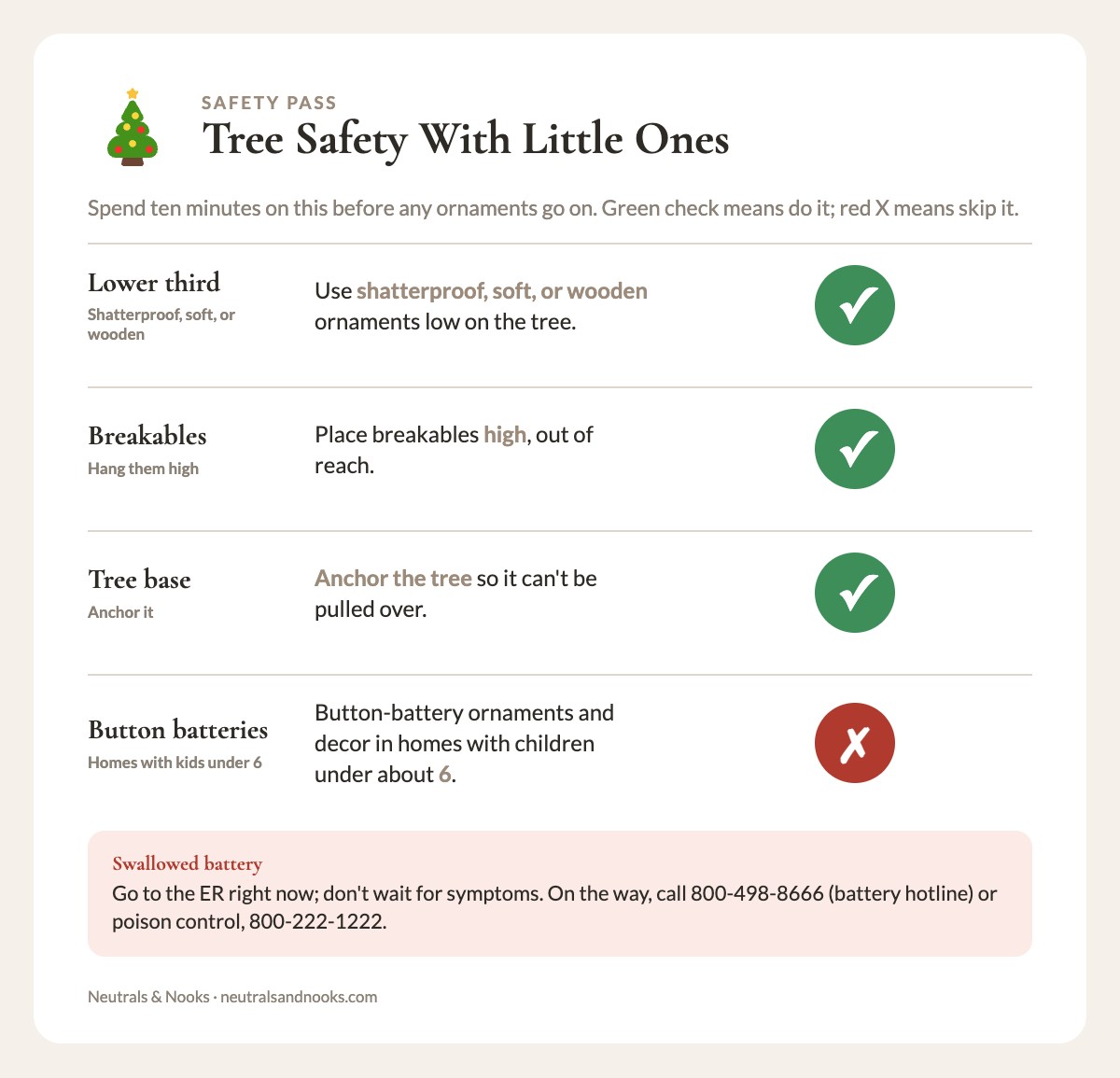
Before the ornaments go on, spend ten minutes on safety, especially if you have a baby, a crawler, or a toddler:
- Place breakables high. Keep the lower third of the tree for shatterproof, soft, or wooden ornaments.
- Check light strings for frayed wires and loose bulbs, use indoor-rated lights, don’t overload outlets, and keep cords out of a small child’s reach.
- Anchor the tree so it can’t be pulled over.
- Skip small button batteries and tiny loose pieces at toddler height.
Safety firstIf a child swallows a button or coin battery, go to the ER right now. Don’t wait for symptoms.
On the way, call the National Battery Ingestion Hotline at 800-498-8666 or poison control at 800-222-1222.
Avoid button-battery ornaments and decor in homes with children under about 6. Check that battery compartments are screwed shut, and store spare and used batteries out of reach.
There’s a longer list of room-by-room ideas in this guide to kid-safe Christmas decor, including what to do about candles, plants, and the ornaments that look exactly like candy.
Let the kids do the low branches
Give each child a zone and let them decorate it however they like. It won’t look like a catalog photo, and that’s fine. A calm palette helps. Keep the lights, base ornaments, and ribbon to a tight range of colors, such as warm white, natural wood, and one accent. The kids’ handmade ornaments will look charming against it instead of chaotic.
Keep the rest of the house simple
Choose two or three spots for decor beyond the tree: the mantel, the entry table, the kitchen windowsill. That’s enough. Every extra surface you decorate is a surface you will dust, un-decorate, and re-pack in January.
Write holiday cards
If you send them, write them this week while the energy from the weekend is high. Set up a little assembly line at the table with a pen, a list, stamps, and a mug of something warm. Keep the message short. Do ten and stop; finish the rest later in the week. If you haven’t gathered addresses, now is the time to text the people you’re unsure about and ask.
Wrap the first batch

Anything that has arrived by now, wrap it. Wrap it and put it straight into its hiding spot. Do this in small sessions. A pile of twenty unwrapped gifts is overwhelming; a pile of five is a pleasant evening.
Week 3 (Dec 4 – 10): The Food Order and the Wrapping Push
This is the week things get ordered. If you wait until week 1 for the food, the good options are already gone. That’s what happened with my turkey.
Place the food order
Use your draft menu from week 5. Call or order online for anything that has a limited supply or needs lead time:
- The main protein (turkey, ham, roast).
- Specialty bakery items such as pies, rolls, or a dessert.
- Anything from a local farm, butcher, or specialty shop.
- Any prepared dishes you don’t want to cook.
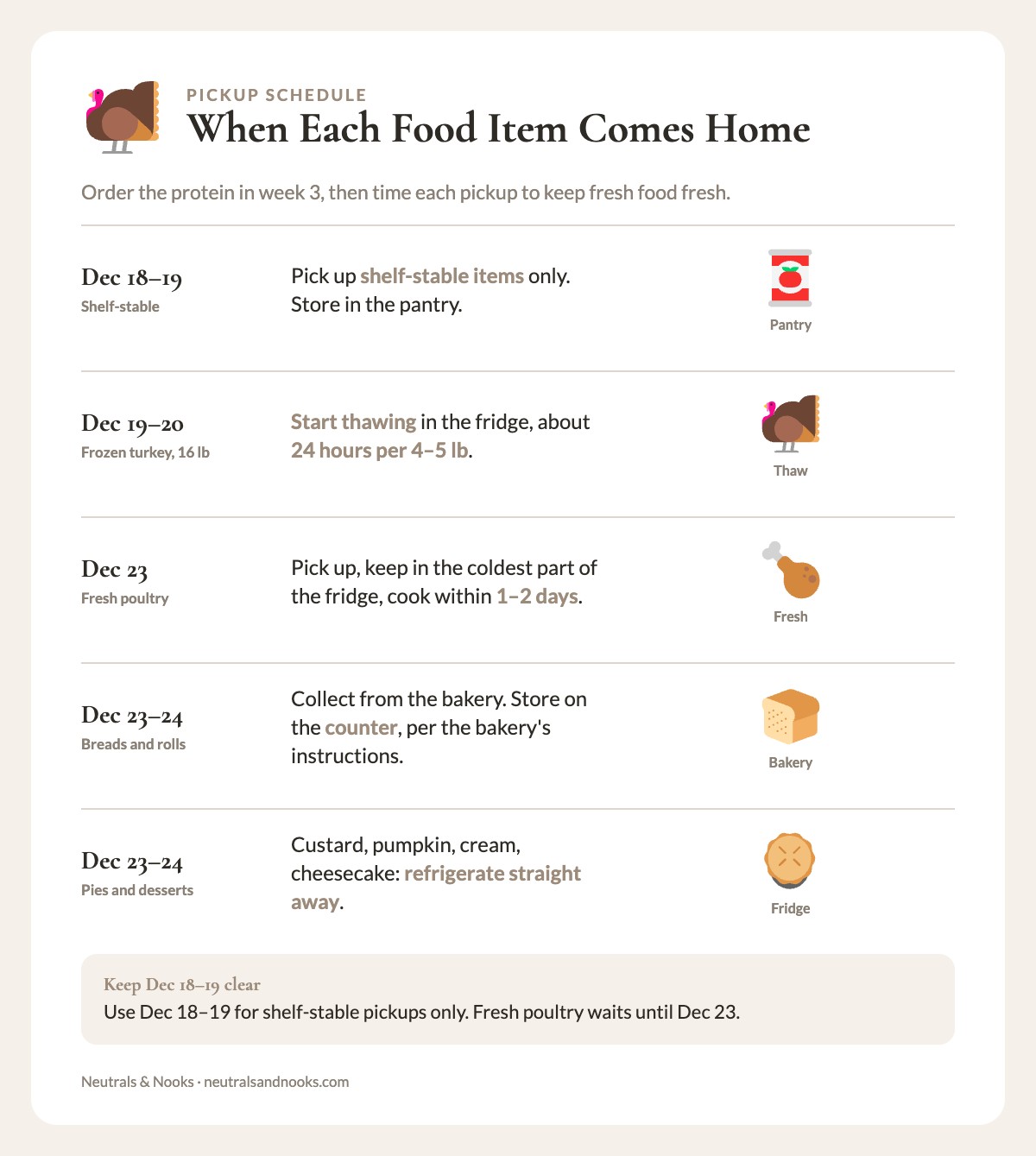
Good to knowOrder the protein now, but schedule fresh poultry pickup for Dec 23 (or Dec 24 for a Christmas Eve meal) and cook it within 1–2 days of purchase.
If you buy frozen, thaw it in the fridge at about 24 hours per 4–5 lb. A 16 lb bird starts thawing around Dec 19–20. Keep Dec 18–19 for shelf-stable pickups only.
Confirm pickup timing and storage with the bakery when you order. Collect bakery items on Dec 23–24. Pies and desserts with custard, pumpkin, cream, or cheesecake fillings go straight into the fridge.
| Item | Pickup or start date | Storage and safe window |
|---|---|---|
| Shelf-stable items | Dec 18–19 | Pantry |
| Frozen turkey (16 lb) | Start thawing Dec 19–20 | In the fridge, about 24 hours per 4–5 lb |
| Fresh poultry | Dec 23 | Coldest part of the fridge; cook within 1–2 days |
| Bakery breads and rolls | Dec 23–24 | Counter, per the bakery’s instructions |
| Perishable pies and desserts (custard, pumpkin, cream, cheesecake) | Dec 23–24 | Refrigerate straight away; use within the bakery’s stated window |
Ask for a pickup window and write it on your calendar and on the command center. Confirm the date a few days ahead, because small shops sometimes shift.
For the rest, make a grocery list sorted by store section, and split it into two: shelf-stable items you can buy now, and fresh items for the week of the 20th.
Finalize guest plans
Confirm arrival and departure times. Who needs a bed, who needs a crib, who is bringing a pet. Ask about allergies and dietary needs again. Decide who will cook which meals. Having this settled prevents last-minute calls to figure out who’s coming on which day.
Safety firstA borrowed or guest crib should meet current standards and be in good condition. Use a fitted sheet only, with no blankets, throws, bumpers, or toys, and keep cords and ribbon away from the sleep space.
Wrap and hide everything that has arrived
By now, most gifts should be at your house. Wrap them, label them (by a code, if you have snoopers; initials work well), and put them away. For gifts that are still on their way, track the delivery and note the date.
A tip that has saved me time: write the recipient’s name on the gift before wrapping. Then use a sticker or small tag for the label, so you never have to unwrap something to remember what it was.
Week 2 (Dec 11 – 17): Last Shipping Window and Fridge Prep
By this point, the house should look festive and the big jobs should be behind you. This week is for closing loops.
Make your last online orders
Most retailers have a last-order date for guaranteed delivery. Check yours and finish any remaining shopping by then. After that, shop in person or give a gift card with a handwritten note.
Mail the cards
If you wrote them in week 4, drop them in the mail now. Anything sent by mid-December will generally arrive before the 25th.
Clear out the fridge and freezer
This is the unglamorous task that saves the most stress. Throw out what’s expired, consolidate half-used jars, and make space on at least one shelf and a corner of the freezer for the food order and baked goods. If your refrigerator tends to be a jumble, there’s a more complete method in this fridge and freezer organizing system.
Bake and freeze
Cookie dough, rolls, and many casseroles freeze well. This is a good way to involve the kids: they roll and decorate, you handle the oven. Label everything with the date and reheating instructions.
Safety firstNo tasting raw dough or batter, because raw flour and eggs can carry E. coli and Salmonella. Wash hands after handling, and use heat-treated flour or an egg-free dough if kids will sample.
Check outfits and travel needs
If anyone needs a holiday outfit, check that it fits and is clean. If you’re traveling, make a packing list now rather than the night before.
Week 1 (Dec 18 – 24): Finish Gently
You’ve spread the work out, so this week is a few small jobs each day, not a marathon. Plan on one to two hours a day.
Day-by-day: Dec 18–24
- Dec 18–19: Pick up shelf-stable orders only. No fresh poultry or bakery items yet.
- Dec 19–20: If your turkey is frozen, start thawing it in the fridge (about 24 hours per 4–5 lb; a 16 lb bird needs about four days).
- Dec 20–21: Wrap any last gifts. Do a quick tidy of living areas. Set up the guest room with fresh towels and a small welcome basket.
- Dec 22: Final grocery run for fresh produce and dairy.
- Dec 22: Prep what can be prepped: chop vegetables, make the dessert, set out serving dishes with sticky notes saying what goes in each.
- Dec 23: Pick up fresh poultry and the bakery order, unless you booked the bakery for Dec 24. Refrigerate the poultry and any custard, pumpkin, cream, or cheesecake desserts straight away.
- Dec 23: Set the table. Put a few stems in a vase. Clear the entry so people can arrive without climbing over shoes.
- Dec 24: Fill a Christmas Eve basket for each child: snug-fitting or flame-resistant pajamas and a book.
- Dec 24: Add an age-appropriate treat that fits known allergies (no hard candy, whole nuts, or popcorn under 4).
- Dec 24: Lay out the gifts and charge the batteries. Then stop.
A few kid-height hooks and a basket by the door make arrivals easier, and this guide to mudroom cubbies for multiple kids shows how to size them.
Do the batteries and the tape
The two items that cause the most Christmas morning frustration are dead batteries and missing tools. Buy extra AA and AAA batteries now. Some toys need assembling, and a toy that can’t be used on Christmas morning is a bigger disappointment than one that arrives late.
Safety firstStore spare and used batteries out of reach. Keep the screwdriver and scissors in a high or latched spot, and bring them out only for assembly. Clear scissors, tape, and wrapping debris before the kids come in.
Christmas Planning Checklist for Families: 8 Weeks Out
The one-page version is below. Copy it into a note, or use the free 8-Week Christmas Planning Kit card on this page for the print-ready version.
Week 8 (Oct 30 – Nov 5): Decide
- Set the total budget and the gift number per person
- Write each child’s gift list (want, need, wear, read)
- Choose your three must-have traditions
- Put all dates on one calendar and protect two empty evenings
Week 7 (Nov 6 – 12): Purge and Order
- Audit toys: keep out, rotate, donate, toss
- Take donations to the car and drop them off
- Check winter coats, boots, and holiday outfits
- Order large or personalized gifts
Week 6 (Nov 13 – 19): Prepare the House
- Clear and reset the guest room
- Wash the guest bedding
- Choose and test your gift-hiding spots
- Take inventory of wrapping supplies and buy what’s missing
- Set up a wrapping station
Week 5 (Nov 20 – 26): Pause
- Draft the Christmas menu and guest count
- Note shipping cutoff dates
- Locate the decor bins
- Check lights and ornaments before anything goes up
- Enjoy Thanksgiving
Week 4 (Nov 27 – Dec 3): Decorate
- Put up the tree and anchor it
- Do a safety pass on lights, cords, batteries, and low ornaments
- Decorate two or three extra spots only
- Write holiday cards
- Wrap and hide the first batch of gifts
Week 3 (Dec 4 – 10): Order and Wrap
- Place the food order and note the pickup window
- Confirm guest arrival and departure times
- Ask again about allergies and dietary needs
- Wrap and hide everything that has arrived
Week 2 (Dec 11 – 17): Close Loops
- Place last online orders before the cutoff
- Mail holiday cards
- Clear the fridge and freezer
- Bake and freeze make-ahead items
- Check outfits and make a packing list if traveling
Week 1 (Dec 18 – 24): Finish Gently
- Pick up shelf-stable items (Dec 18–19)
- Start thawing a frozen turkey in the fridge (Dec 19–20 for 16 lb)
- Pick up fresh poultry on Dec 23 and bakery items on Dec 23–24
- Refrigerate perishable pies and desserts straight away
- Final grocery run for fresh items
- Set up the guest room with towels and a welcome basket
- Prep what can be prepped and set the table
- Buy batteries and keep tools out of reach until assembly
- Fill Christmas Eve baskets
- Stop and sit down
Making the Timeline Fit Your Family
A plan only helps if it fits your actual life. Here’s how to adapt this one.
If you’re starting late
Skip ahead to the week you’re in and fold the earlier tasks into it, in this priority order:
- The food order (it has a deadline).
- Shipping cutoffs (they have deadlines too).
- The hiding spots and wrapping.
- The toy purge (do a quick version: ten minutes, one bag).
- Everything else.
The first two are the ones that cannot be rescued after the fact. The rest can be done imperfectly and nobody will know.
If you’re hosting a large group
Add two weeks of lead time for anything involving guests: renting or borrowing extra chairs, borrowing a second set of dishes, arranging sleeping spots. Move the guest room reset to week 7 and the food order to week 4.
If you’re traveling for Christmas
Most of the house jobs shrink, but the logistics grow. Book transport as early as you can, and put “pack gifts” and “ship gifts ahead” on the week 4 list. Skip full-house decor; one small tabletop tree and a string of lights can carry the season.
If your family celebrates across two households
Make two copies of the timeline. Give each household its own wrapping station and hiding spots, and agree on a rule for who buys what, so children don’t end up with duplicates.
If you have a baby or toddler
Do the safety pass before any decor goes up (the end of week 5 or the start of week 4), and be generous with the “skip” list. Fewer ornaments, fewer lights at low heights, and a smaller gift list. A baby does not need many gifts, and a toddler will be just as happy with a cardboard box.
Who does what
If two adults share the load, divide by type, not by individual tasks. One person owns everything about food and guests. The other owns gifts, wrapping, and decor. Hold a ten-minute check-in each Sunday, with the calendar in front of you, to see what’s on deck this week. Hand a small, age-appropriate job to each child: a six-year-old can sort donations, a nine-year-old can write gift tags, a teenager can run the shipping-label desk.
Calm December Habits for Busy Families
Beyond the checklist, these small things have kept my own December quieter.
- One landing spot for incoming packages. A single bin or shelf by the door, so deliveries don’t scatter through the house and surprise a child.
- A “no new things” rule for the week after Christmas. It gives you space to put the new gifts away properly.
- Three named easy dinners. Pasta with jarred sauce, soup with bread, and a sheet-pan chicken with vegetables. Put them on the calendar for the busiest weeknights.
After Christmas: A Quick Note for Next Year
Before the decorations come down, take five minutes and write down three things: what worked, what you’d skip, and what you ran out of. Put the note inside the lid of your main decor bin. Next October, when you open that bin, you’ll have a plan waiting for you.
When you pack the decor, label each bin by room and keep the lights, the tree stand, and the extension cords in one clear box. The easier it is to put away, the easier it is to start well next year.
Frequently Asked Questions
When should I start planning for Christmas?
Eight weeks before is a comfortable starting point. For Christmas 2026, that’s October 30. This gives you enough time to make decisions, do the heavier house jobs (the toy purge and guest room) early, and still leave the final week for the enjoyable parts. If you’re reading this later than that, start with the week you’re in and prioritize the food order and shipping deadlines first.
What should be on a Christmas prep checklist?
A useful Christmas prep checklist covers six areas: budget and gift lists, house jobs (toy purge, guest room), gift hiding and wrapping, decor and its safety check, food and guest planning, and final-week finishing touches. The timeline above puts each of these in the order that prevents last-week pile-ups, with a time estimate and a helper suggested for every task.
How do I make a Christmas planning timeline that actually works?
Count backward from December 25 and assign each task to a week based on its lead time and effort. Put the jobs that need a long block of time (decluttering, room resets) early, the jobs with outside deadlines (food orders, shipping) in the middle, and the quick finishing jobs in the final week. Then keep a single calendar for everything and hold a short weekly check-in.
What is a good Christmas to-do list for a family with young kids?
Keep it short and weighted toward safety and simplicity. Start with a toy purge to make room for new gifts, then do a safety pass on the tree, lights, and low ornaments. Choose a small number of traditions, wrap gifts in short sessions, and place your food order early. With little ones, fewer decorations and a smaller gift list almost always make the season calmer.
How do I hide Christmas gifts from kids who snoop?
Pick spots that are out of sight, out of reach, and outside anyone’s daily path. Good options are a top shelf in a closet that isn’t the coat closet, a labeled storage bin in the garage, or a non-latching lidded bin under an adult bed. A trusted relative’s house works for the biggest items. Never use a latching suitcase or trunk where a child could climb in. Move items every week or so, and keep a note on your phone of where everything is. Wrapping gifts as soon as they arrive also reduces the temptation to peek.
How much time does it take to prepare for Christmas?
Spread across eight weeks, the work adds up to roughly 25 to 30 hours in total. Most weeks need two to four hours. The final week is the fullest, at one to two hours a day in small jobs. The danger is compressing it into the last ten days, where it can feel like a full-time job. The timeline here is designed to keep any single week manageable, with Thanksgiving week deliberately left nearly empty.
What if I’m already behind on my Christmas planning?
Skip to your current week and fold earlier tasks in, starting with the ones that have outside deadlines: the food order and last shipping dates. Then handle hiding spots and wrapping, a ten-minute version of the toy purge, and the guest room. Anything else can be simplified or dropped. A calm, slightly imperfect Christmas is still a good one.
A Calmer December Starts Now
You don’t need a perfect house or a color-coordinated wrapping station to have a good Christmas. You need a few weeks of small, well-timed jobs, and a plan that puts the heavy ones early and the enjoyable ones last. Pick one task from your current week, do it today, and cross it off. By the time December 24 arrives, you’ll be wrapping the last gift with a cup of tea instead of a roll of tape and a rising sense of panic. Your future self, in the hallway on the 23rd, will be very glad you started.